Communist gunners shot down two South Vietnamese warplanes today, the fifth day of heavy air raids launched in retaliation for the capture of Phước Long Province. The Saigon command reported that 108 Communist soldiers were killed and 195 Communist military installations destroyed in the raids, concentrated on provinces along the Cambodian frontier to the west and north of Saigon. According to reports from the field, an A-37 plane was downed by a heat‐seeking missile over Tuyên Nhơn district, 35 miles west of Saigon. Another of the single‐seater planes was struck by ground fire near the provincial capital of An Lộc, 60 miles north of the capital, but the two pilots ejected and were rescued, ‘the reports said.
Lieutenant Colonel Lê Trung Hiền, the Saigon command spokesman, reported that Communist troops had stepped up shellings and ground attacks across the country, with 217 incidents listed in a 24‐hour period. The command said that the day’s fighting resulted in 353 Communists killed, while government losses were put at 51 killed and 223 wounded. The fiercest battle reported was a Communist attack behind an umbrella of mortar fire against a village in the Mekong delta, 90 miles south of Saigon. The command said the attack was repelled, that 25 Communists were killed and that Government forces suffered 10 killed and 20 wounded.
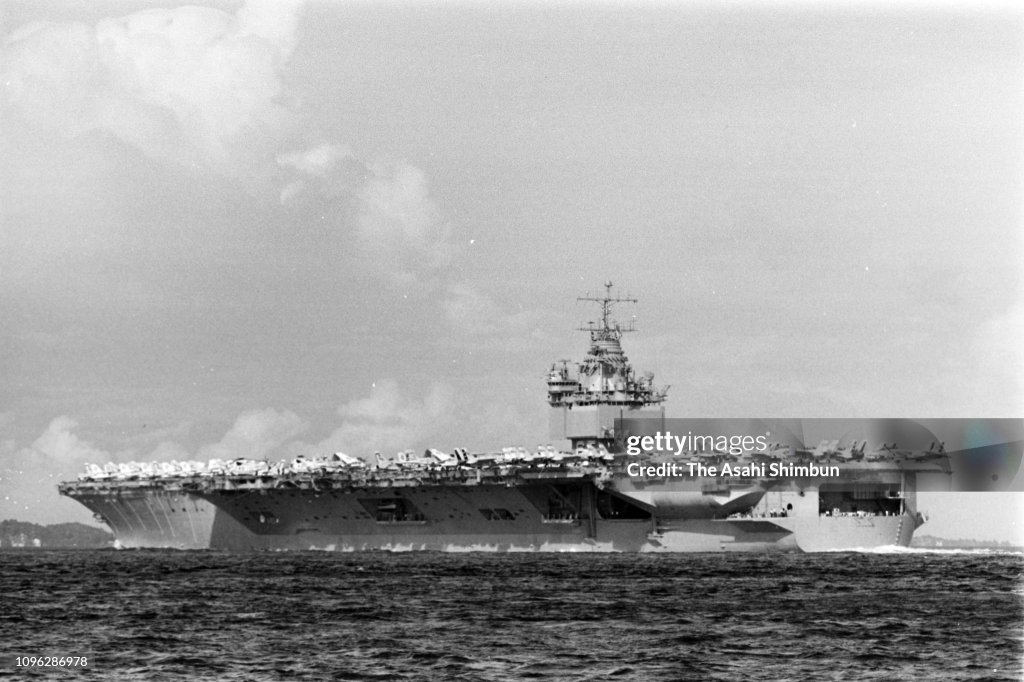
Secretary of State Kissinger denied that he had expressed regret to the Pentagon that a naval task force that left the Philippines early this week had not initially sailed toward Vietnam to signal American determination to North Vietnam. Robert Anderson, the State Department’s spokesman, said that Mr. Kissinger had informed him that there was “no basis of fact” in a report to that effect in yesterday’s edition of The New York Times.
In Cambodia, the major town of Neak Luong, which controls Phnom Perth’s main supply line, the Mekong River, was under heavy pressure today. Witnesses said that the town was virtually surrounded and that the situation was critical. With shells falling into the town, which is jammed with refugees and short of supplies, the Cambodian Government and its American backers were taking emergency steps to try to save Neak Luong — by airdropping ammunition and attempting to send food in via the river under cover of darkness. Neak Luong is a strategic ferry town and naval base about 30 miles southeast of Phnom Penh on Route 1 on the Mekong. Whoever controls it can control and block the river. The importance of this lies in the fact that all other surface supply routes to Phnom Penh were cut by the Communist‐led insurgents long ago, and now at least 80 per cent of the Cambodian capital’s supplies are shipped by the Americans up the Mekong from Thailand and South Vietnam.
Since New Year’s day, when the Cambodian insurgents began their annual dry‐season offensive, the Mekong has been virtually shut down, too. The rebels seized control of a 13mile stretch of Route 1 paralleling the river, starting from a point about 15 miles from Phnom Penh. All river convoys have been temporarily postponed for fear they would be shot up and possibly sunk. The fall of Neak Luong would make the opening of the Mekong doubly difficult. The United States Congress has cut Cambodian aid drastically, this year, and an extended supply airlift to Phnom Penh might be prohibitively costly.
Witnesses from international relief agencies, including medical teams that flew into Neak Luong under shell fire today to drop off medicine and fly out in a hurry, said people there were afraid that with the enemy closing in there might soon be hand‐to‐hand fighting in the streets. However, the relief officials said they had noticed no panic among the people of the town. Neak Luong is choked with more than 20,000 new refugees — some reports put the number over 30,000 — who have poured in from nearby areas, including the western bank of the river, across from the town, as the enemy has pushed closer and closer. Though it is difficult to estimate in the confusion of the latest fighting, Neak Luong probably has a total population now of at least 50,000 including soldiers and their families. The relief workers, who were pessimistic, said the town had only two days supply of rice left and that the government soldiers were subsisting largely on rice gruel.
Ammunition supplies were also apparently tenuous. In an emergency move, American C‐130 transports from Thailand reportedly flew nine missions over the town today to drop crated ammunition by parachute. The pressure against Neak Luong has been building up for the last few days, but today the situation apparently began to deteriorate more suddenly. At 10:30 this morning, government troops still held a few hundred yards on the side of the river opposite Neak Luong. By noon, they had been overrun and even that foothold of the defense perimeter was gone.
Reports that the Central Intelligence Agency engaged in domestic spying have been seized by the Soviet press as the basis of a campaign to convince Russians that they are better off than Americans. The campaign took on international ramifications when the official press agency, Tass, hinted that Western nations pushing for a fuller discussion of human rights at the 35-nation European security talks in Geneva should look at the United States for violations of basic liberties.
The controversy over charges of domestic spying in the United States by the Central Intelligence Agency has aroused considerable interest in West Germany, where similar activities were uncovered last October. But in Bonn, as in Paris, Rome and London, occasional disclosures of questionable activities of security agencies have few lasting effects and the intensity of public reaction in the United States always surprises Europeans. “You don’t have a country over there, you have a huge church,” a diplomat in Bonn remarked.
Recent actions at the United Nations, where the United States warned last month against “a tyranny of the majority,” have prompted thousands of American citizens to write letters expressing disillusion with the world organization.
The reputed chief of staff of the Irish Republican Army, David O’Connell, warned the British government that time is running out in North Ireland’s cease-fire. In an interview in a Dublin paper, O’Connell said the IRA had shown “responsibility, control and discipline” in maintaining the cease-fire since Christmas Eve, but he warned of a resumption of violence when the truce expires Thursday unless Britain responds to IRA demands. The outlawed IRA seeks to force the merger of predominantly Protestant Northern Ireland with the predominantly Catholic Irish Republic to the south.
Several beaches on scenic Bantry Bay in the Irish Republic have been fouled by oil spilled from a supertanker and some of the slicks are up to 6 inches thick, officials reported in the second such incidence at the bay in less than three months. Fishermen and Gulf Oil Co. workers were cleaning up an undetermined amount of bunker fuel that spilled from the 210,000-ton Afran Zodiac when a hole was torn in its hull in a collision with a tugboat.
The British Defense Department removed details of how to make VX, the deadliest known nerve gas, from public access at the London patent office, the Sunday Times of London reported. A week ago, the paper revealed that the patent for the gas had been taken off the secret list and was freely available.
A Greek Cypriot taxi driver was sentenced to death by a civil court in Limassol, Cyprus, for the murder of two Turkish Cypriot women and three children last November. It was the first conviction for an atrocity committed on the war-divided island since the Turkish invasion last summer. The sentenced man, Yannis Vouniotis, 35, has the right to appeal.
Premier Aldo Moro has stated that Italy would be prepared to offer asylum to former Emperor Haile Selassie of Ethiopia if the military Government in Addis Ababa decided to expel him, a Government spokesman here said today. The spokesman emphasized that the matter was now entirely “hypothetical” and that no request for asylum had been received either from the former Emperor or from the Ethiopian Government.
Maria Yoffe, the 75-year-old widow of Adolf Yoffe, a leading Bolshevik revolutionary who backed Leon Trotsky against Stalin in the 1920s, arrived in Vienna on her way to Israel as an emigrant. Mrs. Yoffe, a Communist activist in her youth, spent 26 years in labor camps, after being convicted of opposition activity within the party.
Israeli forces combing southern Lebanon killed a terrorist last night, military headquarters announced today. The official announcement said one guerrilla opened fire on the Israeli force and was killed in the exchange. The Israelis said they returned safely to their base. The combat was opposite the Jebel Rus (Her Dov) area, where four Israeli soldiers were reported injured yesterday morning during an artillery attack. The place where today’s incident occurred has been the scene of frequent fighting between Israeli and Arab forces. Military sources said that the Israeli patrol had come under fire from Soviet‐made automatic rifles, which they added were standard equipment of Palestinian guerrilla forces.
A 200‐man Israeli force stormed a Lebanese border village last night and was engaged by a force of Palestinians, a Palestinian military spokesman said here. The Palestinian press agency Wafa quoted he spokesman as saying that the Israeli force, supported by armored vehicles, stormed Kfar Chouba, about 1,000 yards from the Israeli border. The fighting, which started at 8:15 PM, was continuuing at midnight, the spokesman said. “As a result, neither our losses nor the enemy’s could be determined,” he added. Lebanese military sources had no comment on the report.
Arabs are beginning to question Secretary of State Kissinger’s singer’s role as a peacemaker in the Middle East, following his statement on the use of military force against oil‐producing countries. They are wondering what they really had in mind in his comments in a recent interview with Business Week. Mr. Kissinger appeared to rule out military action just to bring down oil prices as “a very dangerous course,” but he suggested that it was another matter if “there is some actual strangulation of the industralized world” through a new embargo or an outbreak of war between Israel and the Arab states. Al Ahram, a Cairo newspaper that often reflects official thinking, said editorially that his comments did not indicate that the United States was thinking clearly about the relationship between oil and a political settlement in the Middle East.
Shah Mohammed Reza Pahlevi of Iran, acting on an urgent personal appeal from President Anwar el‐Sadat, saved Egypt from a major energy crisis last month by sending her 650,000 tons of oil, Mr. Sadat declared today as the Shah’s five‐day visit here approached its end. Speaking at dinner in the Abdin presidential palace, Mr. Sadat said that the Shah’s visit had marked a turning point in relations between Arab and other Islamic countries. “We can now say that no one will ever again be able to tamper with the map of our region or our fate,” he said. The Shah and Empress Farah, his wife, came here on Wednesday. What had originally been expected to be largely a ceremonial visit turned into a lengthy series of talks between the two heads of state when Mr. Sadat decided to accompany the visitors on a two‐day sightseeing tour of Pharaonic temples in Luxor and Abu Simbel in Upper Egypt. They returned to Cairo today.
Prime Minister Zulfikar Ali Bhutto of Pakistan will step up his request for American arms shipments during his visit to the United States next month, according to Pakistani and Western sources. The 46‐year‐old Pakistani leader will pay an official visit to the United States from February 4 to 7 and is scheduled to meet with President Ford and Secretary of State Kissinger. The visit is at Mr. Bhutto’s request. It was described recently in Rawalpindi, by sources close to him, as a forceful effort to reverse the United States arms ban on the South Asian subcontinent.
Thailand’s National Assembly, by a vote of 56 to 52, turned down a bill to give women equal rights in matrimonial affairs. The measure, sponsored by the 18 women members of the Assembly, would have given wives the right to sue for divorce if their husbands “treat other women like their wives.”
Floods in southern Thailand have killed 131 persons and destroyed numerous rubber plantations and mining facilities in the region, the Interior Ministry said in Bangkok. Floodwaters reached 10 feet above normal during the week and more than 10,000 persons in six provinces were left homeless.
Philippine President Ferdinand E. Marcos said today that he was calling a, national referendum on January 30 to find out whether the people approve of his government. He said that he needed an expression of popular support in order to negotiate successfully with the United States and to move toward recognition of China and the Soviet Union. During the nationwide referendum, 24 million voters aged 15 years and above would be asked, among other things, whether they approve of the Marcos rule by decree since martial law was imposed on September 21, 1972, and whether they want it to continue.
The Japanese Government approved the nation’s first $100‐billion budget today, with large outlays for social security, public works, education, agriculture and defense. The budget, approved by Premier Takeo Miki’s Cabinet at special session this afternoon, is nearly 25 percent larger thai the previous budget, reflecting the pervasive impact of inflation on the Japanese economy. During the 1975 fiscal year beginning April 1, Japan is scheduled to spend $70.9‐billion on general operating expense and $31‐billion in investment and loans. It will be a balanced budget, with revenue covering expenditures. But a supplementary budget is adopted late in each fiscal year, about 10 percent having been added recently to the current fiscal year’s spending.
A U.S. tanker and a West German salvage tug rescued 49 crew members and the wives of two of them from the crippled tanker British Ambassador 180 miles west of Iwo Jima, Japanese Maritime Safety Agency officials said in Tokyo. The 45,000-ton tanker, owned by British Petroleum, sent out a distress signal Friday after its engine room started flooding from a leaking salt water inlet pipe.
A Canadian study, made six years ago but not released by the Environmental Health Directorate until last week, said it found a relationship between arsenic dust from Yellowknife area gold mines and skin lesions among mill workers. Arsenic, a poisonous chemical used in gold smelting and known to cause cancer and respiratory diseases, was found in higher-than-average levels in the air and water around the capital of the Northwest Territories, the report said. Acute respiratory diseases in males were also reported to have a high incidence.
Almost 1,100 workers for the Saskatchewan Power Corp. walked off the job in the middle of the winter’s worst storm. Supervisors immediately took over the strikers’ jobs at key power plants. The walkout by the members of the International Brotherhood of Electrical Workers followed a breakdown in contract negotiations.
Two years after the earthquake that killed 10,000 people and destroyed downtown Managua, dissatisfaction is growing over the slow rate of reconstruction of the Nicaraguan capital. The Somoza regime is thought by most Nicaraguans to be stealing aid from abroad. One newspaper publisher calls the regime both incompetent and corrupt.
The foreign minister in the late Salvador Allende’s Marxist Government was freed after 16 months of imprisonment today and flew to exile in Rumania.
On the eve of a meeting of black leaders to plan strategy for negotiations with the white minority government, the Rhodesian Broadcasting Corporation said tonight that the government had ruled out majority rule by blacks and added “there will never be a sell-out of the white man.”
National Republican congressional leaders said that President Ford’s new antirecession programs would include quick tax relief for the American people. The President will describe the details of his economic proposals Wednesday afternoon in his State of the Union Message to a joint session of Congress.
Reporting on a two-year study of the major international oil companies and American foreign policy, a Senate subcommittee recommended that Congress consider legislation that would shrink the power of the oil companies to negotiate long-term price and supply arrangements with oil exporting nations. The Foreign Relations Subcommittee on Multinational Corporations also advised that President Ford initiate a deep but gradual mandatory reduction in oil imports requiring gasoline rationing.
An Air Force selection board has recommended the selection of the General Dynamics-designed F-16 as the next standard lightweight fighter, according to government spokesmen. The General Dynamics plane had been tested for six months against a design by the Northrop Corporation. The Pentagon is scheduled to make the official announcement next week.
Fred Harris, former Oklahoma Senator, announced in Concord, N.H., that he would join the race for the Democratic presidential nomination in 1976. He will have a “new populist” platform. “Privilege is the issue,” he said. This will be his second presidential campaign. He conducted a brief campaign in 1971. He is the third Democrat preparing to enter the New Hampshire presidential primary, about 14 months away.
The Senate Armed Services Committee raised the possibility that public hearings would be held on allegations of domestic spying by the Central Intelligence Agency as it summoned William Colby, the agency’s director, to testify Thursday. Senator John Stennis, the committee chairman, said that “in-depth hearings” into the alleged domestic spying “would be held in open session to the extent possible.”
Soyuz 17, with Soviet cosmonauts Aleksei Gubarev and Georgi Grechko, both 43 and making their first flights, lifted off from the Baikonur space center and docked successfully with the Salyut 4 space station, becoming the first men to occupy it. They would return to Earth on February 7 after setting a new record for most days (28) spent in outer space. The official press agency Tass, which reported the launching, said that the Soyuz 17 spacecraft was sent up at 12:43 AM, presumably Moscow time (4:43 PM Friday, E.S.T.).
An American Indian Movement spokesman, Doug Durham, is credited with calming a Shawano, Wis, rally of angry whites upset over the Indian occupation of the Alexian Brothers Abbey. Some of the 50 or so whites were armed as the group talked of plans to assist law officers in dealing with about 50 militant Indians who took over the abbey New Year’s Day, ousted the caretaker and demanded that the facility be given to them for a hospital. The Alexian brothers have asked $750,000 for the mansion and surrounding acreage not used by the order since 1968. Durham told the whites, “We want this as peaceful as everyone else.” A later meeting was set up between the whites and a national AIM leader.
Chief Justice Warren E. Burger temporarily extended his order blocking pay hikes for thousands of city and state government employees. Burger asked the League of Cities, which opposes the pay hikes, which are required in an amendment to the Fair Labor Practices Act, to file briefs saying why the court should hear the matter. He asked the government to present counter-arguments. Burger first blocked implementation of the new law on December 31 at the request of the league.
Sixty-eight oil companies have refused to sign contracts with the Pentagon unless relieved of the legal requirement to disclose their costs, Senator William Proxmire (D-Wisconsin) said. The Federal Energy Administration issued a directive last week ordering all oil suppliers to enter into written contracts with the Defense Department and to obey laws requiring disclosure of costs and compliance with uniform accounting standards, Proxmire disclosed. Among companies refusing to comply, he said, are Amoco, Exxon, Shell, Gulf, Mobil, Phillips and Техасо.
A 300-foot dredge sank in the Miami harbor channel minutes after an engine-room explosion, spilling 6,000 barrels of oil that threatened to wash up on resort beaches. The 15 to 17 crewmen aboard the barge-like dredge Caribbean jumped to safety. One was reported injured. The entrance to the Port of Miami was closed and efforts were under way to contain the spilled oil and clear the channel. At least one cruise ship. with 600 passengers aboard, was forced to delay its departure.
Federal aid for “new towns,” specially planned communities designed to integrate residential, recreational and commercial areas, is being ended by the Department of Housing and Urban Development, a HUD source said. The source said that existing “new towns” would not be abandoned but that further applications for construction loan guarantees or other aid would not be accepted.
A threat to place LSD in the drinking water of a hotel in the Catskill Mountains of New York state resulted in a two-year prison sentence for a Philadelphia man. John Van Orsdell, 41, a free-lance writer and filmmaker, maintained during his trial that the scheme had been a hoax to expose FBI investigative procedures; but Judge Whitman Knapp agreed with federal prosecutors, who said Van Orsdell had “fully intended” to extort $320,000 from the Concord Hotel. A letter had been sent to the hotel demanding the $320,000 and threatening to drop LSD into dining room water pitchers.
A U.S. Air Force selection board has recommended a single-engine fighter plane designed by the General Dynamics Corporation for what Pentagon spokesmen have called potentially the richest aircraft project in history, according to Government officials. After six months of testing two competing designs, the Pentagon is scheduled to announce its choice early next week. The competition was between General Dynamics’ F‐16 and the F‐17 developed by the Northrop Corporation. The winning design will become the standard lightweight fighter for this country, and possibly for many other countries, during most of the remainder of this century. Total sales of $10‐billion to $20‐billion are foreseen by some Pentagon officials for the project, which, has been the object of not only an intense technological dogfight but of feverish lobbying by political leaders in four states because it promises to create thousands of jobs. According, to reports from high military sources, the General Dynamics plane is favored by the Air Force selection board that evaluated both designs, largely because of its potential for utilizing an engine that is used in another Air Force fighter, the F‐15.
Of nine proposed nuclear power sites in the San Joaquin Valley of California, Pacific Gas & Electric Co. reported that the “most promising” is northwest of La Grange between the Stanislaus and Tuolumne rivers. However, spokesmen for the utility said the other potential locations have not been eliminated. Selection of a proposed site is expected to be completed by mid-year.
The Santa Ana Regional Water Quality Control Board in California ruled that the Stringfellow acid disposal pits west of Riverside are a severe hazard to the community’s underground water supply and ordered the owners to correct the situation by whatever means necessary. The pits had been used for 15 years for the dumping of industrial wastes from throughout Southern California before they were closed two years ago. The Stringfellow Pits will become a EPA superfund site. The site became the center of national news coverage in the early 1980s, in part because it was considered one of the most polluted sites in California, and because it became linked with mismanagement and scandal in the U.S. Environmental Protection Agency. Rita Lavelle was convicted of perjury and Anne Gorsuch Burford resigned. Currently, the Stringfellow Site is managed by the California Department of Toxic Substances Control (DTSC). According to DTSC, the cleanup effort will take approximately 500 years.
The last remains of the rocket that had launched Skylab into orbit in 1973, re-entered the atmosphere and burned up at about 3:00 pm EST.
Ipswich Town defeat Middlesbrough 2–0 to maintain a one-point lead in the English Soccer First Division with sixteen games remaining. Roger Osborne and David Johnson are the goal scorers.
The Pro Football Hall of Fame announced that it would induct four new members: Roosevelt Brown, George Connor, Dante Lavelli and Lenny Moore.
Born:
Matteo Renzi, Italian politician, Prime Minister of Italy (2014-2016), Senator (2018-), in Florence, Italy.
Rory Fitzpatrick, NHL defenseman (Montreal Canadiens, St. Louis Blues, Nashville Predators, Buffalo Sabres, Vancouver Canucks, Philadelphia Flyers), in Rochester, New York.
Peter Leboutillier, Canadian NHL right wing (Mighty Ducks of Anaheim), in Minnedosa, Manitoba, Canada.
Brad Badger, NFL guard and tackle (Washington Redskins, Minnesota Vikings, Oakland Raiders, Arizona Cardinals), in Corvallis, Oregon.
Brad Jackson, NFL linebacker (NFL Champions, Super Bowl 35-Ravens, 2000; Baltimore Ravens, Carolina Panthers), in Canton, Ohio.
Died:
Paul Peter Meouchi, 80, Lebanese Maronite priest and first Maronite to serve in the Vatican’s college of cardinals.






 History Diaries