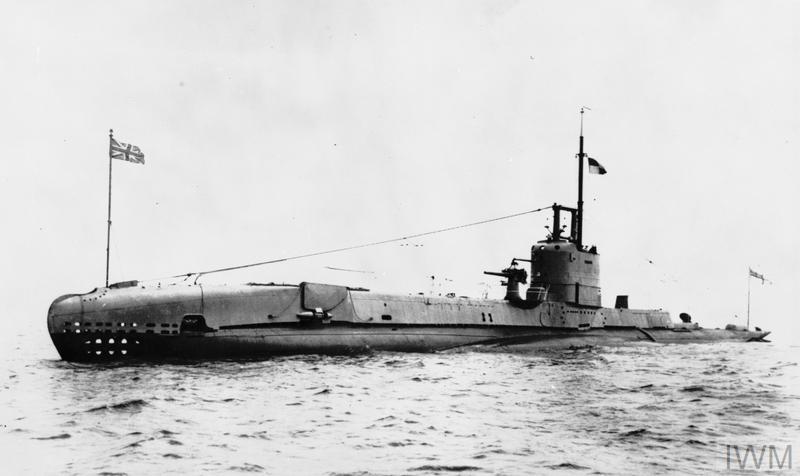
On 6 January 1940, HMS Starfish departed for her sixth and last combat patrol, off Heligoland Bight. On 9 January at 10:40 (UTC), she sighted the German minesweeper M-7 and attacked it in position 55°00′N 07°10′E. However, the attack failed because, due to drill errors, the torpedoes were not fired. Starfish commenced a second attack but her diving planes jammed, and her commander decided to submerge to the 27 meters (88.6 ft) deep bottom to conduct repairs. According to Captain Turner in his postwar report, Starfish was located by the German minesweeper, who dropped two depth charges which caused no damage. At 10:50, a crew member asked for permission to restart one of the motors to prevent the gyro from wandering. Permission was granted, but no sooner the motor had been started, four depth charges were dropped directly above the boat, causing widespread damage. At 14:40, another attack was carried out, and twenty depth charges exploded close to the submarine’s hull, damaging rivets and causing leaking. By 18:00 Starfish was severely flooded, and her commander, seeing the Germans would not leave, gave the order to surface at 18:20. She was forced to drop her ballast keel, coming up at a 45° angle due to flooding. All crew were rescued and taken as prisoners of war, and Starfish sank shortly after.
In Helsinki, President Kyösti Kallio holds a press conference for foreign journalists in the Presidential Palace. Among other matters raised, the President says that during the first month of the war the enemy has dropped approximately 4,000 bombs on about one hundred localities across Finland. These air raids have claimed the lives of 239 civilians.
Soviet bombers raid six small towns in Finland.
The Soviets issue a communiqué admitting that they had to retreat from Suomussalmi. With Russian attacks at a standstill, the quietest interval of tho war has descended on all the Finnish fronts.
The Finns once again stage a secret operation and cut the Leningrad-Murmansk railway.
In Ladoga Karelia, Soviet forces mount an unsuccessful assault to the north of Ruhtinaanmäki.
Finnish radio propaganda has been causing unrest in Russia, it was indicated today when the Russian Government started broadcasts on the same wavelengths as the Finnish high-power station at Lahti, making it impossible for the Russians to listen in. Three Leningrad residents who listened to a Finnish broadcast have been sentenced, one to twenty-five years in prison and the others to ten years. The difference is explained by the fact that the first one started the listening and thus is considered a traitor who misled the others.
Expressions of sympathy and support for Finland’s struggle are pouring in from all over the world.
In Paris, the French National Group of the Inter-Parliamentary Union responds to the appeal by the Finnish Parliament and expresses its support for Finland.
The Canadian Red Cross sends 50,000 dollars in aid to Finland.
Herbert Hoover, the former U.S. President, sends his fifth 100,000 dollar check to Finland.
In response to the appeal by the League of Nations, Argentina sends 50,000 tonnes of grain to Finland with no fixed date for payment.
The Nicaraguan Government launches a national appeal for aid for Finland.
Moscow objects to Swedish protests over the sinking of the steamer Fenris.
There are unofficial peace talks in Stockholm between Hella Wuolijoki, an Estonian-born Finnish writer, and Alexandra Kollontai, the Soviet ambassador to Sweden. Both had been friends of Lenin.
The Finnish Foreign Affairs committee agrees to seek American mediation.
The West Prussian SS chief reports the successful elimination of 4000 incurable mental patients in Poland. Richard Hermann Hildebrandt, chief of the SS and Police in Danzig and West Prussia (and, from 1943 onwards, head of the RuSHA), reports to Himmler on the shootings of German and Polish mental patients which he has carried out: “The other two units of storm troopers at my disposal were employed as follows during October, November and December… For the elimination of about 4,400 incurable patients from Polish mental hospitals… For the elimination of about 2,000 incurable patients from the Konradstein mental hospital…”
The ability of the United States to deliver airplanes to Britain and France was examined today by the leading German economic newspaper, the Deutsche Bergwerkszeitung, and found wanting. Quoting figures from American, French and British periodicals, the newspaper arrives at the conclusion that the United States will not be able to play an important role in the war and that in all probability there will not be enough United States planes produced to tip the scales of air superiority in the Allies’ favor. The primary cause of the United States’ inability to deliver a large number of planes to the Allies, according to the Bergwerkszeitung, is the shortage of skilled labor for the production of planes for the Allies and the increasing United States air force. American factories, it is held, are not equipped to produce anywhere near the number of planes already ordered by the Allies for some time because orders are more than four times the present capacity.
[Ed: Laughs in 1944.]
The Italians protest the German seizure as contraband of Italian exports of war supplies to Finland.
The Balkan Entente — Turkey, Greece, Rumania and Yugoslavia — has been convoked to meet at Belgrade on February 2, 3, and 4.
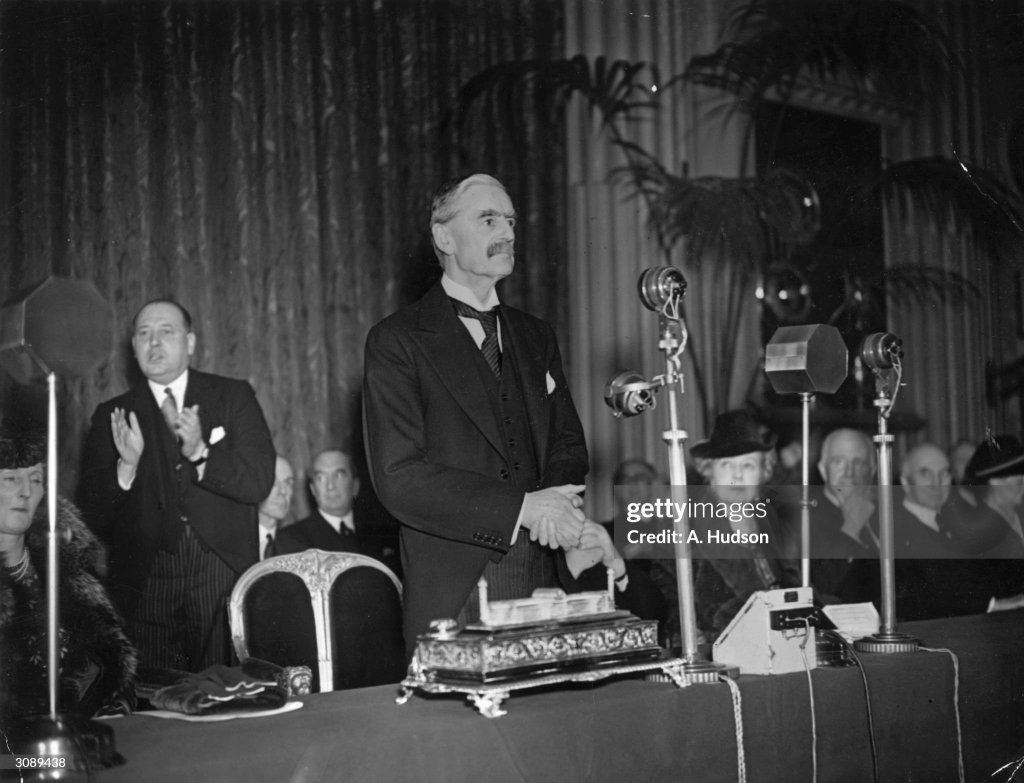
Prime Minister Chamberlain makes the first in a series of “morale-boosting” speeches by Cabinet Ministers. Meanwhile, there is public surprise that, after only 4 months of war, the British employment figure for January stands at 1.6 million (about 120,000 higher than the average for 1939). This increase is despite of the call-up of 1.5 million men for military duty.
When Sir John Anderson, Home Secretary, came to Edinburgh today to urge the people to start a new war effort he received many telegrams from women demanding peace. While he was addressing a city corporation luncheon the telegrams started arriving at his table. They came from across the city, where a meeting of the Scottish Women’s Peace Movement was going on. Each one said: “Urgent. Women in Edinburgh want peace.” Sir John interrupted his speech to refer to the appeal, which he said was either “mischievous or rather pathetic.”
“Who doesn’t want peace?” he asked. “I want peace. Every colleague of mine in the government wants peace. I know the Prime Minister wants peace. I believe Hitler wants peace. But Hitler wants a peace that would leave him free to pursue the objects of his ambition, to establish universal domination for the German people.” He said that even Russia wanted peace, after she had eaten up Finland, but that Finland wanted peace with honor, and so did Britain. He suggested that the absence of stirring events on the home front had been responsible for the widespread feeling that the war was not worthwhile. He warned against the suspicious origin of pacifist propaganda in Britain.
Police made raids on both sides of the Ireland-Northern Ireland border today and seized 120,000 rounds of ammunition reported stolen by the outlawed Irish Republican Army. New raids in Meath and Kildare Counties, south of the border, brought the total of the recovered ammunition within 100,000 rounds of the 1,000,000 stolen December 23 from the arsenal in Phoenix Park, Dublin. Police of Northern Ireland raided numerous houses in Londonderry but made no arrests.
The first colonial contingent of Cypriot troops arrives to reinforce the British Expeditionary Force.
The British Admiralty reports that out of 5,911 ships in convoy, only 12 had been sunk while protected by the convoy.
The British create a unified Royal Air Force command in France. Marshal A. S. Barratt is Commander-In-Chief. All British Air Force units in France are to be combined under one head, it was announced today as Leslie Hore-Belisha, retiring War Minister, handed over the seals of his office to King George at an interview in Buckingham Palace. Mr. Hore-Belisha spent about a half hour with the King. Previously, the bombers had been commanded from London.
German bombers of the FliegerKorps X attacked British shipping off Stonehaven, and sank steamers Gowrie (689grt) four miles east of Stonehaven and Oakgrove (1985grt) seven miles NW by W of North Leman Buoy. The entire crew of Gowrie was rescued, but one man on Oakgrove was lost. They also damaged Danish steamers Ivan Kondrup (2369grt) east of Stonehaven and Feddy (955grt) two and a quarter miles E-SE of Aberdeen. Trawler Thrifty (139grt) rescued the survivors from Ivan Kondrup.
British Steamer Upminster (1013grt) was badly damaged by German bombing nine miles east of Hammond Knoll Light Vessel in 53 03N, 01 29E, and sank on the 10th with the loss of three of her crew . Attacks also damaged steamer Northwood (1146grt) off Whitby, steamer Reculver (683grt) off Great Yarmouth, and trawler Chrysolite (251grt) eight miles NW by N of Smith Knoll Light Vessel. Reculver was taken in tow by trawler Tamora (275grt).
The British submarine Starfish was sunk in the Heligoland Bight by German minesweeper trawlers. Royal Navy Submarine HMS Starfish (Lt T A Turner) is struck by depth charges from German minesweeper M-7 at 1000, after an unsuccessful attack on the same minesweeper. She laid on the bottom until 1815, then returned to the surface, confidential documents were destroyed and the boat scuttled. The ship’s company (5 officers, 34 ratings) was picked up by waiting German ships and taken as POWs. This loss prompted the British Admiralty to end submarine operations in the Heligoland Bight.
Greek steamer Tonis Chandris (3161grt) was lost when she ran aground off Unst. The tug St. Mellons was sent to assist her and the crew was rescued by the Lerwick lifeboat.
The British steamer Dunbar Castle (10,002grt) of convoy OA.69 is sunk in the minefield off Ramsgate, laid by German destroyers on 6 January 1940, at 51 23 N, 01 34 E. The Captain, 7 crewmen, 1 passenger and a racehorse are killed. Chief Officer Herbert Robinson wins the OBE for evacuating 189 survivors in the lifeboats. The survivors are rescued by the trawler Calvi (363grt) and other small ships. The 10,002 ton Dunbar Castle was bound for Beira, Mozambique.
Dutch steamer Truida (176grt) is sunk in the minefield laid by German destroyers on 6 January 1940, at 51 27N, 01 50E; crew were rescued by Dutch trawler Friso (250grt) which transferred them to Dutch steamer Tiberius (1712grt).
Kriegsmarine destroyers lay magnetic mines off Newcastle and Cromer.
At 0221 hours, the Norwegian cargo ship Manx was hit by one torpedo from U-19 off Kinnaird Head (58° 30’N, 1° 33’W) and sank within two minutes. Eight survivors managed to grab hold of an upturned lifeboat, but were scantily clad and in the stormy weather four of them gave up. After 8 hours the remaining four survivors were picked up by the Norwegian steam merchant Leka. Two other survivors were rescued from a raft by the Norwegian steam merchant Isis. 1,343 ton Manx was carrying coal and was bound for Drammen, Norway.
The French collier Montauban ran aground on Saltscar Rocks, Redcar, Yorkshire, United Kingdom and was wrecked. All 39 crew were rescued by the Redcar lifeboat. She broke up on 15 January.
Royal Navy light aircraft carrier HMS Hermes began a period of refitting in Britain.
U.S. freighter Western Queen is detained at Gibraltar for several hours by British authorities.
Convoy OA.69 departs Southend.
Convoy OB.69 departs Liverpool.
The War at Sea, Tuesday, 9 January 1939 (naval-history.net)
Submarine STARFISH (Lt T A Turner) of the 6th Flotilla arrived in the Heligoland Bight to relieve submarine SEAHORSE which was due to return to Blyth. There she attacked German minesweeper M.7 of the 1st Minesweeping Flotilla. M.7 was undamaged, and in return badly damaged STARFISH at 1000 in 55-00N, 07-18E. She was scuttled to avoid capture and the crew of Lt Turner, Lt R T V Kyrke, Sub Lt Geoffrey Wardle, Lt W S W Main RNR, Warrant Engineer C Dodsworth and thirty-four ratings were taken prisoner.
Armed merchant cruiser VOLTAIRE departed the Tyne for Portsmouth and transfer to the Mediterranean.
Light cruiser DUNEDIN arrived at Scapa Flow from Northern Patrol, and armed merchant cruiser ASTURIAS at the Clyde. AMC CORFU also arrived at the Clyde for duty with the Northern Patrol.
Submarine SALMON arrived at Harwich after patrol.
Destroyer ENCOUNTER with tanker BRITISH PRUDENCE (8620grt) departed Invergordon for the Tyne, and both arrived on the 10th.
Destroyers ECLIPSE and ESCAPADE arrived at Invergordon with minelayer PRINCESS VICTORIA.
Destroyers SIKH and DUNCAN departed Sheerness for the Clyde after repairs.
Destroyers ESCORT and ELECTRA with defects proceeded to Falmouth for repairs.
Destroyer MAORI departed the Clyde to relieve sister ship TARTAR in HN.7.
Convoy SA.24 with two steamers departed Southampton escorted by destroyer SHIKARI, and arrived at Brest on the 11th.
Convoy HN.7 of two British, 19 Norwegian, five Swedish, eight Finnish and four Estonian ships departed Bergen escorted by destroyers KASHMIR, KHARTOUM, KANDAHAR and TARTAR. Destroyer FORESTER departed the Clyde on the 8th and joined the convoy at sea. Destroyer AFRIDI departed the Clyde on the 7th to relieve TARTAR, but was reassigned en route and MAORI departed the Clyde on the 9th to relieve TARTAR instead. Light cruisers GLASGOW and EDINBURGH, which departed Rosyth on the 7th to support convoy ON.7, supplied cover for this convoy. On the 9th at 1006, SSW of Utvaer in 60-48.5N, 04-20E, EDINBURGH dropped depth charges on a submarine contact. GLASGOW dropped depth charges at 1052 in 60-45N, 04-25E. GLASGOW, EDINBURGH and convoy HN.7 arrived safely at Methil on the 12th. KHARTOUM took the west coast section of five ships, and escorted tankers SCOTTISH AMERICAN (6999grt) and ARNDALE (8296grt) to the Clyde.
Convoy FN.67 departed Southend, escorted by destroyers VALOROUS, VEGA and sloop LONDONDERRY. Destroyer EXMOUTH proceeded northward with the convoy until dark on the 10th, and arrived in the Tyne on the 10th.
Destroyer WOOLSTON and sloop GRIMSBY departed Methil for the Tyne for duty escorting convoy FS.68.
Southwest of Eddystone in 49 57.8N, 04 32.2W, sloop SCARBOROUGH made a submarine contact. Destroyer KELVIN, en route from Portland to Greenock joined to assist as did destroyer WINDSOR from Plymouth. Destroyers ACASTA and VISCOUNT also joined to hunt the contact, but all without success.
Destroyer VESPER attacked a submarine contact south of Scilly Isle in 49 09N, 6 24W.
Sloop BIDEFORD, escorting convoy HG.14F, attacked a submarine contact 175 miles west of Cape Finisterre in 42-36N, 13-16W.
German bombers of the FliegerKorps X attacked British shipping off Stonehaven, and sank steamers GOWRIE (689grt) four miles east of Stonehaven and OAKGROVE (1985grt) seven miles NW by W of North Leman Buoy. The entire crew of GOWRIE was rescued, but one man on OAKGROVE was lost. They also damaged Danish steamers IVAN KONDRUP (2369grt) east of Stonehaven and FEDDY (955grt) two and a quarter miles ESE of Aberdeen. Trawler THRIFTY (139grt) rescued the survivors from IVAN KONDRUP.
Steamer UPMINSTER (1013grt) was badly damaged by German bombing nine miles east of Hammond Knoll Light Vessel in 53 03N, 01 29E, and sank on the 10th with the loss of three of her crew . Attacks also damaged steamer NORTHWOOD (1146grt) off Whitby, steamer RECULVER (683grt) off Great Yarmouth, and trawler CHRYSOLITE (251grt) eight miles NW by N of Smith Knoll Light Vessel. RECULVER was taken in tow by trawler TAMORA (275grt).
Greek steamer TONIA CHANDRIS (3161grt) was lost when she ran aground off Unst. Tug ST MELLONS was sent to assist her and the crew was rescued by the Lerwick lifeboat.
Destroyer WATCHMAN was taken in hand at Gibraltar to repair defects.
In Washington today, President Roosevelt discussed his peace objectives with a group of churchmen; was asked by John. Kelly of Philadelphia to intervene in the Democratic Senatorial situation in Philadelphia; conferred with Representative Sabath, chairman of the House Rules Committee, with Representative Mary Norton, chairman of the House Labor Committee, and with Secretary Perkins, Katharine Lenroot and Homer Folks of the New York State Charities Aid Association on the annual White House Conference on Children in a Democracy, which he has agreed to address.
The Senate was in recess but the Monopoly Committee continued its hearing on investment banking.
The House debated the Gavagan anti-lynching bill and adjourned at 4:32 PM until noon tomorrow. The Smith Committee continued its investigation of the National Labor Relations Board and the Naval Affairs Committee asked Admiral Stark about the naval appropriation bill.
U.S. President Franklin Roosevelt has formulated general objectives which he regards as essential to any just and lasting peace, but is keeping them secret because of a feeling that to put them on paper and make them public would not be wise. The President said in his press conference today that he outlined these objectives to leaders of the Baptist, Lutheran and Seventh Day Adventist churches under a pledge of secrecy when they conferred with him at the White House today.
Although Mr. Roosevelt emphasized that these objectives at the moment were on the plane of peace ideals rather than proposals, the impression was gained by some correspondents that they were in definite shape and that the President withheld them at this time because of a feeling that a successful peace effort could not be made now. This impression arose in part from the fact that the Chief Executive used the words should not, rather than could not, in explaining that the objectives were not to be made public now. He stressed that he did not want the press to record them as fourteen points or any other number of points.
The President’s disclosure tended to confirm reports that several government experts in the field of economics and foreign affairs have been working for months on a broad survey of possible bases of lasting peace, with the idea that attractive and definite proposals could be put forth should a moment arrive when peace offices might offer some chance of success. Mr. Roosevelt repeated several times today that peace moves would be made only when and if an opportune moment arrives. He used the phrase when and if repeatedly. He did this after it had been called to his attention that one spokesman of the church group said that Mr. Roosevelt had expressed hope of bringing peace by Spring.
The President took pains to emphasize that Myron C. Taylor, whom he appointed as his personal representative at the Vatican, will not hurry to Italy but will confer at the White House toward the end of this week and then take a vacation in Florida for a week or ten days before sailing for Italy. This, together with the fact that it has been decided not to appoint an Ambassador to Berlin for the time being, a step regarded as necessary before any peace gesture could be made by Washington, was interpreted as another indication that the President has scheduled no overtures to end the war.
Influential isolationist Senator Gerald Nye (R-North Dakota) declares his support for Senator Arthur Vandenberg for the GOP presidential nomination. The North Dakotan, who has been mentioned as a possible candidate, said he would not run. “Senator Vandenberg has a great degree of courage,” Mr. Nye said, “a thing that is going to be most essential in these next four years. He has an understanding and an appreciation of human needs. He has a grand record as respects agricultural legislation that has been considered in Congress during the last dozen years.”
Senator Nye said he believed Mr. Vandenberg would “find a pretty level strength in all sections of the country and all classes of citizens. I can’t see the industrialists fighting him,” Mr. Nye continued, “and his agricultural record ought to bring him a grand response from the farming sections. He has demonstrated a degree of independence that would be most appealing to a lot of people.”
Senator Nye said he hoped North Dakota “would see the greatness of Vandenberg as the most available candidate.” Just back from a week in the State, he said he found considerable sentiment there for Mr. Vandenberg, Hanford MacNider of Iowa and Thomas E. Dewey of New York as Republican contenders, and for Senator Wheeler for the Democratic nomination. “Wheeler is going strong out that way,” Senator Nye said. “He would get a lot of Republican votes.”
Senator Vandenberg of Michigan sais in a letter today that he would be willing to serve as Republican Presidential candidate but, he added, “I have absolutely no personal aspirations in this direction.”
Alfred M. Landon, Republican nominee in 1938, asserted today that President Roosevelt’s Jackson Day speech would make it “difficult” for the nation to present “a united front to those foreign countries watching us closely.”
A charge by Representative Mitchell, Democrat, of Illinois, and the only Black member of Congress, that Republican support for the Anti-Lynching Bill was an effort to “buy back” the Black vote precipitated sharp House debate today between members of the two parties. Mr. Mitchell’s charge was elicited by a question asked by Representative Fish, Republican, of New York, who inquired if the Illinois Representative had meant to imply that the Black vote was for sale. Mr. Mitchell declared he resented “such an insinuation,” asserting the Black vote was not for sale, “although the Republican party has tried to use them in that way.”
[Ed: The anti-Lynching Bill of 1940, like that of 1937, will pass the House and go on to Senate to die. Its death there in 1940 is tangled up in the strange tale of John Nance Garner’s about-face to support the bill; and Franklin Roosevelt’s silence on it, in order to further his own third-term ambitions by undercutting Garner. FDR was a right bastard and not at all the “Saint Franklin” your moronic school teachers sang praises for. It wasn’t until 2022 that both houses of Congress passed an Act to make lynching a federal crime.]
The time may come when the United States will build battleships of more than 45,000 tons, the displacement of the largest battle units now under construction or projected, but should. it be decided to have larger battleships the increase probably would not exceed 7,000 tons, Admiral Harold R. Stark, Chief of Naval Operations, said today. The cost of a 52,000-ton ship was estimated for the House Naval Affairs Committee at $105,000,000.
Continuing his testimony in support of the $1,300,000,000 Naval Expansion Bill offered by the committee’s chairman, Representative Vinson of Georgia, Admiral Stark said that next year the United States might increase the gun power of the battleships to be laid down in the fiscal year 1942. This would mean a decrease in speed, but how much he did not disclose. Although Admiral Stark had been called to explain the navy’s support of the Vinson bill, which authorizes the construction only of aircraft carriers, cruisers, destroyers, and submarines, most of the questions put to him by committee members had to do with the building of giant battleships of tonnages surpassing any built thus far by any naval power.
[Ed: Unknown to the U.S. Navy, the Japanese are building larger battleships of the Yamato-class. The Germans are also playing with the idea, but their designs are largely fanciful napkinware. They do not have the resources to build such ships. The U.S. will soon settle on the Montana-class, but the demands of war, and the increasing move to carriers as the fleet’s capital ships, mean that the Montanas never get built.]
Ruling that the Wagner National Labor Relations Act did not require an employer to sign a contract with a labor union, the Federal Circuit Court of Appeals here reversed today the National Labor Relations Board’s order that the Inland Steel Company recognize the C.I.O. Steel Workers Organizing Committee as sole bargaining agent for its employees. The court sustained the company’s contention that it had not received a full and fair hearing before Charles A. Wood, NLRB trial examiner, and castigated Mr. Wood’s conduct in the hearing which led to the order. The decision, written by Judge J. Earl Major, was concurred in by Judge William M. Sparks and Judge Evan A. Evans.
The court remanded to the NLRB for a new hearing all phases of the board’s order of November 12, 1938, in which, among other things, the company was required to cease dominating an independent union. It was the court’s ruling that under the Wagner Act collective bargaining procedure is “mandatory” but the “result is not.” “The statute is barren of any express language requiring a signed agreement and it must be held that no such agreement is required unless we are authorized to read into the term ‘collective bargaining’ the condition that all agreements, not some, must be reduced to writing, the court declared.
Employees of the Endicott-Johnson Corporation overwhelmingly refused union representation today in a National Labor Relations Board election.
Directing the House Committee investigation of the National Labor Relations. Board again today into the activities of Jack Davis, board attorney, who is alleged to have urged witnesses in a labor case to swear that they had been locked out by the Ameri- can Radiator Company, Edmund M. Toland, committee counsel, asked Miss Anne Freeling, Labor Board attorney, if she knew “what subornation of perjury was?” The 29-year-old witness, who is associated with the Board’s Review Division, disclosed that her study had caused her to make this entry in her notes regarding the July, 1937, case of the radiator plant at Litchfield, Illinois: “Tried to induce men to say it was a lockout,”
James Thurber and Elliott Nugent’s stage comedy “The Male Animal” opens at the Cort Theater. NYC; runs for 243 performances.
Dispatches from the South China war zones presented rival claims today. The Chinese reported “smashing victories” in Northern Kwangtung Province and said that Japanese columns suffered extremely heavy losses while being driven back twenty miles toward Canton. They also said that thousands of Japanese reinforcements with tank units were landing at Canton. Foreign reports told of further crippling of China’s communications by Japanese air bombing of the French-owned railway between Kunming, capital of Yunnan Province, and Haiphong, French Indo-China. This was an important route for Chinese supplies and its crippling coming a few weeks after the fall of Nanning, cutting the highway route through Kwangsi Province, would constitute a severe blow for Generalissimo Chiang Kai-shek.
Chinese Winter Offensive: Japanese forces facing Chinese 5th War Area around Huangyang reinforced to three regiments over next few days.
Under pressure from Southern Honan Army of Chinese 5th War Area, Japanese units withdrawing from Pingchangkuan – Hsiaolintien – Kungchiafan sector.
The Japanese Cabinet is facing an extremely delicate domestic situation. It is doubtful whether General Nobuyuki Abe still will be the Premier when the Diet reopens on January 20. General Abe was and is personally ready to meet Parliament and challenge a vote of confidence. He has, however, received some advice from the army that has caused him seriously to consider his position.
The situation at the moment is that General Abe wants to retain his office unless the army definitely advises otherwise. War Minister Shumroku Hata, representing the army, has recommended caution, but has not yet announced his final opinion. General Abe is still engaged in consultations. An essential factor in this situation is the army’s attitude. Party leaders could presumably prevent a majority vote of censure, but they could not prevent damaging oratorical attacks, which would resound throughout the country.
General Abe is prepared to take those risks when Parliament reopens, but the army seems alarmed by the prospect of entrusting vital national policies to an unpopular administration, facing an angry, excitable House of Representatives. The army is not hostile to the Cabinet, but it sets the China policy, for which it is mainly responsible, above any Cabinet. If the Cabinet changes, the China policies will not change, but they will be saved from the hazards of association with an unpopular government fighting its way through a tumultuous session.
Evidently it is no longer possible to depend on the docile patriotism of the Members of Parliament, yet the reappearance of a party Cabinet is still incredible. In ways that are still impossible to predict, the situation seems likely to have a strong influence on political developments. At the Cabinet meeting Foreign Minister Kichisaburō Nomura reported satisfactory progress in his policies aimed at amelioration of Japan’s relations with the United States and with Russia. According to the newspaper Asahi, he stated that American assurances protected Japanese trade against the risks of discriminatory treatment and therefore that trade would continue normally after the expiration of the trade treaty.
Resignation of the Cabinet of Premier General Nobuyuki Abe as soon as the organization is completed of a new Japanese-dominated central government in China was predicted in political circles today. The Cabinet’s failure to achieve any considerable improvement in relations with the United States was regarded as likely to prove the primary cause for the predicted fall. Others were the inability to end the conflict in China and a domestic rice shortage which caused steep price increases.
The struggle of the Cabinet of Japanese Premier Nobuyuki Abe against the army leaders, now going on in Tokyo, is being watched with the keenest interest and anxiety in foreign circles in Shanghai. The belief is widely held here that the fundamental differences are not merely domestic issues but the broader issues of international policies, such as the reopening of the Yangtze River and the appeasement of the democracies. If General Abe’s government falls as the result of army pressure, the new Foreign Office heads are expected to adopt an unyielding attitude toward America.
Dow Jones Industrial Average: 149.84 (-1.50)
Born:
Miguel Ángel Rodríguez, President of Costa Rica (1998–2002), in San José, Costa Rica.
Ruth Dreifuss, Swiss politician (President of Switzerland, 1999; Vice-President of Switzerland, 1998), in St. Gallen, Switzerland.
Mike Gaechter, NFL cornerback and safety (Dallas Cowboys), in Santa Monica, California (d. 2015).
Jimmy Boyd, American singer (“I Saw Mommy Kissing Santa Claus”), and actor (“Bachelor Father”), in Jayess, Mississippi (d. 2009).
Al Downing, American rockabilly piano player and singer (Big Al & The Chartbusters), in Centralia, Oklahoma (d. 2005).
Barbara Buczek, Polish pianist, composer (Anekumena – Concerto for 89 Instruments; Two Impressions), and teacher, in Kraków, Poland (d. 1993).
Naval Construction:
The Royal Navy Bar-class boom defense vessel HMS Barbain (Z 01) is launched by Blyth Shipbuilding & Drydock Co. Ltd. (Blyth, U.K.).
The Royal Navy Hunt-class (Type I) escort destroyer HMS Fernie (L 11) is launched by the John Brown Shipbuilding & Engineering Company Ltd. (Clydebank, Scotland).
 History Diaries