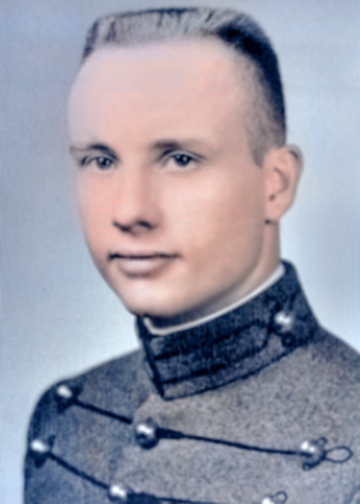
William is buried at the U.S. Military Academy Cemetery at West Point.
He is honored on the Wall at Panel 1E, line 81.
His widow, who had a son that William never saw, soon remarried.
Less than two years later, she was back at West Point — for the funeral of her second husband, who also died in Vietnam. She had just given birth to another son — again, the father never got a chance to see him. She learned of her second husband’s death an hour after giving birth.
An ARVN company is ambushed by Việt Cộng and one U.S. officer is reportedly killed; a U.S. soldier is wounded in an encounter at Tân Bu. A young West Point graduate, 1LT William Reach, died while calling for reinforcements today during a Communist attack on the outpost of Mỹ Yên, only 10 miles from Saigon. The gunfire was heard clearly in the capital. Help came, but it was only from the air, and it was too late. The Việt Cộng had cut off ground approaches and had stymied nearby artillery support. “We have dozens of little units doing little jobs,” one adviser said. “But when these units get hit hard, there are not enough forces around to come to their assistance. They are on their own, like Mỹ Yên this morning.”
The United States officer killed in the fight was a lieutenant with a 100-man unit providing security for a portion of Operation Hop Tac, a project of pacification, or community development, backed by General William C. Westmoreland, commander of United States forces in Vietnam. The Việt Cộng swarmed out ofthe paddy fields at 3 AM and swept through Mỹ Yên. The lieutenant and a United States Army sergeant and the Vietnamese troops with them fought for their lives. A radio set crackled in a battalion command post two and a half miles away. “We have to evacuate the building,” the lieutenant said. “Send in the Hueys.” “Hueys” are armed HU-1 helicopters.
That was the last anyone heard from the lieutenant. His body was found in front of the smashed command post at daybreak, draped over a foxhole. The sergeant was wounded in the foot. He crawled around a wall and escaped the Việt Cộng by hiding in a stream. “On General Westmoreland’s’ map,” an adviser said, “all this area around here is blue, meaning fully pacified. We sort of liked to think so, too, but not now.”
After several weeks of negotiations, Vietnamese civil and military leaders (under pressure from U.S. officials) reach a compromise that agrees to restore the civilian government, with Trần Văn Hương remaining as premier. The five High National Council members and some 50 others arrested on 20 December 1964 are to be released; the armed forces leaders pledge to confine their activities to the military sphere; and a national convention is to be convened to ‘assume legislative powers’ and to draw up a permanent constitution.
Military leaders of South Vietnam agreed today to restore control of the country to the civilian government of Premier Trần Văn Hương. The accord resolved a three-week crisis in relations with the United States. United States officials said they viewed the declaration as satisfactory enough to permit the resumption of planning for aid to the South Vietnamese Government in the war against Communist guerrillas. A communiqué said that the military “fully maintains the stand it solemnly pledged in its proclamation of August 27, 1964.” This referred to a declaration in which the armed forces agreed to assume a purely military mission and to leave affairs of state in the hands of a civilian government,
A departure from this policy three weeks ago, when a group of young generals overturned the civilian legislature, so disturbed the United States that it cut off its aid planning, pending a return to civilian control. Under the compromise communiqué, the government “assumes responsibility for speedily convening a national convention that truly represents all sectors of the population and will assume legislative power.” The convention, to be elected or appointed, will act as a constituent assembly to draft a permanent constitution and will serve as an interim legislature.
Temporary legislative power was invested in the chief of state, Dr. Phan Khắc Sửu, for the “short period” before the convention. The communiqué was signed by Lieutenant General Nguyễn Khánh, commander in chief of the armed forces. He acted for the group of young generals who hold the balance of power in the country. It was also signed by Dr. Sửu and by Premier Hương in a ceremony at the presidential palace.
For weeks the United States Ambassador, Maxwell D. Taylor, had been pressing for a reassertion of civilian authority that would assure a responsible government with which Washington could deal with confidence. United States officials said the compromise would remove a roadblock to negotiations for enlarged support operations at a time when the Việt Cộng have become bolder and are committing larger units to direct clashes with government units. No provision has been made to restore the High National Council, as the overthrown civilian legislature was known. The council appointed Dr. Sửu and the Hương Government, last fall during the transition from military rule by General Khánh.
Immediately after the Generals’ uprising of December 20, Ambassador Taylor declared that the reinstatement of the council was essential to acceptance of the government. Some officials are unhappy about the concession that has been made. Under the compromise, the armed forces agreed to turn over to the Hương Government five imprisoned members of the council. They also consented to release other politicians and military officers who were seized with the arrested members of the council and who were accused of having undermined the war effort and national unity. A government spokesman reported the release of Trần Văn Văn, the secretary general of the council, and four other arrested members who had been “temporarily isolated.”
The Johnson Administration reacted with pointed restraint today to the compromise worked out in South Vietnam.
Communist terrorism in the Philippine countryside is growing ominously, according to official appraisals. The increase in violent subversive activity has prompted the Government to move 2,000 troops into Pampanga Province, principal stronghold of the successors to the Hukbalahap organization.
Indonesia disclosed today that she had started liquidating her mission to the United Nations. This became known as the Secretary Gen eral, U Thant, returned to work to tackle the formidable chores involved in restoring normality to United Nations operations. The red-and-white flag of Indonesia was still flying today with the flags of the 114 other member nations outside the world organization’s headquarters. A spokesman for the Secretary General’s office said it would remain there until Mr. Thant had received a formal request from Indonesia to have it removed. There was still no reply to Mr. Thant’s message last week to President Sukarno asking him to reconsider his decision to leave the United Nations. An Indonesian spokesman said in Jakarta that the formal notification of withdrawal would soon be sent but meanwhile “we ourselves consider there is a lull in the United Nations matter.”
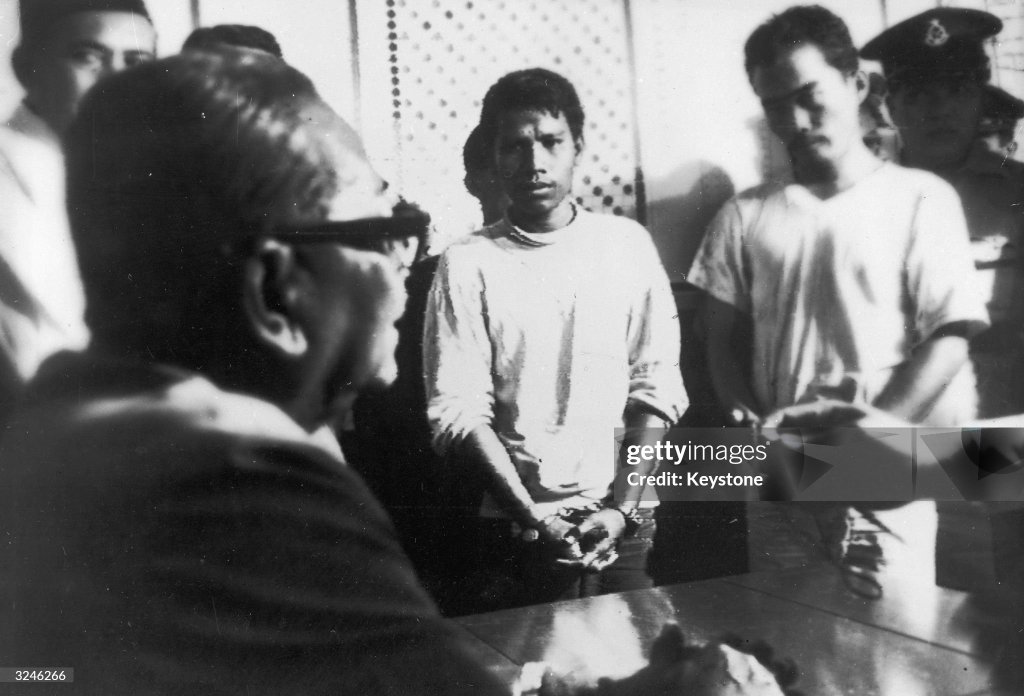
The Malaysian patrol ship Sri Perak fired upon and sank an Indonesian tugboat that was apparently attempting to land guerrillas on the coast near Port Dickson. Sixteen survivors were rescued and taken prisoner, but it was believed at least 40 more had gone down with the ship. The tug, which some reports said was towing at least one boat, had opened fire on the Malaysian patrol vessel, and the patrol boat replied with its 40-mm guns. The Malaysian vessel, the Sri Perak, had bullet scars on its hull when it arrived at the port of Malacca later to land its captives, two of whom were reported to have been brought ashore on stretchers. One of the survivors was believed to be a Singapore Chinese. The tug had been stolen last month from Port Dickson, about 40 miles south of here.
In far southwestern Malaya, at least seven more Indonesians of the 24 who landed at Tanjong Piai yesterday, were captured today, raising the total to 13. Among those seized was a major, the highest-ranking officer yet taken. Prince Abdul Rahman, Prime] Minister of Malaysia, flew to Pontian, the nearest large town, and personally accused the captured major of having used dumdum or expanding bullets, an official announcement said. The major, Abu Talib bin Osman, who led yesterday’s landing, is a Malaysian from the area who went to Indonesia 12 years ago.
The United Nations Children’s Fund which has given $14 million in aid to Indonesia in the last 15 years and has helped almost to eradicate one of the country’s most serious diseases, will continue its operations there until they are stopped by the Indonesian Government.
Soviet Ambassador Nikolai A. Mikailov paid a call on Indonesian Foreign Minister Subandrio today to express Moscow’s disapproval of Indonesia’s withdrawal from the United Nations. He got a caustic reception. Peking, meanwhile, supports the move.
More than 500 persons suspected of being rebels have been executed by Congo Government forces here since Stanleyville was retaken about six weeks ago. The executions have been carried out without trial and without publicity. Government officials are reluctant to discuss the matter. Newsmen have been banned from the city during most of this period. However, informed sources, including those who witnessed some of the executions, supplied details here today.
About 300 of the executions are reported to have taken place in the week after the city was captured by Belgian paratroopers and white mercenaries on November 24. Those executed during this period were chosen in an unusual ceremony at Stanleyville’s ramshackle Patrice Lumumba Stadium, which honors the Congo’s first Premier, slain in 1961. Suspects were led into the stadium one by one. If the spectators cheered or clapped, the suspect was released. If they booed, he was condemned to death. The condemned were driven in trucks to a lonely road near Stanleyville’s swimming pool. There they were ordered to get out of the trucks and as they did so they were mowed down with submachine guns.
The bodies were left lying at the side of the road. Later they were buried in four mass graves under the direction of a United Nations sanitation official. Among those executed during these days were 12 women and seven children, according to the sources. The selection process and the executions during this early period were supervised by Victor Nendaka, head of the National Security Police and one of Premier Moise Tshombe’s closest advisers. It is believed that most of those executed during the first week were probably rebels or at least rebel sympathizers.
“The crowds in the stands at the stadium usually reacted very positively or very negatively to a suspect,” one man who attended several of the sessions said. “They undoubtedly knew pretty well who was a rebel and who wasn’t.” However, there is more doubt about those executed during the second phase, which lasted through the middle of December. After the stadium sessions had drawn too much attention, the army and the police relied more on informers to pick out the rebels. “Many persons during this period were executed on the word of a single informer,” according to one source. “It looks as though some persons used the opportunity to settle a personal grudge. A good number of innocent persons died during these weeks.” The executions during the second period were carried out chiefly by the army and without direct supervision by Mr. Nendaka.
Ambassador Foy D. Kohler, returning from consultations in Washington, said today that he would “not be surprised” if President Johnson met the Soviet leaders before long. Mr. Kohler said he had brought no formal invitation and no direct message from the White House.
The British Government is planning to order major cutbacks in military aircraft and weapons projects in an effort to stem a rise in defense spending, which totals $5.6 billion a year.
India’s ruling Congress party moved today to establish itself in firm political control of the disputed state of Jammu and Kashmir. The party approved an amendment to its constitution establishing a state organization in Jammu and Kashmir, until now ruled by the National Conference party, which operated with the Congress party in the struggle for independence from Britain and has been identified with Indian rule in the state. The Congress party had never before sought to establish itself in Kashmir because of sympathy for the National Conference party and unwillingness to aggravate the dispute with Pakistan over who should rule the state.
Japanese Premier Eisaku Sato left today by air for meetings in Washington with President Johnson and other high United States officials.
The “Hope Slide”, the largest landslide in Canada’s history, buried British Columbia Highway 3 under 47 million cubic meters (1.66 billion cubic feet) of rock at 7:00 in the morning. Four people died when their vehicles, a convertible car and a hay truck, were buried in the debris, while a Greyhound bus driver was able to back up quickly before he and his passengers were caught in the avalanche. Two of the bodies from the hay truck were recovered, while two others remain entombed in a pile of rock and mud as high as 85 meters (280 feet) and three kilometers (almost two miles) wide. Mountain truck driver Norman Stephanishin had spotted an earlier fall of rocks across the highway, and had warned five people to get away, but only one, a young woman, had chosen to leave with him. “I just don’t think they quite realized what I was talking about”, he would say later. Stephanishin then encountered the bus, carrying a dozen passengers, and the driver, David Hughes, “backed the bus at full speed for 1 1/2 miles along the twisting, dark highway while most of his passengers slept.”
A U.S. State Department investigation has indicated that an American oil company airplane that was shot down over the United Arab Republic last month had ignored warnings to land and had headed toward Alexandria, where flights are prohibited, United States officials said today.
Major Wang Shi-chuen of the Republic of China Air Force was captured alive after his U-2 spy plane was shot down during an attempt to photograph the Baotou (Paotow) uranium enrichment plant in the People’s Republic of China. He would remain a prisoner for nearly 18 years, before being released in Hong Kong in November 1982.
Defense authorities in Canberra and elsewhere in Australlia are busy with the problem of expanding Australia’s armed forces in accordance with a program adopted by Parliament two months ago.
The first anniversary of bloody anti-American rioting in Panama passed today without serious incident.
The Mirzapur Cadet College formally opened for academic activities in East Pakistan (now Bangladesh).
A biracial federal grand jury will reconvene in Jackson, Mississippi Monday to hear new evidence in the Justice Department’s latest attempt to get indictments in the murder of three civil rights workers. It will be the jury’s second inquiry into the killing of the three, whose bodies were found under an earthen dam near Philadelphia, Mississippi, last August 4. The newest piece of evidence that the 23-member jury has not heard was expected to be what the government described as a confession by one of the 21 men arrested by the Federal Bureau of Investigation last month. The charges were dropped after a United States Commissioner ruled the statement inadmissible as evidence in the cases of the others.
Presiding over the grand jury sessions here will be District Judge W. Harold Cox, a stern individualist who runs his court with a strict adherence to rules of procedure. The Justice Department is expected to seek indictments on a civil rights violation charge, since murder is not a federal crime unless performed on federal property. The case began June 21 when Michael Schwerner and Andrew Goodman, both white and of New York, and James Cheney, a Meridian Black, drove to Philadelphia to investigate the burning of a Black church. They dropped from sight after being arrested there on a traffic charge. Forty-four days later their bodies, each showing a bullet wound, were dug from beneath the dam.
In October the Justice Department went before the grand jury, largely composed of business and professional people, and sought indictments in the case. The jurors, however, took no action on the matter. Since that time the government obtained the alleged confession and other reported evidence. On December 4, the FBI arrested the 21 men, including Sheriff Lawrence Rainey of Neshoba County and Deputy Sheriff Cecil Price, on a civil rights charge in connection with the deaths. Several of the 21, the FBI said, belonged to the Ku Klux Klan.
At a hearing before United States Commissioner Esther Carter in Meridian six days later, the Justice Department attempted to have the 21 held for grand jury action — a routine procedure. As evidence, the department sought to introduce the alleged confession by Doyle Barnette of Cullen, Louisiana, one of the 21 arrested. Barnette was not present. When Miss Carter said the document signed by Barnette was only “hearsay,” a Justice Department attorney halted presentation of evidence and the charges against the 21 were dropped. Judge Cox ordered the grand jurors back in session December 29 and set Monday in Jackson as the date and place for reconvening to “further investigate such matters as shall be presented to them or otherwise come to their attention.”
Republicans were on the verge of settling their dispute over the national party leadership yesterday. A proposal that Ray C. Bliss of Ohio be elected to replace Dean Burch as Republican National Chairman was reported to be at the core of the tentative arrangement. Party leaders hope to avert a party-splitting showdown between Goldwater and non-Goldwater factions at the Republican National Committee meeting in Chicago January 22-23. It was understood that a key point of the agreement was that the national organization would take some “positive action” to demonstrate the party’s faith in former Senator Barry Goldwater as a major Republican figure.
The organization, it was understood, would also express its desire that the defeated Presidential nominee’s hard-core conservative supporters continue to be active in Republican affairs. Mr. Goldwater has maintained that replacing Mr. Burch as National Chairman would be “a repudiation of me” and a slap at the 27 million persons who voted for the Republican Presidential ticket November 3. Mr. Burch, who was named National Chairman by Mr. Goldwater after his nomination last July, is the target of an ouster movement by non-Goldwater Republicans.
The 100-carat DeLong Star Ruby and four other missing gems stolen from the American Museum of Natural History are understood to be still intact and New York authorities are going to Miami to try to recover them. Nine other missing stones, however, have already been cut up and disposed of by fences, sources close to the investigation reported yesterday. Assistant District Attorney Maurice Nadjari, the man who brought the Star of India and eight other stones back from Florida Friday, will go to Miami again this week or the next to continue negotiations to retrieve the missing gems.
The status of one of the 24 stolen gems, with a total value of $410,000, has not been determined. As the hunt went on, details of the fast-moving action in last week’s chase came to light. The story included a quiet decision by a prosecutor to exploit the fears of suspects he had watched fidgeting and biting their nails in court, a skin diving expedition in which the prosecutor donned, fins and mask to go under water, a daring scramble up a drainpipe, 30-foot leaps out of a window and a placid viewing of Mickey Mouse on television by the leader of the accused ring.
It was learned that Allan Dale Kuhn, one of the three suspects in the October 29 theft at the museum, did not even know how many of the gems had been recovered until he was told so in court in New York on Friday by his lawyer, Gilbert S. Rosenthal. He had accompanied officials to Florida to try to recover the gems. Two fences are said to have disposed of the stones that were cut up. Three other persons — friends of Kuhn’s — were aware that Kuhn and his associates, Jack Roland (Murph the Surf) Murphy and Roger Frederick Clark, had stolen the gems. All played some part in the recovery of the stones in Florida early Friday morning.
White House intervention appeared near last night as longshoremen moved toward a strike that would cripple ocean-borne commerce at midnight tonight from Maine to Texas. Secretary of Labor W. Willard Wirtz sent Assistant Secretary James J. Reynolds to New York yesterday to try to prevent a work stoppage by the 60,000 members of the International Longshoremen’s Association. Mr. Reynolds conferred with Thomas W. Gleason, president of the union, who said he had been shocked by the New York longshoremen’s rejection Friday night of “the best contract we ever had.”
After meeting for one and a quarter hours with the longshore leader, Mr. Reynolds said. he was convinced that it was impossible to halt the strike tonight. He also said that the negative vote appeared to have been taken “primarily because of a lack of full information and understanding” of the contract by the rank and file. He described the rejected contract as a “major breakthrough for job security.” Mr. Reynolds reported his talks to Labor Department officials in Washington. He said he would meet this morning with steamship operators here. then return to Washington. George E. Reedy, the President’s press secretary, said Mr. Johnson was being kept “fully informed” by Labor Department officials.
The American Medical Association advocated today a government-subsidized health insurance program for poor persons 65 years of age or older. The program was announced by Dr. Donovan F. Ward, the association’s president, as a “redefinition” of policy. It is an answer to the Johnson Administration’s medical care proposal under the Social Security system, which the association still bitterly opposes. Instead of using the Social Security machinery, the new program would tie in with the Kerr-Mills Law. This operates under state rather than Federal administration, although the Federal Government makes matching grants to the 40 states that have adopted it. The program provides a “means test” to select the eligible poor. Under the A.M.A. plan, persons over 65 would purchase Blue Cross-Blue Shield or commercial insurance, paying all or none of the cost depending upon income. The states, using state and Federal money, would pay the entire cost for people with incomes below a level to be set by law.
Thirteen Blacks were arrested today while picketing a theater that civil rights workers said had refused them admission. Police Chief J. T. Robinson declined comment on the incident, except to say the group was charged with disorderly conduct. The Student Nonviolent Coordinating Committee said those arrested included Janet Jemott of New York City, Lorne Cress of Chicago and Annie Avery of Birmingham. Stanley Taylor, manager of the Clarke Theater, denied the pickets had been denied admission.
In Atlanta, Scripto, Inc., and the International Chemical Workers Union announced jointly today that they had reached agreement on all issues of a strike that had brought charges of racial discrimination from the union.
Responsibility for the clearance of new drugs and checks on them after marketing will be more sharply delineated under a reorganization of the Food and Drug Administration’s Bureau of Medicine.
The nuclear submarine USS Thresher (SSN-593) was permitted to go to sea on her final cruise despite indications of inadequate design, poor workmanship and defective piping, Congressional testimony disclosed today. A sample inspection, for example, had shown that several hundred joints in the submarine’s critical salt-water piping system could have been defective. To meet its deadline for completing overhaul of the Thresher, however, the Portsmouth Naval Shipyard permitted the submarine to go on a shakedown cruise without inspecting all the joints.
[Ed: Recent analysis of then-top secret SOSUS data seems to indicate that this was not the cause. SOSUS data indicates that after two minutes of electrical instability, the main bus failed at 09:11 a.m., causing the main coolant pumps to trip off. This caused an immediate reactor scram, resulting in a loss of propulsion. Thresher could not be deballasted because ice had formed in the high-pressure air pipes, and so she sank. This analysis holds that flooding (whether from a silver brazed joint or anywhere else) played no role in the reactor scram or the sinking, and that Thresher was intact until she imploded. In addition to the SOSUS data that does not record any sound of flooding, the crew of Skylark did not report hearing any noise that sounded like flooding, and Skylark was able to communicate with Thresher, despite the fact that, at test depth, even a small leak would have produced a deafening roar.]
In a gloomy, year-end analysis, the president of the National Safeay Council estimated today that 48,000 persons — more than in any previous year — were killed in traffic accidents in 1964.
Mrs. Lyndon B. Johnson and her daughter Lynda attended a luncheon today for the Texas Congressional delegation at the House restaurant in the Capitol.
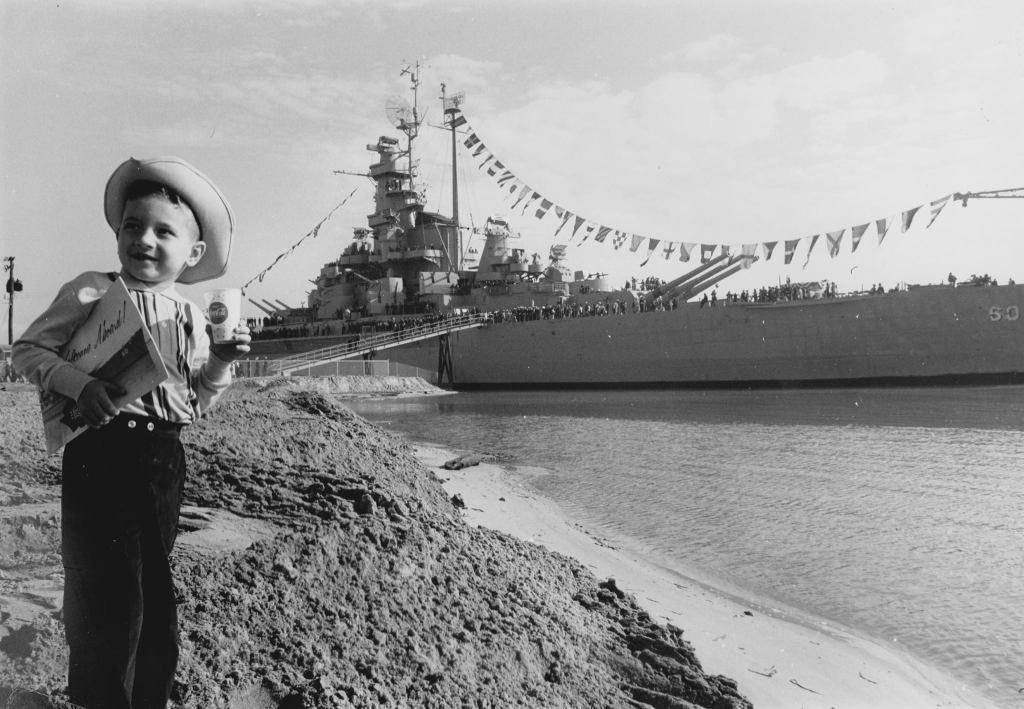
Battleship Memorial Park opened to the public. Alabama Governor George C. Wallace welcomed over 2,000 visitors who came to tour the USS Alabama (BB-60).
The British comedy series “Not Only… But Also” premiered on BBC Two, hosted by Dudley Moore and Peter Cook, with special guests John Lennon and Norman Rossington, and musical guest Diahann Carroll.
Beatles ’65 album goes #1 & stays #1 for 9 weeks.
Born:
Joely Richardson, English TV and film actress (“Body Contact”, “Wetherby”), daughter of actress Vanessa Redgrave and film director Tony Richardson, in Marylebone, England, United Kingdom.
Carin Garbarra, American women’s soccer forward (Olympic gold medal, 1996; FIFA Women’s World Cup gold, 1991), in East Orange, New Jersey
Muggsy Bogues, American NBA guard and the shortest player ever to play in the NBA (Washington Bullets, Charlotte Hornets, Golden State Warriors, Toronto Raptors), in Baltimore, Maryland.
Darren Bennett, Australian AFL player and NFL punter (Pro Bowl, 1995, 2000; San Diego Chargers, Minnesota Vikings), in Sydney, New South Wales, Australia.
Vincent Brown, American NFL inside linebacker (New England Patriots), in Atlanta, Georgia.
Bob Keseday, NFL tight end (St. Louis Cardinals), in Bayonne, New Jersey.
Eric Erlandson, American rock guitarist (Hole), in Los Angeles, California.
Farah Khan, Indian film choreographer and director; in Bombay (now Mumbai), India.
 History Diaries