
In Vietnam, heavy fighting erupted today in the Bồng Sơn area of the rice‐rich central coastal plain, according to reports from the field. At least 50 North Vietnamese soldiers were killed in the fighting, 300 miles northeast of Saigon, and South Vietnamese losses were not immediately known, they said. Communist forces attacked a regimental headquarters west of Bồng Sơn yesterday and then hit government positions on three sides of the district capital.
The White House said today that President Ford might press Congress for more military aid to help South Vietnam and Cambodia resist current Communist offensives. But the Senate Democratic leader, Mike Mansfield of Montana, who has just returned from an extended trip to Asia, told reporters that Congress would resist such efforts by Mr. Ford. “Additional aid means more killing, more fighting,” the Senator said. “This has got to stop some time.” The Presidential press secretary, Ron Nessen, told reporters that Mr. Ford considered current United States military aid to both countries to be insufficient. Mr. Nessen said that the President was “concerned” about the Communist success, in taking over the provincial capital of Phước Bình in South Vietnam, but that Mr. Ford’s “intensive consideration” of supplying more aid was not tied to that single battle. Mr. Nessen did not say how much money, Mr. Ford might ask Congress to authorize. He declined to confirm press reports that the President was considering asking for $300 million in addition to the $700 million already appropriated for the fiscal year that ends June 30.
Senator John C. Stennis, chairman of the Armed Services Committee, said today he would not support the reintroduction of United States troops into South Vietnam nor any type of military action to solve problems in the Middle East. The Mississippi Democrat, making an “annual report” to the people of his state, noted recent military setbacks by the South Vietnamese but added, “We’re certainly not going back in.” Mr. Stennis added, however, that United States military aid to South Vietnam had been “cut in half” and said: “If there is real proof that they are about to be decimated or captured, then I would take the lead in helping get more money. It doesn’t look good over there.” Senator Stennis, a long‐time and powerful advocate of military preparedness, has in recent years softened his views on American involvement overseas and supported some of the legislation to curb the American role in Indochina.
In the soft shade of the stately koki trees, a Cambodian mother nurses her 3‐month‐old infant. A youngster wearing a western‐style football shirt with the number 99, made in Thailand, runs giggling from a stranger. At one side of the compound, a group of young men. preparing supper with gusto, chop up a 50‐pound fish just caught in the Mekong River, which flows past this grove. And close to the river, with friends leaning on a fence kibitzing, two men play a match of boule — a French‐style bowling game played with metal balls. It is all very normal and charming, except that the men are Cambodian soldiers and the women and children are their dependents who always travel to war with them because they have no other home. There are other incongruities. The game of boule is being played next to a sandbagged 81‐mm. mortar emplacement. The giant fish was caught not by net or hook but by exploding an antipersonnel mine in the river.
This compound where the soldiers are encamped is a pagoda complex where saffron‐robed monks with shaven heads used to chant their sing‐song Buddhist prayers and ring the shrill temple bells with wooden hammers on holy days. Today the monks are gone and the pagoda is a front line. Only 500 yards away sit the insurgents,‐also Cambodian, but usually led by Communists and dedicated to the downfall of the American-backed Government in Phnom Penh. Every so often they let loose at the compound with a barrage of mortar shells and machine‐gun fire — not so much to try to cut down the garrison as to remind the government troops that they have not gone away. Starting from this point only about 15 miles southeast of Phnom Penh, the insurgents have seized control of a 13‐mile stretch of this road, Route 1. It is a vital road, for it parallels and commands the Mekong River, the government’s main supply line, on which ply the freighter convoys of American ammunition and food. All other surface supply routes were cut long ago by the rebels.
With the insurgents having mounted their annual dry season offensive on several fronts around Phnom Penh a little over one week ago, the capital will nave to replenish itself soon. This means that government troops will soon have to start a drive to clear the rebels off Route 1. But so far, the Government of Marshal Lon Nol has been forced to commit all its limited reserve troops elsewhere, to fronts such as in the northwest where the immediate physical threat to Phnom Penh has been greater. So the war on Route 1, after some bloody fighting at the start of the offensive, has ground down to a time of waiting. To the visitor who arrives between shellings, the government compound appears virtually tranquil. The only jarring notes are the old scars of this nearly five‐year war that are visible as one drives down Route 1 from Phnom Penh — the leveled villages, the bullet‐marked walls and the branchless trees. But at the compound, soldiers in sarongs are bathing and fishing in the Mekong. Their wives are plucking the juiciest topmost leaves off the manioc plants to use as vegetables with the evening meal. Soldiers sitting on the grass near pungent fields of tomato talk with a Western newsman about their old wounds and their weapons and who they have fired them at and why they joined the army when they were only 15 (”because I was lazy about studying in school.”)
Suddenly the air explodes. A Government spotter plane circling slowly overhead fires several long bursts from his 20‐mm. guns at some insurgents he apparently sees moving about below. The insurgents reciprocate by firing a few machine‐gun bursts toward the compound. The compound insists on the last word by firing five 81‐mm. mortars back at the insurgents jungled positions. It was all over in less than 60 seconds. There was no sign of casualties on either side. The boule players did pause briefly to look around at the noise and some of the kibitzers fell briefly silent. But with the passing of the last explosion, the clack of the metal bowling balls and the bubbling of the pots of fish stew became the dominant sounds in the compound again — as the government camp resumed its special kind of waiting.
[Ed: Many, if not most, of these people will die soon in The Killing Fields of the Khmer Rouge.]
Hundreds of students in Laos marched to the provincial capital of Thakhek today but were stopped by Laotian soldiers, who sealed off the town after students took over two government buildings. Radio reports in Vientiane said one person was killed and 10 wounded when a group of about 300 supporters tried to march on Thakhek, which is 10 miles from a United States Air Force base in Thailand. The students seized the public works office and public information office yesterday in an anti‐government protest. They issued eight demands, similar to those issued by disgruntled government forces when they seized Ban Houayxay last month. Ban Houayxay is a provincial capital in northwestern Laos. The government negotiated an end to that seizure at the new year.
President Ford conferred with the Sultan of Oman, Qabwos Bin Said, who is in the United States for a series of meetings with high-level government officials. The sultan came to the White House during the afternoon for the Oval Office meeting with Mr. Ford. Secretary of State Henry A. Kissinger and General Brent Scowcraft, a presidential national security adviser, joined in the session, as did the sultan’s foreign minister and two of Oman’s ambassadors.
A 28-year-old Iranian accused of Britain’s first domestic hijacking was charged in Uxbridge Magistrate’s Court with extorting $235,000 from British Airways and ordered held without bail. Saeed Madjd, who is unemployed, was accused of hijacking a BAC-111 jetliner on flight from Manchester to London Tuesday. The hijacker ordered the plane to Paris but the pilot flew to another airport in Britain where the hijacker was captured.
France quadrupled the valuation of her gold reserves to $170.40 an ounce in an effort to increase her international borrowing power to finance imports following the quintupling of the price of oil. The revaluation raised the value of French gold stock to more than $17 billion from $4.4 billion. France thus became the first country to break away from the practice of pegging the value of its gold holdings to the “official” intergovernmental price of $42.22 an ounce. The action followed an understanding reached by President Ford and President Valdry Giscard d’Estaing at a conference last month in Martinique. The French acted on gold despite misgivings expressed by three oil‐exporting states — Iran, Iraq and Algeria — that revaluation might create inflationary conditions that would further depress values of paper money and erode the purchasing power of the oil states.
The French government raised the possibility of putting the luxury liner France, retired last year because of financial losses, back into service for the 200th anniversary of American independence next year. Secretary of State for Transport Marcel Cavaille said the government was considering restoring the liner to transatlantic service between France and Philadelphia.
About 4,000 demonstrating workers from the Spanish auto firm SEAT clashed with police in the center of Barcelona. Eyewitnesses said several of the marchers, bleeding from head injuries, were bundled into police jeeps. A wildcat strike Wednesday to back wage demands resulted in the suspension for a week without pay of thousands of workers.
Madrid’s pollution level has risen alarmingly during the past week and presents a serious health risk, Spanish doctors warned. A nine month drought has built up a layer of polluted air over the city and there has been insufficient rain and wind to move it away. The number of persons suffering from respiratory ailments has risen significantly and Madrid’s mayor said he would seek government authorization to limit auto traffic in the city center.
The Soviet Supreme Court has rejected appeals for clemency for Mikhail Leviev, a Moscow Jew sentenced to death for bribe taking, Leviev’s son said in Moscow. Alexander Leviev told Western newsmen that the rejection was made last week. The elder Leviev, 57, former manager of the popular Moscow store Tadzhikistan, was arrested in early 1972. His wife said last month her husband was awaiting execution in Moscow’s Lefortovo jail.
Denmark’s Liberal Party, led by Prime Minister Poul Hartling, gained seats in the election for the Parliament, the 179 seat Folketing, to increase its share to 42 members. The Social Democrats gained as well, winning 53 seats.
Israel has urged Secretary of State Kissinger to stop seeking further territorial concessions from her and fly instead to the Middle East to find out what President Anwar Sadat of Egypt would give up in return for a new Sinai withdrawal, according to diplomats and American officials. Top Kissinger aides said that such a trip always remained a possibility, but that for the moment the Secretary believed that the diplomatic gap between Israel and Egypt had to be narrowed before he undertook another trip. American officials and well-placed Arab and Israeli diplomats in recent days have led to the conclusion that with the Israeli Foreign Minister, Yigal Alton, on his way to the United States, relations between Israel and the United States have entered another potentially difficult period. Both sides agree that the opportunity for a new Egyptian-Israeli accord seems brighter now that Leonid I. Brezhnev, the Soviet leader, has put off his trip to Cairo, but they are at odds over how to achieve another agreement. The basic problem is that Mr. Kissinger, who has served as a mediator for the last year between Israel and the Arabs, seems caught between equally firm Israeli and Egyptian positions.
Saudi Arabia has contracted to purchase from the United States 60 F-5 jet fighters at a total cost of $750 million under an agreement that includes pilot training. It was the largest weapons contract between Saudi Arabia and the United States since sales started 20 years ago. The F-5 jet was designed primarily for air defense, but it can be used as a fighter-bomber. The contract was announced by the Saudi radio in Riyadh yesterday and then by the State Department. The sale is the largest by the United States to Saudi Arabia in more than two decades of supplying arms to the country. A State Department spokesman said that the sale would contribute to “the legitimate self‐defense needs” of Saudi Arabia and that Secretary of State Kissinger believed it would “contribute to stability in the area.”
President Anwar el-Sadat of Egypt said in an interview published here today that Arab countries would blow up their oil wells before allowing them to fall under the control of invading forces from the United States or elsewhere. Mr. Sadat described as “very regrettable” a remark by Secretary of State Kissinger that he could not rule out the use of military force against oil‐producing countries. “We will not need armies, because it is much easier to blow up oil wells than to carry out an invasion,” Mr. Sadat was quoted as having said in the interview. The Beirut newspaper Al Anwar today published the second part of an interview Mr. Sadat had given to Bassarn Freijat, the newspaper’s general manager.
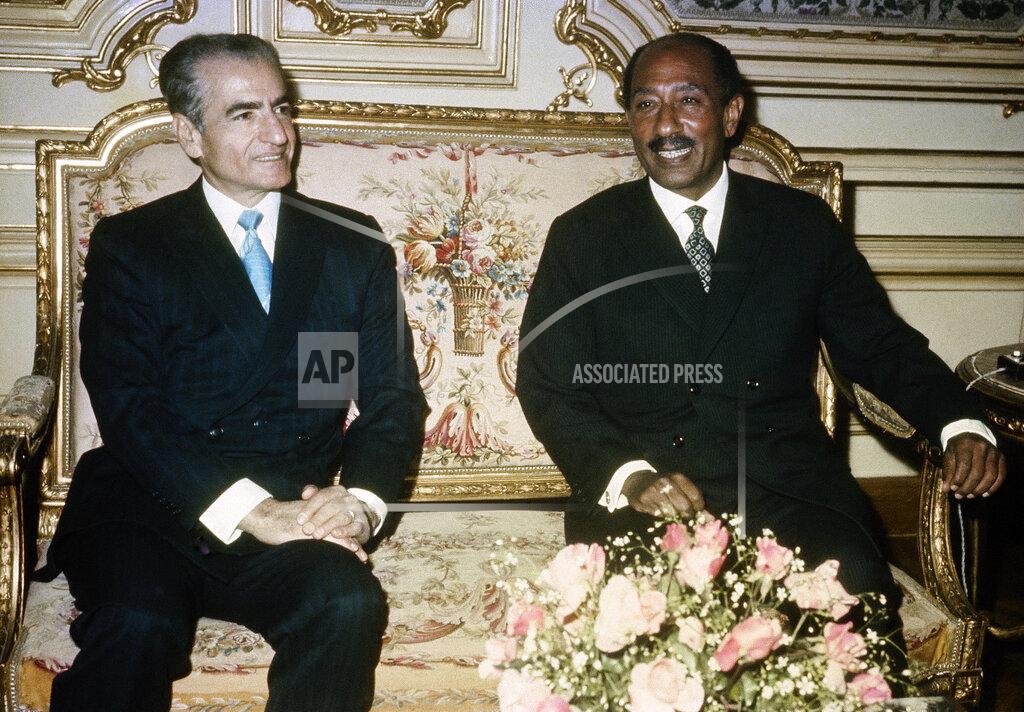
President Anwar el-Sadat and Shah Mohammed Reza Pahlevi of Iran spent more than two and a half hours today discussing Middle East issues, international problems and relations between their two countries. The two leaders met at the Kubeh Republican Palace, where the Shah and Empress Farah are staying during their five‐day visit to Egypt. Much of the visit has been occupied by ceremony, but today’s talk gave the Shah and Mr. Sadat an opportunity for a complete review of political and economic matters. For the first hour, they met with their full delegations, including their Foreign Ministers, Abbas Ali Khalatbari of Iran and Ismail Fahmy of Egypt. They then met in private.
India granted full diplomatic status to the Palestine Liberation Organization official representative in New Delhi today
Indonesia called for a three-nation conference to discuss anti-pollution measures as oil slicks from a ground- ed Japanese supertanker moved into the Strait of Malacca.
Searchers combing the ruins of an explosion-flattened building found the body of an eighth victim of a blast Wednesday in downtown North Bay, Ontario, Canada. Police said they believe this accounted for all people known to have been in the three-story building before it was demolished. Thirty-eight people were injured in the explosion.
600 employees of the Royal Canadian Mint go on strike.
A mountain in Mexico called the Mountain of Butterflies where many monarch butterflies go in wintertime was discovered.
Angolan guerrilla leaders arrived in the Portuguese seaside resort of Lagos for talks aimed at granting full independence to Portugal’s richest African colony. The conference, scheduled to open today, will be the first time the government has sat at the same table with representatives of the three guerrilla movements it fought in West Africa for 13 years. The three groups waged separate wars but drew up a joint independence program at a meeting in Kenya last week.
Uganda President Idi Amin told a meeting of businessmen in Kampala that their companies and shops would be seized and turned over to honest citizens if they continued to overcharge and hoard. He also warned against the futility of plotting against him: “I’m not worried about anything because I am protected by God and even the most powerful witchcraft cannot affect me.”
Miners returned to work at South Africa’s biggest gold mine at Orkney as anger among black employees over new wage legislation appeared to die down. Eight men have been killed and more than 30 injured in disturbances at the Vaal Reefs mine. The rioting erupted when the government of neighboring Lesotho said its nationals working in South Africa must deposit 60% of their earnings with home banks until they return home. Mine officials said most of the 12,000 workers from Lesotho now had left but said that the move had reduced the work force to 55%.
Officials of the Central Intelligence Agency’s Counterintelligence Division, well-placed sources said, unsuccessfully sought authority to destroy illegal domestic files on nearly 10,000 American citizens last fall because they feared the newly liberalized Freedom of Information Act, which had been amended to permit judicial review of secret documents. The sources said that the effort to gain official sanction for the destruction of the files was a direct result of Congress’s amending the act to permit judicial review of secret documents. The obvious fear, sources said, was that a court suit brought under the legislation would disclose the existence of the secret domestic file system.
Well-placed Government sources were quoted by The New York Times on December 22 as reporting the existence of the illegal domestic files on nearly 10,000 American citizens. Today, The Washington Post and Jack Anderson, the columnist, reported that the names of 9,000 Americans were submitted in 1970 to the C.I.A. by a Justice Department unit in an effort to coordinate overseas surveillance of these persons, a legal activity. Justice Department officials said this evening that they had been informed the C.I.A. had made no use of the 1970 files and had destroyed them. The Times’s sources reaffirmed that the C.I.A.’s Counterintelligence Division had maintained its own file system on American citizens separate from that of the Justice Department.
Former Oklahoma Senator Fred R. Harris, who dropped out of the 1972 race for the Democratic presidential nomination saying he was “broke,” announced he would run for the Presidency again next year. In a statement from his home in McLean, Virginia, Harris, 44, said he would formally announce his decision at a news conference in New Hampshire Saturday. He becomes the third Democrat to decide he will seek the nomination, the other two being former Governor Jimmy Carter of Georgia and Rep. Morris K. Udall of Arizona.
Secretary of State Kissinger has asked one of his top aides, Robert J. McCloskey, to assume duties as top liaison official with Congress. President Ford is expected to announce the appointment soon.
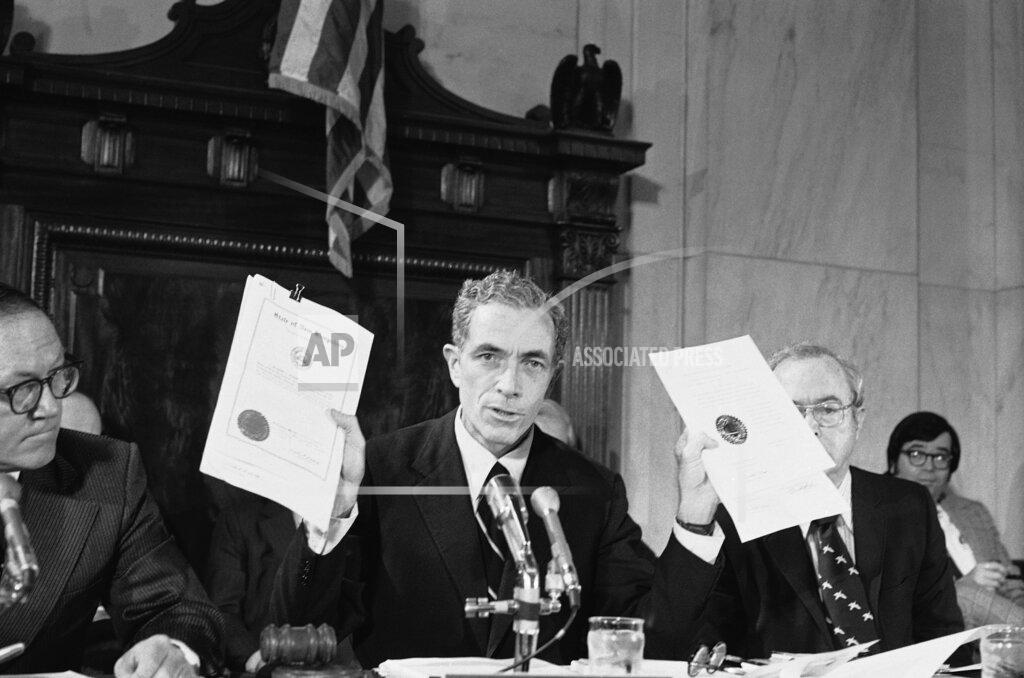
The Senate elections subcommittee passed to the full Rules Committee a decision on what to do about the hotly disputed Senate election in New Hampshire. The committee is next scheduled to meet Monday morning, a day before the Senate is to convene. Republican Louis C. Wyman has been certified as the two-vote winner but both he and Democrat John A. Durkin claimed they were entitled to be seated. They also differed sharply on how the dispute should be settled. Wyman argued that the issue should be returned to the people of New Hampshire for a runoff election. Durkin argued, however, that the Senate itself has a constitutional duty to decide.
With the endorsement of major administration economic advisers, the Department of Transportation proposed an immediate 10 percent reduction in domestic air-coach fares, and brought cries of outrage from the airlines. The proposal was submitted to the Civil Aeronautics Board “as a way to combat inflation, improve aviation fuel efficiency and expand air transportation for the traveling public.”
The Oil, Chemical and Atomic Workers Union delayed for at least another day a general walkout of its 60,000 workers in the nation’s major oil and chemical refineries. Union President A. F. Grospiron said sanctions might be leveled against specific refiners, but not until he and the union’s national oil policy bargaining committee had “exhausted all available avenues” for settlement. Most of the men have continued work since 423 contracts expired last Tuesday but four plants in Texas and California have been struck by locals, affecting 8,000 employees. The union is seeking raises of $1.20 an hour for each of three years. The industry has offered about a raise of $1.10 over two years.
Armed Indians who seized an unoccupied monastery near Gresham, Wisconsin, backed down slightly on their demands in face-to-face negotiations called in an effort to end the occupation. Brother Neal Bennett, a member of the Roman Catholic order of the Alexian Brothers that owns the estate, said the Menominee Warrior Society was no longer demanding that it be given title to the 64-room mansion and 237 acres of land the Indians took over on New Year’s Day. He said the militants now were demanding only “reasonable assurance” that they would eventually be given the facility and that an adequate health program would be set up. The talks were adjourned to give negotiators time to contact state, federal, and private groups.
United States Senator Lowell P. Weicker Jr. announced in Greenwich, Connecticut tonight that he would remain a Republican despite past differences with the national and state party organizations.
An Air Force T-29 trainer and a small private plane carrying a total of nine persons collided over the James River near Newport News, Virginia, the Coast Guard said. No survivors were reported. One body was recovered from the river. The others were missing. Authorities said two persons, both Navy enlisted men from the landing ship USS Pensacola stationed at Little Creek Naval Base in Norfolk, Virginia, were in the small plane, a Cessna 150. The T-29, from Langley Air Force Base, Virginia, carried five crewmen and two passengers.
The U.S. Army today selected a European missile to be developed as its primary all-weather aircraft defense system for forward‐area combat units. If eventually produced, the French‐West German Roland 2 Missile would represent the first large‐scale procurement of a foreign weapon by the Army in recent years. The Army awarded the Hughes Aircraft Company of Canoga Park, California, a $108.4 million contract to modify the European missile for American use.
[Ed: Another Army air defense scheme that went (almost) nowhere. Problems with technology transfer and rising costs (ostensibly at least, institutional resistance within the U.S. Army/DOD and Congress to using a ‘foreign’ weapons system may have actually played more of a role) killed the program and only 27 fire units and 600 missiles were built for one battalion in the Army National Guard, mounted on M812 flatbed trucks. With the failure of the M247 Sergeant York the U.S. Army later leased 5 German Roland systems for evaluation as a possible replacement. And again it went nowhere.]
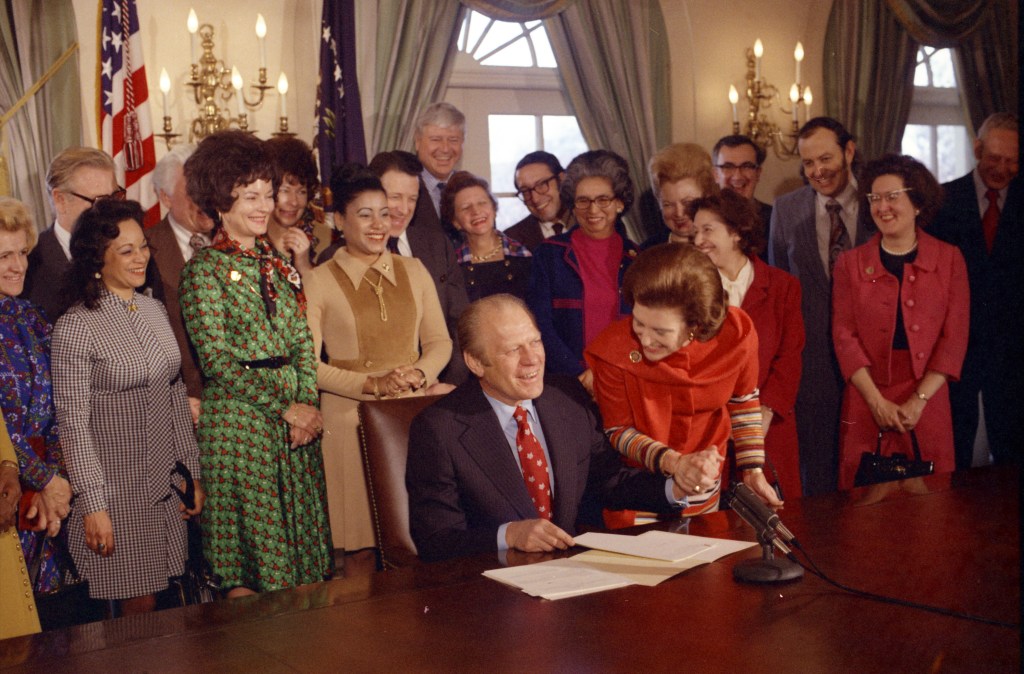
President Ford signed an execufive order today creating a national commission to promote and coordinate United States participation in International Women’s Year. The commission, which is yet to be named, will be made up of 135 persons, all of them to be drawn from private life. Four will be designated by Congress and the rest by Mr. Ford. This year has been proclaimed International Women’s Year by the United Nations General Assembly. Betty Ford was among those present for today’s ceremony in the White House Cabinet Room. When the President invited her to say something after he had read his own statement, Mrs. Ford put her right hand in his left hand and said, with a broad smile, “congratulations, Mr. President, I’m glad to see you have come a long, long way.”
A teen‐aged baby sitter who was stabbed 25 times with an ice pick yesterday morning in Philadelphia was listed in guarded condition today at Chestnut Hill Hospital. The authorities said they believed that the girl, identified as Marilyn Streeter, 13 years old, was stabbed by the same assailants who killed a man who was taking her home
Relocation of 23 Victorian homes that stand in the path of a proposed $35 million crosstown freeway in San Francisco was approved by the California Coastal Commission by an 8-3 vote. A group called Citizens Against the Freeway protested the action. They were told, however, that the action was designed only to save the houses and did not constitute approval of plans to build the freeway as a 6.5-mile extension of U.S. Highway 101.
A student group in Maryland asked the Senate subcommittee on international trade to investigate whether some American industries are exposing workers in foreign countries to industrial dangers that are banned in the United States. The Maryland Public Interest Research Group sent a report to the subcommittee in which it expressed fears that such practices may already be occurring within the asbestos industry and could soon occur in the vinyl chloride industry.
“The Beatles & Co., Ltd.”, the corporation created by John Lennon, Paul McCartney, George Harrison and Ringo Starr to pay them as employees in order to effect a savings on taxes, was formally dissolved by a court in London, four years after McCartney had filed suit in the year after the band’s breakup.
Dow Jones Industrial Average: 645.26 (+9.86, +1.55%)
Born:
Anders Eriksson, Swedish NHL defenseman (NHL Champions, Stanley Cup-Detroit, 1998; Detroit Red Wings, Chicago Blackhawks, Florida Panthers, Toronto Maple Leafs, Columbis Blue Jackets, Calgary Flames, Phoenix Coyotes, New York Rangers), in Bollnas, Sweden.
David Ling, Canadian NHL right wing (Montreal Canadiens, Columbus Blue Jackets), in Halifax, Nova Scotia, Canada.
Micah Knorr, NFL punter (Dallas Cowboys, Denver Broncos), in Orange, Califronia.
Kiko Calero, Puerto Rican MLB pitcher (St. Louis Cardinals, Oakland A’s, Florida Marlins), in Santurce, Puerto Rico.
Justin Huish, American archer (Olympic gold medals, individual, team, 1996), in Fountain Valley, California.
Kimberley Ann Scott [Kim Mathers], Former wife of Eminem, in Warren, Michigan.
Died:
Virginia Ellis Jenckes, 97, U.S. Representative 1933–39, and first woman to represent Indiana in Congress.
Li Fuchun, 74, Communist Chinese economic planner.
John Slater, 58, British actor (“Deadlock”, “3 on a Spree”).
Pierre Fresnay, 77, French actor (“Monsieur Vincent”, “Grand Illusion”).
Pyotr Sergeyevich Novikov, 73, Russian mathematician (group theory).







 History Diaries