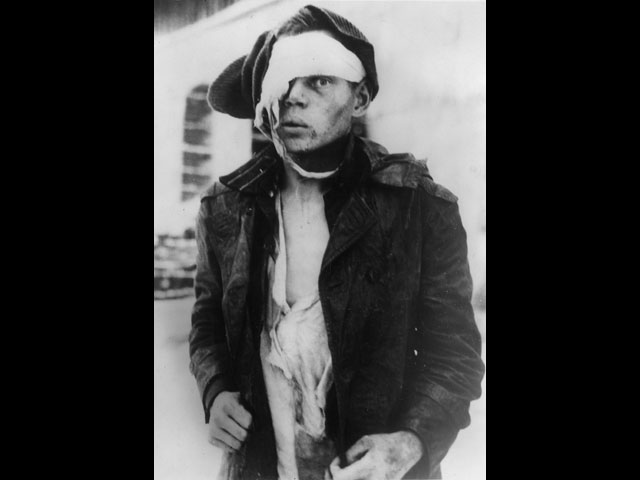
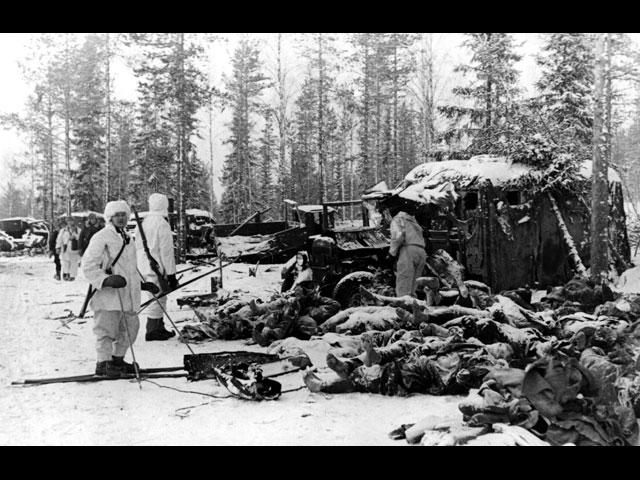
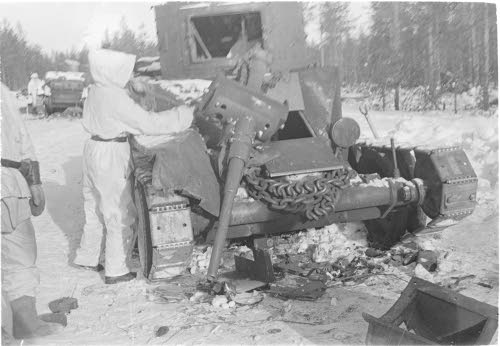
The Battle of Suomussalmi ended in Finnish victory. Two Soviet divisions were encircled and destroyed. In Finland, Finnish 9th division took possession of Raate Road at dawn after taking 1,000 Soviet prisoners of war, 43 tanks, 70 field guns, 278 vehicles, 300 machine guns, 6,000 rifles, and 1,170 horses. An estimated 700 Soviet troops would be successful in escaping back into Soviet lines, but many of these would be shot by NKVD agents for treason for retreating.
By 8 January 1940, the Finns have astounded the world by beating back most of the Soviet incursions on their territory, including all of the most deadly ones.
The Soviet holdouts on the Ratte road surrender around Lakes Kuivasjarvi and Kuomasjarvi (near Captain Mäkinen’s original roadblock). The Finns will take a few days to finish off the remaining Soviet stragglers who ran into the woods or are still hiding in abandoned equipment on the Ratte road. In essence, though, they now have completely eliminated what had been considered the most dangerous advance into the country.
Casualties of the 44th Rifle Division alone totaled over 5,000 men.
While it is an epic defeat, the Soviet Union is far from defeated.
At 7 o’clock in the morning Moscow radio transmits a propaganda broadcast in Finnish in which it claims that “unspeakable terror” has broken out in Finland. According to Moscow “people are being shot in droves and supporters of the Kuusinen Government are being hunted all over the country”.
In Ladoga Karelia, Detachment Pajari defeats a Soviet battalion at Viitavaara.
Finnish troops carry out guerrilla strikes in Soviet-oocupied northern Finland. The commander of a crack Finnish ski patrol told tonight how his men wiped out thirty Russians as they slept around an open campfire and then moved on to Russian soil to dynamite the Leningrad-Murmansk Railroad.
Detachment Sisu is formed in Lapua, composed of foreign volunteers.
Prime Minister Ryti reviews Finland’s economic situation for the foreign press.
Foreign Minister Tanner reminds U.S. envoy Arthur Schoenfeld that Finland has captured more materiel as booty from the enemy than she has received in the form of aid from any friendly power.
Foreign Minister Tanner entrusts Hella Wuolijoki with the task of sounding out the possibility of peace with the Soviet Ambassador in Stockholm, Madam Alexandra Kollontai.
It is reasonable to presume that on the Western Front keeping a constant watch on the Germans’ every move is now more than ever a concern of the Allied high command. This presumption is borne out by the fact that during the past week Allied patrols were numerous and persistent, with the result that numerous prisoners were taken. Such activity is likely to increase, in conjunction with aerial reconnaissance, as more and more information will be sought regarding the German intentions. At present the nature of the campaign that will develop in 1940 turns on the answer to this question: Will the Germans attack in the Spring?
Benito Mussolini sent a message to Adolf Hitler, cautioning against waging war with the United Kingdom.
A defensive alliance between Italy and Hungary assuring Hungary of full Italian support in event of attack by either Germany or Soviet Russia was reported authoritatively today to have been agreed upon by the Foreign Ministers of the two nations in weekend talks at Venice. First reports were that the text of the agreement would be made public with its signature by the Foreign Ministers, Count Ciano and Count Stephen Csáky, at Rome, but later reports said the pact would remain confidential lest publication give offense to the Germans or the Russians. Hungarians understood it would be initialed by both Foreign Ministers if fully approved by their respective governments. Count Csáky is due in Budapest in the morning to report to a special meeting of the Hungarian Crown Council.
A new Heer (German Army) headquarters is reportedly established at Recklingshausen, 10 miles from the Dutch border.
The Reich, claiming “neutrality,” prohibits the transit of shipments of Italian war materiel to Finalnd, including aircraft.
Doubt in the Irish Republic over the constitutionality of a new law today halted a mass round-up of members of the outlawed Irish Republican Army.
There is an I.R.A. bombing of a police constabulary in Londonderry, Northern Ireland.
The British government introduced rationing for butter, bacon, ham and sugar. The government of the United Kingdom introduced rationing, allowing each citizen 112 grams (4 ounces) of bacon and 336 grams (12 ounces) of sugar per week.
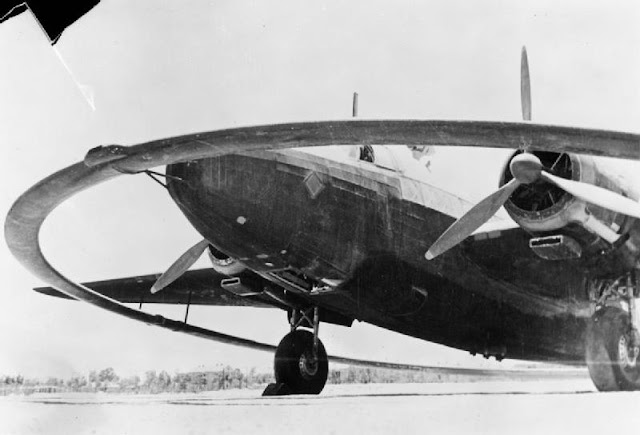
A converted Wellington bomber operating from Manston, Kent, England, and equipped with DWI (Directional Wireless Installation) achieved its first successful detonation of a mine without a problem. In the early weeks of the war mines were dropped from Luftwaffe aircraft in British coastal waters and these magnetic mines sank an increasing amount of ships. The retrieval of an intact mine led to the development of two solutions. One was to degauss the ships, removing their magnetic fields. This would allow the degaussed ships to pass safely over the magnetic mines but left the mines intact. The second was to deliberately generate a magnetic field that would detonate the mine. Attempts to do this from a ship succeeded in detonating the mines but also caused damaged to the ship. The successful solution was DWI and involved attaching an aluminum coil inside a balsa wood ring with a diameter of 51 feet and attached to a Wellington IA bomber. Power was provided by a Ford V8 engine driving an electrical generator. When the power was fed into the coil it generated a magnetic field that could trigger the magnetic mine. The aircraft had to fly slow and low enough to trigger the mine, but not so slow or low that it would be damaged by the explosion. This was a very low level operation – initial tests took place at 60 feet, with 35 feet felt to be the minimum safe altitude. The DWI equipped Wellington was an early example of what Churchill called the “Battle of the Boffins” – the scientific war that saw first one side then the other win a brief technological advantage, before the Allies took an almost unassailable lead later in the war. Along with the development of simple degaussing methods, the DWI Wellingtons ended the threat of one of Germany’s early secret weapons of 1939-40.
British General Wavell departs for an inspection tour of British Somaliland and French Somaliland.
Steamers Gitano (3956grt) and Tynehome (628grt) collided in fog with the loss of Tynehome. Ten survivors were picked up by Gitano.
The British cargo ship Atlantic Scout ran aground 2 nautical miles (3.7 km) north east of Cap Gris Nez, Pas-de-Calais, France and was wrecked. She was refloated and beached at Boulogne, where the wreck was broken up in 1949.
U-56 laid mines off Cross Sands near Yarmouth on which one steamer was lost.
Convoy HG.14 departs Gibraltar for Liverpool.
The War at Sea, Monday, 8 January 1939 (naval-history.net)
Heavy cruiser NORFOLK departed the Clyde for Rosyth where she arrived on the 10th.
Heavy cruiser SUFFOLK and armed merchant cruiser SCOTSTOUN departed the Clyde on Northern Patrol.
Light cruiser COLOMBO departed Scapa Flow for Northern Patrol, which she left on the 12th for Devonport and arrived on the 14th. With her departure from Scapa Flow, the 11th Cruiser Squadron ceased to exist.
Anti-aircraft cruiser CAIRO arrived at Chatham.
Destroyer WESTMINSTER completed her conversion to fast escort vessel. Following working up at Portland, she joined Convoy C operating from Rosyth, arriving on the 30th.
Submarines SEAWOLF and SEALION departed Rosyth on patrol.
Polish submarine ORP WILK arrived at Rosyth after patrol.
Submarines SEAL and NARWHAL departed Gosport, via the Downs where they spent the night of the 8th/9th, for Rosyth. They arrived on the 10th escorted by sloop FLAMINGO for duty as convoy escorts on the ON/HN convoy routes. NARWHAL departed Rosyth on the 15th with convoy ON.8.
Convoy OA.69 departed Southend escorted by destroyer VANESSA from the 9th to 11th. Destroyer WIVERN also joined until detached on the 11th.
Convoy OB.69 departed Liverpool escorted by destroyers MACKAY and WITHERINGTON until the 12th. The convoy dispersed next day on the 13th.
Convoy FS.67 departed the Tyne, escorted by sloops AUCKLAND and STORK, and arrived at Southend on the 9th.
Steamers GITANO (3956grt) and TYNEHOME (628grt) collided in fog with the loss of TYNEHOME. Ten survivors were picked up by GITANO.
U-19 sank Norwegian steamer MANX (1343grt) in 58 30N, 01 33W. Thirteen crew were lost and six crew rescued.
U-56 laid mines off Cross Sands near Yarmouth on which one steamer was lost.
Convoy HG.14 departed Gibraltar with 33 ships escorted by destroyer KEPPEL. The convoy was turned over to ocean escort Sloop ENCHANTRESS and French destroyers VALMY and CHEVALIER PAUL outside the Gibraltar approaches, and arrived on the 17th.
Battlecruiser RENOWN and destroyers HERO and HASTY departed Freetown and joined aircraft carrier ARK ROYAL off Sierra Leone. The destroyers detached on the 10th for refueling.
Light cruiser NEPTUNE departed Dakar on patrol, and stopped and boarded Q-ship LAMBRIDGE (armed steamer BOTLEA (5119grt)) off Freetown without discovering her true identity. After her patrol, NEPTUNE arrived at Freetown on the 20th.
French light cruiser ÉMILE BERTIN departed Toulon on the 8th and proceeded to Casablanca, joined by destroyer ÉPERVIER which departed Bizerte on the 9th. Both ships arrived at Casablanca on the 12th. They then relieved heavy cruisers DUPLEIX, FOCH and destroyer CASSARD, and conducted a surveillance patrol off the Canary Island en route and arrived at Dakar on the 19th. On the 20th, they set off for another patrol off the Canaries. Meanwhile, DUPLEIX and FOCH left for Halifax on escort duty with a convoy at the beginning of February, while CASSARD departed Dakar on the 21st and arrived at Casablanca on the 25th, where she was under repair until 14 February. She then departed Casablanca and arrived at Toulon on 17 February. Destroyer MILAN remained on station
Convoy SL.16 departed Freetown escorted by armed merchant cruiser ESPERANCE BAY until the 25th. Next day, sloop DEPTFORD joined the convoy as escort until its arrival on the 27th.
Light cruiser DAUNTLESS departed Singapore on patrol duties as a unit of the 5th Cruiser Squadron, and arrived back on the 17th.
German steamer SAO PAULO (4977grt) had departed Pernambuco on 16 November 1939 and arrived at Cabedelo the next day. Leaving there on 8 January, she safely arrived at Cuxhaven on 3 March.
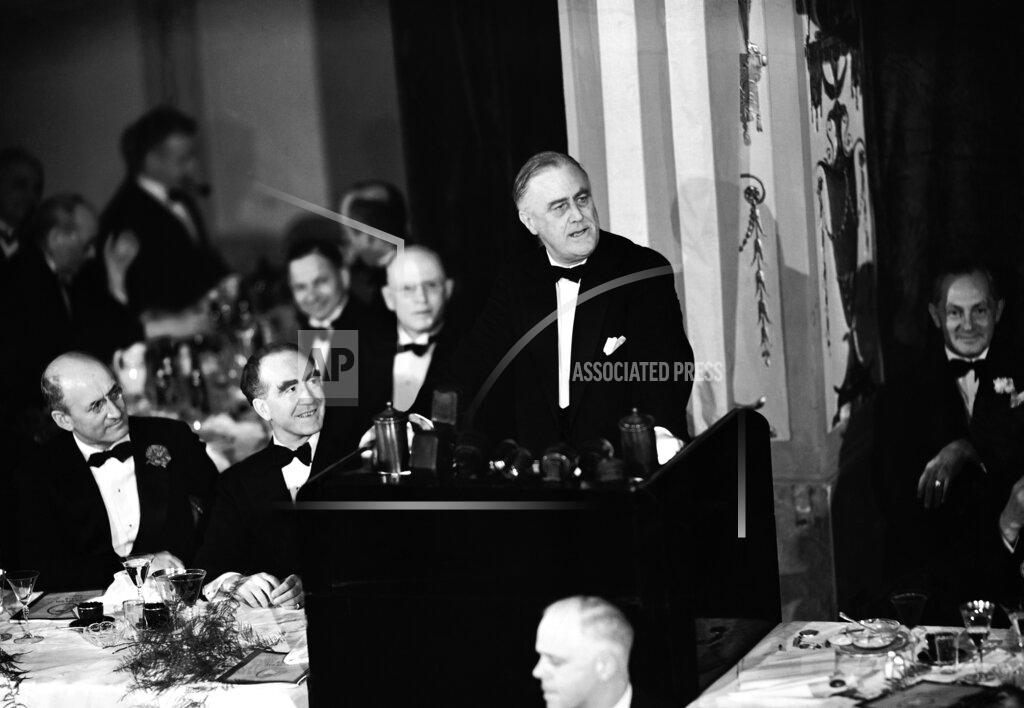
In Washington tonight, President Roosevelt addressed the Jackson Day dinner at the Mayflower Hotel. Earlier, he conferred with Congressional leaders on the legislative program, with Colonel John J. Mangan and General A. A. Anderson of the New York National Guard and with George Creel on plans for continuation of the San Francisco Fair. He sent to the Senate the nomination of Emil Schram to be chairman of the Reconstruction Finance Corporation for a two-year term, and of Charles E. Gauss to be United States Minister to Australia.
The Senate passed the bill providing for deportation of aliens convicted of espionage, postponed action on the Harrison resolution for a study of the 1941 budget, received the Brown bill for a $60,000,000 loan to Finland and heard Senator Wiley oppose loans. to that country, received the Wiley amendments to the Wages and Hours Law, and the Hatch amendments to the Hatch Act to prohibit political activity by government employees, and adjourned at 3:35 PM until noon on Wednesday.
The House voted, 256 to 114, to take up the Gavagan anti-lynching bill and adjourned at 1:51 PM until 11 AM tomorrow. The bill should see a final vote on passage by Wednesday night. The Smith committee resumed its investigation of the National Labor Relations Board, and the Naval Affairs Committee opened hearings on the $1,300,000,000 Naval Expansion Bill.
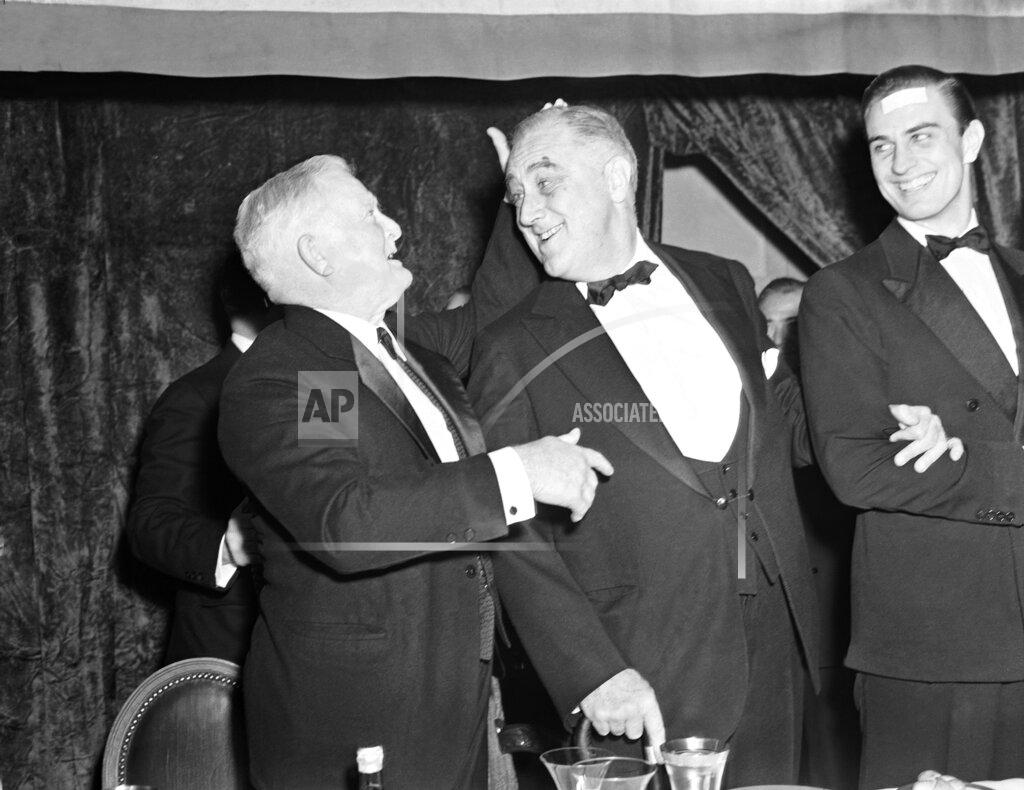
President Roosevelt warned an assemblage of 1,500 Democratic leaders, seated tonight at a $100-a-plate Jackson Day dinner, that they had better contrive to hold the independent party-swapping vote if they expected to win the Presidential election in November. The rock-ribbed Democrats in a crowd which included Vice President Garner, a self-announced candidate for the party’s nomination; Postmaster General Farley, Speaker William H. Bankhead and other hopefuls, subdued the appearance of any astonishment they might have had at this suggestion for party irregularity. They listened instead, and in vain, for more definite word from the President as to his own political intentions.
The President’s speech, good-humored, filled with anecdotes and chidings for the Republican leaders who declined invitations to the dinner, was in the main a plea for the type of party leadership which could keep the independent vote within the Democrat corral. An oblique reference to the fact that he had held the coalition together so effectively in 1936 was the crumb generally seized upon by those present as indicative of the feeling that he might consider himself the one to do it again in 1940.
Otherwise, he gave no aid to either side in the speculation as to whether he should or would stand for a third term — speculation which loomed large, both “pro” and “con,” in other Jackson Day celebrations to which the President’s speech was broadcast by radio throughout the country. From the appearance of the crowd gathered at the Mayflower Hotel in Washington, one would have thought that all had been forgotten among the warring factions within the Democratic party. Democrats of all shades of economic and political views, as well as of all degrees of enthusiasm for Mr. Roosevelt and his program, were there. It was hardly possible to distinguish between them in their greetings of the President.
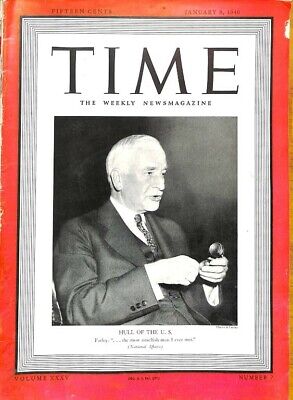
At 8:30 o’clock Mr. Roosevelt entered the banquet room. The diners rose to their feet and cheered for four minutes while the President stood and accepted the ovation. He took his seat at the main table at which were seated Vice President Garner, Speaker Bankhead, Mr. Farley and other distinguished members of the Democratic party. Secretary Hull, Mr. Garner and Mr. Farley, three potential candidates for the Presidential nomination, sat near each other at the head table. Also at this table were Secretary Morgenthau, Secretary Perkins, Senators Glass, Pittman and Harrison and Supreme Court Justice-designate Murphy. As the dinner progressed the President chatted pleasantly with the Vice President, seated next to him.
Passage by the Senate of a House-approved bill providing “prompt deportation of aliens engaged in espionage and sabotage, alien criminals and other undesirable aliens,” took its place today as the first important action of the new session of Congress. The House voted meanwhile to take up the Gavagan Anti-Lynching Bill, one of the most highly controversial measures expected to come up this year, and leaders laid the groundwork for the earliest possible action on extending the Reciprocal Trade Agreements Act, the No. 1 item on the Administration’s abbreviated calendar of “must” legislation.
Congress thus headed into its main issues, including the budget and emergency national defense program, after President Roosevelt reviewed the legislative program with the “Big Four” of the Democratic leadership, including Vice President Garner, Speaker Bankhead, Senator Barkley and Representative Rayburn of Texas, Majority Leaders, respectively, of the Senate and House,
The President was told at the conference that the question of the budget, including taxes and his recommendations for an emergency expenditure for armaments, likely would come up in the Senate immediately and recur in general discussions from time to time until the questions were met in a more practical way with legislation. This prediction was confirmed in part an hour later when Senator Harrison called up his resolution proposing a joint study of the government’s fiscal affairs. The Senate’s approval completed initial action on the alien deportation bill, inasmuch as it was passed by the House on July 6, last. It will go to conference now for composition of minor differences between the House and Senate drafts and then will be sent to the President for his approval or rejection.
The bill provides automatic deportation for any alien who enters the United States at any time, either from foreign territory or an insular possession, who voluntarily admits in writing that he has engaged in, or been convicted of espionage or sabotage affecting the defense of the United States or who has at any time after entry been convicted of a violation, or conspiracy to violate, any narcotic law of the United States or any State, Territory, insular possession or the District of Columbia or has been lawfully committed to a public or private institution as an habitual user of narcotics.
The voice of the United States in world affairs will be heeded in almost exact proportion to its strength on the sea, and now as never before the best interests of the nation demand a navy sufficiently strong “to be an effective deterrent against any foreign aggression,” Admiral Harold R. Stark, Chief of Naval Operations, told the House Committee on Naval Affairs today. He urged prompt enactment of the Administration-supported Vinson naval expansion bill for $1,300,000,000, now before the committee.
Uniess immediate steps are taken to enlarge the fleet at least 25 percent, as provided for in the bill, “the end of the present war,” said Admiral Stark, “will find the United States in a relatively weak naval position.” After observing that the naval situation had changed in the last few months, he asserted that at present the navy was not considered adequate to defend the United States against a coalition of powers.
“The international situation has deteriorated and there is no immediate prospect that it will improve,” Admiral Stark stated. “The situation is rife with possibilities of a general European war, and, in conjunction with Far Eastern conditions, presents a threat of world conflagration. In the world of today it seems only a fair and moderate statement to say that the best interest of our nation will be served by keeping our force sufficiently strong to be an effective deterrent against foreign aggression.” It is a reasonable supposition, he said, that the nations now at war were building to the maximum, augmented wartime capacity of their shipbuilding industries.
The hearing, involving the second most important naval bill submitted to Congress since the World War, began with every member of the committee present and with all the seats in the hearing room occupied. Representative Vinson, the chairman, said the hearing would be speeded and that Admiral Stark would bear most of the burden of explaining the bill to Congress and the country. Secretary Edison was called first but was in the witness chair only a few minutes. He said that Admiral Stark would speak for the Navy Department.
Testimony from the files of a National Labor Relations Board hearing was presented today to the House committee investigating the board to indicate that although a trial examiner had ruled that the American Radiator Company of Litchfield, Illinois, had not locked out its employes and the board had concurred, it then had changed its mind. By doing so the board aligned itself with one of its attorneys who was alleged to have urged witnesses to swear there was a lockout, and he would “prove it” and obtain back pay for them.
The deportation warrant for Harry Bridges, Australian-born leader of the C.I.O. on the West Coast and head of the longshoremen’s union, was canceled today by Secretary Perkins. She adopted the report of James M. Landis, special trial examiner, after hearings to determine whether Bridges was a Communist and subject to deportation. Mr. Landis, dean of the Harvard Law School, ruled that the government’s evidence had not established that Bridges was a Communist or was affiliated with the Communist party.
James Wheeler-Hill, former national secretary of the German-American Bund, whose arrest followed testimony last November at the trial of Fritz Kuhn, Bund leader, unexpectedly pleaded guilty yesterday in Special Sessions to two perjury charges for falsely asserting he was an American citizen.
Chinese Winter Offensive: Southern Honan Army of Chinese 5th War Area counterattacking around Pingchangkuan – Hsiaolintien – Kungchiafan sector.
Japan claims to have killed 25,000 Chinese in battle north of Canton.
The Japanese cabinet has established a puppet government over occupied China. It is headed by Ching-Wei, who previously had lost a power struggle with Chiang Kai-shek for control of the Nationalist government and now seeks to control China by another route. The Japanese Government has promised to grant lenient peace terms to a new Chinese Government that will accept political and economic cooperation with Japan and Manchukuo as its guiding principle. The recognition of Manchukuo, a joint policy of anti-communism and the admission of Japanese industry in the development of China’s natural resources are the foundations upon which cooperation is to be based.
This outline of conditions, agreed upon between Japan and Wang Ching-wei, former Chinese Premier, is clearly sketched in a statement issued by the government tonight after a special Cabinet had confirmed for the third time those “basic terms,” agreed upon in Shanghai on December 31, for the formation of a new Chinese Government. They were subsequently approved in Tokyo by the Japanese Army and the China Board. All the important details with which this peace skeleton will be clothed when a treaty is formally negotiated are not divulged. They have been discussed by Mr. Wang and the Japanese Army for the last six months, and the Japanese Government has evidently decided that it is advisable that Mr. Wang, himself, announce his policy.
This Cabinet statement reaffirms Prince Fumimaro Konoye’s peace terms, announced in 1938 after the fall of Hankow. It is declared in Tokyo that far-sighted Chinese leaders have responded to Prince Konoye’s policy and that finally Mr. Wang and his followers have “openly declared for anti-communism, pro-Japanism and peace.” The Japanese Government is satisfied that the time is now ripe for the formation of a central Chinese government and is prepared to carry out those principles. It is stated that since “what is aimed at by Wang is consonant with Japan’s manifested intentions, the Japanese Empire will direct all possible efforts to help in the formation and expansion of the proposed new government.”
An important part of this announcement is its citation of the Japanese Government’s statement of November 3, 1938 and Prince Konoye’s statement of December 22, 1938, as authoritative definitions of Japan’s “ultimate objectives.” The declared “new order” that Japan seeks is, according to this, a “tripartite relationship of mutual aid and coordination between Japan, China, and Manchukuo, to perfect a joint defense against communism and to realize a close economic cohesion.” Prince Konoye’s statement invited China to abandon anti-Japanism and resentment regarding Manchukuo. It proposed that China recognize Manchukuo, conclude an antiComintern agreement and accept Japanese garrisons at certain specified points as an anti-Communist measure. It designated Inner Mongolia as a special anti-Comintern area and asked for special facilities for the development of China’s resources, especially in North China.
Dow Jones Industrial Average: 151.34 (+0.15)
Born:
Hewritt Dixon, AFL-NFL fullback and tight end (AFL Champions-Raiders, 1967 [lost Super Bowl II]; AFL All-Star, 1966, 1967, 1968; NFL Pro Bowl, 1970; Denver Broncos, Oakland Raiders), in Alachua, Florida (d. 1992, of cancer).
Pat Russ, NFL defensive tackle (Minnesota Vikings), in Cincinnati, Ohio (d. 1984).
Dick Kelley, MLB pitcher (Milwaukee-Atlanta Braves, San Diego Padres), in Brighton, Massachusetts (d. 1991, from cardiac arrest).
Cristy Lane, American country music and gospel singer, in Peoria, Illinois.
Naval Construction:
The Kriegsmarine (German Navy) Type VIIC U-boats U-575, U-576, U-577, U-578, U-579, U-580, U-581, U-582, U-583, U-584, U-585, and U-586 are ordered from Blohm & Voss, Hamburg (werk 551-562).
The Royal Fleet Auxiliary Dale-class fleet tanker RFA Echodale (A 170) is laid down by Hawthorn Leslie and Company (Hawthorn Leslie and Company Hebburn-on-Tyne, England, U.K.).
The Kriegsmarine (German Navy) Type VIIC U-boat U-754 is laid down by Kriegsmarinewerft (KMW), Wilhelmshaven (werk 137).

 History Diaries