In the war against the Việt Cộng, military spokesmen reported that Government troops killed 53 guerillas in a fight Wednesday in the central province of Quảng Nam and about 50 Thursday in Thừa Thiên Province, 30 miles from North Vietnam. Government losses were not disclosed. In a typical series of actions, U.S. and South Vietnamese planes drop bombs and napalm over Phước Tuy Province to destroy a Việt Cộng regiment; and the ARVN claims to have killed 53 guerrillas in a fight at Quảng Nam and to have routed attackers in the area of Huế.
South Vietnamese troops have routed Communist attackers near Huế, the former imperial capital, Government military sources reported. The victory was reported as United States and Vietnamese planes continued to drop bombs land napalm-jellied gasoline-bombs on the jungles of Phước Tuy Province, seeking to destroy a regiment of 2,000 Communist troops. The A-1 Skyraider fighter bombers have dropped 3 tons of napalm and 12½ tons of bombs in at least 16 strikes in the jungle area, 35 miles southeast of Saigon. The planes also strafed the area with 20-mm. cannon, but so far there was no report on the success of the operation. The rebels appear to have disappeared into the jungles since their withdrawal from the village of Bình Giã after a six-day battle last week.
Vietnamese sources said the rout of the Communists near Huế, 400 miles northeast of Saigon, began Thursday when about 100 Việt Cộng guerrillas attacked a platoon of 30 militiamen. At least 50 Communists were reported to have been killed. The Việt Cộng fled the battlefield, abandoning a mortar, 3 machine guns and 10 rifles. Government losses in the action were listed as one militiaman killed, one wounded and four missing.
Nearly 1,000 South Vietnamese students demonstrated against Premier Trần Văn Hương today in the northeastern coastal city of Nha Trang. Carrying on a campaign that has flared lately in Saigon and Huế as well, the youths paraded through the city with a soundtruck blaring demands that the Premier resign. Troops broke up the gathering, but the students thwarted an attempt by the province chief to address them. One student was reported to have been arrested. Premier Hương, striving to keep students and Buddhist monks out of politics, has pledged to meet force with force. As the anti-Government drive went on 400 miles away, compromise efforts continued in Saigon in the dispute between United States officials and the Vietnamese armed forces about military intervention in the Government.
Officials said communiqués were being drafted to close the rift that was opened December 20, when young Vietnamese generals dissolved the High National Council, the provisional legislature that set up Premier Hương’s Government. Under the settlement, the military men are expected to step out of Government affairs and a new legislative assembly is expected to be formed.
Despite the apparent approach of a settlement, Saigon was concerned over rumors that Lieutenant General Nguyễn Khánh, the armed forces commander, planned to depose Premier Hương and install a military dictatorship. Another report, conveyed by a high political source, was that both General Khanh and Premier Hương were targets of a prospective coup by Major General Nguyễn Văn Thiệu, commander of the Army’s IV Corps, and Brigadier General Trần Văn Đôn, military governor of Saigon.
U.S. Secretary of State Dean Rusk reiterated today United States concern over the need for unity in Saigon “so that the war effort can go on full steam.”
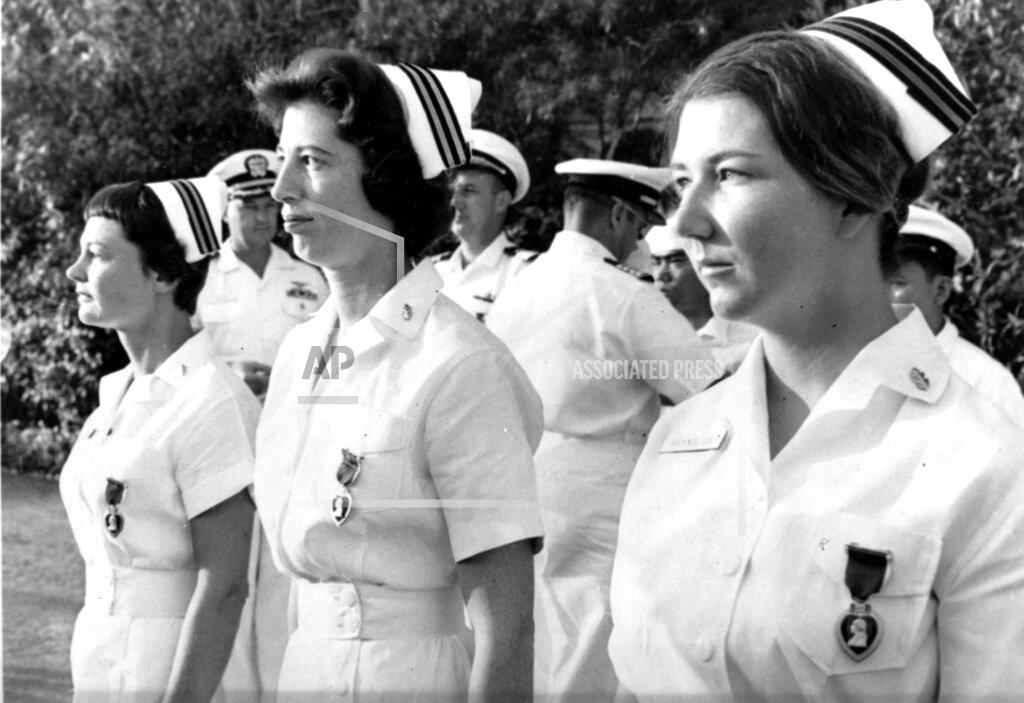
Three United States Navy nurses wounded in the terrorist bomb explosion at the American officers’ quarters on Christmas Eve were awarded Purple Hearts today. They were the first American women to receive the award in South Vietnam. They were hit by glass fragments and thrown to the floor of their room by the explosion, but refused medical help until all 60 wounded servicemen had been treated. The three nurses are Lieutenant Barbara J. Wooster of Laurel, Maryland; Lieutenant Ruth A. Mason of Goshen, New York; and Lieutenant Ann Darby Reynolds of Dover, New Hampshire.
Fifty-six pro-Communist Pathet Lao soldiers were killed and 43 wounded in December, according to a Laotian Government communiqué today. Military sources said government losses were 11 dead and 22 wounded in the same period. Government attempts to push toward Tchepone (Xépôn), on the Hồ Chí Minh Trail, have failed and the government forces in the area now appear to be attempting to achieve only local objectives.
Cambodia denied as “absolutely unfounded” today Thailand’s complaint to the United Nations that Cambodia violated Thai territorial waters December 27.
A marked increase in Communist activity in Thailand’s northeastern provinces has been noted in the last few weeks, Thanat Khoman, the Thai Foreign Minister, said today.
Indonesia made a new landing in Malaya today, and the leader of the raiders told a fisherman whom they captured that they were the advance guard of 1,000 more men. The landing, made by 14 men, was at Tanjong Piai, a remote fishing village at the southernmost tip of West Johore in southern Malaya. Within hours, Malaysian security forces captured five of the raiders, together with their arms. Later dispatches said at least 10 of the raiders had been captured by Saturday noon. Two fishermen, taken captive by the Indonesians at dawn, were freed by Malaysians. Britain’s Army Minister, Fred Mulley, warned in Singapore at the start of a tour of British Far Eastern units that any invasion or aggression against Malaysia would be met by appropriate force. He said there was agreement between the Malaysian and British Governments on plans to meet all contingencies. But he would not say at what point there might be retaliation against Indonesia.
Inche Maarof Bin Sumad, 60 years old, one of the two fishermen held briefly by the raiders, said the Indonesians were fully armed and in uniform. After telling him they were the advance guard of 1,000 men to be sent to invade the Malayan coast, their leader said they had been sent to liberate Malaya from the white man. President Sukarno of Indonesia has announced that his country is stepping up its offensive against Malaysia. So far, 55 Indonesians and Malaysian dissidents have been killed and 266 captured in 11 raids since Indonesia began the policy called “confrontation.”
Viscount Head, the British High Commissioner, said in Kuala Lumpur on his return from consultations and leave in Britain, “We are prepared to meet all eventualities.” He said that Britain could reinforce Malaysia quickly and was determined to see to it that Malaysia faced no risks. Seventy British paratroopers arrived in Singapore today. They were part of a battalion being airlifted to Malaysia in groups. The British aircraft carrier HMS Eagle is now sailing through the Indian Ocean for duty in Malaysian waters.
Indonesia’s move out of the United Nations has produced a long and somber review by the United States of its last remaining assistance programs to President Sukarno’s Government.
Rebels in the northeastern Congo are beginning to show signs of tactical military training. White mercenaries said today that there had been a marked improvement in rebel marksmanship and tactics in recent weeks. “They must be getting some sort of training because they aren’t the hopeless rabble we used to see,” said Noel Hamilton, a 29-year-old mercenary from London. The mercenaries say they are unsure who is providing the training. A rebel prisoner captured near Bunia several days ago reported that “Russian” instructors had arrived at Aba, near the Sudanese border. But the rebels are known to use the term “Russians” for all foreigners who aid them. Algeria and the United Arab Republic, both of which have announced that they are sending arms and equipment to the rebels, are considered more likely sources of the instructors. Algerians or Egyptians have not been authoritatively reported in the northeastern Congo, but most mercenaries firmly believe they are there.
French President de Gaulle has told Chancellor Ludwig Erhard that the march toward European unity can now be resumed by France and West Germany. The French President recently wrote to the West German Chancellor about the latter’s visit to Paris January 19. According to qualified sources, the letter was couched in the “most amiable terms.” General de Gaulle expressed the hope that the agreement on grain prices in the European Common Market, negotiated last month in Brussels, would facilitate progress toward European political unity. But the French Government has also expressed doubt about the usefulness of talks now with the Soviet Union on German reunification. These talks are sought by Dr. Erhard as an essential element of his foreign policy.
One of the threads in the tangled skein of German unity is this year’s German election. Reunification, whatever the prospect for its attainment, remains the most emotional issue of German politics, diplomats said. Dr. Erhard must advocate it, preferably with the support of the United States, France and Britain but, if necessary, alone, they observed. General de Gaulle has given Western diplomats the impression that he believes this is not the time to discuss German unity with the Soviet Union. Behind the general’s suave comments on this topic, experienced diplomats sense a natural French desire to keep Germany divided. As one said, “To France, 50 million Germans in the Federal Republic are tolerable, but 80 million in a united Germany are a danger.” France and Communist East Germany, according to Communist sources here, have signed a trade agreement aimed at increasing trade between the two countries by 80 percent this year. The agreement is in line with the increasingly aggressive French trade campaign in Eastern Europe. France signed a major trade agreement with the Soviet Union last November. Another agreement has been negotiated with Rumania and next week the Hungarian Foreign Minister, Janos Peter, will arrive for preliminary discussions on an economic pact.
The Soviet Union announced today that it had completed four days of high-level negotiations with Poland to coordinate the two countries’ 1966-70 economic development plans.
Communist Rumania’s industry is booming along for the fifth straight year, according to reports reaching Belgrade from Bucharest.
Leaders of France’s trade union federations warned today that they would call a nationwide strike of public-service workers this month unless the Government yielded in its refusal to negotiate immediately and directly in each of the state-controlled industries.
Prime Minister Lal Bahadur Shastri told delegates today at the convention of the Indian National Congress, the country’s governing party, that “I do not know what may happen later, but our present policy is not to make an atom bomb, and it is the right policy.”
Expansion of the United States role in the Philippines may be a byproduct of the current negotiations on the legal status of American forces here, Secretary of Foreign Affairs Mauro Mendez said today.
A London taxi driver was fined in court here today on charges of having insulted Mrs. Francoise Jordan, 32-year-old French-born wife of Colin Jordan, leader of the British Nazi movement.
Premiers of Arab nations will convene in Cairo tomorrow to deal with inter-Arab economic and political problems.
The Syrian Government today set up a military court with extraordinary powers to deal with crimes against the country’s Socialist system.
Juan D. Peron, the former dictator of Argentina, was quoted at a news conference by followers today as having said that his return from exile must be achieved through civil war.
German rocket scientists working for the United Arab Republic live in terror of Israeli secret agents. Bodyguards accompany them. Their homes are protected, their mail examined for explosives.
The police arrested 10 men today for their part in an explosion last night near Abbeyleix House, where Princess Margaret and her husband, the Earl of Snowden, are staying. More arrests were expected.
Three months after his ouster, Nikita S. Khrushchev is living comfortably on a monthly pension of $330 in the country house where he once entertained former Vice President Richard M. Nixon.
U.S. President Lyndon Johnson is determined to eliminate barriers to the right to vote in both South and North during his next four years in office. Mr. Johnson is also eager to work on fundamental reforms in the nation’s farm programs, and has given Vice President-elect Hubert H. Humphrey and Secretary of Agriculture Orville L. Freeman the task of finding these new approaches. Mr. Johnson has asked what he believes to be the best legal minds in the nation to advise him on how arbitrary and unreasonable restrictions voting can be eliminated. Whether he will ask for a constitutional amendment or for legislation will depend on which approach promises to be more effective.
The goal in any case is to make it possible for every American who can read and write and has resided in a state for a reasonable period of time to become a registered voter. Although Mr. Johnson has not decided the question, officials within the Administration are leaning heavily toward an amendment that would strip the states of virtually all authority to set voting standards other than age. Mr. Johnson clearly believes that voters should be literate. But state literacy tests might be abolished, according to some Administration sources. On agriculture, Mr. Johnson is searching for less expensive and at the same time more equitable price support systems than are now on the books.
What Mr. Johnson will decide is not yet clear, but some of his most influential advisers favor legislation that would pay lower support prices to prosperous farmers who grow large crops and higher supports to small growers. At present, about 80 percent of support money goes to about 20 percent of the farmers — and these are the ones who need it least. Some policy makers would like to reduce the share going to large growers to about 60 percent. Mr. Johnson would also like to see farm laws control production more effectively than is now the case. He would also like to end the bitter divisions over farm policy between such farm organizations as the American Farm Bureau Federation and the National Farmers Union. His goal is a policy that farmers can generally agree on and not one that perpetuates division.
The Star of India, missing since a robbery that occurred on October 29, 1964, of the American Museum of Natural History in New York, was found along with eight other priceless jewels after suspect Allen Kuhn led detectives to a bus station in Miami. Kuhn and his partners in crime had placed the gems in “a damp and moldy bag” and hidden them in one of the station’s lockers. The Star of India is returned to American Museum of Natural History.
The Treasury, in an unusual move, issued a statement today designed to calm a new attack of jitters in the world’s key gold and foreign exchange markets. The statement said, “A wave of speculative comment has distorted the significance of recent developments” in these markets. “The Treasury,” it continued, “is able to give categorical assurance that neither the announced purchases of gold by the French Treasury, nor the minor technical adjustment that has been executed in the market quotations for pound sterling, nor newspaper stories concerning a possible revision in gold cover requirements in the United States, reflect or imply any fundamental change in the basic supply and demand situation that has prevailed in the gold and foreign exchange markets in recent months.” As a new gold rush developed in London, the Treasury said the gold market there was “under firm control but has been allowed to fluctuate from time to time as needed to make such speculation more costly.”
Ports from Maine to Texas are scheduled to be shut down at midnight tomorrow by a strike of 60,000 longshoremen. The strike situation was set up last night when members of the International Longshoremen’s Association in the Port of New York voted 8,508 to 7,561 to reject a four-year “peace” contract recommended by their leaders as “the best in the history of the I.L.A.” It is an unbroken tradition in the union that if one local strikes, all strike. Angry steamship operators, who had withdrawn demands for the elimination of what they call “featherbedding” after seven months of intensive negotiations, are expected to ask for immediate legislation to force the union to compulsory arbitration.
John T. Connor, President Johnson’s choice for Secretary of Commerce, will place in a trust more than $1.5 million in stock he holds in the company he headed, White House sources said today.
A single sentence in President Johnson’s State of the Union Message prompted a Roman Catholic official today to restate the church’s opposition to most aspects of birth control. The stand against contraception and the use of public funds to promote artificial birth prevention was voiced by Monsignor John C. Knott, director of the Family Life Bureau of the National Catholic Welfare Conference here. The conference is the secretariat for Catholic bishops in this country.
The President had said: “I will seek new ways to use our knowledge to help deal with the explosion in our world population and the growing scarcity in world resources.” This was widely interpreted as notice that the Government intended to take a much more active approach to the overpopulation problem here and abroad. Its role has been limited to research and to referral of individuals and governments to private organizations.
Robert Glenn Thompson denied vigorously today that he had served as a spy for the Soviet Union in this country and abroad. “The charges against me are fantastic and absolutely untrue,” he said. “I am 100 percent American and I’m shattered because I can’t believe this could happen to me.” Thompson, a 29-year-old former Air Force enlisted man who had served in West Berlin, was arrested at a gas station! in Babylon yesterday after being indicted as a co-conspirator with three Russians in a spy ring. He was later released on $15,000 bail. “It’s not true that I ever received money from the Russians,” Thompson said. “I have never in my life seen top secret information. I know I’ll be vindicated. But the stigma of this thing will hurt me.”
[Ed: He was Not vindicated; he confessed to passing hundreds of photos of secret documents to the Soviet Union since 1957 while he was based in West Berlin, at the Office of Special Investigation at Tempelhof Air Base.]
Two women and a man who refused to answer behind closed doors any questions put by the House Committee on Un-American Activities pleaded not guilty today to contempt of Congress charges. The women are Mrs. Dagmar Wilson and Mrs. Donna Allen of Washington. They are leaders of Women Strike for Peace, an organization that opposes the use of nuclear weapons. The man is Russell Nixon of New York City, who manages The National Guardian, a weekly newspaper that calls itself progressive. The three refused to testify at a closed session of the committee on December 7 but said they would be willing to be questioned at a public hearing. The committee was investigating possible breaches in the enforcement of immigration laws. At today’s arraignment the United States district courtroom was filled mostly with members of the women’s organization.
Senator Everett Dirksen introduces a bill to make the marigold the American national flower (it does not pass).
The 1965 PGA Tour began with the Los Angeles Open golf tournament at Rancho Park Golf Course.
Dow Jones Industrial Average: 882.60 (-1.76)
Born:
Michelle Forbes [Guajardo], American actress (“True Blood”, “Guiding Light”, “Star Trek: The Next Generation”), in Austin, Texas.
Rossen Milanov, Bulgarian conductor (Philadelphia Orchestra, 2000-11; Princeton Symphony, 2009-present; Columbus Symphony, 2015-present), in Sofia, Bulgaria.







 History Diaries