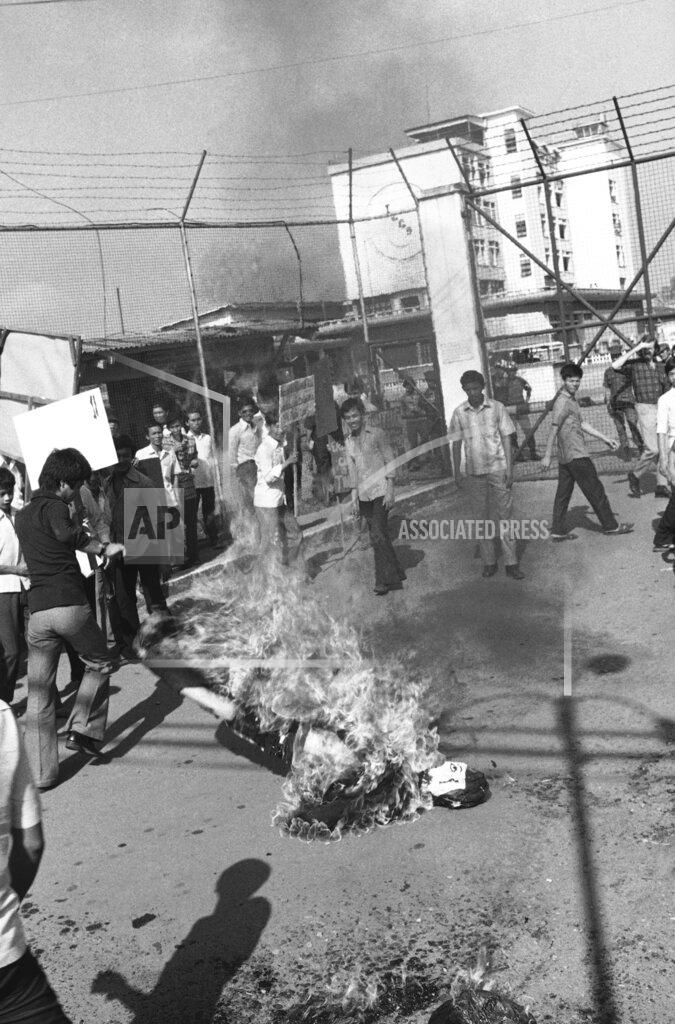
After South Vietnam’s Phước Long Province had been conquered without any intervention by the United States, the Politburo of North Vietnam’s Communist Party approved “Campaign 275”, to “liberate” the rest of South Vietnam, starting with a full-scale attack on the Central Highlands. Party First Secretary Lê Duẩn ordered strikes on Buôn Ma Thuột, Tuy Hòa, Qui Nhơn, Huế and Đà Nẵng.
The Saigon Government today denounced the Communists for their seizure of the province capital of Phước Bình while its planes struck a Việt Cộng administrative center in retaliation. At a news conference, Ngô Khắc Tỉnh, the acting Foreign Minister, read a statement describing the capture of Phước Bình yesterday as “the most blatant violation of the Paris agreement ever perpetrated… This act also lays bare the deceitful and treacherous nature of the usual Communist claims that they seriously and faithfully implement the Paris agreement,” Mr. Tỉnh said. From now on rambunctious statements like those will of course be meaningless.”
Government military sources said that fighter‐bombers staged attacks last night and this morning in the area around the Communist administrative center of Lộc Ninh, 75 miles north, of Saigon and 30 miles west of Phước Bình. Officers said Lộc Ninh had been a launching point for the assault on Phước Bình. The town and its vicinity are also traditional targets for retaliatory air strikes. Warplanes were also reported to have struck North Vietnamese formations in and around Phước Bình itself. At the news conference, Major General Lê Ngọc Triển said that some of the Government troops trapped in Phước Bình had managed to break through Communist lines into the plantation country outside the town. But the general said he had no information about any men who might have been rescued by helicopter or who had managed to walk through miles of hostile territory to Government lines. In Saigon, the Government was reportedly planning to stage demonstrations outside City Hall and the headquarters of the International Commission of Control and Supervision, which is charged with supervising the Paris cease‐fire agreement, to protest the capture of Phước Bình.
On the battlefield the Saigon Command reported a high level of military activity around the country. In northern Bình Định Province, a regiment of the 22nd Division was reported to have retaken two key hills that overlook a Communist‐controlled area near Hoài Nhơn district town.
Washington officials said that President Ford would ask Congress for at least $300 million in military aid for South Vietnam in the current fiscal year, in addition to the $700 million already appropriated. They said he would propose $1.3 billion for the next year. Some officials said the request for this year was only partly related to the current Communist offensive. They cited Mr. Ford’s earlier statement that $700 million was inadequate. They expressed confidence that with the new aid the Saigon government could survive without renewed American military intervention.
Secretary of State Kissinger, they said, has made clear his view that Congress should provide sufficient funds for the war or accept responsibility for the loss of South Vietnam. This year the Administration asked for $1.45‐billion. Congress authorized the Administration to spend $1‐billion but appropriated only $700‐million. The authorization and appropriation were handled in separate legislation. South Vietnam is also scheduled to receive about $400‐million in economic aid in the current fiscal year. Based on Pentagon‐supplied figures, Representative Les Aspin, Democrat of Wisconsin, has. estimated that Washington has provided South Vietnam with $3.7‐billion in all forms of aid since the cease‐fire of January, 1973. Mr. Aspin.lalso estimated all aid to Indochina since the cease‐fire at $8.2‐billion. Several Administration officials said that they did not expect Congress to approve the entire request for supplemental military aid to South Vietnam, but to approve a sizable part of it.
A Pentagon memorandum written several weeks ago called for a broad publicity campaign to convince congress and the public that an emergency effort was needed or the Saigon government would run out of ammunition in 30 days. Senators and Congressmen were to be encouraged to visit South Vietnam, reports and assessement from the field were to be shown to them, material was to be leaked to reporters and certain Congressional committee were to receive special attention. When asked about the memorandum, a ranking Pentagon official responded that it had “no status” and that “there is now no calculated campaign, but one may develop.”
The week‐old insurgent offensive is eating deeply into the Cambodian Government’s arms supplies, and the Government of Marshal Lon Nol, operating under a sharply reduced American aid program, could be in a tight situation within a few months. Every time an explosion rends the air of Phnom Penh, it represents an expenditure of at least $43.83. That’s for the smallest artillery shell. If it is a big bomb, it costs over $300. With the Communist-led Cambodian insurgents having opened fronts at several points no more than 10 miles from Phnom Penh, the government’s bombing and shelling of enemy positions within earshot of the capital has become almost as continuous as a string of firecrackers exploding day and night round the clock.
The result is a huge expenditure of ammunition and the draining away of Cambodia’s only military aid—the aid that comes from the United States. Last year, total declared American aid to Cambodia — both economic and military — was over $650 million. For fiscal 1975, which ends June 30, Congress has cut it by $200 million, or 30 percent, to a ceiling of $452 million. Of this, $275 million for`military aide, and the remaining $177 million for economic assistance. The two categories have thus lost about $100 million each. In a sense the economic aid is just as important as the military aid to the survival of the Lon Nol Government, for much of it is food for the increasingly hungry and hard‐pressed population. If the people are not fed, the government could collapse just as easily as if the insurgents took Phnom Penh by military conquest.
The American Embassy says that nearly two‐thirds of the economic aid has already been either used up or is in the country and being consumed now — with half the fiscal year still to go. The embassy’s economic mission has argued for a supplemental appropriation on the ground that any reluctance by Congress to continue American military involvement in Cernbodia and in Indochina in general should not affect the feeding of people. The embassy, citing security reasons, will not say how much of the military aid had been used up when the insurgent offensive began on New Year’s Day, but according to Western military sources it, is probable that, like the economic aid, it was at least half to two‐thirds gone.
The embassy also will not release figures on the ammunition expended daily by the Government forces since the offensive began, but it did give the cost and weight of the various types of shells and other ammunition. From this information — and, from the fact that ammunition usage was about 300 tons a day before the offensive and is now estimated by military sources at double or triple that — consumption now would seem to amount to more than $1‐million a day and maybe closer to $2‐million. This means that the Phnom Penh Government will begin to run low on ammunition should the insurgent offensive continue at the present level for two months or so. Opinions differ among military analysts here as to how serious the supply situation could become. Some Western sources, for example, think it is not critical and that the government army, under close American supervision, will get through the fiscal year by cutting down on wastage and the unnecessary use of ammunition.
Some of these sources also contend that the aid cut in Cambodia is not as debilitating as that in Vietnam. In addition, they feel that past experience in Indochina suggests that if the White House wants to keep a government alive, it will find a way to do so. President Ford has already given strong indications that he attaches some priority to Cambodia. In his statement on signing the foreign aid bill recently, his first major point Was that aid to Cambodia was “clearly inadequate to meet minimum basic needs.” He also made it clear that he was going to ask Congress for a supplemental appropriation. Whether Congress will go along is less than clear. An increasing number of Congressmen have come to feel that aid to Cambodia rather than bringing peace talks closer, only serves to prolong the war, now nearly five years old.
The official Soviet news agency rebutted speculation abroad about a Kremlin power struggle that might explain the recent absence of Leonid Brezhnev from public view. The unusual Tass response followed its report of the Soviet party leader’s attending his mother’s funeral in Moscow. Usually knowledgeable Western diplomats in Moscow had been unable to confirm rumors that he had leukemia, pneumonia, bronchitis, influenza or an abscessed tooth.
The Boston Globe broke an exclusive story that Soviet leader Leonid Brezhnev was going to arrive in Boston’s Sidney Farber Cancer Center to receive treatment for leukemia. The hospital, the Kremlin and the White House quickly denied the story and the Globe soon admitted that it had been the victim of a hoax. Brezhnev, who did not have leukemia and who was not coming to the United States, would live on until 1982.
A former chairman of the North Atlantic Treaty Organization’s military committee said the alliance must halt the decline in its military strength and guarantee freedom of the seas if Europe is to remain secure. Retired Gen. A. D. Johannes Steinhoff, ex-chief of the German air force, told a NATO symposium in Norfolk, Virginia, he is encouraged by the modernization of some NATO forces. But he said cutbacks by members of the alliance have caused a “slow erosion which must be stopped.”
Norway and Britain failed to resolve problems posed by Norway’s decision to extend its fisheries limit by establishing three trawler-free zones off its northern coast. Negotiators for the two nations said in Oslo they doubted they could reach a compromise solution before Norway goes ahead with establishment of the zones-probably within two weeks. The zones are being demanded by Norwegian fishermen who fear collisions in the area during the dark winter months.
More than 17,000 hospital resident doctors settled a pay dispute with the British government and called off a threatened slowdown that could have crippled Britain’s already hardpressed National Health Service. Social Services Secretary Barbara Castle met doctors’ representatives and said afterwards that the physicians would be paid overtime rates for work beyond 40 hours a week. Under the present contract, they receive overtime pay after working 80 hours a week.
Security precautions are to be tightened on internal flights in Britain as a result of yesterday’s attempted hijacking of an airliner on a Manchester-to-London flight. There will now be personal and baggage checks for all passengers. In the past, about half of the hand baggage has been examined on local flights and not many passengers were searched. Precautions on flights between England and Ireland, as well as on the longer international routes, are already tight. The man who tried to hijack the British Airways plane was an Iranian citizen. He is being held but has not yet been charged. The gun with which he threatened the crew at London’s Heathrow Airport yesterday was a toy. He also had a cannister, with which he said he would blow up the aircraft, but it contained no explosive.
Glafkos Clerides, president of the Greek Cypriote House of Representatives, and Rauf Denktaş, leader of the Turkish community on the island, reached agreement to resume negotiations to settle the island’s future on the basis of a federal state. The Turkish leader had called off the talks shortly before Archbishop Makarios returned to Cyprus, saying they would be useless until the Archbishop had made his intentions clear. Previously the Archbishop had rejected a federal solution of the problem. The breakthrough came during a 90‐minute meeting, between Clerides and Denktaş, in the presence of the United Nations’ special representative on the island, Luis Weckmann‐Muñoz. An official announcement at the end of the Clerides‐Denktaş meeting said that they had agreed to continue their talks on humanitarian issues — arising from the Turkish invasion and occupation of nearly half the island last summer — and “to commence talks on the substance of the Cyprus problem.”
Three Black French draftees whose arrest had become a focus for widespread debate on conditions in French military service went on trial yesterday in Marseilles on charges of having organized a protest demonstration against the army. Today one was acquitted, and the two others received light prison sentences.
The management of SEAT automobile works, Spain’s largest industrial plant, closed down its Barcelona factories indefinitely following months-long political wildcat strikes by its labor force of 30,000. A company spokesman said that the measure was taken when the 7,374 morning shift workers, back at work after a two-day lockout, refused to work. The management then ordered the workers to leave the plant and closed it down.
The West German Government today proposed a strong tightening of the laws on so-called white-collar crimes. A new bill, submitted to Parliament today, aims specifically at stopping fraud in getting state subsidies, obtaining credit from banks and declaring for bankruptcy.
President Anwar Sadat of Egypt was quoted in a Beirut newspaper as having expressed dissatisfaction over the Soviet refusal to replace all arms the Egyptians lost in the 1973 Middle East war. In his interview, his first major comment on relations with the Soviet Union since the postponement of a visit by Leonid Brezhnev, the Soviet leader, he also expressed dissatisfaction over a Soviet refusal to supply advanced weapons to Egypt. In the interview, with Bassam Freijat, general manager of Al Anwar, Mr. Sadat said he had wanted to discuss two main questions with Mr. Brezhnev. These, he said, were Soviet armament for the Egyptian armed forces and a rescheduling of Egypt’s debts, to the Soviet Union, believed to exceed $4‐billion. Mr. Sadat said that when Lieutenant General Mohammed Abdel Ghany el Gamasy, the new War Minister, and Ismail Fahmy, the Foreign Minister, visited Moscow nine days ago, they found the Russians unwilling to replace all Egyptian arms lost during the October, 1973, war with Israel. Our request for complete replacement and for new weapons developed since the October war has not been met.” Mr. Sadat was quoted as having said.
Shah Mohammed Reza Pahlevi of Iran and Empress Farah arrived to a warm welcome in Cairo today for a five-day state visit. Egypt hopes the visit will produce further Iranian financial assistance as well as a strengthening of Islamic unity against Israel.
The sultan of Oman, Qabwos Bin Said, is due to arrive in Washington for what is described as a three-day private visit, the State Department announced. The Omani ruler, who took over the sultanate in 1970 when he ousted his father, will meet with President Ford, Vice President Rockefeller, Secretary of State Henry A. Kissinger and Defense Secretary James R. Schlesinger.
The Indian Government, seeking to avert a major crisis this year, has quietly bought more than five million tons of food abroad. Never before in the 27 years of India’s independence has she bought so much food for a single year at commercial rates. So far, India has spent at least $1‐billion, largely for wheat, and has become the largest buyer of food from the United States. The food purchases indicate the degree of uneasiness here about agricultural production, which persistently lags behind needs. The population is growing by 13 million a year and is nearing 600 million. In the last agricultural year, which ended in June, India hoped to produce 115 million tons of grain but actually produced 103.6 million.
The 10-mile-long trail of oil that seeped from a grounded Japanese supertanker was contained near the Port of Singapore but still threatened beaches of Malaysia and Sumatra, Indonesia. A Singapore Port Authority spokesman said that antipollution operations were confined mostly to the port area and that only small patches remained along the western edge of the port.
Divers in Hobart, Tasmania, found a third car containing bodies in the mud at the bottom of the Derwent River, bringing to at least 10 the death toll in the Tasman Bridge disaster. Police said they were looking for another two bodies and possibly five more in 90-foot-deep waters where two spans of the bridge collapsed when the ore carrier Lake Illawarra hit a support pylon Sunday.
A Colombian plane carrying 18 persons crashed in southern Colombia and officials said apparently there were no survivors. First reports said that the plane apparently had mechanical trouble shortly after takeoff and hit a hill. The plane of the air force-run Airline Satena was on a domestic flight from Neiva, 155 miles southwest of Bogota, to Florencia, 85 miles further south.
Four men were killed and eight were injured in more rioting at the Vaal Reffs gold mines, a company spokesman reported in Johannesburg, South Africa. A spokesman for Anglo-American Corp., the operator of the mines, said fighting broke out between miners of the Basotho and Xhosa tribes. He said police restored order after four Basothos were killed, but the situation was still tense.
Convicted Watergate conspirators John W. Dean III, Jeb Stuart Magruder and Herbert W. Kalmbach were released from prison after serving sentences ranging from four months to seven months. Judge John Sirica ordered the immediate release of John Dean, Herbert Kalmbach and Jeb Magruder, reducing the sentences of these major Watergate figures to time already served. The judge’s order, which came as a surprise to the men, their lawyers and the prosecution, gave no reason beyond citing motions previously filed in their behalf. It was generally believed their cooperation with the prosecution and in the Watergate cover-up trial strongly influenced his decision.
The 35‐year‐old Mr. Dean, whose decision in April, 1973, to talk to prosecutors signaled the collapse of the Watergate conspiracy, has served four months. He was sentenced to one to four years after pleading guilty to conspiring to obstruct justice and defraud the United States.
Mr. Magruder, 39, the former deputy director of the Committee for the Re‐election of the President, has served seven months. He was sentenced to 10 months to four years after pleading guilty to the same charges.
Mr. Kalmbach, the 52‐year‐old former personal attorney for former President Nixon, was the principal money raiser for the Watergate burglars on Mr. Dean’s orders. He has served six months of his six-to‐18‐month term. He pleaded guilty to violating the Federal Corrupt Practices Act and also to an unrelated misdemeanor, selling an ambassadorship.
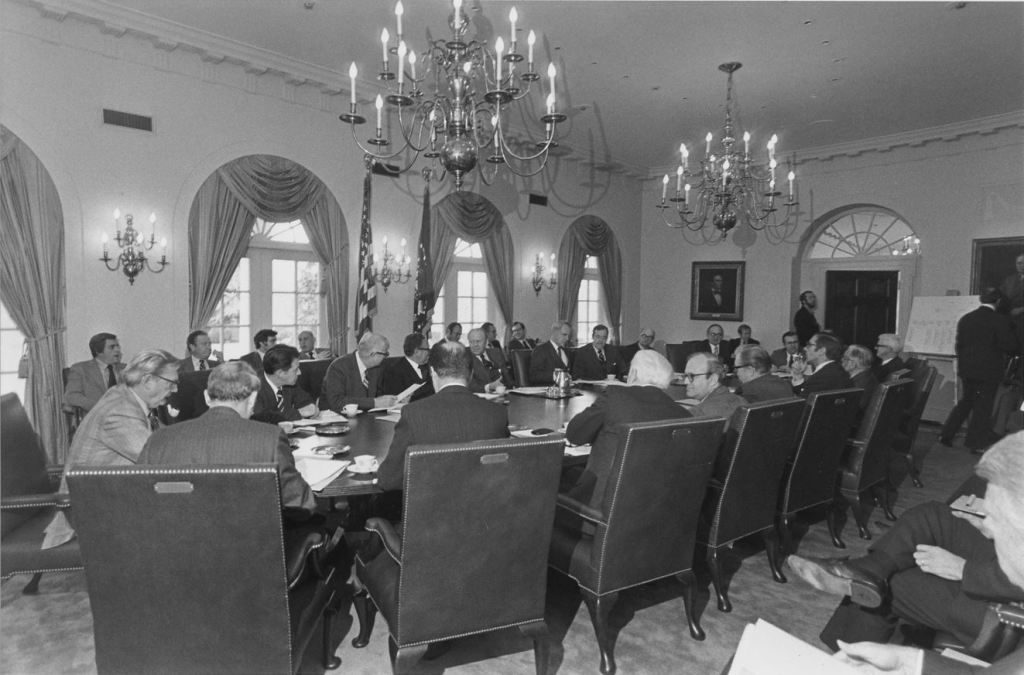
President Ford will announce within the next two weeks an economic program differing considerably from his hands-off policies proposed in October, the White House indicated. Ron Nessen, White House press secretary, said Mr. Ford told a cabinet meeting the program was “tough, fully defendable,” and “will give us the restoration of confidence that is essential for recovery.” Alan Greenspan, chairman of his Council of Economic Advisers, briefing the cabinet, said an upturn was clearly not here.
Elmer Klassen announced that he would step down February 15 as Postmaster General, and the governors of the semi-independent agency announced that Benjamin Bailer, his deputy, would succeed him. The White House said President Ford would nominate Betty Southard Murphy as the first woman member of the National Labor Relations Board and that following Senate confirmation she would become its chairman.
The majority leader of the Washington state Senate was indicted in Seattle on charges of extorting $10,000 for his support of legislation favoring trash haulers and for income tax evasion in 1971. Sen. August P. Mardesich (D-Everett), an attorney and commercial fisherman, was accused of accepting the money from two representatives of the garbage disposal industry. The indictment came five days before the Legislature was to convene. Mardesich, 53, issued a statement denying “emphatically that I am guilty of these charges.”
The Federal Trade Commission announced it would act on a complaint charging that Ford Motor Co. ran misleading ads for its cars’ gasoline mileage. A Ford spokesman denied it and said the company would contest the administrative action. The FTC said the ads claimed Hugh Downs and others got at least 26 miles per gallon on a run from Phoenix to Los Angeles. It said the ads implied that any driver could get similar mileage. Ford said, “The test conditions and equipment were fully described” and “in fact, the ads expressly noted” that the mileage would vary due to maintenance, weight, driving habits and road conditions.
Senate Minority Leader Hugh Scott of Pennsylvania threw his support behind the calling of a new election to settle the dispute over a Senate seat from New Hampshire. He said that in his own view Republican Louis C. Wyman, certified as the winner by two votes in the November election, should be seated. But he added that “to dispel any doubts,” a new election should be held. Wyman’s seating is being challenged by John A. Durkin, the Democrat who first was certified as elected to the seat. The Senate elections subcommittee is to hold a public hearing on the dispute today.
Talks between a group of militant Indians and representatives of a Roman Catholic religious order will resume today in efforts to end the armed occupation of the order’s unused monastery, located near Gresham, Wisconsin. Colonel Hugh Simonson of the National Guard Troops, activated after weekend exchanges of gunfire between the Menominee Indians and lawmen, said the formal talks would be held in a camper near the 64-room mansion. Brother Maurice Wilson of the Alexian Brothers said his order might be willing to sell the facility to the government. An Indian spokesman said the government must “involve themselves for the people here to get a comprehensive health program going.”
William L. Calley Jr., the former Army lieutenant convicted for his role in the Mỹ Lai killing in 1968, said yesterday that he felt he was a victim of the Vietnam war, but that the American people were “the greatest victims.”
Five major railroads were targeted for strikes beginning January 24 as contract talks resumed in Washington for 560,000 railway workers. The Sheet Metal Workers Union served formal strike notices with the required warning of at least 14 days on the Union Pacific, Missouri Pacific, Texas Pacific, Baltimore & Ohio and the Seaboard Coast Lines.
H.J. Heinz Co. said it had made spot checks of instant mixed cereal for infants and found no further evidence of metal slivers such as those reportedly discovered in a package in Charlotte, North Carolina. It said it would not know the exact nature of the matter or how the slivers got in the cereal until further tests were made. This week’s incident was the third in the Charlotte area in less than a month. Earlier, slivers of metal found in cereal were traced to a metal bin in the Heins plant in Pittsburgh. The company said a worker had accidentally dropped metal slivers into the container and cereal was later added.
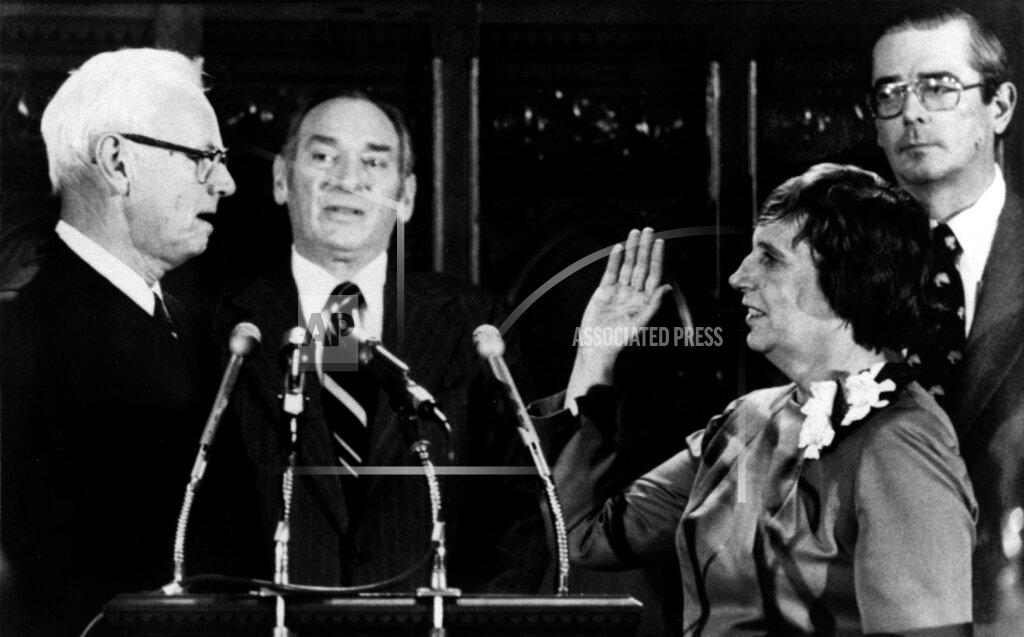
Ella Grasso became Governor of Connecticut, the first female U.S. governor who did not succeed her husband. Ella Tambussi Grasso was sworn in today as Governor of Connecticut, and she promised a government that would keep within the fiscal restraints of the times, yet be more responsive to the people than governments before hers were. In the Hall of the House of Representatives, which was packed with members of both the House and the Senate, with the families of the members and with political notables from around the state, Mrs. Grasso took the oath of office from Chief Justice Charles S. House of the Connecticut Supreme Court.
Environmentalists will protest a proposed natural gas pipeline route that runs through a wildlife refuge in Alaska, says a representative of the Audubon Society. This isn’t going to breeze through, Paul Howard, the group’s western regional representative, said after a Sacramento public hearing on the pipeline.
Testing procedures employed by the Environmental Protection Agency in its adverse evaluation of the controversial LaForce automobile engine will be investigated by the Senate Commerce Committee, a committee spokesman announced in Washington. The committee asked EPA to turn over files and documents pertaining to the testing, and committee Chairman Warren G. Magnuson (D-Washington) said he has instructed his staff to review such material with an eye to refuting or reinforcing claims by the engine’s developers that the testing was weighted against the engine. Robert LaForce, one of the brothers who developed it, said his engine was not given a fair trial. He has in the past claimed the engine substantially reduces exhaust pollution and saves fuel.
Shellfish harvesting could be opened up extensively in San Francisco Bay as early as 1977 because of a new water quality control program, the state said. The state Water Resources Control Board said the program adopted last month will control municipal and industrial waste discharge into the bay beds that have contaminated the clams, oysters and mussels.
Dow Jones Industrial Average: 635.40 (-5.79, -0.90%)
Born:
Vitali Yachmenev, Russian NHL right wing and left wing (Los Angeles Kings, Nashville Predators), in Chelyabinsk, Russian SFSR, Soviet Union.
Alexander Vasilevski, Ukrainian NHL right wing (St. Louis Blues), in Kiev, Ukrainian SSR, Soviet Union.
Geremi González, Venezuelan MLB pitcher (Chicago Cubs, Tampa Bay Devil Rays, Boston Red Sox, New York Mets, Milwaukee Brewers), in Maracaibo, Venezuela (d. 2008, after being struck by lightning).
Rafael Cooper, NFL running back (Detroit Lions), in Detroit, Michigan.
DJ Clue, [Ernesto Shaw] American hip-hop DJ and music producer, in New York, New York.
Harris Jayaraj, Indian music composer, in Chennai, India.
Died:
Anthony Warde, 66, American actor (“Dangers of the Canadian Mounted”, “Buck Rogers”, “Black Widow”).
John Dierkes, 69, American actor (“Shane”, “Daughter of Dr Jekyll”, “Hanging Tree”), from emphysema.
John Gregson, 55, British actor (“Gideon CID”, “The Longest Day”, “Shirley’s World”), from a heart attack.
Richard Tucker, 61, American operatic tenor, while on tour with the Metropolitan Opera.
David “Carbine” Williams, 74, inventor of M-1 carbine rifle, portrayed by Jimmy Stewart in the 1952 film “Carbine Williams.”




 History Diaries