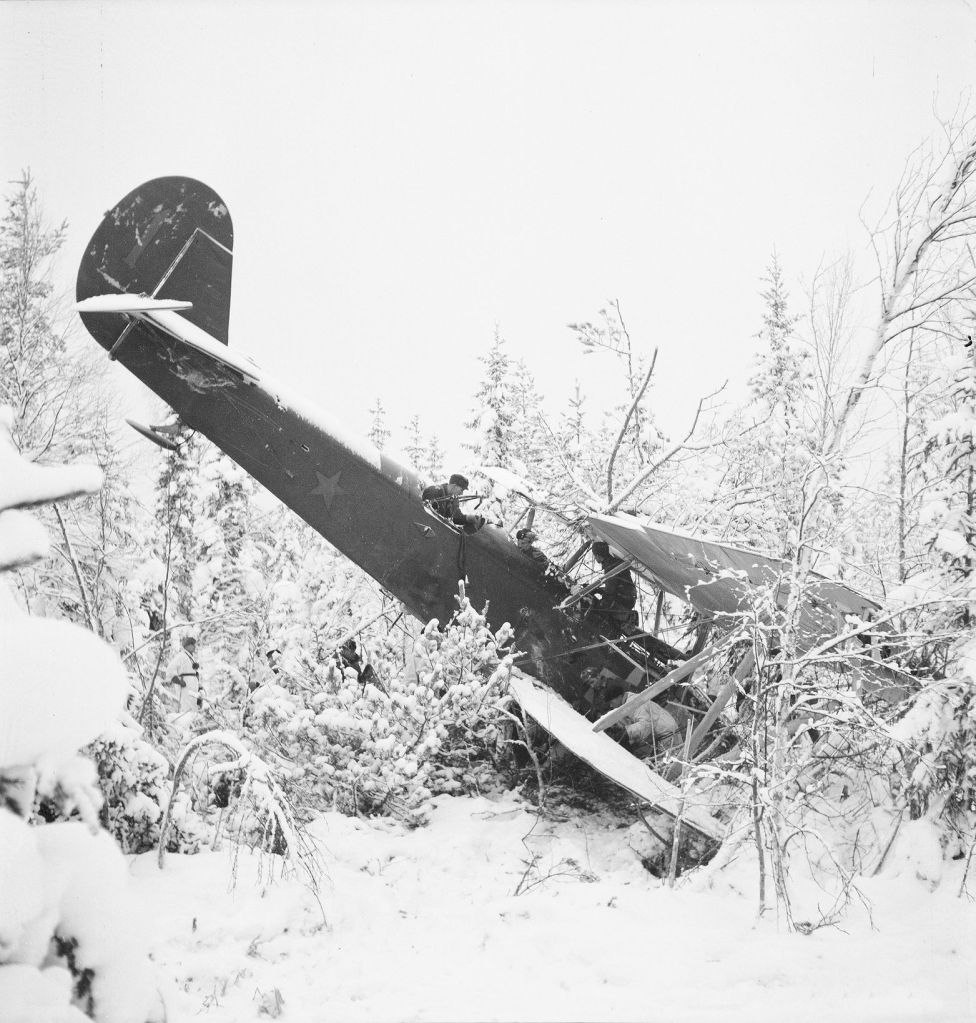
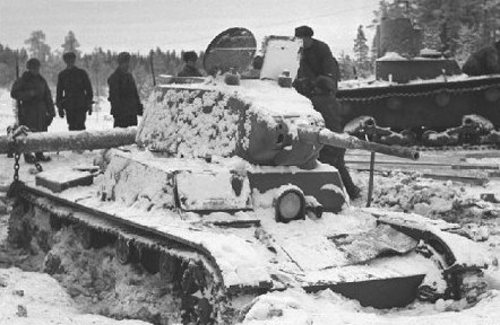
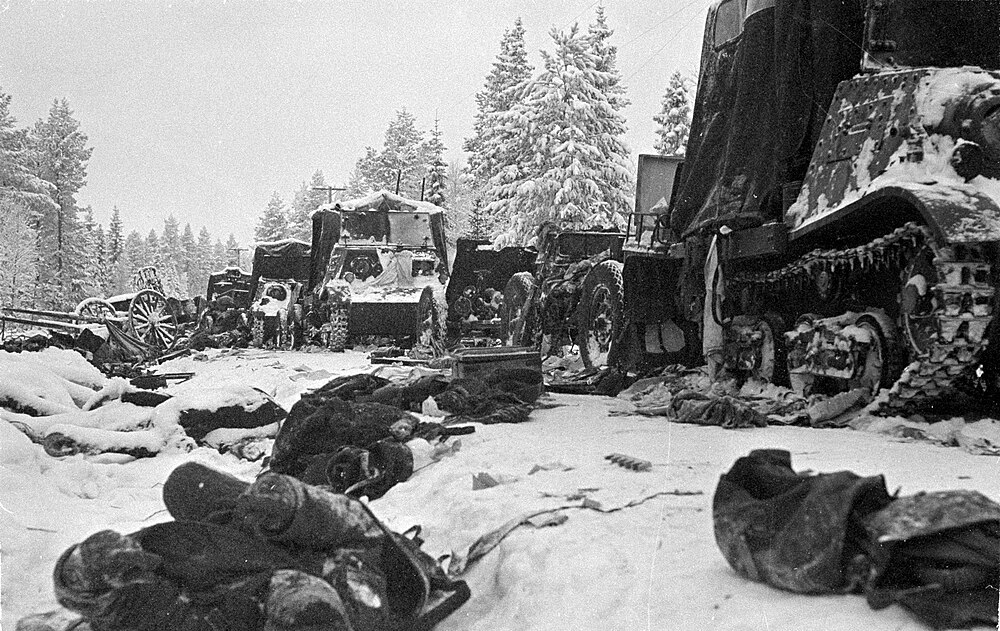
The Battle of Raate Road ended in Finnish victory. The day begins with heavy fighting and ends with a complete rout of Soviet 44th division by the Finnish 9th Division. At 3 AM, the mottis at the Western end (the head) of the Soviet column collapse completely. As the day progresses, Soviet 44th division gradually gives up the entire length of Raate Road with soldiers trying to retreat back to safety in the USSR or scattering into the woods. Finns again hold their positions where Raate Road crosses the destroyed Purasjoki River bridge, limiting the Soviet retreat. Finnish troops at the village of Raate near the border block an attempt to relieve 44th division with fresh troop from USSR. Only a few pockets of Soviet troops remain to be mopped up by the Finns. The fighting on the Raate road peters out during the course of the morning. The great battle is over.
The booty taken on the Raate road includes 43 tanks, 71 field and anti-aircraft guns, 29 anti-tank guns, a number of armoured cars and tractors, 260 lorries, 1,170 horses, and an assortment of infantry weaponry, ammunition, and medical and communications material. Almost 17,500 men of the Soviet 44th Division perish at Raate, a loss of approximately 70% of the Division’s strength. 1,200 enemy soldiers were taken prisoner and a large number of military vehicles were captured. Finnish losses were also severe: 900 dead and 1,200 wounded, which was approximately 15% of the 9th Division’s combat strength. Finland took foreign journalists to view the combat zone.
The survivors are not greeted warmly on the Soviet side of the border. The 305th Rifle Regiment (Captain Chervyakov), the only relatively intact Soviet formation to make it back, is immediately ordered to man the border against the nearby Finns. Many the men no longer have rifles, and some 40% have no gloves or mittens.
There is no food at the border for the troops of the 44th Rifle Division that escaped. They had abandoned their own field kitchens and supplies to the Finns. The Soviets behind the lines do not believe in helping losers.
Dispatches from the Salla front in Northwest Finland told today a story of bitter cold and death. A Finnish patrol, coming suddenly upon a detachment of Russian troops, was surprised when the enemy continued to lie still in the snow as the Finns approached. Cautiously advancing, the Finns found the entire detachment — 150 men — frozen to death behind barbed-wire entanglements.
General Semyon Konstantinovich Timoshenko takes command of all the Soviet forces engaged in the war with Finland. His troops on the Karelian Isthmus are now organized in two armies, Seventh and Thirteenth. The Finns are in the process of a reorganization also. In the fighting north of Lake Ladoga the Finnish pressure on the Soviet 18th and 168th Divisions continues. Finnish claims estimate 50,000 Soviet troops have perished in the last five weeks.
The Supreme Military Soviet decides to focus the coming main strike on the Viipuri sector.
The Finns have evacuated non-essential civilians from the major cities. there are 400,000 who have left home for safer towns.
Scandinavian newspapers today declared Sweden and Norway would reject “with arms” if necessary any attempt by a great power to use their territory as a springboard for an attach against another.
There is artillery fire east of the Blies River (a tributary of the Saar) on the Western Front.
First Lord of the Admiralty Winston Churchill visits the BEF in France.
Far from abating, the week-end storm over the retirement of Leslie Hore-Belisha as War Secretary grew today to the dimensions of a major political crisis that threatened to terminate the truce between the government and the Opposition.
Britain, France and Turkey signed a trade agreement.
The British Broadcasting Corporation (BBC) began broadcasting the BBC Forces Program, a second program in addition to the Home Service, the single wavelength allowed for entertainment in Great Britain. The aim was to lift the morale of British troops stationed overseas. Attractions such as popular American variety stars quickly helped the BBC Forces Program secure a huge civilian audience in Britain who used to have only the news and highbrow entertainment on the Home Service programming.
Another step toward the strengthening of Italy’s military forces was seen in the announcement today that Premier Mussolini had received General Mario Caracciolo, army corps commander, to whom he “entrusted supervision of the artillery, engineering and motorized services of the army.”
A rough day at sea for the Royal Navy: Two British submarines are lost; one with all hands, the other with the entire crew taken prisoner.
German documents record an attack on this date by the German First Minesweeper Flotilla on an unidentified submarine near Heligoland. Since the British submarine HMS Seahorse was on patrol at the time but never returned, it is thought to have been sunk in this attack.
Royal Navy submarine HMS Seahorse (Lt D S Massey-Dawson) of the 6th Flotilla departed Blyth on 26 December. On the 7th, she was sunk by a minesweeper of the 1st Minesweeping Flotilla in a 24 hour long attack in the Heligoland Bight. Damage to the submarine early in the attack provided a considerable oil leak to guide the attacking minesweeper. Lt Massey-Dawson, Lt J W Fleming, Lt J C Baker, Lt W Thain RNR, Warrant Engineer A Cockburn and thirty four ratings of crew were lost. The German 1st Minesweeping Flotilla was composed at this time of minesweepers M.1, M.3, M.4, M.7, M.8, and M.14.
The British submarine HMS Undine was attacked and badly damaged near Heligoland by three German minesweepers. Early the next day the submarine was scuttled and the crew taken prisoner.
On patrol in the Heligoland Bight, 15 miles from Heligoland, submarine HMS Undine (Cdr A S Jackson) was attacked and badly damaged by German auxiliary minesweepers M.1201 (trawler Harvestehude, 523grt), M.1204 (trawler Anna Busse, 468grt) and M.1207 (trawler Frisia, 429grt) after she had unsuccessfully attempted to attack two of the trawlers at 1100/7th. Early next morning, Undine was forced to surface and was scuttled and the entire crew – Cdr Jackson, Lt E M Harvey, Lt C J Senior RNR, Lt J F Stewart and twenty six ratings were taken prisoner. M.1204 took off the crew and M.1201 attempted to take her in tow. When Undine sank, several crew members of M.1201 were lost with her.
Destroyer HMS Nubian, departing the Clyde, was damaged in a collision with an examination vessel two miles off Greenock. Her damaged stem required drydocking at the Clyde until the 24th, when she returned to duties with the Home Fleet.
U-32 laid 8 mines off the Firth of Clyde without result.
French auxiliary sloop Barsac (1145grt) was lost when she ran aground on the Isle of Onza near Vigo.
British steamer Cedrington Court (5160grt) sinks on the destroyer minefield laid on the 6th, two miles NE of North Goodwins Light Vessel in 51-22N, 1-35E; the crew were saved.
British steamer Towneley (2888grt) sinks on the destroyer minefield laid on the 6th, one mile ENE of North East Spit Buoy; crew were saved when they rowed to shore in the Margate lifeboat.
The Swedish cargo Dicido ship ran aground at Tjoroneset and was wrecked. There were no casualties.
The City Of Flint, now flying under the Finnish flag, departs from Narvik for Baltimore under its original captain, Joseph A. Gainard. He is awarded the Navy Cross for his actions during the ordeal.
German freighter SS Konsul Horn escapes from Aruba, Netherlands West Indies, and, disguised as a Soviet merchantman, manages to deceive USN patrol planes from the Neutrality Patrol and light cruiser HMS Enterprise. The ship reaches Norwegian waters on 6 February.
Convoy OA.68GF departs Southend.
Convoy OB.68 departs Liverpool.
U.S. passenger liner SS Manhattan, detained at Gibraltar by British authorities the previous day, is released
U.S. freighter City of Flint departs Narvik for Baltimore, Maryland. For his “skill, fine judgement [sic], and devotion to duty” during City of Flint’s ordeal, Captain Joseph A. Gainard, the freighter’s master, will receive the Navy Cross.
The War at Sea, Sunday, 7 January 1940 (naval-history.net)
BRITISH SUBMARINE LOSSES IN HELIGOLAND BIGHT
On patrol in the Heligoland Bight, 15 miles from Heligoland, submarine UNDINE (Cdr A S Jackson) was attacked and badly damaged by German auxiliary minesweepers M.1201 (trawler HARVESTEHUDE, 523grt), M.1204 (trawler ANNA BUSSE, 468grt) and M.1207 (trawler FRISIA, 429grt) after she had unsuccessfully attempted to attack two of the trawlers at 1100/7th. Early next morning, UNDINE was scuttled and the entire crew — Cdr Jackson, Lt E M Harvey, Lt C J Senior RNR, Lt J F Stewart and twenty-six ratings were taken prisoner. M.1204 took off the crew and M.1201 attempted to take her in tow. When UNDINE sank, several crew members of M.1201 were lost with her.
Submarine SEAHORSE (Lt D S Massey-Dawson) of the 6th Flotilla departed Blyth on 26 December. On the 7th, she was sunk by a minesweeper of the 1st Minesweeping Flotilla in a 24-hour long attack in the Heligoland Bight. Damage to the submarine early in the attack provided a considerable oil leak to guide the attacking minesweeper. Lt Massey-Dawson, Lt J W Fleming, Lt J C Baker, Lt W Thain RNR, Warrant Engineer A Cockburn and thirty-four ratings of crew were lost. The German 1st Minesweeping Flotilla was composed at this time of minesweepers M.1, M.3, M.4, M.7, M.8 and M.14
Destroyer NUBIAN, departing the Clyde, was damaged in a collision with an examination vessel two miles off Greenock. Her damaged stem required drydocking at the Clyde until the 24th, when she returned to duties with the Home Fleet.
Destroyer AFRIDI departed the Clyde to join sister ship TARTAR escorting HN.7 from Scapa Flow.
Battleship ROYAL SOVEREIGN departed Plymouth, escorted by destroyers WITCH and WIVERN on working up exercises.
Convoy OB.68GF departed Liverpool escorted by destroyers WANDERER and WARWICK, and on the same day OA.68GF, with destroyers VETERAN and WHITSHED left Southend. The two groups merged on the 10th to form convoy OG.14F of 29 ships, and on the same day, WANDERER and WARWICK detached to HG.14F. Sloop ENCHANTRESS was with OG.14F from the 10th to 13th, when she detached to convoy HG.15F. The OG convoy was joined by destroyers VELOX and VORTIGERN from the 13th to 15th, and arrived that day at Gibraltar.
Convoy FN.65 departed Southend, escorted by destroyer VIVIEN and sloop STORK, but was obliged to anchor in Knock Deep due to fog. It left on the 8th, and arrived in the Tyne on the 9th. There was no convoy FN.66.
Armed merchant cruisers TRANSYLVANIA and AURANIA arrived in the Clyde after Northern Patrol.
Light cruiser CERES arrived with captured Norwegian steamer TROMA (5029grt) off North Rona.
Submarine depot ship TITANIA departed Rosyth for the Tyne with two tugs and escorted by sloop AUCKLAND, and arrived with the tugs on the 8th.
Submarine TRIUMPH, after emergency repairs, departed Rosyth escorted by destroyer EXMOUTH for Chatham. Off the Humber, destroyer GRIFFIN relieved EXMOUTH which returned to Rosyth escorting convoy FN.67.
Destroyer ESKIMO departed Rosyth for refitting at Southampton.
U-32 laid mines off Ailsa Craig in the Firth of Clyde, but no shipping was sunk or damaged.
German steamer CONSUL HORN (8384grt) departed Aruba and evaded blockading French submarine AGOSTA near St Martin. She was later sighted by an American PBY flying boat from San Juan, then located by light cruiser ENTERPRISE on the 27th in 46 51N, 42 50W, but CONSUL HORN, disguised as a Soviet steamer, was able to convince the British cruiser she was a neutral. CONSUL HORN arrived at Trondheim on 6 February and reached Hamburg on the 19th.
French auxiliary sloop BARSAC (1145grt) was lost when she ran aground on the Isle of Onza near Vigo.
Submarine RAINBOW departed Hong Kong on the 7th to patrol off Vladivostok from the 13th to 19th. At the time, 1st Submarine Flotilla had the following units in refit: depot ship MEDWAY at Singapore, submarines PARTHIAN, PHOENIX and PANDORA at Hong Kong, REGENT, ROVER, RORQUAL and GRAMPUS at Singapore, while PROTEUS was en route to Hong Kong to refit.
RAINBOW arrived back at Hong Kong from Vladivostok on the 25th and confirmed the results of submarine REGULUS’s patrol in the same area that no German submarines were using the Soviet port. Due to RAINBOW’s difficulties with heavy icing, there was no Vladivostok patrol in February, but PROTEUS did leave Hong Kong at the end of the month for a repeat patrol.
The U.S. Congress will go into the first full week of the session tomorrow conscious that it will be obliged soon to meet obliquely, if not head on, two of the politically troublesome questions of the 1940 Presidential election year. These questions are whether to grant President Roosevelt’s request for $460.000,000 additional in taxes to meet defense needs or see the national debt limit exceeded, and whether to extend the Reciprocal Trade Agreements Act which expires next June 12.
The Democratic members, since they are a majority of Congress, must decide these questions. The budget question, since it cannot be dodged, naturally rises to first place as the majority party must choose between levying taxes or raising the debt limit, or denying their constituents farm benefit payments, the usual road-aid allotments and “pork barrel” appropriations which ordinarily take the form of irrigation and reclamation allotments, rivers and harbors improvements and power dams and the like.
Senator Harrison of Mississippi, chairman of the Senate Finance Committee, will formally propose tomorrow that Congress set up a joint committee to study the question of finances and make recommendations. This would consist of six members each of the House Ways and Means and Appropriation Committees and the Senate Finance and Appropriation Committees. Senate Republicans have warmed to this proposal, while going on record against new taxes, but House leaders shied at it, being concerned over the possible political pitfalls it holds and jealous of the House’s prerogatives under the Constitution, which provides that taxing and appropriation bills originate there. To set up a joint committee, leaders say, would in effect negate this provision.
Senator Harrison said after a conference with the President that Mr. Roosevelt liked the idea of a joint committee, which originally was suggested last Spring by Secretary Morgenthau. Whether the Presidential smile of approval will influence House leaders remains to be seen, but at this time, it can be said definitely that the leaders who plan House strategy are against it, save Representative Doughton, chairman of the Ways and Means Committee. The House Appropriations Committee has five appropriation bills ready for action, and its chairman, Representative Taylor of Colorado, was emphatic in his refusal to hold them up while a joint committee studied taxing and appropriating matters.
Mr. Harrison’s proposal may be acted upon by the Senate the coming week, in order to clear the atmosphere as far as it is concerned. If it adopts the resolution, the House will be put on the spot, since if it does not accept the Senate’s invitation to work out the problem jointly, then it must proceed to tackle it alone. There has been brisk political skirmishing on both finances and the trade treaty extension, and the lines are beginning to take shape for the big battles later. Mr. Doughton will begin hearings before the Ways and Means Committee Thursday on his resolution to extend the Reciprocal Trade Agreements Act, but its consideration in this small group will not prevent speeches from the floors of the two houses, which have already resounded to pleas from both sides.
The American Federation of Labor today threw its, influence against extension of the Administration’s reciprocal trade agreements program in its present form, and demanded also that all existing agreements be repudiated.
The National Labor Relations Board ruled tonight, in effect, that the approximately 115,000 anthracite coal miners employed by 202 Pennsylvania operators constituted a single appropriate unit for collective bargaining. The ruling was sharply criticized by William Green, president of the The American Federation of Labor.
The House committee investigating the Labor Relations Board, it was learned today, will attempt to show at hearings starting tomorrow that inexperienced college graduates have been entrusted with important jobs in the board’s Review Division.
The Wages and Hours Administration told Congress today that complaints of wages and hours law violations were pouring in at the rate of 1,000 a week, and that it was confronted with a task “far beyond” its resources in trying to investigate the 15,547 already received.
No strikes or interruptions to service because of labor difficulties marred the record of the railroad industry for 1939, the second successive strikeless year, according to the fifth annual report of the National Mediation Board, made public today.
The war has not yet appreciably stimulated United States export trade, according to a statement by the Department of Commerce for 1939, and as a result export figures for last year show a decrease, while imports increased.
“The world will make a grave mistake if it concludes that the revival of intolerance is primarily or peculiarly a Jewish problem,” Attorney General Frank Murphy said today, delivering before the National Conference of the United Palestine Appeal his first public address since his nomination to the United States Supreme Court. Declaring that “the Jews are serving as a smoke-screen to conceal more aggressive designs of powermad men,” Mr. Murphy warned that “not guns nor battleships will ultimately preserve democracy. Democracy will be saved if as a people we are wise enough to know that if we do not respect others’ faiths the day may come when other men will not respect our faiths.”
The Rev. Charles E. Coughlin asked in his radio talk today if, under certain circumstances, “it is possibly true that the retention of democracy would have proved a greater menace than the adoption of a dictatorship.
Recruiting for the Canadian Active Service Force will be resumed tomorrow after a lapse of several weeks, with the idea of bringing to full strength the units of the Second Division, now in training, and filling up any gaps that remain in the corps troops, artillery, engineers, ordnance and signalers now being organized to reinforce the First Division, already overseas.
Correspondence published in Bombay today revealed that all attempts to solve the Hindu-Muslim differences have broken down. The correspondence consisted of an exchange of letters between Mahomed Ali Jinnah, president of the All-India Muslim League, and Pandit Jawaharlal Nehru, president of the All-India Congress. Mr. Jinnah’s case is that before the Muslims can join the congress even in a modified demand for a declaration of war aims by the British Government two steps are necessary: first, that the congress must recognize the Muslim League as the authoritative and representative organization of Indian Muslims, and second, that the Hindu-Muslim differences must be settled. Mr. Nehru, on the other hand, claims that there are other Muslim the Muslim League and that the Congress cannot repudiate or disown them. In an accompanying statement to the press, Mr. Jinnah described as “unwarranted and mean” the Pandit’s assertion that the Muslim leader was bent on the preservation of British domination over India.
The Japanese cabinet approves establishment of a Chinese puppet government headed by Wang Ching-Wei.
Chinese Winter Offensive: 31st Army Group of Chinese 5th War Area captures Huashan.
Both Chinese and Japanese claimed victories on the fighting fronts in China during the weekend. Chungking forwarded unconfirmed Chinese press reports stating that Japanese columns driving northward from Canton along the Canton-Hankow railway were in “full retreat” and that Chinese forces pursuing them had killed 1,000 Japanese soldiers at Pakonghow, eighty miles north of Canton. The Chinese claimed that Kwangtung provincial troops had reoccupied Chinese towns bordering the British Kowloon Leased Territory, adjacent to the Crown Colony of Hong Kong. These towns were evacuated by the Japanese some days ago as a “gesture of goodwill” to the British. About 30,000 Chinese refugees from the Nanning area in Kwangsi Province have been admitted to French Indo-China, Chungking said.
A Japanese communiqué issued in Shanghai again denied all Chinese claims of victories and said that new Japanese raids on the Yunnan Railway near Mengtze, South Yunnan Province, again had stopped traffic on that vital railway from French Indo-China to Generalissimo Chiang Kai-shek’s southwest defense area. One bridge on the French-owned railway south of Mengtze was completely destroyed and several others damaged, the communiqué said.
Establishment of diplomatic relations between the United States and Australia was announced today by the State Department. A similar announcement, the department said, was made simultaneously at Canberra, the Australian capital.
Born:
Henry Neijhorst, Surinamese economist and politician (Prime Minister of Suriname, 1982), in Suriname (Dutch Guiana).
Naval Construction:
The Royal Canadian Navy Flower-class corvette HMCS The Pas (K 168) is laid down by Collingwood Shipyards Ltd. (Collingwood, Ontario, Canada).
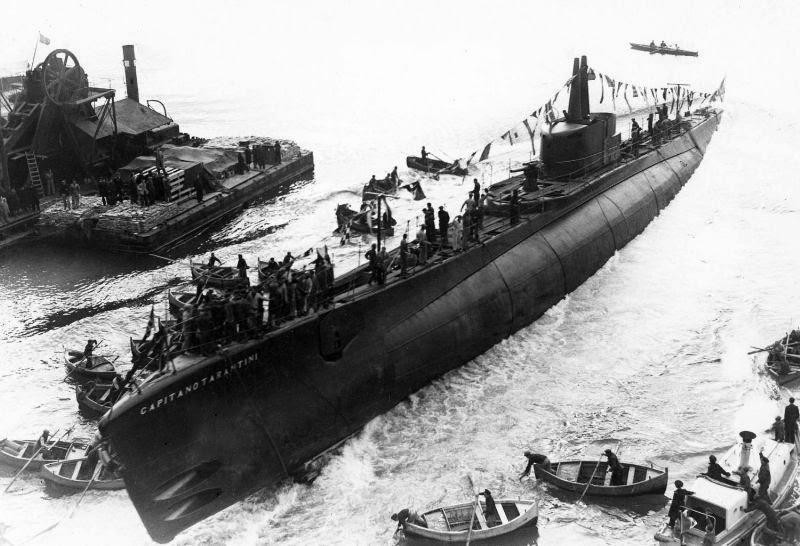
The Regia Marina (Royal Italian Navy) Liuzzi-class submarine Capitano Tarantini is launched by Cantieri navali Tosi di Taranto shipyard (Taranto, Italy).
The Kriegsmarine (German Navy) auxiliary minesweeper M 1406 Johann Schulte is commissioned.
 History Diaries