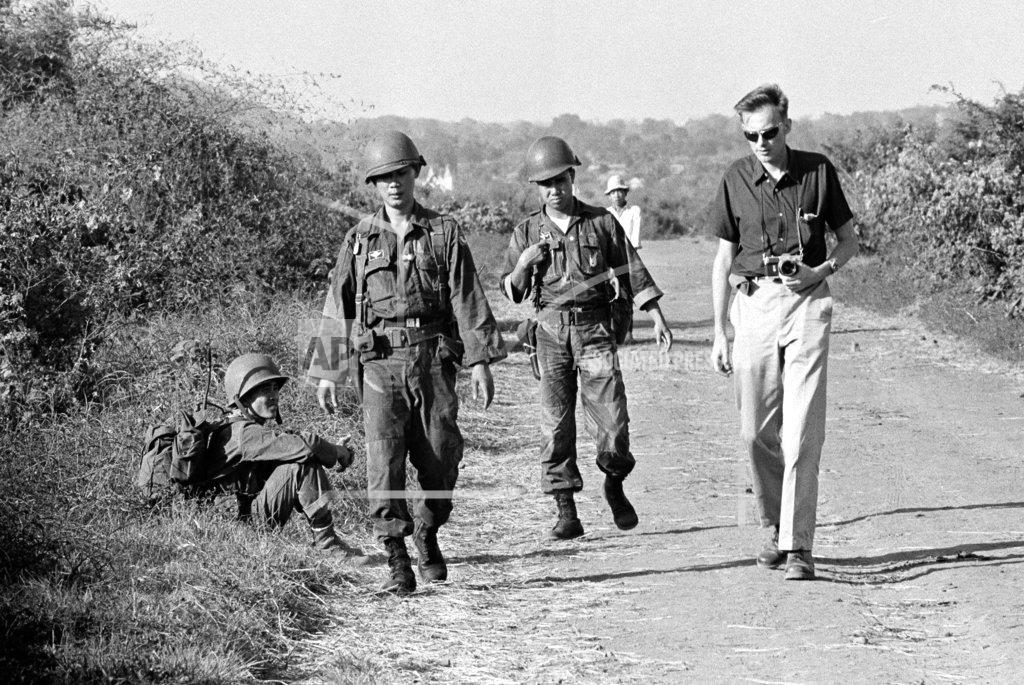
Another Việt Cộng success in the war against the South Vietnamese Government was reported today. The Defense Ministry said Communist guerrillas overran an outpost in Kiên Giang Province, near the Cambodian border, yesterday and killed 21 of the defenders.
The final drafting of agreements that would end the stalemate between the United States and South Vietnam over the role of the military forces was continuing tonight, official sources said. Those involved in talks between the South Vietnamese military leaders, the civilian government and the American mission cautioned that the negotiations could still founder as detailed language was drafted. Without such a breakdown, one or more communiqués might soon be issued, perhaps beginning tomorrow.
Although the United States is reported to be less than completely satisfied with the developing agreements, officials here are inclined to accept them. The compromises would mean a continuation of American military and economic assistance and, apparently, the large-scale expansion of certain aid programs that was being discussed before December 20, when the military dissolved the High National Council, the provisional legislature.
Americans have stressed privately that the crisis of the last 19 days has not resulted in any delays or stoppages in the flow of aid. A “re-examination” of the aid program had been threatened to bolster the United States demand for a return to full civilian control. One projected communiqué from the Vietnamese Government or military, it was reported, would assure the nation that relations with the United States were again harmonious. Other communiqués were expected to focus on three chief points in the dispute between the American mission and the young generals who engineered the December 20 upheaval. One statement, issued unilaterally by the Government or signed also by the military. would reassert the authority of Premier Trần Văn Hương’s civilian Government over the military.
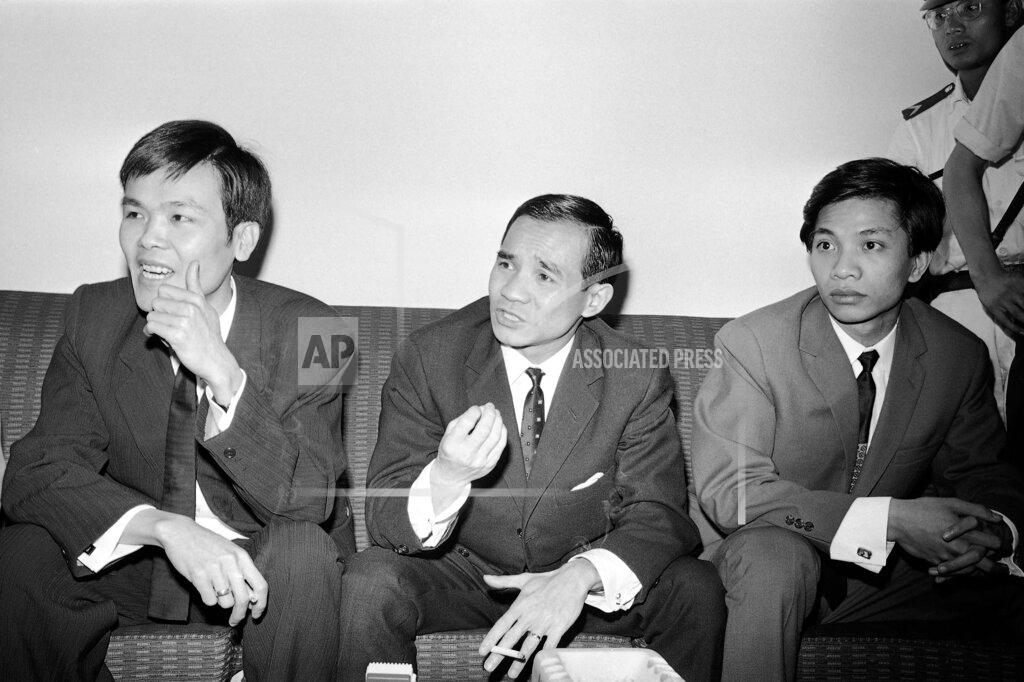
A second disputed matter has been the fate of members of the High National Council. The United States is not insisting that the members be released from military custody, it was said, but is pressing for a clearcut decision on them, preferably one in which they would be turned over to the civilian authorities. The current negotiations have been conducted over the last week largely by five men representing the Government, the military, and the United States. They are: Deputy Premiers Nguyễn Xuân Oánh and Nguyễn Lưu Viên, Rear Admiral Chung Tấn Cang and Major General Nguyễn Văn Thiệu, and U. Alexis Johnson, Deputy United States Ambassador.
Former Ambassador Henry Cabot Lodge said tonight that withdrawal from war-torn South Vietnam would be “the most dangerous and imprudent” action the United States could take. “Such action would be on a par of importance with getting out of West Berlin and would appear in the eyes of other Western nations as a vindication of Soviet-Chinese methods,” he declared. Mr. Lodge, who resigned as United States Ambassador to South Vietnam shortly before the Republican National Convention last July, said in an interview that an American withdrawal would make the Soviet Union more belligerent. “It would force Japan, the Philippines, and other countries to come to terms with Red China and would result in a grave threat to Formosa as well as be of deadly concern to Australia and New Zealand,” he added.
Representative Gerald R. Ford of Michigan, the new Republican leader in the House, said today “we’re going downhill” in South Vietnam and should undertake military operations to cut Communist supply lines from North Vietnam. “Somebody might say, “This will lead to war, but I don’t think it will necessarily lead to an all-out war,” he said on a Columbia Broadcasting System radio interview program, “Capital Cloakroom.”
Four years of involvement in the war in South Vietnam has cost the United States armed forces 356 dead, 1,546 wounded and 19 missing. A Defense Department tabulation of casualties for the period January 1, 1961, through January 4, 1965, showed this today. Of the dead, 246 were killed by the Communist Việt Cộng. The 110 others died as a result of aircraft accidents and other incidents that the Pentagon said were unrelated to hostile action. In 1961 there was only one combat death and two from other causes. In 1964 the combat death totaled 136 and the non-combat deaths 48.
President Sukarno declared tonight that Indonesia had turned her back on the United Nations agencies as well as “walked out of the United Nations” itself. Specialized agencies of the world organization had earmarked $50 million to help Indonesia. Mr. Sukarno carried out a threat voiced a week ago. He acted in the face of pleas from the Soviet Union and friends in the African-Asian bloc and made Indonesia the first nation to pull out of the world organization in its 20-year history. “We can afford to operate without the United Nations specialized agencies,” Mr. Sukarno said. “It is good for our nation to stand on our own feet. I have said: ‘Go to hell with your aid.’” Last March, when the United States was reported putting pressure on him to let up on Malaysia, Mr. Sukarno declared in a speech, “To hell with U.S. aid.”
President Sukarno ordered Indonesia’s build-up on the borders of Malaysia’s states of Sarawak and Sabah on direct advice from China, according to information received by diplomatic quarters. The advice purportedly came from the Chinese Communist Foreign Minister, Marshal Chen Yi, who visited Jakarta in a quick surprise trip November 27. The information on the Sukarno-Chen Yi conferences was that the Chinese, a top military expert, advised the Indonesians to abandon unproductive sea and air guerrilla raids on Malaysia and to turn to a new strategy. The new strategy was said to call for massing conventional forces on the frontiers of Sarawak and Sabah on the island of Borneo, which is shared by Malaysia and Indonesia, to strain the Malaysian and British resources, establish bases for active infiltration and ultimately work for insurrection among the Chinese inhabitants of the two Malaysian states. Of a population of 1.3 million, the Chinese account for 37 percent in Sarawak and Sabah.
There is evidence that the Indonesian forces in the area have increased from about 2,000 men in November to 15,000 to 20,000. These Indonesian forces were reported to be composed of four brigades or 19 battalions, including the expert Sillwangi Division. Diplomats here who are familiar with Indonesian and Chinese Communist thinking are inclined to doubt that President Sukarno is willing to risk a major showdown over Malaysia. For one thing, they say, the superiority of British power, which is being reinforced in Malaysia, over the Soviet-equipped Indonesian forces could turn an Indonesian attack into a defeat, unless China was prepared to become fully involved. Although Marshal Chen Yi was reported to have offered Mr. Sukarno Chinese military aid of unknown scope, the belief among the informed diplomats is that Peking would stop short of risking what could turn into a major war.
This is the reason, these diplomats said, why Marshal Chen Yi advised Mr. Sukarno to undertake the strategy of attrition that now is being developed by Indonesia under her avowed policy of “crushing” the 18-month-old Malaysian federation. To support the hoped-for insurrection in Sarawak and Sabah, the reports said, Marshal Chen Yi offered to try to reactivate the long-dormant Communist guerrilla activities on the Malayan peninsula. A guerrilla leader, Chem Pang, was said to be at large with about 500 men. Unconfirmed reports indicated that a Chinese Communist ship landed arms for the Malayan guerrillas at Pontianak on the west coast of Indonesian Borneo. Pontianak faces the tip of Malaya across the South China Sea. The material available here suggests that the Chen Yi visit to Jakarta was the final step in working out a full political alignment between Indonesia and Communist China.
The British aircraft carrier HMS Eagle was en route to Southeast Asian waters today as the limited build-up of British military strength in this area continued.
Indonesian efforts to drive a wedge between the Philippines and the United States have been one of a series of developments that have severely damaged the once promising friendship of Manila and Jakarta. The two neighboring island republics, with common racial stock, have ceased to talk seriously of their former project to form a Pan-Malay confederation. High Philippine officials have come to accept that one of Indonesia’s foremost policy aims in this region is to break up the close association between Manila and Washington. It is assumed that Jakarta’s ultimate goal is to have United States military bases removed from the Philippines, along with British installations in nearby Malaysia. The expulsion of foreign forces would leave Indonesia’s dominance of the area unquestioned.
The North Atlantic Treaty Organization will establish no new command mechanism for nuclear weapons in 1965, in the view of officials in London. They regard as dead the United States proposal for a jointly manned surface fleet with nuclear arms, and no urgency is evident in discussions of the alternative British proposal for a nuclear force under joint command. In fact, the air of urgency is gone from the whole issue. A month ago American officials were pressing for immediate action and the British Government’s energies were concentrated on the issue.
The most important reason for the change of atmosphere, the British say, is President Johnson’s memorandum of last month instructing the State and Defense Departments to avoid pressure tactics on the nuclear issue. A second reason given by the British is a belated West German recognition of the depth of President de Gaulle’s opposition to any joint nuclear command. The results have included a deflation of German eagerness for the project.
There is also an internal British political factor. Having put forward its ideas, the Labor party Government has fulfilled its campaign promises. It may care less deeply now about the outcome. This is not to suggest any British abandonment of London’s own proposal. The feeling here is that this plan is recognized in NATO as the outstanding idea on the table, even though progress may not be measurable.
Robert Glenn Thompson, a gasoline station owner and former U.S. Air Force clerk who had sold photos of secret documents to the Soviet Union, was arrested at his fuel-oil distribution service station at Bay Shore, New York. After pleading guilty to espionage, Thompson was sentenced to 30 years in prison and would spend more than 13 years at the federal penitentiary in Lewisburg, Pennsylvania before being released on May 1, 1978, by the U.S. to East Germany as part of a prisoner exchange between the two nations.
The town of Simacota, located in the Santander Department in northeastern Colombia, was seized by more than 100 members of the new Ejército de Liberación Nacional (ELN), the “National Liberation Army”). The invaders murdered three of Simacota’s four policemen, robbed the local bank, harassed the townspeople and looted the local pharmacy of its medicines, before being driven out by the Colombian Army. Only three of the 100 ELN men were captured.
The Bank of France demanded that the United States Treasury convert French holdings of $150,000,000 worth of United States dollars into gold. The U.S. had honored two previous requests for smaller amounts in 1962 and 1963. France’s move came in light of the Finance Ministry’s report that France had only 70% of its optimal gold reserve to back up its own currency.
West Germany is seeking to organize under four-power auspices direct negotiations with East Germany toward reunification of the country.
Rice, wheat and sugar, the three staples in India’s diet, will be rationed in New Delhi starting next month, the Government announced today, bringing the nation’s food shortage home to the capital with a jolt.
The annual convention of the Indian National Congress, the country’s ruling political party, debated the issue of the atomic bomb until early this morning.
The United Arab Republic has provided the United States Embassy with a rent-free building to serve as a temporary site for the John F. Kennedy Memorial Library, which was destroyed by fire during a riot last November, the embassy said today.
Identical twin brothers Ronnie Kray and Reggie Kray, 31, were arrested on suspicion of running a protection racket in London. The Kray Twins were English gangsters and identical twin brothers from Haggerston who were prominent from the late 1950s until their final arrest in 1968. Their gang, known as the Firm, was based in Bethnal Green, where the Kray twins lived. They were involved in murder, armed robbery, arson, protection rackets, gambling and assaults. At their peak in the 1960s, they gained a certain measure of celebrity status by mixing with prominent members of London society, being photographed by David Bailey and interviewed on television.
Kuwait is trying to reconcile the ideal of free enterprise with that of the socialist welfare state.
In a major step to heal embittered relations with Brazil, Uruguay’s National Council voted tonight to deny political asylum to two prominent members of the deposed regime of President Joao Goulart.
An explosion last night that was attributed by the police to Irish Republican Army extremist saboteurs rocked the Irish manor house where Princess Margaret and her husband, the Earl of Snowden, are vacationing.
President Johnson proposed today a broad national health program including health care for the aged and needy children and regional medical complexes to combat heart disease, cancer, stroke and other major illnesses. In a special message to Congress, Mr. Johnson gave first priority to passage of a bill on health care for the aged to be financed through Social Security. He said the measure was “of utmost urgency.” That measure, sometimes called medicare, would be financed through a special, separate trust fund within the Social Security system. The rest of Mr. Johnson’s program would require $262 million in new spending authority in the fiscal year 1966, which begins July 1, and $800 million in the fiscal year 1967, Government sources said.
A major part of the plan is to create 32 regional centers to provide more Americans with the most advanced treatment for such diseases as heart disease, cancer and stroke. The cost of this project over six years would be $1.2 billion. The President also proposed more Federal aid to build medical and dental schools, Federal grants to help operate such schools and Federal scholarships for needy medical and dental students. He asked for laws to control the production and sale of such drugs as barbiturates, amphetamines and other psychotoxic drugs.
He asked for more money and attention for problems of mental health and mental retardation. Passage of a medicare plan has seemed certain ever since the election, when the Democrats increased their majority in the House. But even smoother sailing appeared likely after Representative Wilbur D. Mills, chairman of the House Ways and Means Committee, said today that the method of financing the plan sought by Mr. Johnson met his basic requirements.
A constitutional amendment providing for filling a vacancy in the office of Vice President and for his assumption of Presidential powers if the President is unable to perform his duties was urged today by the Committee for Economic Development.
The nation’s employment situation continued to improve slowly in December as it had been doing throughout the rest of 1964, the Labor Department reported today.
The jobless rate declined from 5 per cent in November to 4.9 percent last month, equaling the July rate. The drop was too small to be counted significant in statistical terms by Bureau of Labor Statistics experts. It did mean, however, that the prediction a year ago by Administration economists that the rate would fall below 5 percent by the end of 1964 was fulfilled.
The White House came out modestly ahead today in the reshuffling of the Democratic membership on two key committees of Congress. The Democratic caucus in the Senate voted 34 to 22 to add two Middle Westerners, Senators Pat McNamara of Michigan and Eugene J. McCarthy of Minnesota, to the heavily Southern Democratic Steering Committee. The additions raise the total membership of the committee from 15 to 17 and reduce the Southern contingent to a minority of eight. In the House, Democrats added three relatively liberal members to the Ways and Means Committee, apparently assuring clear sailing for the Administration’s program of medical care for the aged under Social Security. The membership of the committee remains at 25. The Democrats gained two new seats, however, by altering the ratio of Republican representation in accordance with its reduced membership in the new House. They had a third seat to fill because of the election of former Representative Ross Bass of Tennessee to the Senate.
The Johnson Administration is near a decision to ask Congress to repeal all or part of the required 25 percent gold backing for the nation’s money supply. The possibility of such a request has been under consideration for weeks because the growth of the money supply had gradually reduced the effective gold behind the dollar to 27.7 percent by the end of December. Treasury officials insisted that France’s decision today to convert $150 million of her dollars into gold at the United States Treasury was not the cause of the suggested request to Congress. Moves to unfreeze the nation’s gold supply had been considered long before the French move. However, the French action will inevitably bring closer the day when the ratio drops to 25 percent because it will slightly reduce the American gold supply.
The requirement of a gold backing, or cover, for United States currency dates to the days when this country was on the gold standard. At that time the holder of a dollar bill could demand gold for it. Since the United States went off the gold standard in 1934, the gold-cover requirement has been largely symbolic. The Federal Reserve System adds each year to the nation’s money supply according to its judgment of the needs of the economy, without regard for the gold cover or the amount of gold the nation possesses. Once before, in 1945, Congress had to reduce the required percentage of cover as the money supply “grew up” to the gold stock.
The Administration will make a major effort this year to have Congress strengthen the Unemployment Insurance system, probably through a combination of Federal minimum standards and Federal programs.
John T. Connor, the man President Johnson has selected to become Secretary of Commerce, bought more than $600,000 worth of stock in his own company, Merck Co., Inc., a week after President Johnson announced his appointment to the Cabinet. The Senate may require him to sell it outright before he is confirmed for the Cabinet job and also to divest himself of the balance of his $1.5 million worth of holdings of Merck stock. Several members of the Senate Commerce Committee, who must pass on Mr. Connor’s appointment, said today that they thought Mr. Connor’s purchase of the stock — which cost him only a little more than $100,000 under the company’s stock-option plan — was improper.
The first three persons arrested under the Civil Rights Act of 1964 were indicted by a Federal grand jury today in connection with the beating of a Black civil rights worker. Those indicted were Willie Amon Belk, 47 years old; his son, Jimmy Allen Belk, 19, and Sam Allen Shaffer Jr., 40. All work as plumbers in Greenwood, Mississippi. They were charged with threatening and beating Silas McGhee, 21, on July 16, 1964, because he had entered a previously segregated movie theater in Greenwood.
The indictment charged “the defendants did unlawfully injure, oppress, threaten and intimidate Silas McGhee by striking and beating him because of his having exercised [his] rights and privileges.” All three are free on $1,000 bond. Mr. McGhee said at a preliminary hearing that he had been forced into a truck at gunpoint and driven to an auto repair shop, where he had been struck with a board and pipe. About a month later Mr. McGhee was shot in the face by a sniper as he sat in his car in a Black section of Greenwood.
Allan Dale Kuhn, four New York detectives and an assistant district attorney went into hiding today in their effort to recover the 24 gems stolen from the American Museum of Natural History in New York.
District Attorney Frank S. Hogan plans to recommend a prison sentence of one to two years for three suspects accused of the American Museum of Natural History burglary if they plead guilty — and if the gems are returned.
Seven major Detroit hotels locked out union workers today and two others were struck.
The battle for presidency of the United Steelworkers of America has led to a recess, until February 15, in the nationwide contract negotiations in the steel industry.
Dow Jones Industrial Average: 884.36 (+4.68)
Born:
‘Five for Fighting’ [Vladimir John Ondrasik], American soft rock-pop pianist, singer-songwriter, and record producer (“Superman (It’s Not Easy)”; “100 Years”), in Los Angeles, California.
Yves Beaudoin, Canadian NHL defenseman (Washington Capitals), in Pointe-aux-Trembles, Quebec, Canada.




 History Diaries