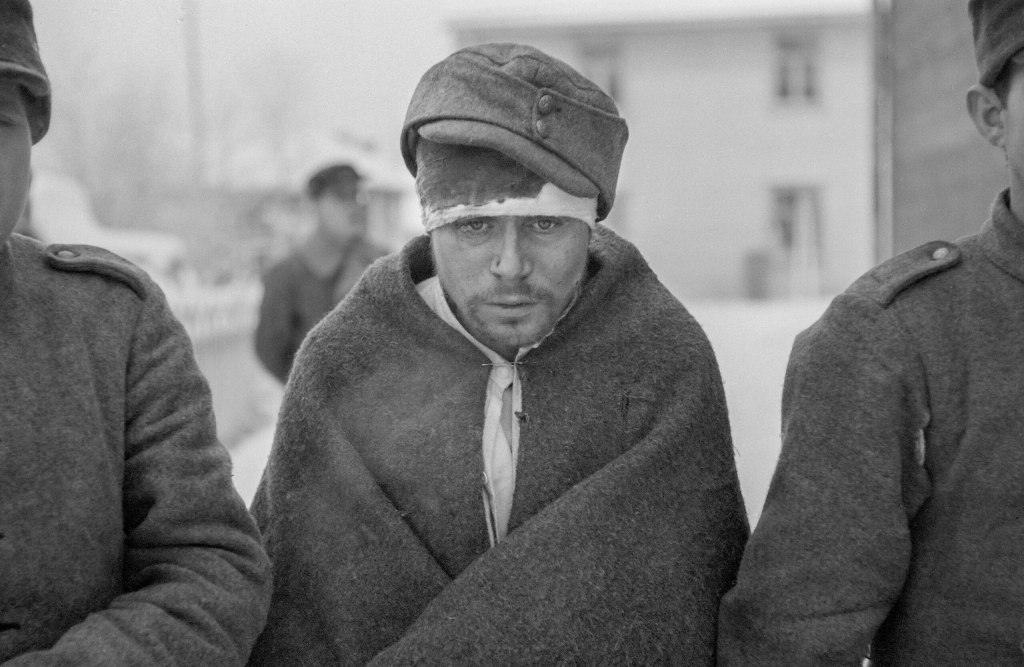
The New York Times observes:
“Russia’s attempt at a “Blitzkrieg,” after a thirty-eight-day trial against Finland, a country of 3,800,000 inhabitants, has netted her about 5,000 square miles, or about one-forty-eighth of the 240,000 square miles she apparently set out to capture. And Finnish leaders say they voluntarily gave up most of the Finnish territory now occupied by the Red Army. Reports of changed leadership of the Soviet Army on the Karelian Isthmus, and its digging-in operations there, indicate a change of tactics now. But the distribution of Soviet troops at the beginning of the war left little doubt to observers that Joseph Stalin planned something similar to Chancellor Hitler’s conquest of Poland.”
The counteroffensive by the Finnish IV Army Corps north of Lake Ladoga begins in temperatures of -29° Celsius.
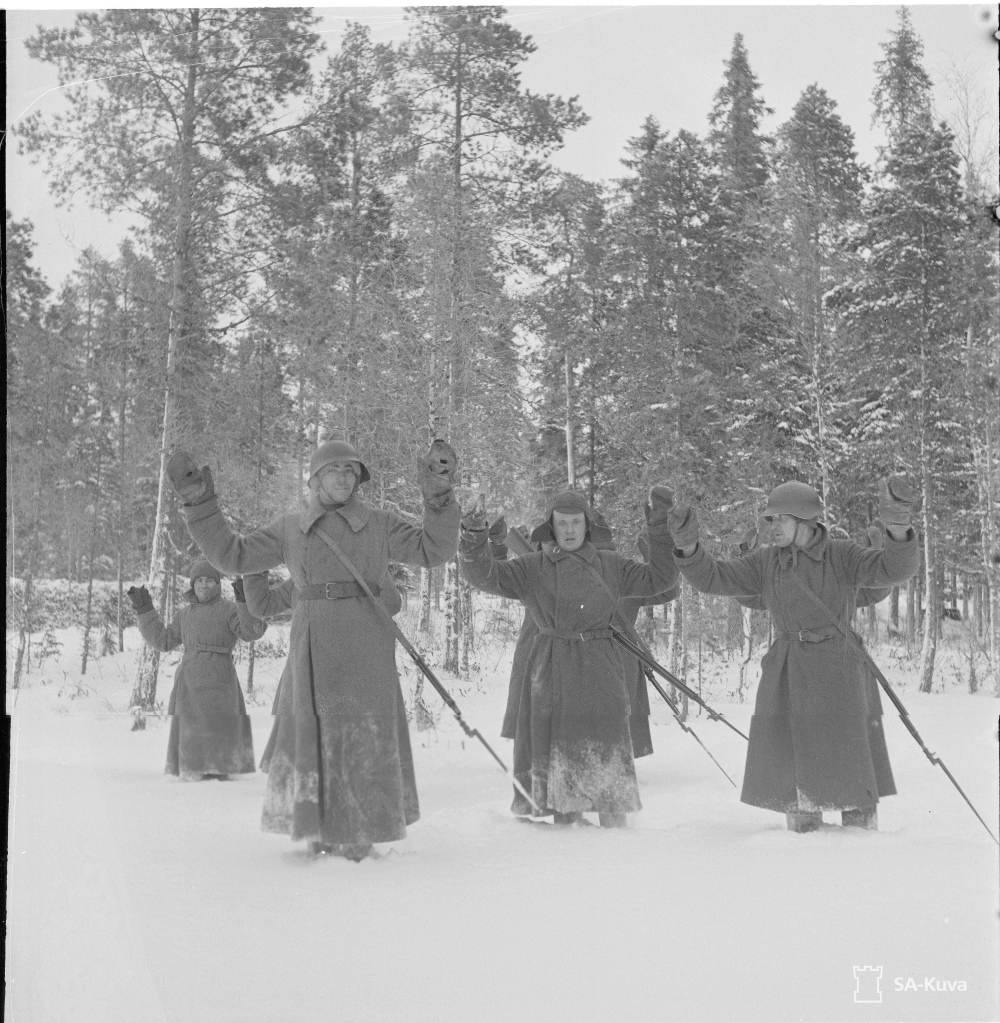
Starting at 3 AM, Finns make several cuts in the Soviet column up to 5 miles East of Mäkinen’s original roadblock. As the Finns crush this part of the column, Soviet soldiers flee into the forests, where the Finns on skis track them down. In any event, there is nothing for them there, no shelter, so most soon perish in the bitter, lifeless cold.
Task Force Fagernas continues holding the Purasjoki River crossing area where they blew up the bridge on 5 January 1940. The NKVD troops from the USSR attempt to get by them to relieve their comrades further east, but fail. The Task Force also has enough troops to spare to cut the Ratte road further west as well.
Comrade Vinogradov, in command of Soviet 44th Rifle Division, radios Chuikov at 9th Army HQ that his men can only return through the forest and must leave all their equipment behind. Chuikov replies that the men must wait where they are until relief forces arrive. However, Chuikov himself asks the Stavka for instructions, requesting a breakout without the heavy equipment.
Division headquarter has lost all contact with the Division on the Ratte road except with the 122nd Artillery Regiment and the 305th Rifle Regiment.
Late in the day, the Finns construct a barrier near the border. Vinogradov breaks down at 16:00 and tells his subordinates to break out at 22:00. Everything is put into the effort, which is led by two rifle companies of the 25th Rifle Regiment under Major Plyukhin. Two batteries of artillery, tanks, and the rest of the Division follow along. The vast majority of the wounded are left behind on the road.
The breakout begins sometime during the night. The breakout failed immediately. The Soviets abandoned their heavy equipment and ran north of the road, into the woods. The vast majority of the heavy equipment remained intact. The fleeing Soviet troops then headed eastward through deep snow, about 2-3 kilometers away toward the border. One group, the 305th Regiment, escaped without opposition. Vinogradov, who had joined the column at some point, escaped guarded by two rifle companies and a Guard Platoon.
Finnish 12th Infantry Division and 13th Infantry Division begin offensive against Soviet 8th Army north of Lake Ladoga
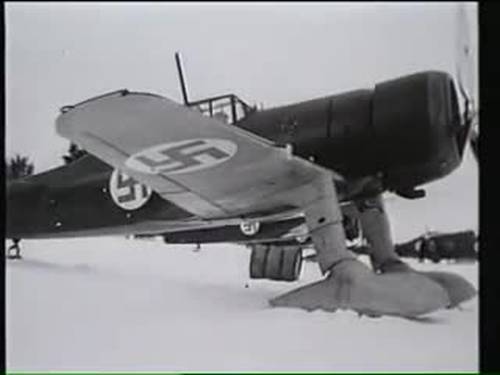
A pair of Finnish Fokker fighters destroy a formation of 7 Ilyushin bombers over Utti, 60 miles northeast of Helsinki.Soviet and Finnish aircraft engage in air battle northeast of Helsinki. Finnish Air Force Lieutenant Jorma Sarvanto in his Fokker fighter shoots down 6 of 7 Soviet Ilyushin bombers he attacks in about 25 minutes.
At Viipuri, Soviet aircraft cause serious damage in the city.
The Finns insist there is little military significance in the continued Soviet air raids, which since the beginning of the war have killed about 300 civilians and caused material damage in about sixty cities and towns. The Finns assert they have shot down more than 150 Russian planes.
The Merivoimat (Finnish Navy) icebreaker Sampo ran aground off Pori. There were no casualties but the ship could only be raised in May 1940 and repairs were not completed March 1941.
The Norwegian government rejects the Soviet claim that Norway is pursuing an “unneutral” policy. (A claim made on January 5th.)
The theory is advanced by the Soviet Army organ Red Star today that offers of assistance to Finland, especially by Great Britain and France, are “camouflage for dragging the Scandinavian countries into the war” on the Allies’ side.
In neighboring Sweden and Norway, the governments there reasserted their neutrality, both rejecting British requests to operate in their waters.
London notifies the Norwegian ambassador that the Royal Navy must be allowed to operate in Norwegian waters due to German naval activity.
A mass execution of Poles is committed by Germans in the city of Poznań, Warthegau as part of Intelligenzaktion Posen. The Intelligenzaktion was a major step towards the implementation of Sonderaktion Tannenberg (Special Operation Tannenberg), the installation of Nazi policemen and functionaries — from the SiPo (composed of Kripo and Gestapo members), and members of the SD — to manage the occupation and facilitate the realization of Generalplan Ost, the German colonization of Poland. Among the 100,000 people who were killed in the Intelligenzaktion operations, approximately 61,000 of them were members of the Polish intelligenzia, people who the Germans considered political targets according to the Special Prosecution Book-Poland, a book which was compiled before the war began in September 1939. The Intelligenzaktion occurred soon after the German invasion of Poland (1 September 1939), and lasted from the autumn of 1939 until the spring of 1940; the mass murder of the Polish intellectuals continued with the operations of the AB-Aktion.
High German stormtrooper and police leaders in the Polish “Government General” have issued a series of decrees regulating the conduct of Jews in this section. Jews there already are in the compulsory labor service as the result of a decree of October 26. Effective January 1 all Jews in German-occupied Poland were forbidden to change their residences or cross the border of the communities In which they live without written permission. Jews may not give up their residences to go “tramping” without such written permission. Jews who come into the Government General must register with the Mayor of the place they enter within twenty-four hours and also inform the Jewish Community Council, which each week must present a list of immigrant Jews to the Mayor. Jews are forbidden to appear on any street between 9 PM and 5 AM without written permission. Jews violating these ordinances are to be severely punished and also subjected to the hardest manual labor for long hours.
The Kriegsmarine issues orders to its U-boats to “make immediately unrestricted use of weapons against all ships” in an area of the North Sea the limits of which were defined.
The German Ministry of Ecclesiastical Affairs issues an edict, based on the Führer’s amnesty of September 9, 1939, restoring the salaries of a large number of priests who had their state subsidy cut off because of minor infractions of the law.
Cardinal Hlond submits a new and detailed report to Pius XII on the deportations and arrests of Polish priests, the closing of churches and the brutal treatment meted out to the Polish population.
The Dutch government announces that it will defend itself against any attack. Netherlands today issued a drastic warning that all violations of their neutrality will be met with force regardless of their source.
King Carol declared that all Rumanians “are ready to die together to defend their borders” in a bristling speech today interpreted throughout the Balkans as a warning to both Russia and Hungary. King Carol visited the most worried of his minority regions today and in a short but strong speech at Kishineff, capital of Bessarabia, declared that Rumania was united in her determination to defend her frontiers from invasion.
The Italian and Hungarian foreign ministers, Count Ciano and Stephen Csáky, meet in Venice. Foreign Minister Count Ciano was reported in authoritative circles tonight to have given Count Csáky, Hungarian Foreign Minister, assurances of Italy’s support to the fullest extent if any Communist move is directed against Hungary.
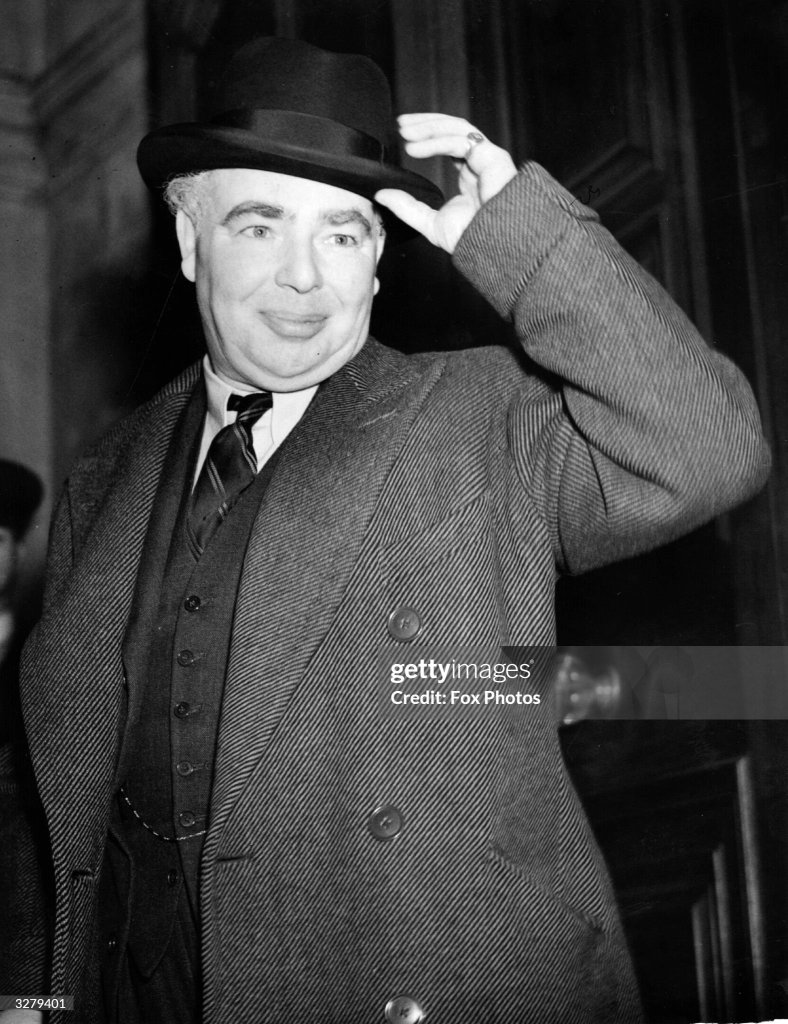
Widespread clamor for a full explanation of the circumstances leading to the retirement of Leslie Hore-Belisha from the British War Cabinet was voiced throughout the country today, but it did not produce results from Prime Minister Neville Chamberlain or the former War Secretary. The Cabinet shake-up, however, is certain to have repercussions in Parliament when that body reconvenes January 16.
Dogs in Britain are reportedly wearing bicycle reflectors on their collars to boost their visibility in the blackout.
Eamon de Valera, the prime minister of Eire, is calling for new emergency powers to aid a nationwide crackdown on the IRA. The move follows an Irish High Court ruling which set free 53 men detained under the Emergency Powers Act. An amended and draconian version of the act has been proposed in the Dail, the Irish parliament. The amended act would allow the government to arrest and detain suspects without trial.
The Irish Government tonight pressed an intensive search for five men who fired at a military patrol attempting to question them regarding ammunition stolen last week from the Phoenix Park government arsenal.
The Kriegsmarine conducts more mine-laying operations in the English Channel. During the night of the 6th/7th, German destroyers of the 1st Flotilla, Friedrich Eckholdt, Erich Steinbrinck and Friedrich Ihn, supported by Karl Galster, Richard Beitzen and Hermann Schoemann laid mines in the Thames Estuary. Destroyer HMS Grenville and six merchant ships for 21,617 tons would be lost in the field.
The Marine Nationale (French Navy) armed patrol ship Barsac ran aground on the Isalons Rocks, Vigo, Galicia, Spain and sank with the loss of eighteen crew.
The British Motor trawler Eta (81grt) sinks on this destroyer barrage six miles NW of Outer Gabbard Light Vessel; the crew were saved.
The German submarine U-30 laid mines in Liverpool Bay, on which four merchant ships would be sunk and one badly damaged.
Tanker British Liberty (8485grt) was sunk on a British defensive minefield two miles NE of Dyck Light Vessel; twenty four crew, including a Marine gunner, were lost.
The British steam merchant City of Marseilles was damaged when it struck a mine laid by the U-13 on December 12, 1939 1.5 miles southeast of Tay Fairway Buoy, in the River Tay off the east coast of Scotland in the North Sea (56° 27’N, 2° 34’W). The ship had just taken a pilot aboard when the mine exploded under her bridge, stopping the engines and causing a list of 10 to 15° to starboard. The crew began to abandon ship, but two lifeboats had been destroyed by the explosion and another capsized during launch, throwing the 14 occupants into the water. One crew member was lost. Screened by a Hudson aircraft (224 Sqdn RAF), the survivors were picked up by the pilot cutter, a RAF crash launch from Tayport and the Broughty Ferry lifeboat Mona and landed at Broughty. The 8,317 ton City of Marseilles was carrying general cargo and was bound for London, England. The abandoned City of Marseilles was boarded by crew members of the trawlers HMS Cranefly and HMS Sturton and the harbor defense patrol craft HMS Suilven. The next day, the vessels towed the City of Marseilles to Dundee where temporary repairs were made. The ship then continued to the Clyde for repairs and returned to service in April 1940.
The British cargo ship Beltinge ran aground at Les Sables d’Olonne, Vendée, France and was wrecked. Her twenty crew survived.
German steamer Frankenwald (5062grt) ran aground on Bratholmen, Norway and sank. All 48 crew were rescued.
Destroyer HMS Foxhound, escorting damaged battleship HMS Nelson, attacked a submarine contact south of Wolf Rock.
U.S. passenger liner Manhattan is detained at Gibraltar by British authorities (see 7 January).
Convoy OG.13 forms at sea for Gibraltar.
Convoy HX.15 departs Halifax for Liverpool.
The War at Sea, Saturday, 6 January 1940 (naval-history.net)
Destroyer FOXHOUND, escorting damaged battleship NELSON, attacked a submarine contact south of Wolf Rock in 49 39N, 5 50. 5W.
Armed merchant cruisers ANDANIA, CHITRAL and WORCESTERSHIRE departed the Clyde for Northern Patrol. Light cruiser COLOMBO arrived at Scapa Flow.
Armed merchant cruiser LAURENTIC, returning to the Clyde, went ashore southwest of Islay. Tug ENGLISHMAN was carrying some of the survivors of steamer ROTHESAY CASTLE (7016grt) and had to transfer them to a destroyer before she could assist. However, LAURENTIC got off without assistance and proceeded to Belfast arriving on the 7th. She was under repair until 25 May.
Convoy ON.7 of one British, one Norwegian and four Finnish ships departed Methil escorted by destroyers ESKIMO, TARTAR, KASHMIR, KHARTOUM and submarine TRITON. KASHMIR had departed the Clyde on the 4th to join the escort and arrived at Rosyth on the 6th, while KHARTOUM had left the Clyde on the 5th and refueled at Scapa Flow on the 6th before proceeding to Rosyth. ESKIMO developed defects and was relieved by destroyer ENCOUNTER until joined by destroyer KANDAHAR which departed Scapa Flow at midnight on the 7th. Light cruisers GLASGOW and EDINBURGH left Rosyth on the 7th to cover the convoy, which arrived safely at Bergen on the 9th.
Convoy FN.64 departed Southend, escorted by destroyer WOOLSTON and sloops GRIMSBY and WESTON, but was cancelled when progress was impeded by fog.
Convoy FS.66 departed the Tyne, escorted by destroyer/escort vessel VEGA and sloop LONDONDERRY. Sloop STORK was intended to join them, but (as noted on the 5th) fouled the boom net at Inchkeith and had to return to harbour. VEGA collided with steamer REGFOS (1548grt) on the 8th, but was able to continue with the convoy, which arrived at Southend on the 8th. After temporary repairs at Sheerness, VEGA departed on the 9th and proceeded to Rosyth, but as there were no facilities available for her there, went on to Dundee, arriving on the 12th for repairs which completed on the 24th.
Steamer CITY OF MARSEILLES (8317grt) was damaged on a mine laid by U-13 1½ miles SE of No.1 Black Buoy, River Tay.
Tanker BRITISH LIBERTY (8485grt) was sunk on a British defensive minefield two miles NE of Dyck Light Vessel; twenty-four crew, including a Marine gunner, were lost.
GERMAN DESTROYER MINELAYING IN THE THAMES ESTUARY
During the night of the 6th/7th, German destroyers of the 1st Flotilla, FRIEDRICH ECKHOLDT, ERICH STEINBRINCK and FRIEDRICH IHN, supported by KARL GALSTER, RICHARD BEITZEN and HERMANN SCHOEMANN laid mines in the Thames Estuary. Destroyer GRENVILLE and six merchant ships for 21,617 tons were lost in the field.
On the 6th, motor trawler ETA (81grt) six miles NW of Outer Gabbard Light Vessel; the crew were saved.
On the 7th, steamer CEDRINGTON COURT (5160grt) two miles NE of North Goodwins Light Vessel in 51-22N, 1-35E; again the crew were saved.
On the 7th, steamer TOWNELEY (2888grt) one mile ENE of North East Spit Buoy; crew were saved when they rowed to shore in the Margate lifeboat (?).
On the 9th, steamer DUNBAR CASTLE (10,002grt) of convoy OA.69 in 51 23N, 01 34E; nine crew were lost and the survivors rescued by trawler CALVI (363grt) and other small ships.
On the 9th, Dutch steamer TRUIDA (176grt) in 51 27N, 01 50E; crew were rescued by Dutch trawler FRISO (250grt) which transferred them to Dutch steamer TIBERIUS (1712grt).
On the 15th, steamer KILDALE (3877grt) was damaged two miles east of South Shiphead Buoy.
On the 16th, Belgian steamer JOSEPHINE CHARLOTTE (3422grt) in 51 32N, 01 33E; four crew were lost and the survivors rescued by steamer MICKLETON (777grt).
On the 19th, destroyer GRENVILLE was sunk east of the Thames Estuary.
U-30 laid mines in Liverpool Bay, on which four merchant ships were sunk and one badly damaged.
German steamer FRANKENWALD (5062grt) was lost by stranding near Bratholmen and Felsen.
German steamer BAHIA (4118grt) departed Bahia, arrived at Narvik on 6 February, and continued on to Hamburg which she reached on the 17th.
Convoy HX.15 departed Halifax at 0900 escorted by Canadian destroyers HMCS FRASER and HMCS RESTIGOUCHE, which detached on the 7th. Ocean escort was battleship RESOLUTION which detached on the 18th, and proceeded to Plymouth, arriving on the 19th for refitting. Destroyers WREN, VANESSA and VANQUISHER were with the convoy from the 18th to 19th, when it arrived at Liverpool.
PASSAGE OF FIRST ANZAC CONVOY TO NORTH AFRICA
The first of the Australian-New Zealand troop convoys, US.1, departed Wellington with liners ORION (23,456grt), EMPRESS OF CANADA (21,517grt), STRAITHAIRD (22,284grt) and RANGITATA (16,969grt) carrying troops for North African service, and escorted by battleship RAMILLIES and Australian heavy cruiser HMAS CANBERRA from Wellington. New Zealand light cruiser HMNZS LEANDER departed Wellington on the 4th, arrived at Lyttleton on the 5th and after collecting liners DUNERA (11,162grt) and SOBIESKI (11,030grt) left again the same day. They joined the convoy in Cook Strait off North Island on the 6th.
On the 9th, liners ORCADES (23,456grt), STRATHNAVER (22,457grt), OTRANTO (20,032grt) and ORFORD (19,941grt) escorted by Australian heavy cruiser HMAS AUSTRALIA departed Sydney and joined the convoy on the 10th off Sydney.
Light cruiser LEANDER arrived at Sydney on the 11th. Australian light cruiser HMAS SYDNEY joined the convoy on the 11th and was detached on the 12th in Jervis Bay. Liner EMPRESS OF JAPAN (26,032grt) from Melbourne joined on the 12th.
Earlier, on the 8th, heavy cruiser KENT and the French SUFFREN departed Colombo and arrived at Fremantle on the 17th. On the 20th they relieved the escorting Australian cruisers, which arrived in Fremantle for refueling.
On the convoy’s arrival at Colombo on the 30th, KENT and SUFFREN were in turn relieved by Force I – aircraft carrier EAGLE, heavy cruiser SUSSEX (Flag Murray) and Australian light cruiser HOBART.
Force I had been conducting sweeps in the Indian Ocean since the 15th when it departed Colombo, arriving back on the 18th. It left again on the 25th, reached Trincomalee on the 28th, and sailed on the 30th to meet the convoy. Reaching Colombo on the 30th together, both force and convoy sailed for the Middle East on 1 February.
Destroyer WESTCOTT departed Singapore on the 28th, arrived at Colombo on 1 February and left the same day as a convoy escort. French liner ATHOS II (15,276grt) joined the convoy at Colombo.
The convoy was also screened by submarines OTUS and OLYMPUS, patrolling submerged in Nine Degree Channel between the Laccadives and Minicoy after investigating the Maldives, Addu and Chagos groups. The convoy’s entry into the Red Sea on 8 February was preceded by anti-submarine patrols by Australian destroyer VENDETTA, which had been detached from the Mediterranean Fleet, and WESTCOTT, which reached Aden on the 8th. The convoy escorts were detached on the 10th and US.1 arrived safely at Suez on 12 February.
German steamer RIO GRANDE (6062grt) departed Rio Grande del Sol, Brazil, but returned on the 7th to avoid contact with light cruiser AJAX.
President Roosevelt approves of the proposed study and analysis of the 1941 budget estimates by a joint Congressional committee, Senator Harrison announced today after a legislative conference at the White House. The Mississippi Senator, who is chairman of the Finance Committee, will introduce in the Senate on Monday a resolution to create such a committee. This move, however, although it is ostensibly aimed at expediting Congressional consideration of both the income and expenditure items recommended by the President by ironing out inter-committee difficulties early in the procedure, will meet with opposition on both sides of the Capitol, according to indications today.
Senator Byrnes, chairman of the Appropriations Committee, followed Mr. Harrison to the White House and had lunch with the President. On leaving, he conceded that the President liked Mr. Harrison’s idea but said that, for his own part, he saw disadvantage in it. He held that this plan might have been advantageous “had the committee begun work last Summer,” but agreed with Representative Taylor of Colorado, chairman of the House Appropriations Committee, that its adoption now would slow down the machinery.
Mr. Harrison, in telling of Mr. Roosevelt’s support of his suggestion, fell into a football metaphor. “The quarterback,” he said, “thought it would be a good idea for us to get together on a set of signals so that there would be no misplays. We have got to have teamwork between the revenue and expenditure committees if we want to approach the time when income balances outgo. Some of us have this goal in view and we want to make a touchdown.” Speaking of the budget message as a whole, Mr. Harrison described it as beginning “a retrenchment program which I hope will continue for some time.”
The plan the Senator has suggested calls for setting up a committee made up of six members each from the Appropriations Committees of the Senate and House, the Finance Committee and the Way and Means Committee. To these would be added, by invitation, representatives of the Military and Naval Affairs Committees of both houses during the discussion of the national defense items. Senate Republicans, meeting in conference as a minority yesterday, approved the general idea, except that they asked for a special joint committee to consider the national defense budget and to investigate the results obtained from past expenditures in this field.
Mr. Byrnes, who heads the Naval Affairs Subcommittee of the Appropriations Committee, advanced, among his other objections to the Harrison plan, the contention that the naval budget might have to be considerably revised in the light of current war experiences. He mentioned the battle off Montevideo between the Admiral Graf Spee, German pocket battleship, and the three British cruisers of conventional design as an incident from which useful naval construction lessons could doubtless be learned.
The nomination of Robert H. Jackson to be Attorney General was favorably reported to the Senate Judiciary Committee today by a subcommittee of which Senator King was chairman.
A Gallup Poll indicates that 60% of registered Republicans support Thomas E. Dewey for the 1940 GOP Presidential nomination.
Certainty that the 250,000 members of the Amalgamated Clothing Workers of America would support President Roosevelt if he sought a third term was expressed yesterday by Sidney Hillman, president of the union and vice president of the Congress of Industrial Organizations. Mr. Hillman, who is one of the President’s closest friends in the labor movement, told members of his organization at a forum in the Rand School that he did not know whether Mr. Roosevelt would run for re-election, but that he regarded him as “the ablest and best man” to keep the United States out of war.
Representative Sam Rayburn of Texas, majority leader of the House, said tonight that he was convinced the American people “would rather pay cash for additional security against any possible aggression than to have such security by deficit-financing or by increasing the national debt.” He supports Roosevelt’s call for more taxes to pay for the increase in defense spending.
The battle to put through Congress the program to make the navy the equal of any in the world will begin before the House Committee on Naval Affairs Monday when hearings start on the Administration bill to authorize $1,300,000,000 for naval expansion. The bill calls for the construction of ninety-five combatant and thirty-one auxiliary ships, the President to have authority to alter the program within the specified categories if it appears to the interest of the national defense. Representative Carl Vinson, chairman of the committee, who piloted the two previous large authorization bills through the House, is confident that the bill will pass by a substantial majority. There will be opposition in and out of Congress, according to present signs, the outside opposition largely from the organizations which opposed the expansion acts of 1934 and 1937.
Authorization is sought for the construction of three aircraft carriers, eight cruisers, fifty-two destroyers, thirty-two submarines, and thirty-one auxiliaries, No additional battleships are sought. Under the expansion act of 1934 eight battleships, in addition to the eight under construction and the two proposed in the 1941 budget, can be laid down.
If the government had been alert in the past ten years it could have obtained much evidence about the subversive activities of an-American organizations, Martin Dies, chairman of the House committee to investigate un-American activities, charged in a broadcast from Beaumont, Texas, last night over the network of the National Broadcasting Company. He said that the Department of Justice, if it was sincere in its desire to prosecute, could obtain convictions of persons named by the committee before any jury in the country. “If the department will perform its duty without fear or favor,” he went on, “I will gladly give the department full credit.”
The Census Bureau tonight published 299 questions relating to the inhabitants of the United States, their homes and their farms for use in the greatest question bee in history, the 1940 decennial census.
The death rate in the United States in 1938 was the lowest ever recorded, and health conditions generally continued to improve during the year, Surgeon General Thomas Parran said today in his annual report.
The air transport industry in the United States enjoyed the biggest and safest year in its history during 1939, according to a report made public yesterday by Colonel Edgar S. Gorrell, president of the Air Transport Association of America.
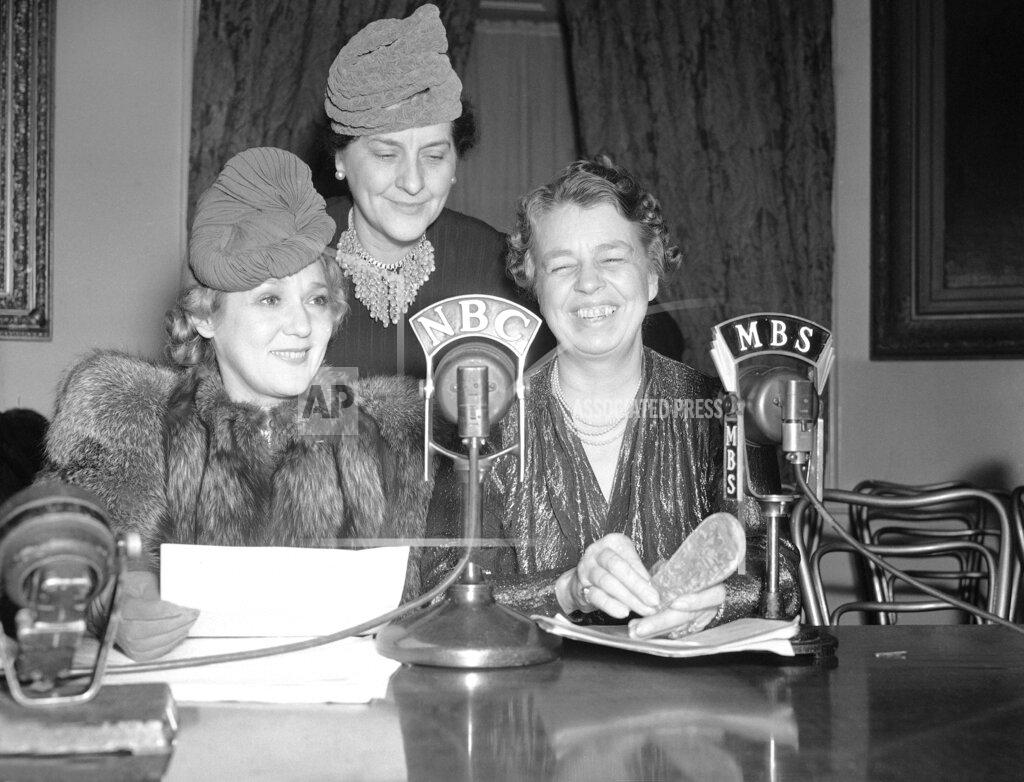
Mary Pickford, Dorothy Thompson, Mrs. Stanley Forman Reed, and other women leaders from the forty-eight States participated with Mrs. Roosevelt at the White House this afternoon in a broadcast discussion of their “Fight Infantile Paralysis Campaign.” Then they sat down to a dinner given in honor of the First Lady by the committee for the celebration of the President’s birthday, at which last year’s progress against the disease and this year’s plans were reviewed.
The Mardi Gras season officially opened tonight as the Twelfth Night Revelers made merry at a ball in the Municipal Auditorium.
America’s sea, land and air forces will engage in joint exercises the week after next between Point Conception and Point Montara. The United States fleet and all the land forces on the Pacific Coast will participate.
Admiral James O. Richardson relieves Admiral Claude C. Bloch as Commander in Chief, U.S. Fleet on board battleship Pennsylvania (BB-38) at Pearl Harbor, Territory of Hawaii.
Admiral Charles P. Snyder hoists flag as Commander Battle Force on board battleship California (BB-44).
Duke Indoor Stadium (now Cameron Indoor Stadium) opened on the West Campus of Duke University in Durham, North Carolina.
The new year is said to have brought early successes to the Chinese defenders in South China. The southward drive toward Canton is reported to have progressed after two days of heavy fighting in Northern Kwangtung Province. The Chinese said they counterattacked and drove the Japanese back along the entire front. The Chinese reported they were assisted in the recapture of the important cities of Yingtak and Yungyan by the first large-scale use of modern armament, giant bombers having been called into action.
The Japanese losses were put at 12,000 men in what is regarded as the most spectacular Chinese success in three months. Chinese say the real reason for the complete withdrawal of Japanese troops from the Hong Kong border is the need for reinforcements in Northern Kwangtung.
Despite a Chinese victory lantern parade at Chungking, the results of a week’s heavy fighting were left in doubt today by conflicting Chinese and Japanese claims. The celebration in the temporary Chinese capital last night was based on reports that a Japanese advance in Kwangtung Province had been stopped. Although official Chinese quarters remained reticent about details, the semi-official press said Chinese artillery and the air force had led attacks routing a Japanese column north of Canton. The Japanese, however, said Chinese forces had been swept from an area extending 100 miles north and northeast of Canton, while Japanese troops had crossed the North River and captured Tsingyun, sixty miles to the northwest.
Similar contradictions were reported from Kwangsi Province, where Japanese asserted an unsuccessful attempt to recapture Nanning, the provincial capital, had cost nearly 30,000 Chinese lives. The Chinese, however, said they were digging up twelve field guns and six anti-tank guns the Japanese had buried about twenty-five miles north of Nanning when forced to retreat hastily. They acknowledged Nanning was still held by the Japanese.
Means of arriving at a modus vivendi under which Japan would receive most-favored-nation treatment by the United States when the joint trade treaty denounced by this country expires January 26 were discussed today at the State Department by Secretary of State Cordell Hull and the Japanese Ambassador, Kensuke Horinouchi. That such an arrangement would be reached to allow more time for negotiations between the United States Ambassador, Joseph C. Grew, and the Japanese Foreign Minister, Admiral Kichisaburo Nomura, in Tokyo and conversations in Washington was regarded as almost certain. Ambassador Horinouchi today said he was “hopeful” this would be the case, although no agreement had yet been reached.
The Australian launch Gloreda caught fire and sank in Hervey Bay, Queensland. All four men aboard survived.
The New Zealand 4th Brigade (General Bernard Freyberg, commanding) sails from Auckland for Egypt in six transports escorted by the battleship HMS Ramillies, heavy cruiser HMAS Canberra and New Zealand-manned light cruiser HMS Leander.
Dow Jones Industrial Average: 151.19 (-0.35)
Born:
Van McCoy, American musician and songwriter (“The Hustle”), in Englewood, New Jersey (d. 1979).
Laudir de Oliveira, Brazilian percussionist (Sérgio Mendes; Chicago, 1973–81), in Rio de Janeiro, Brazil (d. 2017).
Ed Zschau, American politician (Rep-R-California, 1983–1987), in Omaha, Nebraska.
Dick Meissner, Canadian NHL right wing (Boston Bruins, New York Rangers), in Kindersley, Saskatchewan, Canada (d. 2002).
Elvio Jiménez, Dominican MLB outfielder (New York Yankees), in San Pedro de Macoris, Dominican Republic.
Penny Lernoux, journalist and author, in California (d. 1989).
Died:
George H. Himes, 95, American pioneer.
Naval Construction:
The Japanese Nitta Maru class of passenger-cargo liner Kasuga Maru (春日丸) is laid down for the NYK Line by the Mitsubishi Shipbuilding & Engineering Co. (Nagasaki, Japan). The ship was requisitioned by the Nihon Kaigun (Imperial Japanese Navy) in early 1941 and was converted into an escort aircraft carrier, entering service as the HIJMS Taiyō (大鷹, “Big Eagle”)
The Kriegsmarine (German Navy) Type VIIC U-boats U-557 and U-558 are laid down by Blohm & Voss, Hamburg (werk 533 and 534).
The Royal Navy “T”-class (First Group) submarine HMS Tempest (N 86) is laid down by Cammell Laird Shipyard (Birkenhead, U.K.).
The Regia Marina (Royal Italian Navy) Marconi-class submarine Luigi Torelli is launched by Odero Terni Orlando [OTO] (La Spezia, Italy).
The Kriegsmarine (German Navy) Adolf Lüderitz-class fleet tender Carl Peters is commissioned. Her first commanding officer is Kapitänleutnant Otto Hinzke.
The Royal Navy armed merchant cruiser HMS Laconia (F 42) is commissioned. Her first commanding officer is Captain (Retired) Gilbert George Pearse Hewett, RN.

 History Diaries