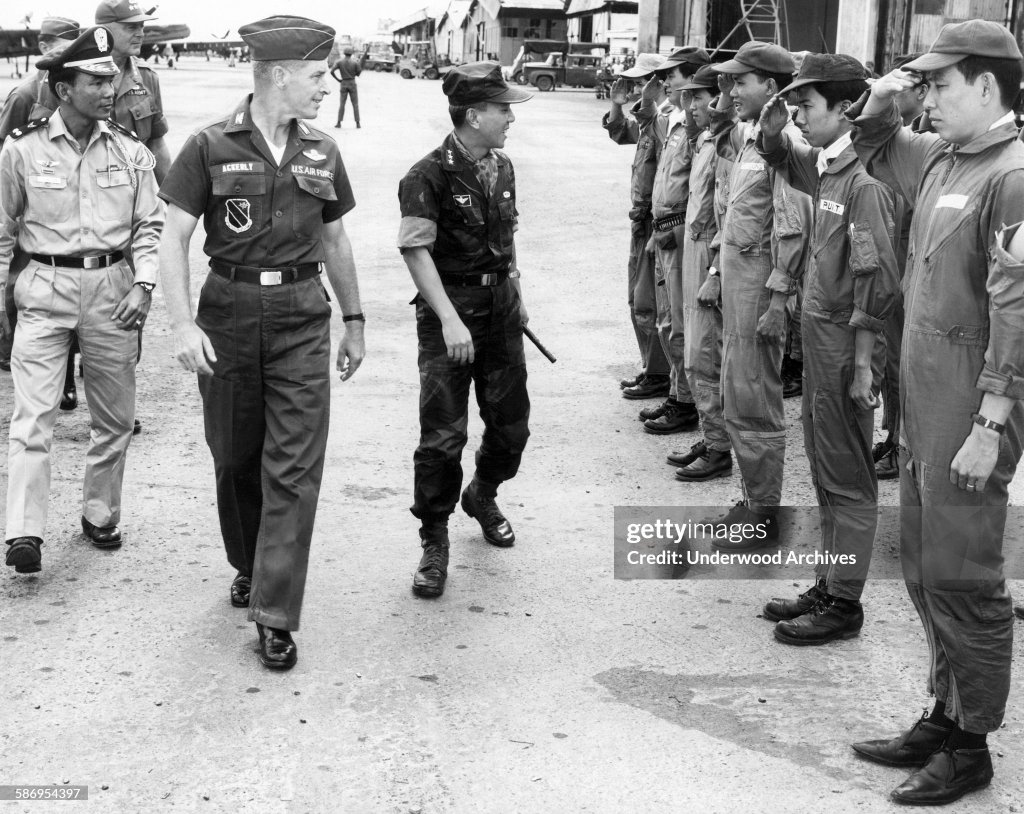
Johnson Administration officials expressed guarded optimism tonight that a solution of the South Vietnamese political crisis was imminent, with restoration of a unified government under civilian control. The military and civilian factions were reported to be near an agreement to end their three-week struggle for power. There is a possibility that an announcement of the political compromise they have worked out will be made tomorrow. If American officials were being guarded in their optimism, it was because they could not be certain, in the current situation in Saigon, where tempers are frayed and personality clashes are intense, that a settlement was reached until the agreement was signed and announced. There was concern, therefore, that some last-minute hitch might develop.
Even if the agreement were signed, the officials acknowledge, only the facade of civilian government will have been patched together. It is recognized that the military will continue to wield substantial power and that, at best, it can be prevailed upon only to keep this in the background. Basically, it was reported here, the agreement calls for military recognition of the authority of the civilian Government, with the Chief of State, Phan Khắc Sửu, and Premier Trần Văn Hương remaining in power.
As a concession to the military, it was said, the High National Council, now in abeyance, would be abolished. In its place some form of national congress would be established to provide the legal basis for the Government’s continuation. The council has become, at the least, the symbolic issue in the political dispute that has kept Saigon in turmoil and Washington in uncertainty for three weeks. The 17-man council was set up last November 1 as a provisional legislature to carry out the transition from military to civilian control.
The Armed Forces Council made a show of officially renouncing all their power to Prime Minister Trần Văn Hương, who was asked to organize elections. They also agreed to appoint a civilian body and release those arrested in the December coup.
The U.S. Ambassador to South Vietnam General Maxwell Taylor summed up the situation in a telegram to the U.S. government in Washington. “We are faced here with a seriously deteriorating situation characterized by continued political turmoil, irresponsibility and division within the armed forces, lethargy in the pacification program, some anti-US feeling which could grow, signs of mounting terrorism by VC directly at US personnel and deepening discouragement and loss of morale throughout SVN. Unless these conditions are somehow changed and trends reversed, we are likely soon to face a number of unpleasant developments ranging from anti-American demonstrations, further civil disorders, and even political assassinations to the ultimate installation of a hostile govt which will ask us to leave while it seeks accommodation with the National Liberation Front and Hanoi.”
Taylor opposed the introduction of U.S. ground units to help fight the VC (as proposed in frustration by President Johnson a few days earlier), endorsing instead a U.S. policy of graduated air attacks against the Hồ Chí Minh trail, the supply line for the PAVN/VC itself.
An Associated Press survey of 83 U.S. Senators shows considerable ambivalence and division on the situation in Vietnam. On the threshold of renewed Congressional debate over South Vietnam, many Senators share a sense of frustration and uncertainty over the course of the United States-backed war on Communism in Southeast Asia. Eighty-three Senators spoke out in an Associated Press survey today as Congress prepared to review the situation in South Vietnam. Senator Mike Mansfield of Montana, the Democratic majority leader, has forecast a full-scale debate in the Senate. “The problem is tragically difficult,” said Senator Alan Bible, Democrat of Nevada. “but I believe we must continue to do everything possible under the present policy — increasing the emphasis on a stable and responsible Vietnamese Government.”
Thirty-one of the Senators, ready to prescribe a course, voiced generally similar views, many of them suggesting negotiations later if the anti Communist forces are in a better bargaining position. “It’s a mistake to negotiate when losing,” said Senator William Proxmire, Democrat of Wisconsin. Ten Senators favored moving for negotiations now, some suggesting United Nations guidance toward a settlement based on neutrality.
Only three took an unqualified stand for expansion of the struggle into Communist North Vietnam. However, five others mentioned commitment of United States combat troops or action against North Vietnam as possible steps toward an end to the struggle. Senator George D. Aiken, Republican of Vermont, said the United States should not take either step unless the nation was ready to face an all-out war that would include nuclear weapons. Senator Mansfield said: “Expansion will not resolve the problem. It is more likely to enlarge it, and in the end we may find ourselves engaged all over Asia in full-scale war.”
Three Senators called for the withdrawal of United States advisers and military aid from South Vietnam. Raising the specter of a new Korea, Senator Allen J. Ellender, Democrat of Louisiana, said it was time for the United States to get out “without any ifs or ands.”
William Bundy submits a memo to Secretary of State Dean Rusk that expresses the bleak view held by some top administration officials: “The sum total… seems to us to point — together with almost certainly stepped-up Việt Cộng actions in the current favorable weather — to a prognosis that the situation in Vietnam is now likely to come apart more rapidly than we had anticipated.”
A senior United States military officer said today that the Việt Cộng had been experimenting in recent battles, capped by that at Bình Giã, with a more intensive form of warfare. The officer pointed to four occasions on which Communist guerrillas in regimental strength engaged Government troops. “It seems to be a test,” the officer said. “Only time will tell whether they can sustain the kind of losses they have been taking. In another month we should have a pretty clear view if a decision has been made to change their tactics.”
In the past the Việt Cộng have generally struck by night in small units, making little attempt to hold the villages they overran. Theories of guerrilla warfare call for a switch from this phase to a third, decisive, phase of conventional battles. The American spokesman said he was not talking about an abrupt move by the Việt Cộng to that third phase but about a decision to commit more troops that would stand and fight a few days to hold the towns they had captured.
He cited elements of a common pattern at An Lão, in central Vietnam; Ba Dua and Sóc Trăng, in the Mekong Delta, and Bình Giã. The action at Bình Giã is considered here to have been the most determined and best organized of major Communist offensives. The officer’s analysis came during a briefing for correspondents on the battle at Bình Giã, a village of Roman Catholic refugees from North Vietnam that is 40 miles east of Saigon.
Government forces have retaken the village, which is in Phước Tuy Province, and are clearing the jungle and the rubber plantations in the area. Superior Vietcong numbers at the outset and subsequent ambushes resulted in a large number of Government casualties. “Obviously, a lot of things went wrong.” the American officer said when asked about the tactical decisions that led to the high losses. “There were some bum decisions.” He declined to say whether American advisers had recommended a course of action different from the one employed by the Vietnamese.
The United States military mission made public today the total of combat casualties suffered by American military advisers during 1964. There were 136 Americans from the Army, Navy, Air Force and Marine Corps killed and 1,022 wounded, and 11 are listed as missing. There are at least 16,000 men serving as advisers under the United States Military Assistance Command. Thirty-two Americans were killed in 1961-62 and 76 in 1963.
The Prime Minister of Malaysia called today for immediate aid from the United Nations and the British Commonwealth against the threat of a major Indonesian offensive. The Prime Minister, Prince Abdul Rahman, declined to specify whether he wanted a United Nations peace-keeping force sent to Malaysia. “We can’t tell them in what form their aid should be given,” he said. Asked whether he wanted active help now or only in the event of a major Indonesian attack, the Prince. replied: “Of course they could wait, but we want them to decide and prepare for it now.”
L.N. Palar, Indonesian delegate to the United Nations, left New York for Jakarta tonight for consultations with President Sukarno regarding Indonesia’s withdrawal.
The Soviet leadership, through its press, accused President Johnson today in effect of giving only lip service to the cause of peace while doing nothing about it and even permitting United States “aggression” in South Vietnam to continue.
The United States again urged the Soviet Union today to follow an American example by voluntarily placing one of its atomic-power stations under inspection by the International Atomic Energy Agency.
President Johnson is preparing to submit a special message to Congress, probably early in the spring, outlining the Administration’s proposals for expanding trade with the Soviet Union and the countries of Eastern Europe.
Britain and the Soviet Union signed a five-year agreement today to exchange information about all aspects of agricultural research.
A cold war has broken out in Stanleyville between the United Nations and Congo Premier Moise Tshombe’s mercenary fighters. The old antagonists, who fought three rounds against each other in Katanga Province, have fallen out again over thefts and pillaging of United Nations supplies. The friction reached a high point last weekend when the United Nations threatened to withdraw its 11-man mission from Stanleyville unless the mercenaries returned four stolen jeeps and promised to stop pillaging. The warning was contained in a letter from Bibiano Ossorio-Tafall, chief United Nations envoy to Premier Tshombe.
Dr. Ralph J. Bunche, Under Secretary for Political Affairs at the United Nations, said today that he had no knowledge of any warning issued to Premier Tshombe of the Congo that the United Nations technical assistance mission would be withdrawn from Stanleyville unless some equipment reported stolen from its members by Mercenary troops was returned.
The issue of economic aid to Premier Tshombe’s Republic of the Congo was discussed intensively and indecisively today by the North Atlantic Council.
Communist China has sent a strong protest note to India, charging “new and grave intrusions” by Indian troops along the China-Sikkim border in the Himalayas, the official press agency Hsinhua reported today.
Another stage of Israel’s diversion of the Jordan River to irrigate the Negev Desert has been completed. Water from the Sea of Galilee, through which the river flows, started pouring into an artificial lake at Beit Netufa yesterday, shortly after a sluice gate was lifted into place. The Israel Water Authority said it would take three days to fill the lake, which has a capacity of 159 million cubic feet. Much of the water to irrigate crops next summer will pass through the lake and a pipeline to the Negev, but it will be years before the system can be used to full capacity because of the water’s high salt content, a spokesman said. Neighboring Arab states have threatened war over the Israeli project
Greece’s moderate Government moved further to the left today in a Cabinet reorganization.
Josef Stalin went into hiding for the first four days of the Soviet German war in 1941 and refused to see anyone or make any decisions on the conduct of the war, according to Ivan M. Maisky, Moscow’s wartime Ambassador to London.
The Panama National Guard will be prepared to meet any emergency this weekend during observances of the first anniversary of anti-American riots at the Canal Zone border.
Senator Stuart Symington, Democrat of Missouri, proposed today a legal ban on foreign aid to countries that permit the destruction of United States properties by rioters.
West Pakistan’s Minister for Law, Information and Parliamentary Affairs has denied that he has accused the United States of giving financial support to Miss Fatima Jinnah, the losing candidate in last Saturdays’ Presidential election.
Construction of Milan Cathedral was completed after 567 years, with the installation of the last of its massive bronze doors. Giovanni Colombo, the Archbishop of Milan, blessed the event with the words, “May this door be one to hope and salvation.”
Kuwait has weathered her first Government crisis in two years of parliamentary rule. A new cabinet, headed like its predecessor by Crown Prince Sabah al-Salem al-Sabah, was sworn in last night before Parliament.
Former King Saud of Saudi Arabia arrived in snow-covered Vienna today from Riyadh for an indefinite stay and treatment of heart and stomach ailments.
President Abdullah al-Salal of Yemen proclaimed a state of emergency last night, a few hours after he returned from consultations with President Gamal Abdel Nasser in Cairo. Hassan al-Amri, “the General of Yemen”, became Prime Minister of the Yemen Arab Republic for the second time, in a military government.
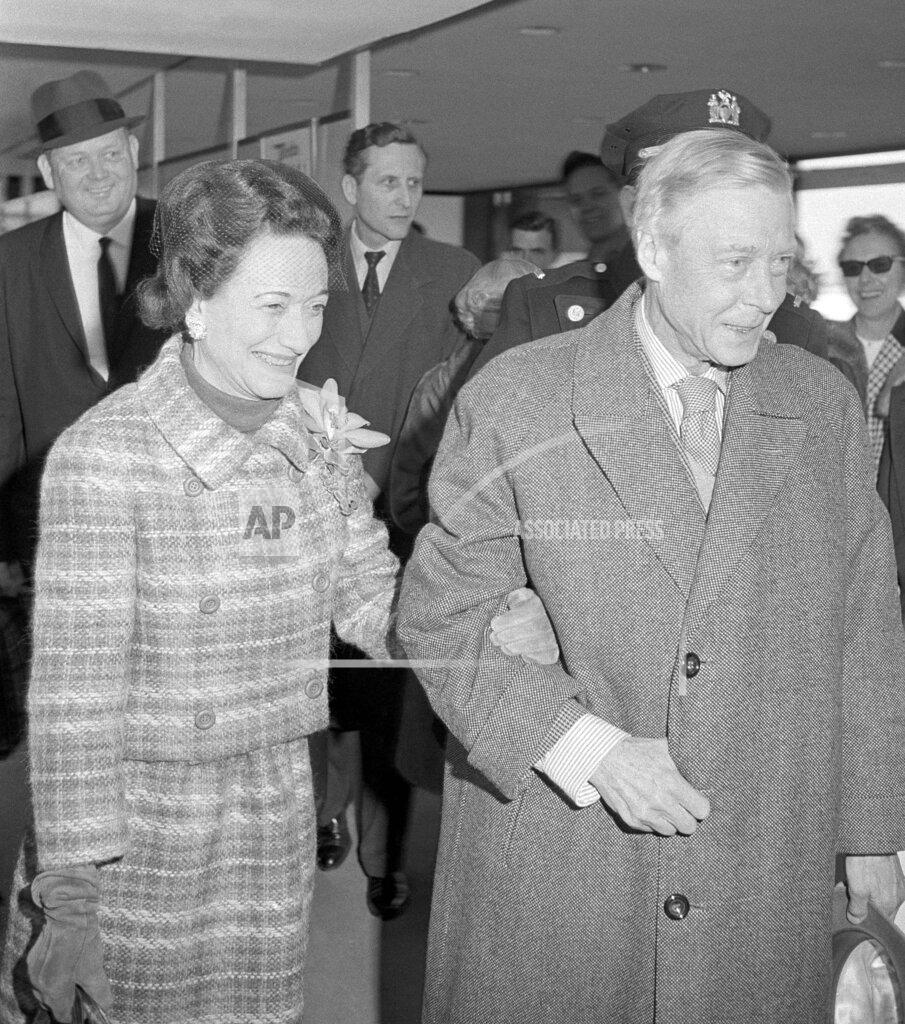
The 70-year-old Duke of Windsor returned to New York yesterday, with his Duchess on a flight from Houston, Texas, where he underwent abdominal surgery 21 days ago.
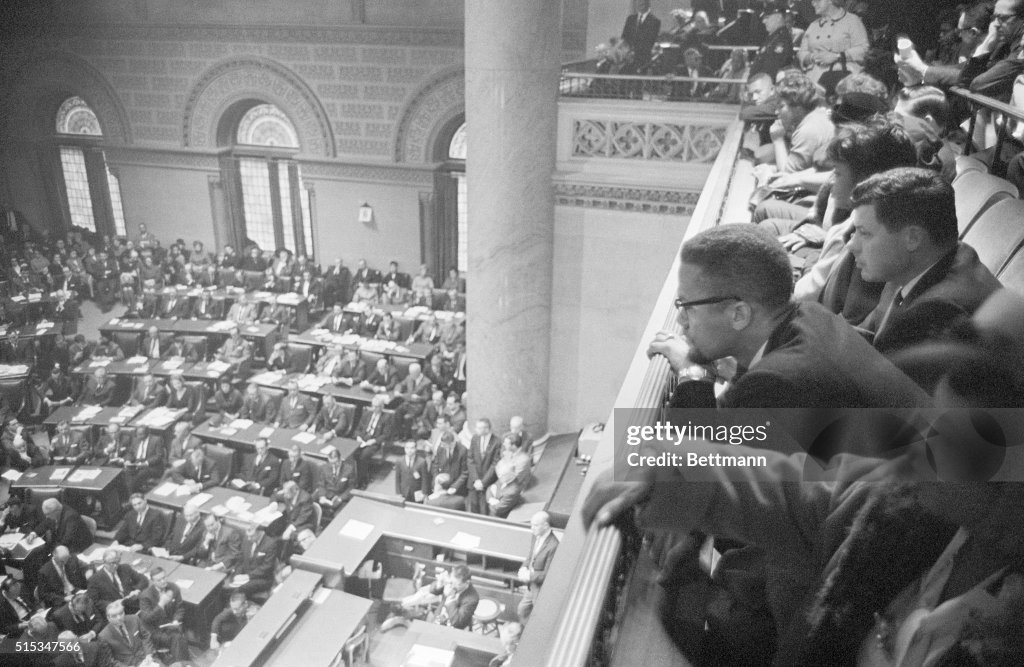
Lyndon B. Johnson and Hubert H. Humphrey were certified as the duly elected President and Vice President of the United States today at a joint session of the Senate and House of Representatives. The occasion was the official count of the vote of the Electoral College, which cast ballots in the state capitals and the District of Columbia on December 14. Observance of the traditional ritual was the last pre-inaugural requirement of the Constitution for the 36th President and his Vice President.
Republican leaders in Congress will propose soon the creation of a continuing, broadly representative body that would attempt to speak for the Republican party with one voice. The new body would not disturb existing political structures, such as the Republican National Committee, the Republican Governors Association and the Senate-House Leadership Conference. Instead, it would include representatives from all these and perhaps a few members from the county level as well. The idea, one well-placed source said, is to achieve a permanent organization that pulls everybody together, to provide better coordination and communication within the party. Present plans, still subject to change, call for an official and detailed announcement of the plan on Monday by Senator Everett McKinley Dirksen of Illinois and Representative Gerald R. Ford Jr. of Michigan, the minority leaders. Dean Burch, the Republican National Chairman, has been informed of the plan and is expected to take part in the news conference Monday.
Republican policy control tends to gravitate to Congressional leaders after the party has lost a national election. This is explained perhaps by the fact that, next to the White House, Congress offers the most effective forum in the country.) In view of this history, the plan to be proposed by Republican leaders in Congress would seem to be voluntary sharing of the leadership authority that naturally fell to them. However, pressures for change in the party organization, structure and personnel have been accumulating since the G.O.P. defeat in November. Thus the move by Congressional leaders may be defensive. Presumably their proposal has been accepted in principle by Mr. Burch, who has been under heavy attack from party liberals. The proposal might shift attention from Mr. Burch’s problem.
Senator Hugh Scott of Pennsylvania, who knows first-hand what it is to be the target of an angry uprising over leadership in a defeated party, said yesterday that Dean Burch was “through” as the Republican National Chairman.
Representative Charles A. Halleck of Indiana, uncertain over his proper role as a deposed Republican leader, is weighing an offer of a place on the House Rules Committee.
President Johnson will give Congress a heavy dose of reading next week when he will present four special messages in as many days. Tomorrow the President will present a special message on health that will include a call for passage of a medical care plan for the aged to be financed through Social Security. The White House press secretary, George E. Reedy, said that next week there would be messages on education on Tuesday, immigration Wednesday, foreign aid Thursday and the space program on Friday. It appeared that Mr. Johnson had decided to accelerate the preparation and delivery of these messages since originally the plan had been to space them more widely. Mr. Johnson spent today working in his office. In the afternoon he met with Secretary of State Dean Rusk and Secretary of Defense Robert S. McNamara.
President Johnson’s proposal for doubling Federal aid to education has already run into trouble of one sort — many members of Congress favor a far larger program.
President Johnson turned up today to watch his wife dedicate a life-size bronze statue of Sam Rayburn. At ceremonies in the New House Office Building, which bears the late Speaker’s name, Congressional friends of “Mister Sam” gathered for the event on what would have been his 83d birthday. The sculpture by Felix de Weldon, looking small and frail in the huge marble and granite building, was dedicated by Mrs Johnson in these words: “To all members of the 89th Congress and all future Congresses in hopes that — like Sam Rayburn — they will labor under the great white dome of the Capitol with the same faith in the people and the same nobility of purpose.”
Everett McKinley Dirksen, the Senate Republican leader, introduced today a resolution to amend the Constitution to permit one house of a state legislature to be apportioned on the basis of “factors other than population.”
U.S. Senator Karl Mundt of South Dakota (Republican) introduced a proposed amendment to the U.S. Constitution that would reform the electoral college system that had been in place since 1789. Under the Mundt proposal, which would fail in the Senate, the presidential candidate with the plurality of popular votes in a particular state would not necessarily win all of the state’s electoral votes. Mundt’s idea was to award one electoral vote for each congressional district where a candidate finished first, with two additional electoral votes to the overall winner of a particular state.
Senate liberals of both parties made their customary biennial move today to ease the rule for shutting off debate during a filibuster.
Senator B. Everett Jordan, Democrat of North Carolina, asked today that the Senate Rules Committee, which he heads, be relieved of any further work in the investigation of Robert G. Baker. “We have done a wonderful job,” he told the Senate. “We have no intention of quitting this job until we have done the work we set out to do.” But he said that the Senate’s newly authorized Committee on Standards and Conduct “ought to be activated to take over” any further evidence dealing with Mr. Baker’s activities.
Three white men accused of setting off an explosion outside a Black church in Montgomery, Alabama pleaded guilty to reduced charges today and received the maximum sentence. They were each fined $200 and costs and sentenced to six months in jail on charges of disturbing religious services, but they will be released after 10 days. The rest of the term. will be served on probation. Originally, the three — Henry Alexander, 35 years old, James White, 31, and Donald Landers, 19, all of Montgomery — were charged with setting off an explosive device near an inhabited building, a capital offense in Alabama. Circuit Solicitor Dave Crosland told City Judge Eugene Loe that the state had decided to reduce the charges because the explosion could not have injured Blacks in the church or damaged the property. The explosion outside the First Baptist Church during services last December 13 was caused when a gas-filled balloon attached to the rear of a pickup truck was exploded by an electric spark.
Two white youths accused of exploding a tear gas grenade in a Black residential area of Selma, Alabama were fined $10 each in City Court today and sentenced to six months in jail. Both defendants — Delton Lee Bickerstaff, and his brother-in-law, Ben J. Cobb — served notice of appeal.
The United States Commission on Civil Rights announced today that it would hold hearings on denials of voting rights to Mississippi Blacks and on discrimination in the administration of justice in the state, beginning February 10 in the city of Jackson.
The General Dynamics F-111 Aardvark, the first aircraft that could fold and unfold its wings while in flight, made its first successful demonstration of changing the wing sweep in flight. Richard L. Johnson and Val E. Pruhl, test pilots for General Dynamics, were the flight crew on the expensive fighter-bomber. Johnson commented later, “For the first time, with wing sweep, we can have an airplane with supersonic performance that, at the same time, does not need a concrete lake to land upon.” During the flight, “the wings were swept from the 16-degree full-forward position to the 72.5-degree full aft position.”
The Atomic Energy Commission said today that employment would be curtailed by 1,000 this year at its Oak Ridge, Tennessee, plant as a result of a reduction in Defense Department requirements for additional nuclear weapons.
Allan Dale Kuhn, one of the three suspects in the theft of 24 precious stones from the American Museum of Natural History, flew to Florida Tuesday night with two detectives in what was a secret effort to recover the stolen gems.
Dow Jones Industrial Average: 879.68 (+3.82)
Born:
Tim McDonald, NFL safety (NFL Champions, Super Bowl 29-49ers, 1994; Pro Bowl, 1989, 1991-1995; St. Louis-Phoenix Cardinals, San Francisco 49ers), in Fresno, California.
Greg Cox, NFL safety (NFL Champions, Super Bowl 23-49ers, 1988; San Francisco 49ers, New York Giants), in Niagara Falls, New York.
José DeJesús, MLB pitcher (Kansas City Royals, Philadelphia Phillies), in Brooklyn, New York, New York.
Lindsay Burns, American rower (Olympic silver medal, 1996), in Big Timber, Montana.
Bjorn Lomborg, Danish mathematician, born in Frederiksberg, Denmark.



 History Diaries