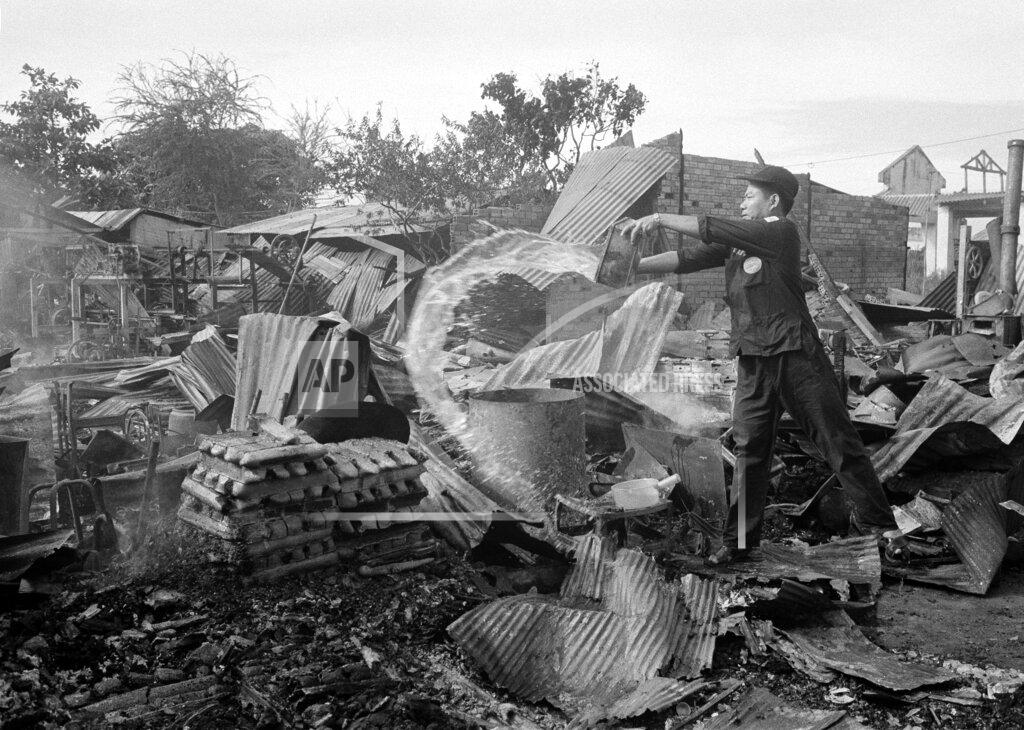
The Saigon command reported this morning that the beleaguered garrison of the provincial capital of Phước Bình began to crumble early this morning under a North Vietnamese tank assault. The town’s fall “is now only a matter of hours,” the command spokesman, Lieutenant Colonel Lê Trung Hiền, said gravely at a press briefing. Several hours after the briefing, the situation at Phước Bình was described as “desperate.” With no reinforcements being sent to the town, it seemed to be coming inexorably under the control of the numerically superior North Vietnamese forces.
Phước Long Province and its capital Phước Bình, about 60 miles north of Saigon, fall to the North Vietnamese. Phước Bình is the first regional seat taken from
Saigon since the fall of Quảng Trị on 1 May 1972. The South Vietnamese Air Force loses 20 planes defending the province, many to SA-7 missiles. The total lack of reaction from U.S. forces convinces North Vietnam that the Americans will not return to Vietnam; it also encourages Hanoi’s Lê Duẩn to urge more aggressive action to create a general uprising by 1976.
At the same time that the Saigon side’s defeat in Phước Long Province was unfolding, informed sources reported that, last night, Communist troops appeared to have overrun the small government garrison on Ba Den Mountain in Tây Ninh Province, 65 miles northeast of Saigon. The sources said that radio contact with the 80‐man force had been lost. The mountain dominates Tây Ninh city and would give the Communists ideal artillery emplacements from which to shell the provincial capital there.
In Saigon yesterday, President Nguyễn Văn Thiệu met with his top military commanders to decide whether to give all out support to Phước Bình or write off the garrison as lost. By this morning, no new reinforcements had been flown into the isolated battlefield. According to one account, there was great reluctance to send: any more troops into Phước Bình because to do so would weaken the defense of Saigon. Also, though the capture of a provincial capital is a prestige victory for the Communists, Phước Bình town and Phước Long province are of negligible military importance. About 200 airborne rangers were lifted into Phước Bình through heavy antiaircraft fire over the weekend. Other airborne ranger units were readied but were not sent into battle.
In Saigon, for the first time in more than three years, Việt Cộng rockets struck the city’s western outskirts, killing four slum dwellers and wounding 13 in an‐unsuccessful attack on a huge communications facility. The early‐morning rocket attack on the Phú Lâm area, just west of Saigon, where there is a military‐and‐civilian communications facility, fell short of the target. At least six rockets landed in a sprawling slum area, inhabited for the most part by Nung tribesmen who migrated here from North Vietnam in 1954, after the Geneva peace agreements. The four people killed, a young man, two girls and boy, had gathered at the house of Hua Hung Ven, a weaver, to celebrate his 62d birthday. The weaver was hospitalized with burns.
A State Department man is missing aboard an Air America plane that disappeared, on a flight over the central part of South Vietnam, and a second was killed in an explosion at his residence on the central coast. The man killed was identified by the United States Embassy as William E. Bennett, 36 years of age, of Springfield, Virginia. The missing man was identified as James A. Rawlings, 38 of Hyattsville, Maryland. Mr. Bennett was a political reporting officer for the embassy and was stationed at Tuy Hòa, on the central coast. Air America, which is operated by the Central Intelligence Agency, said that Mr. Rawlings had been aboard a leased C‐123 cargo plane that disappeared in bad weather Friday on a 30-minute flight from Đà Lạt, mountain resort, to Nha Trang, on the central coast. Mr. Rawlings was a supply officer with the United States Consulate at Nha Trang.
The latest military offensive of the Cambodian insurgents continued today within earshot of Phnom Penh, as the Communist‐led rebels seemed to be opening a new front south of the capital. As this year’s version of the insurgents’ annual dry‐season offensive went through its sixth day, the fighting on fronts to the northwest, north and east within 10 miles or less of the city remained heavy, and fleeing refugees kept pouring into the capital in large numbers. In the predawn hours, a barrage of more than 40 rockets fell in the area of the airport, about five miles west of the city. The rockets landed harmlessly, in empty fields and on unused parts of Pochentong Airport, but they underscored the vulnerability of the crucial airfield and of the military command’s main ammunition dump, situated only five miles away in Kambol. One Khmer‐language newspaper here reported the appearance in the city of leaflets from the insurgents warning of an attack soon on the airport area.
Meanwhile, to the south, fighting erupted less than 10 miles from Phnom Penh along the Bassac River, in an area that had been quiet until now. So far, this assault is not a major one, but it represents the opening of a new rebel front at a time when the Government has its hands full trying to cope with enemy drives from several other directions. Phnom Penh has been under this kind of heavy pressure before — the insurgents pushed just about as close to the city in the dry‐season offensives of both 1973 and 1974 — and the capital does not appear to be in any immediate danger.
There is no discernible panic in Phnom Penh, though many people in this refugee‐swollen city have become jumpy and nervous with the constant explosions of bombs and artillery fired by Government forces—and sometimes insurgent rockets fired at the city—that can be heard day and night. Yet despite the absence of an imminent threat to the capital, the situation remains difficult. Government troops, using all available reinforcements, have stabilized the situation on some fronts and pushed the insurgents back in places, but the rebels are still on the offensive in other regions.
North of the city, on the peninsula between the Tonle Sap and the Mekong River, the insurgents have taken many of the bridges along Route 7, and other Government outposts are isolated and in danger of falling. The Government will have to retake these bridges and positions if it is to protect the capital from rocket attacks from that direction—and also protect an artillery base and its main naval base, situated on this peninsula at Chrui Changvar Krau. As yet, however, Government troops have made almost no headway in dislodging the insurgents there.
The same is true on Route 1, which runs southeast out of Phnom Penh. Government forces have suffered severe casualties there and the insurgents have seized a 10‐mile stretch of the road, which parallels the crucial Mekong River supply route from South Vietnam. The government will have to clear this road if it is to protect the river convoys that are the main means of supplying food and American arms for the Government of Lon Nol.
On another front, only two miles or so east of Phnom Penh on the other side of the Mekong, the government has thrown large‐scale air and artillery firepower into an attempt to wipe out an enemy force that has been burning villages and firing rockets into the center of Phnom Penh almost daily. The enemy force on the eastern bank is not believed to be large and Western military sources think the assault there against such government garrisons as Arey Khsat is largely a diversionary one, to draw government troops from more important fronts. Some of these sources feel therefore that the government has expended more ammunition and manpower on this front than necessary.
No solid intelligence is available on the number of Cambodian insurgent troops now arrayed on the various fronts around the city, but some estimates put it at 15,000 to 20,000 with an unknown number in reserve. It is this as yet untapped reserve force that has the Cambodians and their American supporters concerned about a possible second and more intense phase of the offensive. Furthermore, the attacks on the several fronts have been well coordinated, and the insurgents have held together despite heavy casualties from government bombing and artillery — firepower that the insurgents do not have. Thus there can be no doubt that this is a serious offensive.
Military action to solve the oil problem, once a matter for cocktail‐party conversation in Washington, has become the subject of serious speculation here and abroad as a result of remarks by Secretary of State Kissinger. Today Kenneth Rush, American Ambassador in Paris, called on the French Foreign Minister, Jean Sauvagnargues, to “clarify” Mr. Kissinger’s statement refusing to rule out the possibility of intervention in the Middle East. Mr. Rush was one of several envoys to major European countries who were instructed to offer explanations of the remarks, particularly those interpreted as critical of European governments. Those comments appeared in an interview with Mr. Kissinger published last week by Business Week. Responding to questions about the oil problem, the Secretary said, “I’m not saying there’s no circumstances where we would not use force. “But it is one thing,” he added, “to use it in the case of a dispute over price; it’s another where there’s some actual strangulation of the industrial world.”
Later in the interview Mr. Kissinger, asked why Europeans were so hostile to the United States, especially in regard to its dealings with the Middle East, replied that “I think they suffer from an enormous feeling of insecurity that leads to “a certain peevishness.” Mr. Rush told Mr. Sauvagnargues that the Secretary had been referring to the past, and not to governments but to individuals, according to a Paris dispatch to The New York Times. The same explanation had already been given here. The French Minister’s reaction was not indicated, but the dispatch said he raised no objection to Mr. Rush’s explanation.
The Soviet press reported today that Secretary of State Kissinger’s refusal to rule out force in dealing with Middle East oil problems had “caused a stormy reaction in the world.”
The White House has no information to confirm a report that Soviet leader Leonid L. Brezhnev is suffering from leukemia, Press Secretary Ron Nessen said. Asked whether a Brezhnev-Ford summit is still planned for early summer, Nessen said, “I know nothing to change that.”
Physicist Andrei D. Sakharov said that his son-in-law had been waylaid near Moscow by two men who threatened him and his 15-month-old son with violence if Sakharov did not stop his dissident activities. The report followed delivery of a note to the family December 20 containing a similar threat. Sakharov called a press conference in his Moscow apartment to report the incident. He alleged the two men were security policemen.
President Valery Giscard d’Estaing launched a new, competitive system within the French state-run television network aimed at improving quality and increasing independence. Under the reform, the three state-run television companies will operate independently and in competition with one another. Until now, they have been controlled by the monolithic Office de Radiodiffusion et Television Francaise, which has been abolished.
The British subsidiary of Chrysler announced that it is putting thousands of workers on a three-day week because of the depressed auto market. The company said the short-time work will begin next week and last until the end of January, at least. Chrysler has plants in Coventry, England, and Linwood, Scotland.
Defense Minister Shimon Peres of Israel said today that Palestinian guerrillas in Lebanon had been reinforced by Palestinian troops frm Syria armed with missiles. He told Parliament that Israel would see any attempt by the Syrian army “to take a foothold” outside Syrian borders as “the start of a confrontation and the extension of aggression.” He did not specify whether the reinforcements were part of a Palestinian unit of the Syrian army. He said they were armed with antitank and anti‐aircraft missiles.
Indian and United States officials are seeking to resolve a deadlock over the terms of American food shipments. The snag, over financial matters and the wording of an agreement, has assumed political overtones, and officials on both sides are troubled. Secretary of State Kissinger is scheduled to meet T. N. Kaul, India’s Ambassador, tomorrow in an attempt to resolve the differences.
Oil seeping from a Japanese supertanker that ran aground early today outside Singapore Harbor formed slicks three miles wide in one of the world’s busiest shipping lanes. The tanker was carrying 237,000 tons of crude oil from the Persian Gulf to Japan. About 4,500 tons were spilled when the ship struck. The captain said there was no chance that the ship might break up. Fire-fighting ships and vessels from Singapore- based oil firms sprayed the waters between the oil slick and Singapore win detergent. There were fears that tides might bring the slick into the main part of Singapore harbor.
Sixty foreign missionaries petitioned for a free, open trial for 22 political prisoners branded by South Korea as Communists or Communist sympathizers. The prisoners, seven of whom were sentenced to death last year by military courts for anti-government activities, all belonged to the defunct leftist People’s Revolutionary Party. They were convicted along with 181 others under decrees banning open opposition to South Korea’s regime.
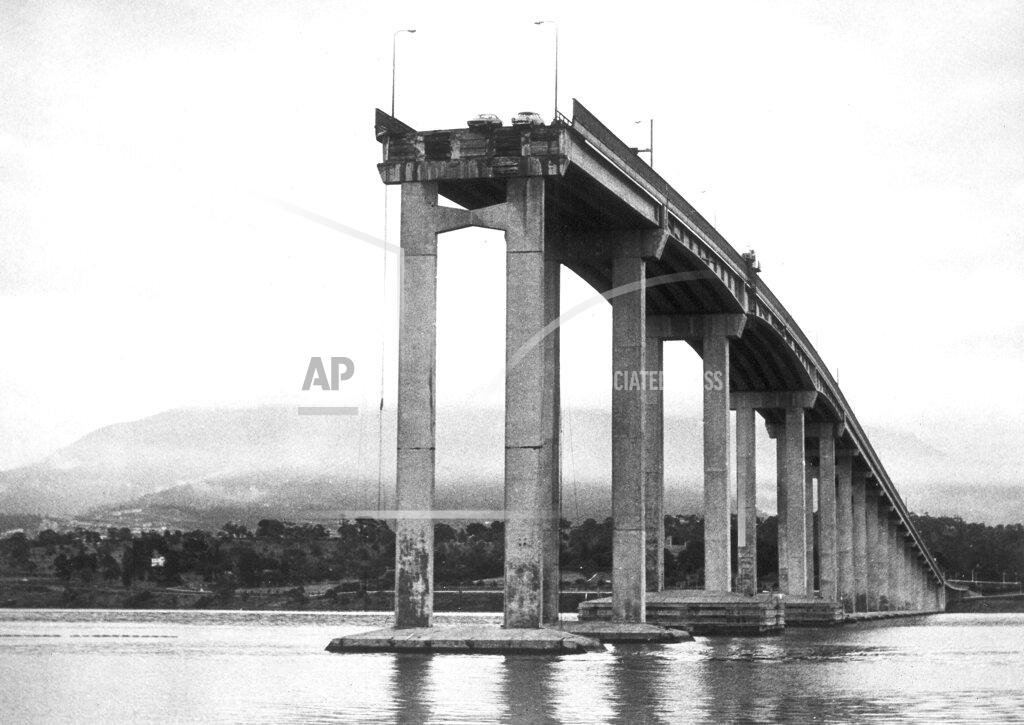
Divers searched the Derwent River in Tasmania for “an undetermined” number of persons still missing in the collapse of a bridge that was rammed by a British freighter Sunday. The bodies of five crewmen aboard the ship which sank almost immediately after the collision have been recovered. Four cars containing at least 13 people plunged 150 feet into the river.
Prime Minister Gough Whitlam of Australia arrived in Paris on an official visit today, marking the end of strained relations between his country and France over French nuclear tests in the South Pacific. President Valery Giscard d’Estaing announced last year that further French tests would be conducted underground, a promise that apparently satisfied the Australian Government. Mr. Whitlam’s two days of talks in Paris were focusing on reviving economic exchanges, sharply reduced by an Australian boycott during the series of French tests in the atmosphere.
Venezuela and Ecuador called for a special session of the Organization of American States to discuss US. “economic aggression” against Latin America. They also left little doubt that they would refuse to attend a meeting with Secretary of State Henry A. Kissinger in Buenos Aires in March. Both countries objected strongly to a clause in the recently signed U.S. trade bill that denies special trade status to countries that join cartels to control world prices of such products as oil and coffee.
The Brazilian government, in what was seen as a liberalization move, apparently has lifted its censorship of the newspaper O Estado de Sao Paulo, a constant critic of the authoritarian military regime. For the past two nights — in a step coinciding with the newspaper’s 100th anniversary celebrations — censors have failed to appear at the O Estado office and editions have been published in full without the lengthy columns of poetry that formerly were used to fill in for censored articles.
Two Argentine army generals were among the 13 people killed in the crash of a twin-engine military plane in rugged mountains of northwest Argentina, the police chief of Tucuman province announced. The crash occurred in a rainstorm shortly after the plane took off from Tucuman Sunday morning. All aboard were killed.
Foreign Secretary James Callaghan of Britain conferred today with President Julius K. Nyerere of Tanzania, winding up his consultations with African leaders directly involved in the latest search for a Rhodesia settlement. Mr. Callaghan’s talks with President Nyerere were held at Butiama on the eastern shore of Lake Victoria, about 800 miles inland from here.
Two African employees of the Vaal Reefs gold mine in Orkney, South Africa, died of injuries received in riots Sunday night, a mine spokesman said. Migrant workers from the African nation of Lesotho started the riot to protest a deferred-payment system introduced by the Lesotho government. Under the system, Lesotho citizens working in South African mines must deposit about 60% of their pay in Lesotho banks.
Twelve thousand black mine workers went on strike today at the world’s biggest gold mine, Vaal Reefs, after rioting that left a man dead and four critically injured. A spokesman for the mine, which is administered by the Anglo-American Corporation, said that the entire black labor force had refused to go underground. South African gold mines have been trouble‐plagued for nearly 18 months. Riots, mainly over pay and tribal differences, have caused nearly 60 deaths and scores of injuries.
Alan Greenspan, the chairman of President Ford’s Council of Economic Advisers, said that the nation’s economic slump could last longer and be deeper than anticipated. He predicted that unemployment would approach 8 percent of the work force this year. The administration, he said, still foresees a “bottoming out in economic activity by midyear.”
President Ford has requested the resignation of Alexander P. Butterfield, the federal aviation administrator, as part of a general shakeup directed at all prominent Nixon holdovers, according to White House sources. But the sources said that Butterfield, the man who disclosed the existence of the secret White House tape system which helped push former President Richard M. Nixon from the Presidency, would be given a chance to present the case for his retention in a meeting with White House chief of staff Donald Rumsfeld, probably later this week.
With only three weeks left for men to sign up for the amnesty program for convicted draft evaders and deserters, the Presidential Clemency Board launched a nationwide radio and television campaign to get word to those who are eligible. Board Chairman Charles E. Goodell said only 900 of the 100,000 eligible have signed, mainly because many did not know they were eligible. He said the board was mailing tapes to stations to be played as a public service. The deadline is January 31.
The Central Intelligence Agency was told by Senator John Sparkman, acting chairman of the Senate Foreign Relations Committee, to begin heeding new legislation that calls for an immediate stop to most foreign C.I.A. operations not solely aimed at the gathering of intelligence. The new restrictions on the agency came amid growing controversy over the make-up of the presidential panel named to investigate charges of domestic spying by the C.I.A.
Defense Secretary James Schlesinger is seeking some way to justify the construction of a squadron of radar command planes that would be the most expensive aircraft ever built by the Air Force. The Pentagon proposes to build 34 of the aircraft — basically Boeing 707 transports — at a cost of nearly $4 billion, but its plans have been stymied by the strong, persistent opposition of Senator Thomas Eagleton.
After the sale of gold was legalized in the United States, for the first time since 1933, on December 31, the U.S. Treasury conducted its first auction of a part of its gold reserves, setting aside an unprecedented 2,000,000 ounces (57,000,000 g) for sale, in individual 400-ounce (11,000 g) gold bricks, valued at $70,000 apiece based on the European market price of $175 an ounce. The first sealed bid that was opened was for $156 an ounce by the investment firm of Austern and Paul.
Mayor Fred Hofheinz said the Houston Police Department had compiled dossiers on a substantial number of residents, including U.S. Rep. Barbara C. Jordan (D-Texas) a member of the House Judiciary Committee. Hofheinz declined to identify any others in the files but said they included some of Houston’s most distinguished citizens. The mayor said Police Chief Carroll M. Lynn had been asked to purge the files and deliver the dossiers to him. Lynn said. “I found numerous names of persons on file who were never suspects in any case under investigation and I was surprised to see them there.” He said the files were compiled before he took office.
Supreme Court Justice William O. Douglas has been removed from the intensive care unit to a private room at Walter Reed Army Medical Center, and a spokesman said his condition continued to improve. Douglas, 76, spent a restful weekend. He had suffered a stroke New Year’s Eve when vacationing in the Bahamas. The hospital said Douglas had sat up in a chair briefly Sunday and that he was alert and resting comfortably.
The state will again step into the Boston school situation to supply “substantial police assistance” when the South Boston High School complex reopens Wednesday, Governor Michael S. Dukakis said. The governor made his statement after meeting with Boston School Superintendent William J Leary. The récommendation is for an estimated force of 300 state police and 100 Boston-area police. Since a partial desegregation order last June, sporadic violence has hit some schools, including the South Boston complex which was forced to close about a month ago.
The New Hampshire Supreme Court ruled that a lower court does not have the power to invalidate the bitterly contested U.S. Senate election in the state. The ruling was prompted by a Superior Court suit brought by Republican Senator-elect Louis C. Wyman, who had sought to have the election invalidated on grounds of voting irregularities, Wyman, recently declared a two-vote winner over Democrat John A. Durkin, said he did not consider his victory a mandate. Durkin opposed possible court action, saying it usurped the US. Senate’s role as final judge of the election.”
The Justice Department, under instructions from President Ford to emphasize antitrust action, already has reached a 12-year high in enforcement of antitrust laws, the agency said. Outgoing Attorney General William B. Saxbe said the department returned 33 indictments against antitrust violators in 1974 — the most in a single year since 1962. Saxbe said that in addition, the department also filed 38 civil suits against businessmen and companies.
Richard M. Nixon’s lawyers charged that a new law returning the former President’s tapes and documents to government control was passed by Congress as “a measure of punishment” and asked for an injunction against it. Meanwhile, Mr. Nixon lost a round in his battle to prevent public broadcast of tapes played as evidence at the Watergate coverup trial. U.S. District Judge Gerhard A. Gesell ruled December 5 that the tapes could be released once the trial was over, but his order was not final. He has refused a Nixon request to make it final immediately so appeals could begin, saying that to let appeals start now “would delay the ultimate determination of the issues. Gesell’s final order will set forth how the tapes will be made public.
Fifty barrels of tetraethyl lead, a dangerous chemical used as an “antiknock” compound in engines, were still floating somewhere in the Atlantic Ocean between Virginia and New York, about 190 miles at sea, the US. Coast Guard said. The 55-gallon drums containing the material — said by the Coast Guard to be “poisonous, explosive, caustic and flammable” washed off the decks of the containership Mormac-Vega in heavy seas last Thursday and have not been found. The drums, owned by E. I. duPont de Nemours & Co., are not believed to be washing toward shore, the Coast Guard said, but seamen have been warned not to approach any of the barrels should they be sighted.
Kern County supervisors in Bakersfield, California were assured by the president of the Los Angeles Board of Water and Power Commissioners that the Department of Water and Power would file applications for any zone changes or permits required by Kern County for construction of the proposed $4.5 billion San Joaquin Nuclear Project near Wasco. Burton J. Gindler also told the supervisors that a draft environmental impact report on the project would be released for public review in February. He said that no purchases of water, land or capital equipment in respect to the project would be made until a final EIR has been certified.
Officials of 11 Atlantic Coast states were scheduled to meet today to unify opposition to the federal government’s plan to allow oil drilling along the continental shelf. The conference, called by Governor Brendan T. Byrne of New Jersey, is expected to ask the Interior Department to hold regional environmental hearings before beginning offshore oil explorations. Jared G. Carter, deputy under secretary of interior, was scheduled to attend.
An attempt by Malcolm Forbes to become the first person to fly a balloon across the Atlantic Ocean ended before it started. Multimillionaire publisher Forbes and aerospace scientist Thomas Heinsheimer were preparing to lift off from Santa Ana, California in the Windborne for a 7,000-mile (11,000 km) trip.
“AM America,” which would later be replaced by Good Morning America, made its television debut on ABC at 7:00 am Eastern time. Intended to compete against the Today show and The CBS Morning News, the news series was hosted by Bill Beutel, with co-hosts Stephanie Edwards and Peter Jennings.
“Another World,” an afternoon soap opera airing on NBC since 1964 as a 30-minute show, expanded to 60 minutes. It was the first ongoing attempt of a U.S. serial to air in a time slot of that length, and would be the beginning of a wave of other soaps expanding to 60-minute lengths. The last long-running 30-minute serial to expand to 60 minutes would be The Young and the Restless in 1980.
The game show “Wheel of Fortune,” created by Merv Griffin and inspired by the children’s game “Hangman”, premiered on NBC at 10:30 am Eastern time. The original hosts were Chuck Woolery and Susan Stafford, who would be replaced in 1982 by Pat Sajak and Vanna White, respectively.
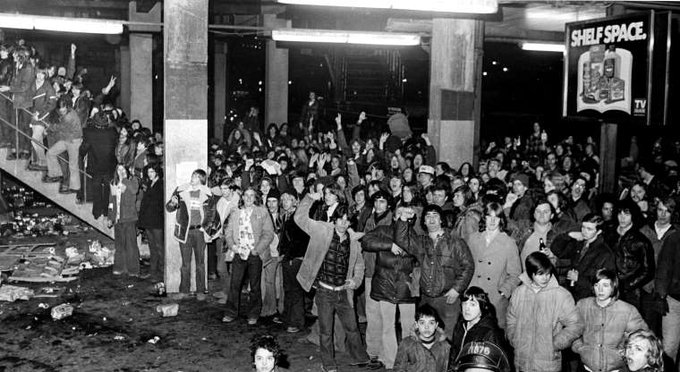
A thousand Led Zeppelin fans, waiting overnight inside the lobby of the Boston Garden for tickets to the group’s February 4th gig to go on sale, cause a riot and an estimated $30,000 damage.
Dow Jones Industrial Average: 637.20 (+2.66, +0.42%)
Born:
James Farrior, NFL linebacker (NFL Champions, Super Bowls 40 and 43-Steelers, 2005, 2008; Pro Bowl, 2004, 2008; New York Jets, Pittsburgh Steelers), in Ettrick, Virginia.
Mike Reed, NFL running back (Philadelphia Eagles), in Washington, District of Columbia (d. 2014, of cancer).
Jeremy Linn, American swimmer (Olympic silver {100 m breaststroke} and gold {4×100 m medley} medals, 1996), in Harrisburg, Pennsylvania.
Laura Berg, American women’s softball outfielder (Olympic gold medal, 1996), in Whittier, California.
Ricardo Santos (aka Ricardo), Brazilian beach volleyball player (Olympic gold medal, 2004), in Salvador, Bahia, Brazil.
Jason King, English radio DJ (Radio 1), in Tenbury Wells, England, United Kingdom.
Died:
Burton K. Wheeler, 92, American isolationist U.S. Senator (D-Montana, 1923–1947).
Noel Madison, 77, American actor (“Jitterbugs”, “Black Raven”)




 History Diaries