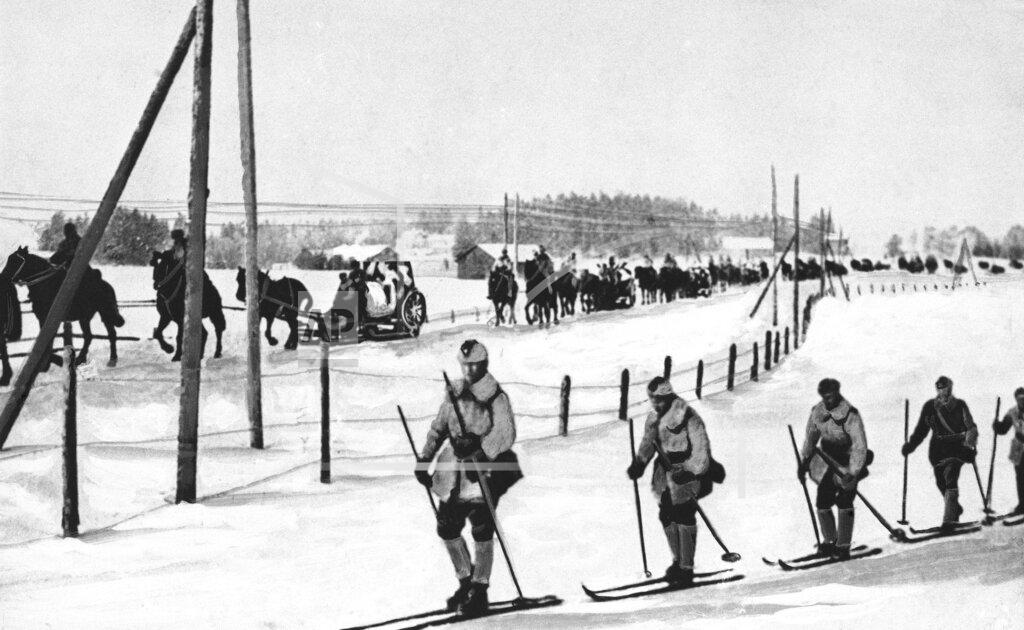
Finns give Soviet 44th division another day to suffer in the subzero temperatures while they prepare for an assault on Raate Road. They drag guns & munitions into place and Task Force Kari clears Soviet flank forces from the village of Eskola. Many Soviet troops freeze to death or die of starvation & frostbite is widespread. Dry gangrene is common as limbs quickly mortify from frostbite & minor wounds. Amputated limbs pile up. Colonel Siilasvuo now gives his troops the final order to attack.
General Vinogradov orders — or, more aptly stated, permits — the trapped 44th Rifle Division to try to break out again. Just as on the 3rd, this attempt fails miserably.
General Chuikov in command of the Ninth Army is running out of options. He cannot get supplies to the trapped men, and he discovers today that, contrary to false assurances from Colonel Volkov on the Ratte road, they have no connection to the outside world. Chuikov informs the Stavka that a disaster is brewing. He manages to get a plane in the air, which drops bags of dry tack. He tentatively plans for a full-scale relief attempt on the 5th.
The trapped Soviets, meanwhile, realize their predicament completely. Captain Pastukhov of the 2nd Battalion, 146th Rifle Regiment, whose troops have not eaten in four days, leaves his own position to consolidate his troops with the headquarters of the nearby 305th Rifle Regiment. He explains that he has no more ammunition anyway. Since this leaves a hole in the Soviet defenses, General Vinogradov orders him to return. Before he can get back there, though, the Finns move in and cut the road where his troops had been. This produces another Motti (log).
Further east, Task Force Kari takes the village of Eskola.
At Salla, Detachment Roininen breaks off its attack at Joutsijärvi.
In the Eastern Isthmus, Finnish troops repulse the enemy offensive at Kirvesmäki in the Taipale sector.
The Soviets attack the vital Finnish railway line that heads through Sweden to Narvik.
The Finns bomb Soviet island bases on Oesel and Dagoe.
The Finnish Ministry of Education urges parish priests and officials to reserve areas for establishing heroes’ cemeteries as a matter of urgency
The voluntary defence organization Maan Turva organizes a tour of the front by well-known entertainers which becomes popularly known as the ‘anti-boredom battery’. The main attractions are the popular character actor Aku Korhonen and the conductor George de Godzinsky. Others taking part in the tour include Siiri Rantanen, Uuno Laakso, the accordionist Onni Laihanen, and the actress Tuire Orri.
The period for completing tax return forms and paying both income and property tax in Finland is extended to April 1st.
Members of the public in Finland are forbidden to take photographs of the damage caused by enemy bombers or of equipment used for military or civil defence.
Sweden rejects the Allied offer of assistance in respect of both armaments and troops.
An anonymous Danish businessman announces he is to donate 50 lorries to Finland.
The first Norwegian volunteers departed Oslo, Norway for Finland.
Finland seeks German mediation in war against Soviet Union. Germany, of course, has secretly allocated Finland to the Soviet sphere in the Ribbentrop/Molotov agreement.
Britain & France develop plans to send troops to Finland overland via Norway & Sweden (requiring, of course, permission from these two neutral countries). Great Britain and France are formulating plans to send troops to Finland via the Narvik railway. That line extends from the port to Oulu and Helsinki, but it passes through Sweden. Swedish iron ore at Gällivare, which is typically shipped from Narvik, is on the priority list for seizure by both sides, so there may be ulterior motives behind these troop transfer requests. Foreign Secretary Lord Halifax asks Norway for permission to use the port, but curiously only copies Sweden on the request – when the Swedes have complete control over the line. It is as if he considers Swedish acquiescence a foregone conclusion. He cites German sinkings of British freighters as a pretext. Sweden, for its part, has been holding on to its neutrality with an iron fist, though if anything it leans toward the British and French.
Hermann Göring was appointed head of the German war economy. His primary mission is to find ways around the British blockade. He studied economics in school. Walther Funk was made Executive Vice President for the economy.
The Soviet Union and Bulgaria complete a trade treaty.
The Polish government-in-exile reached an agreement with French authorities to establish Polish military units in France. French Prime Minister Daladier and General Sikorski sign agreement for arming and equipping Polish forces in France, primarily from 85,000 Polish military personnel interned in Hungary, Rumania, Lithuania, and Latvia.
Adolf Eichmann reaffirmed that “On the order of the Reichsfuhrer-SS the evacuation of all the Jews from the former Polish occupied territories is to be carried out as a top priority.”
After the recent wave of arrests reported from Prague, it is learned that Czechs, fearing arrest, have adopted the practice of changing their sleeping quarters nightly. It is impossible to obtain confirmation of the total number of victims of the new Gestapo drive, but it is believed to run into many hundreds.
The forthcoming visit to Italy of Count Stephen Csáky, Hungarian Foreign Minister, which was announced at first as private, is treated today as an event of the utmost political importance.
The Irish parliament completed action tonight on an emergency powers bill giving the government authority to intern without trial members of the outlawed Irish Republican Party. Premier Eamon de Valera’s Special Powers Bill to combat the outlawed Irish Republican Army was passed early today after government spokesmen had pictured the I.R.A. as a highly organized criminal organization “with a war chest full of United States dollars.”
Tales of Jews shot and tortured in Poland, as well as reports of fines amounting to impoverishment imposed by Nazis on Jews in sections of that country occupied by Germany, are reaching Jewish organizations in London.
The British bacon ration to be introduced on January 8th is fixed at four ounces per person per week.
All British merchant shipping is requisitioned for the war effort.
The British declare that no one with a German passport, including Jewish refugees, is to be allowed into Palestine.
The British 48th Infantry Brigade moves to join the BEF in France.
The Luftwaffe attacks the British liner Tuscan Star, but the ship’s anti-aircraft guns drive them off.
The RAF conducts reconnaissance over the German seaplane bases in the Heligoland Bight.
Admiral Max Horton becomes Flag Officer, Submarines.
The British tug Swarthy sank at Portsmouth. Later salvaged, repaired and returned to service. Minesweeper HMS Saltburn alongside was damaged at the time.
Kriegsmarine cruiser Karlsruhe and Schiff 23 capture Swedish vessel Konung Oscar with 41 Polish refugees aboard.
Kriegsmarine armed merchant cruiser Schiff 20 sinks an Estonian freighter.
The British cargo ship Ardongorm ran aground on the Gwineas Rock, near Dodman Point, Cornwall (50°14′42″N 4°45′36″W), broke in two and was wrecked. All 36 crew were rescued by the lifeboat C.D.E.C. of Fowey (Royal National Lifeboat Institution). The wreck was partly salvaged.
The Irish cargo ship Maigue ran aground on Cape Clear Island, County Cork and was beached in a sinking condition. She was refloated on 21 May but was damaged beyond repair and was subsequently scrapped.
Sloop HMS Egret was in a collision with steamer Sea Valour (1950grt) at 0808/4th. The steamer only received minor damage, while HMS Egret was repaired at Cardiff in three weeks.
U.S. freighter Exiria is detained at Gibraltar by British authorities.
Convoy OA.66 departs Southend.
Convoy OB.66 departs Liverpool.
Convoy HXF.15 departs Halifax for Liverpool.
The War at Sea, Thursday, 4 January 1939 (naval-history.net)
Armed merchant cruisers WORCESTERSHIRE and ANDANIA arrived in the Clyde after Northern Patrol.
Battleship NELSON departed Loch Ewe. Old German steamer ILSENSTEIN sailed from Loch Ewe ahead of her to detonate any remaining mines. Escorted by destroyers FAULKNOR, FOXHOUND and IMPULSIVE, NELSON proceeded to Portsmouth, arriving on the 7th for repairs which began on the 14th. FAULKNOR, FOXHOUND and IMPULSIVE were ordered to remain at Portsmouth for two days, then return to the Clyde. Destroyers ISIS, FAME and FORESIGHT proceeded independently at the same time to Devonport and returned to the Clyde with FAULKNOR, FOXHOUND, and IMPULSIVE. NELSON was repairing until early June 1940 at Portsmouth, arrived at Greenock on 8 June for refitting and departed on the 29th to rejoin the Home Fleet at Scapa Flow.
Anti-aircraft cruisers CAIRO and CALCUTTA completed their anti-aircraft guard duty at Loch Ewe and departed, arriving at Sheerness on the 6th.
Battleship RODNEY, battlecruiser REPULSE and destroyers INGLEFIELD, IMOGEN, ICARUS, MOHAWK, BEDOUIN, KINGSTON, FIREDRAKE and MATABELE departed Greenock on patrol. Destroyer FEARLESS departed Scapa Flow to relieve MOHAWK, which was sent to Portsmouth for repairs. Destroyers FORESIGHT and SOMALI also departed Greenock on the 4th for repairs at Plymouth and Middlesbrough respectively. After the patrol, MATABELE went to Plymouth for refitting.
Light cruiser AURORA departed the Clyde after refitting, and arrived at Scapa Flow on the 5th.
Light cruiser ENTERPRISE departed Portsmouth, and arrived at Halifax on the 10th.
Convoy FN.63 departed Southend, escorted by sloops BITTERN and FLEETWOOD. Southeast of Shipwash Light Vessel in 51-57N, 01-48. 7E, BITTERN attacked a submarine contact. The convoy arrived in the Tyne on the 5th.
Convoy FS.64 departed Rosyth with tankers BRITISH UNION and BRITISH CONSOL for the Tyne, escorted by destroyer VIVIEN and sloop PELICAN. Sloop BITTERN replaced VIVIEN on the 5th, and the convoy arrived at Southend on the 6th.
Tug SWARTHY sank at Portsmouth, but was later salved. Minesweeper SALTBURN alongside was damaged at the time.
Submarine THISTLE arrived at Rosyth after patrol.
Submarine H.34 departed Dundee for Rosyth escorted by minesweeping trawler CRANEFLY (312grt).
Sloop EGRET was in a collision with steamer SEA VALOUR (1950grt) at 0808/4th. The steamer only received minor damage, while EGRET’s was repaired at Cardiff in three weeks.
Convoy OA.65 departed Southend escorted by destroyer BROKE from the 4th to 6th. Destroyer AMAZON escorted the convoy from the 5th to 6th, when it dispersed.
Convoy OB.66 departed Liverpool escorted by destroyers VANOC and VOLUNTEER, and after it dispersed, the two destroyers joined HG.13 on the 6th.
Convoy HXF.15 departed Halifax at 0900 escorted by Canadian destroyers HMCS FRASER and HMCS RESTIGOUCHE, which detached on the 6th. Ocean escort was armed merchant cruiser LETITIA, which detached on the 13th. The convoy was joined in Home Waters by destroyer WHITEHALL from the 12th to 15th, when it arrived at Liverpool.
Aircraft carrier ARK ROYAL arrived at Dakar and battlecruiser RENOWN at Freetown for refueling. Departing on the 7th, ARK ROYAL joined RENOWN off Sierra Leone on the 8th after she had left earlier that day with destroyers HERO and HASTY. They searched unsuccessfully for German supply ship ALTMARK in the South Atlantic until arriving at Freetown on the 19th. Destroyer DAINTY departed Gibraltar for Freetown and briefly joined RENOWN for transfer of mail before arriving on the 10th at Freetown for escort duties.
German steamer QUITO (1230grt) departed Guayaquil, Ecuador, and arrived at Coquimbo, Chile on the 12th. The only German ship remaining at Guayaquil was steamer CERIGO (1120grt) which was later scuttled on 1 April 1941 and salved as 29 DE MAYO for Ecuadorian use.
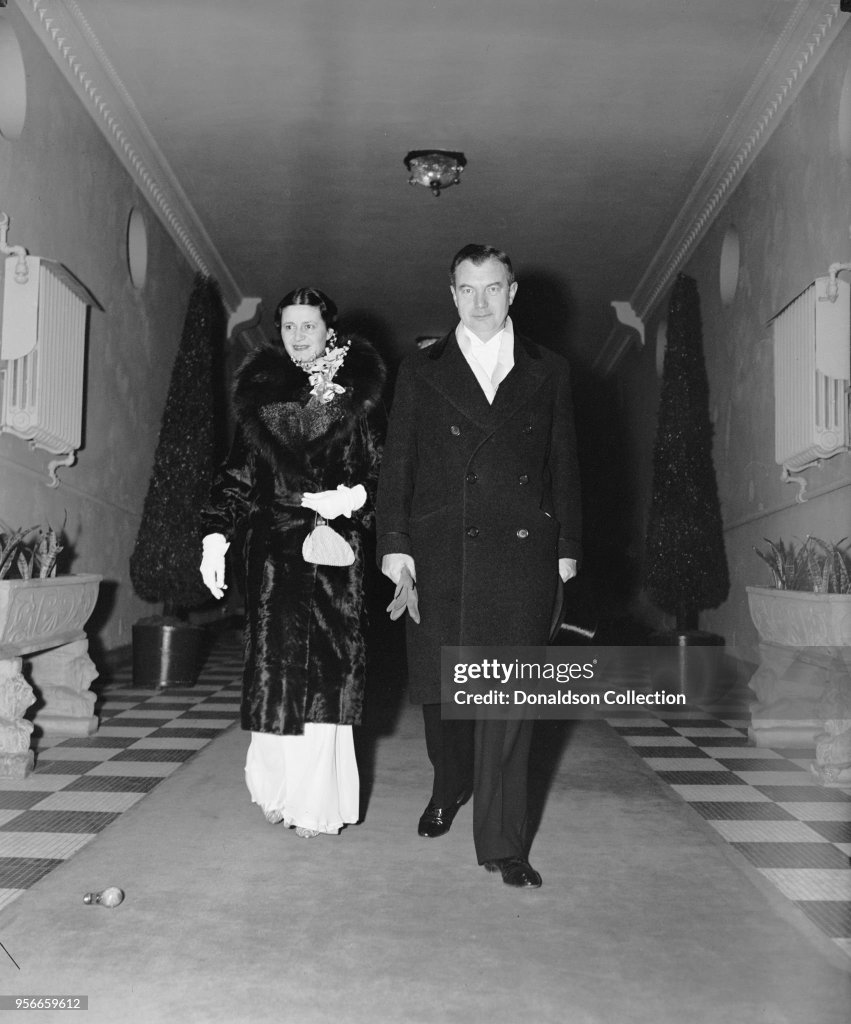
President Franklin Roosevelt nominates Attorney General Frank Murphy as an Associate Justice of the U.S. Supreme Court. U.S. Solicitor General Robert H. Jackson is nominated as the next Attorney General, and Judge Francis J. Biddle of the third U. S. circuit court of appeals to be the new solicitor general. President Roosevelt nominated U.S. Attorney General Frank Murphy of Michigan today as associate justice of the Supreme Court to succeed the late Pierce Butler, and thus raised to five the number of his appointments to the court, a record exceeded only by George Washington and equaled only by Presidents Taft, Lincoln and Jackson.
To succeed Attorney General Murphy, Mr. Roosevelt nominated Robert H. Jackson of New York, now Solicitor General. He appointed Circuit Judge Francis Biddle of Pennsylvania to take Mr. Jackson’s present post. The nomination of Mr. Murphy, now 46 years old, for the Supreme Court, and the consequent reorganization in the Department of Justice, had been expected in Washington, where it was known that the President had prevailed upon the former Governor of Michigan, who also had been High Commissioner to the Philippines, to accept the post over a reputed protest by Mr. Murphy.
The appointment was immediately praised not only by Senator Barkley, majority leader of the upper house, but by the minority leader, Senator McNary, and such. figures as Senator Borah, who declared it “a good appointment.” This was regarded here tonight as assuring Senate confirmation. While some members of both houses today criticized Mr. Murphy’s handling of the sit-down strike situation as Governor of Michigan, it was recalled that, before his confirmation as Attorney General, Mr. Murphy appeared at his own request before a Senate committee to explain the manner in which he handled this problem, making a good impression, numerous Senators said.
While it was noted that President Roosevelt, in appointing a majority of the nine members of the present court, had been equaled in new appointments to the court by only three Presidents and exceeded only by the first, President Taft actually made six appointments. Mr. Taft promoted Associate Justice Edward Douglas White to be Chief Justice, in addition to naming five new members. Besides Mr. Murphy, the President has named the following to the Supreme Court: Hugo Black, Stanley Reed, Felix Frankfurter and William O. Douglas. They succeeded, respectively, Justices Van Devanter and Sutherland who retired, and Justice Cardozo who died and Justice Brandeis who retired. At his regular press conference
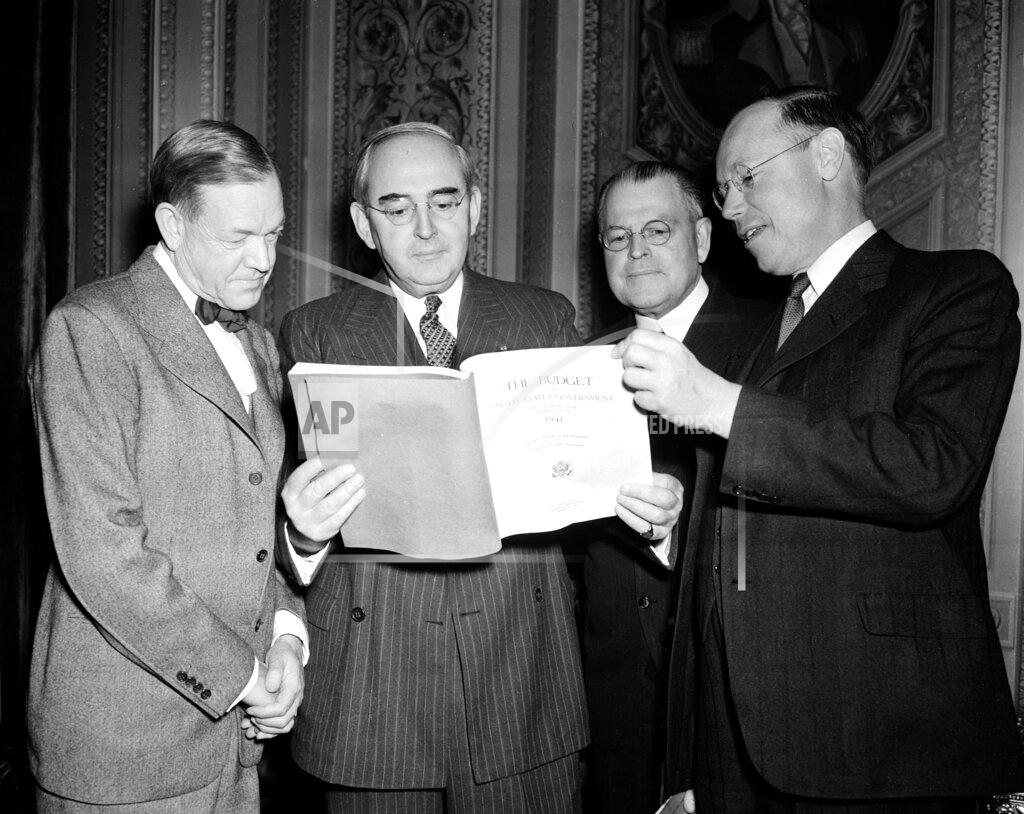
Federal expenditures of $8,424,000,000 for the fiscal year 1941 and a possible minimum deficit of $1,716,000,000 were forecast by President Roosevelt to Congress today in a budget message recommending reductions in practically every major spending category except national defense. Total revenues were estimated at $5,548,000,000, exclusive of social security collections, but the possible minimum deficit figure was reached by the anticipation of new taxes and a recovery of excess capital funds from government corporations.
The new fiscal year runs from July 1, 1940, to June 30, 1941. The estimated outlay was $675,000,000 less than the most recent estimates for the current fiscal year, and the expected. tax yield $382,000,000 more. Exclusive of carryovers and debt retirement, the actual new appropriations, as distinguished from actual expenditures, were estimated at $8,101,000,000, against $8,889,000,000 in the fiscal year 1940.
By the same document, which was labeled immediately by Administration leaders as an “economy budget,” despite its militant defense of the spending policies of the New Deal, the President recommended new taxes to bring in at least $460,000,000 to finance an emergency program of national defense, and the recovery by the Treasury of excess “capital funds” of various Federal credit agencies up to a total of $700,000,000. With these two items added to the “receipt” side of the ledger, the President figured that the gross spread of $2,876,000,000 between the government’s estimated income and outgo could be reduced to the $1,716,000,000, or the second lowest net deficit in ten years.
For the first time since he became President he announced cancellation of a semiweekly press conference, stating that tomorrow’s conference would not be held because he had no news.
The Senate received the budget message and adjourned at 12:58 PM until noon on Monday.
The House heard Representative Hoffman attack the National Labor Relations Board and adjourned at 1:14 PM until noon on Monday.
Senator Harrison, chairman of the Finance Committee, stated tonight that he would introduce a resolution Monday for creation of a temporary joint Congressional committee which would study the problems of new taxation and reduced appropriations laid at Congress’ doorstep today by President Roosevelt in his budget message, and recommend solutions. The suggestion for a joint committee, consisting of six members each from the House Ways and Means and Appropriations Committees and the Senate Finance and Appropriations Committees, was made originally last Spring by Secretary Morgenthau, but House reaction then and tonight was cool to the proposition.
New York District Attorney Thomas E. Dewey, an aspirant for the Republican nomination for President, characterized yesterday President Roosevelt’s address to Congress on Wednesday as “a tragic confession of failure.” Mr. Dewey made this assertion on his return from a week’s vacation at Augusta, Georgia, when interviewed at the Pennsylvania station. The President’s message was an attempt to defend seven years in which there has been no success in solving either of the two major political problems, unemployment and an increasingly unbalanced budget,” Mr. Dewey said. “It was an attempt to defend a situation where we cannot pay ordinary expenses of government and the reasonable expenses of national defense without going far deeper into debt. The President asks unity behind a domestic program which has failed and has brought about these results.”
The activities of Communists in the United States are considered a more important field of investigation than those of the Nazis, according to a survey of the American Institute of Public Opinion, of which Dr. George Gallup is director.
The long dormant project for a deeper St. Lawrence waterway, with collateral hydroelectric power development, was revived today under circumstances pointing to the relatively early conclusion of a treaty which will make the improvement possible.
The Governor of Mississippi dispatched National Guard troops to Meadville in an attempt to prevent a lynching.
James H.R. Cromwell of New Jersey, husband of Doris Duke, tobacco heiress, was appointed Minister to Canada today to fill the vacancy caused by the recent resignation of Daniel C. Roper former Secretary of Commerce.
A hotel fire in Omaha, Nebraska caused $200,000 in damage and critically injured a 69-year old woman.
The Reds send sore-armed lefty Lee Grissom to the Yankees for 26-year-old pitcher Joe Beggs. As noted by historian Lyle Spatz, Beggs had to clear waivers from all 7 American League teams, who likely were not aware of the impending swap. This is due to the new rule voted last month barring the American League pennant winner (read Yankees) from any trades within the league. Beggs will go 12–3 for the Reds, while Grissom will be sold to the Dodgers on May 15.
Chinese 4th War Area captures Kuantu.
Battle of South Kwangsi: Chinese forces capture Chiutang, five miles south of Kunlunkuan.
The Japanese offensive in Northern Kwangtung Province has been smashed and the Japanese forces there have lost their striking power as a result of Chinese counterattacks causing a general retreat of enemy troops, a Chinese military spokesman told foreign correspondents here today. The Japanese casualties were said to total more than 10,000. The Chinese victory was declared to be equal in importance to last year’s defeat of the Japanese northward of Changsha.
The Chinese spokesman said the Japanese offensive was being carried out by three columns, each composed of a division. One moved along the Canton-Hankow Railway, the central column along the Canton-Hankow highway, and the third formed the right wing along a provincial road from Lungmen northward.
Meeting each column in mountain terrain favorable to the defenders, the Chinese combined flank and frontal attacks to administer a crushing defeat to the invaders, the spokesman declared. The left column, he said, fell back after reaching Yingtak; the central column was licking its wounds at Liangkow after a disastrous defeat at a point northward, and the right column was withdrawing after a rebuff at Yungyun. The central column, which the spokesman said was made up partly of troops of the Tokyo garrison, was said to have suffered most. The Chinese spokesman admitted the Japanese had pushed 3,000 reinforcements from the seacoast toward Nanning.
The Japanese Army’s foray northward of Canton resulted in the capture of virtually the entire reserves of munitions and war supplies that the Chinese Army had been able to accumulate in that area within the last twelve months, a Japanese spokesman announced in Shanghai tonight. The spokesman again derided Chinese claims of victories in the Canton areas, asserting that when the Japanese advances northward were begun late in December it was announced the push had no specific town or area as an objective, but was designed to restrict Chinese forces, capture supplies and shatter possibilities of Chinese counterattacks. This has been achieved in the fullest measure, the Japanese spokesman declares, and, therefore, Japanese forces are retiring to predetermined bases at their own convenience.
Unidentified representatives of the Japanese Army in China arrived in Tokyo this evening with particulars of the basic terms agreed on by the Japanese authorities in China and Wang Ching-wei, former Chinese Premier, who is to head a “central government” there under Japanese sponsorship.
In the next few days there will be a rapid development of Cabinet measures for settling the “China incident.” After the higher Japanese authorities here have assented to the terms and the army has accepted, the Chinese leaders who favor peace are expected to move quickly. A tripartite conference will be held at Tsingtao between Wang Ching-wei and the heads of the Peiping and Nanking regimes to agree upon a Central Political Council, which will formally inaugurate a new “central government” pledged to sign a peace with Japan. The nature of the terms that the army and Wang Ching-wei finally agreed on is a closely guarded secret, but press dispatches from China are preparing the public to expect some diminution of its hopes.
The newspaper Nichi Nichi says Wang Ching-wei was extremely prudent throughout his protracted negotiations and steadily declined to accept the conditions first proposed. He refused to organize a new government except on conditions compatible with Japan’s professed aims of founding a new order in China and with former Premier Fumimaro Konoye’s pledges to respect China’s territorial integrity and independence.
It appears that Wang Ching-wei during the negotiations skillfully emphasized Japan’s ideal aims as broadcast to the world by Japanese leaders, while the Japanese insisted that they must take account of the Japanese people’s demand for some recompense commensurate with their human and material sacrifices. Those reports, emanating from Japanese sources and passed by Japanese censors, suggest that Wang Ching-wei’s stubbornness has caused the Japanese Army to moderate its first terms.
Dow Jones Industrial Average: 152.43 (-0.37)
Born:
Anthony “Skooter” Teague, American screen and stage actor (“How to Succeed in Business Without Really Trying”; “No, No, Nanette”), in Jacksboro, Texas (d. 1989).
Bart Shirley, MLB shortstop, second baseman, and third baseman (Los Angeles Dodgers, New York Mets), in Corpus Christi, Texas.
Brian Josephson, Welsh theoretical physicist and Nobel laureate (1973), in Cardiff, Wales, United Kingdom.
Gao Xingjian, Chinese-born French novelist, playwright, critic and Nobel laureate (2000), in Ganzhou, China.
Helmut Jahn, German-American architect who designed the O’Hare United Airlines Terminal and the Thompson Center in Chicago and One Liberty Place in Philadelphia, in Nuremberg, Germany (d. 2021).
Died:
Konrad Weiss, 59, German writer and poet (Tantum dic verbo – Heart of Words).
Flora Finch, 72, English-born film actress and comedian.
Naval Construction:
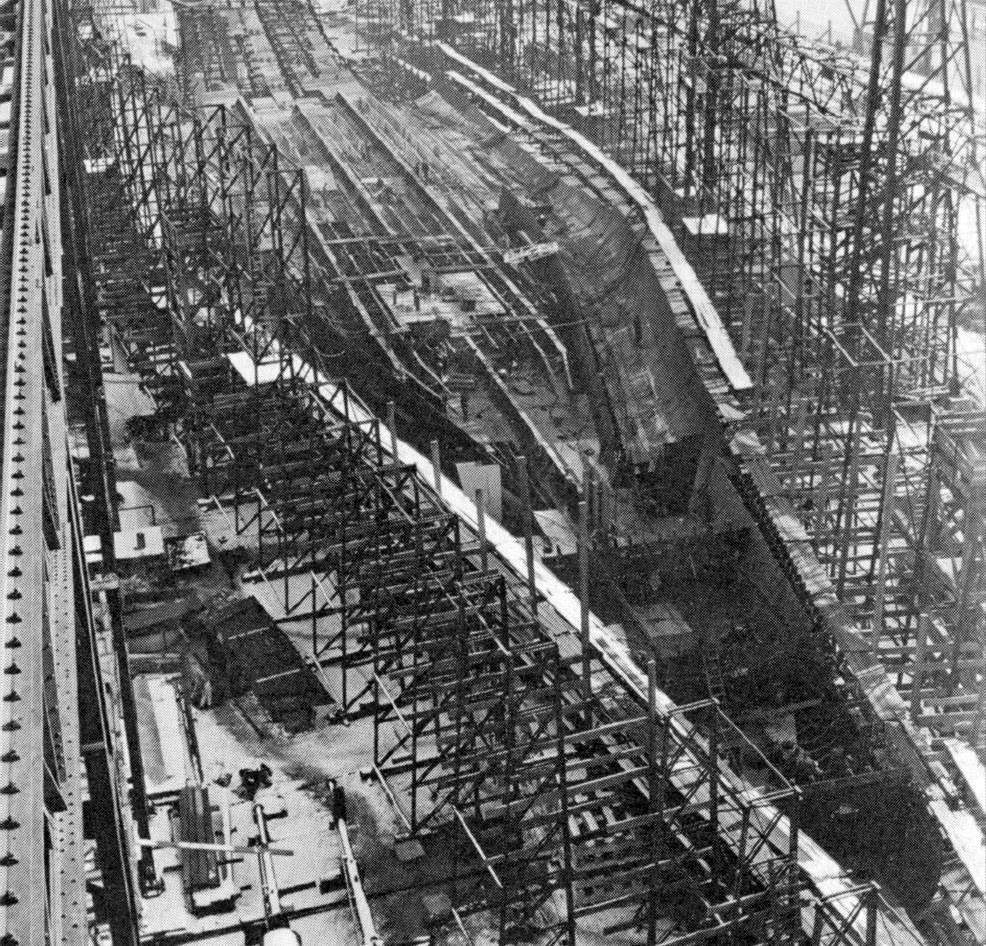
The Kriegsmarine (German Navy) Type VIIC U-boats U-431 and U-433 are laid down by F Schichau GmbH, Danzig (werk 1472 and 1474).
The Royal Indian Navy Black Swan class sloop HMIS Sutlej (U 95) is laid down by William Denny & Brothers (Dumbarton, Scotland).
The Royal Navy Flower-class corvette HMCS Godetia (K 72) is laid down by the Smiths Dock Co., Ltd. (South Bank-on-Tees, U.K.).
The Royal Navy armed merchant cruiser HMS Voltaire (F 47) is commissioned. Her first commanding officer is Captain (retired) Claude Lindesay Bate, DSO, RN
The Royal Navy armed merchant cruiser HMS Bulolo (F 82) is commissioned. Her first commanding officer is Captain (retired) Christopher Henry Petrie, RN.
The Royal Navy Fiji-class (Crown Colony-class) light cruiser HMS Mauritius (80) is commissioned. Her first commanding officer is Captain Leicester Charles Assheton Curzon-Howe, RN.
 History Diaries