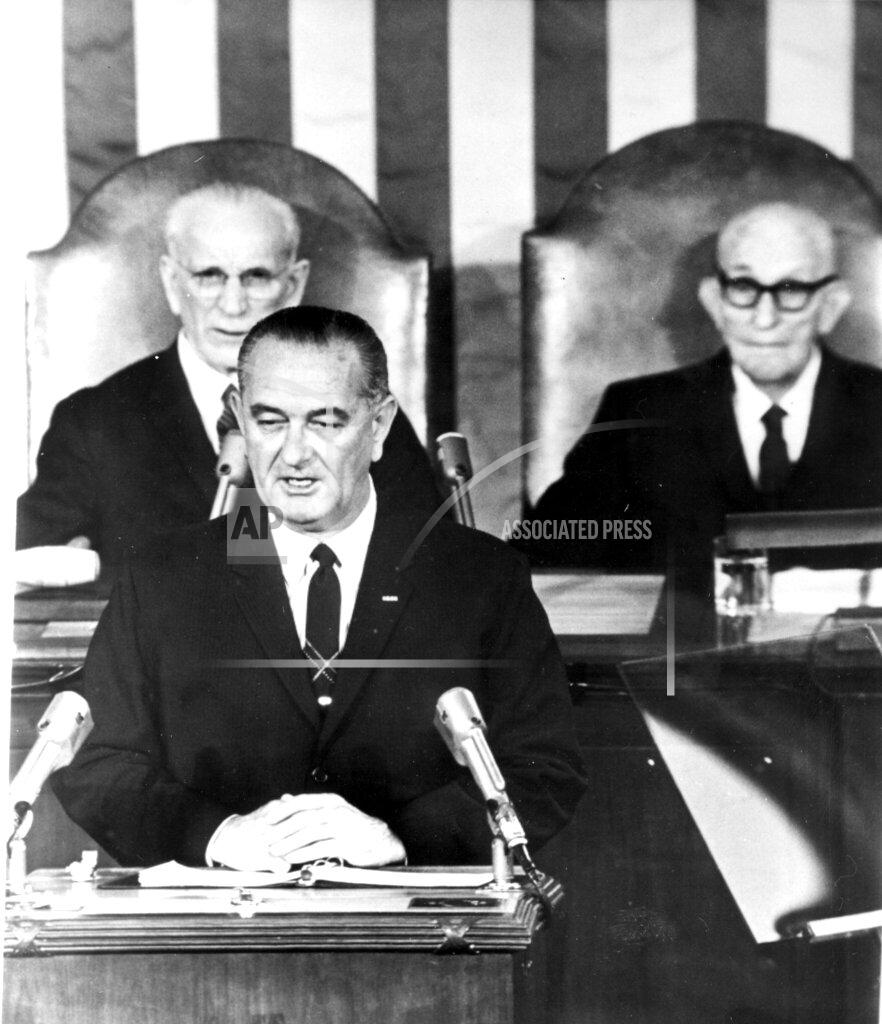
In his State of the Union message, President Lyndon B. Johnson reaffirms the U.S. commitment to support South Vietnam in fighting Communist aggression. He gives two basic reasons: for ten years now, U.S. Presidents have pledged the help requested by the South Vietnamese; and secondly, says Johnson, “Our own security is tied to the peace of Asia.”
The young generals of South Vietnam have proposed the setting up of a military commission that would oversee the civilian government, reliable sources said today. The commission, a so-called organization of control, would be headed by Air Vice Marshal Nguyen Cao Ky, the sources added. The proposal of the generals was believed to be unsatisfactory to the American officials who have insisted on a clearer line of responsibility for the Vietnamese Government. By persisting with policies that the United States has openly condemned, the generals seemed content to perpetuate the impasse between the two countries despite warnings that American aid might be reexamined.
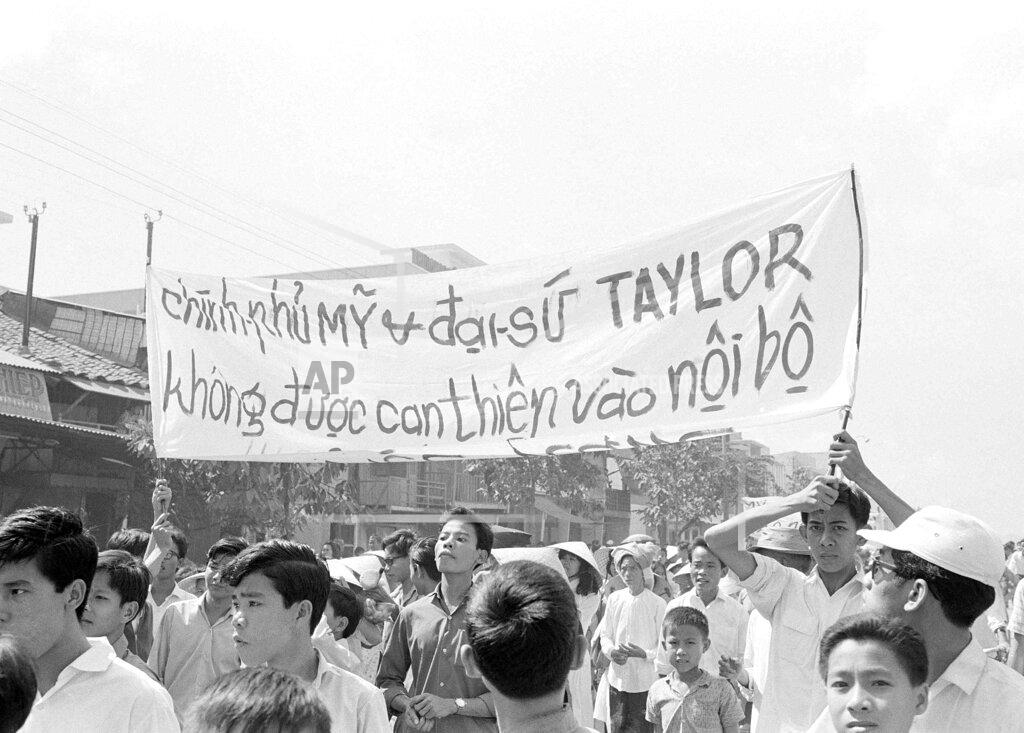
Ambassador Maxwell D. Taylor, who met Premier Trần Văn Hương yesterday after not having seen him for several days, conferred with him again late today. The outcome of their talks was not made public. Although the Premier is reported to express concern to American officials, he is not generally believed to share their determination that his Government regain control over South Vietnam’s military branch. On December 20 a group of young generals took over the Government, dissolved the High National Council, the country’s civilian provisional legislative body, and imprisoned some of its members. For the last two weeks American officials here have pressed hard for a restoration of civilian authority.
The idea of a military commission was said to have been developed during meetings of 20 of the young Vietnamese officers at the seaside town of Vũng Tàu. The talks ended yesterday. In its initial stages the commission would consult with leaders of various factions among the political parties and religious groups to gather recommendations for future action. Since December 20 the American position has been that a civilian government, supervised by a group of generals who hold all the power and none of the responsibility, would be totally ineffectual.
The United States mission has required that the officers disregard, if not repeal outright, Decision 1, a statement by the generals that would permit them to intervene when they felt the civilian officials were acting unwisely. The Americans here have insisted that they were not trying to force upon the Vietnamese any specific governmental framework but were requiring that Premier Hương and the generals devise a workable system. At the Buddhist headquarters, spokesmen announced that 500 priests and nuns had begun another 24-hour hunger strike to protest Premier Hương’s continuation as Premier.
Premier Hương said in an interview published by The Indian Express today that his country had no intention of restoring its ousted civilian legislature. The Premier said the dispute touched off by the removal of the High National Council seemed to him to be a personal clash between Ambasador Taylor and Lieutenant General Nguyễn Khánh, the commander of the armed forces.
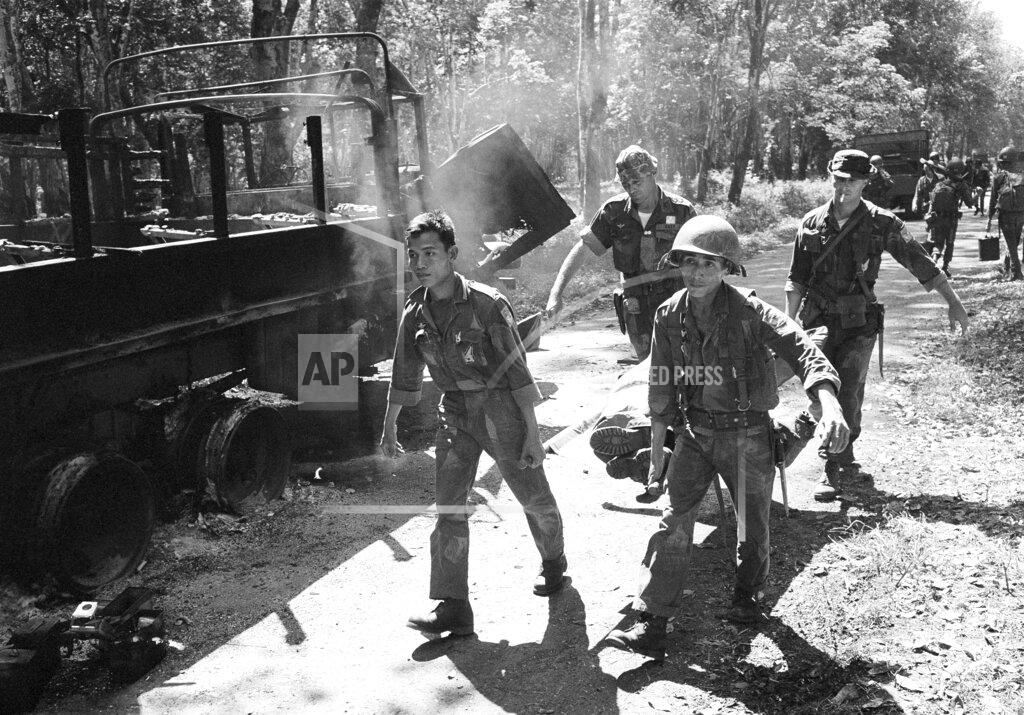
A strong force of Việt Cộng broke from hiding and renewed the fight today for Bình Giã, their target for almost a week in a drive apparently aimed at control of this coastal area east of Saigon. A Communist shell fired in an ambush last night killed an American Army sergeant. He was the sixth United States serviceman to perish in the battle of Bình Giã and the first to die in combat in the new year. His name was withheld. South Vietnamese casualties in the attack were 11 killed, 27 wounded and 40 missing.
Prince Souvanna Phouma sharply attacked the Pathet Lao today for permitting “foreign troops” to use Laotian mountain trails to supply Communist guerrillas in South Vietnam. The Laotian Premier also singled out North Vietnam for criticism in a New Year’s message that constituted one of his strongest attacks on the Communists. He said the Pathet Lao is “bound hand and foot in continuous connivance and collaboration with neo-imperialism that has proved itself by sending its soldiers onto our territory over the last 20 years.”
The Soviet Government has assured the Communist regime of North Vietnam of its support and complete solidarity in the face of “aggressive actions” by the United States. The assurance was contained in a letter sent by Foreign Minister Andrei A. Gromyko to Xuân Thủy, Foreign Minister of North Vietnam, on December 30. The letter, which was a reply to a communication from Mr. Thủy, was made public in summary form tonight by Tass, the official Soviet press agency. Mr. Gromyko accused the United States of interfering in the domestic affairs of Laos and Cambodia as well as of South Vietnam.
He renewed the Soviet Government’s appeal for a convocation “without preliminary conditions” of an international conference on Laos. Such a conference was proposed by the Soviet Union last summer but the Western powers, notably the United States and Britain, insisted that the conference could be held only after a cease-fire had been achieved and after the ‘pro-Communist Pathet Lao forces had withdrawn to positions they held before their offensive last spring. Faced with this Western opposition, the Soviet Government, in August, threatened it would ask to be relieved of its obligations as co-chairman, with Britain, of the 1962 conference on Laos. The fact that the Russians renewed the call for a Laos conference today without repeating the threat of withdrawal was seen by Western observers as the strongest indication so far that the new Soviet regime no longer intends complete political disengagement from Southeast Asia.
Even before today’s letter it had been believed here that the new leaders had quietly dropped as unfeasible the idea of a complete political withdrawal from Vietnam, The idea had been ascribed to the former Premier, Nikita S. Khrushchev. Today’s expression of solidarity with North Vietnam did not go beyond similar statements of the last two months. The new Soviet regime has repeatedly stated that North Vietnam would get “the necessary” Soviet aid if the United States carried war onto its territory. Mr. Gromyko’s letter repeated this assurance and added that the Soviet Government felt it was the duty of all participants in the Geneva agreements to take the “necessary steps” to frustrate American military plans for extending the war in Indochina.
The United States in effect rejected a new Soviet move today for a 14-nation Geneva conference on Laos. The State Department press officer, Robert J. McCloskey, said the United States did not view such a meeting as a contribution to peace or security, nor did the United States believe the meeting would bring a halt to North Vietnam’s interference in Laos.
Prince Abdul Rahman, the Prime Minister, said today Malaysia was ready for “hot pursuit” retaliation against attacks by Indonesia. The Prime Minister held an emergency Cabinet meeting hours after an Indonesian guerrilla landing party, the third in three weeks, was captured in Malaysian waters and disarmed. He said that Malaysia’s existence was threatened by continuing Indonesian attacks and that the danger was greater since Indonesia decided to quit the United Nations. Indonesia’s representative at the United Nations said he would return to Jakarta for consultations, and reliable sources said Indonesia would not submit formal notice of her withdrawal from the world organization until the consultations were completed.
Prince Abdul Rahman asked Britain and Malaysia’s other allies to send reinforcements if necessary and informed the United Nations of the deteriorating situation with a view to appealing for help if needed. Britain moved to bolster the defenses of the new federation, formed in 1963 of the British territories of Malaya, Singapore, Sarawak and Sabah, which was formerly North Borneo. The first 50 of 1,000 British paratroops arrived today. Authorities in London ordered the 44,000-ton aircraft carrier HMS Eagle to sail urgently from the East African port of Mombasa for Singapore. The Naval Minister, Christopher Mayhew, said before leaving London for talks in Washington that Britain was also flying crews to Malaysia to man reactivated ships.
Abdul Rahman said Indonesian actions defied world opinion, the United Nations and the rule of international law. Guerrillas Taken on Island The latest moves in President Sukarno’s campaign to crush Malaysia, he said, threatened the existence of the federation. President Sukarno has opposed the federation, a member of the Commonwealth, from the start, calling it a new form of British colonialism designed to encircle Indonesia. The Prince said the Cabinet decided to prepare for retaliation if attacked, “under the rule of hot pursuit, when and if forced to do so for our own existence.”
L.N. Paler, the Indonesian representative, said today that he would return to Jakarta for consultations, and reliable sources said that Indonesia would not submit formal notice of her withdrawal from the United Nations until the consultations were completed.
Indonesia has withdrawn from the United Nations because she considers the election of Malaysia to the Security Council as the “greatest threat” to her security, Indonesia’s representative at the United Nations said in an interview last night.
France can no longer be considered a full working member of the North Atlantic Treaty Organization, according to a former Secretary General of NATO. Dr. Dirk U. Stikker of the Netherlands, who resigned as Secretary General last August because of poor health, suggested tonight that the policies of President de Gaulle had reduced France’s role to associate membership.
“France, under de Gaulle, cannot any longer be considered a full working member, but has become, rather, an associate member, of the alliance,” Dr. Stikker said. His address on “NATO — the Shifting Western Alliance” was delivered as part of the Alexander S. Keller Memorial Lectures at the University of Hartford. Emphasizing problems of cooperation and coordination between high military and civil authorities within the alliance, Dr. Stikker said some major changes in its military organization were essential.
He proposed abolishing the Standing Group, which consists of three high-ranking military officers, one each from the United States, Britain and France. “If ever proof was needed that in an organization like NATO a triumvirate does not work,” he said, “then the Standing Group provides a glaring example. It has given adequate proof that in time of peace it does not work; and, being a conceptual and not an operating body, it is clear that in time of war it will not act.” The present arrangements have resulted in “a combination of unrealistic military requirements and no clear strategy” for several years, he declared.
Troops took over law enforcement in parts of Karachi tonight to put down post-election violence that has left at least 23 dead and hundreds injured. Riots broke out in four crowded areas of Pakistan’s largest city after a mass “victory parade” by supporters of the incumbent president, Mohammad Ayub Khan, in Saturday’s presidential election. Although President Ayub defeated his opponent, Miss Fatima Jinnah, by nearly 2 to 1 in nationwide electoral college balloting, Karachi was one of few places where Miss Jinnah had a slight edge. People who supported her were principal targets of the violence.
Chen Yun, a moderate in the Chinese Communist hierarchy who fell into disfavor for having resisted the radical economic policies of the “great leap forward” was reappointed today a Vice Premier of the Peking Government.
[Ed: Chen would again be demoted during the Cultural Revolution though he returned to power after Mao’s death in 1976. After Deng Xiaoping’s rehabilitation, Chen voiced his criticism of Maoist policies, decrying China’s lack of economic policies, and later became one of the architects of Deng’s reform and opening up policy.]
President Nnamdi Azikiwe said tonight that he would appoint a new government headed by Prime Minister Sir Abubakar Tafawa Balewa under a compromise solution of the election crisis, which has threatened to break up Nigeria’s federation.
Sixty-four of the 103 people on Aeroflot Flight SU-101 were killed when the plane crashed while attempting to land at the Alma-Ata airport in the Kazakh SSR in the Soviet Union, after departing from Semipalatinsk as part of a multi-stop flight that had originated in Moscow. The pilot had attempted to land during poor visibility, and brought the Ilyushin 18B turboprop down into trees about 600 feet (180 m) to the right of the runway.
The Rumanian Government initialed preliminary agreements with two American corporations last month for the construction of a synthetic rubber plant and a catalytic petroleum cracking unit in Rumania.
Pope Paul VI, in a letter made public today, appealed for closer relations between Christians and Arab Muslims “as sons of the same God.” He said old conflicts must be put aside in favor of an “immense effort” to build a more peaceful world.
Belgium was threatened with economic paralysis today by labor disputes on several fronts.
The Canadian Government expects the smallest deficit in seven years for the fiscal year that ends March 31.
The British Foreign Office announced early today the appointment of Sir Patrick Dean as Ambassador to the United States. Sir Patrick will succeed Lord Harlech in the post.
American officials in Seoul appear to be annoyed by a resolution adopted by the National Assembly criticizing the plan of the United States to reduce its military assistance.
U.S. President Lyndon B. Johnson announced his plans for the “Great Society” during his State of the Union Address. Johnson spoke at 9:00 in the evening Eastern time, setting a precedent for the annual State of the Union speech to be seen in “prime time”; with few exceptions, previous addresses had generally been given in the afternoon. President Johnson expressed the hope tonight that the new leaders of the Soviet Union could visit the United States and that they and American leaders could exchange television appearances in their respective countries. In his second State of the Union Message, Mr. Johnson also disclosed plans to visit Europe and Latin America. this year. Then he moved on to outline a sweeping prograni for improved education and for moving the nation “toward the Great Society.” The bid for a visit by the Soviet leaders was the major surprise of a 50-minute address. Government sources said diplomatic approaches to the Soviet Government had been going forward for some time and that Soviet officials had been informed today of what Mr. Johnson would say.
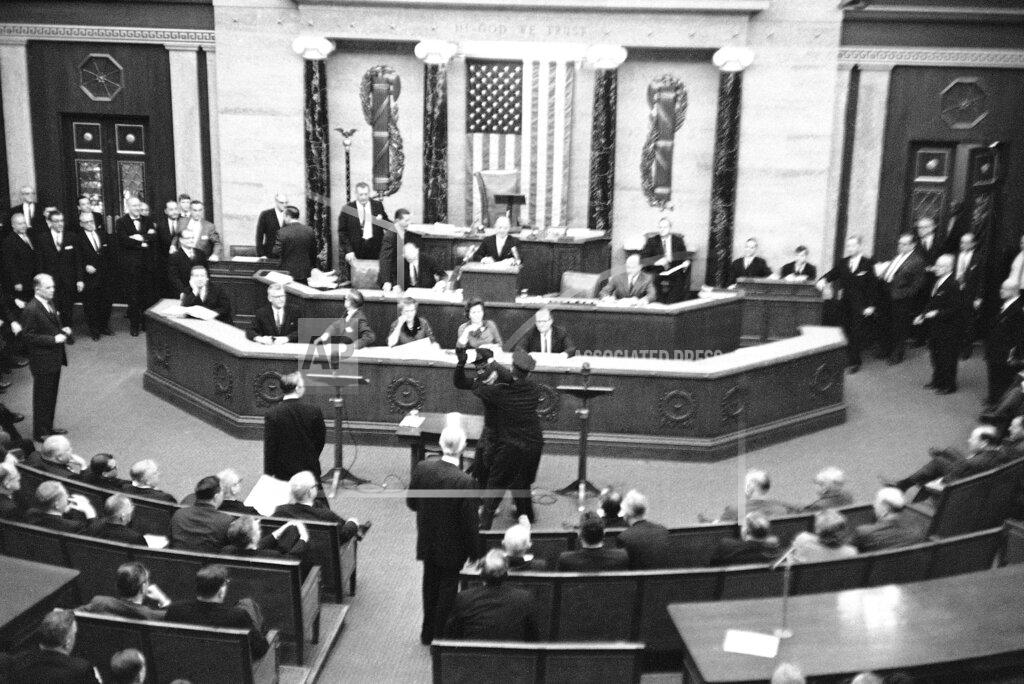
Mr. Johnson set forth a domestic program that swept almost literally from the Potomac to the Pedernales in his native Texas. He addressed a joint session of the House and Senate from the rostrum of the House of Representatives nine hours after Congress convened at noon. Mr. Johnson spoke in a packed chamber and before jammed galleries. Mrs. Johnson and her two daughters, Lynda Bird and Luci Baines, sat in a box to his left. Members of the Cabinet, the Supreme Court Justices, the diplomatic corps and most of the members of the 89th Congress were in a semicircle before him. Chief Justice Earl Warren was absent from the row of black-robed Justices.
The President read his message from an electrically operated prompter the first time such a device has been used for a State of the Union Message. He read slowly, pausing long to make many of his points, and a planned 30-minute speech gradually stretched out to about 50 minutes. Mr. Johnson occasionally glanced at a reading script. In a generally somber speech, he evoked one laugh by asserting that a President’s hardest job was not “meeting daily troubles. large and small — or even working with the Congress.” He was interrupted for applause 57 times a slight drop from the more than 80 interruptions recorded for his first. State of the Union address last year.
President Johnson presented to Congress tonight a long and expansive agenda that will keep the lawmakers working late in building the Great Society. With a heavy Democratic majority in both houses, the President seems certain to get a large part of his program through Congress. But there will be efforts both to slice his proposals and to expand on them. As had been expected, Congressional reaction to the President’s State of the Union Message split largely along party lines.
Most Democrats hailed it. Most Republicans were less enthusiastic. House Speaker John W. McCormack said: “It is truly a great message representing sound progress on the domestic level.” But Senator Strom Thurmond, the South Carolinian who switched from Democratic to Republican during last fall’s Presidential campaign, termed the message “a frightening package of generalities and omissions.”
President Johnson promised tonight to propose reforms in the Electoral College system of electing Presidents that would make sure “no elector can substitute his will for that of the people.”
As the new U.S. Congress opened, Republican members of the U.S. House of Representatives voted, 73–67, to replace 64-year-old minority leader Charles A. Halleck of Indiana with a younger candidate, 51-year-old Representative Gerald R. Ford of Michigan. “If Ford had not made that run against Halleck”, longtime friend and aide Donald Rumsfeld would write later, “he would not have become the House Republican leader, nor would he later have been selected by President Nixon as vice president when Spiro Agnew had to resign. Indeed, it can probably be said that the man who was never elected president by the American people became president of the United States by the narrow margin he received to become House minority leader on January 4, 1965.”
The U.S. House of Representatives voted 224–201 to revise its rules in order to prevent the House Rules Committee from blocking legislation that it opposed. Under the new system, if a bill had not been cleared by the Rules Committee within 21 legislative days, the Speaker of the House was authorized to remove it directly to the entire House for a vote.
Russell B. Long of Louisiana was chosen by his party colleagues today to succeed Vice President-elect Hubert H. Humphrey as assistant Democratic leader of the Senate. Mr. Long, who is serving his third term although he is only 46 years old, beat out John O. Pastore of Rhode Island and A. S. Mike Monroney of Oklahoma. Senator Long won on the second ballot under a procedure that eliminated the low man if no candidate got a majority of the 68 Democrats in the Senate. On the first ballot, Mr. Long received 34 votes, one short of the needed 35: Mr. Pastore got 20 and Mr. Monroney 14, The Oklahoman was thus eliminated. On the second ballot. Mr. Long received 41, Mr. Pastore 25, and Phillip A. Hart of Michigan, 2.
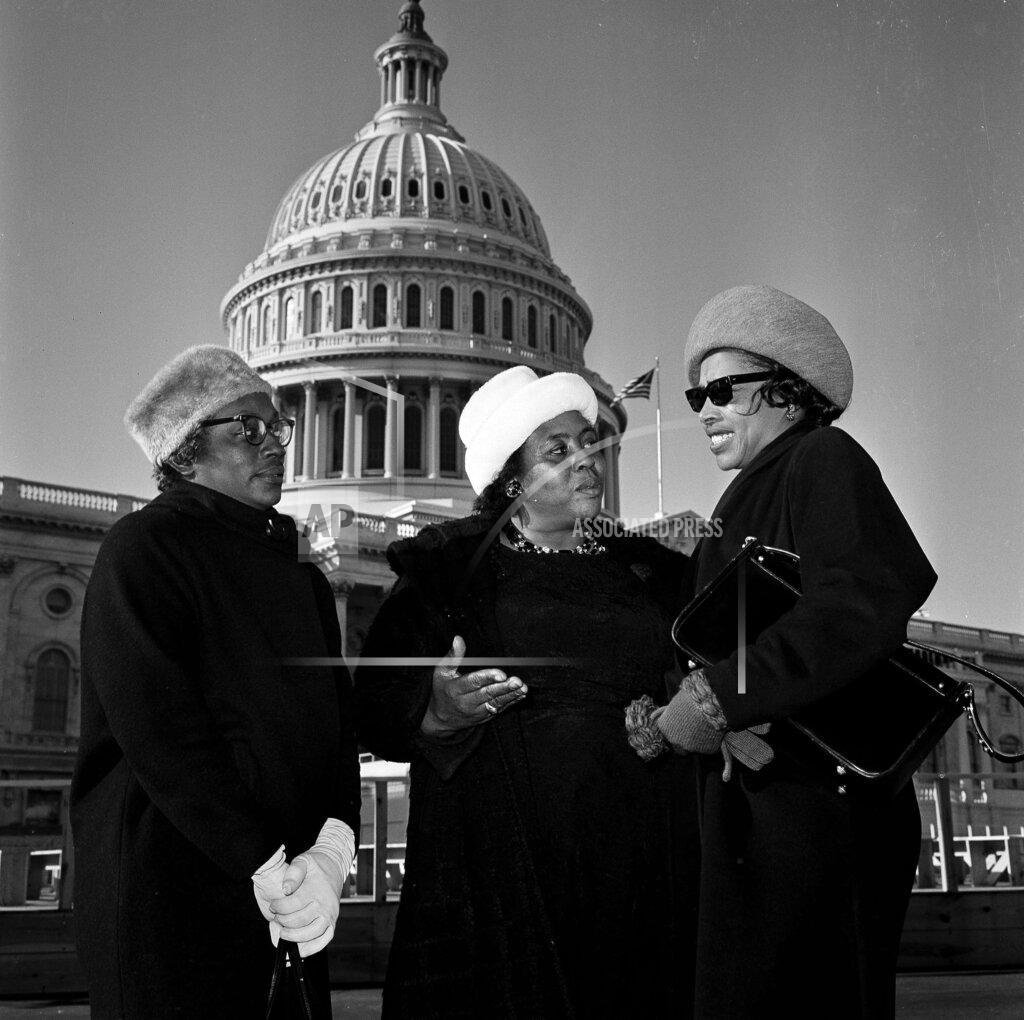
Members of the Mississippi Freedom Democratic Party, a group of several hundred protesters, mostly African-American, asked the House of Representatives to disqualify four Democrats and one Republican who had been elected to represent Mississippi in the House in November, on the grounds that the MFDP’s candidates had been illegally kept off the ballot. On the motion of New York Congressman William F. Ryan, the five stood aside while the representatives from the other 49 states were sworn in, and a roll call vote was taken. The House voted 277 to 148 to administer the oath to their five Mississippi colleagues.
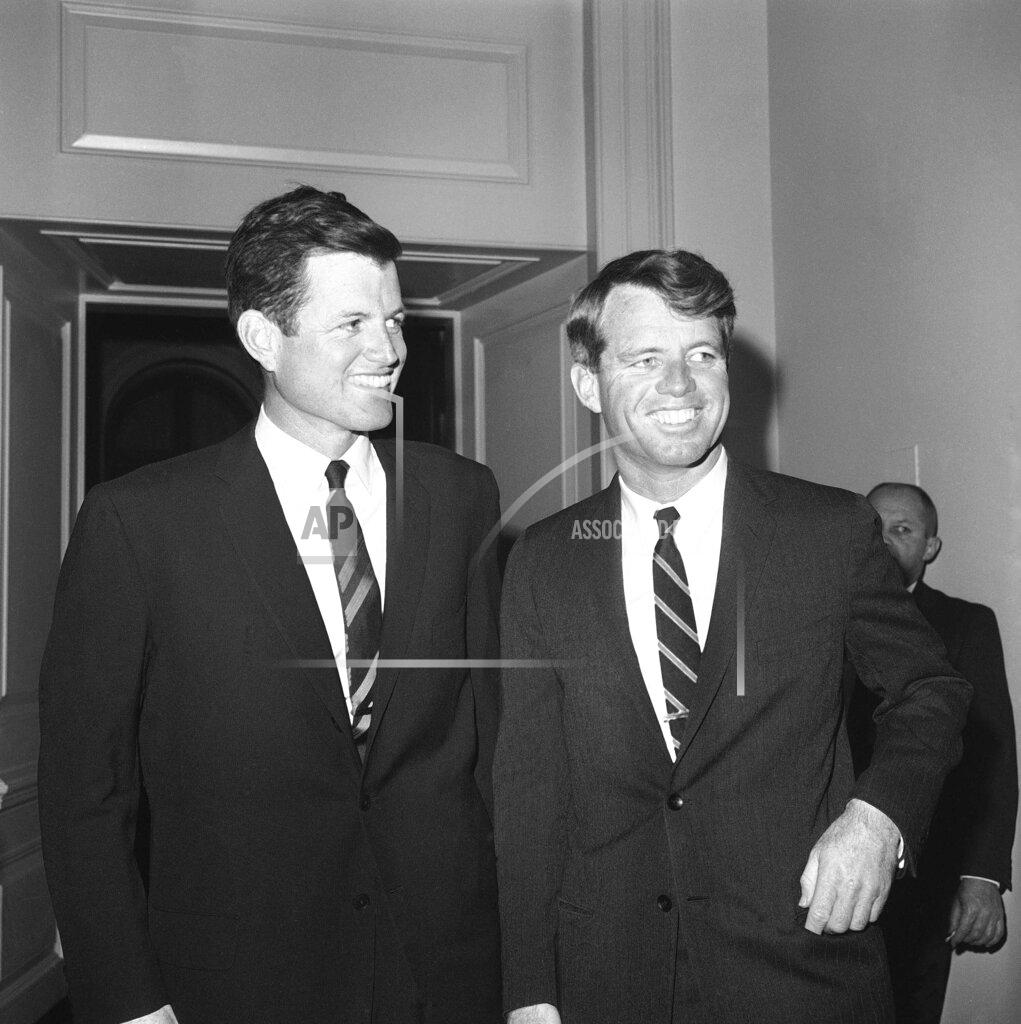
Robert F. Kennedy took his seat in the Senate today — in the very back row. In fact, a special new row of two seats, in a corner behind the four semicircular ranks of Senators’ desks, was set up for the New York Democrat and Joseph D. Tydings of Maryland, who is even a notch lower in seniority. President Kennedy, the Senator’s brother, was also a back-bencher throughout his Senate career, sitting one desk off the center aisle in the fourth row. Last November’s election, however, produced 68 Democratic Senators, and four rows would not hold them, so the New Yorker wound up in the corner.
The Republican National Chairman, Dean Burch, said today that it was time for the Republican party to “put away the switchblades and take out the Band-Aids” in a drive for party unity.
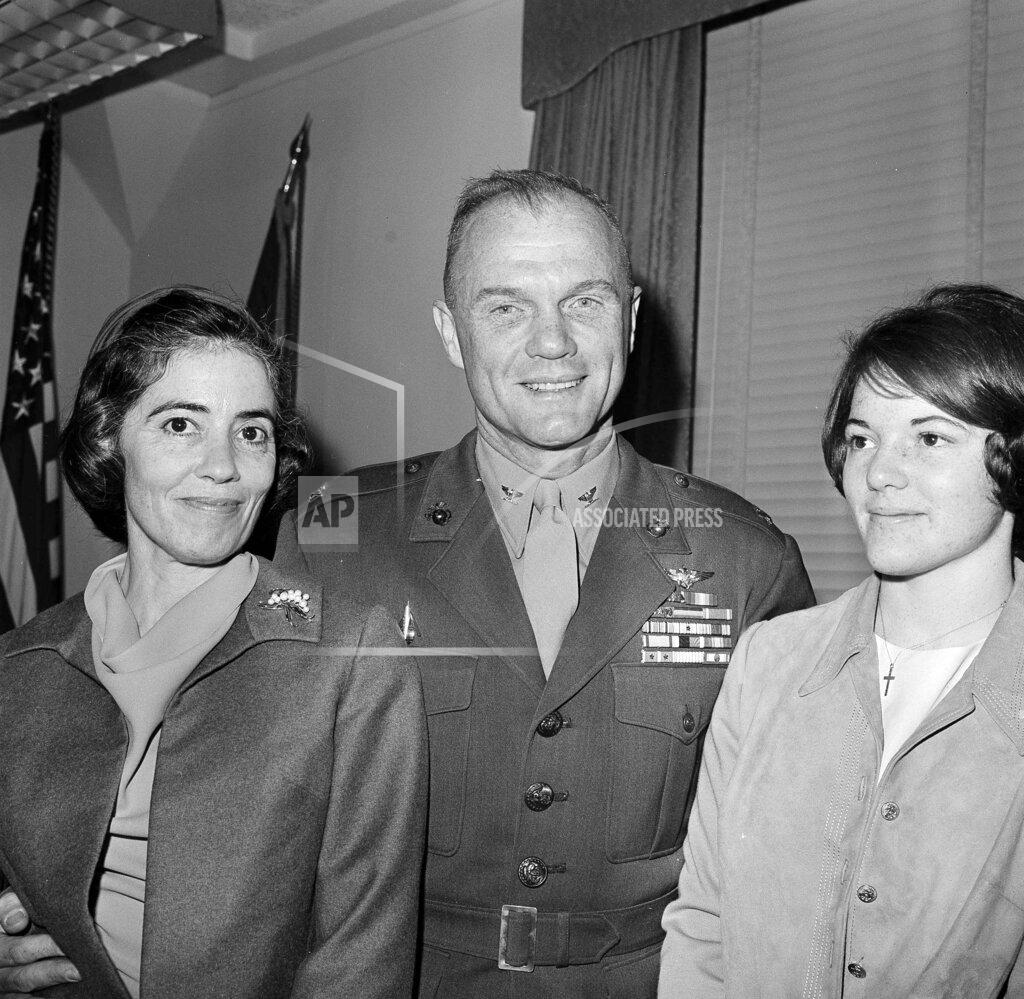
Colonel John H. Glenn Jr. retired from the Marine Corps today. He declared that he was 100 percent fit and denied reports that a bathroom fall in which he was injured had been an after effect of his experience as an astronaut.
The National Association for the Advancement of Colored People announced yesterday a nationwide program of “citizenship clinics” designed to strengthen the Black community from within. Roy Wilkins, N.A.A.C.P. executive director, said the clinics would not confine their duties to combating discrimination. The “broad goal,” he said, “will be the assumption of full citizenship responsibilities along with utilization of full citizenship rights.”
A hearing board of the Michigan Civil Rights Commission agreed today with charges that city officials in suburban Dearborn had ordered clippings humiliating to Blacks placed on municipal bulletin boards.
Jack Roland (Murph the Surf) Murphy, one of three men charged with the $410,000 jewelry burglary at the American Museum of Natural History. stepped out of a quiet courtroom in New York yesterday and into more trouble. He was arrested on charges of taking part in a $250 armed robbery and assault at the Algonquin Hotel on July 10. Detectives pushed the 27-year-old defendant across the courthouse corridor into a narrow hall, where he was searched, handcuffed and then led away.
Deactivation of America’s Titan I missiles began less than three years after they had first become operational on April 18, 1962. The 144 Titans had been deployed at five air force bases in the Western United States, and the first to be taken off of alert were those at Beale Air Force Base in California. The ICBMs, which had to be raised out of their silos for fueling before they could be launched, had been made obsolete by the new Minuteman missiles.
T.S. Eliot, the quiet, gray figure who gave new meaning to English-language poetry, died today at his home in London. He was 76 years old.
Rubén Olivares began his professional boxing career in a bout in Cuernavaca, Mexico, knocking out Isidro Sotelo in the first round. Olivares would enter the Hall of Fame as one of the hardest punching boxers of all time and would win almost three-quarters of his fights by knockouts, including his first 24 bouts and 50 of his first 53. He would reign as the world bantamweight champion between 1969 and 1972, and the world featherweight champion briefly during 1974, and 1975.
Harris County Commissioners vote to restrict visitors from the construction site of the new domed stadium in Houston, fearing the constant traffic of onlookers would delay completion of the ballpark. While Judge Hofheinz calls the stadium “95-percent complete”, commissioners are concerned that the deadline for the April 9th opener will be approaching soon.
Born:
Julia Ormond, English film and television actress (“Sabrina”, “Legends of the Fall”); in Epsom, Surrey, England, United Kingdom.
Rick Hearst, American actor (“General Hospital”), in Howard Beach, New York.
Cait O’Riordan, British musician (The Pogues), in Lagos, Nigeria.
Beth Gibbons, English singer (Portishead), in Exeter, Devon, England, United Kingdom.
David Glasper, Welsh rock singer (Breathe – “Hands To Heaven”), in Cardigan, Wales, United Kingdom.
Guy Forget, French tennis player (ATP Tour Finals 1990; France Davis Cup 1991, 96; Fed Cup/Davis Cup captain; Director French Open), in Casablanca, Morocco.
John Jackson, NFL tackle (Pittsburgh Steelers, San Diego Chargers, Cincinnati Bengals), in Camp Kwe, Japan.
Scott Bolton, NFL wide receiver (Green Bay Packers), in Mobile, Alabama.
Kevin Wickander, MLB pitcher (Cleveland Indians, Cincinnati Reds, Detroit Tigers, Milwaukee Brewers), in Fort Dodge, Iowa.
Jerguš Bača, Slovak National Team and NHL defenseman (Olympics, 1994; Hartford Whalers), in Liptovsky Mikulas, Czechoslovakia.
Died:
T. S. Eliot, 76, American-born British poet (“The Waste Land”), and 1948 winner of the Nobel Prize in Literature; of emphysema.
Dow Jones Industrial Average: 869.78 (-4.35)
 History Diaries