Fierce fighting with North Vietnamese forces was reported from the besieged province capital of Phước Bình in South Vietnam, 75 miles north of Saigon. There were unconfirmed reports that the Communists had captured the town. The Saigon command said that infantrymen and regional forces last night threw back a North Vietnamese assault on the town. Five Soviet made T‐54 tanks were said to have been knocked out.
The command said that the town was in government hands but one South Vietnamese military source said the fighting was so close to the town that planes could no longer parachute supplies and ammunition with any chance of reaching their targets. According to one account, a tank scored a direct hit one Phước Bình’s command bunker, killing the province chief who was directing the defense of the town, and cutting radio contact with the outside. The Communists were also said to be shelling the town from nearby Bà Rá mountain, which they took at the beginning of their attacks last week.
The Saigon Government was known to have flown several hundred rangers to reinforce the beleaguered town, which had been defended by about 2,500 men — most of them in regional units. But it was not clear if all the Chinook helicopters carrying the reinforcements had been able to reach the province capital, whose airfield is under fire. After wiping out all other government footholds in the province of Phước Long last month, the Communists laid siege to the province’s capital.
Three days ago North Vietnamese tanks were reported to have penetrated the city’s defense perimeter but subsequent communiqués from the Saigon, command indicated that the situation had been somewhat stabilized. At his weekly press conference, Col. Vo Dong Giang, deputy chief of the Việt Cộng’s negotiating team here in the South Vietnamese capital, said he had no details on the fighting at Phước Bình.
Leaving Saigon yesterday morning after a two‐day visit, Senator Strom Thurmond, Republican of South Carolina, said the Communist attacks in Phước Long Province demonstrated that “the North Vietnamese are openly and brazenly violating the cease‐fire agreement” of 1973 and argued for increased aid to Saigon
The Việt Cộng’s Provisional Revolutionary Government today rejected a charge by the United States State Department spokesman, Robert Anderson, that the current North Vietnamese offensive is the most serious violation yet of the 1973 Paris peace accords, and attacked continuing American aid for the Saigon Government. A spokesman for the Vietcong delegation to the stalled peace talks with the South Vietnamese said here that Mr. Anderson’s statement, made yesterday, “one again throws responsibility for the situation in South Vietnam on the revolutionary forces.”
Cambodia’s capital, Phnom Penh, does not seem to be in immediate danger from the Communist-led rebels’ latest offensive, though the drive continues with intensity on several fronts within 10 miles of the city. Once again, neither side seems able to win this war, begun nearly five years ago. This year’s offensive started a few hours before dawn on New Year’s Day, coordinated at all points all around the city’s defense perimeter. A huge new refugee problem was instantly created as the insurgents swept through village after village, abducting, burning and killing. The hospitals are full of casualties and there is more noise and window‐rattling from bomb and artillery explosions than at any time since the summer of 1973, when the insurgents pushed close to Phnom Penh despite massive American bombing.
Government troops, taken by surprise and thrown into confusion and retreat and rout by the offensive, begun in darkness, have regrouped and, with reinforcements, seem to have halted the insurgent advances on most fronts. But government attempts to push the insurgents back from their early gains — though supported by bombing, artillery and the use of other heavy weapons not available to the rebels — are meeting very dogged resistance. It would appear that this offensive is far from over. At present, the several combat fronts, with wide gaps of countryside between them, roughly describe a semicircular arc around Phnom Penh, running from west to north to east. And the city’s airport at Pochentong is threatened. A tour of several of the battle-scarred roads that radiate out of Phnom Penh today showed that while the fighting has tapered off from the intensity of the first two days, it is still heavy. Even where government troops have retaken some lost outposts, security is thin, and less than half a mile off the roads the insurgents are reported to be moving freely through the jungle underbrush into new positions.
Some Government garrisons remain surrounded, holding out only with the help of air drops. Phnom Penh’s airport, about three miles west of the city, has become vulnerable to rocket and mortar attacks. The insurgents have moved within a few miles of the field. Although no shells have struck the airport, a few rockets have begun falling regularly every day on the city. Most are from the east, where the insurgents are within about two miles of the city, on the other side of the Mekong River, which is Phnom Penh’s eastern boundary. At one point, they had driven right to the river bank, where they burned villages and took up positions as city residents watched from the other bank.
Outside the city, the panoply of war is equally vivid and the brutality more obvious. Machine guns, howitzers, helicopter gunships and fighter‐bombers send shock waves across the paddy fields, peasants flee the fighting, walking, pushing carts, riding motorbikes, carrying their chickens and pigs and children and cooking pots and straw sleeping mats. Some are running from battle for the fourth or fifth time.
Some have not been lucky enough to get away this time. Reports of Khmer Rouge insurgents murdering civilians have been coming in from all fronts. Today, there was eyewitness confirmation. Residents of Ang Snuol, a district town about 15 miles southwest of Phnom Penh on Route 4 that had been overrun but was retaken late yesterday, returned to their town today. They found about 40 of their relatives and neighbors dead in the ashes and ruins. They had been bayoneted. As newsmen and Government soldiers watched, the grieving villagers prepared makeshift pyres and cremated their dead according to Buddhist tradition. When the fires cooled, they collected the bits of bone from the ashes and washed them for preservation in ceremonial urns. Then, carrying these remains, they walked off down the road with the trancelike motions of those in shock.
President Ford’s chief spokesman acknowledged today that Secretary of State Kissinger “did reflect the President’s views” when he said the United States would consider using military force in the Middle East “in the gravest emergency.” The statement by Press Secretary Ron Nessen came a day after he had told reporters that Mr. Ford would have nothing to add to Mr. Kissinger’s statement in an interview with Business Week Magazine. Mr. Kissinger himself had declared yesterday that “I reflect the views of the President.” “I do not make a major statement of foreign policy on which I do not reflect his views,” he said.
A Soviet commentator suggested today that Russia’s business could go to other capitalist countries if Washington persisted in limiting trade credits to the Soviet Union. The comment over nationwide television by Yuri Zhukov, Pravda’s political columnist, was the latest Soviet attack on the United States trade bill signed by President Ford on Friday. The new law sets a limit of $300‐million over the next four years on Export‐Import bank credits to Moscow, and Mr. Zhukov focused on the Kremlin’s disappointment with the credit restrictions. He fell short of saying that the Kremlin planned specific retaliation but said the low credit ceiling set by the bill would “strike like a boomerang against all interests of the United States.” The commentator concluded on a hopeful note by saying that Soviet‐American economic cooperation would thrive “no matter how the enemies of détente try to hamper it.”
Thirty‐three passengers were killed in a plane crash on a domestic flight in Rumania last Sunday, the Rumanian press agency Agerpres reported today. It said the crew also died when the aircraft crashed in the Lotru Mountains area on a regular flight from Oradea, near the Hungarian border, to Bucharest. There was no explanation for the six‐day delay in disclosing the crash. Accidents are often not reported by the government‐controlled press and radio of Rumania. The Rumanian airline, Tarom, normally uses Soviet‐built Antonov‐24 planes on the 70‐minute flight. It was assumed that the plane had struck a mountain.
Prime Minister Konstantine Karamanlis of Greece criticized former Turkish leader Bulent Ecevit for making what he called provocative remarks on the Cyprus situation. “Mr. Ecevit’s sharp tone undermined efforts being made by different sides to resume negotiations between the Greek and Turkish communities on the island,” Karamanlis said.
Sinn Fein, the political arm of the Irish Republican Army, demanded direct talks with the British Government today. Seamus Loughran, Northern Ireland organizer for the Provisional Sinn Fein, said his group should be used as an intermediary to set up face‐toface talks between the I.R.A.’s militant Provisional wing and the British administrator for Northern Ireland, Merlyn Rees. There was no immediate response from Mr. Rees, who has said that he is not prepared for direct talks with the outlawed I.R.A.
A slowdown strike by 12,000 English doctors is spreading to Northern Ireland where about 400 consulting physicians in Belfast, said they would join in “work to contract” action. This means that the physicians, who handle cases from childbirth to bullet wounds, will work only the number of hours specified in their contract in the province’s national health hospitals. A spokesman said they would also withdraw from all medical advisory groups.
Portugal and the Soviet Union moved to strengthen political cooperation, according to a joint communique released in Moscow after a two-day visit by Portuguese Foreign Minister Mario Soares. Relations were resumed after the Portuguese coup of April. The joint communique said the Soviet Union expressed a positive attitude to Portugal’s policy on overseas territories. Both called for withdrawal of Israeli troops from Arab land and statehood for Palestinians.
Jordan and the Palestine Liberation Organization, at a meeting in Cairo, took a first step toward ending the deep hostility between them by agreeing to hold regular meetings in the coming months to discuss the issues dividing them. The meeting was also attended by the Egyptian and Syrian foreign ministers. The P.L.O. said it would stop its bitter propaganda campaign against King Hussein of Jordan, and the Jordanian government gave assurances that it would respect the “vested rights” of the nearly one million Palestinians who live on the east bank of the Jordan River and who make up about half the population of Jordan east of the river.
Israeli forces shelled an area in South Lebanon today, then crossed into Lebanese territory and fired at shepherds, local residents reported. They said the area between the villages of Kozah and Ramiya, in the Bint Jbail district, was shelled for half an hour. Israeli soldiers, they said, then infiltrated to the outskirts of Ayta al‐Shaab and fired on shepherds with automatic weapons but there were no casualties.
Israeli military headquarters had no comment tonight on a report from Beirut that Israeli forces had shelled an area in south Lebanon and opened fire on a band of shepherds. “I don’t know anything about such a thing,” a headquarters spokesman said.
Crude oil prices at Mediterranean terminals haves been reduced to meet the competition of exports from the Persian Gulf, and Libya is reported to have lifted her ban on oil sales to the United States.
Morocco has decided to take over operations of Esso Standard Oil Co. and shut down the operations, the Industry Ministry reported. A statement said that Esso Standard Maroc and Esso Gas failed to accept a government plan calling for foreign-owned oil firms to surrender 50% control to a new national oil company. Officials reported that 10 other oil companies have accepted government terms.
Two independent evening newspapers that usually reflect Iranian foreign policies today criticized Secretary of State Kissinger’s comments on the possibility of using force against oil producing countries. The influential newspaper Kayhan described Mr. Kissinger’s statement, published in Business Week, as a thinly veiled threat of military intervention.
Opposition politicians demanded today that former Thai Premier Thanom Kittikachorn leave Singapore immediately. He and several members of his family have been staying at the Thai Embassy in Singapore since he was expelled from Thailand last week after a two‐day return from exile. Representatives of 13 Opposition parties went to the embassy and met with the first secretary there. A spokesman for the group, Darus Shariff, head of the Persatuan Melayu Singapura party, said later: “We came to the conclusion that the present Government of Thailand has a soft heart for Thanom Kittikachorn because Thanom is a stooge of America. Lee Kuan Yew’s government, by allowing Thanom in, has stirred the political atmosphere of Singapore.” Singapore said the exile could stay at the Thai Embassy until he decided where he wanted to go.
South Korean Premier Kim Jong Pil said today that the Government could not indefinitely tolerate the stirring of social confusion through irresponsible and academic demands for restoration of democracy in South Korea.
Thousands of American mines sown around Japanese harbors in the closing months of World War II still pose a hazard to port and dredging operations nearly 30 years later. The Japanese Transport Ministry recently completed construction of a new magnetic-probe vessel to scour the shallow waters along the coast for mines. Two similar vessels will be finished next year to search for the old but still deadly weapons.
Separated Siamese twins Clara and Alta Rodriguez were welcomed back to their hometown of San Jose de Ocoa in the Dominican Republic by crowds of well-wishers and ringing church bells. The 16-month-old twins were surgically separated September 18 in Philadelphia. Dr. C. Everett Koop, who performed the operation, also received a tribute from townspeople who lined the streets with flowers in their hands.
Cuban Premier Fidel Castro has told Mexican newsmen that there has been “a change, but not very radical” in Cuba’s relations with the United States. Castro made the remarks in an interview with reporters who accompanied Mexico’s first lady, Maria Echeverria, to Havana. A copy of the interview was released in Mexico City by President Luis Echeverria’s office.
Bolivia’s former undersecretary of commerce claimed that Cuba schemed with Chile and Peru to give landlocked Bolivia an outlet to the Pacific Ocean. Juan Pereira Fiorilo, in an article published by the newspaper Presencia in La Paz, said Cuba advocated the sea outlet in exchange for Bolivia’s conversion to a socialist republic. The plan was advanced during the leftist military government of President Juan Jose Torres, Pereira said, but was scuttled when Torres was overthrown in 1971.
Britain’s Foreign Secretary, James Callaghan, arrived in Zambia tonight after holding what he called a frank exchange of views with South Africa’s Prime Minister, John Vorster, concentrating on Rhodesia’s constitutional dispute with Britain.
President Ford signed an emergency $4.5 billion appropriations bill that will provide funds for extended unemployment insurance and public jobs programs. He also made some “tentative decisions” on new economic and energy policies after a meeting with his top economic advisers, his press secretary said. Under instructions from the President, no details about his new policies were disclosed at a news briefing at the White House. It is expected that he will announce his new program in his State of the Union message, which is tentatively scheduled for January 20.
Executive Order 11828 created the Commission on CIA Activities within the United States, chaired by U.S. Vice-President Nelson Rockefeller. President Ford established a commission that will investigate allegations of illegal domestic spying by the Central Intelligence Agency. Ron Nessen, the White House press secretary, said Mr. Ford had interviewed several persons and hoped to make from five to seven appointments, all from outside the government, this week. The President, in a statement describing the new commission as a “blue ribbon panel,” said that the Justice Department was also “looking into such aspects of the matter as are within its jurisdiction.”
Senator Howard Baker, the Tennessee Republican who served as vice chairman of the Senate Watergate Committee, called for a renewed inquiry into the Central Intelligence Agency’s connection with Watergate before and after the June 17, 1972, break-in at the Democratic national headquarters. His staff conducted an extensive inquiry into the C.I.A.’s Watergate role, and he said today: “There’s a whole range of unanswered questions and they are far more important now than they were last year. It was just some loose ends then.”
U.S. President Gerald R. Ford signed legislation making 55 miles per hour (89 km/h) the maximum speed limit across the United States, making permanent what had been a temporary order in 1973 by President Nixon.
School Superintendent William J. Leary said tonight that he would reopen on Wednesday the racially troubled South Boston High School, the scene of violent clashes over busing to achieve desegregation.
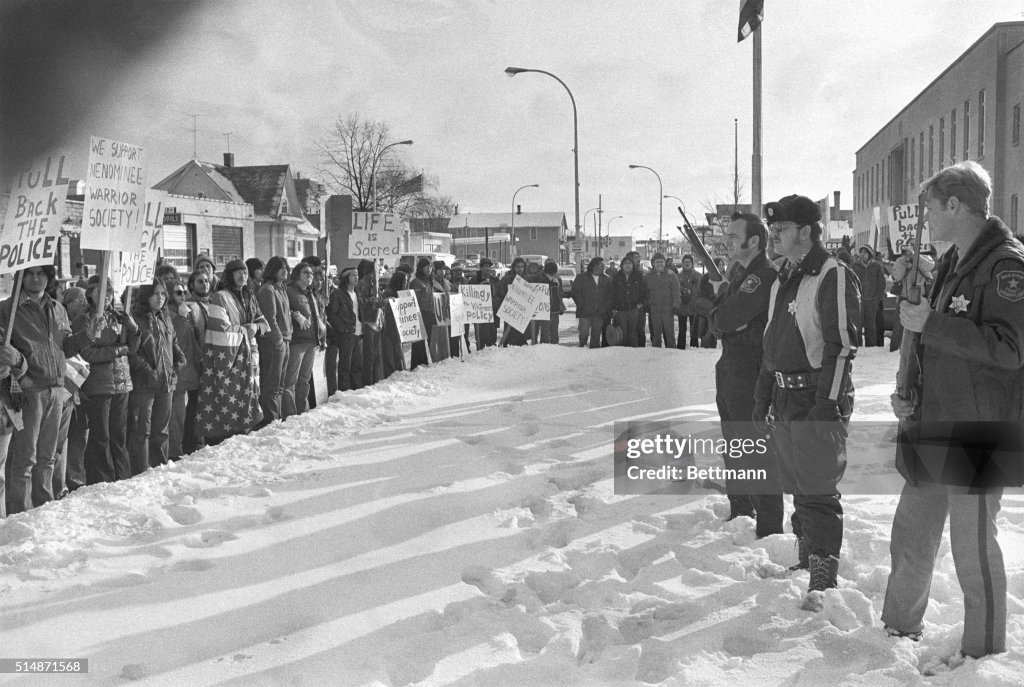
Law enforcement officers and Menominee Indians occupying a monastery exchanged gunfire late today for the first time since the Menominees seized the building New Year’s Day and demanded that the monastery and its lands be turned over to them under Federal law for a medical center.
A loaded rifle was wrested from a man attempting to board an empty National Airlines jetliner at Pensacola, Florida, apparently in a hijacking attempt. “He was carrying a rifle in one hand and a suitcase and a can of beer in the other,” said Charles Wallis, a station agent for the airlines who overpowered the suspect, Paul Thomas Landers, 27, of Tampa. “Well it looks like we are going to have a hijacking,” Wallis quoted Landers as saying. I was scared, but the way he was staggering I didn’t think he could put up much of a fight.” Members of a cleanup crew aboard the plane summoned policemen, who took Landers to jail. Officials said Landers had told them he was upset that he had not been able to get help for a drug problem.
A former board chairman of the Veve Pepsi Cola Co, James Bentley Sommerall, was found dead of a single shotgun wound in his posh Sutton Place apartment in New York. Detectives said the death apparently was suicide. They said his 23-year-old son, Stephen Robert Sommerall, had found the body. The victim had been board chairman of Pepsi from 1971 to 1973 and at the time of his death was president and chief executive officer of Champale, Inc.
Three workmen were killed in an explosion and fire at a rubber plant in Philadelphia. Police said the victims had been installing an oil tank at the Aldan Rubber Co. when vapors ignited, causing the explosion. Two other men and a fireman suffered minor injuries.
A search centered on San Diego this week for four suspects reported to have fled across the border from Mexico following a firebomb and shotgun attack on a polygamous religious colony operated by excommunicated Mormons from Utah.
Two possible cancer-causing substances have been found by biologists in the blood of 21 residents of New Orleans. The University of New Orleans scientists cautiously suggested in an article in Science magazine that the dangerous substances might have come from the city’s drinking water. The research raises new questions in the controversy over chlorinating drinking water taken from polluted sources.
A biodegradable birth control capsule, said to be effective for up to a year after being implanted under the skin, has been developed by Massachusetts Institute of Technology scientists. The slow-release delivery system is still in the animal testing stage and is not likely to be tested on humans for about three years, Paul M. Newberne, professor of nutritional pathology, said. The capsule, using norgestrel as the birth control agent. is designed to be broken down and absorbed by normal body action in the same manner as absorbable sutures in surgery, Newberne said.
After years of controversy, the Air Force has decided to abandon its bombing range on Matagorda Island near Corpus Christi, Texas, in deference to the nearly extinct whooping crane. The crane has flown every fall for centuries to spend the winter on the island, which in 1942 was taken over as a bombing range. The military use of the island had been a long-standing issue with conservationists, but it was never decisively proved that target practice contributed to the crane’s near extinction.
Some nuclear reactors producing electricity in the United States may have to close down this year because of a shortage of space to store their radioactive waste, an Atomic Energy Commission report has concluded.
The Atomic Energy Commission has disclosed that it already has on hand a large supply of the raw material that could significantly reduce both the economic cost and environmental impact of introducing in the nineteen-nineties a nuclear power industry based on a commercial-scale use of “breeder” plants.
Snow and gusting winds whipped through the plateau region, accompanied by a blizzard in Montana and a tornado in Utah. Wind and snow warnings were issued for sections of Colorado, Montana, Idaho, Oregon. Nevada and northern Utah. Winds of up to 70 m.p.h. damaged aircraft and hangars at Salt Lake City. Snow was reported in the upper Ohio Valley, the eastern Great Lakes and parts of New England. A cold front brought rain and drizzle to the lower Atlantic Coast.
Revival of Jules Styne and Stephen Sondheim’s “Gypsy” closes at Winter Garden Theater, NYC. after 120 performances, and a Tony Award for Angela Lansbury.
Revival of Ray Henderson, B.G. DeSylva, and Lew Brown’s musical “Good News” closes at St James Theater, NYC, after 16 performances.
Richard Sherman and Robert Sherman’s musical “Over Here!”, closes at Shubert Theater, NYC; runs for 341 performances and was the top-grossing production of the year.
Wimbledon become the first non-league club to win at a First Division club in the F A cup third round since the creation of the Third Division in 1920. Altrincham almost achieve the same objective when holding Everton to a draw. Thirty-one of the Thirty-two ties take place with cup holders, Liverpool defeating Stoke while West Ham win at Southampton at the start of their ultimately victorious cup run.
The New Orleans Jazz set a then-NBA record (with 24-second shot clock) by scoring only 20 points in the first half of a 111-89 loss in Seattle; unwanted record stands for nearly 25 years.
Henry Boucha of the Minnesota North Stars, who had been the NHL’s Rookie of the Year two years earlier, suffered a career-ending eye injury after being high-sticked by Dave Forbes of the Boston Bruins during Boston’s 8–0 win. Forbes would become the first American professional athlete to be criminally indicted for a crime committed in the course of a game, although the trial ended in a hung jury. In 1980, Boucha settled a lawsuit against Forbes, the Bruins and the NHL for $1,500,000.
Born:
Scott Frost, NFL defensive back (New York Jets, Cleveland Browns, Tampa Bay Buccaneers), in Wood River, Nebraska.
Jill Marie Jones, American actress (“Girlfriends”, “Sleepy Hollow”), in Dallas, Texas.
Died:
Bob Montana, 54, American comic strip artist who created the characters in Archie Comics.
Carlo Levi, 71, Italian anti-fascist activist, writer (“Cristo si è fermato a Eboli” (“Christ Stopped at Eboli”)), painter, and politician (Senator, 1963-1972), of pneumonia.





 History Diaries