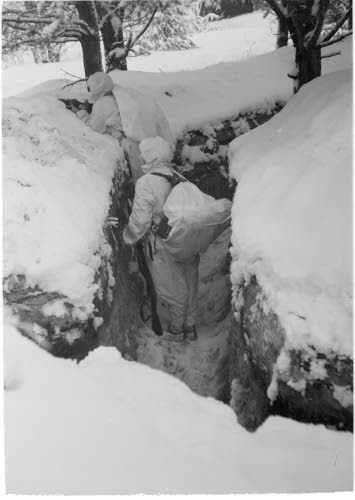
Finnish units continue attacking Soviet 44th Motorized Rifle Division of 9th Army in the Suomussalmi sector. Soviet 44th division stubbornly resists further attacks and the Finns do not manage to cut the stationary column. The immobilized Soviet troops desperately try to stay warm in sub-zero temperatures, flocking to field kitchens for warm food and huddling around log fires cut from the expansive forests. In simple but stunningly effective tactics, the Finns reinforce the effect of the elements on the trapped Soviet 44th Rifle Division by targeting the Soviet field kitchens. Finnish snipers target Soviet officers. Soviet troops have received permission to butcher horses for food. The most advanced Soviet units are running short of just about everything. Colonel Siilasvuo prepares for coordinated attacks on 44th division’s extended flanks.
Colonel Volkov, a commander within the Soviet column, requests air resupply from Ninth Army. He states that the trapped column requires:
9 tons of rifle ammunition;
8 tons of 76 mm rounds;
1.2 tons of 122 mm rounds;
2 tons of hand grenades;
1 ton of rifle grenades;
12 tons of straw for horses;
10 tons of oats;
8 tons of bread;
2 tons of meat;
800 kg of fat;
270 kg of sugar;
240 kg of salt;
500 kg of butter;
8,000 tins of preserves.
The Ninth Army has neither the items requested nor the available planes to fly them in. General Chuikov has four TB-3 and R-5 planes, but they are grounded due to the weather. He looks for alternative sources of supply, such as by truck via the taiga north of the road, but promises nothing. The issue essentially decided, there ensue various phony representations from Volkov that everything is fine, the trapped men actually have everything they need and there’s nothing to worry about.
General Vinogradov, commander of the trapped Soviet division, who is behind the Soviet border, orders the doomed Soviet division to break out and re-establish communications to the USSR. He also sends armored vehicles from the Scout Battalion in the USSR to breakthrough. Both attempts fail, as the Finns have been working hard on blocking the road by felling trees and planting mines.
General Siilasvuo sends two regiment-sized forces (Task Force Kari and TF Fagernas) all the way down the ice road to the Soviet border, south of Ratte. He wishes to bolt the door closed.
The Finnish 13th Division breaks off its assault at Ruhtinaanmäki.
In Northern Finland, Soviet troops supported by tanks and artillery launch an offensive in the Kuhmo sector.
Finnish forces surround the enemy base entrenched at Sanginlampi.
In the Salla sector, in temperatures approaching -40° Celsius, four Finnish battalions begin a counterattack at Joutsijärvi designed to break the defences of the enemy division.
Finnish aircraft drop leaflets over Leningrad depicting starving and freezing Soviet troops in Finland. Finnish aircraft drop three million pamphlets on Leningrad. The Finnish government claims to have destroyed 400 Soviet tanks and brought down 150 Soviet planes since the fighting began.
The Finnish labour office of the Ministry of Supply announces that the most important work to be carried out in the countryside is the gathering of firewood.
According to German radio, the Soviet Union is concentrating its call-up on reservists with a technical background.
In Norway, a special rucksack collection in aid of Finland has already gathered 25,000 rucksacks packed with food and clothing.
The German Government warns the Scandinavian countries not to take advantage of Finland’s distress.
Premier Daladier reiterated that the French would assist the Finns as much as possible.
Anglo-Russian affairs, it was apparent in London today, are approaching a crisis over Finland.
Asserting that “fantastic anti-Soviet Inventions” concerning the progress of the war in Finland are being circulated from Helsinki and other Scandinavian capitals, the Soviet embassy’s press bureau tonight warned against “hasty conclusions based on doubtful evidence.
The Moscow newspaper Trud alleged today that the “Finnish White Government” [the Helsinki government] had arrested thousands of workers and honest patriots “who do not want to fight for the Mannerheim gang.”
In the Vosges area on the Western Front, French patrols ambush two German detachments and take several prisoners. Between the Rhine and the Moselle in the past twenty-four hours Allied parties in contact with the enemy have proved both enterprising and successful. In particular they were able to gather information desired by the commanders of various sectors. At some points the Germans reacted. There were a number of clashes, in one of which a German officer was killed. This was in the Vosges area, where a French group intercepted a German patrol and sought to take prisoners.
Again today many planes took to the air. Since the visibility improved on Monday, French squadrons, protected by fighters, have made considerably more than one hundred reconnaissance flights over the German lines. There were several dogfights, two of which ended in the loss of German machines. “Nothing to report,” said this morning’s French communiqué No. 243, while No. 244 this evening stated: “During the day our patrols and scouting parties successfully fulfilled their missions at various points of the front. Two enemy airplanes were brought down by our fighters.”
Hitler receives letter from Mussolini trying to avert war in the west. A conciliatory letter from Mussolini transmitted to Hitler in an effort to offset the Italian condemnations of the Nazi-Soviet Pact. The Duce, however, maintains that “the solution of your Lebensraum is in Russia and not elsewhere.” The implication appears to be to leave France alone. Hitler, of course, ignores him.
Augusto Rosso, Italian ambassador to Soviet Russia, took a train for Rome tonight, apparently ignored by Soviet officials, none of whom was seen to bid him goodbye. Italian newspapers for the first time today confirm the fact that Augusto Rosso, the Italian Ambassador, is leaving Moscow and judging from the way they word the story, it is a definite recall. The Italian Government sees trouble ahead with the Soviets.
The Fascist press in Rome today also forecast a possible struggle for power in the Middle East between Germany and Russia on one side and Britain and France on the other, and said Europe’s war ultimately might spread to Western Asia.
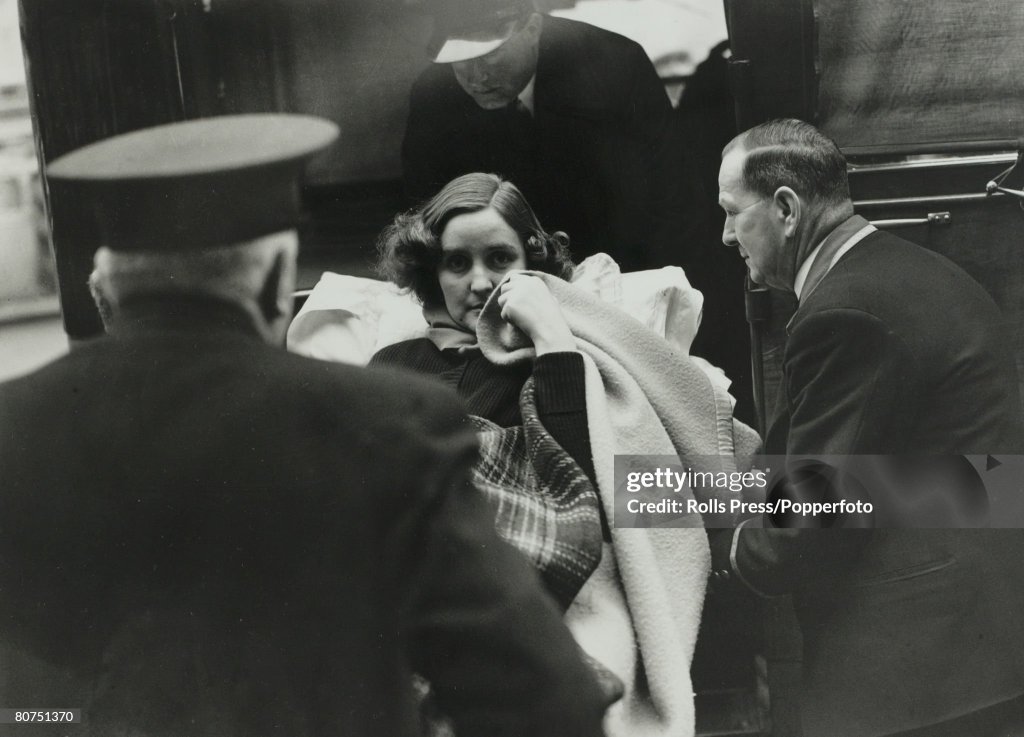
The pro-Nazi English socialite Unity Mitford, who was in Germany when the war began, arrived at the English port of Folkestone under heavy police guard and was brought ashore on a stretcher. Her father Lord Redesdale told a reporter that his daughter was very ill. Unity Mitford returned from Germany via Switzerland and France on a stretcher with a bullet lodged in her skull from suicide attempt in Munich. She will remain an invalid and never fully recover from her wounds. She will die shortly after the war.
It was confirmed tonight in the highest sources that the Foreign Ministers of the four member countries of the Balkan Entente will meet in Belgrade within a few weeks.
Floods ravage areas already devastated by earthquakes in Turkey. Death and destruction from raging rivers in earthquake-stricken and flood-ravaged Turkey increased hourly tonight as torrential rains fell again throughout the nation. An aftershock at Yozgad caused hundreds of already damaged buildings to collapse, adding to the existing homelessness and misery.
An RAF reconnaissance aircraft if brought down in Belgian territory near the German border by three Luftwaffe fighters.
The German Kriegsmarine R-boat minesweeper R-5 was wrecked by ice and sank off Stolpmünde, Germany.
U-58 sank Swedish steamer Svartön (2574grt) from convoy HN.6 northeast of the Firth of Forth in 57-48N, 1-47W. At 09.11 hours the Svartön (Master Bror Emil Larsson), a romper from convoy HN.6, was hit amidships by a G7e torpedo from U-58, broke in two and sank quickly off Kinnaird Head. The master 19 crew members and a Norwegian pilot were lost. The 11 survivors were picked up by HMS Oak (T 54) (Lt C. Edgecombe, RNR). The survivors were later transferred to the Fraserburgh lifeboat. The 2,475-ton Svartön was carrying iron ore and was bound for Middlesbrough, England.
Swedish steamer Kiruna (5484grt) was lost to unknown cause in the Bay of Biscay at 45 20N, 25 10W.
The U-25 became the first Axis submarine to take advantage of Spain’s offer to allow re-provisioning and refueling in its ports. It secretly moored along the German freighter SS Thalia in Cadiz. After four hours of taking supplies off the merchant ship, the U-25 returned to sea. It is a particularly bold move because of the proximity of Cadiz to the British base at Gibraltar.
The Greek tanker Motorina ran aground on Chios and was wrecked.
Latvian steamer Iris Faulbaums (1675grt) was seized in a German port, and renamed Wally Faulbaum in German service.
Paddle minesweeper Brighton Queen was in collision with tug Gannet in the Imperial Dock at Rosyth at 0855.
U.S. freighter Mormacsun is intercepted by British naval vessel and diverted to Kirkwall, Scotland, into the zone designated as a combat area
Freighter Nashaba is detained by British authorities at Gibraltar
U.S. freighter Executive, detained at Gibraltar since 20 December 1939, is released to proceed on her voyage to Greece, Turkey, and Rumania.
Contraband seized by the British for the week ending 30 December 1939 equaled 20,800 tons.
Convoy OA.65G departs Southend.
Convoy OB.65 departs Liverpool.
The War at Sea, Wednesday, 3 January 1940 (naval-history.net)
Heavy cruiser DEVONSHIRE departed the Clyde on Northern Patrol, and arrived back on the 10th.
Heavy cruiser SUFFOLK and light cruiser CERES arrived at Scapa Flow after Northern Patrol.
American steamer MORMACSUN (4996grt) was taken into Kirkwall for contraband inspection. The United States protested so strongly about a neutral ship being sent into a war zone that the British government ordered the Admiralty to cease taking suspect American ships into contraband control stations.
Light cruisers EDINBURGH and GLASGOW arrived at Rosyth ahead of convoy HN.6.
Destroyers ESCORT and ELECTRA departed Invergordon with tanker BEACONSTREET (7467grt) for Liverpool. After delivering her, the destroyers went on to Plymouth for refitting.
Sloop AUCKLAND arrived at Rosyth from Portsmouth for duty in Convoy C.
Convoy OA.65G departed Southend escorted by destroyers WHITEHALL and WIVERN from the 3rd to 5th when they detached off the Lizard. (Sister ships VESPER and VISCOUNT escorted a coastal portion to Liverpool from the 5th to 7th.) By then, convoy OB.65G had departed Liverpool escorted by destroyers VENETIA and WINCHELSEA, and then merged with OA.65G to form convoy OG.13 on the 6th. VENETIA and WINCHELSEA continued the escort until the 8th. Finally French destroyers TARTU and VAUQUELIN provided escort from the 6th to 11th, when the convoy arrived at Gibraltar.
Convoy FS.63 departed the Tyne, escorted by destroyer WOOLSTON and sloops GRIMSBY and WESTON, and arrived at Southend on the 5th.
U-58 sank Swedish steamer SVARTON (2574grt) from convoy HN.6 northeast of the Firth of Forth in 57-48N, 1-47W. Twenty crew were lost, but minesweeping trawler OAK (357grt) picked up 11 survivors who were later transferred to the Fraserburgh lifeboat.
Paddle minesweeper BRIGHTON QUEEN was in collision with tug GANNET in the Imperial Dock at Rosyth at 0855/3rd.
Swedish steamer KIRUNA (5484grt) was lost to unknown cause in 45 20N, 25 10W.
Latvian steamer IRIS FAULBAUMS (1675grt) was seized in a German port, and renamed WALLY FAULBAUM in German service.
Light cruiser BIRMINGHAM departed Hong Kong on the 3rd. Calling at Singapore on the 8th and Colombo on the 11th, she arrived at Aden on the 16th. Reaching Suez on the 19th, she was attached to the Mediterranean Fleet as the Commander in Chief’s Flagship. She arrived at Malta on the 21st, and refitted from 22 January to 5 February, on which day she left for Alexandria. At Alexandria from 6 to 11 February, BIRMINGHAM then patrolled in the Mediterranean before departing Malta on the 19th for the Home Fleet. Admiral Cunningham hauled down his flag and BIRMINGHAM left the Mediterranean, passing Gibraltar on 21 February and arriving at Portsmouth on the 24th. On 6 March, she was attached to the Portsmouth Command while refitting there.
Australian destroyers HMAS VENDETTA and HMAS WATERHEN departed Marseilles escorting convoy K.6 consisting of troopships ROHNA (8602grt), TAIREA (7933grt), DEVONSHIRE (11,275grt), DILWARA (11,080grt), RAJULA (8478grt) and TALAMBA (8018grt). They were relieved on the 5th by Australian destroyers HMAS STUART and HMAS VAMPIRE, and proceeded to Malta. The convoy, less VAMPIRE detached to Port Said on the 7th, arrived at Haifa on the 9th, and departed on the 12th, escorted by STUART. Destroyer HMAS VOYAGER, with repair ship RESOURCE from Alexandria joined the convoy at sea, and arrived at Malta on the 15th.
Sloop WELLINGTON, escorting a homeward bound Sierra Leone convoy, attacked a submarine contact 350 miles west of Ushant in 47-32N, 12-34W.
German steamer BOGOTA (1230grt) departed Guayaquil, Ecuador, and arrived at Coquimbo, Chile on the 11th.
Today in Washington, President Roosevelt delivered his annual message on the state of the union to a joint session of the Senate and the House of Representatives; gave to newspapermen his usual “off-the-record” preview of the budget estimates to be made public tomorrow and fulfilled routine appointments at the White House.
The Senate met formally after the joint session and received the Connally bill to increase social security payments; the Federal Communications Commission’s report urging a merger of the Western Union and Postal Telegraph Companies, and adjourned at 2:46 PM until noon tomorrow.
The House continued its session after the joint meeting and received the report of the Dies committee on un-American activities; the Attorney General’s annual report; the suggestion of the Secretary of the Navy for granting wider Presidential powers regarding naval efficiency in a national emergency; various bills to extend financial aid to Finland and to discontinue diplomatic relations with the Soviet Union and adjourned at 3:07 PM until noon tomorrow.
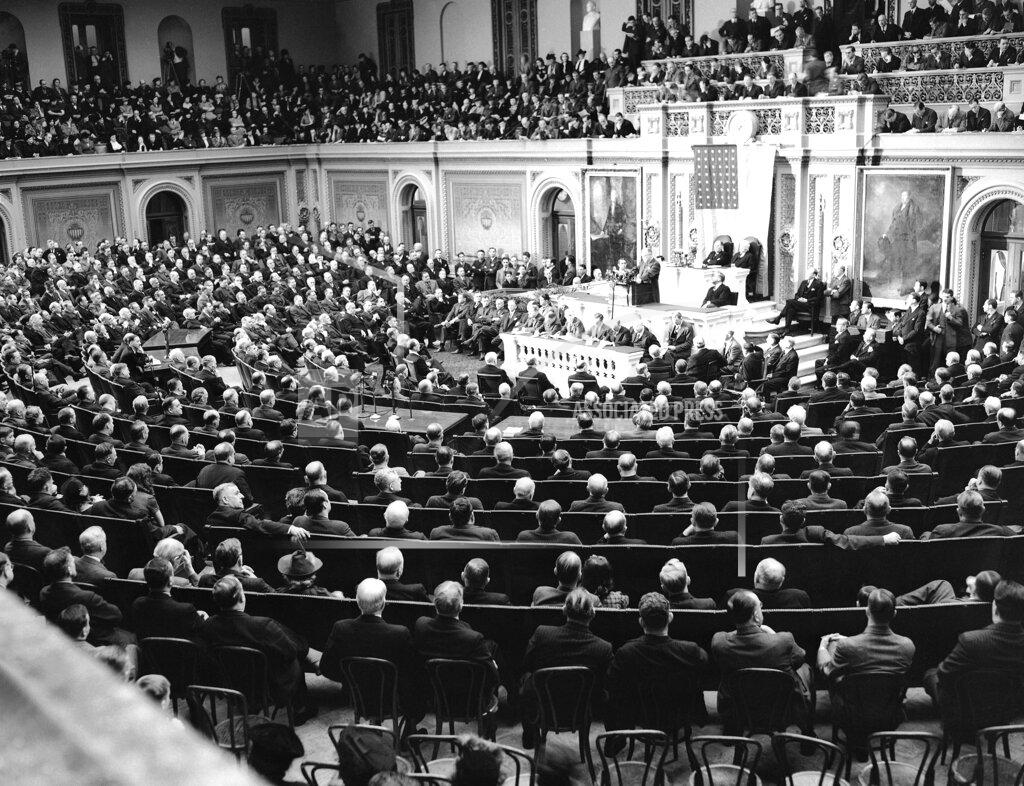
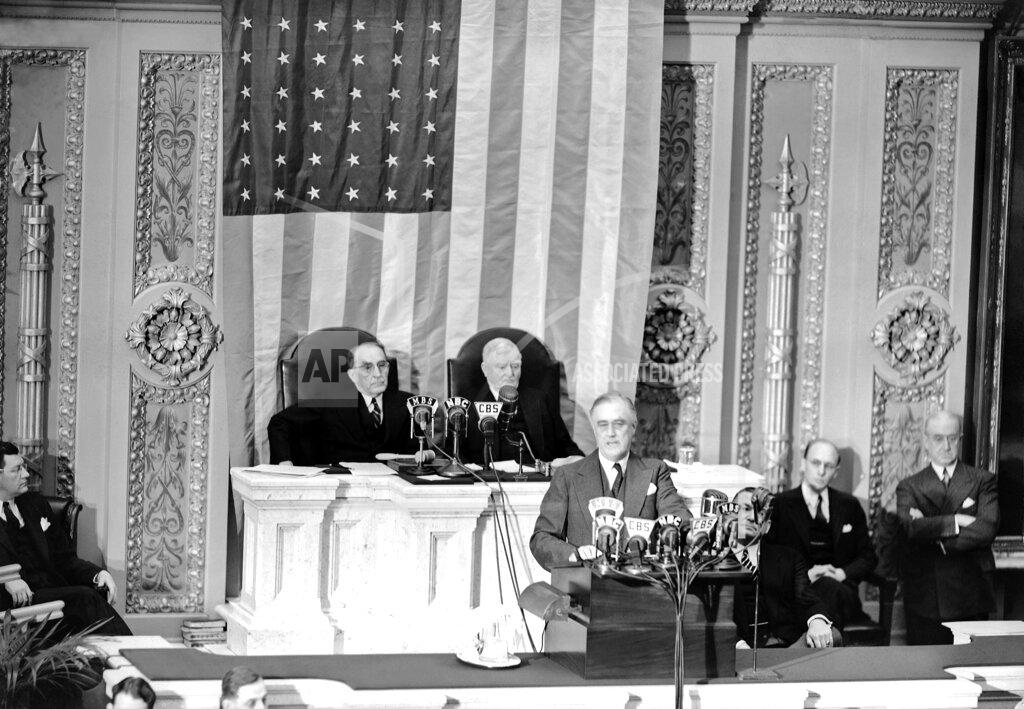
U.S. President Franklin D. Roosevelt gave the 1940 State of the Union Address to Congress tonight, saying, “There is a vast difference between keeping out of war and pretending that this war is none of our business… In previous messages to the Congress I have repeatedly warned that, whether we like it or not, the daily lives of American citizens will, of necessity, feel the shock of events on other continents. This is no longer mere theory; because it has been definitely proved to us by the facts of yesterday and today,” the president said. He asked the Congress to approve increased national defense spending “based not on panic but on common sense” and “to levy sufficient additional taxes” to help pay for it. Roosevelt asked Congress to provide $1.8 billion for national defense, new appropriations of almost $1.2 billion, and the development of an annual production program of 50,000 aircraft. A stronger U.S. national defense financed by new taxes, a constitution of new deal policies, and a national unity reinforced by “calmness, tolerance and cooperative wisdom,” was urged upon Congress today by President Roosevelt, in a message delivered to the newly convened session.
An extraordinary restraint, reflected in delivery and reception, marked the message which President Roosevelt delivered in person today before a joint meeting of the Senate and the House opening the third session of the Seventy-sixth Congress. There was applause for peace, for economy and for the trade agreement policy as he described them, and Mr. Roosevelt received an ovation on entering and on departing. But observers noted that the President showed a notable lack of the vibrant quality usually distinguishing his voice, and he made little of the effort common to all orators of coaxing applause for special pronouncements by a rising inflection. of the voice at the conclusion of a sentence.
Mr. Roosevelt delivered his message at a reading stand banked by microphones, in front of the House dais, on which Speaker Bankhead and Vice President Garner sat. He stood in the flood-glare of banks of light erected for newsreel cameras. For the most part he delivered his speech in the confidential tone which marked the “fireside chats” of earlier years of his Administration. He wore a pearl gray suit, with a formal morning coat.
The Washington Post comments on FDR’s address: “It is already impossible to dissociate analysis of ‘the state of the union’ from consideration of the state of the world. And Mr. Roosevelt is wholly justified in intimating that it will become increasingly difficult to do so.”
The Dies committee in a unanimous report to congress today exonerated John L. Lewis and the majority of members of the Congress of Industrial Organizations of charges that they are Communists or Communist sympathizers, but charged that the leadership of 11 of the 48 CIO unions “is more than tinged with Communism.” In making its final report to Congress today, the Dies Committee branded. the Communist party and the German-American Bund as un-American agents of foreign governments, said that the American labor movement generally and “the overwhelming majority of the members of the C.I.O. as well as the president are not Communists or Communist sympathizers,” but added that “the leadership” of some ten or twelve of the C.I.O.’s constituent unions “is more than tinged with communism.” The committee’s 15,000-word report made no legislative recommendations but suggested extension of its life so that it might act as a continuing searchlight on subversive activities in the present troubled times.
Although it is expected that there will be acrimonious debate over extending the committee’s life, caused by criticism of its methods and procedure, the general opinion among House members today appeared to be that it would obtain its added authorization and funds. The report asserted that not more than 1,000,000 of the 132,000,000 American people had been lured from “their devotion to basic American institutions” despite the economic and social hardships of the last decade and added that solution of “the problem of unnecessary poverty in the midst of possible plenty” would mitigate against the efforts of subversive groups attempting to lead them away from democratic processes.
The proposed U.S. Federal budget shows a deficit for the 11th consecutive year. On the eve of President Roosevelt’s message to Congress on plans for financing the government through the next fiscal year, the Treasury reported today in its position statement for the end of the calendar year 1939 a gross public debt of $41,942,456,008, which was $15,345,754,360 larger than the debt at the height of the World War and $2,515,272,107 greater than that of a year ago. The debt at the end of 1939 was equivalent to $318.59 for each man, woman and child in the country, and compared with $250.18 per capita at the peak of the World War debt burden in 1919.
The Navy Department has requested the enactment by Congress of a bill vesting in the President the power to commandeer factories, ships and materials, to cancel or modify existing contracts or agreements, and to exercise other far-reaching powers in “a national emergency.” Under existing law, the President is empowered to exercise such authority in time of war, but not in advance of a declaration of war, as proposed in the suggested legislation. The one restriction is that the authority must be exercised within the limit of Congressional appropriations. By the provisions of the Naval Appropriation Act of March 4, 1917, Congress voted such emergency powers to President Wilson, but with the stipulation that the authority would not extend beyond March 1, 1918.
After much confusion and a last-minute scramble, the third and largest group of Finns to sail from the United States to fight for their homeland departed New York on the Norwegian-American liner Bergensfjord.
Consolidation of existing telegraph companies, of which the Western Union and the Postal handle all except 2 percent of the business, was recommended to Congress today by the Federal Communications Commission in a “special report on the telegraph industry,” filed with the Senate Interstate Commerce Committee pursuant to a Senate resolution. The report does not suggest specific legislation, holding that changes in the industry are occurring so rapidly that detailed proposals today might be inapplicable at the time consolidation is effected. Neither does it include discussion of the international telegraph service, on which a report will be submitted later. It holds, however, that competition between the two principal companies has placed the smaller Postal system in a “precarious” financial condition, while that of the Western Union, “although less critical, is definitely unfavorable.”
At least 20 people perished today in a fire that swept tip from the furnace through the halls and stairways of the Marlborough apartment hotel in Minneapolis, Minnesota. Scores of the hotel’s 200 residents were trapped when flames blocked every stairway. Fire Capt. Larry Buck said 20 persons either ware burned to death or died of injuries. Screaming women and children jumped from second and third story windows into the icy streets. Many were trapped in their beds. Others ran into the flaming hallways where firemen found their charred bodies.
HMS Ajax makes port at Montevideo, while HMS Achilles does the same across the River Platte at Buenos Aires. As victors of the Battle of the River Platte, they receive a celebratory welcome.
Moscow has accepted the Japanese Government’s draft of agreements for the complete demarcation of all borders. where Japanese and Soviet interests are in contact and for the creation of mixed commissions empowered to prevent or settle all border disputes. The Foreign Office interrupted the New Year holiday tonight to announce this substantial measure of progress in Japan’s efforts to settle outstanding differences with the Soviets. A frontier commission has been sitting at Chita, but it deals only with the border at Nomonhan, scene of last Summer’s fighting. The agreement now announced covers the entire frontiers between. Japan and Russia and their protected allies of Manchukuo and Outer Mongolia. The terms of the Foreign Office communiqué make it clear that Japan recognizes the Soviet’s predominant interests in Outer Mongolia, as the Soviets, since 1934, have recognized Japan’s predominant interests in Manchukuo.
Japan has reinforced her armies in South China and plans a general offensive against more than 500,000 Chinese troops in Kwangsi and Kwangtung Provinces, it was reported today by Japanese sources.
Chinese Winter Offensive: The Japanese relief force is heavily engaged with 40th Army and 27th Army of Chinese 2nd War Area around Changze and Tunliu.
Chinese 4th War Area is attacking Yingteh north of Canton.
Japanese Navy Minister Admiral Zengo Yoshida, in his New Year message published yesterday, said that the European war had complicated Japan’s foreign relations and made an early solution of the war with China more difficult. He forecast a gradual improvement, however, after the new Japan-sponsored “Central China Government” was launched in Nanking, and said the navy would continue to cooperate with the army in eliminating all anti-Japanese elements from China. The Minister offered the navy’s thanks for the “unparalleled” support which the people had given the empire’s armed forces during the two and one-half years of the China conflict and told the people they must be ready to make still more sacrifices.
Dow Jones Industrial Average: 152.80 (+1.37)
Born:
Tsutomu Hanahara, Japanese freestyle wrestler (Olympic gold medal, flyweight, 1964), in Shimonoseki, Japan (d. 2024).
Thelma Schoonmaker, American actress/editor (“Casino”, “Cape Fear”, “Good Fellas”), in Algiers, French Algeria.
Leo de Berardinis, stage actor and theatre director, in Gioi, Italy (d. 2008).
Naval Construction:
The Kriegsmarine (German Navy) Type IID U-boat U-143 is laid down by Deutsche Werke AG, Kiel (werk 272).
The Kriegsmarine (German Navy) Type VIIC U-boat U-753 is laid down by Kriegsmarinewerft (KMW), Wilhelmshaven (werk 136).
The Royal Navy ASW trawler HMS Kingston Crystal (FY 216) is commissioned. Her first commander is Skipper George Henry Oliver, RNR.
The Royal Navy “T”-class (First Group) submarine HMS Taku (N 38) is commissioned. Her first commanding officer is Lieutenant Commander Walter Selby Hall, RN.
 History Diaries