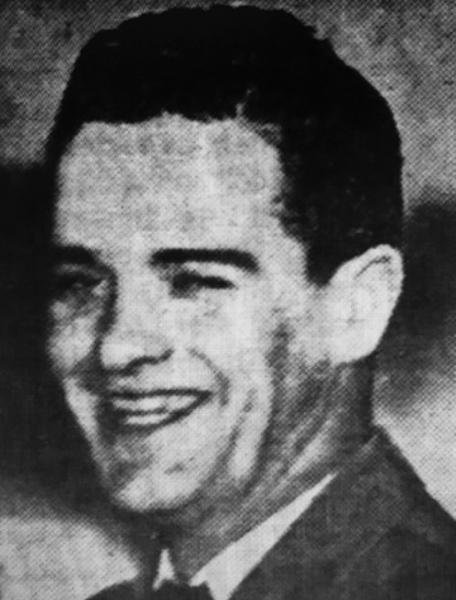
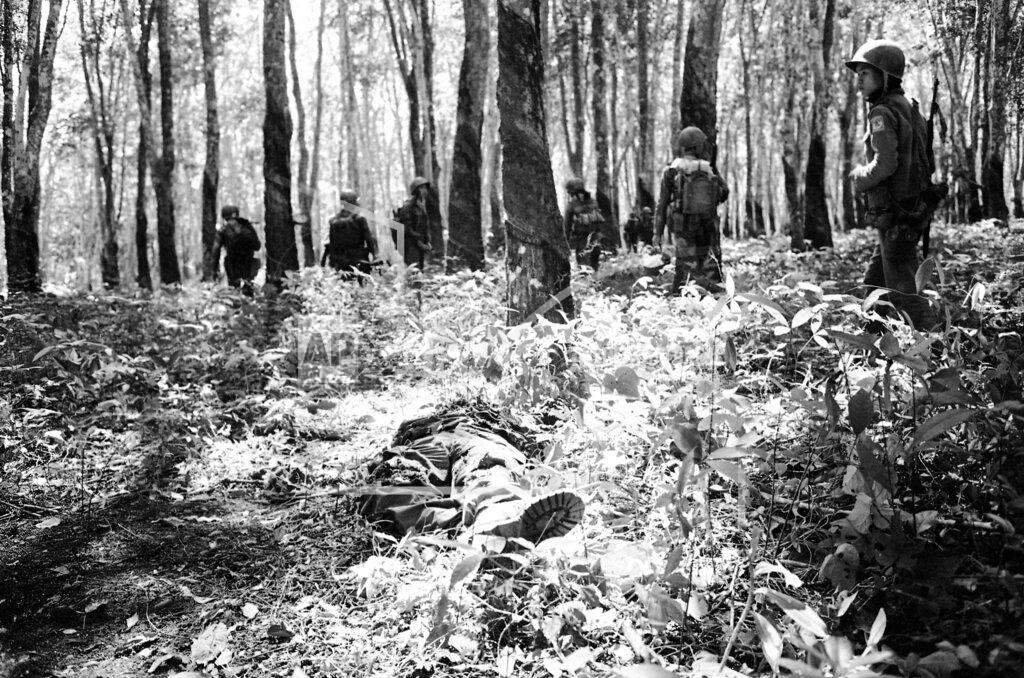
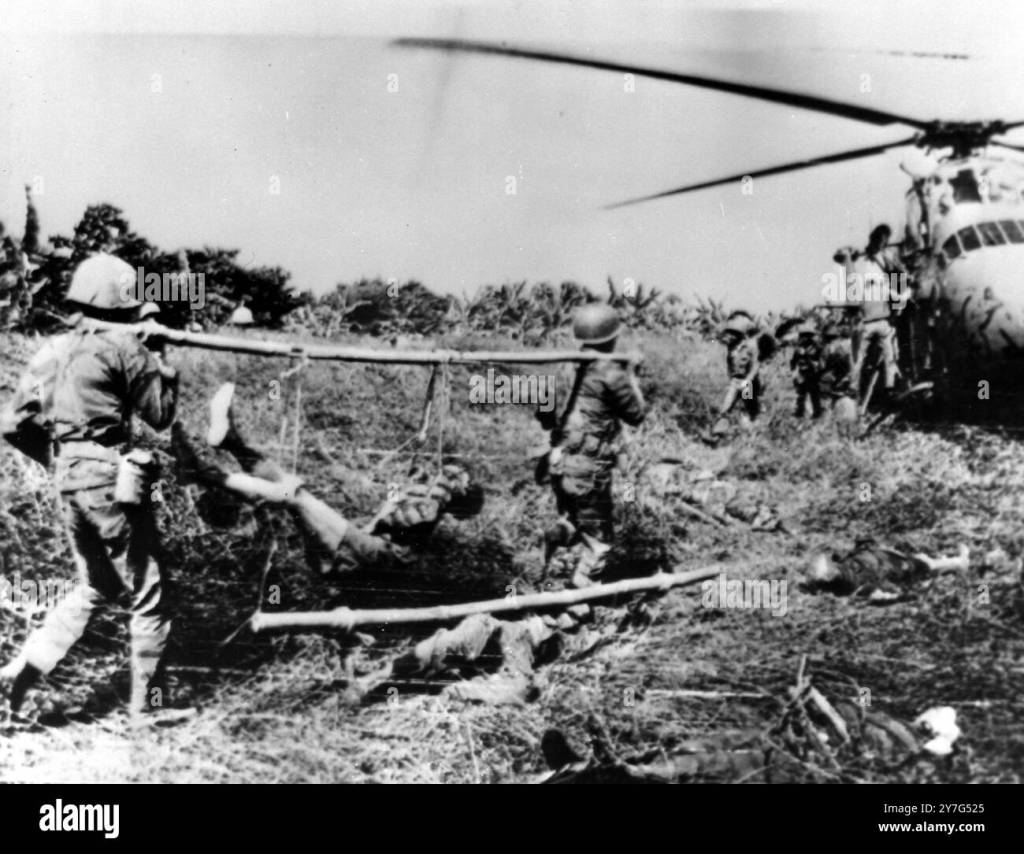
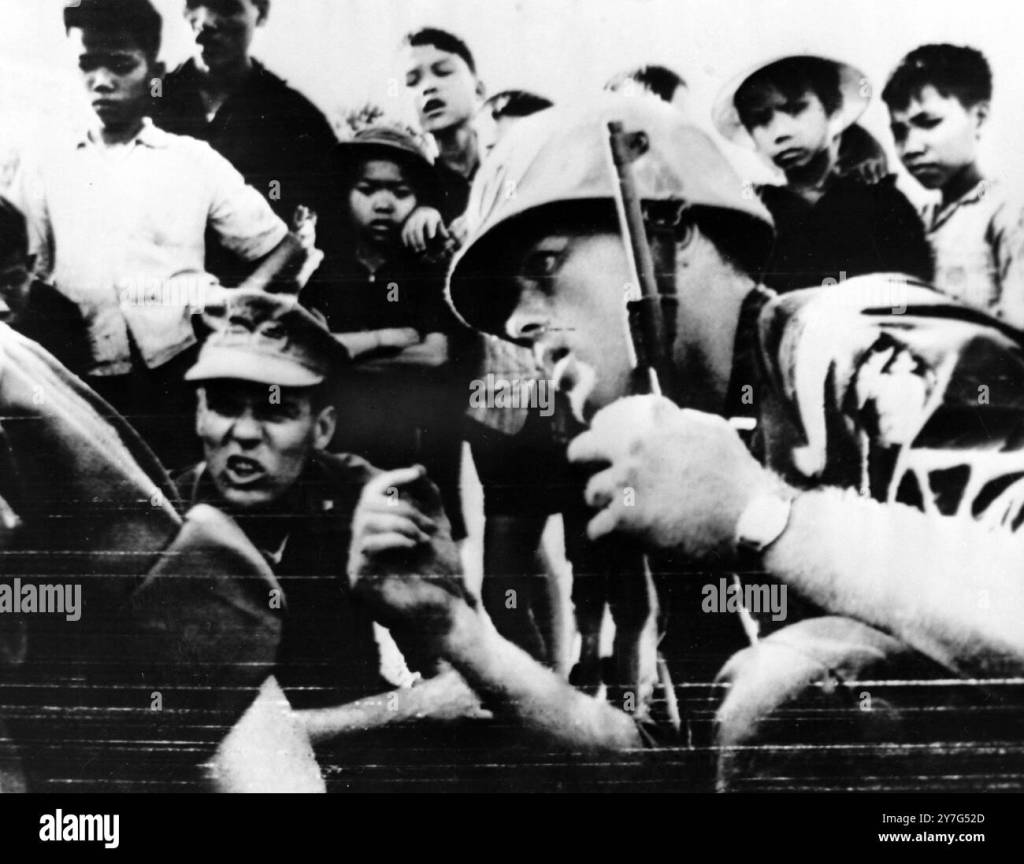
The political crisis that has been undermining the South Vietnamese government and military for months is aggravated when thousands of anti-government demonstrators in Saigon clash with government marines and police; there is also rioting in Huế, where students are organizing strikes. The main resistance comes from the Buddhists, who are strongly opposed to Trần Văn Hương, who became premier on 4 November 1964. Street fighting erupted in Saigon today as thousands of anti-Government demonstrators clashed with marines and policemen. The disorder began as a quiet demonstration near the residence of the armed forces commander, Lieutenant General Nguyễn Khánh. But as the marines and policemen moved in to contain the demonstrators, 300 broke through police lines.
The rioters were quickly joined by at least 1,000 other demonstrators in several downtown streets. They beat passersby, photographers, and policemen. At least 20 persons were believed to have been injured. They included Huỳnh Công Mỹ, a photographer for The Associated Press. By noon the riot appeared to be spreading to other parts of the city. Some youths established a stronghold in the middle of the marketplace.
They hooted and jeered at marines who threatened them with bayonets. Others ran along main boulevards and moved to set up a demonstration headquarters at the city’s main Buddhist compound. There was also trouble in the city of Hué, 400 miles to the north. Student agitators were planning to begin a two-day hunger-strike, accompanied by anti-Government demonstrations and agitation. The Saigon demonstration was called to protest plans for the trial of four students charged with having incited riots in November. The trial, in a military court, was to start today, but it was postponed. The Ministry of Education was trying to have the trial canceled and the students freed.
The police had blocked off a five-block area to keep demonstrators away from the waterfront military compound where the trial was to take place. The compound is next to the residence of General Khánh. The demonstrators hoisted banners demanding the release of the students, and then fastened slogans to the coils of barbed wire blocking their way. Several additional truckloads of marines and fire trucks drove up with high-pressure hoses. A battalion of 500 marines was detailed to riot control. Behind the barricades were armored cars and heavy machine guns.
Thích Tâm Châu, the chief political spokesman for South Vietnam’s Buddhist movement, spoke out against the Government today, making it clear that Buddhist opposition to Premier Trần Văn Hương was un diminished. The monk’s speech, delivered unexpectedly at a prayer meeting in the National Pagoda, was his first formal reaction to the armed forces’ uprising of December 20, which abolished South Vietnam’s civilian legislature and threw the nation’s politics back into confusion.
Some listeners said they detected a vague anti-Americanism in Thích Tâm Châu’s speech. At one point he charged that only the support of “foreigners” was keeping Premier Hương in power. The Premier has been a target of Buddhist and other activist factions since the end of October, when he appointed a Cabinet of nonpolitical civil servants. Thích Tâm Châu’s speech made no new charges. It repeated the Buddhists’ accusation that the Hương Government lacks a basis in law or popular support, and it specifically avoided taking any position on the uprising by the young generals.
According to reliable sources. Buddhist leaders are still trying to assess the situation. Their hesitation reflects uncertainty in many quarters, shared by senior American officials, about the alignment of power in Saigon. Besides charging that Premier Hương showed a hostile attitude) toward Buddhism, Thích Tâm Châu cited the dissolution of the legislature — known as the High National Council — as evidence that the Government should be deposed.
The council, formed last summer to guide South Vietnam back to civilian rule, was the legal foundation for Mr. Huong’s Cabinet. Without the legislature, Thích Tâm Châu said, the Government is illegal. This attitude appears to conflict with that of the armed forces. White dissolving the legislature, they voiced support for Premier Hương and for the chief of state, Phan Khắc Sửu.
When Buddhist leaders have been pressed for a description of their attitude toward the United States’ involvement in South Vietnam, they have consistently avoided a firm reply. A Buddhist official described Thích Tâm Châu’s latest speech as “a warning shot” rather than a full-force attack. And Thích Tâm Châu himself denied that he was ready to revive the vigorous Buddhist campaign against Mr. Hương, which was interrupted by the military uprising.
Secretary of State Dean Rusk today ruled out either withdrawal from South Vietnam or a major expansion of the war there at this time. He said that with unity and aid the South Vietnamese themselves could defeat the Communist guerrillas. In a television interview over the National Broadcasting Company network, Mr. Rusk said he saw progress on the international scene generally although “there remains much unfinished business.” He conceded he shared with many Americans “a sense of frustration” about the Vietnamese campaign. “It is going to require persistence, it is going to require a good deal of effort by the South Vietnamese, as well as ourselves, and a certain coolness in dealing with this problem,” he said.
The Senate Democratic leader, Mike Mansfield, said today that neutralization of Southeast Asia “perhaps would offer some hope for the future.” On the eve of the opening session of the 89th Congress, Senator Mansfield predicted that a full-scale debate on United States policy in Vietnam would be held in the Senate, “and it will be a good thing.” America’s problem is that it cannot withdraw and cannot carry the war into North Vietnam for fear of a major conflict with Communist China, he said in a television interview; on “Meet the Press” on the National Broadcasting Company. network.
North Vietnam has charged that three warships operating under the command of United States and South Vietnamese authorities, shelled one of its communes today, burning a number of civilian houses.
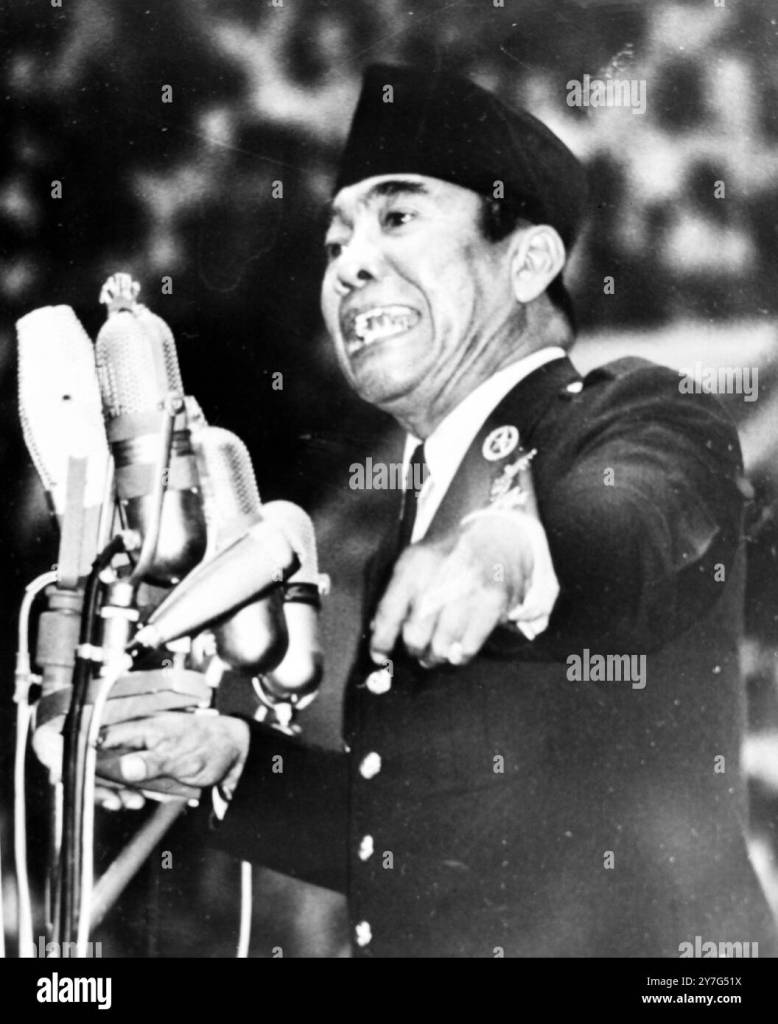
President Sukarno’s strategy in quitting the United Nations appeared today to be aimed at the formation of a rival body in which Indonesia would emerge as “a significant nation.”
Indonesia’s action to leave the United Nations remained incomplete today as her delegation withheld delivery of the written confirmation on which it has been working. Oral notice was given last week.
The early development of active, militant and continuing cooperation in Southeast Asia between Indonesia and Communist China was believed possible by high United States officials today.
The Malaysian Government announced today the capture of four Indonesian infiltrators near St. John’s Island off Singapore. Defense Ministry sources said. that the men were aboard a motor launch headed for Singapore. It was seized at night by a patrolling British vessel, the Wilkieston, they said. The Indonesians surrendered without resistance, it was reported. The men had with them three Sten guns, a light machine gun, several hundred rounds of ammunition and some T.N.T.
Advance elements of a battalion of the elite Scots Guards will leave Singapore tomorrow to reinforce units along the border between Sarawak, a component of Malaysia, and Indonesian Borneo. The move is part of a limited build-up of British strength in the area that began over the weekend to meet any increase in Indonesia’s guerrilla war against Malaysia. At the large British naval base in Singapore, work will begin tomorrow to take four minesweepers and two patrol craft out of mothballs.
Liu Shao-chi, the chief of state, and other top Government leaders of Communist China were re-elected today at a plenary meeting of the National People’s Congress.
The Soviet Government has thrown its support behind a Chinese Communist proposal for a world conference of heads of state on the prohibition and destruction of nuclear weapons.
The collapse of a Roman Catholic church in Rijo, a town in the Mexican state of Puebla, killed 57 people and injured 61 others during the first Sunday services in the new building. Twenty of the victims were children, and 100 other children were left as orphans by the disaster.
During the last year Communist countries have promised President Gamal Abdel Nasser more than $500 million worth of economic credits for the United Arab Republic’s second five-year plan, which starts in July.
The Philippine Government reported today a new outbreak of Communist Hukbalahap guerrilla activity in Pampagna province and sent 2,000 troops there to put it down. The province was the scene of a Hukbalahap rebellion 14 years ago.
The gaps in the Berlin wall were sealed again today after a holiday arrangement under which 800,000 West Berliners visited relatives in the Communist sector.
The first German airbase on foreign soil since the end of World War II opened, when West Germany’s Luftwaffe began joint-operation with the Portuguese Air Force of a base 110 miles (180 km) from Lisbon.
In his first public appearance of the year, Pope Paul VI gave a homily at a Mass for the Italian University. He deplored the racial violence and massacres in the Congo.
The staunchly pro-Soviet Mongolian regime is faced with apparently serious internal dissension. The existence of opposition within the leadership of the Mongolian Communist party was disclosed in a recent speech by Yumzhagiin Tsedenbal, the Mongolian Premier and party leader who is the most frequent visitor to Moscow of all foreign Communist leaders. Premier Tsedenbal’s speech seemed to indicate that the opposition was directed largely against his policy of friendship with and reliance on Moscow.
Syria announced nationalization of foreign-controlled industries. The Syrian Government today took full or partial control of 107 enterprises that form the country’s main industries.
Pakistani President Mohammad Ayub Khan declared today that relations between the United States and Pakistan would probably remain strained so long as the United States supplied arms to India.
The Argentine Government is convinced that 1965 will be a year of political decision for Argentina and that the outcome will be determined by the solutions it can provide for an accumulation of economic problems.
The feasibility of building the world’s longest bridge across the mouth of Tokyo Bay will be surveyed this year by Japan’s Construction Ministry.
The 89th Congress, which President Johnson hopes will provide a great consensus for the beginnings of his Great Society, will convene tomorrow. Before the two houses meet at noon, however, Republicans in the House must caucus and reach a consensus by secret ballot on whether they will retain Charles A. Halleck of Indiana as their leader or supplant him with Gerald R. Ford of Michigan.
On the Senate side, the Democrats must likewise caucus and reach a consensus on whether Russell B. Long of Louisiana, John O. Pastore of Rhode Island or A. S. Mike Monroney of Oklahoma will succeed Vice President-elect Hubert H. Humphrey as assistant leader. These two contests will infuse the opening-day ceremonies with some unwanted drama. Usually the “organization” of the House and Senate — as the initial caucuses for the selection of party leaders are called — is a perfunctory affair.
There will also be a skirmish in the Senate tomorrow — but probably only a halfhearted one — over changing the Senate rules to make it easier to break filibusters. In addition, in the House, Representative William Fitts Ryan, Democrat of Manhattan, will challenge the seating of four regular Democrats and one Republican from Mississippl on the ground that their election was constitutionally invalid because Blacks were systematically excluded from voting. The challenge, on behalf of the predominantly Black Mississippi Freedom Democratic party, is expected to be thrust aside by the House. Eight new Senators and 91 new Representatives will be among those taking the oath of office when Congress opens tomorrow.
President Johnson was polishing the State of the Union Message he will deliver at 9 PM tomorrow. He will be breaking tradition, inasmuch as State of the Union Messages are not normally delivered on the opening day of a Congressional session and they have almost always been delivered at noon.
The candidates for House Republican leader and Senate Democratic whip were also busy today, scrambling for votes. Supporters of Mr. Ford, who held a strategy meeting this afternoon, said they had “62 sure votes” for him. If all 140 House Republicans are on hand, 71 votes will be needed for victory.
The stripping of Representative John Bell Williams’s seniority by the House Democratic caucus yesterday was viewed in his home district today as helping his political prestige in the state while hurting the Democratic party.
United States Representative Albert W. Watson of South Carolina, stripped of his Democratic seniority in the House yesterday because of his support of Senator Barry Goldwater, the Republican Presidential nominee last fall, may turn independent or join the Republican party.
Jed Johnson Jr., elected U.S. Representative for Oklahoma in November at the age of 24, became the youngest member of Congress in modern times when he was sworn into office one week after reaching the required minimum age of 25 on December 27.
The first bill to be introduced tomorrow in the new Congress will seek to provide both cash and hospital-care benefits for millions of older Americans. Teaming up to push for their long-stalled health-care program known as the King-Anderson bill, Senator Clinton P. Anderson of New Mexico and Representative Cecil R. King of California, both Democrats, have expanded their earlier proposal to include cash-benefit increases for those receiving Social Security payments.
The hospital-care feature of the new bill will tally closely with previous King-Anderson measures. It would provide hospital insurance for all elderly Americans, including those not on the Social Security rolls. Cash-benefit increases under the bill would be retroactive for all of 1965, but not payable until the latter half of the year.
Some 600 Mississippians arrived in Washington by car and bus late today to demonstrate in the Black-liberal challenge of the state’s election laws. The demonstration will take place as the new Congress holds its opening session tomorrow. The feature will be a silent watch at the Capitol when an investigation will be demanded into the election of all five of the state’s House members.
But before the House meets at noon, the white and Black supporters will try to call in groups of four at the offices of all Representatives-elect. Other groups will picket the White House and the Department of Justice, the parent body of the Federal Bureau of Investigation. Tonight the demonstrators were briefed on their actions tomorrow and their goals. The briefing, which was not public, was held in the Lincoln Memorial Congressional Temple, a church a few blocks north of the city’s business district.
The realistic objective of the challenge to the seating of the Representatives-elect from Mississippi Jamie L. Whitten, William M. Colmer, Thomas G. Abernethy and John Bell Williams, Democrats, and Prentiss Walker, a Republican, is to dramatize the voting situation in Mississippi, where 94 percent of adult Blacks are not registered.
J. Edgar Hoover, director of the Federal Bureau of Investigation, reported today a “sharp trend upward” in the number of civil rights cases investigated last year, with 960 under the law that took effect last July 2.
An upstate New York real estate developer has been ordered to build a house for a Black man who charged he had been denied an equal opportunity to purchase a home.
Dean Burch’s appeal to the Republican National Committee for time to prove his worth as National Chairman appears to have changed few minds. Initial reaction to a letter Mr. Burch mailed to the 132 committee members indicates that those who opposed him still do, and that those who favored him still want him to remain.
A new acting chancellor of the University of California extended an olive branch tonight to rebellious students but declared that further civil disobedience on the controversy-ridden Berkeley campus was unwarranted.
Harry Gallatin was named coach and Eddie Donovan general manager of the New York Knickerbockers yesterday in a major reorganization of the most unsuccessful team in the National Basketball Association.
A comparatively green, 175-pound split end, Billy Gambrell, stole the show in collaboration with his quarterback, Charlie Johnson, as the St. Louis Cardinals defeated the favored Green Bay Packers, 24–17, today in the playoff bowl game of the National Football League.
Born:
Luis Sojo, Venezuelan MLB second baseman, shortstop, and third baseman (World Series Champions-Yankees, 1996, 1998, 1999, 2000; Toronto Blue Jays, California Angels, Seattle Mariners, New York Yankees, Pittsburgh Pirates), in Caracas, Venezuela.
Mark Dewey, MLB pitcher (San Francisco Giants, New York Mets, PPittsburgh Pirates), in Grand Rapids, Michigan.
Danny Stubbs, NFL defensive end (NFL Champions, Super Bowl 23, 24-49ers, 1988, 1989; Dallas Cowboys, Cincinnati Bengals, Philadelphia Eagles, Miami Dolphins), in Long Brance, New Jersey.
Darryl Usher, NFL wide receiver and kick returner (San Diego Chargers, Phoenix Cardinals), in Los Angeles, California (d. 1990, murdered).
Died:
Semyon Kosberg, 61, Soviet Jewish aviation and rocket engineer, Hero of Socialist Labor and four time awardee of the Order of Lenin.
Betty Harte, 82, American silent screen actress.
Milton Avery, 79, American modern art painter.

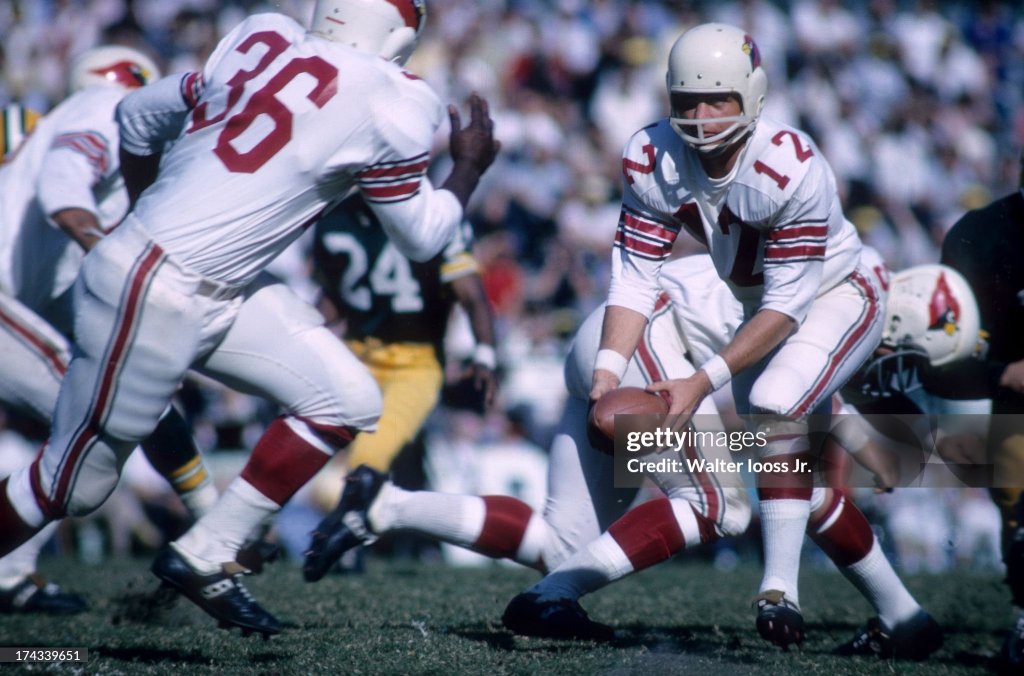
[Ed: The Playoff Bowl was a 1960’s consolation game of sorts, for the runners-up in the two conferences, with proceeds going to the players’ pension fund, and reportedly raised a million dollars over the decade of the 1960s.]
 History Diaries