The Saigon military command said yesterday that its forces had weathered a North Vietnamese attack on Phước Bình, a province capital 75 miles north of Saigon, and were still in control of the city. Supported by heavy air strikes and artillery barrages that reportedly knocked out a dozen Soviet‐built T‐54 tanks, the 2,000 to 2,500 South Vietnamese defenders were said to have driven a small force of North Vietnamese troops from within the city and pushed the front line two‐and‐a‐half miles to the south. But Phước Bình was still considered in danger of becoming the first province capital to fall since Quảng Trị was overrun in 1972. One well‐placed South Vietnamese Army officer noted that the city was surrounded by North Vietnamese troops who had not yet attacked as intensively as they could. “So far, incoming rounds have been counted only by the hundreds,” the officer explained. “The real fight is when the incoming rounds are in the thousands.” He said that the South Vietnamese Air Force was dropping supplies into the besieged city by parachute, but that no helicopters had been able to evacuate the wounded.
According to the South Vietnamese Government, about 26,000 civilians are trapped in Phước Bình without adequate food, drinking water or medical supplies. Saigon appealed on Thursday to the Việt Cộng to negotiate a short truce at Phước Bình to permit the evacuation of the civilians. The Việt Cộng refused. Saigon’s Foreign Ministry held a televised press conference at which officials detailed the major government military losses in the nearly two years since the abortive Việt Cộng ceasefire agreed to in Paris. Maps were brought out showing the positions of 14 major base camps and 11 district capitals overrun by Communist forces, mostly in the last six months. “The people of the Republic of Vietnam have never enjoyed a single peaceful day in the last two years,” declared Lieutenant Colonel Lê Trung Hiền, spokesman for the military command.
Cambodian Government forces killed 183 insurgents in fighting on three fronts today around Phnom Penh, according to a spokesman for the Cambodian command. He added that many of the dead were North Vietnamese and Việt Cộng soldiers. It was the first time in several months that the command had reported that Vietnamese Communist forces were taking part in the Cambodian fighting on a large scale. In keeping with a policy dating from New Year’s day, when the latest offensive by the insurgents began, the command gave no details of government casualties in any of the reported clashes.
Tonight, three civilians in the capital’s central market were wounded when two rockets fired by insurgents exploded in the market, which had been nearly deserted since dusk. Earlier, a command spokesman said that government troops were pushing back the insurgents in all sectors, but he did not elaborate. Military sources said the insurgents, having killed several hundred government troops, had established positions from which they could launch rocket and mortar attacks against the Pochentong international airport and the country’s largest arms dump, 10 miles southwest of Phnom Penh. These sources also said that the insurgents were trying to join forces in the western and northwest regions, posing a serious threat to the capital’s security.
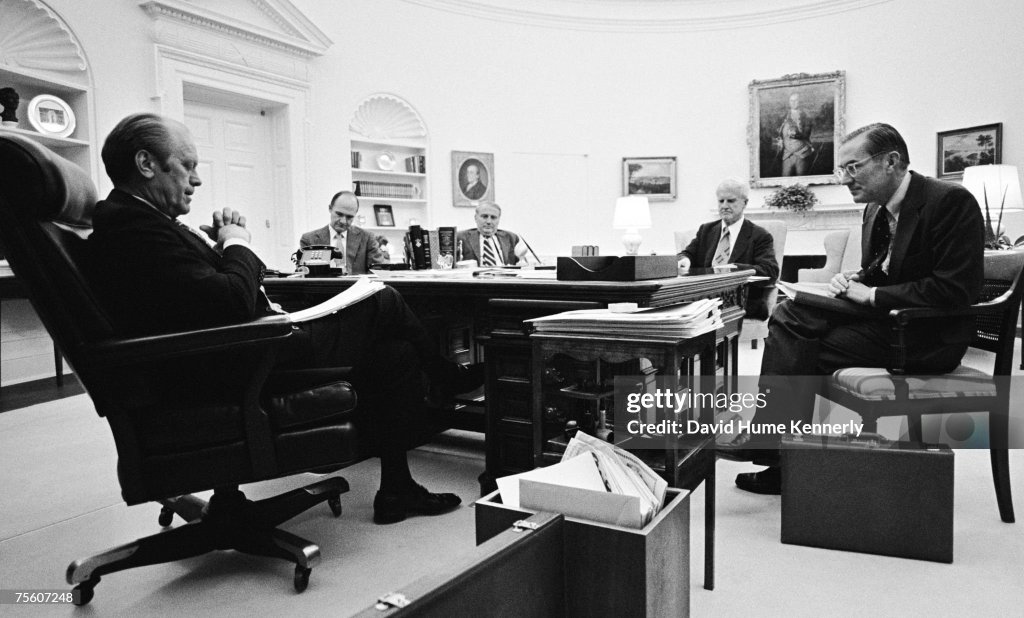
President Ford signed a wide-ranging trade reform act, but left uncertain the fate of the controversial part that would provide trade benefits to Moscow in return for assurances of freer Soviet emigration policies. He told the 200 guests at the signing ceremony in the White House that because of recent Soviet denials that any such “assurances” had been given to the United States, it was questionable whether the trade-benefit clause would be carried out. Administration officials said that before any final decision on whether to grant the trade benefits was made, conversations would have to be held with Soviet officials to discuss their emigration policies and technical changes in the Soviet-American trade agreement of 1972. The signing ceremony in the East Room was witnessed by Vice President Rockefeller, Secretary of State Kissinger, other Administration officials, members of Congress, and public figures, including Jewish leaders who want Soviet restrictions on emigration eased.
Pentagon officials said that the administration had approved a $95 billion defense budget for the coming fiscal year, an $11 billion increase over the current defense budget. The argument expected to be offered by the administration when the new budget is presented to Congress this month is that the increase is necessary to maintain the country’s basic defense position in the face of inflation. Whether this view will be accepted by the new Democratic majorities in Congress, however, is a subject of considerable concern in the Pentagon. From the Pentagon’s perspective, the proposed budget, despite the unusually large increase, still is too small to offset completely an inflationary erosion that officials say is beginning to cut into the readiness and modernization of the armed forces. Basically, according to Pentagon officials, the proposed budget would permit the military to keep pace with anticipated inflation in the coming year, but not to recoup all past losses in purchasing power caused by inflation.
President Valéry Giscard d’Estaing, chatting at a New Year’s reception for the press, said today that he had found President Ford and Leonid I. Brezhnev to be closer in their views on a Middle East settlement than was generally supposed. Mr. Giscard d’Estaing did not go into detail, but he said that the problem now was to see if “the will and the capacity” existed to put a solution into effect. The President ranged briefly over a broad series of topics, serious and not so serious, as he moved, a glass of grapefruit juice in hand, around a bar set up in one of the salons of the Elysée Palace. Mr. Giscard d’Estaing said he had found “a greater convergence of views than supposed” when he discussed a possible Middle East settlement last month with the Soviet Communist party leader, Mr. Brezhnev in Paris, and with the American President on Martinique.
Rumors that Soviet leader Leonid I. Brezhnev was ill made the rounds of Moscow’s foreign colony Friday but usually reliable diplomatic sources said they had no information that would confirm the reports. Soviet officials were not talking. The rumors appeared to be an outgrowth of an announcement Monday by the Soviet news agency Tass that a much-heralded trip by Brezhnev to the Middle East in mid-January had been indefinitely postponed. No reason was given. The rumors ranged all the way from Brezhnev being tired, following a busy round of summit meetings. and official appearances, to his suffering a “slight” heart attack.
Many of Britain’s doctors wrestled with their consciences Friday on the second day of an unprecedented work slowdown over pay that spread sporadically through the National Health Service. The slowdown, carried out by working strictly according to contract, began Thursday among the nation’s 12,000 hospital consultants, or specialists, attached to one or more state-run hospitals. The slowdown received less than the 100% support predicted by militant spokesmen. Some doctors indicated that the action was at variance with the oath they had taken upon graduation from medical school. The regimen I adopt,” the medical profession’s Hippocratic oath says, “shall be for the benefit of my patients according to my ability and judgment, and not for their hurt or for any wrong.”
A man posing first as a Scotland Yard inspector and then as an Irish Republican Army terrorist hoodwinked a large department store into parting with $125,000 last night. Three telephone calls to the store, John Lewis, on Oxford Street, was all it took. In the first call, about 7:35 PM, 25 minutes before the store closed, he told the managing director that he was “Inspector Bassett” of Scotland Yard and that a peaceful I.R.A. demonstration would take place outside the store. Ten minutes later, the manager got a call from “John Muldoon,” who said he was an I.R.A. leader and that 12 incendiary bombs hidden in the store would explode at 9 PM. He demanded the day’s takings in return for revealing the location of the bombs. A member of the store’s security staff left with the money in a shopping bag as directed, walking along Oxford Steet toward Marble Arch. He had not gone far before the hoaxer approached him, exchanged prearranged password, took the money and sped off in a waiting taxi.
West Germany denied a report that it had given secret assurances not to oppose U.S. military supply of Israel through American bases in West Germany in the event of a new Middle East war. But a Foreign Ministry spokesman refused to say specifically whether West Germany — which under North Atlantic Treaty Organization rules may only protest use of American bases here for Mideast logistic support — would flatly refuse to permit such arms movements.
Former Prime Minister Golda Meir returned to Israel after a month-long fund-raising trip to Europe, the United States and Canada, and told newsmen she felt reassured of continued American support for Israel. She said differences were bound to arise between Israel and the United States, but “there is no real debate on basic issues.”
Lebanese and Israeli forces exchanged artillery and small arms fire Friday in the third straight day of hostilities along the border, according to reports reaching Beirut. Israel said one of its soldiers was killed and three were wounded by Lebanese fire. In Cairo, the Palestine Liberation Organization charged Jordan with supporting “a new American plot” that would return the Israeli-occupied West Bank to Jordan’s King Hussein and not to the PLO. The charge, which did not specify the U.S. involvement, came on the eve of a two-day meeting in Cairo of PLO leaders with the foreign ministers of Syria, Jordan and Egypt to seek a solution to the continued rift between Hussein and the PLO. It is their first meeting since the Rabat conference in October.
Reports from southern Lebanon said sporadic exchanges of artillery and small arms fire erupted between Lebanese and Israeli troops after an Israeli armored car had tried to cross into Lebanon near the Lebanese village of Majidieh. The reports said Lebanese gunners shelled two Israeli positions at Tal Abassieh across the border from Majidieh and Israeli artillery shelled the vicinity of Dheirjat and Halta villages on the western fringes of Mt. Hermon. In Tel Aviv, the Israeli command. said an Israeli was killed and three were wounded by the Lebanese artillery and small arms fire, and that three other Israeli soldiers were wounded when their car hit a landmine. The command said all seven. casualties occurred on Israeli territory. Lebanese sources also said that Lebanese troops captured an Israeli soldier four miles inside Lebanon. He was said to have strayed into the village of Yater while on a reconnaissance mission, according to the sources.
The Foreign Ministers of Jordan, Syria and Egypt and a senior official of the Palestine Liberation Organization opened talks here tonight aired at settling some of the differences between King Hussein of Jordan and the Palestinian leadership. The talks, to be continued tomorrow, are also meant to coordinate military and political strategy toward Israel and, if possible, to move toward an Arab consensus on the Palestinian and Jordanian roles at the Geneva peace conference. This meeting, delayed two months, was ordered by Arab kings and presidents in October at their summit meeting, at Rabat, Morocco. They had decided that Hussein and Yasser Arafat, head of the Palestine Liberation Organization, should attend, but neither is yet ready for such a confrontation.
Officials in six Arab countries say that their new oil wealth will create a framework for stability in the Middle East, but their vast income is now being used to put international pressure on Israel. Western and Japanese financial institutions and industrial corporations are reportedly shying away from dealings with Israel to avoid the danger of being barred from the enormous market the Arabs are opening to foreigners.
Explosions rocked the Egyptian and Jordanian embassies in Damascus, causing extensive damage Friday night. Spokesmen for the two embassies said both buildings were empty, except for guards because Friday was the Muslim sabbath. No one was reported injured. The explosions occurred about 10 minutes apart. The buildings are about 300 yards from one another.
The killing in a bomb explosion of Lalit Narayan Mishra, 52‐year‐old Railway Minister and a confidant of Prime Minister Indira Gandhi, sent shock waves through India’s major political parties today. Mr. Mishra, central figure in a Governmental licensing scandal, died today following surgery for injuries received in the bombing yesterday at Samastipur in his home state of Bihar. His brother, a minister in the state government, was injured in the explosion, which occurred during a rally to mark the opening of a new railway line. The murder of Mr. Mishra immediately brought charges from the governing Congress party and from opposition parties that the other side was responsible. Mrs. Gandhi declared: “The forces of disruption which have come to the fore lately have spread hatred and indirectly encouraged violence. It is this atmosphere which is responsible for the dastardly crime.”
The British Foreign Secretary, James Callaghan, said today that he would have talks in South Africa with Prime Minister John Vorster within the next few days. Mr. Callaghan will be the highest‐ranking British minister to visit South Africa since Harold Macmillan went there as Prime Minister in 1960 and made his celebrated “winds of change” speech, in which he said that Britain could not support South Africa’s racial apartheid policies.
Unemployment in the United States in December was at its highest rate in more than 13 years. The Labor Department reported that 7.1 percent of the labor force, a total of 6.5 million persons, was out of work last month. The 7.1 percent rate was last reported in May, 1961, and was last exceeded in August, 1958. Ron Nessen, the White House press secretary, said President Ford had heard estimates that the jobless rate could reach 8 percent over the next few months.
The Federal Reserve Board cut its discount rate — the rate at which banks borrow temporarily from the Federal Reserve when they are pinched for funds — to 7¼ percent from 7¾ percent. This was an indication that the Federal Reserve was adopting an easier monetary policy as an anti-recession move. The board said “the action was taken in view of the weakening in economic activity.”
President Ford plans to meet with Richard Helms within the next few days, White House officials said today, as part of his promised review into allegations of illegal domestic spying by the Central Intelligence Agency. Mr. Helms, the former Director of Central Intelligence, whom well‐placed government sources have called a key figure in the domestic spying, returned to Washington today on what State Department officials said was a prearranged home leave from his post as Ambassador to Iran. “There’s going to be no whitewash of this,” one White House aide said. “He’s [President Ford] going to see all the principals.” The President, who has made no substantial public statement on the alleged spying since the first published reports two weeks ago, met separately today with Secretary of State Kissinger, Secretary of Defense James R. Schlesinger, and William E. Colby, the Director of Central Intelligence. After his meeting with the President, Mr. Kissinger told newsmen that he planned to meet at the State Department tomorrow with Mr. Helms, who has been quoted as denying any involvement in “illegal” domestic activities.
The Justice Department has decided not to prosecute anyone in connection with the Federal Bureau of Investigation’s 15‐yearcampaign to disrupt the activities of suspected subversive organizations. The decision was reached after Assistant Attorney General J. Stanley Pottinger, head of the Civil Rights Division, reported to Attorney General William B. Saxbe that he had found “no basis for criminal charges against any particular individual involving particular incidents.” But Mr. Pottinger also told Mr. Saxbe, according to a Justice spokesman, that he had not reviewed the entire 60,000 pages of records of the so‐called Cointelpro [for counterintelligence program] and that any allegations of specific violations that might come in later could still lead to criminal charges. The operation was reviewed earlier by a team headed by Henry E. Petersen, who retired December 31 as Assistant Attorney General in charge of the Criminal Division. He concluded that no criminal charges were justified, but he also sent Mr. Saxbe two reports that have not been made public. One argued against prosecution of present or former FBI officials; the other said that prosecution of some criminal offenses might be called for.
Mr. Saxbe then asked Mr. Pottinger to review the bureau’s actions to see if there had been violations of civil rights laws. If there had, two sections of the criminal code making it an offense to deprive citizens of their civil rights seemed most likely to have been violated. Mr. Pottinger replied almost immediately that he had found no basis for criminal charges. Then Mr. Saxbe asked him to make a more thorough study, which resulted in the same conclusion. A report on Cointelpro released by Mr. Saxbe and the FBI director, Clarence M. Kelly, on November 18 said that some of the bureau’s practices under the program were “abhorrent in a free society.” Mr. Kelly said, however, that he did not think use of the word “abhorrent” was justified.
Attorneys for H. R. Haldeman asked Federal District Judge John J. Sirica today for a new trial on grounds that some of the jurors in the Watergate cover‐up trial may have violated his order not to watch television or read newspapers during their deliberations.
In its gloomiest report on the natural gas supply to date, the staff of the Federal Power Commission said that the outlook for gas supplies has worsened unexpectedly and recommended mandatory conservation measures affecting all gas consumers, including homeowners. Natural gas production from the lower 48 states “has reached its peak and will be declining for the indefinite future,” the report said.
In the largest return in history of U.S. government land to an American Indian tribe, 250 square miles (650 km2) of the Grand Canyon National Monument were deeded back to the Havasupai people with the signing of a bill by President Ford. The 400 members of the tribe had been limited to a reservation of only 518 acres (210 ha), less than one square mile, at the bottom of Havasu Canyon, since 1882. The legislation also enlarged the National Park by adding 687,000 acres (278,000 ha) to bring its total size to 1,875 square miles (4,860 km2).
California Governor Ronald Reagan insisted at a farewell news conference today that he had never said some of the most controversial things attributed to him during his eight‐year tenure. At his last formal meeting with State Capitol reporters, the retiring Governor alternately struck joking and serious postures. At one point, he was asked whether he would like to take back any of his controversial statements. “What I’d rather do once and for all is get an acceptance of the truth that I didn’t say them in the way in which they were reported,” the Governor replied. “I never said, ‘A tree is a tree, and once you’ve seen one, you’ve seen them all,’ ” he said, referring to a quotation widely publicized during his first campaign for governor in 1966. Some researchers and conservation authorities agree that Mr. Reagan was wronged in that quotation.
Bob C. Riley became the first blind person to serve as the governor of a U.S. state, when he was sworn in as Governor of Arkansas after Governor Dale Bumpers resigned to take office as a U.S. Senator. Riley, who had had his left eye removed after he was wounded, wore an eyepatch and could only perceive light and dark out of his right eye. Riley served the remaining 11 days of the term to which Bumpers had been elected in 1970. On January 14, David H. Pryor took office upon the expiration of his predecessor’s term.
Vincent Kinek, the first person convicted of draft evasion in New Jersey since conditional amnesty was announced, was given a suspended sentence today with the condition that he spend two years in public‐service work. Judge H. Curtis Meanor in Federal District Court also indicated that he would revise the sentence if Mr. Kinek was successful in gaining admission to the University of Louisiana or Ramapo College in Mahwah within four months. “I wish you the best of luck, and I hope you take advantage of this program — frankly, I hope you go to college,” the judge told Mr. Kinek, a 22‐year‐old drifter who asserted that he had never received a draft notice mailed in 1972.
The University of Oklahoma Sooners were given the number 1 ranking in the final AP sportswriters poll of the 1974 college football season, and a share of the unofficial national college football championship. The Sooners had been the only undefeated and untied team, but had been ineligible for postseason play, and were not included in the UPI coaches’ poll. The USC Trojans, #1 in UPI, were 2nd in the AP poll.
Dow Jones Industrial Average: 634.54 (+2.50, +0.40%)
Born:
Danica McKellar, American actress (‘Winnie Cooper’ – “The Wonder Years”), in La Jolla, California.
Jason Marsden, American actor (“General Hospital”; “Munsters Today”; “Step By Step”), in Providence, Rhode Island.
Thomas Bangalter, French DJ (Daft Punk – “Get Lucky”), in Paris, France.
James Cannida, NFL defensive tackle (Tampa Bay Buccaneers, Indianapolis Colts), in Savannah, Georgia.
Arnold Miller, NFL defensive end (Cleveland Browns), in New Orleans, Louisiana.
Sergei Vyshedkevich, Russian NHL defenseman (Atlanta Thrashers), in Dedovsk, Russian SFSR, Soviet Union.
Died:
Milton Cross, 77, announcer since 1931 for the weekly radio broadcasts of the Metropolitan Opera. Cross, known to his fans as “Mr. Opera”, was preparing for the next day’s show when he collapsed at his home.
Robert Neumann, 77, Austrian-British author (“False Flag”).






 History Diaries