The six-day battle that has been fought in and around the village of Bình Giã ends with a clear defeat of South Vietnamese forces. Nearly 200 of their best troops are dead and some 300 wounded. Five Americans are killed, three are missing — the highest U.S. casualties in a single battle to date. Most sobering, though, is the fact that the South Vietnamese, despite the advantage of tanks, artillery, and helicopters, could not withstand the more flexible tactics of the Việt Cộng. On 4 January, Việt Cộng remaining in the area will make another surprise attack and account for several more casualties among the South Vietnamese and Americans.
Helicopters streamed toward Saigon, loaded with Vietnamese and American dead and wounded. The bodies of three Americans and scores of Vietnamese servicemen were recovered in the rubber plantations and rice paddies after most of the Việt Cộng forces had withdrawn from the Roman Catholic refugee town 40 miles southeast of Saigon.
Government casualties were expected to reach 100 dead, 200 wounded and 100 missing. Some sources feared that the total might increase to 500 or more. Although the Việt Cộng also suffered heavy casualties, the government’s losses were described as disastrous because of enormous losses in equipment, including three United States helicopters, and because the guerrillas proved capable of striking at will in government-held territory.
The hardest blow since Monday, when Communist guerrillas overran the village, occurred Thursday, when 200 Vietnamese marines moved to recover the bodies of four Americans shot down in a helicopter. When they ran into an ambush, 400 more marines were rushed to their relief. They met the same ambush and were beaten furiously. Today marine reinforcements linked up with Vietnamese Ranger troops at the site and recovered three of the Americans’ bodies. The body of the fourth crewman was recovered earlier.
In casualty figures and in the sizes of the forces that clashed, this battle was among the biggest in four years of the war. Preliminary estimates showed that besides the four Americans killed in the fighting, eleven were wounded. Three more are listed as missing and presumed captured. United States authorities said they had counted the bodies of 102 Communist guerrillas and had witnessed the removal of 20 more. These authorities discounted a report by the village priest that the Việt Cộng had removed 600 more bodies.
Ambassador Maxwell D. Taylor encouraged Premier Trần Văn Hương today to press for a rapid solution of the lingering political crisis that has stalled United States support planning with the Saigon Government. They met for the first time since early in the week. American officials had hoped that once the United States position was made clear the Vietnamese could find their own way to restore legal relations between the Government and the armed forces. Two weeks have passed since the military commanders abruptly dissolved the High National Council, the civilian provisional legislative body that technically provided the Government’s legal basis. During the last few days several formulas have been considered by the civilian ministers and the military commanders in private meetings, but none have been acceptable to both sides.
Observers were struck by the lack of urgency felt among Vietnamese leaders. Within hours of the military action December 20, Mr. Taylor expressed strong American opposition, asserting that it had disrupted the constitutional framework evolved over the last four months. Negotiations between senior American policymakers here and the Vietnamese Government toward increasing United States material support for the war against the Việt Cộng insurgency were immediately cut off. A few days later orders went to American field representatives not to commit the United States to any future military or civilian planning. These actions, plus Mr. Taylor’s scarcely guarded warnings that American aid could not be considered automatic by any Vietnamese group in power, seems to have had little effect so far.
One reported proposal was to set up an advisory council to replace the defunct High National Council. American officials declared this unsatisfactory because it would merely confirm the military action in disposing of the legislature constituted according to theoretically legal means. Reports that this proposal was being favorably considered by the chief of state, Phan Khắc Sửu, were called premature. An official spokesman denied that any decision had been. made and reliable sources doubted that Mr. Sửu would accept this formula, especially in the light of American opposition. The Americans hold that the military or any other group must not have the authority to sweep aside established governmental institutions whenever it chooses.
The Senate Republican Leader, Everett McKinley Dirksen, urged that President Johnson seek a “united decision” from Congressional leaders of both parties on whether to fight or withdraw from South Vietnam. He said in an interview that “the rank of the United States in the Orient would plummet” and that Communist China would win the Asian rice bowl if America pulled out. “A hard decision now has to be made.” Senator Dirksen added. “The cold, hard facts ought to be set forth around a conference table — with the best military, intelligence and other authorities spelling them out.
Senator Frank Church, whose opinions on Vietnam you have quoted at length, believes “the United States should never have got in, in the first place, and, while there is no immediate way out, the ground should be laid for ultimate extrication.”
Prince Norodom Sihanouk of Cambodia has accused the United States of attempting to disrupt his country’s policy of “peaceful co-existence” in Southeast Asian affairs.
Indonesia, ignoring an appeal by the Secretary General, declared today that she already considered herself out of the United Nations. The Indonesian representative, L. N. Palar, and his staff were drafting communications confirming the announcement. which had been foreshadowed by a statement in Jakarta Thursday by President Sukarno. Unlike the League of Nations, which permitted members to withdraw after giving two years’ notice, the charter of the United Nations makes no provision for withdrawal.
There is no machinery in the 19-year-old organization to deal with the action, but the consensus among those available for comment was that formal notification would be required to give effect to a withdrawal by one of the 115 members. An Indonesian spokesman said the mission was awaiting detailed instructions from Jakarta and it was expected here that the notification would not be delivered before Monday at the earliest. The spokesman said Indonesia did not intend to withdraw from specialized agencies such as the World Health Organization and the United Nations Educational Scientific and Cultural Organization.
A spokesman for the office of the Secretary General said there could be no comment on Indonesia’s withdrawal until notification had been received in writing. A majority of the delegates here during a holiday recess in the General Assembly session said they would await formal Indonesian action before commenting.
Mr. Sukarno said on New Year’s Eve that he would withdraw his country from the United Nations if Malaysia, to which he is bitterly opposed, took the nonpermanent seat on the Security Council given her last Tuesday by the General Assembly. Early today the Indonesian mission informed officials of the intention to carry out Mr. Sukarno’s threat. “Indonesia no longer considers itself a member of the United Nations,” the Indonesian spokesman said.
Indonesia’s large Communist party said today it fully supports President Sukarno’s decision to withdraw from the United Nations.
Reports that Indonesia is withdrawing from the United Nations has increased the prospects of an enlarged conflict between Indonesia and Australia. The Jakarta move has stirred a wave of apprehension in Ausralia.
The United Kingdom airlifted 1,200 British paratroopers, infantrymen and sailors to Singapore in order to help guard Malaysia from a threatened attack by Indonesia.
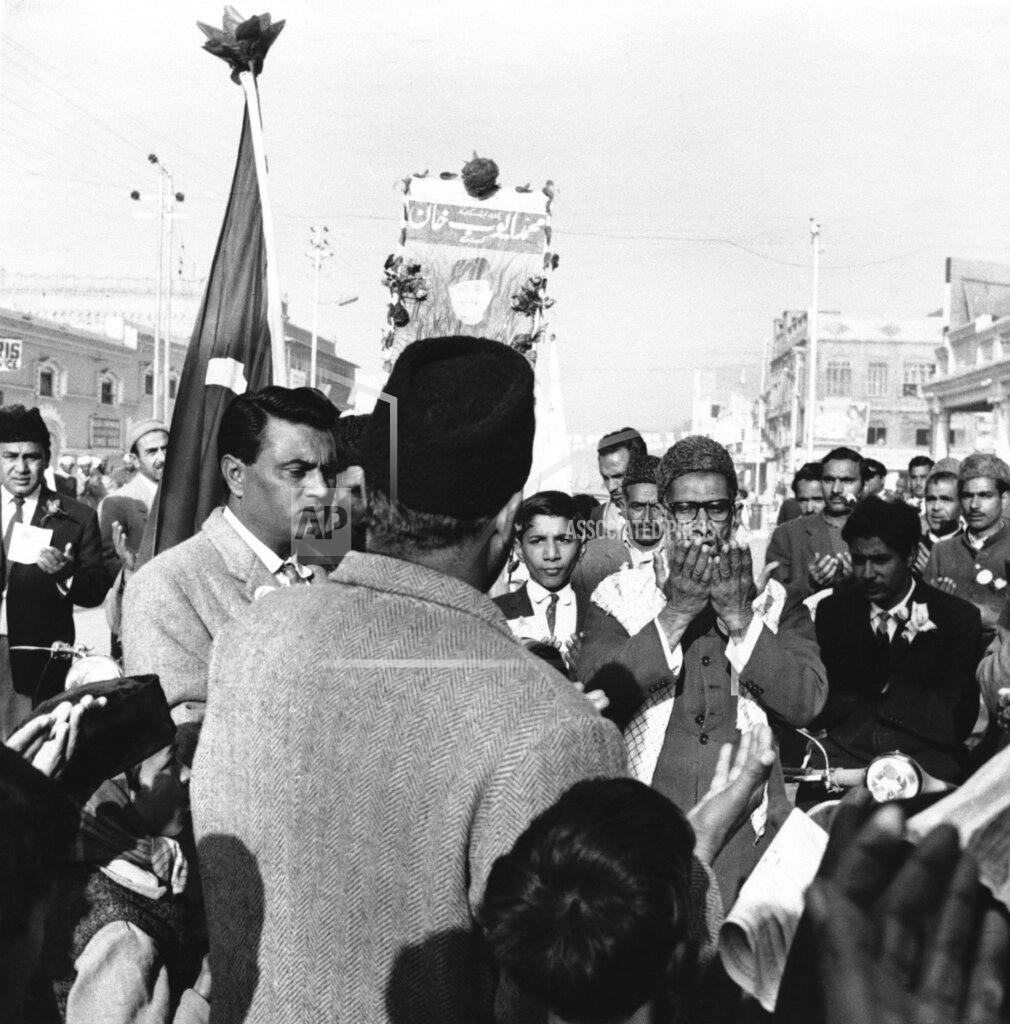
Mohammed Ayub Khan was re-elected as President of Pakistan, defeating challenger Fatima Jinnah, the 76-year-old sister of Pakistan’s founder Mohammed Ali Jinnah. The election results came in favour of the incumbent President Ayub Khan, who, despite losing the popular vote, won 62.43% of the Electoral vote. Fatima Jinnah won 35.86% of the electoral college votes. Jinnah was however extremely successful in some areas of the country. She had swept across major urban centres such as Karachi and Dhaka. Ayub also faced disappointing results in East Pakistan. However, Ayub had decisively triumphed in rural Pakistan. As majority of the Electoral College consisted of representatives from the rural setup, Ayub was able to win a clear majority. The election results were not accepted by the Combined Opposition Parties, who accused Ayub Khan of rigging. The COP staged demonstrations and protests, however, didn’t gain much public support, as Jinnah accepted the election results.
The Government of the Congo announced today that the legislative elections scheduled for the first two weeks of February had been postponed until the last two weeks of March, as the rebellion there continues.
Radio Peking said that the Panchen Lama, who had been removed from office in late 1964 as China’s puppet ruler for Tibet, had confessed to conspiring with Tibetan “serf owners” to foment unrest in the former kingdom.
Communist China announced tonight that its air force shot down a pilotless United States high-altitude reconnaissance plane today.
Denis Healey, the United Kingdom Secretary of Defence, canceled the nation’s fighter and military transport programmes and ordered the purchase of the U.S.-built F-4 Phantom and C-130 Hercules in their place.
Surgeons at the Oswestry Orthopaedic Hospital in Britain performed the last of several operations on Ann Rowston, a 19-year-old woman who had grown to 6 feet 7 inches (2.01 m) tall because of a pituitary gland disorder. With the removal of four inches from her left femur, preceded by operations to take two inches from her shin bones and four from her right femur, it was hoped that her height could be reduced to slightly over 6 feet (1.8 m) tall. On June 2, eight months after the first surgery had started, Rowston would be recovered sufficiently to leave the hospital on crutches and to begin therapy to resume walking.
In Czechoslovakia, the children’s television program Večerníček (featuring a boy of the same name who provides a bedtime story for young children) aired its first episode. The show would celebrate its 50th anniversary in 2015.
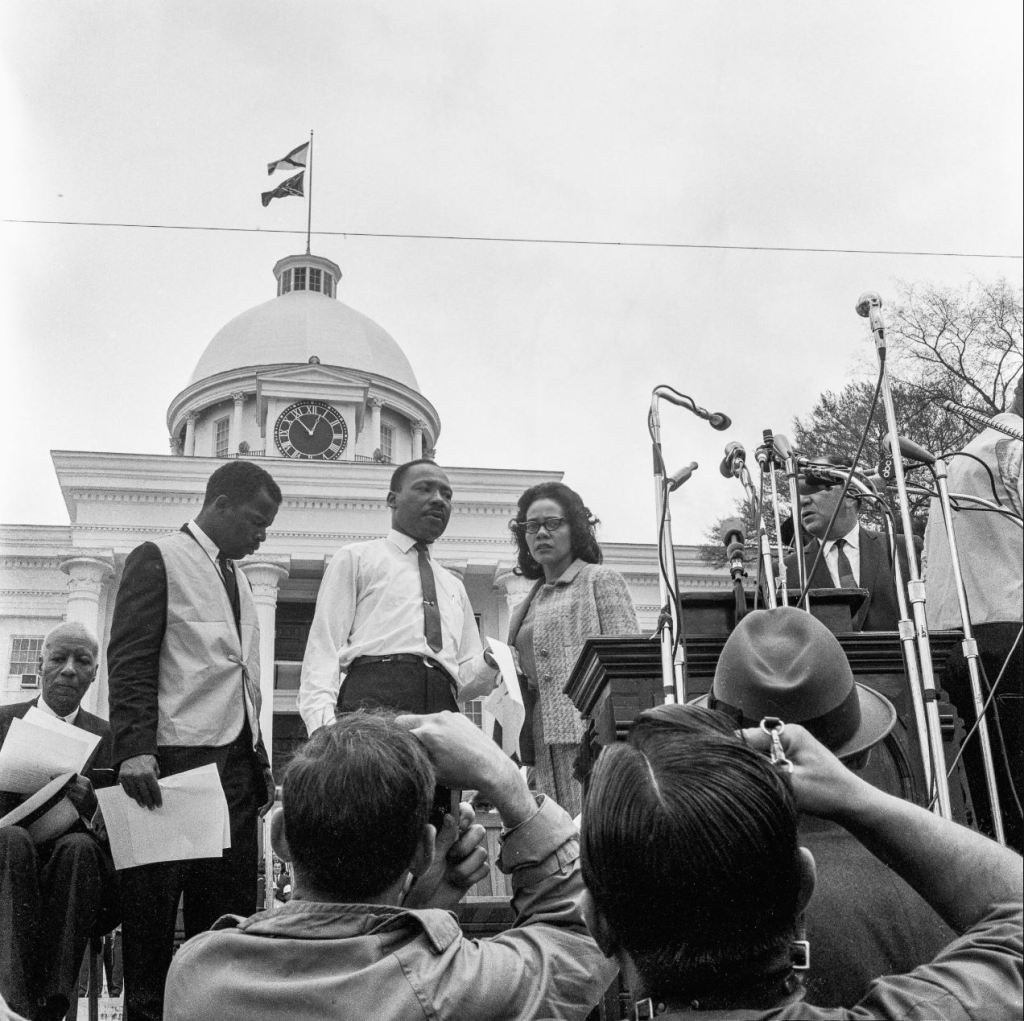
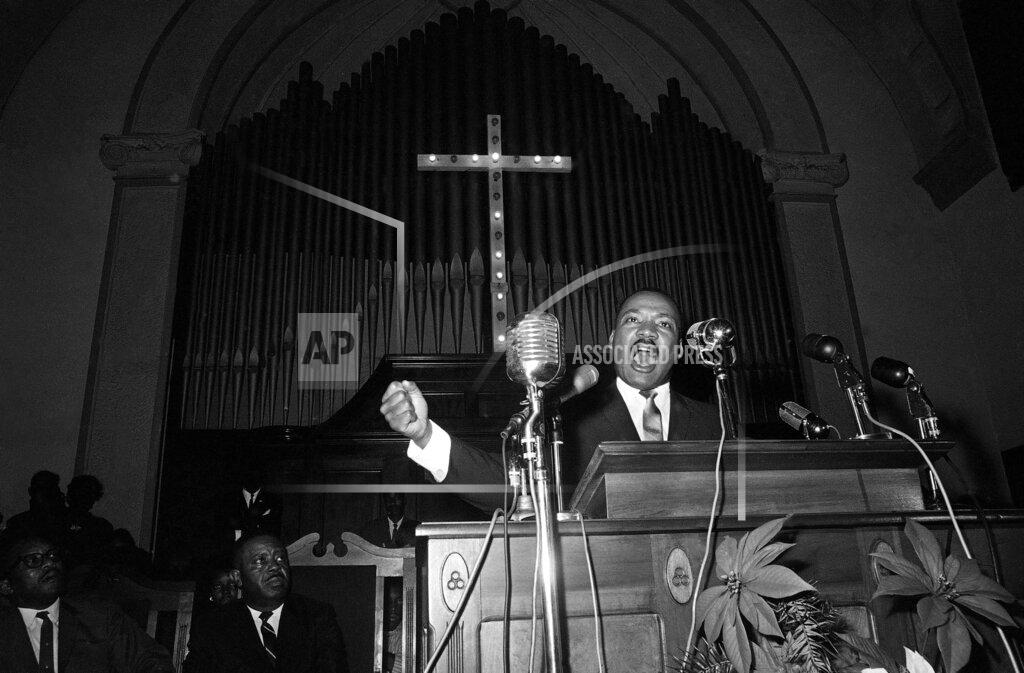
Martin Luther King Jr. begins a new drive to register Black voters. The Rev. Dr. Martin Luther King Jr. said tonight in Selma, Alabama that he would call for massive street demonstrations if Alabama Blacks were not permitted to register to vote in larger numbers. Dr. King, sounding a call for a new Black voter registration drive throughout the state, pledged a “march on the ballot boxes by the thousands” if necessary. The president of the Southern Christian Leadership Conference, winner of the 1964 Nobel Peace Prize, told 700 cheering Blacks in the Browns Chapel Methodist Episcopal Church that Alabama kept down Black registration by limiting the amount of registration time. “If they refuse to register us,” he said, “We will appeal to Governor (George C.) Wallace. If he doesn’t listen, we will appeal to the Legislature. If the Legislature doesn’t listen, we will seek to arouse the Federal Government by marching by the thousands by the places of registration. We must be willing to go to jail by the thousands. “We are not asking, we are demanding the ballot.”
This “black belt” city of 28,000 was chosen for the opening of the drive because it has become a symbol of bitter-end resistance to the civil rights movement in the Deep South. Dallas County, of which Selma is the seat, has more Black residents than white, yet only about 300 Blacks are registered, Dr. King said. The books are open for registration two days a month. He said a maximum of 30 persons can register in a day and fewer than that number are accepted.
After the meeting, Dr. King told reporters his organization would concentrate on larger cities in ten “black belt” counties in its registration drive. Alabama now has some 100,000 Blacks registered. The Atlanta clergyman told the church rally that the most serious question faced by the United States was whether democracy “can exist for her 22 million black children.”
A new political year will open in Washington Monday with both Democrats and Republicans showing more fight among themselves than against each other. President Johnson, who hopes to make it a year of “national consensus” in support of his initial proposals for a Great Society, will deliver what is expected to be a low-keyed State of the Union Message at 9 PM. Mr. Johnson returned to Washington today after spending two weeks at his LBJ Ranch in Texas. At noon on Monday, the 89th Congress will be convened under the control of the heaviest Democratic majorities since 1937. Before that, however, the first blows will have been struck in morning caucuses of Senate Democrats and House Republicans.
In the House, Representative Gerald R. Ford of Michigan is making a strong effort to win the Republican floor leadership from Representative Charles A. Halleck of Indiana, who has held it for six years. In the Senate, a three-way struggle is being waged for the post of assistant to Senator Mike Mansfield of Montana, the Democratic leader. The combatants seeking to replace Vice President-elect Hubert H. Humphrey in a post considered of increasing importance are Senators Russell Long of Louisiana, John O. Pastore of Rhode Island and A. S. Mike Monroney of Oklahoma. Everett McKinley Dirksen, the Republican leader in the Senate, may support some form of Federal aid to education. Asked yesterday whether he might alter his stand against such aid, he did not say yes but did not say no.
The outcome of both the House and Senate leadership fights is in doubt. Once the winners have been declared and the two houses are convened, significant changes could be worked in their tangle of procedural rules — long a target of liberal reformers.
House Democrats stripped two Southerners of their seniority rights today for party disloyalty in the 1964 Presidential election. The Democrats, in party caucus, also approved proposals for major changes in House rules to curtail the power of conservatives to obstruct President Johnson’s legislative program. The two Southerners, Representatives John Bell Williams of Mississippi and Albert W. Watson of South Carolina, were disciplined for openly supporting the Republican Presidential candidate, Senator Barry Goldwater, in the November election.
In a joint statement, the two men called the action “repugnant to our representative government” and the start of an attack on the Congressional seniority system that would lead to its demise. Neither would say what he planned to do about it, but Mr. Watson hinted that he might leave the Democratic party.The action came on a resolution by Representative John A. Blatnik of Minnesota on behalf of the Democratic Study Group, an organization of House liberals. The vote was 157 to 115. Both Mr. Williams and Mr. Watson will lose their seniority ranking on the Interstate and Foreign Commerce Committee. The ranking determines the order in which members move up to the chairmanship.
Mr. Williams, who has been in the House for 18 years, is the second-ranking Democratic member of that committee and thus had been first in line to succeed the chairman, Oren Harris of Arkansas. Mr. Watson, now beginning his second term, ranks 18th. Both will go to the bottom of the committee’s seniority list below freshman Democrats in the new Congress, which convenes Monday. Mr. Williams also loses his ranking as fifth in Democratic seniority on the District of Columbia Committee. Mr. Watson does not have a second committee assignment. Researchers for the Democratic Study Group said they believed it was the first time in history that any House Democrat had been disciplined for party disloyalty in an election.
Dean Burch asked the Republican National Committee today to keep him as chairman now and to assess his work later this year. “My ability to do the job has not been the issue,” Mr. Burch said in letters to members of the committee.”I hope sincerely you will make it the issue. The problem all of us face as Republicans is planning for 1966. If in six or nine months you were not satisfied with my progress in that direction, or if you felt I was using the office to advance the candidacy of a particular individual or cause, I would unquestionably be obligated to step aside. But in that case the burden would be on me personally as chairman. The effect of my resignation under those circumstances would not be divisive, as it would be now.”
The chairmanship is expected to be the principal item on the committee’s agenda at its meeting in Chicago on January 23-24. Mr. Burch said he would give the committee at that time a comprehensive party-building program. Chairman Burch did not say his ability should be made the “sole” issue. He recognized that Goldwater symbolism had been made an issue. Yet the chairman dealt with this symbolism in a way that seemed subtly different from Senator Barry Goldwater’s approach in letters to committee members a week ago.
The American Telephone and Telegraph Company announced yesterday net profits representing the highest yearly earnings ever reported by a corporation in the United States. For the 12 months ended last November 30, the company’s earnings were $1.7 billion. The comparable figure for the preceding year for the Bell System, consisting of A.T.&T. and its main telephone subsidiaries, was $1.52 billion. General Motors, which showed net income of $1.36 billion for the first nine months of 1964. has not yet disclosed its profits for the full year. In 1963 the concern, the country’s biggest automaker, established an earnings record of $1.59 billion.
Jack (Murph the Surf) Murphy and a companion, suspects in the theft of $410,000 in gems from the American Museum of Natural History, were arrested here today in a new burglary. The two were found near an expensive home that had been ransacked.
New York Governor Rockefeller called today for “a massive effort” to wipe out narcotics addiction.
The Ford Foundation announced yesterday that it had given more than $2 billion in its support of education, culture and community welfare since it started making grants in 1936.
Martin Meyerson replaced Edward Strong as acting chancellor of U.C. Berkeley, betokening a shift of policy towards the campus Free Speech Movement.
The long-running British TV sports series World of Sport was launched.
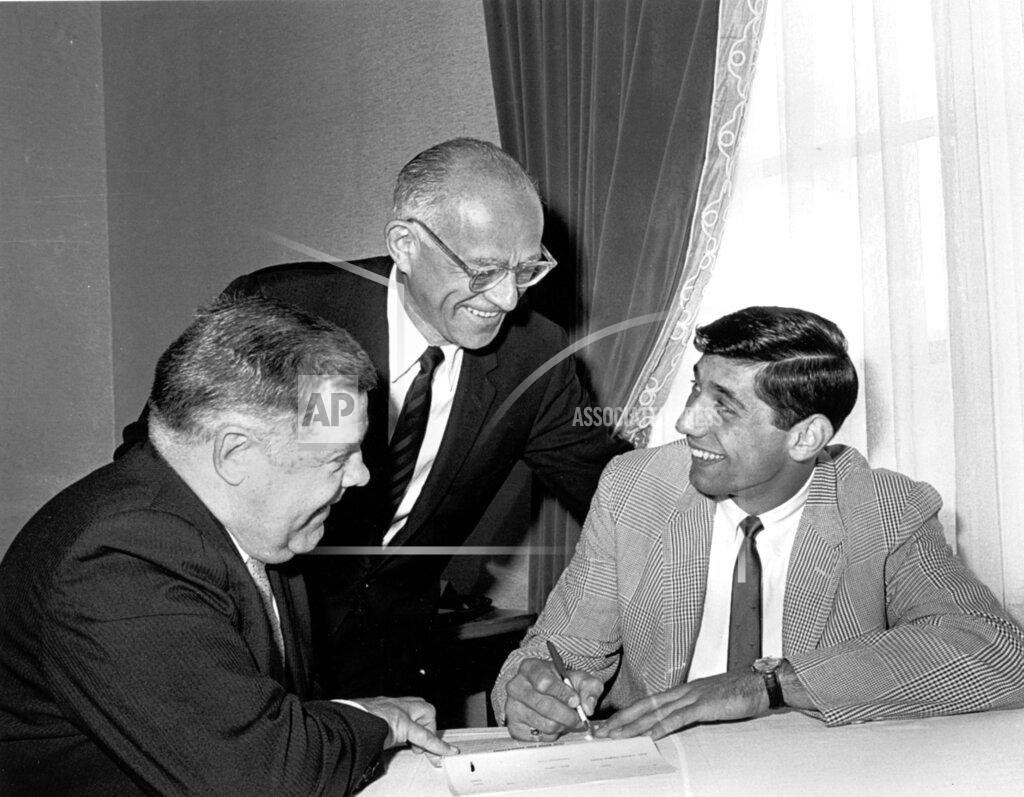
Joe Namath, quarterback for the University of Alabama, signed a three-year contract with the New York Jets of the American Football League (AFL) for an unprecedented $400,000 – the highest amount ever paid to a professional football player. Namath signed at a hotel in Miami, the day after completing his college football career in the Orange Bowl. The deal would prove to be a breakthrough for the AFL in its attempt to compete with the established NFL, and would be a major reason for a major contract offer by the NBC television network for the rights to broadcast the newer league’s games.
Born:
Greg Swindell, MLB pitcher (World Series Champions-Arizona, 2001; All-Star, 1989; Cleveland Indians, Cincinnati Reds, Houston Astros, Minnesota Twins, Boston Red Sox, Arizona Diamondbacks), in Fort Worth, Texas.
Barry Helton, NFL punter (NFL Champions, Super Bowl 23 and 24-49ers, 1988, 1989; San Francisco 49ers, Los Angeles Rams), in Colorado Springs, Colorado.
David Jackson, NFL wide receiver (Tampa Bay Buccaneers), in Baltimore, Maryland.


 History Diaries