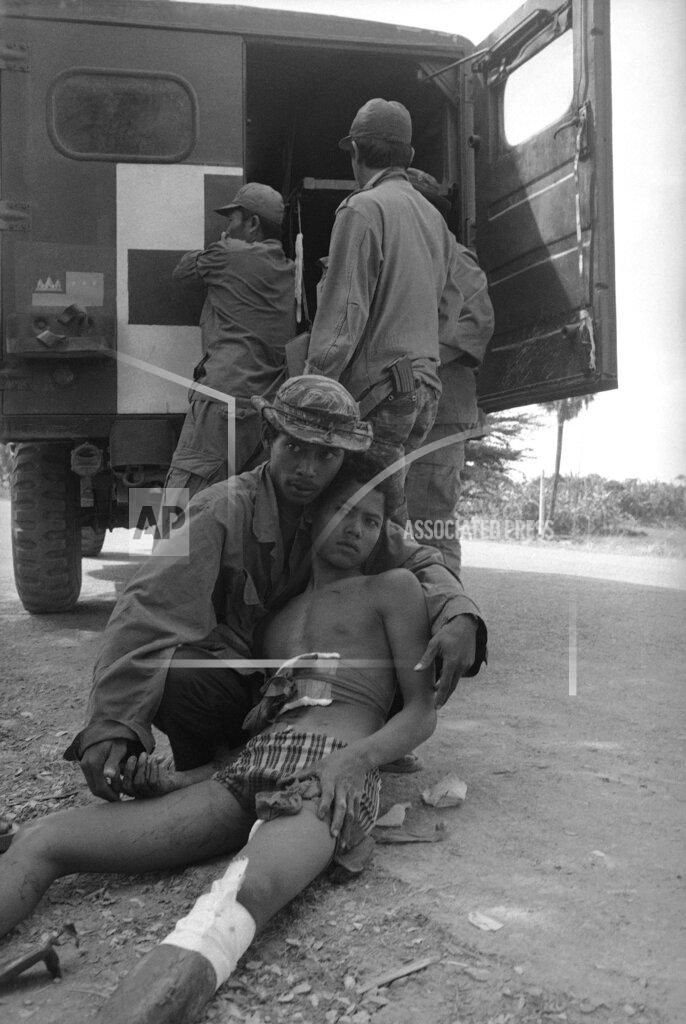
Communist forces appeared on the verge today of overrunning the first province capital in South Vietnam since they took Quảng Trị on May 1, 1972, nine months before the signing of the Paris peace agreement. According to the Saigon military command, North Vietnamese troops and Soviet‐made tanks fought their way yesterday into Phước Bình, a small remote city 75 miles north of Saigon. Intense fighting was reported in the streets. The Vietnamese Air Force bombed and strafed the edge of the city, reportedly destroying one tank and three antiaircraft guns. The command said that late yesterday afternoon, Government troops destroyed four more tanks in the southern part of the city. Early this morning a new force of North Vietnamese troops and tanks was spotted less than a mile south of the center of Phước Bình. They were hit with Government artillery, the cornmand reported. Later this morning, the fighting spread to the marketplace and the airstrip. The drive for the city, which serves as the capital of heavily forested Phước Long Province, culminated a regional campaign in which the Communists took the province’s four district capitals — equivalent to county seats — between December 15 and 31.
The Communists’ campaign in Phước Long, where the Vietcong and the North Vietnamese have long exercised considerable control, is seen by military analysts here as one aspect of an expanding winter‐spring offensive aimed at erasing pockets of Government military presence, improving supply routes, gaining land and population and inflicting heavy casualties on the Government side, thereby possibly tipping the military balance enough to force President Nguyen Van Thieu from office or to gain some political concessions from the Government side. In addition, with the attack on Phước Bình, the North Vietnamese passed the threshold of military activity that some foreign diplomats believe the Paris agreement had effectively imposed. Just two days ago one diplomat here remarked that despite widespread truce violations, “the Paris agreement does create an inhibition — it makes attacks on the province capitals and the city of Saigon taboo.”
The assault against Phước Bình began after North Vietnamese troops took a nearby district capital of the same name on New Year’s Eve, then attacked several Government outposts defending the province’s capital. Most of the government defenders were local militiamen, not regular army forces, and according to one foreign military attaché they quickly abandoned a vital base camp atop Ba Ra Mountain, 2.5 miles south of the capital. Then on New Year’s Day, according to the Saigon command’s account, the North Vietnamese troops poured about 300 rounds of artillery and rockets into the city, which is reported to have a civilian population of 26,000. Yesterday morning, the command said, the North Vietnamese attacked with about 10 tanks and an undetermined number of troops. Fighting continued throughout the day. With the city’s tiny airfield within range of Communist rockets and all roads cut, the government had been unable to reinforce or resupply its troops.
In Cambodia, Communist-led rebels pressed nearer to Phnom Penh’s defense perimeter today. In the closest action to this city since just before the end of American bombing in August, 1973, government forces withdrew from a position about two miles to the north, across the Tonle Sap, in the second day of heavy insurgent artillery fire, military sources said. Refugees who reached the town of Prek Phnou, six miles north of the city, told reporters today that the Seventh Infantry Division headquarters nearby had been surrounded by the insurgents, along with two other outposts in the same area. Reports reaching Phnom Penh said that two government battalions had landed from assault craft on the east bank of the Mekong River opposite the capital this morning. But after three hours of fierce — and at times close — fighting, they had managed to advance only about 200 yards. Military sources here said the Government has committed all its reserves, except for some units which have remained in the capital as a last line of defense. Officials have described the insurgent action as “the New Year offensive,” but there was no firm indication yet that it was an attempt to seize Phnom Penh.
Secretary of State Kissinger, in an interview made public today, said that he could not rule out completely the use of military force against oil‐producing nations, but that such action “would be considered only in the gravest emergency.” Speaking for the first time publicly about the possibility of military action in another oil crisis, Mr. Kissinger stressed that such moves should be undertaken only as a last resort to save the Western world, not as a way of lowering oil prices. In the interview, which was given shortly before Christmas and is published in the current issue of the magazine Business Week, Mr. Kissinger said that “we should have learned from Vietnam that it is easier to get into a war than to get out of it.” “I am not saying that there’s no circumstances where we would not use force,” he added. “But it is one thing to use it in the case of a dispute over price; it’s another where there is some actual strangulation of the industrialized world,” he said.
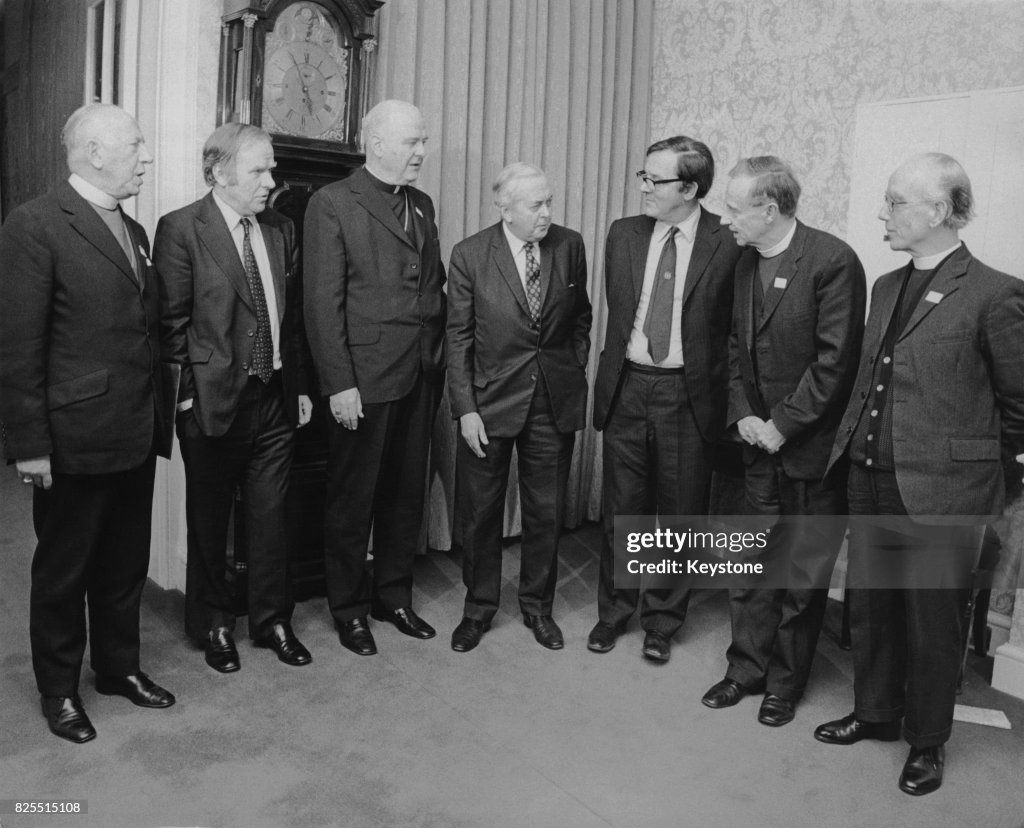
The Provisional Irish Republican Army announced in Dublin a 14-day extension of the Christmas truce in Ulster, to January 16. This was a shorter period than had been hoped for, and the announcement was welcomed cautiously in Dublin and Northern Ireland. It warned, however, that if substantial progress toward a “lasting peace” was not made by then, it would consider resuming guerrilla violence. The Provisionals rejected as “minor developments” the British response to the 11‐day Christmas truce—the release of about 100 convicted guerrillas, the freeing of 20 terrorist suspects and the offer of parole to 50. “A permanent cease‐fire will he established only when the causes of the war are courageously examined and eradicated,” the Provisionals’ statement declared. The Provisionals want an end of the policy of interning terrorist suspects indefinitely. They also demand an amnesty for all prisoners, the withdrawal of the 15,000 British soldiers in Northern Ireland to their barracks and a declaration by the British Government that it intends to relinquish its responsibilities in the province irrespective of the wishes of the Protestant majority there.
Former Turkish Premier Bulent Ecevit said Turkey would not retreat from positions it gained through its invasion of Cyprus last summer. In a speech to Turkish Cypriots at the start of his five-day visit to the Turkish-occupied northeastern third of the island, Ecevit accused the Cyprus government, President Makarios and Greece of undermining talks between Greek and Turkish Cypriot community leaders on the future of the island.
Pravda, the Communist Party organ, promised the Soviet people higher salaries and living standards under economic plans for 1975. “The highest goal of the party is the welfare of the people, the newspaper proclaimed. It did not mention that the 1975 plan, the last of the current five-year program, again stresses heavy industry over consumer production.
The son of an imprisoned Jewish doctor said Soviet police pulled him off a Moscow-bound train and confiscated a secret transcript of his father’s trial. Viktor Shtern, 34, said the incident happened Wednesday as he was crossing the Ukraine from the small town of Vinnitsa, where the trial took place. Dr. Mikhail Shtern, his 56-year-old father, was sentenced. Tuesday to eight years in a labor camp after being convicted of accepting bribes and malpractice.
A long-awaited Vatican statement on ways to improve Roman Catholic-Jewish relations was made public. The guidelines, as they are called, were prepared by the church’s Commission on Relations with Judaism to carry out the “Declaration on the Jews” issued in 1965 by the Second Vatican Council. Like the declaration the guidelines reassert the church’s condemnation of anti‐Semitism and call for a sweeping action to eliminate all forms of discrimination against Jews that might be found in the church’s worship and teaching. The guidelines call for dialogue, affirmation of a joint Biblical and theological heritage and emphasis on “common elements of the liturgical life” as means for improving relations between Catholics and Jews.
Israeli troops staged several raids into southern Lebanon last night in a continuing drive to keep the border area clear of Palestinian guerrillas, and the Lebanese Defense Ministry said today that the attacks left five Lebanese dead. The incidents, the latest in a series of Israeli incursions, air attacks and artillery bombardments of Southern Lebanon, are causing mounting political pressure on the Lebanese Government to take measures to protect the southern villages. A Defense Ministry communiqué said one of the Lebanese dead was a soldier shot while driving a jeep. He was struck by fire from a roadblock that Israelis had set up in Lebanese territory near Rumaysh. The communiqué said the four other Lebanese were killed during an Israeli raid at Taibe, a village a mile from the Lebanese‐Israeli border.
Israeli military headquarters in Tel Aviv said that the casualties at Taibe were Arab guerrillas who were hit during an exchange of fire but that it could not be ascertained whether they were killed or wounded. The Israeli command also reported that one Lebanese soldier was killed near Ruhaysh and added that one Israeli was missing on a patrol near Debil. The problem of the Israeli attacks has become a subject of high‐level discussions between the Lebanese and other Arab governments, particularly with Syria, whose president, Lieutenant General Hafez al‐Assad, is due here on Tuesday for an official visit. In Syria’s view, the Israeli activity is part of a larger military operation that could be in preparation for an Israeli attack through southern Lebanon against Syria, around the western slopes of Mount Hermon.
Reports from Cairo that Leonid Brezhnev postponed his trip to the Middle East for reasons of health have met with widespread skepticism in Moscow’s foreign diplomatic circles. The diplomats generally continue to believe that the trip was put off because of unresolved differences between Moscow and Cairo. President Anwar Sadat said in a speech that he understood the reasons for the postponement and looked forward to a new chapter in Soviet-Egyptian relations once they were resolved.
Eritrean guerrillas attempted to blow up a major telecommunications center in the northern provincial capital of Asmara, touching off an hour-long battle with Ethiopian security forces on the outskirts of the city. The guerrillas reportedly set off three or four large explosions near the center but failed to destroy it before being driven off by army and police forces rushed to the scene.
Iraqi troops have forced the bulk of the Kurdistan rebel army into a narrow strip of mountainous land along the border with Iran, but are coming under fire from Iranian artillery, well-informed diplomatic sources in Bagdad said. They said government troops now controlled all key centers in the Kurdistan region of northern Iraq, but that the Iranian army was continuing to shell Iraqi positions from both sides of the border.
Former President Richard M. Nixon made a secret armament deal with Iran that has cost the United States about $35 million and seriously has depleted the U.S. military of needed technical skills and equipment, Rep. Clarence D. Long (D-Maryland) charged. Long released the text of his letter to President Ford, based on a classified General Accounting Office report, urging him to review U.S. commitments to Iran and fully inform Congress.
Lalit Narayan Mishra, the Railway Minister of India, was assassinated as he attended a ceremony to dedicate a new railway line at Samastipur in the Bihar State. Mishra was fatally injured by a bomb that had been placed under the speaker’s dais, in a blast that killed another person and injured 23 other people, and died the next day. Mishra had been accused by political opponents of mishandling a railroad strike and of involvement in an import license scandal. Members of the terrorist group Ananda Marg claimed responsibility for the blast, aiming to retaliate for the imprisonment of their leader, Prabhat Ranjan Sarkar.
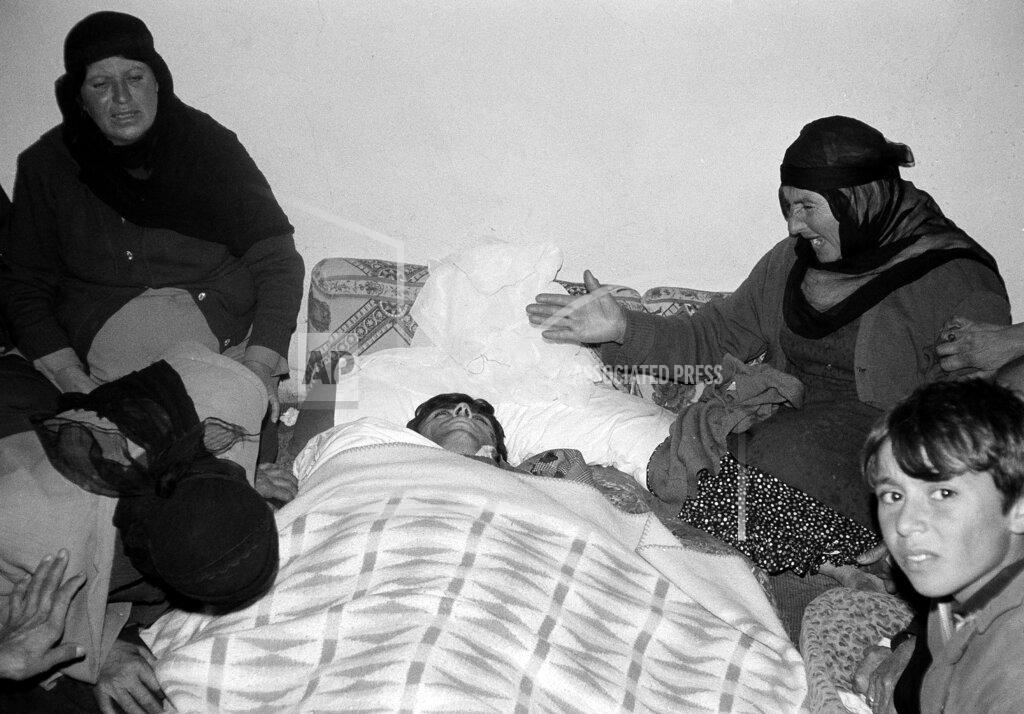
Helicopters found two more devastated areas in the Karakoram Mountains today, raising fears that the death toll in the Pakistan earthquake could reach 6,000.
Bangladeshi Marxist leader Siraj Sikder, after being arrested, was shot and killed. The official explanation that he died during an escape attempt was widely doubted.
The Philippine government ordered an investigation of charges by an imprisoned Roman Catholic priest that some persons detained under martial law have been tortured. The priest, the Rev. Edicio de la Torre, 31, has been on a hunger strike since Christmas Day to protest the alleged torture of 23 political detainees while undergoing questioning at the Camp Olivas stockade, 50 miles north of Manila.
The U.S. Navy announced today the loss of its first operational F-14 fighter plane in a crash off the Philippines.
Nicaragua’s usual political tranquillity has been abruptly shattered by the leftist guerrilla action last weekend in which a group of prominent politicians and businesssmen were kidnapped and exchanged for 14 political prisoners. Almost overnight, the extreme left emerged as a political force capable of inflicting a stinging defeat on the Government and proving the vulnerability of the long‐ruling Somoza regime. The family of General Anastasio Somoza Debayle, 49, who was recently elected to a new presidential term ending in 1981, has been in power here since 1936. Nicaraguan political observers, who were surprised by the guerrilla action, expressed the view that the mass kidnapping would quicken the polarization between supporters and opponents of the Somozas.
Top Rhodesian black leaders said in Salisbury the government had barred them from leaving the country to meet in Lusaka, Zambia, with British Foreign Secretary James Callaghan. Edson Sithole of the African National Council reported the action at a news conference and declared, “The consequences of this unwise decision may wreck what now appears to be a move toward a solution of the country’s constitutional problem.”
The World Tourism Organization (WTO) was established by the United Nations, replacing the International Union of Official Travel Organizations (IUOTO).
Administration officials said that just about all of President Ford’s principal economic advisers, including Secretary of the Treasury William Simon, who had supported restrictive fiscal policies, have reached virtual unanimity on the need for a tax cut as an antirecession measure. The President appears to be moving toward such a decision, they said.
The bill approving the Federal Rules of Evidence was signed into law by U.S. President Ford.
President Ford, limping slightly after his Colorado skiing holiday, returned to Washington to prepare for consultations on allegations that the Central Intelligence Agency illegally spied on thousands of American citizens. White House Press Secretary Ron Nessen said Mr. Ford was expected to begin meetings today with Secretary of State Henry A. Kissinger and CIA Director William E. Colby on the matter. The President was spotted limping as he prepared to board the presidential jet in Colorado but Nessen said that Mr. Ford favored his right leg “once in a while” because of an old football injury which apparently gives him trouble after strenuous exercise.
U.S. District Judge W. Arthur Garrity rejected a move to close a racially troubled school complex in South Boston for the rest of the school year but asked for more information regarding possible violence. Garrity ordered depositions taken from city and state officials who have warned of danger to students if the South Boston-Roxbury High School district reopens. School officials ordered the four schools closed Thursday and today because of a “substantial risk of personal injury.” Classes were scheduled to resume Monday. Judge W. Arthur Garrity Jr. declined to grant the city’s motion today, but left open the possibility that he would hear additional evidence on the matter. Late this afternoon, attorneys for the various parties to the case—the city, the Boston School Committee, the National Association for the Advancement of Colored People, the Teachers Union and the Home and School Association, a parents’ group—were taking depositions in closed session from police officials.
Gold prices plunged because of lack of interest by American investors and speculators. The afternoon price in London was $175 an ounce, off $11.50 from Tuesday, and prices also declined sharply in American markets and bullion sales by brokerage houses and banks were few and far between. On the nation’s commodity exchanges, prices for futures contracts dropped by $7 to $9 an ounce.
John Hoffar, the foreman of the jury in the Watergate cover-up case that decided the fate of former associates of former President Richard Nixon, shyly answered questions in an interview in his Washington home. The jury was congenial, he said, there were no dominating personalities, no significant disagreements. “We tried not to let our personal feelings get in the way and to decide it on the facts,” he said.
Former President Richard Nixon was described by an associate as “deeply anguished” by the plight of four of his former White House and political aides who were convicted in the Watergate cover-up trial. The associate, who did not want to be identified by name, said that Mr. Nixon had been advised by a lawyer against making any specific comment, because the four defendants “have stated their intention to file appeals.”
A federal judge dismissed a civil rights suit filed in Dallas by the parents of a kindergarten student who was suspended from school for wearing his hair long to cover a head deformity. Billy Epperson, 6, was sent home from the Golden Acres elementary school in suburban Pasadena last February for having long hair in violation of the school’s dress code and Mr. and Mrs. William Epperson filed suit. U.S. District Judge Woodrow Seals dismissed the suit, citing an appeals court decision that school hair codes are valid. Last July, however, the school district amended the code to allow exceptions for medical reasons.
A group of armed Menominee Indians that seized an abandoned mansion owned by a religious order broke off negotiations with authorities besieging the 175-acre estate near Gresham, Wisconsin. Indian spokesman Mike Sturdevant warned FBI, state, and Shawano County authorities to stop tightening their circle around the building formerly used as a novitiate by the Alexian Brothers of America, a Roman Catholic order. Authorities have refused to allow food to be taken to the estimated 40 Indians. The Indians reportedly want the Alexian Brothers to agree that the Indians can use the mansion for a school or hospital.
A financier, his wife and son were found shot to death in an apparent murder-suicide at the family’s estate in Morris Township, New Jersey, police said. The victims were Charles W. Call Jr., 44, once chairman of British. Arkady, Ltd., of England, and president of Ward Foods, an American firm that makes bread; his wife, Eloise, and their son, Brad, 14. Police said the three were killed on New Year’s night, apparently with a single-barrel shotgun. Police said no suicide note was found but that it appeared Call had shot his wife and son and then taken his own life.
The threat of a rail strike became a possibility as an agreement between the railroads and the Sheet Metal Workers Union expired. End of the pact freed the union to call a strike by its 5,300 members on 14 days notice. The union already has exhausted all mediation procedures under. the Railway Labor Act and apparently would not be subject to the 60-day cooling off period the act requires before strikes can be called.
Senator William Proxmire (D-Wisconsin) said he would introduce legislation to limit the number of federal officials entitled to chauffeur-driven limousines. He said his bill would lower the number from about 800 to 27. Proxmire said hundreds of officials were in daily violation of the law, which bars the use of limousines to transport them between their homes and their offices.
The Atomic Energy Commission said today that “only a small amount” of nuclear material that could be fashioned into a homemade nuclear bomb was now missing from an Oklahoma processing plant.
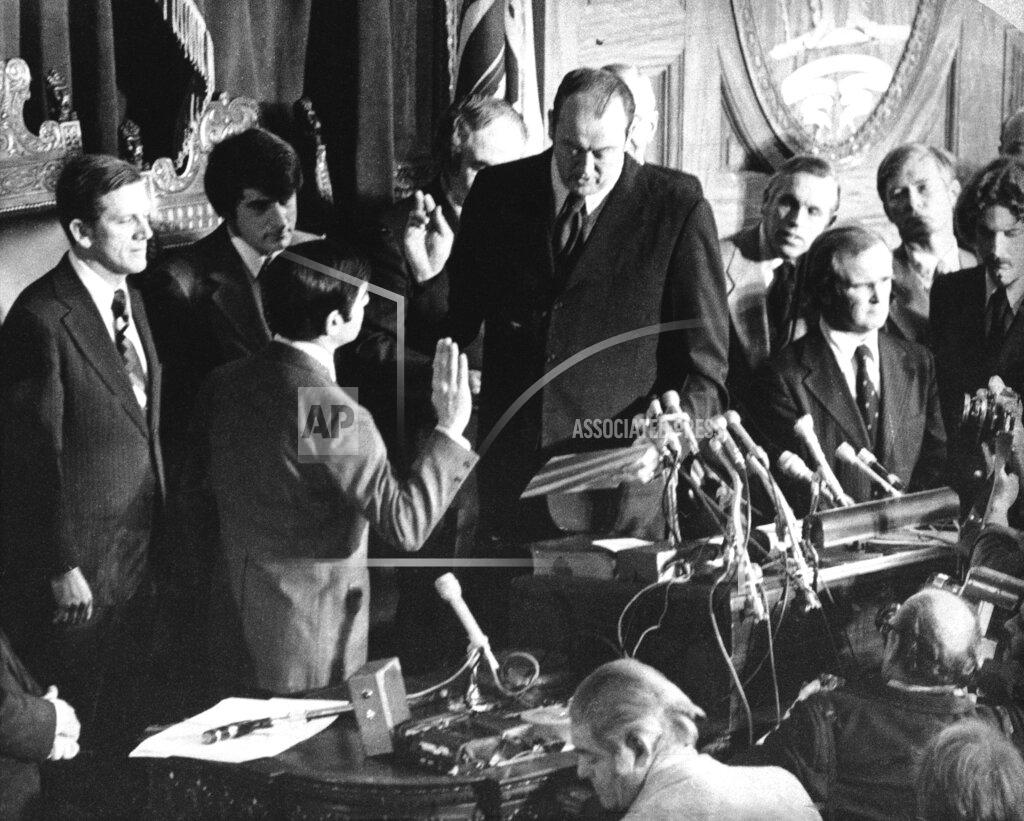
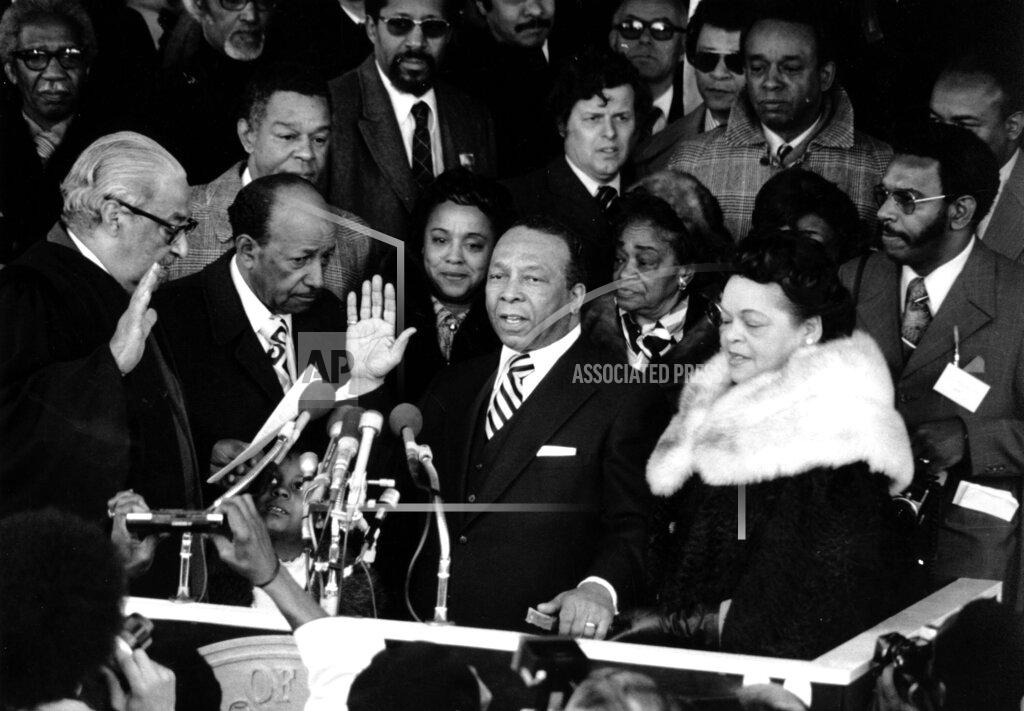
At a historic and moving ceremony, the District of Columbia inaugurated today its first elected city Government since 1871.
The state of the economy has forced the Sierra Pacific Power Co. in Nevada to shelve plans to build a nuclear power plant to supply electricity to several northwestern states. Neil Plath, president of the power company, said the facility, to be a joint venture with Pacific Gas & Electric Co. of California, had been postponed “because the money we were investing in nuclear plant siting couldn’t bear fruit for too many years.” He said the capital which would have been spent for site study is needed for more immediate projects, such as the possibility of building a giant coal power plant.
The U.S. Department of Interior designates the grizzly bear a threatened species.
Eleven miles of new firebreaks will be built by the U.S. Forest Service in the San Bernardino National Forest, according to Supervisor Harold Mitchell. Most of the breaks, Mitchell said, will be built in the area of last year’s Soboba fire, in the San Jacinto Mountains. That blaze, which consumed 17,000 acres, was California’s largest in 1974. The firebreaks, to be built in the spring, will cost about $88,000.
The Central Intelligence Agency, asked by the Secret Service in 1968 about Eartha Kitt, produced an extensive report containing second‐hand gossip about the entertainer but no evidence of any foreign intelligence connections, a copy of the report showed today. The report supplied a week after Miss Kitt criticized the Vietnam war at a White House luncheon during the Johnson Administration, shows that the C.I.A. had been collecting raw and unevaluated data on her at least since 1956, eight years after she began appearing professionally in Europe and the United States.
The USC Trojans were ranked #1 in the final UPI college football poll, taken of college coaches, giving them a share of the mythical national championship.
Dow Jones Industrial Average: 632.04 (+15.80, +2.56%)
Born:
Jeff Suppan, MLB pitcher (World Series Champions-Cardinals, 2006; Boston Red Sox, Arizona Diamondbacks, Kansas City Royals, Pittsburgh Pirates, St. Louis Cardinals, Milwaukee Brewers, San Diego Padres), in Oklahoma City, Oklahoma.
Rick Mrozik, NHL centre (Calgary Flames), in Duluth, Minnesota.
Dax Shepard, American actor (“Parenthood” (TV series); “CHiPS” movie), in Highland Township, Michigan.
Doug Robb, American singer (Hoobastank – “The Reason”), in Agoura Hills, California.
Chris Cheney, Australian rockabilly guitarist, songwriter, and vocalist (The Living End – “One Said to the Other”; “White Noise”; The Wrights – “Evie”), record producer and studio owner, in Melbourne, Victoria, Australia.
Died:
Theo Osterkamp, 82, German fighter pilot.
Lenn Hjortzberg, 55, Swedish director (“Persona”; “Through a Glass Darkly”).
Dimitrios Chiladiti, 91, Greek radiologist.



 History Diaries