Finnish offensives against the Soviet 8th and 9th Armies continue. The Finns claim to have pushed the Red Army back across the frontier on the Soumussalmi-Kemijarvi front.
Finnish forces halt the Russian offensives in all sectors along the front.
The Finnish 9th Division secured the village of Suomussalmi after four days of heavy fighting, capturing 625 rifles, 33 light machine guns, 19 medium and heavy machine guns, 2 anti-aircraft machine guns, 12 anti-tank guns, 27 field and anti-aircraft guns, 26 tanks, 2 armored cars, 350 horses, 181 trucks, 11 tractors, 26 field kitchens, 800,000 rounds of 7.62mm rifle ammunition, 9,000 artillery shells, a field hospital, and a bakery.
General Siilsavuo has his men scout out the Raate road from the parallel ice road he has had them build on Lake Voukki. They find that Soviet 44th Rifle Division is stationary and now stretches over 39 km back to the Soviet border. Captain Mäkinen of Group Kontula is blocking the road at the western end with just two machine companies, which the Soviets must believe is a far greater force because they have more than enough firepower to level the Finns there, including artillery. The Soviet armor is bunched up in front of this blockade but is immobile. Finnish Army Colonel Siilasvuo received the intelligence and decided to prepare a strike at this concentration.
The commander of the Soviet 44th Rifle Divison, Kombrig Vinogradov, and his commissar Parhomenko both advance to the regimental headquarters (still on Soviet territory) from their position far behind the lines.
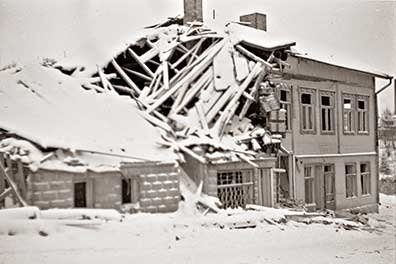
The Soviets conduct air raids against Viipuri and other Finnish targets. Jyväskylä and Vaasa are subjected to fierce enemy bombing killing 21 civilians in Jyväskylä and four in Vaasa. Both towns suffer serious damage.
President Kyösti Kallio hosts a reception to celebrate the New Year. Those present include the Speaker of Parliament, Väinö Hakkila, Prime Minister Risto Ryti and Members of Parliament.
Despite yesterday’s news of the great victory on the Eastern Front there was no public rejoicing in Helsinki and the new year festival, important one on the Finnish calendar, was celebrated quietly in the blackout.
Foreign Minister Väinö Tanner gives an interview to the Swedish newspapers’ telegraph office, TT, in which he welcomes Swedish volunteers to Finland.
The Central Organization of Finnish Trade Unions (SAK) publishes its New Year message to Finnish workers. The SAK emphasizes the trade union movement’s determination to defend Finnish independence and democracy.
In Amsterdam, persons unknown raise the Finnish flag on the mast of the Soviet steamship Joseph Stalin.
Britain and France inform the League of Nations that they will give all possible assistance to Finland. Many British volunteers have been sailing to Finland. One is a teenager who will later go on to serve with the Long Range Desert Group, and oh, yes, does abit of acting in later years. His name is Christopher Lee.
German Propaganda Minister Joseph Goebbels made a radio address reviewing the official Nazi version of the events of 1939. No predictions were made for 1940 other than saying that the next year “will be a hard year, and we must be ready for it.”
By 31 December 1939, the Sondergericht Bromberg (Special Court in Bydgoszcz, Poland) had considered 1,005 cases of the previously unknown concept in German law of “expanded aiding and abetting in murder” (German: Mord nach erweiterten Mittäterbegriff), filing 160 indictments. 147 defendants were convicted: 100 people to death (including 13 women), 10 people to life imprisonment, 23 people to severe imprisonment (totaling 295 years), and 14 people to ordinary imprisonment (totaling 69 years). 21 people were acquitted. The average sentence of severe imprisonment imposed by the special court in Bydgoszcz was 12 years and 8 months, and for “ordinary” imprisonment – 4 years and 9 months. For comparison, during the same period, the other six German special courts operating in occupied Poland handed down a total of 56 death sentences. By the end of the war, the Bydgoszcz Special Court in cases related to the “Bloody Sunday” events sentenced 243 people to death (including one of German nationality). As a result, the Sondergericht Bromberg was hailed by the Nazi press as the “sharpest weapon against the Polish rabble and Polish murderers” (Danziger Vorposten, 1 February 1940).
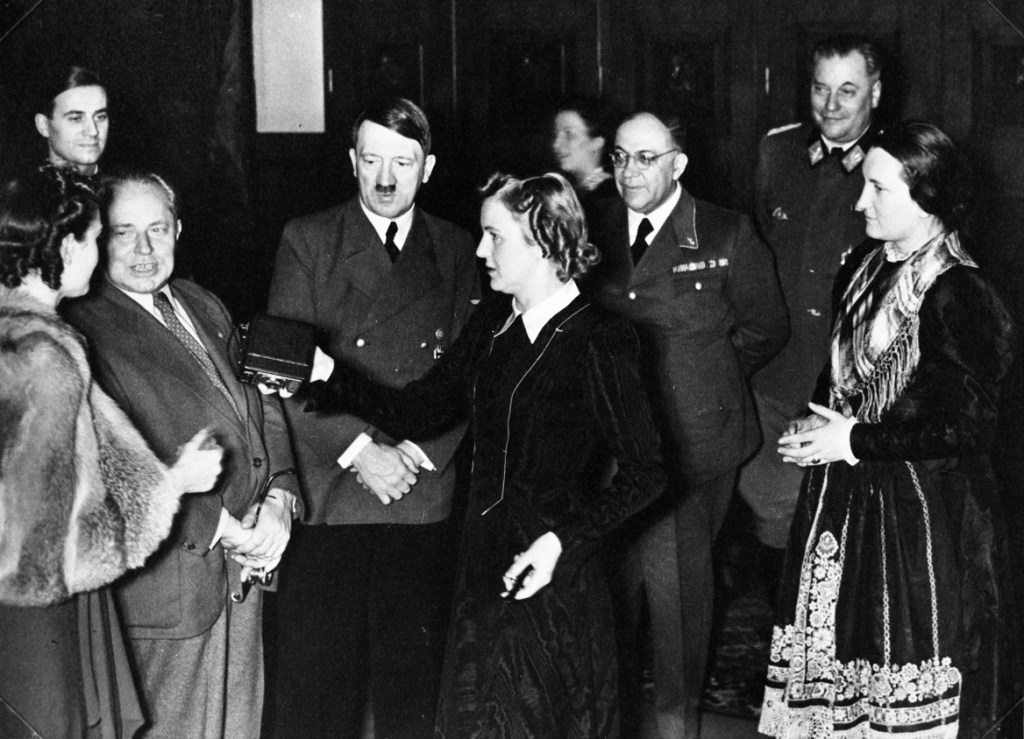
Hitler makes a New Year proclamation: “We shall only talk of peace when we have won the war. The Jewish-capitalistic world will not survive the twentieth century.” He looks forward to the creation of a new Europe under German leadership, a Europe liberated from “British tyranny.” Meanwhile, in an Order of the Day to the armed forces, Hitler notes that, in the effort to create a new order in Europe, “the hardest struggle for the existence or non-existence of the German people lies before us.”
Hitler tells a private meeting of his Gauleiters at the end of 1939, “The Jews may deceive the world… but they cannot deceive me. I know that they are guilty of starting this war — they alone and nobody else.”
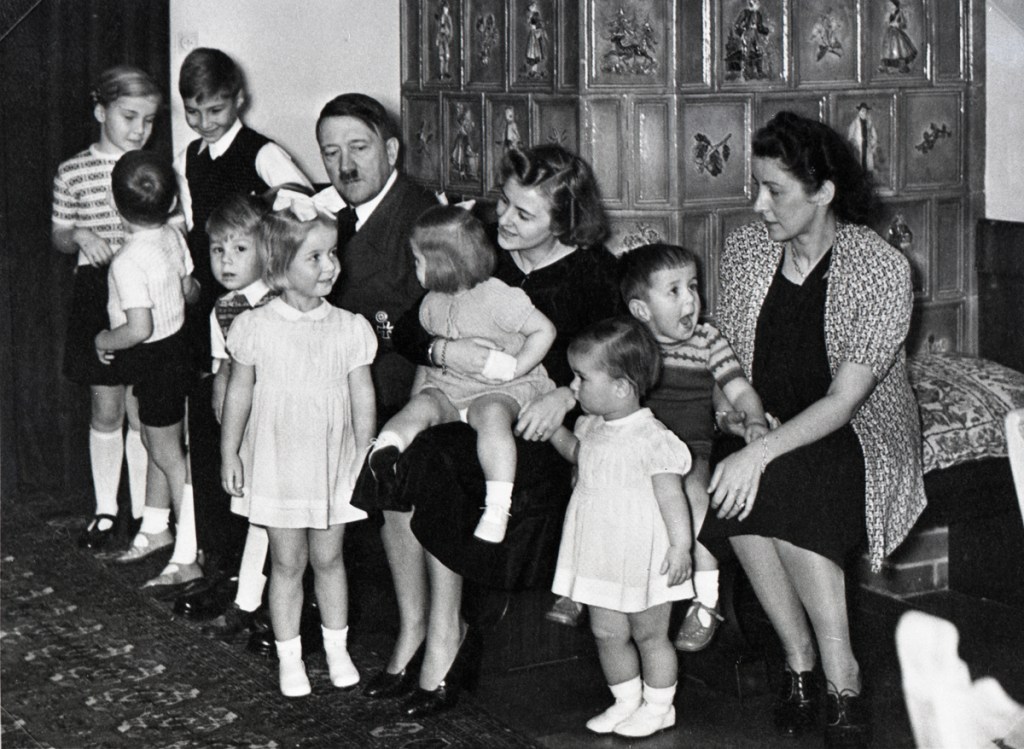
Adolf Hitler and his entourage celebrated New Year’s Eve at the Berghof.
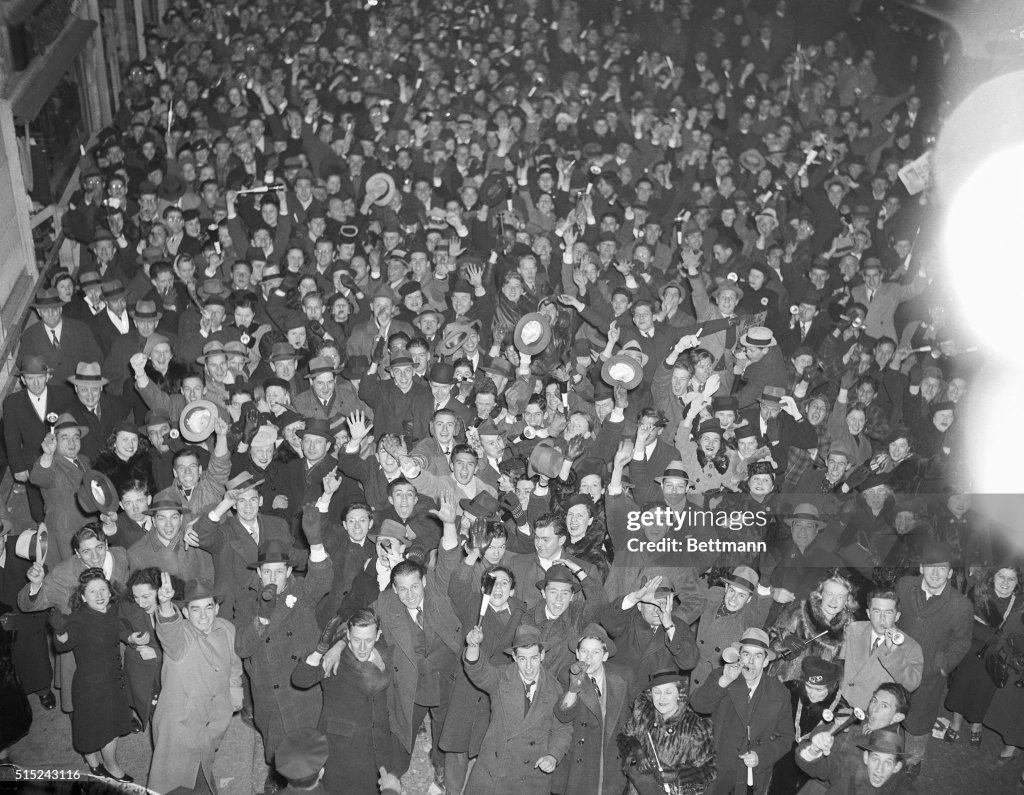
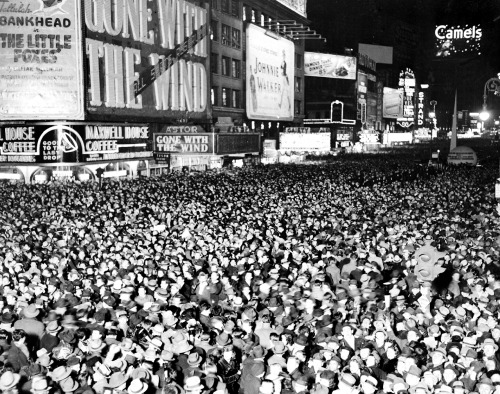
New Year’s Eve observances in Britain, France and Germany were very subdued due to blackout and noise restrictions. Most celebrations were held in private homes with the windows shuttered. New Year celebrations in London will be restrained. Large gatherings are frowned upon, but the hours are extended at public houses.
On the British Homefront, for the war months September – December 1939:
Road Deaths: 4,130
Military Deaths (all causes): 2,511
The blackout has been murder on the highways. In addition, 15,626 people have registered as conscientious objectors.
In some rare acts of defiance, New Year’s celebrants shine torches despite the blackout.
The second convoy of Canadian troops arrives at a west coast port.
This tragic year of 1939 ended in France to the accompaniment of roaring artillery while in the No Man’s Land that separates the Maginot Line and the Westwall little groups of men grappled and fought in the darkness and the snow.
Floods and further earthquakes push the death toll in Turkey up to 30,000.
Fire destroyed during the night the Papal Chancery Palace — the Palazzo della Cancelleria — one of the most notable Renaissance monuments in Rome. From an artistic standpoint the loss was inestimable.
Irish authorities today recovered two and a half tons of ammunition hidden under a straw stack near Dundalk and asserted it was part of the nearly twenty-eight tons seized in the December 23 raid on the magazine in Phoenix Park, Dublin.
Boris Shaposhnikov was awarded his first Order of Lenin.
Generalissimo Francisco Franco made a radio broadcast asking “all Spaniards in this period of depression which follows any war to close the mouths of grumblers and not permit the enemies of the state to take advantage of the situation.”
The neutral and unescorted British steam merchant Luna was torpedoed and sunk by the U-32, commanded by Kapitänleutnant Paul Büchel, in the North Sea. At 19.47 hours the Luna was hit aft by one torpedo from U-32 and sank slowly by the stern. The Germans reported that the nationality markings were not visible in the dark. The crew was picked up by the Norwegian steam merchant Colombia and taken to Kopervik.The 959-ton Luna was carrying general cargo, including rubber hose, zinc plates, and hessian cloth and was bound for Trondheim, Norway.
The Belgian fishing vessel Adeline was bombed and sunk in the North Sea off the Noordhinder Lightship.
The British cargo ship Box Hill struck a mine and sank in the North Sea off the Humber Lightship (53°32′ N, 0°24′ E) with the loss of 20 of her 32 crew. Survivors were rescued by the Royal Navy destroyer HMS Ivanhoe and another ship. The wreck was dispersed by explosives in 1952.
U.S. freighter Excalibur, detained at Gibraltar by British authorities since 17 December, is released.
Convoy HG.13 departs Gibraltar for Liverpool.
For the month of December 1939, German U-boats sank 43 Allied ships (108,347 tons) and damaged 4 ships (73,313 tons).
For all of 1939, the totals for the Battle of the Atlantic, also including mines and bombing, are:
Allied/Neutral ships lost: 225 ships, 767,358 tons
U-boats lost: 9
For December 1939:
72 Allied ships 190,768 tons
U-boats lost: 1
The War at Sea, Sunday, 31 December 1939 (naval-history.net)
On Northern Patrol, one cruiser was between the Orkneys and the Faroes, two cruisers and five AMCs between the Faroes and Iceland, and one cruiser was in the Denmark Strait. Light cruiser COLOMBO departed Scapa Flow and armed merchant cruiser DERBYSHIRE the Clyde, both for Northern Patrol, while light cruiser DUNEDIN returned to Scapa Flow.
U-58 attacked a V & W destroyer of Convoy C off Kinnaird Head.
Battleship RODNEY, after repairing her rudder defect at Liverpool, departed at 1230/30th with destroyers ICARUS and IMOGEN and rejoined the Home Fleet at Greenock at 0140/31st. Admiral Forbes re-hoisted his flag on her on 1 January 1940.
Destroyer VIVIEN and sloops FLEETWOOD and BITTERN departed Rosyth for the Tyne to escort convoy FS.62, which had been due to leave the evening of the 31st, but was postponed until next day.
Destroyer WALKER attacked a submarine contact 70 miles SW of Scillies in 49-18N, 8-11W. Destroyer VIMY assisted in the search.
Anti-submarine trawler LORD NUFFIELD (466grt) attacked a submarine contact 65° from Sauds Island. Minesweeper/escort vessels GLEANER and JASON were sent to assist her.
After British aircraft reported a submarine seven miles south of Dover, destroyer BRAZEN proceeded to investigate.
Submarines TRUANT departed from Rosyth and UNDINE from Blyth on patrol.
Light cruiser CALEDON departed Malta on patrol duties.
Light cruiser GLOUCESTER departed Port Victoria, Seychelles, for Colombo, arriving on 8 January for refitting, completed on the 22nd.
Destroyer DARING departed Malta on the 27th and arrived at Gibraltar on the 30th. On the 31st, sloop SCARBOROUGH (Cdr J H Ruck-Keene), which had arrived from Malta on the 29th, departed Gibraltar escorting armed merchant cruiser DUNOTTAR CASTLE to Belfast with DARING in company. On 2 January off Cape Roca in 38 40N, 10 04W, DARING attacked a submarine contact. She reached Belfast on 7 January and Portsmouth on the 10th.
Light cruiser ARETHUSA departed Malta. Calling at Gibraltar on 3 January, she arrived at Portsmouth on the 6th, left again on the 26th and arrived at Scapa Flow on the 29th for duty with the Home Fleet. ARETHUSA and sister ship PENELOPE (which was at Malta and departed station on 5 January) in the Mediterranean, were relieved by light cruiser CALEDON and CALYPSO which arrived at Malta from Home Waters on 28 and 31 December, respectively.
Destroyer DAINTY departed Malta for Gibraltar for duty in the South Atlantic. Sister ships DIAMOND departed Malta on 7 January on the same duty, DEFENDER was prevented from sailing for the South Atlantic due to a perforated superheater on the 13th, and DECOY and DEFENDER were able to depart Malta after repairs on the 27th.
Convoy HG.13 of 30 ships departed Gibraltar escorted by anti-submarine trawler ARCTIC RANGER (493grt) as local escort and French large destroyers GUÉPARD and VERDUN from 31 December to 7 January. The French destroyers arrived at Brest on the 9th. Destroyers VANOC and VISCOUNT were with the convoy from the 7th to 10th, and VENETIA from convoy OG.13 and VOLUNTEER from SL.14 from the 8th to 10th, when the convoy arrived.
U-32 sank Norwegian steamer LUNA (959grt) in 58 48N, 03 20E. Norwegian steamer COLUMBA (1118grt) rescued the entire crew and landed them at Kopervik.
Late this month, shortly after the loss of German pocket battleship ADMIRAL GRAF SPEE, submarine SEVERN was ordered to patrol in the South Atlantic around Trinidade Island for German supply ship ALTMARK.
Armed merchant cruisers RANPURA and ANTENOR were attached to the Mediterranean Fleet as replacements for ships transferred away. RANPURA was ordered in early January to the South Atlantic, and was relieved by AMC VOLTAIRE which departed the Tyne on 9 January. However, their presence in the Mediterranean was not judged worthwhile and by April, they had been transferred to other commands.
DAYS AT SEA BY BRITISH SHIPS
When 1939 ended, 120 days had elapsed since the declaration of war.
Destroyers SOMALI and BEDOUIN held the record for days at sea with 104 underway out of the 120 .
Following were destroyer HOTSPUR with 103 days, light cruiser ORION on 102, light cruiser PERTH, destroyers MAORI and ISIS with 99, destroyer FIREDRAKE with 96, light cruiser EMERALD with 95, light cruiser DUNEDIN with 92 days, and light cruisers NEWCASTLE and SHEFFIELD with 88 days.
Of the 19th Destroyer Flotilla in the Nore, destroyer CODRINGTON was underway 93 days, BASILISK for 89, BEAGLE for 86, BOREAS for 82, BRAZEN for 69, and BRILLIANT for 67.
Battleship NELSON was at sea 74 days of the 93 days until she was mined.
At the end of December, the following destroyers were under repair – ACASTA at Plymouth repairing, ACHERON at Portsmouth repairing, ARROW at Portsmouth repairing, ASHANTI at Liverpool repairing, BEAGLE at Falmouth repairing, BOADICEA at Dover repairing, COSSACK at Leith repairing, DECOY at Malta repairing, DEFENDER at Malta refitting, DUNCAN at Chatham repairing, ELECTRA at Rosyth repairing, ESK at Portsmouth repairing, EXPRESS at Portsmouth repairing, FORESTER at Clyde with defects, FORTUNE at Liverpool with defects, GARLAND at Malta repairing, GURKHA at Southampton repairing, HAVOCK at Chatham repairing, JAVELIN at Middlesbrough repairing, JERSEY at Hull repairing, JUPITER at Hull repairing, KEITH at Plymouth repairing, KELLY at Tyne repairing, MALCOLM at Portsmouth repairing, MASHONA at Clyde with defects, MATABELE at Clyde with defects, PUNJABI at Govan repairing, SABRE at Grangemouth repairing, SALADIN at Plymouth repairing, SIKH at Chatham repairing, THANET at Hong Kong repairing, VANQUISHER at Plymouth repairing, VANSITTART at Portsmouth repairing, VISCOUNT at Plymouth with defects, WAKEFUL at Plymouth repairing, WALPOLE at Liverpool with defects, WHITLEY at Leith repairing, WINDSOR at Plymouth boiler cleaning, WRESTLER at Malta repairing, ZULU at Rosyth repairing, Polish ORP BURZA at Chatham repairing.
Congress will convene Wednesday for a session which Administration leaders hope will be peaceful and relatively short, but which many observers expect to be turbulent in spots, filled with political maneuvering and continuing right up to the 1940 party conventions. President Roosevelt spent part of today in his study in the White House working on his message on the “State of the Union,” which he will deliver in person before a joint meeting of the Senate and House Wednesday afternoon. He is understood to have given some attention, also, to the budget message he is expected to send to Congress on Thursday.
Official sources were silent as to the probable contents of the President’s message. In some circles it was believed, however, that he might emphasize various aspects of the world situation in the light of wars in Europe and Asia, with only brief mention of many domestic questions. It was thought that he might strike a strong peace note, similar to that sounded in Christmas letters to Pope Pius XII and to Protestant and Jewish leaders, coupled with a restatement of his purpose to keep the United States out of war and to strengthen national and hemispherical defenses as a means of preserving peace on this continent.
Appropriations for defense promise to provide some of the fuel for controversy that may prolong the session beyond time limits desired by the Administration. It is understood that Mr. Roosevelt’s budget will recommend economies along many lines, but not in funds for the armed services. Congressmen who expect funds to be curtailed for projects, such as rivers and harbors, in which they have a personal interest already are challenging the Administration’s economy program. Some of them may assail making huge defense appropriations at the expense of other governmental activities.
The consensus is, however, that Congress will grant the President his wishes with regard to funds for the army, navy, and air services. Whether it will override him in efforts to economize along other lines remains to be seen but it is certain that his economy program will provoke extensive debate. Republicans in both houses will confer on their legislative program after they have heard the President’s message and studied his budget recommendations. It was indicated today that there would be little Republican opposition to the Administration’s foreign policies or its recommendations for defense appropriations but that strong Republican assaults might be expected on New Deal economic policies and practices.
A world that faces 1940 torn between hope of an early peace and fear of an intensifying of war was pictured by Secretary of State Cordell Hull today in a statement voicing his views on the outlook for the coming year which he said he was making in response to numerous requests.
Varying views of the prospects and situation of labor as it faces the New Year came today from Secretary Perkins, William Green, president of the American Federation of Labor; John L. Lewis, president of the C.I.O., and the national administrative committee of the Workers Alliance of America.
Approval of an application by the United States Lines for sale to a Norwegian corporation of eight of its ships which have been operated in the North European transatlantic service was announced today by the United States Maritime Commission.
As the U.S. National Debt approaches the legal limit of $45 Million, there are calls in Congress to raise the limit to $50 Million.
American First Lady Eleanor Roosevelt closes her daily column with: ‘At our gathering tonight, we will be voicing the same wish that will be in the heart of every American: “May the New Year be a happy one for our beloved country and for us, and may it bring greater happiness to the world as a whole!”’
The Uruguayan Government this morning gave the German cargo steamer Tacoma twenty-four hours to leave the port or be interned with her crew for the duration of the war on the ground that her assistance to the Admiral Graf Spee made her an auxiliary vessel of the German Navy. The Tacoma complies with the order of the Uruguayan government this afternoon and moves its anchorage outside of Uruguayan waters.
Japan and the Soviet Union signed an accord on fishing rights in adjacent territorial waters. After heightened tensions between the Soviet and Japanese governments since Summer 1939, the two states signed an accord which renewed fishing rights in adjacent territorial waters and the settlement of Soviet debt claims in Manchukuo. The Kamchatka fisheries question, which has troubled Japan’s relations with the Soviet Union for many years, and the Soviet’s claim against Manchukuo for payment of the final installment for the Chinese Eastern Railway were simultaneously settled in Moscow today by mutual concessions.
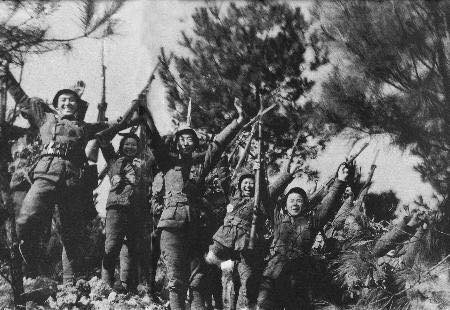
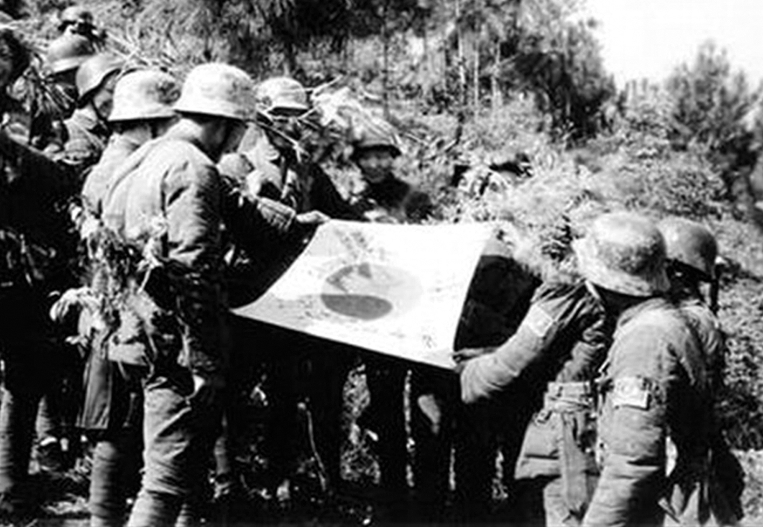
Battle of South Kwangsi: Chinese East Route Force captures Kunlunkuan and Tienyin from Japanese 5th Infantry Division. Chinese declared victory at Kunlun Pass 59 kilometers northeast of Nanning, Guangxi Province, China, although the remnants of Japanese troops trapped in the region would not capitulate until mid-January 1940.
Chinese 2nd War Area finish clearing Japanese forces around Peishe on approximately this date.
Japanese 21st Army reaches Yingteh in Chinese 4th War Area zone.
River North Army of Chinese 5th War Area completes withdrawal back across Han River.
The first direct attack by Japanese planes on the French-owned IndoChina-Yunnan Railway was carried out yesterday when a squadron of Japanese bombers raided Mengtze, a treaty port city in Yunnan Province, fifty miles from the French border.
The Japanese Army has lost 70,000 men in fighting in China since the war began in 1937, a Japanese General announces.
Born:
Willye White, American athlete (Olympic silver medals, women’s long jump 1956, 4x100m relay 1964; Sports Illustrated 100 greatest women athletes of 20th century), in Money, Mississippi (d. 2007).
Hugh Lewin, South African anti-apartheid activist and writer (“Bandiet: Seven Years in a South African Prison”), in Lydenburg, South Africa (d. 2019)
Peter Camejo, author, activist and politician, in New York, New York (d. 2008).
Died:
Frank Benson, 81, British actor-manager.
Naval Construction:
The Royal Navy Bangor-class (Turbine engined) minesweeper HMS Beaumaris (J 07) is laid down by the Ailsa Shipbuilding Co. Ltd. (Troon, Scotland).
The Вое́нно-морско́й флот СССР (ВМФ) (Soviet Navy) “S” (Stalinec)-class (3rd group, Type IX-modified-2) submarine S-21 is laid down by Sudomekh (Leningrad, U.S.S.R.) / Yard 196.
The Вое́нно-морско́й флот СССР (ВМФ) (Soviet Navy) Project 7U-class (Storozhevoy-class) destroyer Strogy (Строгий, “Strict”) is launched by Zhdanov (Leningrad, U.S.S.R.) / Yard 190.
The Royal Navy Tree-class minesweeping trawler HMS Walnut (T 103) is commissioned. Her first commander is Skipper Tom Smith, RNR.


 History Diaries