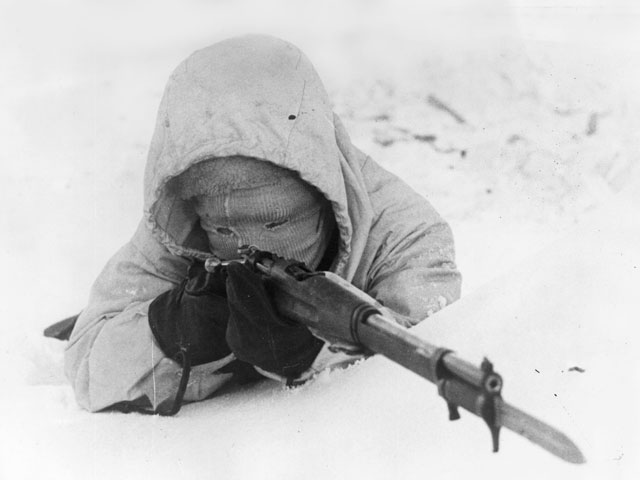
The gradual dwindling of the Russians’ artillery fire and mass attacks on the Karelian isthmus yesterday and today seems to indicate that the invaders have been stopped, at least temporarily, by the Finns’ massive Mannerheim Line. But the Soviets are moving massive reinforcements of men and materiel into the theatre.
Most remnants of the Soviet 163rd Division are destroyed by the Finnish 9th Division at Suomussalmi as they attempt to retreat over the frozen Lake Kiantajärvi. The Finnish 9th Division has been pursuing the fleeing Soviets from Suomussalmi. A platoon under Captain Kuistio embarks in two trucks and manages to catch the tail end of the 4 kilometer-long Soviet column at the northern end of Lake Kiantajärvi. There is nowhere to hide on the ice, and Kuistio and his men kill another 500 Soviet men using 4 machine guns, 1 twin antiaircraft- machine gun and various submachine guns. In addition, the Finnish air force (Bristol Blenheim Mk 1 bombers) and Finnish artillery blast away at the fleeing Soviets, killing some outright and sending others through holes in the ice. The 163rd Division loses just today around 6,500 men, approximately 35% of its strength. Total losses for the Soviet 163rd Rifle Division are estimated at 15,000, versus 420 Finnish dead or missing along with 600 wounded.
The total war booty from Suomussalmi brought back to headquarters is staggering for the poorly armed Finns:
625 Rifles,
33 Light machine-guns,
19 Machine-guns,
2 Anti-aircraft machine-guns (four barrels),
12 Anti-tank guns,
27 Field and Anti-aircraft-guns,
26 Tanks,
2 Armored cars,
350 Horses,
181 Trucks,
11 Tractors,
26 Field kitchens,
800,000 rounds of 7.62 mm rifle ammo,
9,000 artillery shells,
a field hospital, and
a bakery.
In addition, the local Finnish troops get their fill of rifles, ammunition, and machine guns which they can put to immediate use without headquarters ever knowing about it.
Colonel Siilasvuo is ordered to destroy the Russian 44th Division grouped along the Raate road. The Soviet 44th Rifle Division on the Raate road is still intact, but their standard Red Army 1902 model Moisin-Nagant 7.62 mm rifles are freezing in the extreme cold (gun-oil can freeze). In addition, most of their vehicle engines have seized because there is not enough fuel to keep them running through the frigid days and nights. This means the men and their animals are stuck – and with few ways to warm up. Thus, the Soviets are immobile and freezing. If they can be defeated, there will plenty of more booty to be had.
The Finnish force at Hulkonniemi captures large amounts of enemy material, including 25 artillery pieces, 11 tanks, 150 lorries and 250 horses.
Finnish losses are 350 dead and 600 wounded.
Finnish troops repel an exploratory offensive by the enemy across the newly-frozen Lake Ladoga.
Finnish offensives against the Soviet 8th and 9th Armies continue. General Stern, formerly in command of the Soviet Far Eastern Army, is assigned to direct operations north of Lake Ladoga.
Some 60 bombs are dropped by Soviet aircraft on Hango.
Soviet battleship Oktyabrskaya Revolutsiya and escorting warships bombard the Finnish shore battery at Saarenpää.
The Finnish cargo ship Telma foundered and sank by ice in the Gulf of Bothnia off Oulu. Her fifteen crewmen were rescued.
Germany’s reported efforts to intimidate the Nordic bloc into refusing transit facilities for the League of Nations’ material aid to Finland will not succeed, according to well-informed circles in Paris.
Report of the Commander in Chief, Navy, to the Führer on 30 December 1939.
Present: Generaloberst Keitel
Fregattenkapitän von Puttkamer
- Baltic Sea. The sinking of a number of German steamers, which occurred in the course of Russian naval warfare against Finland, is brought up. The Russians now respect the German flag. An agreement is being discussed with regard to German ore steamers from Lulea.
German naval warfare is greatly impeded by the extensive traffic of neutral steamers to Britain through Swedish territorial waters, e.g., Falsterbo Channel. Firm pressure should be brought to bear on Sweden with the object of getting her to mine her own territorial waters; all traffic at the southern entrance of the Sound would then pass through the gap in the German mine field, which would be under a combined patrol.
- Scandinavia. It is essential that Norway does not fall into British hands. There is danger that volunteers from Britain, in disguise, will carry out an unobtrusive occupation of Norway. Therefore it is necessary to be prepared and ready. Serious resistance in Norway, and probably also in Sweden, is not to be expected. Opinion in higher military circles in Norway is divided: One section believes that Russia will not occupy Tromsø, as the difficulties would be too great; the other section believes that the partition of Norway between Russia and Germany has already been arranged.
- Northern sea route. Negotiations are in progress through the Naval Attaché in Moscow for the use of the northern sea route by returning German ships, i.e., auxiliary cruisers and Panzerschiffe. Perhaps political pressure from a higher source will be necessary, as subordinate departments do not take the responsibility.
- Warfare in the North Sea. The mine belt along the east coast of Britain was extended by destroyers and submarines in December; submarines are carrying out further extension along the west coast. The British now dim their outer beacons at night, and have declared the whole east coast a danger zone; this is a purely defensive measure. At the northern and southern entrances a heavy concentration of traffic will occur, and opportunities for submarine torpedo attacks in the north will therefore continue to be good. In the south it will be necessary to disrupt traffic by laying aerial mines. In view of the new situation the following steps are being taken:
a. In the coastal waters off the east coast protected by mine fields, the Commander in Chief, Luftwaffe, is making bombing attacks on steamers sailing unescorted as well as on convoys.
b. The Commander in Chief, Navy, has suggested to the Commander in Chief, Luftwaffe, that neutral ships proceeding through or anchoring in the Downs should also be attacked by bombers, after previous warning to neutral governments. These ships are proceeding under the orders and supervision of the British Navy, and are thus in a way being convoyed.
The Commander in Chief, Luftwaffe, will ask a decision to be made in due course. The Führer also considers a warning necessary; perhaps a favorable moment would be the commencement of a general intensification of warfare. (Note in writing: Who will do this?)
The over-all effect of the mine fields is as follows:
British and neutral merchant shipping are suffering severe losses, and neutral shipping is discouraged. On the other hand, the British are constantly able to create gaps in the mine fields by taking advantage of the removal of individual mines caused by ships which have been sunk. Traffic is continuing by day at least, though at great risk on account of the great number of wrecks, as many of the neutral captains have stated. Aerial mines must continually be laid to fill the gaps.
In January a large number of submarines will be ready for torpedo attacks and for cooperation with the surface forces.
The surface forces will be ready for operations by the second half of January. Operations will be made more difficult in the future by the absence of the strategic effect of the GRAF SFEE and the DEUTSCHLAND in the Atlantic. There is a greater concentration of heavy British naval forces in the north (2 to 3 battle cruisers, 5 to 6 battleships, 3 to 4 heavy cruisers).
The LÜTZOW and the first auxiliary cruiser will be completed by the end of January, and ready to sail by the middle of February. Italian participation in the war would relieve the situation in the Atlantic, as then a part of the British naval forces would be withdrawn to the Mediterranean.
Air activity: The enemy is very active in the North Sea; the Navy is dependent to a great extent on good air reconnaissance; modern types of aircraft for the Navy in sufficient numbers are therefore necessary. Negotiations are in progress. Radar equipment has proved very satisfactory and is the only method of warning coastal defense of the approach of enemy aircraft.
- Intensification of submarine warfare (See Annex 1). Previous experience has shown that gradual intensification without special proclamation, is the best method. If a proclamation is planned in conjunction with general intensification of warfare, as advocated by the Führer, only a general statement concerning intensified naval warfare should be made, without commitment to specific detail; moreover it is requested that the Seekriegsleitung be authorized to introduce intensification according to the general situation and the state of preparedness of the forces, subject always to fundamental agreement previously obtained from the Führer. The same procedure is recommended in case no proclamation is made. The Führer agrees to the following:
a. Merchant ships of all nations which sell or lease ships to Britain, primarily Greek ships, can be torpedoed without warning in the American declared war zone by any or all submarines, depending on the situation, possibly with limitations to certain defined areas.
b. Any or all submarines may fire without warning on neutral ships in those parts of the American declared war zone in which sinkings can be blamed on mines, for instance in the Bristol Channel. Ships of friendly nations are excepted.
c. The Führer is withholding publication of the ruling in reply to the “order in council” until the general intensification of warfare, or, in the case of a long delay in the offensive, until substitute measures are introduced in place of the offensive.
Friendly nations will be handled with consideration as before.
The Italians sent a note requesting designation of a safe harbor. The Commander in Chief, Navy, suggests replying that this is unfortunately impossible, since all harbors concerned have already been mined. It is impossible to establish the exact position of mines layed by submarines and planes, and the German Government therefore can give no guarantee. Italian ships would have to rely on data from British pilots. (Note: The Führer agrees.)
- Sinking of the GRAF SFEE. On account of insufficient details, no final judgement can yet be made concerning tactical conduct during the battle, why the EXETER could not be disposed of, and the necessity for entering Montevideo harbor. After the ship entered port and no extension of time for repairs was obtained, the decision of the commanding officer to use all remaining ammunition for effective destruction of the ship was justified, seeing there was no guarantee that after an attempt at a break-through and expenditure of the remaining ammunition the ship could be scuttled effectively in the shallow waters of the La Plata River estuary by merely opening the sea cocks. The defenseless, only partially submerged ship would have been in danger of being captured by the British. The Führer reiterated the fact that the EXETER should have been completely destroyed.
- NÜRNBERG: The damage is only slight. Repairs would take a short time, but will be taken care of during the period already set aside for overhauling the engines.
LEIPZIG: It will probably be necessary to replace one or two boilers, involving a long time in dock. KARLSRUHE, now fit for service, is to act as substitute. ADMIRAL SCHEER was already due for lengthy repairs at the outbreak of war, and they will begin shortly. The ship will not be ready to sail until autumn 1940 at the earliest. - Submarine construction program. Negotiations are in progress with the Chief of the OKW about a submarine construction program which by 1 January 1942 would provide us with 316 more submarines than we have at present. This would be done by drawing on metal, particularly tin, reserved for the Navy for later years. The Chief of the OKW confirms this and intends to investigate industry thoroughly to see if any more tin can be obtained. A final decision as to whether this program can be carried out or whether further reductions must be made can be deferred until May or June 1940.
Allied and German patrols are active between Moselle and Saar, despite intense cold.
Hermann Goering threatens terror for Britain. Nazis will unleash the worst air raids and smash the blockade, he says. Germany’s air force is prepared for a fierce counter-offensive such as “the world has never known” against the Allied blockade, Field Marshal Hermann Goering wrote in an article for the New Year’s edition of Chancellor Hitler’s newspaper Voelkischer Beobachter.
The German Kriegsmarine vorpostenboot (torpedo boat) V-704 Claus Wish struck a mine and ran aground east of Trelleborg, Sweden. Her crew were rescued, except for two men. She was a total loss.
Many cases of desertion from Soviet units stationed in Eastern Poland are reported from the Polish-Hungarian frontier.
Premier Mussolini’s forthcoming visit to Pope Pius provided the main topic of conversation in Vatican circles the last few days. Despite the fact that the date has not yet been set and authorized Italian quarters keep denying that his visit is “imminent,” it is taken for granted here that it will not long be delayed.
In the Naples region today an unprecedentedly severe snow storm indirectly caused a train wreck in which at least twenty-nine persons were killed and about 100 injured.
The press of Central and Southeastern Europe is replete with speculations about the impending meeting of the Foreign Ministers of the four countries belonging to the Balkan Entente — Rumania, Yugoslavia, Greece and Turkey.
Ireland faces the new year with a problem of dealing with increasingly active Republican radicals within its borders, added to the already serious economic and fiscal problems created by the war situation.
Relief efforts in the Anatolian earthquake area, already hampered by floods, blizzards and broken communications, tonight were disrupted by new aftershocks.
Convoy OA.63GF departs Southend.
Convoy OB.63 departs Liverpool.
The War at Sea, Saturday, 30 December 1939 (naval-history.net)
On Northern Patrol, two cruisers were between the Orkneys and Faroes, two cruisers and eight AMCs between the Faroes and Iceland, and one cruiser and one AMC in the Denmark Strait. Armed merchant cruiser CORFU departed Portsmouth for the Clyde, while heavy cruiser BERWICK, escorted by destroyer FORESIGHT, departed the Clyde on Northern Patrol, returning to Rosyth on 10 January.
Light cruiser COLOMBO departed Scapa Flow for Northern Patrol and arrived back on 6 January.
Destroyers ESCORT and ELECTRA departed Rosyth escorting base ship MANCHESTER CITY and steamer ASTRONOMER (8401grt) to Scapa Flow.
Destroyers FEARLESS and FURY took tanker ATHELEMPRESS (8941grt) to the Clyde. On the 31st, they were ordered to return to Scapa Flow taking with them tanker ARNDALE (8296grt) which departed the Clyde the same day.
Destroyer MASHONA arrived at Belfast with defects.
Submarine STURGEON arrived in the Blyth from patrol.
Convoy FN.61 departed Southend, escorted by destroyer VEGA and slops FLAMINGO and STORK, and arrived in the Tyne on the 31st.
Convoy FS.61 departed the Tyne, escorted by sloops PELICAN, WESTON, HASTINGS, and arrived at Southend on the 31st.
Anti-submarine yacht CUTTY SARK attacked a submarine contact 14 miles NW of Liverpool. Destroyer WESSEX was sent to assist.
Anti-submarine trawler ARSENAL (389grt) attacked a submarine contact 28 miles SSW of Calf of Man in 53-40N, 5-02W.
New Zealand light cruiser HMNZS ACHILLES departed the Falklands and joined light cruiser AJAX. On 3 January, they parted company and ACHILLES went to Buenos Aires and AJAX to Montevideo.
President Roosevelt named Charles Edison United States Secretary of the Navy. President Roosevelt appoints the son of inventor Thomas Edison as Secretary of the Navy. On January 18, 1937, President Roosevelt appointed Charles Edison as Assistant Secretary of the Navy, then as Secretary effective January 2, 1940, Claude A. Swanson having died several months previously. Edison himself only kept the job until June 24, 1940, resigning to run for Governor of New Jersey. During his time in the Navy department, he advocated construction of the large Iowa-class battleships, and that one of them be built at the Philadelphia Navy Yard, which secured votes for Roosevelt in Pennsylvania and New Jersey in the 1940 presidential election; in return, Roosevelt had BB-62 named the USS New Jersey.
Secretary Perkins urged in her annual report, issued today, that the American Federation of Labor and the Congress of Industrial Organizations reunite to make effective “the further development of our democratic process of living in the American way.”
She was immediately attacked by William Green, president of the American Federation of Labor, for her references pertaining to the labor split. Mr. Green said that the references were “thoroughly uninformed, misleading and untrue.” He accused Miss Perkins of withholding vital information from Congress and expressed the hope that some Congressional committee would summon her “and wring from her the truth she has suppressed.” His ire was particularly aroused by the statement that the split was “crystallized” by the “expulsion” of ten unions by the A. F. of L. and by her remark that the A. F. of L. “claims” 4,000,000 members.
“It is noteworthy that throughout the country among the various local unions affiliated with the A. F. of L. and the C. I. O. there is an increasing spirit of cooperation with regard to local matters,” the Secretary’s report stated. “In actual practice there is an unwritten but developing respect for each other’s jurisdictions and joint action to protect certain rights and opportunities, to prevent adverse legislation and to promote desired legislation.”
This section of the report opened with the statement that “administration of the programs for promoting the welfare of the wage-earners of the United States has been complicated by the split in the labor movement between the old A. F. of L. and the new group. During the early part of the year, in addition to the Secretary of Labor, the President and other officers of the government received a very large number of communications from labor groups all over the United States regretting the split in the labor movement and requesting that the Secretary of Labor or some other well-disposed officer of the government undertake to assist in healing the breach.”
Miss Perkins recalled her own efforts in initiating informal conversations with leaders on both sides, and said that she and those assisting her learned that officials in both labor camps appreciated the hazards to the labor movement “of a prolonged separation of the two groups, particularly if it was accompanied by rivalry and bitterness.”
Senator Key Pittman of Nevada, chairman of the Senate Foreign Relations Committee, said tonight that “at the proper time” he would ask his committee to authorize export embargoes against Japan. He said that he had no information that Japan has ceased violating American rights in China and that this was disappointing because he had hoped that Japan would carry out her pledges, making further action by Congress unnecessary. The 1911 Treaty of Commerce and Amity between Japan and the United States expires January 26, having been cancelled by the U.S. Government. Conversations are in progress in Tokyo between the Japanese foreign minister, Admiral Kichisaburo Nomura, and Joseph C. Grew, the United States ambassador to Japan. Japan has made several overtures, such as opening the Pearl River to American ships but the United States Government has not indicated that these gestures would bring about a new trade treaty.
The Tennessee Valley Authority asserted in its 1939 report today that its power operations were now on a paying basis and that, far from creating a large surplus of electricity, they already promised to prove inadequate for the growing demand.
With the approval of President Roosevelt, the Jackson Day Dinner Committee has broken precedent to invite Republican leaders in Congress to be honor guests at the traditional Democratic love feast to be held in Washington on January 8. The invitations to the Republicans stated that President Roosevelt’s speech at the dinner would be “nonpartisan in character.” The Republicans received the invitations with surprise and some suspicion. None would say definitely what he would do, but they indicated that they feared a political Trojan horse.
The invitations, sent out by Homer Cummings, former Attorney General and chairman of the Jackson Day committee of the District of Columbia, provoked speculation as to whether the President would devote his address to a call for national unity in solving internal and foreign problems. Some observers expressed the belief that it meant Mr. Roosevelt would not in his speech disclose his intentions regarding a third term.
An assertion that governments now had it in their power to check deflation and had a duty to do so was made today by Harry L. Hopkins, Secretary of Commerce, in his annual report.
At least thirty-five persons were injured in Hoboken, New Jersey this morning and many others shaken when an electric commuter train of the Delaware, Lackawanna Western Railroad, with locked wheels skidding on a slippery track, crashed into a bumper block at the end of the line in the Hoboken Terminal.
Changes in taxes for 1939 are reviewed. Whereas the year 1938 marked a pause in punitive Federal taxes, 1939 evidenced a tendency toward more equitable and sound taxation. Tax legislation of 1939 was generally of a remedial and corrective character.
Farmers fear 1940, the Secretary of Agriculture asserts, saying they will watch Congress for any hamstring. Secretary Henry A. Wallace asserted in a talk broadcast today over the Columbia Broadcasting System’s network that American farmers would be watching Congress in 1940 to see whether the necessity for general economy will result in the hamstringing of their program.
The film adaptation of John Steinbeck’s novel “Of Mice and Men” is released, starring Burgess Meredith as George, and Lon Chaney Jr. as Lennie.
Victory for China in 1940 was predicted today by Dr. Wang Chung-hui, Foreign Minister, in an appraisal of the Chinese outlook. Declaring that Japan was now “at the end of her rope,” Dr. Wang envisaged a serious weakening of Japan, militarily and economically. As a consequence Japan may get out of China, he asserted.
“In such an eventuality,” he declared, “the United States is certain to take an important role. An international conference of all powers having interests in the Far East would probably meet to work out an equitable settlement on the basis of the Nine-Power Treaty.” Supporting his conviction that Japan had reached the breaking point, Dr. Wang stressed her international isolation and “her acute economic difficulties, marked by rice riots, high prices and inflation.” He said the recent sending of an Imperial Guards division to China was a sign of the straits of the Japanese Army, especially the country’s shortage of trained troops.
The Foreign Minister drew a contrasting picture of China’s prospects in 1940. He predicted continued unity, augmented military strength and an increasingly favorable strategic position. “China is able to carry on the war as long as the Japanese aggression lasts,” he emphasized.
He showed keen interest in the attitude of the United States in connection with the termination of the trade treaty with Japan January 26. “It seems Washington is not impressed by Japan’s puny gesture in agreeing to open the Yangtze River to Nanking,” he said. “It is gratifying to see America taking a stand on fundamental issues.”
Referring to the coming visit to Chungking of the British Ambassador to China, Sir Archibald Clark Kerr, for discussions of Tientsin issues, Dr. Wang declared: “We have always insisted that the British Government should not discuss with Japan any question concerning Tientsin not of a local nature. We cannot agree to concessions of a fundamental character affecting our sovereign rights.”
A breakaway group of Chinese Nationalists led by the former foreign minister of the Kuomintang, Wang Chingwei, signs an agreement in Hanoi with Japanese representatives to set up a rival Nationalist government under Japanese protection. Wang Chingwei is Tokyo-educated and was the main rival to Chiang Kai-shek for the leadership of the Kuomintang. Since the loss of Wuhan, he has become convinced that the war against Japan cannot be won, and thus he is agreeing to set up a rival Nationalist government under Japanese overlordship. He hopes to have the undisputed rule over China as a Japanese satrap after the Japanese win the war.
Chinese Winter Offensive: Japanese 21st Army captures Wongyuan in Chinese 4th War Area zone.
Battle of South Kwangsi: Under continued Chinese attacks, Japanese 5th Infantry Division withdraws from Kunlunkuan overnight.
The revived Nationalist Chinese air force suffers a crushing defeat over Liuchow (Lanchow). Forty fighters challenge 13 Japanese Type-96 aircraft. In the ensuing air battle 14 of the Chinese planes are shot down without a Japanese loss. The Nationalist Chinese Air Force, which Claire Chennault has been working on, sends 40 fighters into the air over Liuchow. They encounter 13 Japanese Type 96 fighters. The Chinese apparently need more practice, because they lose 14 planes to none by the Japanese.
Dow Jones Industrial Average: 150.24 (+0.25)
Born:
Elena Tchaikovskaia, Russian pairs figure skating coach, choreographer (Lyudmila Pakhomova / Aleksandr Gorshkov; 6 x World Championship gold, Olympic gold 1976), in Moscow, Russian SFSR, Soviet Union.
Maria Alexandru, Romanian table tennis player (World C’ship gold women’s doubles 1961, 1973, 1975), in Plugova, Romania (d. 2024).
Felix Pappalardi, American rock music producer, songwriter, vocalist, and bassist (Mountain – “Mississippi Queen”), in The Bronx, New York, New York (d. 1983).
Viola Mae Wilkerson, American pop singer (“Gonna Get Along Without Ya Now”), in Watts, Los Angeles, California (d. 2009).
Glenda Adams (née Fenton), Australian novelist (Dancing on Coral; Longlegs), and playwright (The Monkey Trap), in Ryde, New South Wales, Australia (d. 2007).
Naval Construction:
The Royal Navy Flower-class corvette HMS Marguerite (K 54) is laid down by Hall, Russell & Co. Ltd. (Aberdeen, Scotland).
The Royal Navy armed merchant cruiser HMS Carinthia is commissioned. Her first commanding officer is Captain (retired) John Francis Benjamin Barrett, RN.
The Royal Navy armed merchant cruiser HMS Comorin (F 49) is commissioned. Her first commanding officer is Captain (retired) John Ignatius Hallett, DSO, RN





 History Diaries