
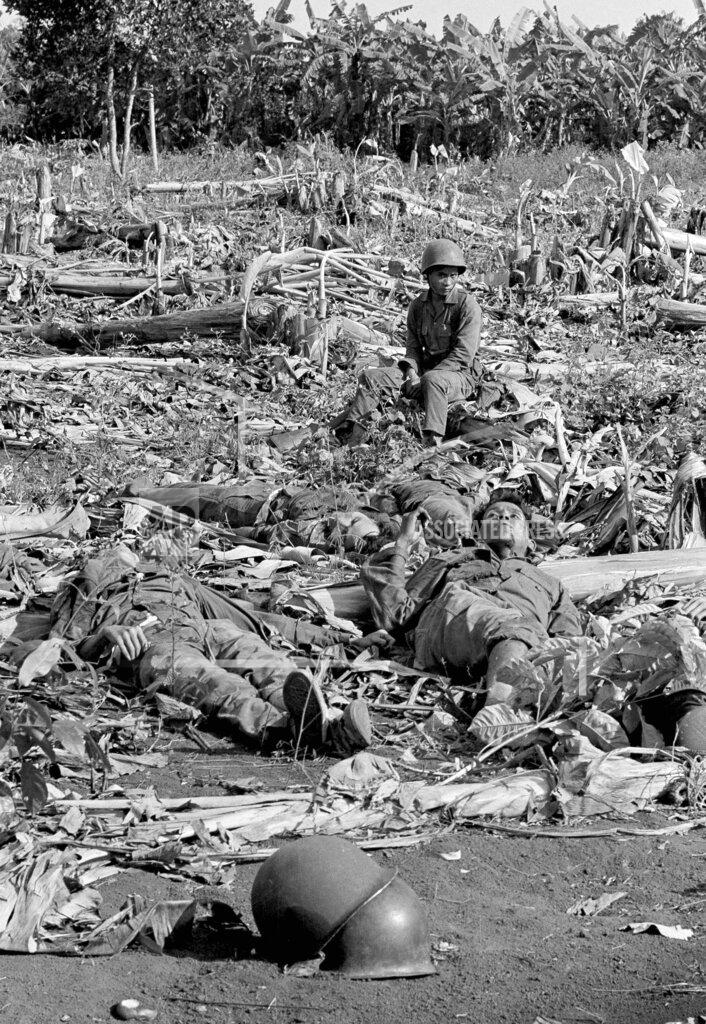
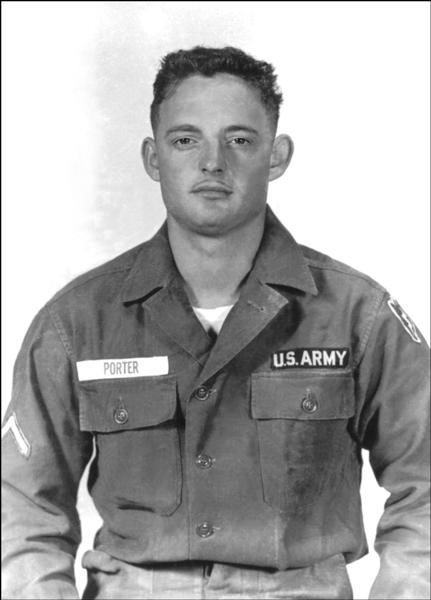
On December 30, 1964, a U.S. Army helicopter UH-1B (tail number 63-08654) from the 68th Aviation Company (Armed Helicopter) was shot down at Bình Giã with the loss of all crew members aboard. After being hit by ground fire, witnesses watched as they began to trail smoke, then flames from a fuel cell fire. Then, as the tail boom drooped and separated from the aircraft, the nose dropped and the rotor disc then tilted back, an apparent attempt by the pilot to keep the nose from dropping. The pilot was unable to overcome the nose tucking condition caused by the tail boom loss, and they crashed, not quite fully inverted, into the rubber trees, just off the S.E. corner of the village (of Bình Giã. The lost crew members included aircraft commander WO1 Roy G. Azbill, pilot WO1 Stephen E. Morgan, crew chief SGT Franklin D. Porter, and gunner PFC Theodore A. Winowitch. An unnamed passenger also perished in the crash. Note: John W. Vandeven Jr. was the regular crew chief on this aircraft but did not fly that day.
Citation:
Silver Star
Awarded for actions during the Vietnam War
The President of the United States of America, authorized by Act of Congress, July 8, 1918 (amended by act of July 25, 1963), takes pride in presenting the Silver Star (Posthumously) to Warrant Officer Roy Gordon Azbill (ASN: W-3151203), United States Army, for gallantry in action while engaged in military operations in the Republic of Vietnam, on 30 December 1964. As a Pilot of an Army aircraft, Warrant Officer Azbill was participating in a reconnaissance and support mission to provide aerial cover for a Vietnamese unit which had sustained heavy casualties on the previous day in a battle with the Việt Cộng, near Bình Giã. Although he was wounded early in the day when his helicopter was hit by enemy small arms and .50 caliber machine gun fire, Warrant Officer Azbill engaged the enemy until the ammunition was expended. After his departure to return, refuel, and get two replacement crew members for his aircraft, he voluntarily returned to the battle zone and continued to detect and strike enemy positions throughout the afternoon. At dusk, when his aircraft became the prime target of the Việt Cộng gunfire, he demonstrated fortitude, perseverance, and professional skill by retaliating with the utmost effectiveness until his ship crashed after being struck by enemy gunfire, taking the lives of all aboard. Throughout the seven hours in which he participated in the defense effort, he inspired other aviators in the air and the troops on the ground by his indomitable courage and devotion to duty. Warrant Officer Azbill’s conspicuous gallantry is in the highest traditions of the United States Army and reflects great credit upon himself and the military services.


The Battle of Bình Giã continues. The morning of December 30, the 4th South Vietnamese Marine Battalion moved out to Biên Hòa Air Base, waiting to be airlifted into the battlefield. The 1/4th Marine Battalion was the first unit to arrive on the outskirts of Bình Giã, but the 1st Company commander decided to secure the landing zone, to wait for the rest of the battalion to arrive instead of moving on to their objective. After the rest of the 4th Marine Battalion had arrived, they marched towards the Catholic church to relieve the besieged Rangers. About one and a half hours later, the 4th Marine Battalion linked up with the 30th, 33rd and 38th Ranger Battalions, as the Việt Cộng began withdrawing to the northeast. That afternoon the 4th Marine Battalion recaptured the village, but the Việt Cộng were nowhere to be seen, as all their units had withdrawn from the village during the previous night, linking with other Việt Cộng elements in the forest to attack the government relief forces.
On the evening of December 30, the Việt Cộng returned to Bình Giã and attacked from the south-eastern perimeter of the village. The local villagers, who discovered the approaching Việt Cộng, immediately sounded the alarm to alert the ARVN soldiers defending the village. The South Vietnamese were able to repel the Việt Cộng, with support from U.S. Army helicopter gunships flown out from Vũng Tàu airbase. While pursuing the Việt Cộng, a helicopter gunship from the U.S. 68th Assault Helicopter Company was shot down and crashed in the Quảng Giao rubber plantation, about four kilometers away from Bình Giã, killing four of its crewmen, commander WO1 Roy G. Azbill, pilot WO1 Stephen E. Morgan, crew chief SGT Franklin D. Porter, and gunner PFC Theodore A. Winowitch.
An almost continuous airlift of troops from the Saigon and Biên Hòa airbases brought the government strength above 1,000 men. The Việt Cộng force also rose to a concentration rarely achieved in this guerrilla war. Three United States helicopters were shot down this afternoon. Two of the crews escaped injury, and their aircraft were recovered. The third helicopter was destroyed by fire; all four crewmen were injured and taken to the United States Navy Hospital in Saigon, where their condition was described as good. Two other American helicopter crewmen were injured by ground fire and were also said to be in good condition. Two United States enlisted men, serving as advisers with ground troops, were reported missing. They were with the Ranger unit that was surrounded yesterday, and they are believed to have been captured.
According to incomplete casualty reports, 34 government soldiers were killed in action and the bodies of 32 Việt Cộng soldiers were counted. The government’s losses are expected to be much higher because an airlifted unit of 175 Rangers was surrounded and overrun within minutes. The area of that clash had not yet been examined for bodies. A Việt Cộng force estimated between one and three battalions — possibly more than 1,000 men — pulled out of the village during the day under sporadic rear‐guard fire. Bình Giã is a sprawling agricultural village with homes spread among thick palm and banana groves. Its Catholic population made, it one of the strongest anti‐Communist centers of Phước Tuy Province along the coast of the South China Sea and thus a prune target for Việt Cộng pressure as the guerillas spread their influence to an area that Saigon had considered secure.
The Defense Department today identified two Army enlisted men killed in operations in Vietnam. They were MSgt. William L. Siegrist of Stumpy Point, North Carolina, and SSgt Reino A. Panula of Columbia City, Indiana. The department said the men were killed while on a combat patrol. Two other, soldiers — Pvt. Charles E. Crafts of North Jay, Maine, and Sgt. Harold G. Bennett of Perryville, Arkansas — were reported missing and presumed captured.
A Navy pilot was also lost off Vietnam to a ramp strike on his carrier, making a total of seven Americans lost in Vietnam on this day.
Senator Richard B. Russell, Democrat of Georgia, said today that the Senate Armed Services Committee he headed would evaluate the United States position in South Vietnam in view of the lack of popular support for the present Saigon regime. The committee also will soon examine in detail this country’s position in the Congo, Mr. Russell went on. He expressed hope that President Johnson would not let the United States get too involved there. “It would be nothing less than tragedy for us to go and get involved in the Congo as we are in Vietnam,” he said. “That would be a monument to poor statesmanship.” The Senator said to newsmen he thought the United States had “made a terrible mistake getting involved in Vietnam.” “I don’t know just how we can get out now, but the time is about at hand when we must re‐evaluate our position,” Mr. Russell said.
Saigon, a gambling town, is placing bets on the latest political crisis. Some Chinese businessmen are offering 5‐to‐l odds that the South Vietnamese Government will announce a policy of neutrality and negotiation with the Việt Cộng before January 9.
In a New Year’s greeting today to the leaders of the Soviet Union, President Johnson urged agreement on a series of United States disarmament and arms‐control proposals. A letter addressed to president Anastas I. Mikoyan and Premier Aleksei N. Kosygin said it was Mr. Johnson’s “earnest wish that in the coming year we can make substantial progress” in strengthening world peace. Meantime, Dr. Glenn T. Seaborg, chairman of the Atomic Energy Commission, said after a conference with the President that the agency’s new budget would call for a decrease in spending for the production of fissionable material and for nuclear weapons.
President Johnson suggested in his message moves to limit the spread of nuclear weapons and to achieve a worldwide, comprehensive ban on nuclear tests. He suggested agreement on a “cutoff” of production of fissionable material for weapons use, coupled with measures to allow for the peaceful use of nuclear power. And he asked for a “verified freeze in existing offensive and defensive strategic nuclear delivery systems.” The United States has advanced these proposals in the past, but agreement has not yet been found.
At year’s end the Soviet Government appears to be marking time on virtually all foreign policy fronts. Western diplomats here expect no major initiatives — neither overtures nor unusually aggressive moves — with respect to the Western powers in the coming months. The Soviet leaders are thought to be preoccupied with the urgent domestic tasks of reforming the economy, overhauling the Communist party structure and searching for a balance of power in the new hierarchy. The regime is also faced with a new deadline in the continuing ideological dispute with Communist China. It has set March 1 as the date for the opening of the controversial meeting of 26 Communist parties aimed at preparing a world Communist conference.
Eastern European Communists have been saying recently that the Russians are determined to go ahead with the March meeting even if the Chinese Communists and their allies boycott it, as is now thought likely. The outcome of the March meeting is expected to determine not only the course of the Chinese‐Soviet dispute but also to a large extent the attitude of the Soviet regime toward the West. Western diplomats here expect the high‐pressure propaganda campaign against the projected mixed‐manned nuclear fleet in the Atlantic alliance to remain the principal feature of Soviet policy toward the West.
The U.N. General Assembly recessed tonight until January 18 without taking action on unpaid Soviet assessments for the United Nations peace‐keeping forces in the Congo and the Middle East. Until virtually the last moment, the recess was imperiled by a deadlock between Mali and Jordan, the candidates for the Security Council seat that Morocco will give up January 1. This was settled when they agreed to a split term, with Jordan serving in 1965 and Mali in 1966. In accordance with a Soviet demand, the Secretary General, U Thant, deleted from his closing statement a projected appeal to the 115 members of the United Nations for voluntary contributions to restore the organization’s “solvency.” Such a “rescue fund” had been the main element of several proposals made during the session to avoid a confrontation between the United States and the Soviet Union.
Moscow has refused to pay $52.6 million in assessments for the two peace‐keeping forces on the ground that they are illegal and the United States has insisted that the Soviet Union, therefore, is subject to Article 19 of the Charter. This provides that members two years behind on their assessments “shall have no vote” in the Assembly. To avoid a showdown, the Assembly has transacted its business without a formal vote since the 1964 session began December 1. Just before the recess, which came at 8:06 PM, Nikolai T. Fedorenko, the Soviet representative, informed the Assembly that Moscow would also continue to refuse to pay certain assessments under the United Nations regular budget. These include payments on principal and interest on bonds issued by the United Nations to help finance the Congo and Middle Eastern forces.
Communist China “said in a major foreign policy statement published tonight that it would seek to forge the “broadest united front” of nations against the United States. Speaking before the National People’s Congress in Peking, Premier Chou En‐lai asserted that the United States’ power was declining, Peking’s “international prestige has been enhanced and our revolutionary influence has become wider,” he added. The Premier urged Communist nations to join with other countries, particularly those of Asia, Africa and Latin America, which he described as the “main storm center of world revolution” in a united front against the United States.
Mr. Chou reiterated warnings that Communist China would “absolutely not stand idly by” if the United States expanded the South Vietnamese war. “Such an action by the United States would result only in a more disastrous defeat,” he said. Premier Chou said that the United States had been informed in ambassadorial talks in Warsaw that a settlement of any concrete problems between Peking and Washington “was out off the question” until the United States armed forces had been removed from Taiwan and Taiwan Strait.
The Security Council called today for an end of all foreign intervention in the Congo, a cease‐fire and the withdrawal of foreign mercenaries. The compromise resolution was adopted by 10 to 0, with France abstaining. The resolution also asked the Organization of African Unity to continue its efforts to achieve a “national reconciliation” in the Congo and requested all countries to assist the organization in attaining this objective. Adoption of the resolution came after nearly three weeks of behind‐the‐scenes maneuvering and a frequently bitter debate that went on through 16 meetings of the Council.
The resolution as adopted did not achieve the original objective of the 18 militant African countries, spearheaded by Algeria, Ghana, Guinea and the United Arab Republic, that initiated the Council debate at the beginning of the month with a complaint against the United States‐Belgian rescue operation at Stanleyville. The 18 countries had asked the Council to condemn that action. The text of the resolution made no specific mention of the operation. It merely described the Security Council as “deploring the recent events in the Democratic Republic of the Congo.”
In a New Year’s message, Spain’s Generalissimo Francisco Franco pledged his regime today to a broadening of religious liberty. He assured Spaniards they had “nothing to fear” from it.
The Portuguese Foreign Minister, Dr. Alberto Franco Nogueira, denounced today what he said was an arms build-up in Tanzania. He said it constituted a threat to Portugal’s East African possession of Mozambique.
The latest crisis in relations between the United States and President Gamal Abdel Nasser appeared at least superficially to be easing. The authoritative newspaper Al Ahram, widely regarded as the organ of President Nasser’s regime, welcomed Washington’s decision to ship the United Arab Republic nearly $17 million worth of surplus wheat under a long‐standing economic aid agreement. It ignored for the time being Washington’s decision to hold off on Cairo’s request for $35 million in new equipment. The editorial, with its implied praise of the United States, was the first conciliatory comment toward Washington in the Egyptian press since Mr. Nasser lashed out at United States policies a week ago, charging that Washington was attempting to use economic aid to exert pressure on the United Arab Republic.
The United Progressive Grand Alliance, based in the Nigerian south, called tonight for a conference to break up the Federation of Nigeria peacefully after a massive boycott of today’s national elections by millions of its supporters. The Alliance’s statement cast a pall over the future of Nigeria — the most populous nation in Africa and the continent’s most prominent democracy. The boycott in almost all areas of the south threatened to split Nigeria in two.
Two captured Indonesian Army sergeants said today that they had been sent to Malaysia as officers in a new guerrilla force, the National Army of Malaya.
Law enforcement officers in India arrested more than 500 pro-Chinese Indian communists in a predawn raid throughout the Kerala state, and charged them with planning “nationwide sabotage and violent revolution”. Those arrested included at least one member of the Lok Sabha, India’s national parliament, as A. K. Copalan was picked up.
The Soviet Union said today that it had begun moving the headquarters of its Antarctic operations from its eight-yearold base of Mirny to the new research station of Molodezhnaya, 1,300 miles to the west.
The United Nations Conference on Trade and Development (UNCTAD) was established as a permanent organ of the UN General Assembly.
Mount Paget, the highest point on South Georgia Island, was successfully climbed for the first time. The team of British servicemen, led by Royal Navy Commander Malcolm Burley, reached the 9,629 foot (2,935 m) tall peak as part of the Joint Services Commission.
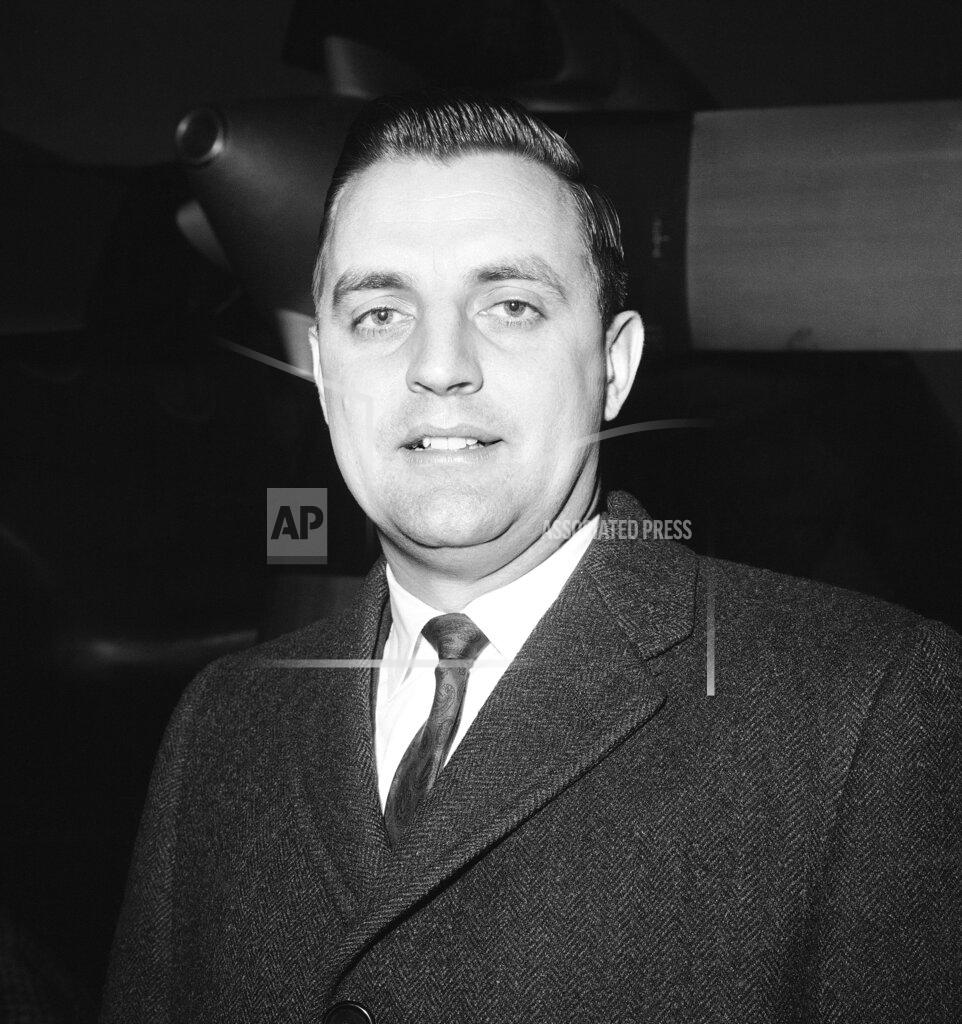
Minnesota’s new U.S. Senator, Walter F. Mondale, a Democrat, signed his appointment papers today and officially went on the Congressional payroll. Mr. Mondale flew to Washington after being appointed by Gov. Karl F. Rolvaag to succeed Vice President‐elect Hubert H. Humphrey. Mr. Humphrey resigned his Senate seat yesterday to permit the 36‐year‐old Mr. Mondale to pick up a few days’ seniority on other incoming Senators. Mr. Humphrey and Representative Donald Frazer, Democrat of Minnesota, accompanied Mr. Mondale to the office of Felton Johnson, the Secretary of the Senate, for the signing of the appointment papers.
Two leaders of Women Strike for Peace, an organization opposing nuclear weapons, were indicted on charges of contempt of Congress today for their refusal to testify at a closed session of a subcommittee of the House Un‐American Activities Committee. Indicted with them was Russell Nixon of New York, general manager of The National Guardian, which describes itself as a “progressive weekly.” The women are Mrs. Dagmar Wilson and Mrs. Donna Allen, both of Washington. All three said that they would have been willing to testify if the committee session had been opened to the press and the public, but that they would not answer questions in secret. They emphasized that they were not seeking protection against possible self‐incrimination under the Fifth Amendment.
The three were called by the House group December 7 in an investigation of a possible breach of United States immigration laws. Mr. Nixon was charged with one count alleging that he “deliberately, intentionally, and unlawfully” refused to be sworn to answer questions. Mrs. Wilson and Mrs. Allen were charged with two counts each for refusing to answer questions. The three were to be questioned about their part in trying to help obtain a visa for a Japanese professor who was coming to the United States on a lecture tour last year. The professor, Dr. Kadru Yasui, dean of the Hosei University law faculty in Tokyo, was visiting here for a lecture tour sponsored by Mr. Nixon’s newspaper. The professor, a director of the Japan Council Against Atomic and Hydrogen Bombs, received the Lenin Peace Prize in 1958. He obtained a visa from the State Department the day before he was to leave Japan in November, 1963.
Under Secretary of Labor John F. Henning will stay on the job for the indefinite future under an agreement reached by Secretary W. Willard Wirtz and George Meany, president of the American Federation of Labor and Congress of Industrial Organizations. The Secretary and the union leader had been caught up in a squabble over the Secretary’s expressed desire to replace his chief subordinate, who has long been active in the labor movement. Ostensibly neither Mr. Wirtz nor Mr. Meany has changed his basic aim. However, Mr. Meany’s insistence on the status quo becomes the order of the day, while Mr. Wirtz reserves the right to insist on his point whenever he is moved to do so.
An airliner with 47 persons aboard made a safe landing in a plowed field near Newhall, California today when both engines failed. Two of 43 passengers on the United Air Lines Convair 340, registration N73102, Fresno‐to‐Los Angeles flight reportedly were shaken up when the twin-engine Convair mushed down in the rain. The Newhall area is an island of flat land in a wilderness of rugged mountains that separate the Los Angeles Basin from the San Joaquin Valley to the north. A forced landing a few miles earlier or later might have meant tragedy. The report that both engines had quit came from the tower at Los Angeles International Airport, the plane’s destination. The flight originated in Reno, Nevada, and had stopped at San Francisco, Stockton and Modesto as well as Fresno. The pilot, Capt. Bill Wade of Los Angeles, pancaked the plane into a field muddy from recent rains, after the tail surface struck and snapped high tension wires. He was able to keep the nose up, despite uneven ground.
Atlanta Mayor Ivan Allen Jr. predicted today that a planned hometown banquet honoring the Rev. Dr. Martin Luther King Jr., winner of the Nobel Peace Prize, would be supported by most of the business community. The Mayor has been active in private personal contacts to encourage comprehensive community support for the occasion, scheduled for January 27 at a downtown hotel. Active opposition to plans for the dinner is no longer evident. One source said about 40 leading citizens have agreed to serve as sponsors of the event, and the number is expected to grow. In a letter dated December 16, about 125 persons were asked to serve as sponsors of the banquet to honor Georgia’s first Nobel winner. Responses were slow. Although a number of prominent citizens quickly agreed, active though quiet opposition developed among some downtown financial and business leaders. The matter was discussed by a group of the most influential leaders Monday. There was no unanimity of opinion, but Mayor Allen was not the only person who afterward was optimistic about support for the plans.
More than 200 Black parents and their children attended a civil rights rally tonight in a church near Ripley, Mississippi that was burned to the ground and rebuilt by a group of white college students from Ohio. The rally was held almost two months to the day that the Antioch Baptist Church was destroyed by fire shortly after an integration meeting in the building October 31. The “Christmas carpenters” were students and three professors from Ohio’s Oberlin College who gave up their holiday to come live with Blacks in this rural area while they rebuilt the church.
The church is still not finished. The congregation sat on planks perched on concrete blocks during the 90‐minute rally. One of the speakers was Mrs. Annie Devine, an official of the Mississippi Freedom Party, a predominantly Black group that plans to challenge the seating of the state’s Congressional delegation in Washington next week when Congress convenes. She declared: “Students from Oberlin could do without a Christmas holiday. Kids from all over the north did without their summer vacation. And now it is time for us to do some work ourselves.“I appeal to you to finish this church and to continue with determination in our struggle for freedom, even after these college students are gone.”
Despite two “shocking and ghastly” setbacks, the year; 1964 brought the most significant advancements for Black rights since the Supreme Court’s school desegregation decree in 1954, a civil rights leader said yesterday. Roy Wilkins, executive director of the National Association for the Advancement of Colored People, issued a year‐end statement praising government efforts and those of private groups to advance the cause of civil rights. He said the gains in 1964 “were not limited to legislation and political actions.” He cited the awarding of the Nobel Peace Prize to the Rev. Dr. Martin Luther King Jr. and a drive for an economic boycott of Mississippi.
Among the setbacks, Mr. Wilkins said, “the most shocking and ghastly were the lynching of three young civil rights workers in Mississippi and the wanton killing of a Black U.S. Army Reserve officer on a Georgia highway.” Civil rights advocates also were dealt a blow in California, Mr. Wilkins asserted, by “the adoption of a constitutional provision forbidding any fair‐housing legislation henceforth” in that state. Mr. Wilkins called the Civil Rights Act of 1964 “a milestone in the Negro’s long struggle for equality.”
Agencies of the federal government disbursing aid to localities are mailing out forms in which the recipients pledge compliance with the 1964 Civil Rights Act. They must be signed if the aid is to continue. The forms are required by the new rights act. A Justice Department spokesman said today that the department was advising the various agencies, although each is drawing up its own form. Pledges must be returned within 60 days. If they are not, the Federal agency involved will notify the local authorities that there must be a hearing. If it becomes apparent that the locality does not intend to comply, steps will be taken to cut off Federal aid.
The Administration is thinking of seeking increases in Social Security cash benefits that would be payable in the latter half of 1965 but be retroactive to January 1.
President Johnson announced today the appointment of the six public members of the Public Land Law Review Commission. During the next four years, the commission will study the nation’s public land laws, practices and problems and report its findings to the President and Congress.
Charles L. Watkins, after 59 years of Senate service, more than 40 of them as Parliamentarian, retired today at the age of 85.
A leading mathematics educator warned today against what he called hasty and unwise changes in the mathematics curriculum in elementary schools of the United States. We’re in danger of raising a generation of kids who can’t do computational arithmetic, Prof. Max Beherman of the University of Illinois told a meeting of the National Council of Teachers of Mathematics here this afternoon. He said that excessive and unskilled emphasis was being placed on esoteric branches of mathematics at the expense of fundamentals. Professor Beberman was himself one of the instigators of the radical changes — “New Math” — that have been made in the last decade in the teaching of mathematics at the elementary and secondary levels in the United States. But he argued today that the trends set in motion by these changes were leading to very unsatisfactory results in many cases.
The United States Air Force accepted the last of 732 Boeing KC-135 Stratotankers: KC-135A serial number 64-14840. The new tanker was assigned to the 380th Air Refueling Squadron at Plattsburgh Air Force Base, New York, 12 January 1965.
The Consumer Price Index rose by two‐tenths of 1 percent in November, the Labor Department reported today. Part of the rise was attributed to strikes in the automobile industry, which had the effect of pushing up the price of used cars. The index for November was 108.7, with average prices in the 1957‐59 period taken as the base of 100. Thus it cost $108.87 in November to buy the goods and services that cost $100 in the base period. Despite the small rise in November, the eighth monthly increase this year, the index for the month was only 1.2 percent above November a year earlier.
After four days of declining prices, the stock market did a quick about‐face yesterday and closed smartly higher in heavy trading. On the New York Stock Exchange, golds, chemicals, selected rails and a variety of investment grade issues were in the vanguard of the recovery. Gains ranged up to 2 points, while losses for the most part were limited to fractions.
Edward Albee’s play “Tiny Alice” premieres on Broadway in NYC.
Dow Jones Industrial Average: 868.69 (+6.51)
Born:
Duglas T. Stewart, Scottish rock singer-songwriter (BMX Bandits), in Glasgow, Scotland, United Kingdom.
Died:
Andrés Soriano, 66, Philippine business magnate and philanthropist who founded his nation’s largest conglomerate, the San Miguel Corporation (San Miguel Brewery), as well as Philippine Airlines, of pancreatic cancer.
Hans Gerhard Creutzfeldt, 79, German neurologist who first described the brain disorder Creutzfeldt–Jakob disease


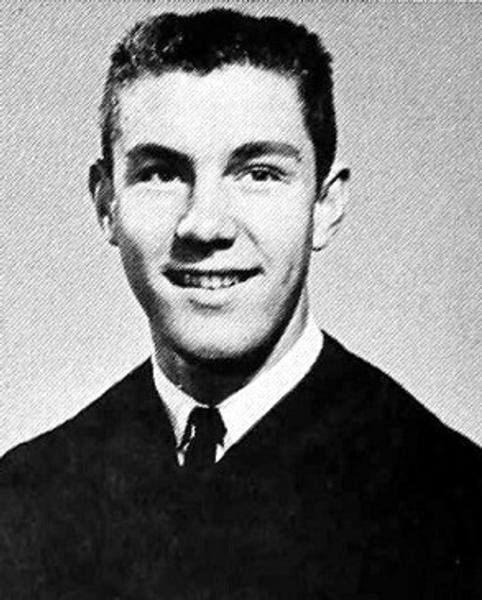


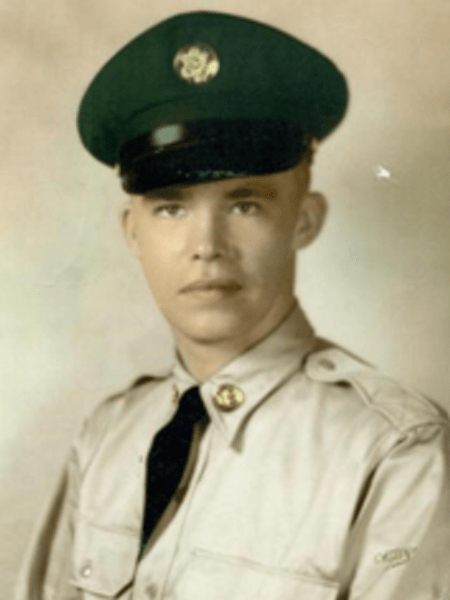
Silver Star
Citation:
The President of the United States of America, authorized by Act of Congress, July 8, 1918 (amended by act of July 25, 1963), takes pride in presenting the Silver Star (Posthumously) to Master Sergeant William Leroy Siegrist, United States Army, for gallantry in action while engaged in military operations in the Republic of Vietnam, on 30 December 1964. As Detachment Operations Sergeant to a Vietnamese Task Force comprised of three companies, Sergeant Siegrist was the Senior Advisor for a night road clearing operation on a Vietnam National Route. After the Task Force had established a perimeter defense and a forward operational base at Ben Dong So, a Việt Cộng force of approximately two battalions launched a violent attack against the friendly position. During the ensuing battle, he bravely placed himself in dangerous positions to advise his Vietnamese counterparts and, when the Vietnamese Commander was killed, Sergeant Siegrist exposed himself to the enemy gunfire to direct the supporting artillery fire by radio. When his fearless actions placed him in the midst of enemy troops which were overrunning the Task Force, he completely disregarded his own safety and called for three hundred rounds of 105-mm. howitzer fire on his position. Throughout the fierce fight, he inspired the defenders by his indomitable courage and continued to engage the Việt Cộng until he sustained a mortal wound during hand-to-hand combat. Sergeant Siegrist’s conspicuous gallantry is in the highest traditions of the United States Army and reflects great credit upon himself and the military services.
William is buried at Shiloh United Methodist Church Cemetery, Stumpy Point, Dare County, North Carolina. He is honored on the Wall at Panel 1E, line 80.




 History Diaries