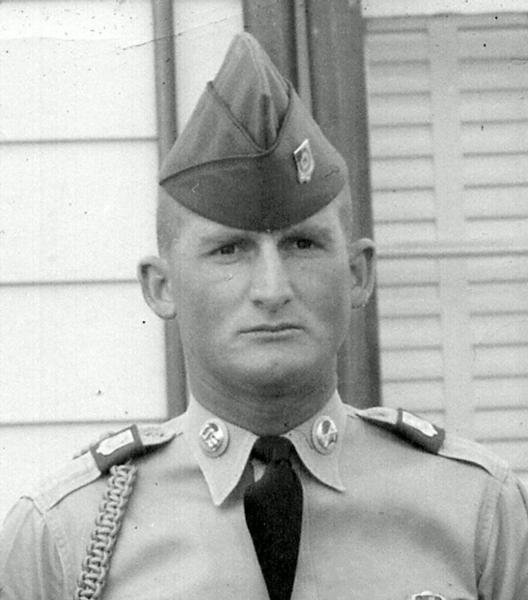
Silver Star
Awarded for actions during the Vietnam War
The President of the United States of America, authorized by Act of Congress July 9, 1918 (amended by an act of July 25, 1963), takes pride in presenting the Silver Star (Posthumously) to Staff Sergeant Harold George Bennett (ASN: 18542931), United States Army, for gallantry in action from 29 December 1964 to 25 June 1965, while serving as a Ranger Advisor to the Vietnamese during the Vietnam War. On 29 December 1964, Staff Sergeant Bennett assisted two companies of the 33d Vietnamese Ranger Battalion in assaulting a powerful Viet Cong Force occupying the village of Binh Gia in Phuo Tuy Province. En route, the Rangers were ambushed and overwhelmed by enemy forces employing mortars, recoilless rifles, and small arms fire. Staff Sergeant Bennett fearlessly traversed the battlefield, rallying survivors and calling in supporting fire from American gunships in the area. On two separate occasions, Staff Sergeant Bennett refused extraction, electing instead to stay behind and fight. He was eventually captured by the enemy. During his time in captivity, Staff Sergeant Bennett planned three separate escape attempts, the third of which resulted in his finger being bitten to the bone by the Viet Cong guard he was attempting to overcome. As a result of his tenacity and insubordination, Staff Sergeant Bennett was frequently blindfolded and beaten, given reduced rations and shackled in solitary confinement for prolonged periods. On 25 June 1965, the Viet Cong announced that they had executed Staff Sergeant Bennett in reprisal for the Saigon Government’s execution of a communist terrorist. Staff Sergeant Bennett’s valor and intrepidity during combat and his conspicuous courage and bravery while in captivity are in keeping with the highest traditions of the military service and reflect great credit upon himself and the United States Army.
He was the first POW to be executed in retaliation. When the war ended in 1973, the Vietnamese listed Bennett as having died in captivity. They did not return his remains. They continue to stonewall all requests for the remains of executed PoWs to be returned. Harold has a military stone in his memory at Perryville Cemetery, Perryville, Arkansas. He is honored on the Wall at Panel 1E, line 79.
The Battle of Bình Giã continues. Government troops clashed with guerrillas for the third straight day today in an effort to recapture the Communist‐held village of Bình Giã, 40 miles southeast of Saigon. Eight Vietnamese soldiers were reportedly killed in the latest fighting. Việt Cộng losses were put at 32 dead. The actual numbers were far less favorable to ARVN. Yesterday United States helicopters carrying Vietnamese troops into the battle flew into a Communist ambush. Three were shot down and two were damaged. Six American crewmen were wounded. Today helicopters continued flying Vietnamese Ranger reinforcements into the battle area. The Communists wrested control of Bình Giã from Government troops Monday. The setback was reported as the government disclosed that its forces had suffered a major defeat Saturday at an outpost 40 miles southwest of Saigon. Communists there ambushed a relief column and killed 60 government soldiers and wounded 43. Thirty‐eight others were missing.
Government authorities expressed fear today for 6,000 Roman Catholic refugees crowded into Bình Giã, and for the townspeople there. The Việt Cộng were believed to be seeking revenge for their defeat at the town December 5.
Secretary of State Dean Rusk told President Johnson today that South Vietnamese generals were having second thoughts about the wisdom of their defying American political advice. At the same time it became known that the United States now feels that political unity in South Vietnam may well require broader representation in the Cabinet of Premier Trần Văn Hương. It was thought by observers that this could signal some American support for demands by Vietnamese Buddhists and other factions for representation in Premier Hương’s Cabinet of largely nonpolitical “technicians.” Official United States sources reported afterward that the Administration believed that various feuding political factions in South Vietnam, were beginning to recognize the importance of national unity and of setting aside personal rivalries for the time being.
More than a hundred politicians suspected of agitation under Communist direction in provinces in Central Vietnam were arrested in last week’s military purge, reliable sources. said today. Activists of the People’s Council for National Salvation, a political movement begun last September by Buddhist intellectuals at Huế University, were rounded up along with members of the civilian Legislature in Saigon. The attention of Premier Hương and Ambassador Taylor has been focused on obtaining the release of the legislators and on the recostitution of a legislature. Less has been said in the 10 days’ Since the armed forces’ intervention about the fate of the other opposition politicians. Their detention seems not entirely unwelcome to Vietnamese and American officials.
The People’s Council for National Salvation organized anti-government riots and demonstrations in the coastal lowands in late September and October. For days, their mobs controlled the Government radio station in the important town of Quy Nhơn. On at least one occasion they exchanged gunfire with Government security forces trying to maintain order. Attempts by the group to spread its influence into provinces of the Mekong Delta failed and the movement’s momentum slowed as it became evident that Vietcong agents were infiltrating its ranks. The generals who carried out the military purge on December 20, particularly Brigadier General Nguyễn Chánh Thi, commander of Central Vietnam’s First Army, had reports that the group was being reactivated with Việt Cộng encouragement.
Lieutenant General Nguyễn Khánh, Commander in Chief of the armed forces of South Vietnam, flew to the resort of Cap St. Jacques (Vũng Tàu) today for talks with his generals.
Although none of the combatants have formally declared war, it is undeniable that a full-scale war is now being waged in Vietnam and the adjacent territories of Laos and Cambodia. The United States has about 23,000 military personnel in South Vietnam, all still designated as ‘military advisers’; South Vietnam has some 265,000 in its regular armed forces but also supports paramilitary and militia forces of some 290,000; South Korea has already sent some 2,000 military advisers, Australia and New Zealand have assigned small units and individuals as advisers and Thailand and the Philippines are readying some units. It is reliably estimated that there are some 34,000 Communist troops fighting fulltime in South Vietnam. Calling themselves members of the National Liberation Front and popularly known as the Việt Cộng, increasing numbers of them have been trained in North Vietnam and have made their way southward along the Hồ Chí Minh Trail, which is being greatly expanded and developed as a major logistical supply network. By December 1964, a continuous stream of North Vietnamese-trained soldiers is moving into South Vietnam.
Meanwhile, the Communists can count on another 80,000 part-time activists who, whether through acts of terrorism or political ‘education,’ are gaining power over perhaps as much as 50 percent of the Vietnamese people. The costs of all this in terms of money and materiel are already beginning to defy accounting. (The United States, for instance, admits to losing 38 fixed-wing aircraft and 24 helicopters in 1964 alone.) The human casualties are mounting. The U.S. official figures show 140 dead in combat (versus 76 in 1963), 1,138 wounded, and 11 missing in action. The South Vietnamese have not such sophisticated statistical methods but estimates show some 7000 military personnel killed, 16,700 wounded, and 500 missing or captured. U.S. estimates of Communists killed are 17,000, with some 4,200 captured.
A deadlock developed today in the race between Jordan and Mali for a seat on the Security Council. This threatened to upset arrangements for adjourning the General Assembly without a showdown over unpaid assessments. The Assembly, which has transacted business since it convened four weeks ago without taking any formal votes, was forced to adopt a new procedure to fill four seats on the Security Council. These will become vacant January 1. African and Asian members contended that, with the Assembly virtually paralyzed, it was necessary to fill the vacancies and enable the Council to function in January. Three uncontested races for the Security Council were decided without difficulty by a popularity contest conducted by the President of the Assembly, Alex Quaison‐Sackey of Ghana. Delegates voted by written secret ballot in the usual way, but the ballot box was in Mr. Quaison‐Sackey’s office behind the Assembly podium, not in the Assembly Hall.
Mr. Quaison‐Sackey then announced to the Assembly that, as a result of his consultations, Uruguay had been chosen to replace Brazil for a two‐year term, the Netherlands to succeed Norway for two years and Malaysia to replace Czechoslovakia for a one‐year term. The contest failed, however, to produced the required two-thirds majority for Jordan, which was reported to have re ceived 70 or 71 votes to 50 or 51 for Mali. The total was greater than the 115 members of the Assembly, and the discrepancy was even greater when the French and Portuguese refusal to participate and the absence of Zambia’s delegate were taken into account. The explanation, however, was reported to be that some members especially Latin Americans, voted for both Jordan and Mali.
Meanwhile, the United States, the Soviet Union, France, the African‐Asian group and other delegates were given copies of the statements that U Thant, the Secretary General, and Mr. Quaison‐Sackey intend to make just before the Assembly recesses until some time in January. According to reliable sources, Mr. Thant, who returned to his office yesterday after treatment for a peptic ulcer, plans to appeal to the members to make voluntary contributions to the hard‐pressed United Nations treasury during the New Year recess. Before it recesses, the Assembly must also adopt an interim budget authorizing Mr. Thant to meet the expenses of the organization until the official budget for 1965 is adopted. Mr. Quaison‐Sackey’s projected statement, it was understood, will endorse Mr. Thant’s appeal for funds. In addition, according to a draft shown to African and Asian members, it would provide that when the Assembly reconvened — he suggested January 11 — it resume the normal voting procedure.
Communist China has expanded its military air power, informed sources reported in Hong Kong today. It is believed that Peking has begun to manufacture modern Soviet‐type jet fighters. As these developments were reported, the Peking Government issued a statement tonight denouncing the first patrol of the United States nuclear submarine Daniel Boone off the Asian mainland. The submarine, equipped with Polaris missiles capable of striking targets deep in the mainland, is the first of a fleet of about seven scheduled for duty in that part of the West Pacific from a base at Guam.
The Chinese Communists asserted that the assignment of the Daniel Boone was a “naked war provocation against the Chinese people and other peoples of Pacific countries.” Denouncing the submarine patrol as “nuclear blackmail,” the Chinese declared that it was absurd to think that Polaris‐missile submarines would frighten the Peking Government. The Chinese Communists reiterated their view that the atomic bomb was a “paper tiger” and added: “While the United States is piling up more and more atom bombs, the United States puppets in South Vietnam are getting into an ever worsening mess.”
Concerning the Chinese buildup of air power, the experts in Hong Kong said that a small but increasing number of jet fighters of the Soviet MIG‐21 type had been detected in the country recently. The delta wing supersonic aircraft is similar in appearance to the Soviet Air Force’s principal operational fighter. It is a match for many of the fighters operated by the United States and its Asian allies. The Chinese Communist Air Force has also put into the air recently a larger number of MIG‐19 fighters than had been seen in several years. Available information indicates that these MIG‐19’s were manufactured in Communist China. It has not yet been determined definitely where the MIG‐21’s are coming from, but some experts believe that they are being manufactured in China.
Disputed fields on the eastern coast of the Sea of Galilee came under Syrian artillery fire today as Israeli farmers, in armored tractors, were sowing grain. The tractors withdrew after an artillery duel of two-and-a-half hours was halted by a cease‐fire arranged by United Nations observers. A statement by army headquarters here said the sowing had already been completed. The fields are in a zone that was demilitarized in the armistice agreement between Syria and Israel in 1949. United‐Nations supervisors of the armistice “have maintained that Israeli and Arab civilians may cultivate their respective lands;‐in the zone without prejudice to an ultimate territorial settlement.
Residents of On, an Israeli communal village in the zone, began sowing fields east of their settlement shortly after 7 AM. They plowed the land in October, also under Syrian fire. Syrians telephoned a complaint to United Nations observers that the Israelis were working Arab‐owned lands. Shortly after 9 AM they reported that the Israelis were still there and that they had fired warning shots. The Israelis fired back. Israeli sources said that light artillery was used at first, but that later two Syrian tanks and a recoilless gun went into action. No casualties were reported here.
Congolese government forces and white mercenaries rescued 120 white hostages from the captivity of the Simba rebels, after successfully storming the town of Wamba in the northeastern part of the African nation. Located in the Haut-Uele province on the upper Uele River, Wamba was one of the few remaining locations where a large number of European hostages had been kept. At least 25 other foreign hostages had been killed by the rebels; a news dispatch noted that “Reliable sources quoted survivors as saying that the rebels had killed and eaten about 10 white hostages on Christmas day.” Official reports said that among those apparently massacred was the Most Rev. Joseph‐Pierre Albert Wittebols, Roman Catholic Bishop of Wamba, a Belgian.
The Federal Republic of Nigeria moved to the brink of dissolution tonight, the eve of the first national elections since the country became independent of Britain four years ago. The Prime Minister, Sir Abubakar Tafawa Balewa, emerged from a three‐hour emergency meeting with President Nnamdi Azikiwe and Opposition southern leaders and announced that the elections would go ahead tomorrow as planned. The United Progressive Grand Alliance, which dominates the southern half of the nation, reaffirmed its threat to boycott the polls. The election is now virtually conceded here to the National Nigerian Alliance, the party of the conservative Moslem Hausas of the vast Northern Region and of a faction of Yoruba tribesmen in the Western Region.
Leaders of the southern opposition appealed at today’s meeting for an election postponement after alleging that scores of the organization’s candidates had been denied the right to contest seats in the north. The boycott decision by the southerners and the North’s seemingly certain yictory heightened fears here that the prosperous Eastern Region, rich in newly found oil, might secede from the Federation. The Premier of the Northern Region, Sir Ahmadu Bello, openly accused the Ibo tribesmen of the Eastern Region of plotting a separate state.
Mayor Willy Brandt said today that the year 1964 was seeing the end of the acute East‐West crisis over Berlin that began in 1958 with the Soviet ultimatum for the Western powers to move out of the city. Mr. Brandt, in an annual year‐end statement, expressed cautious optimism for the future. He said that he did not foresee a new crisis in 1965 over Berlin or in East‐West relations in general. But he warned the German people against expecting any tangible success soon in the quest for German reunification. Elaborating on his remark about the end of the Berlin crisis, the Mayor said that his assessment was based on Soviet policy statements. While Western observers in the city agreed that the Russians and the East Germans had eased their pressure on West Berlin, some officials observed that the Communists had not relinquished their poltical aim of eventually ending the Western presence in the city.
The British Government is consulting with the United States on the advisability of undertaking another discussion on nuclear defense policy in the North Atlantic Treaty Organization council before beginning nuclear talks outside the alliance. There is no serious hope here that renewed discussion within the council can bridge the wide gap among the allies, specifically between France on the one hand and the United States and Britain on the other. But in the British view, such a discussion could have the virtue of forestalling criticism that Prime Minister Harold Wilson’s Government is provoking a split in the alliance with its proposal for an allied nuclear force. The discussion with Washington implies a postponement of a meeting, planned for late January, to begin consideration of the British proposal. The United States, Britain, West Germany, Italy and the Netherlands were to have taken part. It had been hoped that the Netherlands or Italy, as representative of the smaller nonnuclear powers, would act as host for the five‐power meeting. Both, however, have expressed reluctance to do so.
Giuseppe Saragat began his seven‐year term as President today with an affirmation of Italy’s allegiance to the North Atlantic Treaty Organization and to disarmament and peace. Italy’s fifth President, the first Socialist to hold the post, took the oath of office before a joint session of the Italian Senate and Chamber of Deputies at the end of a difficult 13‐day electoral battle. While artillery pieces on the Janiculum Hill, across the Tiber, fired a 101‐gun salute under lowering gray skies; the 66‐year‐old Mr. Saragat made his inaugural address to the Senators, Deputies and regional representatives who had elected him.
A Chinese Communist accusation that Indian aircraft had intruded into Sinkiang Province and Tibet was rejected today by a Government spokesman as a “fantastic fabrication.” Indian aircraft “have strict instructions not to fly beyond the well-recognized borders of India.”
When President Johnson delivers his State of the Union message next week he is expected to expound his philosophy that government succeeds only when it finds agreed national answers to national problems rather than the temporary, political will of a legislative majority. It has become known from a qualified source that in preparing his speech Mr. Johnson will draw heavily on the line of thought he used in an article he wrote in The Texas Quarterly’s winter issue in 1958. Those who read the article, Political Philosophy,” it was said, will have a good foretaste of key passages in the State of the Union speech, which will be delivered Monday. The article reveals a highly individualistic and original view of the American political genius. It begins with a personal manifesto that has been much guoted.
“I am a free man, an American, a United States Senator and a Democrat in that order. I am also a liberal, a conservative, a Texan, a taxpayer, a rancher, a businessman, a consumer, a parent, a voter, and not as young as I used to be nor as old as I expect to be — and I am all these things in no fixed order.” Mr. Johnson explains that he is in rebellion against a growing tendency to classify Americans by special interest and to label them politically. He expresses a strong distaste for firm dogma of any kind and for strong partisanship.
President Johnson plans to propose a high‐speed transportation proram that could lead within 15 years to riding between cities on cushions of air, through tubes or on electronically guided cars. Administration sources said an immediate result could be the fastest East Coast rail service in history next year. These sources said Mr. Johnson would probably disclose the three‐year research and test program in his State of the Union message to Congress Monday. The long‐range program will call for an initial $20. million outlay in the first year. If Congress approves that amount, $10 million would be spent for research and development of new ground transportation systems, $8 million for demonstration projects and $2 million for statistical studies.
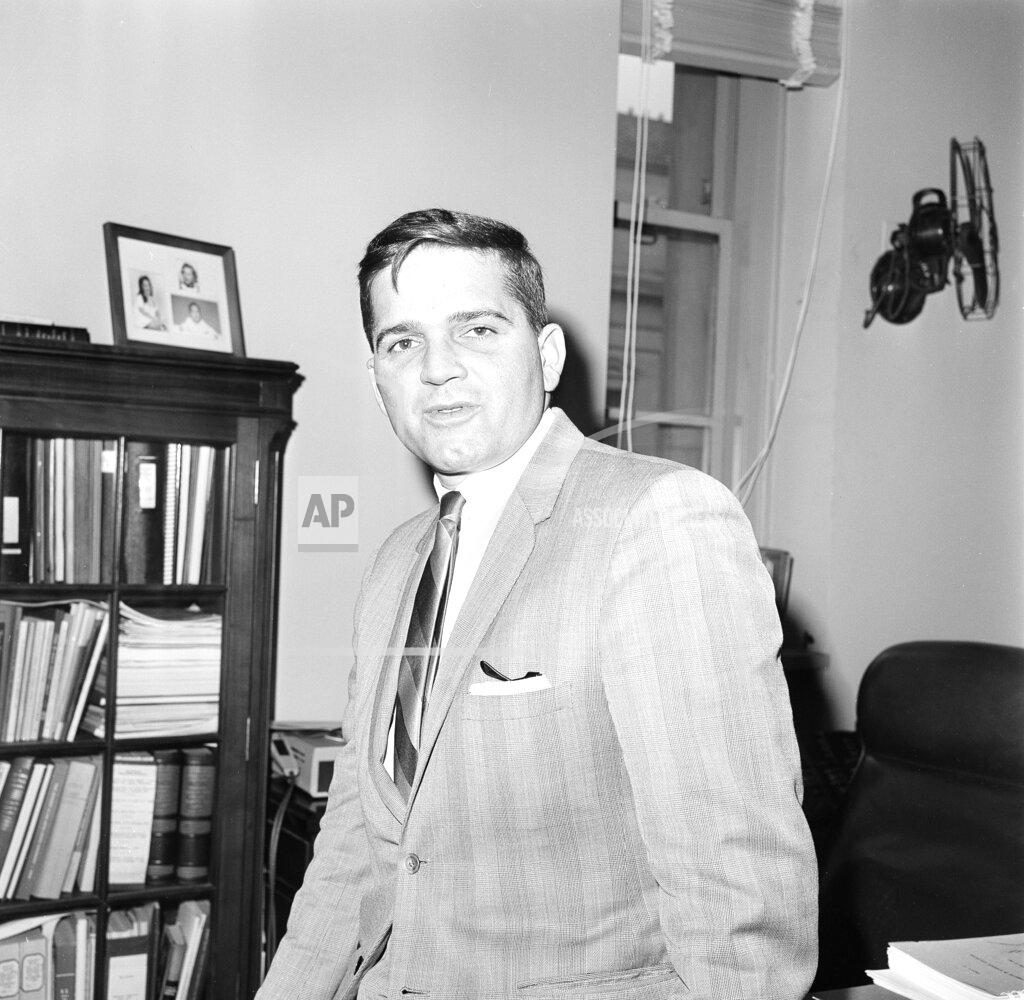
Hubert H. Humphrey resigned his Senate seat today in a move costing him $1,700. The Vice President‐elect stepped aside for the appointment of Attorney General Walter F. Mondale of Minnesota to fill out Mr. Humphrey’s elected term, which expires in January, 1967. Governor Karl T. Rolvaag of Minnesota will probably appoint Mr. Mondale to the seat tomorrow. The action will permit Mr. Mondale to gain a few days of seniority over other new Senators. ‘This is often important when Senate committee assignments are made.
Mr. Humphrey will be dropped from the Senate payroll tonight. During the campaign, Mr. Humphrey’s net worth was reported at less than $200,000 — below that of President Johnson or of the Republican candidates, Senator Barry Goldwater and Representative William E. Miller. On inauguration day, January 20, Mr. Humphrey will get a 520,500 pay increase over his $22,500‐a‐year Senator’s salary. At $43,000 annually, he will become the nation’s highest paid Vice President in history. The Vice President’s salary was $35,000 until the pay rise bill was passed this year. This bill also raised the pay of Senators and Representatives to $30,000. Mr. Humphrey’s staff will continue to be paid under a recent statute covering transition expenses for newly elected Vice Presidents.
Senator Barry Goldwater’s office said today the Senator’s physicians had decided that he would not require surgery to correct a back ailment. Earlier it had been indicated that the senator would have an operation in Washington, January 5. A spokesman said that Mr. Goldwater advised him this afternoon that his doctors had concluded that therapy, rather than surgery, should resove the problem. Mr. Goldwater, it was explained, suffers occasional pain from a muscle pinch caused by a chip from a vertebra.
Liberal Democrats are growing increasingly doubtful that party leaders in the House will actively support a move to discipline two Southern colleagues for backing the Republican national ticket in the November election. They are encouraged, however, by signs that the leaders will not oppose them, either, in their attempt to purge Representatives John Bell Williams of Mississippi and Albert W. Watson of South Carolina from the House Democratic caucus. The proposed purge was discussed today at a 45‐minute conference between House Speaker John W. McCormack of Massachusetts and Representative John A. Blatnik of Minnesota. Mr. Blatnik is chairman of the Democratic Study Group, an informal organization of about 125 House liberals, which will seek to bar the two Southerners from the caucus when it meets next Saturday. If the move is successful, Mr. Williams and Mr. Watson will lose their seniority on House committees and be deprived of other party privileges such as job patronage at the Capitol.
The proposed hometown banquet honoring the Rev. Dr. Martin Luther King Jr., recent recipient of the Nobel Peace Prize, gained the support of more prominent Atlanta leaders today. Others invited to help sponsor the event next month continued to refrain, however, and some were privately outspoken in their opposition. The banquet is scheduled for January 27 at the Dinkier Plaza Hotel, but still has not been officially announced. A letter was sent almost two weeks ago to about 125 business, political, religious and educational leaders asking them to join in sponsoring the event. Many of those invited have not yet replied, but a substantial number have answered affirmatively. During the last two days, a number of prominent names have been added, Recent additions include white college presidents and some leading professional men. The list of sponsors has not been disclosed.
Federal indictments charging six white men with conspiring to injure and oppress Blacks were thrown out of court today by a United States District Court Judge. The indictments grew out of the slaying of Lemuel Penn, a Washington Black educator who was shot dead on the night of July 11. Mr. Penn, a lieutenant colonel in the Army Reserve, was returning to Washington with two other Army Reserve officers from Fort Benning where they had attended a training course. Two of the six men, Cecil Myers and Joseph Howard Sims, earlier were tried and acquitted in a state court on murder charges in the slaying of Mr. Penn. The four others are Denver Willis Phillips, George Hampton Turner, Herbert Guest and James S. Lackey. Lackey still faces a state charge of murder in Mr. Penn’s death.
In dismissing the federal conspiracy charges, Judge W. A. Bootle said that constitutional questions were involved. The judge’s ruling said: “The question is by what authority should they be tried… The enforcement of general criminal laws is a local matter with authority and responsibility resting squarely and solely on local city, county and state governmental authorities…” He referred to the acquittal of Mr. Sims and Mr. Myers hi a state court and said it was important “that this court not usurp jurisdiction where it has none.” The ruling then stated that the Government had a speedy remedy for a review of his decision by the Supreme Court and if the indictment was valid, the men could still be tried.
The six men were identified by Federal Bureau of Investigation agents as active in Ku Klux Klan affairs. Attorneys for the defendants asked Judge Bootle to dismiss the Federal charges of conspiracy, arguing that the indictment failed to charge any violation of federal law. A Justice Department attorney said the indictments were based on an 1870 law, as well as on the newly enacted Civil Rights Act. The Federal conspiracy charges carry a maximum penalty of 10 years in prison, a $5,000 fine, or both. The charges alleged that the six men engaged in systematic intimidation of Blacks. The Government said they conspired to shoot, beat and kill Blacks, damage and destroy their property, pursue them in cars and threaten them with guns.
Beloved film actor and action hero John Wayne went against the advice of his agent and several advisers, and revealed that he had been treated for lung cancer with the removal of his left lung in September. He told reporters at his home in Encino, California, “I licked the Big C. I know the man upstairs will pull the plug when he wants to, but I don’t want to end my life being sick.” The Associated Press commented that “The always honest Wayne refused to abide by the Hollywood code that cancer or any other serious illness could destroy a box office image.” After four months rest, Wayne, who had been a five-pack a day cigarette smoker, returned to film making to appear in the western “The Sons of Katie Elder”; he would survive for more than 14 years, winning an Academy Award for Best Actor in “True Grit,” and portraying a cancer sufferer in his final film, “The Shootist.” Wayne would die of stomach cancer on June 11, 1979.
The three-act play “Tiny Alice,” written by Edward Albee, premiered on Broadway at the Billy Rose Theatre and ran for 167 performances. Its female lead, Irene Worth, would win a Tony Award for Best Actress, and the play would receive five other Tony Award nominations. p84
Dow Jones Industrial Average: 862.18 (-4.83)
Born:
Michael Cudlitz, American actor (“Southland”, “Band of Brothers”, “Walking Dead”), on Long Island, New York.
Kimberly Russell, American actress (Sarah-“Head of the Class”), in Brooklyn, New York, New York.
Craig Grebeck, MLB second baseman, shortstop, and third baseman (Chicago White Sox,Florida Marlins, Anaheim Angels, Toronto Blue Jays, Boston Red Sox), in Johnstown, Pennsylvania.
Rod Nichols, MLB pitcher (Cleveland Indians, Los Angeles Dodgers, Atlanta Braves), in Burlington, Iowa.
Died:
Vladimir Favorsky, 78, Russian artist and engraver





 History Diaries