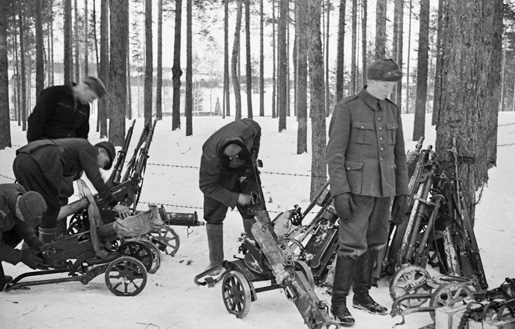
Soviet 7th Army and 13th Army in Karelian Isthmus ordered to assume defensive positions. Joseph Stalin ordered the Soviet troops in Finland to hold position as his generals worked on a new offensive plan against the surprisingly resilient Finnish defenses. The Soviet troops enveloped within Finnish lines was thus abandoned and left to be eliminated by the Finnish forces.
Most of Soviet 163rd Division, trapped in the Finnish village of Suomussalmi for the past 22 days, began evacuating on an ice road over Lake Kiantajärvi; troops of the Finnish 9th Division attacked the rearguard. Meanwhile, in Moscow, Russia, Stalin endorsed Chief of Staff Shaposhnikov’s plan for a major attack on Finnish forces on the Karelian Isthmus; Semyon Timoshenko volunteered to lead the offensive as the disgraced Kirill Meretskov was demoted to the commander of the Soviet 7th Army. Soviet soldiers suffer terribly. Daylight lasts only two hours and even the slightly wounded freeze to death.
Joseph Stalin ordered the Soviet troops in Finland to hold position as his generals worked on a new offensive plan against the surprisingly resilient Finnish defenses. The Soviet troops enveloped within Finnish lines was thus abandoned and left to be eliminated by the Finnish forces. The Soviet invasion plans assumed the political and military collapse of Finland in 12 days but they have few gains to show after a month of fighting. Only 14th Army in Lapland has achieved its objectives. Stalin pragmatically and ruthlessly abandons Meretskov’s plan and orders a ‘temporary defensive posture’ prior to concerted attacks on the Mannerheim Line. He similarly abandons the elements of the Red Army currently on the border from Lake Lagoda to Lapland. 14th Army and 9th Army (122 Div) held in Lapland, 9th Army (163 44 Div) trapped around Suomussalmi and 8th Army held North of Lake Lagoda are left to the mercy of the Finns. There is no plan to reinforce, resupply or evacuate them; retreat or surrender will be punished by death when they return to the Soviet Union.
Comrade Zelentsov in Suomussalmi gathers his men of the 163rd Rifle Division together at dawn. The troops form a 4 kilometer-long column on the ice of Kiantajärvi lake and head away from the doomed village they have been defending for weeks. The two regiments, the 81st Mountain Rifles, and the 759th Rifle Regiment receive elaborate Red Air Force protection, and tanks assist on the ground. By evening, they have made good progress toward safety that lies 20 km to the northeast, taking with them 2000 men, 48 trucks, 20 field guns, and 6 tanks. Zelentsov’s division actually has three regiments, the third being the 662nd Rifle Regiment. It remains back forming a defensive perimeter by the road, oblivious to the departure of the men it had been guarding. Regiment commander Sharov and commissar Podhomutov – both having equal authority – sneak out on their men and leave them to their fate, making their way together through the forest to safety. Virtually everyone they leave behind is annihilated. Both Sharov and Podhomutov are immediately arrested and executed in front of the few of their troops that also survived.
The Soviets are not out of danger yet. They still must cross a very long lake and get ashore before the Finns catch up with them.
Aside from recapturing the village and eliminating a substantial Soviet formation, for the Finns it also is a huge strategic victory because now they can turn all of their attention to the stranded and immobile Soviet 44th Rifle Division on the Ratte road. The beleaguered division is stretched over 20 kilometers on what essentially is a rough logging road through deep forests. The division is oriented to proceed west to Suomussalmi, but now there is no need to go there. The division’s only rational destination is where it came from, but the best troops are at the wrong end of the 20 kilometers. The division headquarters (kombrig Vinogradov and commissar Parkhomenko) is all the way back on the Soviet side of the border. The Soviets are bringing in reinforcements to the Karelian Isthmus, including picked NKVD troops. However, they are not intended to help the Soviet troops that are in trouble. Orders to the division: no retreat. Stalin essentially writes off the Soviet formations in Finland and prepares a completely new plan. The new mission for Soviet 8th, 9th and 14th Armies essentially is to stand their ground for as long as they can, with no permission to retreat and no plans to resupply or reinforce them. Soviet liquidation squads are ready for any commanders that return from the front without orders or success.
Finns again cross the Soviet border, threatening a Soviet railroad. The Soviet Union calls in more troops.
In Kuhmo, after three days of fighting, Detachment Kekkonen forces a Soviet detachment of around company strength back across the border at Kiekinkoski.
On the Central Isthmus, enemy tanks penetrate Finnish positions at the northern end of Lake Hatjalahti. The tanks have no infantry support and two are destroyed and two captured.
An Allied pledge to Sweden is expected; Finland’s stand against Russia is regarded by France and Britain as equivalent to the blockade of Germany.
Fritjof Lager, editor of the Stockholm-published Communist paper Ny Dag, is sentenced to two months in prison for abuse of press freedom. The article concerned bore the headline ‘A free, independent People’s Republic of Finland’.
The London dailies, The Times and the Daily Telegraph praise the stalwart Finnish resistance against overwhelming odds
Norway bars military aid to Finland. Foreign Minister Halvdan Koht said in a radio address today that Norway under no circumstances could give military aid to Finland. Norway’s attitude, as he outlined it, was one of readiness to lend moral or material help but no soldiers.
The Russian silence concerning the war in Finland deepens. Tonight’s communique consisted of one perfunctory sentence to the effect that “no events of importance” had occurred during the day.
Foreign correspondents in Moscow were informed tonight that from tomorrow a censorship would be imposed upon all dispatches to be sent out of the Soviet Union.
Nazi authorities announce that the entire population of the Polish town of Kalisz (about 70,000 inhabitants) is to be deported to make room for ethnic Germans arriving from the Baltic states (Estonia, Latvia and Lithuania).
As the result of experiences during four months of war, the administrative apparatus of German war economy is again being reorganized in such a way that the decisive influence of initiative is being taken out of the hands of respective Cabinet Ministers and is being concentrated in an economic general staff under Field Marshal Hermann Goering as head of the Cabinet Council for the Defense of the Reich.
In Switzerland, the exiled industrialist and former Nazi fundraiser, Fritz Thyssen, protests to Hitler: “I have not sacrificed my millions for Bolshevism but against it.” Actually, he has sacrificed his millions to save his own neck. Statements like this, though, do not endear him to Hitler, and Hitler is not someone that you want to cross unless you are behind a big, bad army.
Willy Brandt publishes an article in the Norwegian newspaper Bergens Arbeiderblad in which he advocates the establishment in stages of a United States of Europe.
France’s 80,000,000,000-franc budget was passed unanimously through the Senate this afternoon in a manner thatwas at the same time a triumph for Finance Minister Paul Reynaud and a guarantee that France has started on the enormous task of paying for the war.
The Pope visits the Italian King Vittorio Emmanuel III and solidifies ties. Pope Pius XII returned the visit of the King Victor Emmanuel of Italy this morning in a solemn and gorgeous ceremony that set a precedent for this era of papal history. He will also receive Premier Mussolini.
The British Minister of Food W.S. Morrison announced that starting January 8, rationing would be expanded to include butter, bacon, ham and sugar. The British Ministry of Food announced that sugar would be rationed from 8 January 1940 and meat from a date still to be fixed. The Minister of Food William Morrison said this would release foreign exchange and provide shipping space for the importation of armaments and raw materials.
Spanish Falangists publish “The Protocols of the Elders of Zion” as a prelude to a New Year’s denunciation of Jews and Freemasons by Franco.
The crews of Luftwaffe I(J)./LG 2 transfer from Koln to Hage on the North Sea Coast.
The British lose a reconnaissance plane over northwest Germany during the night.
The Royal Navy Mersey-class anti-submarine trawler HMS Barbara Robertson was sunk by gunfire by the U-30, commanded by Kapitänleutnant Fritz-Julius Lemp, approximately 35 miles northwest of Butt of Lewis in the northern Atlantic Ocean (58° 54’N, 6° 30’W). At 04.00 hours the HMS Barbara Robertson (T/Skipper G.W. Edgar, RNR) was shelled and sunk by U-30. The U-boat stopped the Swedish steam merchant Hispania at 04.50 hours and asked them to pick up the survivors of the armed trawler. However, the survivors were rescued after 14 hours by HMS Isis (D 87) which was directed to their lifeboat by a Gladiator aircraft and taken to Loch Ewe.
Later on the same day, U-30 spotted and damaged British battleship HMS Barham with one torpedo, 66 miles west of the Butt of Lewis (58° 47’N, 08° 05’W); she was chased off by destroyers HMS Isis and HMS Nubian. At 15.45 hours on 28 Dec 1939, HMS Barham (04) (Capt H.T.C. Walker, RN) was damaged on the port side by one torpedo from U-30 (Lemp). Four crew members were lost. The battleship was returning from patrol with HMS Repulse (34) (Capt E.J. Spooner, DSO, RN), escorted by HMS Isis (D 87) (Cdr J.C. Clouston, RN) and HMS Nubian (F 36) (Cdr R.W. Ravenhill, RN). She was able to proceed under her own power to Liverpool, but was out of action for six months while being repaired at Birkenhead by Cammell Laird and returned to service on 30 June 1940.
At 0932, the Danish steam merchant Hanne struck a mine laid by U-22 and sank 1 mile east of Blyth Pier, Scotland in the North Sea (55° 08’N, 1° 28’W). Fifteen of her crew of 40 died.
The 258-ton British fishing steam trawler Resercho (Master Albert Darewood) struck a mine laid by U-15 and sank approximately 6 miles southeast by east from Flamborough Head, England in the North Sea (54° 04’N, 0° 03’E). The entire crew of 10 survived.
Convoy OA.62 departs Southend.
Convoy OB.62 departs Liverpool.
Convoy OG.12 forms at sea for Gibraltar.
U.S. freighter Exilona is detained at Gibraltar by British authorities.
The War at Sea, Thursday, 28 December 1939 (naval-history.net)
BATTLESHIP BARHAM TORPEDOED
Battleship BARHAM, battlecruiser REPULSE, and destroyers NUBIAN and ISIS were NW of Flannan Island in 58 47N, 08 05W when U-30 attacked. BARHAM was torpedoed at 1449 hours, and U-30 was able to escape counterattacks by the destroyers. A and B shell rooms and magazines, and the pom-pom magazine were flooded and the forward bulkhead of the 6-inch magazine was leaking. Four ratings were killed.
REPULSE left her escort and proceeded at high speed, unaccompanied, into the Clyde arriving early on the 29th. Destroyers FAULKNOR and MASHONA departed Loch Ewe at 2300 to join the damaged BARHAM. Additionally, destroyer FOXHOUND departed Loch Ewe several hours later. After the submarine hunt FOXHOUND, FAULKNOR and ISIS were sent into Loch Ewe and destroyer NUBIAN joined the screen of battlecruiser HOOD.
The patrol sloops of the 1st and 2nd Anti-Submarine Striking Forces departed the Clyde to assist.
At 1404/29th, destroyers INGLEFIELD and ICARUS attacked a submarine contact near BARHAM.
Escorted by destroyers FAME, ICARUS and IMOGEN, the damaged BARHAM was brought at 12 knots into the port of Liverpool at 2335/29th. She entered Gladstone Dock at 0245/30th for repairs which lasted until 1 July when she left for Scapa Flow.
On Northern Patrol, one cruiser and one armed merchant cruiser were in the Denmark Strait, two cruisers and seven AMCs between the Faroes and Iceland, and one cruiser between the Orkneys and the Faroes. Armed merchant cruiser MONTCLARE arrived in the Clyde and light cruiser COLOMBO reached Scapa Flow.
Light cruiser CERES departed Scapa Flow for Northern Patrol duties, and arrived back on 3 January.
Sloops PELICAN, WESTON, HASTINGS after exercising in the Firth of Forth, escorted steamer CORDELIA (8190grt) to the Tyne.
Destroyers INTREPID and IVANHOE of the 20th Destroyer Flotilla departed Portsmouth at 2330, and early on the 30th, laid minefield LA east of the Farne Islands in the North Sea. They were given close escort by six MTBs.
Convoy OG.12 was formed from convoys OA.60G and OB.60G totaling 44 ships. Destroyers VANESSA and AMAZON escorted OA.60G from the 26th to 28th, while WHITEHALL, WIVERN, VANOC and WHIRLWIND from OB.60G escorted OG.12 from the 28th to 29th. French destroyers VALMY and CHEVALIER PAUL, which departed Brest on the 28th, escorted the convoy from 29 December to 4 January when it reached Gibraltar.
Convoy OA.62 departed Southend escorted by sloop ENCHANTRESS and destroyer WINDSOR from the 28th to 30th. The convoy was then escorted by destroyers WOLVERINE and VERITY from the 30th to 31st, when it dispersed.
Convoy OB.62 departed Liverpool escorted by destroyers MACKAY, WARWICK and VIMY to the 31st, when they detached to convoy HX.13.
Convoy FN.60 departed Southend, escorted by destroyers VALOROUS, VIVIEN, and BITTERN, and arrived in the Tyne on the 29th.
Convoy FS.60 departed the Tyne, escorted by destroyer VEGA and sloops HASTINGS and PELICAN, which had departed Rosyth on the 27th to join. The convoy arrived at Southend on the 29th.
Danish steamer HANNE (1080grt) was sunk one mile east of Blyth Pier on a mine laid by U-22 on the 22nd; fifteen crew were lost and there were 25 survivors.
Trawler RESEARCHO (258grt) was lost in a minefield laid six miles SE by E of Flamborough Head by U-15 on 17 November. The entire crew was rescued. Destroyer JACKAL later reported the trawler abandoned and still afloat 7½ miles east of Flamborough Head.
U-30 sank armed patrol trawler BARBARA ROBERTSON (325grt, T/Skipper G. W. Edgar RNR) with gunfire, 35 miles NW of the Butt of Lewis in 58-54N, 6-30W; one rating was lost. Destroyer ISIS was dispatched to assist, and guided to the area by British seaplanes. rescued the 16 survivors. She then went on to assist damaged battleship BARHAM.
Anti-submarine trawler CAPE ARGONA (494grt) attacked a submarine contact 21 miles 114° from Flamborough Head.
Light cruiser CALYPSO departed Gibraltar and arrived at Malta on the 31st for duty with the 3rd Cruiser Squadron.
Armed merchant cruiser MALOJA sighted a submarine in 44-28N, 13-00W. Destroyer DELIGHT was advised.
Submarine SEVERN was at Freetown with a defect to the engine exhaust pipe. Repairs took 14 days.
Soviet submarine ShCh-311 sank Finnish steamer WILPAS (775grt) off Vasa.
Democratic leaders, hoping to eliminate the Wagner act as an issue in the 1940 Presidential campaign, will present to President Roosevelt within the next few days definite suggestions for amending that much criticized law. Informed sources said today that leading advocates of revision were among those working with the party leadership in an effort to prevent a bitter fight which might be carried into the party’s Summer convention.
The concrete suggestions, they said, would be put before the Chief Executive at conferences with members of Congress concerned with the various statutes. One of the first major legislative conferences dealing with the Congressional session starting Wednesday will be held tomorrow, when Speaker Bankhead has lunch with Mr. Roosevelt. They are expected to survey the whole legislative program, including demands from organized industry and both major elements of organized labor — the A.F.L. and the C.I.O. — for changes in the labor law.
Figuring strongly in efforts of leaders to bring together various. party elements on a set of compromise amendments is the proposal of Representative Smith, Democrat of Virginia, that the Wagner law be made to resemble more closely the Railway Labor Act. Mr. Smith, chairman of the special House committee investigating the Labor Relations Board, suggested that the board might receive powers to mediate labor disputes. He noted that the board now lacked such powers, although they are possessed by the Railway Mediation Board. Some groups in Congress believe that such authority would make for industrial peace.
The Railway Labor Act, under which the Railway Mediation Board was created, also provides for a “cooling off” period before strikes. After industry or labor asks for the mediation services of the board, neither side can take any action until mediation collapses. Even after that there is a still further wait before a strike is permitted. The Smith proposal already is opposed by Representative Ramspeck of Georgia, ranking Democrat on the standing House Committee on Labor. He expressed the belief that general mediation services should be left in the Labor Department. The department provides such services when both sides in a disagreement are willing to accept them.
James Wheeler-Hill, the 34-year-old $30-a-week national secretary of the German-American Bund, was arrested yesterday after a grand jury had handed up an information charging him with three counts of second degree perjury.
American Baptists protest the U.S. link to the Vatican. Leaders of 10,250,000 members approve a letter to be sent to President Roosevelt today. A letter supporting President Roosevelt’s program for peace but disapproving the appointment of a personal representative of the Chief Executive at the Vatican will be delivered to the White House tomorrow morning on behalf of 10,250,000 Baptists in the United States.
The European conflict has created again a danger that American natural resources will be raided for war profits, said Secretary ot the Interior Ickes in his annual report issued today.
The Dies committee made public tonight a confidential report saying that the Communist Party in California sought the defeat of the Republican administration in that State last year with a $250,000 campaign fund and an organization campaign in mass industries.
After a day of charge and counter-charge between the New York Film Critics and the National Broadcasting Company, the issue of whether—and what—Mayor La Guardia shall be permitted to broadcast at the critics’ annual party for the award of the year’s movie “bests” was settled amicably last night. The mayor was originally told he was banned from the broadcast to “avoid politics”, but NBC President David Sarnoff decided otherwise.
General George C. Marshall, Army Chief of Staff, declared today that “the army machine is probably less than 25 percent ready for immediate action.”
Reinforcement of the air defenses of the nation by the creation of fifty-two new Army Air Corps squadrons has been ordered by the War Department.
Rear Admiral Julius C. Townsend, Commandant Fourth Naval District and Philadelphia Navy Yard, dies of bronchial cancer at U.S. Naval Hospital, Brooklyn, N.Y.
U.S. Navy Rear Admiral William L. Calhoun assumes duty as Commander Base Force and breaks his flag in auxiliary Argonne (AG-31).
Issue #52 of “More Fun Comics” (cover date February 1940) was published, featuring the first appearance of the Spectre.
A general denial of Japanese reports that Chinese military operations in December had been smashed was issued last night by the National Military Council’s spokesman. Disclaiming any plan by Chinese armies to carry out concerted operations for the purpose of cutting Japanese communications in the Yangtze Valley, the spokesman scouted Japanese reports of the “failure” of such operations. He declared, however, that as the result of persistent Chinese attacks Japanese communications in Central China had been badly disrupted and along the river “an average of two Japanese ships were destroyed weekly.”
The Japanese claim that a Chinese Winter offensive had been shattered was refuted with the denial that such an offensive had ever been launched. The spokesman maintained, on the other hand, that intensified Chinese activities in December inflicted important losses on the Japanese. “The total enemy casualties in December must have exceeded 100,000,” the spokesman said.
While Japanese spokesmen will not admit that the city of Hengyang is their ultimate objective, they concede that their army is pushing in the general direction of Hengyang, which is the junction point of the new railway to Kweilin. “China’s so-called Winter offensives have already failed on three fronts,” a Japanese Army spokesman said. “Our three coordinated offensives on lines of communications should soon result in telling weakening of China’s powers of resistance. China’s Winter offensive is largely centered in the Middle Yangtze Valley on the south bank of the river between Kiukiang and Anking, but also thrusts were prepared in the vicinity of Yochow and additionally westward and northward of Hankow. These moves have been decisively repulsed at all points.
“The Chinese officially declare they have been sinking an average of two Japanese vessels daily on the Yangtze, and our best reply to these ridiculous claims is to refer any one to officers of British gunboats that have been coming downstream. We guarantee that they have not seen any Japanese wreckage, which would be visible at present with extreme low water. Our three moves to cut off Chinese supply routes are really a brilliant prelude to what we will accomplish in 1940, celebrating the 2,600th anniversary of the founding of the Japanese empire.”
A Chinese Army spokesman asserted today that Japan had suffered 100,000 casualties on all fronts in the December campaigns and that each week three Japanese vessels were being damaged on the Yangtze. River. He declared that Japanese reports of recent military successes “betray their own fears and anxieties, reflecting alarm over their own staggering losses.” The Chinese spokesman said Japan could not have broken up a Chinese counter-offensive because “we never launched one.” He said the Chinese were less interested in recapturing the South China city of Nanning, which Japan recently took, than in destroying Japanese forces within that province of Kwangsi. The Japanese reports, he said, were aimed at assisting in passage of the military budget by the Japanese Diet and at impressing the United States.
There are repeated Japanese bombing raids on Lanchow, a vital Chinese military supply base in the northwest. Attacking one of China’s overland supply routes, more than 100 Japanese army and navy planes completed today three consecutive days of intensive bombing of the city of Lanchow, Kansu Province, which is rated the most important point on the so-called Red route over which military supplies from Soviet Russia reach Chungking.
Japanese spokesmen officially announced that the Lanchow operations constituted by far the biggest mass air attack Japan had made since hostilities began thirty months ago-the biggest both in number of planes engaged, in the intensity of the attack and in number and size of bombs dropped. Two other attacks on the Chinese lines of communications were the Japanese Army’s raid southwest of Nanning to the Indo-China border and also the Japanese Army’s steady push northward from the Canton area along the Canton-Hankow Railway.
Chinese 3rd War Area is attempting to interdict boat traffic on Yangtze River with troops and mines.
Chinese 5th War Area captures undefended Yuntankang but comes under attack around Loyangtien, Tzepakang, Tuchungshan, and Hsuchiatien, and Japanese troops take Changshoutien.
In the Battle of South Kwangsi, the Chinese are attacking the Japanese Fifth Infantry Division at Kunlunkuan.
The Japanese Cabinet will not resign but will meet Parliament and continue its policies directed toward a settlement of the “China incident” and toward adjustment of Japan’s relations with foreign powers. This decision was taken by the Cabinet today and announced by Premier Nobuyuki Abe in a press interview tonight. The Premier also stated that a Japanese nonaggression pact with the Soviet Union was not being considered. General Abe said: “The Cabinet considers its most important task is settlement of the China incident and adjustment of Japan’s relations with third powers. With full confidence the government is concentrating its efforts on this task and intends to fulfill its duty. We are now in the middle of our task and we have no intention whatever of resigning.” Premier Abe declared the present Cabinet’s policies had not caused losses or inconvenience to the people. He did not accept the statement of a member of Parliament that the people lacked confidence in the government.
The Premier denied Japan wanted to use reopening of the Yangtze River as a bargaining bait in dealing with the United States. He said the decision to reopen the river to foreign shipping was made last year but that action had been. postponed until now because of military requirements. A number of questions were asked of the Premier regarding the “indications” that the Foreign Office spokesman said had been given by United States Ambassador Joseph C. Grew to the effect that a no-treaty situation would not arise. The Premier said he had heard of the statement. He suggested it might mean the Japanese would not be treated harshly after the United States-Japanese trade treaty expired January 26.
Dow Jones Industrial Average: 149.48 (+0.96)
Born:
Charles Neville, American vocalist and saxophonist (Neville Brothers), in New Orleans, Louisiana (d. 2018).
Yehoram Gaon, Israeli actor and singer.
Naval Construction:
The Royal Navy Bar-class boom defense vessels HMS Barrhead (Z 40) and HMS Barrington (Z 59) are laid down by W. Simons & Co. Ltd. (Renfrew, Scotland).
The Kriegsmarine (German Navy) Type VIIC U-boat U-72 is laid down by F. Krupp Germaniawerft AG, Kiel (werk 619).
The Kriegsmarine (German Navy) Type VIIB U-boat U-76 is laid down by Bremer Vulkan-Vegesacker Werft, Bremen-Vegesack (werk 4).
The Royal Navy Avenger / Charger-class escort carrier HMS Biter (D 97) is laid down by the Sun Shipbuilding (Chester, U.S.A.).
The Royal Navy Hunt-class (Type I) escort destroyer HMS Eglington (L 87) is launched by Vickers Armstrong (Newcastle-on-Tyne, U.K.); completed by Parsons.




 History Diaries