
The Soviet Minister of Internal Affairs asserted today that collective farmers and state‐farm workers would be entitled to new internal passports, putting hem on an equal footing with the rest of the population. Several articles quoting the Minister, Nikolai A. Shchelokov, and two of his subordinates, followed yesterday’s announcement of a new internal passport system and helped to clear up confusion caused by the original decree on the subject issued August 28 by the Soviet Government. Moscow’s practice has been to tie farm workers to the countryside by not issuing them internal passports required for travel within the Soviet Union. According to Western political specialists, a misunderstanding that this had not changed was caused by obscure language in the original decree that was clarified by announcements yesterday and today.
A Soviet prosecutor demanded a sentence of nine years at hard labor for Mikhail Shtern, 56, a Jewish doctor being tried in the Ukrainian town of Vinnitsa on charges of bribery, swindling and medical malpractice, sources at the trial said. Jewish activists claim Shtern is being prosecuted because his sons have applied to emigrate to Israel. Shtern has been in prison since charges were brought in May.
West Germany’s jobless rate averaged 2.6 percent for the entire year, the highest proportion of unemployed in 15 years, the Federal employment office said today. The present number of 600,000 unemployed can be expected to rise to one million, or 4 percent, this winter, Josef Stingl, employment director, said.
The essential thesis of French policy on the problem of oil prices is to seek the solution through massive, long‐term industrial export programs, it has now emerged. This has become clear from the concluding reports on four recent French missions to oil‐producing countries. Premier Jacques Chirac has just returned from Iran and Foreign Minister Jean Sauvagnargues from Egypt. Mr. Chirac was recently in Iraq and Interior Minister Michel Poniatowski in Algeria.
New and conspicuous diplomatic tension, reflected in the public and private remarks of officials in their respective capitals, seems to be building up between the United States and Israel in advance of the next round of negotiations with Egypt over the Sinai peninsula. The United States, concerned about the possibility of renewed fighting in the Middle East and the possibility of another oil embargo, is expected to press Israel to agree to significant territorial and political concessions in the negotiations. This is a possible source of trouble between the two countries. In background conversations in the last two weeks, senior officials in Washington and Jerusalem expressed concern that a serious collision of interests might emerge between the United States and Israel when hard bargaining over Sinai gets under way with Egypt.
Israel and Egypt were reported to be very far apart in their initial positions for the next round of negotiations over Sinai. Well-placed diplomats and American officials said that each side had passed on to Secretary of State Kissinger positions that were clearly unacceptable to the other. But both Cairo and Jerusalem have indicated to Mr. Kissinger that they remain interested in his promotion of the Sinai negotiations. Mr. Kissinger, who left today for a week’s vacation with his wife at Dorado Beach, Puerto Rico, has said that he believes he can make progress toward breaking the impasse, but that the Middle East situation remains extremely delicate. Mr. Kissinger was reported to have said in an unpublicized meeting Monday night with the Israeli Ambassador, Simcha Dinitz, that he did not foresee any significant progress toward negotiations until after a planned meeting January 1 in Cairo among Egypt, Syria, Jordan and the Palestine Liberation Organization and after a scheduled mid-January visit to Cairo of the Soviet leader, Leonid I. Brezhnev.
Mr. Kissinger has told Israeli officials that he does not believe that President Anwar el‐Sadat of Egypt would be interested in negotiations that do not at least hold out the strong possibility of Egypt’s recovering either the key Mitla and Gidi passes in central Sinai, or the Abu Rudeis oilfields now controlled by Israel. Egyptian diplomats have said that both the passes and the oilfields must be recovered through the talks. A dispatch from Damascus published December 18 in The New York Times quoted authoritative diplomatic sources as having said that President Sadat was counting on Mr. Kissinger to obtain Israeli concessions on the Sinai passes and oilfields and that he was hoping that such concessions would come before Mr. Brezhnev’s visit to Cairo. Israel has ruled out the returns of either the passes or oilfields.
Israeli troops shelled a number of southern Lebanese villages today, causing property damage but no casualties, residents of the area said. The residents said that the shelling began at 2 PM and went on intermittently for 20 minutes. Israeli jets flew over border villages and Palestinian refugee camps in southern Lebanon this morning, the residents added. This afternoon, planes flew over the coastal town of Saida and then headed westward.
The Battle of Phước Long intensified as the 4th Corps of the People’s Army of Vietnam (PAVN) continued their invasion of South Vietnam, partly with the objective of testing whether the United States would send troops to defend against a Communist invasion. Skirmishes had been going on since 12 December. At 5.37 AM on December 26, 1974, the PAVN 141st Regiment opened their attack on the ARVN base at Đôn Luân from four different directions, after 15 minutes of artillery bombardment from supporting artillery units. Due to the strong presence of PAVN artillery, ARVN artillery units at Đôn Luân were simply overwhelmed. In addition, the high calibre anti-aircraft guns used by the PAVN 20th Air-Defence Battalion also limited the effectiveness of the RVNAF air support. At 10.30 AM all ARVN units at Đôn Luân capitulated and Major Đặng Vũ Khoái, commander of the 352nd Security Battalion, was captured at Suoi Rat along with his junior officers. Towards the end of the day, the PAVN 141st Regiment also captured other South Vietnamese installations at Ta Be, Phước Thiền and a helicopter base.
In just two weeks the PAVN had managed to punch several holes in the defensive line of South Vietnam’s III Corps, with the capture of Bù Đốp, Bù Na, Bù Đăng and Đôn Luân. For the ARVN, the loss of four important outposts in III Corps was a severe blow, especially with opposing PAVN and Viet Cong forces controlling all main roads leading to the district of Phước Long such as Route 14, Route 7, and the provincial roads 1 and 2. The ARVN, based at the administrative centre of Phước Bình and Phước Long, suddenly found themselves surrounded by the PAVN 4th Army Corps.The battle for control of South Vietnam’s Phước Long Province would last for 25 days before the III Corps of the Army of the Republic of Vietnam (ARVN) was forced to retreat.
Down the middle of the Saigon street strode Nguyễn Văn Thành, a wiry 12‐year‐old boy known in the neighborhood as ach bich — “the ace of spades.” At that moment, his worldly possessions consisted of a pair of blue shorts, a blue shirt, a borrowed deck of dog‐eared playing cards and one firecracker. A moment later, he also owned a handful of peanuts, plucked deftly from a basket carried on the head of a young woman. She whirled around, caught him and ordered him, though not angrily, to return what he had stolen. He dropped half the nuts into the basket and scampered off with the rest. The success of a prank of this sort might make most boys’ eyes twinkle mischievously. But Nguyễn does not have time to be a child. He must survive in the streets the way a lost explorer must live off the wilderness. Only a distant flicker of streetwise canniness shows through his brooding stare. He is part of a subculture of street boys who sleep on the sidewalks and bathe in the fountains of Saigon. Most either have run away from disintegrating families or have no families left at all. They drift from block to block and slip into groups and cliques and gangs that are sometimes exploited by older “brothers” who make them beg or steal. They are known, both to themselves and to other Vietnamese, as bụi đời — “the dust of life.”
No special celebrations took place. The official party newspaper, The People’s Daily, didn’t even mention the fact, although a front-page article — called The Philosophical Thought of Mao Tse-tung Directs Our Long Road to Victory — did pay tribute to the leader on his 81st birthday. The activities of Chairman Mao, who has ruled mainland China for the last 25 years, remained in 1974 just as secret and surrounded by mystery as ever. His last public appearance was on May 1, 1971. But so far as is known, he is in good physical and mental condition. Mao received 19 official VIP visitors during the year and the masses were kept aware of their “great helmsman” through television, newspapers and posters.
A Filipino Roman Catholic priest captured two weeks ago after more than two years in hiding has begun a hunger strike to protest the alleged torture and indefinite detention of detainees, his superior said in Manila. The Rev. Florante Camacho, superior of the Society of the Divine Word, said Father Edicio de la Torre, 31, fasted throughout Christmas Day in his cell at Camp Olivas in Pampagna province. Father Torre said he had joined the Philippine underground after martial law was declared.
Australian airliners and military aircraft shuttled between cyclone-shattered Darwin and other Australian cities, carrying emergency supplies in and thousands of refugees out. The government pledged to rebuild Darwin, a port in the northern part of the country. The known death toll stood at 44 but was expected to rise to 80 or more as rescue teams worked their way through rubble‐strewn streets and wrecked buildings. Hundreds were injured. Ninety percent of all buildings in Darwin were said to have been damaged, and there were reports that as many as 25,000 of the city’s 40,000 residents would have to be evacuated. More than 20,000 were said to be homeless. Television film shot from the air showed miles of flattened buildings. Cars, trees and steel light poles had been tossed about by the winds. At the airport, 50 planes were said to have been smashed. The Darwin harbor was also a scene of wreckage, with a patrol vessel tossed half way up a hill among houses.
John Stonehouse, the runaway member of the British Parliament, was reunited with his wife Barbara in Melbourne while the Australian government pondered whether to deport him for entering the country on a false passport. She flew in from England and the couple met for two hours at the Commonwealth detention center where he is being held.
Three Tucson high school teachers were rescued from a boat in the Gulf of California after being missing for two days. Rescued by another boat were Mike Ward, 25; Kenneth Harkin, 20, and Edward Barron, 35, who had been listed as missing after failing to return from a diving trip.
An elderly American couple were found slain in their home in San Luis Potosi, Mexico, apparently tortured with lighted cigarettes and knives before being killed, police reported. Melvin Joel Kahle, 68, and his wife, Ada Hayer Kahle, 74, who had been raped, had lived in San Luis Potosi about five years. They apparently had been dead for about a week when their bodies were discovered on Christmas Eve.
A policeman was killed and another wounded in a shootout with 15 terrorists on the outskirts of Buenos Aires. A limousine carrying two foreign executives of the Argentine subsidiary of the British-Dutch firm of Unilever was stopped by police near the scene of the shooting, apparently in fear they would become targets in the exchange of gunshots. A Unilever spokesman denied earlier reports that the car had been stopped by terrorists in an attempted kidnapping.
In a manifesto directed at Chile’s largest political party, the outlawed Communists invited the center-left Christian Democrats to join them in forming a united front against the ruling military junta. The Communist Party has been operating underground since it was banned by the junta that toppled the late Marxist President Salvador Allende on September 11, 1973.
Voters in Guinea go to the polls today to reelect President Ahmed Sekou Toure, who is running unopposed for a third consecutive seven-year term. They also will elect 150 members of the Guinean Democratic Party — the nation’s only political party — to the national assembly for five-year terms. The authoritarian president’s policy has been one of isolation, under which Guinea has severed relations with several countries and refused to join any West African political or economic groupings.
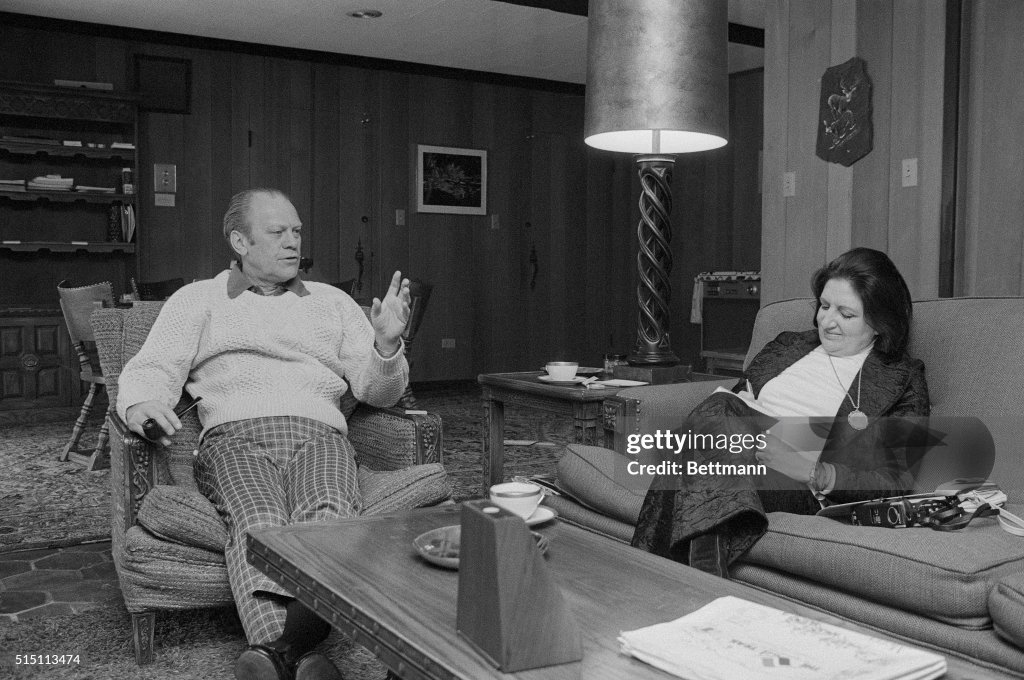
President Ford, heralding a major policy conference with his chief energy advisers tomorrow at this winter resort in the Rocky Mountains again rejected today any increase in the gasoline tax to curb oil consumption. “That’s about as dead as any option I know,” said Mr. Ford, clad in his bright orange parka as he started up the ski slopes for his fifth day of holiday skiing. Mr. Ford has repeatedly asserted his opposition to an increase in the gasoline tax, but the idea is still widely discussed among his advisers and elsewhere as an energy‐conservation measure. Mr. Ford did not rule out consideration of a gas tax along with other proposals to be discussed with his advisers, but he said: “I think there are many better choices.”
William Frates, John Ehrlichman’s chief defense lawyer, told the jury in his closing argument at the Watergate cover-up trial that Mr. Ehrlichman was a “loyal servant” whom President Nixon had “thrown to the wolves” to protect himself. He asked jurors not to be influenced by any dislike they might have for Mr. Nixon. He also asked them not to be swayed by the “golden tongue” of the chief prosecutor, James Neal, whose summation a few days ago had often appeared to hold jurors as well as spectators spellbound.
In a formerly secret report on the DC-10 crash near Paris last March, in which 346 persons died, the Federal Aviation Administration has been charged by its own inquiry board with “questionable” actions in certifying the plane and with being “ineffective” in enforcing corrective steps after a near-disaster involving another DC-10 in 1972. The report, made in mid-April, was made public as pressure increased on the F.A.A. to order new safety measures for the more than 160 DC-10’s now in service. A key point in the 41‐page document was that changes already made in the rear cargo door, the loss of which caused both DC‐10 accidents, might fall short of what was desirabe. The passage in the report dealing with this matter struck some observers as somewhat contradictory. But it was generally interpreted as meaning that the investigators felt more improvements could be made in the interests of safety. The Paris crash, in which 346 persons died, was the worst air tragedy in history.
Richard Helms told the Senate Foreign Relations Committee at a secret hearing in February, 1973, that he could not “recall” whether the White House had urged the Central Intelligence Agency to engage in domestic spying because of increasing antiwar activity in 1969 and 1970, His testimony was given four months before the first published accounts of Mr. Helms’ participation in the so-called Huston plan for domestic spying, put forward in 1970 by a White House staff member.
Marshall H. Fields, who crashed through a traffic gate with his car and drove to the doorstep of the White House on Christmas Day, underwent the first of several in-depth psychological interviews, said a spokesman for St. Elizabeth’s Hospital, a federal mental institution. Fields threatened security guards with packages of what he called explosives for four hours before surrendering. The incident occurred despite the fact that the Secret Service had classified Fields as “of possible protective interest.” But the President’s protectors maintained unruffled confidence in their procedures. Earl L. Drescher, head of the Executive Protective Service, indicated no changes were expected at this time.
Income tax forms have been mailed to nearly 80 million taxpayers, the Internal Revenue Service said. The deadline for most returns is April 15 and the 1040 and 1040A forms are the same as last year with the exception of a “No” box added to the line for checking off contributions to the presidential election campaign fund. Last year’s form contained only a “Yes” box to note a contribution of $1 on an individual return or $2 for a joint return.
The U.S. Center for Disease Control said in Atlanta that influenza deaths were expected to increase in the next week or two but that the severity of the outbreak had not been determined. Dr. Michael Hattwick said there had been confirmed outbreaks in several Southeastern states, including Georgia and Tennessee. The first outbreaks were reported in Hawaii and New York. All of the influenza reported so far has been of a variety known as Type A Port Chalmers, Hattwick said, and was “slightly different” from the strain prevalent last winter.
A sampling program has turned up two more cases of illegal contamination of beef livers with residues of a cancer-causing hormone, Agriculture Department officials said. The livers came from animals produced in Kansas and Iowa. Although producers can use the chemical DES to help animals grow faster, no trace of it is permitted when livestock is slaughtered for food. The synthetic female hormone has caused cancer in laboratory animals. So far this year, the department said, the presence of DES — diethylstilvestrol — has been found in seven of 3,050 liver samples. None, however, has been found in muscle tissue.
The Federal Trade Commission moved to eliminate what it called unfair and deceptive warranty practices in the mobile home industry by reaching agreements with large manufacturers and by proposing a new rule on all future warranties. The FTC said it had accepted consent orders from Skyline Corp. of Elkhart, Indiana, the largest producer; from No. 2 Redman Industries, Inc., of Dallas; and from Fleetwood Enterprises of Riverside, California, and Commodore Corp. of Omaha. The agency alleged that the warranties did not completely inform about the actual protection offered.
While at least one neighbor heard her dying screams and did nothing, Sandra Zahler, a 25-year-old model, was beaten to death early Christmas Day in her Kew Gardens, Queens, (New York City) apartment, which virtually overlooks the site of the murder of Catherine Genovese 10 years ago. The new slaying occurred in the building that was the residence of many of the 38 witnesses who heard the dying appeals of Miss Genovese.
Christopher Carrier, the 10‐year‐old son of a prominent lawyer from Coral Gables, Florida who has been missing since last Friday, was found alive tonight by a hunter in Collier County, 125 miles from the spot where he disappeared. The youngster vanished two blocks from his home in Coral Gables, a suburb of Miami, after he had gotten off a bus returning him home from a party at the private school he attended. The police said the boy was found badly beaten, repeatedly stabbed with an icepick, and shot in the head, in a remote area near here, and was taken to a hospital in Naples, which is on Florida’s Gulf Coast, about 125 miles west of Coral Gables.
Chris survived. He lost the sight in one eye, but other than that, he made a full recovery. And what happened decades later… you have to read it to beleive it.
A Federal judge refused today to countermand the order of a Federal judge in Washington depriving Chicago of $19-million in Federal revenue-sharing funds because the city has been discriminating against minorities and women in hiring policemen.
Saks Fifth Avenue, Bergdorf Goodman, and Bonwit Teller have notified the government that they want to change their plea from not guilty to no contest on charges of fixing prices of women’s clothing. The stores were indicted last October on charges of conspiring to fix prices and adopt uniform mark-up lists. The government said it would oppose the motion to change the plea.
The Teton Dam project in Idaho may continue because its environmental impact statement is adequate, the 9th U.S. Circuit Court of Appeals ruled in San Francisco. Conservationists claimed the statement did not give enough information for full evaluation. They argued that trout would be destroyed and mule deer perhaps eliminated by the dam and reservoir. But an irrigation district spokesman contended the dam was needed to prevent annual flooding by the Teton River. The case was referred to the federal appeals court after last January’s ruling by a federal judge in Boise that the statement was adequate.
J. Russell Penny announced in Sacramento he will retire as California director of the U.S. Bureau of Land Management, effective December 31. Penny became the California director in 1966 after serving as state director for the BLM in Montana, Idaho and Nevada. His career spanned 39 years in land and resources management with the BLM. Under his supervision, BLM developed an extensive land-use program for California’s desert to govern recreational and off-road vehicle use of national resource lands.
Jack Benny, the comedian who had been a star of radio and then television for 40 years, died at his home in Beverly Hills, California. He was 80 years old, but Mr. Benny, in one of his best-loved and oldest jokes, had insisted for years that he was only 39. For millions in the 1930’s and 1940’s Sunday night at 7 meant Jack Benny and “The Gang.”
The Soviet space station Salyut 4 was launched into orbit. Two separate crews would stay on the space station, both in 1975, on the Soyuz 17 (29 days by Aleksei Gubarev and Georgy Grechko) and Soyuz 18 (63 days by Pyotr Klimuk and Vitaly Sevastyanov) missions, before the station’s de-orbiting on February 2, 1977.
The Little League is officially open to girls as President Gerald Ford signs legislation amending the charter of the organization. Little League had sought changes in their charter after a series of lawsuits challenged its boys-only rule.
Dow Jones Industrial Average: 604.74 (+6.34, +1.06%).
Born:
Tony Brackens, NFL defensive end (Pro Bowl, 1999; Jacksonville Jaguars), in Fairfield, Texas.
Corey Lee, MLB pitcher (Texas Rangers) in Raleigh, North Carolina.
Brian Fitzgerald, MLB pitcher (Seattle Mariners), in Woodbridge, Virginia.
Tiffany Brissette, American actress (Vicki-“Small Wonder”), in Paradise, California.
Joshua John Miller, American screenwriter and actor; in Los Angeles, California.
Died:
Jack Benny [stage name for Benjamin Kubelsky], 80, American actor and comedian, of pancreatic cancer.
Farid al-Atrash, 64, Syrian-born Egyptian singer and film actor.
William Henry Draper Jr., 80, American diplomat, banker and army officer, of a heart attack.
Gerald Heaney, 75, American stage magician who toured as “Heaney the Great” and later operated a mail-order business to sell magic supplies.
Robert Sanders, 68, American composer, conductor and music teacher.






 History Diaries