
Christmas Day.
The Battle of Kelja began. The Red Army resumed attacking the Taipale sector in Finland between 0500 and 0700 hours; spearheaded by the Soviet 4th Rifle Division across the frozen Suvanto River, the offensive initially gained three bridgeheads, but heavy Finnish artillery would push Soviet forces back across the river at two spots. In the weeks before the Soviet attack, the whole Taipale sector had been under heavy shelling and daily infantry attacks. These attacks were all repulsed, mainly by Finnish artillery. The infantry attacks had reached their climax on December 17, and abruptly ceased the next day. However, the shelling increased in intensity, and lasted throughout the invasion. In the final days before the main attack, Finnish reconnaissance planes reported the arrival of the Soviet 4th Rifle Division, and ground patrols reported unusually high amounts of Soviet soldiers in the area.
The attack began early in the morning, with Soviet soldiers crossing the iced-over Lake Suvanto under the cover of darkness. With the help of dense snowfall, the attack achieved nearly total surprise. The Soviets unleashed a massive artillery barrage on Patoniemi Fort, away from the main attack at Kelja. When the first Soviet soldiers reached the beachhead, artillery finally opened up on rear Finnish positions. This caused confusion as to the size of the attack, including the company defending the beachhead reporting the attack as “nothing unusual”. Eventually, three beachheads were established at Patoniemi, Volossula, and Kelja. Finnish artillery was able to repel the second and third waves of reinforcements, however a battalion had already landed at each of the three beachheads.
At the Patoniemi sector, the Soviets had deployed their heavy machine guns on the flanks of the Finns before they realised what was happening. The defenders were able to stall the attack long enough to alert their battalion headquarters. Finnish command reacted swiftly, committing a reserve battalion to the defence, and within a few hours the majority of the attackers had been pushed back across the ice or destroyed. However, sporadic resistance lasted until evening, when the area was finally cleared.
The Volossula sector was put on alert after the regimental headquarters was informed of the Patoniemi landings. After reporting that there were no Soviet forces in sight, they were ordered to advance towards Patoniemi. However, the Soviet troops began landing on the shores and they were forced to deal with them before advancing. The Finnish battalion sent to reinforce the company defending the beach was hit by an artillery barrage, but nevertheless reached the objective within an hour. When they got there, the Soviets were already starting to dig in. Intense fighting ensued, and the Soviets were pushed back across the ice with heavy casualties.
At the Kelja sector, the battalion commander received reports of Soviet forces crossing the ice. Finnish artillery opened up immediately and prevented the left wing of the attack from reaching the shores. By the time the battalion reserves could be mobilised, the rest of the attacking forces were already at the edge of the field near Kelja. A Finnish counter-attack managed to push them back to the edge of the forest with the help of an artillery barrage. The Soviet troops dug in and managed to repel another counter-attack, with fighting lasting throughout the day…
The trapped Soviet 163rd division of the 9th Army attempted another break-out at Suomussalmi but it was repulsed; Soviet 44th Division continued to move toward Suomussalmi, but it was largely pinned down on the Raate Road. With their backs to Lake Vuonanlahti and no way out to the east, the Soviets are starting to try to escape to safety that way, but with little success.
The Soviet 13th Army is formed in the Karelian Isthmus.
The Soviets launch more air raids on Finnish cities. Helsinki, Viipuri and over 30 other Finnish towns and villages are bombed or strafed. Käkisalmi comes under fire from as many as 50 enemy aircraft. Railway lines are also attacked. Finnish air defenses damage or destroy 20 bombers.
Finland protests to Estonia for breach of neutrality because Soviet warships use Tallinn as a base. The Riigivanem (Estonian head of state) Konstantin Päts answers the protest by stating that Soviet Union isn’t officially at war with Finland, thus echoing the official Soviet line.
The Soviet cruiser Marat shells Kovisto coastal batteries.
Four Soviet submarines move into the Gulf of Bothnia to operate against Finnish shipping.
The author Hella Wuolijoki offers to help the Finnish Government make contact with the Soviet Union with a view to opening negotiations.
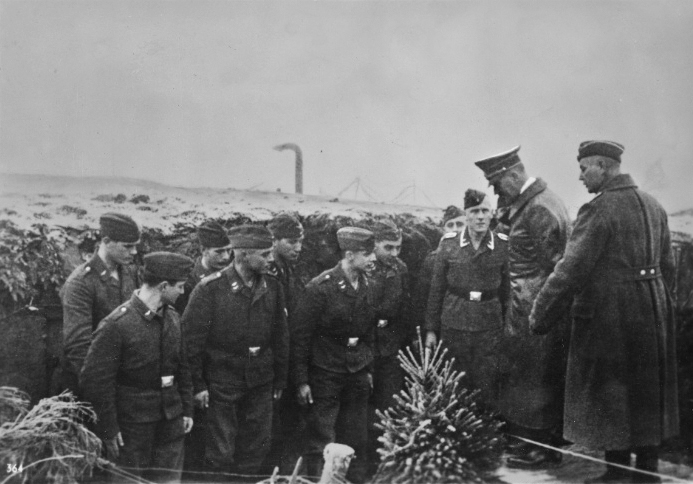
A silent Christmas passes on the western front. The holiday truce is unbroken despite the massing of troops. Within the concrete and under the turrets of the Maginot and Siegfried Lines the armies celebrate the first Christmas of the war. The frontline is reported to be quiet. Hitler begins a 3-day visit with German troops at the front, joining in the Christmas celebrations.
The British Empire hears King George hail unity in war. King George VI broadcasts a Christmas message to the Empire: “A New Year is at hand. We cannot tell what it will bring. If it brings peace, how thankful we shall all be. If it brings us continued struggle, we shall remain undaunted.
Britain’s half-million evacuated children celebrated Christmas today in the great halls of England’s mansions, in village churches and halls, and in the strange but safe surroundings of other men’s houses.
This Christmas in France was the fete of the refugees, the evacuees and the permissionaires. It was around the children exiled from their frontier homes and from the big cities, and around the soldiers on leave that the festivities revolved.
Italians throughout Italy thronged to churches both on Christmas Eve and early this morning to thank God for having spared Italy from the horrors of war and to pray that this danger, still looming darkly ahead, may be averted in the future.
Italy pledges to support Rumania against the Soviet Union.
Eamon de Valera, Prime Minister of Ireland, broadcasting yesterday from Dublin, urged the belligerent nations of the world to call a conference now to settle their differences rather than wait until after a long war when hate, prejudice and utter exhaustion would permeate the conference room.
Irish Republican Army rioting spread throughout Northern Ireland today. At Londonderry Jail sixty Republican prisoners set fire to the prison. The police initiated searches and raids in Belfast, seizing scores of suspects. The trouble started in Dublin yesterday where I.R.A. sympathizers seized arms and ammunition from an Irish Army magazine. Four men were arrested. The rioting lasted five hours at Londonderry where men suspected of being members of the I.R.A. had been interned for the duration of the war. Three jailers were overpowered and locked in cells and the mutineers burned bedding, smashed furniture and leaned from the high windows singing Republican songs to a crowd that gathered quickly in the street. They made a final stand against police reinforcements called to subdue them, fighting with bottles and nail-studded timbers as workmen with acetylene torches burned through barricades that the prisoners had erected and firemen played streams of water on the mutineers.
RAF Bomber Command sends 12 aircraft to attack German shipping without success.
The Royal Navy minesweeping trawler HMS Loch Doon (FY 127) (Skipper G.H.A. Thompson, RNR) struck a mine laid on 20 December by U-22 east of Blyth and sank (55° 08’N, 1° 21’W). The commander and all 15 crew members were lost.
The British collier Edenwood collided with the Royal Navy armed merchant cruiser HMS Derbyshire and sank in the English Channel east of Bembridge, Isle of Wight.
The British steam merchant Stanholme struck a mine and sank off Foreland Point in the Bristol Channel in the Irish Sea, at 51.20 N, 03.39 W. At 08.45 hours the Stanholme (Master David Llewellyn Hook) struck a mine laid on 9 November by U-33 and sank. 13 crew members were lost. The master and eleven crew members were picked up by the Norwegian steam merchant Liv and landed at Cardiff. The 2,473-ton Stanholme was carrying coal and was bound for London, England.
The Norwegian cargo ship Lappen was sunk by an explosion in the Norwegian Sea 10 nautical miles (19 km) off Bergen, Hordaland. The crew were rescued by the Royal Norwegian Navy patrol vessel HNoMS Fridtjof Nansen. The explosion was later attributed to barratry.
The German cargo ship Tanger collided with another vessel and sank in the North Sea off Brunsbüttel, Schleswig-Holstein.
The Norwegian coaster Torwood struck a mine in the North Sea west of Karmøy, Rogaland and was damaged. She sank the next day with the loss of four of her 11 crew. Survivors were rescued by the Norwegian ship Hild.
The War at Sea, Monday, 25 December 1939 (naval-history.net)
On Northern Patrol, one cruiser was between the Orkneys and the Faroes, two cruisers and seven AMCs between the Faroes and Iceland, and one cruiser and one AMC in the Denmark Strait.
Of the ships engaged on Northern Patrol, heavy cruiser BERWICK arrived in the Clyde for a period of rest and refit; light cruiser CERES arrived at Scapa Flow after patrol; light cruiser DUNEDIN arrived at Scapa Flow after her refit in the Clyde, and left for Northern Patrol; and armed merchant cruiser JERVIS BAY arrived at Portsmouth.
Destroyers MAORI and AFRIDI departed Rosyth for the Clyde.
Armed merchant cruiser DERBYSHIRE was in a collision with collier EDENWOOD (1167grt) two miles ENE of the Nab. The collier sank, but no crew were lost. DERBYSHIRE was undamaged.
Submarine TRIDENT arrived at Rosyth after patrol.
ARRIVAL OF CANADIAN TROOP CONVOY TC.2
Canadian convoy TC.2 was in mid-Atlantic when Admiral Forbes ordered the sortie of twelve Home Fleet destroyers to escort it through the Western Approaches and into the Clyde.
Destroyers SOMALI, BEDOUIN, ESKIMO, MATABELE, MOHAWK, FEARLESS, FIREDRAKE, FURY, IMPERIAL and IMPULSIVE departed on the 25th and KINGSTON and KASHMIR on the 26th, all from Greenock and joined the convoy at sea on the 28th.
On the 29th, destroyers FAME and FORESIGHT conducted an anti-submarine sweep off Ailsa Craig, after which, FAME arrived back in the Clyde on the 30th and FORESIGHT went to Loch Ewe.
Also on the 29th, the French ships (battleship DUNKERQUE and light cruiser GLOIRE) were detached, escorted by destroyers FEARLESS, FURY, FIREDRAKE and joined later in the morning by destroyers MOGADOR, VOLTA, LE TRIOMPHANT, LE FANTASQUE, and LE TERRIBLE, which had departed Brest on the 26th. The destroyers were detached before the French ships arrived at Brest on the 30th.
On the 29th and 30th, convoy escort was supplemented by escort vessels PUFFIN, JASON, GLEANER and SHEARWATER.
At 0900/30th, TC.2 arrived safely in the Clyde escorted by battleship REVENGE and destroyers SOMALI, IMPERIAL, MOHAWK, KINGSTON, KASHMIR, MATABELE, BEDOUIN, FEARLESS, FURY, FAME and FIREDRAKE.
REVENGE, escorted by destroyers MOHAWK, MASHONA, KHARTOUM and KINGSTON, departed the Clyde at 0800/31st, and proceeded to Plymouth arriving at 1200 on 1 January for refitting, completed on 23 January.
The destroyers, less MASHONA, returned to the Clyde. MASHONA sailed to Chatham for repairs.
Destroyers ECHO and ELECTRA were hunting off Rattray Head in 57-36N, 1-35W.
Sloop FLAMINGO attacked a submarine contact in the Knock Deep off the mouth of the Thames.
On Christmas Day 1939, the following submarines were on patrol in the Heligoland Bight and the North Sea: STURGEON which had departed from Blyth on the 17th and whose patrol ended on the 29th when she left the area to return, THISTLE which had departed from Rosyth on the 20th and was on patrol at entrance to Oslofjord, TRIUMPH from Rosyth on the 23rd, TRUANT from Rosyth on the 25th, SEALION from Harwich on the 12th, SNAPPER from Harwich on the 19th, UNITY from Blyth on the 21st, and L.23 from Blyth on the 17th to patrol in the area of Kristiansandfjord.
Convoy FS.59 departed the Tyne, escorted by destroyers VALOROUS, VIVIEN and sloop BITTERN. After a submarine was sighted by aircraft close to Spurn Point on the 25th, the three escorts were sent to investigate, and VALOROUS attacked a contact; two anti-submarine trawlers were also searching in the area. The convoy arrived at Southend on the 27th.
Steamer STANHOLME (2473grt) was sunk in 51 20N, 03 39W on a mine laid by U-33 on 5 November. Thirteen crew were lost, and 11 survivors picked up by a Norwegian steamer and landed at Barry.
Minesweeping trawler LOCH DOON (534grt, Skipper G H A Thompson RNR) was sunk eight miles east of Blyth on a mine laid by U-22 on the 22nd. There were no survivors – one officer and 14 ratings lost.
Norwegian steamer LAPPEN (563grt), en route Oslo to the Tyne, was lost after an internal explosion ten miles outside Brandasund, west of Bergen. The loss was later attributed to barratry (maritime fraud). The crew was landed at Bergen.
Sloop BIDEFORD arrived at Suez on her passage from the China Station to the UK. She left Port Said on the 30th for Malta escorting steamer ETTRICK. Off Malta on 1 January, destroyer HMAS VOYAGER relieved her and the steamer was taken to Marseilles. BIDEFORD arrived at Malta that day.
French heavy cruiser SUFFREN and sloop SAVORGNAN DE BRAZZA began escorting three French troopships from Achin Head. British aircraft carrier GLORIOUS, destroyer BULLDOG and Australian light cruiser HMAS HOBART departed Colombo on the 29th. They joined the convoy and escorted it to Cape Guardafui. GLORIOUS and BULLDOG proceeded on to Suez arriving on 9 January, while HOBART arrived back at Colombo on 10 January 1940.
German steamer TANGER (1742grt) was sunk in a collision at Brunsbüttel.
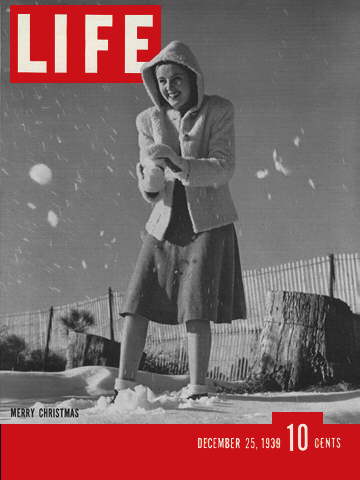
The United States, at peace, unites in thanks on Christmas. With charity and goodwill, and with solemn thanksgiving for peace, the United States celebrated Christmas yesterday. It was a white Christmas in much of the nation, and a happy one everywhere.
The war in Europe gave a deeper significance to the celebration of the most-loved religious feast day. From pulpits throughout the land church-goers were reminded that America was especially blessed. President Roosevelt and his family left a White House, in which there was a complement of children sufficient to ensure a proper Christmas, to attend interdenominational services at Washington’s Covenant First Presbyterian Church. Their example was followed by millions of Americans whose holiday joy was tempered by the knowledge that in some lands, Christmas was under a blackout.
Except for the deep South and California, the nation had traditional Christmas weather with snow in many places and extreme cold. New York got only a trace of the snow, but it was enough for all early-rising children — and that takes in all of them on Christmas Day — to give new sleds a brief tryout in the parks. The city observed to the fullest, its foremost Christmas tradition, that no one be permitted to go hungry. Public agencies, private charities, missions, churches and other groups supplied food to the needy in hundreds of places throughout the five boroughs. In some cases it was chicken fricassee instead of turkey, but in all cases there was plenty for all comers.
The Detroit News today attributed to Attorney General Frank Murphy the prediction that President Roosevelt will seek a third term “only in case of a dire national emergency.” “President Roosevelt can, of course, win re-election easily if he should decide to run,” The News quoted Mr. Murphy. “However, it is difficult for me to conceive of his becoming a candidate unless forced to do so by some national emergency. Of course that is just a personal opinion.”
Mr. Murphy, who came here to spend Caristmas with members of his family, named Senator Arthur H. Vandenberg of Michigan as the leading Republican Presidential candidate, but refused to discuss his own political future. Mr. Murphy said that in his opinion a third party, formed to combine liberals from both camps, would be disastrous to the progressive cause, and would place a “reactionary” in the White House.
The U.S. Cabinet reports all around gains in the economy, as industry, agriculture, and trade improve. Substantial gains in all branches of the national economy were reported today by Secretary Harry Hopkins in a statement reviewing the trend of business in the last twelve months. Mr. Hopkins warned, however, that while foreign trade might prove a stimulus to the domestic. economy in 1940, the prospects must remain highly uncertain under existing circumstances and the outlook must be appraised largely in the light of general domestic conditions. Outbreak of the war, he said, although not greatly affecting the total of export trade, brought some important shifts in its volume and direction and also a 20 percent increase in production in basic industries from August through December as industries readjusted their policies to meet the war situation.
“The recent high rate of activity has created additional consumer purchasing power,” Mr. Hopkins continued, “and the capital expenditures initiated during recent months have been a constructive development. But along with this expanded use of goods for consumption and investment purposes has come some accumulation of inventories. At the present time our rate of production of economic goods is not balanced by a correspondingly high rate of utilization of these goods.
“It is apparent that, lacking a greatly expanded export demand in 1940, the prospects for continued improvement are largely conditioned upon our ability to achieve such a balance. This means that consumption and real investment must be increased from their present levels in order to maintain and increase the present high rate of production. The importance, also, of proper pricing policies in fostering economic expansion and of the willingness of the business community to accept the risks involved in new enterprise are obvious.”
The Secretary of Commerce commented, however, that the price level had remained fairly stable, despite the impetus given by the war. “Commodity prices, which had inclined to weakness in the first two-thirds of the year, advanced under. the impetus of concentrated demand in September,” he stated. “Prices of farm products and foods rose substantially, with benefit to purchasing power in rural areas. Industrial raw materials were bid up rapidly and there soon followed price advances over a widening range of semi-finished and finished goods which gave promise for a time of exercising adverse effects upon consumer purchasing.
Efficiency gains kill farm jobs. A WPA report says the trend is not greater leisure, but migration to cities. The analysis of the causes and effects of farm-to-city migration and the counterflow of city workers displaced from jobs back to the soil was released in Chicago today by the federal government through the office of the State WPA Administrator.
French and British inquiries have indicated to well-informed sources in Washington that the Allies contemplate more than doubling their purchases of American-made planes to arm for air battles which they appear to consider inevitable.
The head of Jewish veterans asks President Roosevelt to rebuke Russia; he urges the President to remove the U.S. envoy.
Present day problems to be faced in keeping libraries free from outside political control or other outside influences will be a major topic at the annual midwinter conference of the American Library Association.
Montgomery Ward introduces Rudolph, the 9th, red-nosed, reindeer this year. Robert L. May created Rudolph in 1939 as an assignment for Chicago-based Montgomery Ward. The retailer had been buying and giving away booklets for Christmas every year and it was decided that creating their own book would save money. May considered naming the reindeer Rollo or Reginald before deciding upon using the name Rudolph. In its first year of publication, Montgomery Ward distributed 2.4 million copies of Rudolph’s story.
Chungking celebrates Christmas widely. The holiday is observed by Chinese Nationalists as well as Christians.
Tokyo will consult its army on U.S. policy. Generals in China must agree on any trade policy.
The Japanese 21st Army captures Liangkou and attacks around Meikeng in the Chinese 4th War Area zone.
There is continued heavy fighting around Kunlunkuan as a relief column breaks through with ammunition and reinforcements for the Japanese 5th Infantry Division.
A detachment of the Japanese 5th Infantry Division around Lungchow is withdrawing toward Nanning under pressure from the Chinese West Route Force.
Kensuke Horinouchi, the Japanese Ambassador, said today that Japanese military leaders in China must approve any concessions that Japan might offer for a new trade treaty with the United States.
Major General Bernard Freyberg arrives from the UK to assume command of the New Zealand Expeditionary Force.
Born:
Roland Lakes, NFL defensive tackle, tackle, and center (San Francisco 49ers, New York Giants), in Vicksburg, Mississippi (d. 2012).
Chris Krug, MLB catcher (Chicago Cubs, San Diego Padres), in Los Angeles, California.
Bob James, American smooth jazz keyboardist and composer (“Angela”; “Tappen Zee”), in Marshall, Missouri.
Naval Construction:
The Вое́нно-морско́й флот СССР (ВМФ) (Soviet Navy) “S” (Stalinec)-class (2nd group, Type IX-modified) submarine S-56 is launched by Dalzavod (Vladivostok, U.S.S.R.) / Yard 202.



 History Diaries