Christmas Day.
Stringent security measures went into force in Saigon today to prevent a repetition of the Christmas Eve bomb blast that killed two men and injured 98 in an American officers billet. A 65‐man United States Navy patrol reinforced military police guarding American quarters. Heavily armed sentries were posted in all American billets in Saigon and security men were seen checking people in the streets for weapons. United States officials held a series of urgent meetings with Vietnamese officials to discuss tighter security in Saigon. The two dead in the bomb blast were a United States Army lieutenant colonel, whose body was found buried by debris two hours after the blast, and an American civilian working as a real estate agent for the Navy, who died in a hospital.
Sixty‐one United States servicemen, two American civilians, 34 Vietnamese and one Australian were taken to hospitals, according to revised casualty figures. Most of them suffered from shock and cuts caused by flying glass. This morning 24 Americans and 15 Vietnamese were reported still hospitalized. The injured Australian was one of a four‐man Australian military advisory team billeted in the bombed building. The bomb was believed to have been a powerful charge of plastic material placed in a car that was driven into the parking area under the eightstory bachelor officers quarters known as the Brink billet.
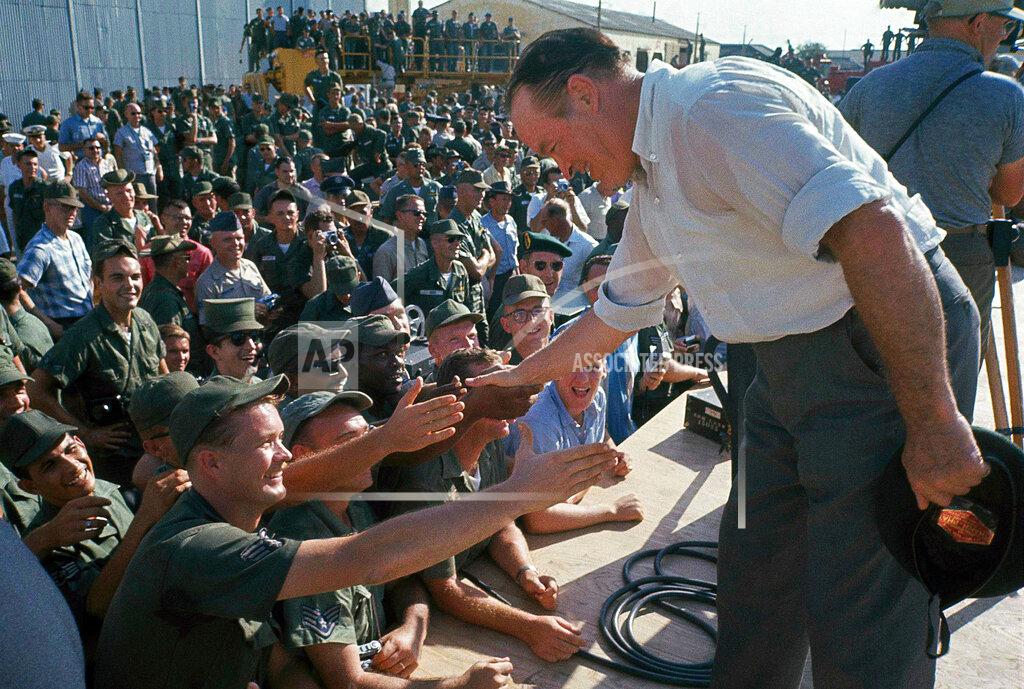
Bob Hope flew to the American helicopter base of Vĩnh Long in the heart of the Việt Cộng-controlled Mekong Delta today and told the troops: “A funny thing happened to me when I was driving through downtown Saigon to my hotel last night. We met a hotel going the other way.” The comedian was alluding to a bomb explosion that virtually wrecked a United States officers’ quarters in downtown Saigon yesterday. Mr. Hope and his troupe of girls performed at the base, 70 miles southeast of Saigon, on the back of a truck before about 400 helicopter pilots and maintenance men. The boom of artillery fire was heard in the distance. Sandbag bunkers were lined behind the truck on which Mr. Hope, Jill St. John, Jerry Colonna, Janis Paige and Anna Maria Alberghetti performed. The company flew back to Saigon for an afternoon show before 3,000 Air Force men.
South Vietnamese Premier Trần Văn Huong broadcasts a Christmas message to U.S. personnel in Vietnam. (General Khánh will issue his own Christmas message with thanks to the U.S. troops on the 27th).
This Christmas week has brought demonstrations of ill will toward the American presence in South Vietnam not only from foes but also from men once considered friends. It almost seems as if the Việt Cộng insurgents and the Saigon Government had conspired to make the United States feel unwelcome. Appearances deceiving but the conclusions drawn from them are not always wrong. Not since the last months of the late President Ngô Đình Diệm’s regime has the vast support from the Americans been so suspect to Vietnamese leaders. Neither of the demonstrations against the Americans this week was entirely surprising, as United States diplomats are the first to concede. The more tragic of the two seems the less serious for the nation.
The terrorist bomb that exploded among more than 100 officers at their Saigon billet last night killed two Americans and injured more than 60. It was the sort of thing the Việt Cộng saboteurs had been trying to do for months in an effort to sap morale. For the toughened men involved in last night’s disaster it had the opposite effect. One American officer in the rubble and the heat of the flames was overheard muttering, “The best way to show these bastards is for us to stay right here and beat the hell out of them.”
Attacks of another sort were leveled against the Americans by Lieutenant General Nguyễn Khánh, commander in chief of the armed forces, which the United States has been giving heavy assistance for three years. In public statements General Khánh heaped scorn on Ambassador Maxwell D. Taylor of the United States and implied that American policy had imposed a new colonialism on South Vietnam. The General’s personal position was not as surprising as it would seem when one considers the high esteem American policymakers had for him in the role of Premier. General Khánh’s relations with Ambassador Taylor have long been abrasive. Mr. Taylor former Chairman of the Joint Chiefs of Staff, never seemed to regard the youthful Vietnamese general as much of a gentleman or an officer.
Air crewmen of the 315th Troop Carrier Group, known as the Air Commandos, blinked in surprise at the Christmas eve scheduling board. There were the names of two full colonels where the names of a captain and a lieutenant normally would appear as pilot and co‐pilot for a Christmas eve Christmas morning combat mission. The officers who volunteered so that their juniors could have the holiday off were Colonel Allison Brooks, 47‐year‐old Deputy Commander of the Air Force’s Second Division, and Colonel David T. Fleming, also 47, commanding officer of the Air Commandos. Before the sun had set, the colonels had four clerks demanding to be taken along as volunteer “flare kickers” to provide flare‐drops over areas attacked by the Việt Cộng.
General Phoumi Nosavan, the Laotian Defense Minister and leader of the right‐wing faction of the Coalition Government, returned home today from Saigon. He was reported to have gone there to discuss with Vietnamese leaders the possibility of Vietnamese-Laotian air strikes against Communist guerrilla supply routes to South Vietnam.
A Cambodian Government communique declared today that helicopter‐borne troops from South Vietnam attacked a Cambodian border village yesterday. The communique said about 50 troops, including one American soldier, landed at Phum Scatum after they had raked it with machine‐gun fire from four helicopters and left about three hours later. Cambodia, the communique continued, “issues the strongest protest against this deliberate aggression.”
In another development today, a new Cambodian Government, headed by Prince Norodom Kantol, who resigned yesterday as Premier, was approved by the National Assembly.
The principal ministers are: Lon Nol, National Defense; Kou Roun, Security; In Tare, Interior; Koun Wick. Foreign Affairs; Chea San, Information; Hso Nem, Trade; Chau Sau, Finance, and Kruphum Phkar, Industry.
There have been a number of clashes along the CambodianSouth Vietnamese border. Saigon has asserted that the Vietcong launched attacks from Cambodia; Pnompenh has accused the South Vietnamese of deliberately raiding Cambodia.
A raiding party of 22 Indonesian guerrillas was captured in the Strait of Malacca late yesterday by the British frigate HMS Ajax. Details of the incident were disclosed today by the Malaysian Ministry of Information. It was the second attempt this week to send a group of guerrillas into the Malayan mainland. Police field forces captured 11 of the estimated total of 27 Indonesian guerrillas who landed early Wednesday on the coast of Johore, 150 miles southwest of Kuala Lumpur. Three members of this band were killed by Malaysian security forces yesterday. According to the official version of the capture in the strait, the Ajax discovered seven sampans carrying guerrillas in Malaysian waters off Kuala Selangor, 30 miles northwest of here. The Indonesians were armed and carried explosives, the Ministry of Information said. They made no attempt to fight off the Ajax. The official report noted the capture of the party’s leader, Sgt. Marimba Nana. He was reported to have said the group had been training more than two months to make a landing at Kuala Selangor.
Pravda said today that “the Soviet Government is prepared to discuss any steps and proposals aimed at preservation and consolidation of peace.” The Soviet Communist party newspaper asserted that the desire for peace had influenced the United States electorate to defeat Senator Barry Goldwater’s bid for the Presidency. The same desire, the paper added, impelled British voters to put Prime Minister Harold Wilson’s Labor party into power.
The Soviet Union announced in its government newspaper, Izvestia, that it would experiment with a profit-oriented capitalist economy in certain factories in Lvov, the capital of the Ukrainian SSR, starting on January 1. Economist Evsei Liberman of the University of Lvov had proposed that directors of factories be given wide latitude in making production decisions with minimum oversight from the nation’s central planning commission, and the test in two textile factories (in Moscow and in Gorky) had proven effective enough that Liberman selected be expanded from light industry into heavy industries. The factories that would carry out the pilot program in 1965 were “a plant producing loading machines”; the television set factory operated by the Progress Enterprise; the Zarya textile factory; and the Velkomostovskaya Number 9 coal mine.
Taiwan’s President Chiang Kaishek said today that he believed Communist China might have deliverable atomic bombs in “three to five years.” The Chinese Nationalist leader said at the national assemblymen’s convention that, once the Communists had nuclear weapons, their first target would be Taiwan. “Nationalist China is now in a most dangerous and most crucial period because it has to destroy the Peking regime before it turns this island into a nuclear ruin,” the President declared. He said his government had to protect Taiwan from a Communist nuclear attack. “It also has to preevnt an Anglo‐American nuclear retaliation against the China mainland in the case of a nuclear war,” he added.
Premier Eisaku Sato’s ruling Liberal‐Democratic party decided today on a policy calling for cautious handling in the United Nations of the China representation issue — the possible seating of Communist China instead of or in addition to Nationalist China. This was one of the key issues making up the Government party’s policy formulated by the party’s 60‐member Foreign Affairs Investigation Committee. The committee advised that “the China representation issue in the United Nations” should be regarded as an “important matter” requiring a two‐thirds majority for approval because of the complications of the problem. The committee also advised that Japan’s economic and trade relations with Communist China should continue to be built up.
Queen Elizabeth II appealed to the young people of the British Commonwealth today to hang onto the thread of freedom that binds them together. “If it is not to degenerate,” she said, “freedom must be maintained by a thousand invisible forces: self‐discipline, the common law, the right of citizens to assemble and to speak and argue.” The Queen’s Christmas message was delivered to a television audience of perhaps 25 million Britons and to millions abroad. The British Broadcasting Corporation relayed sound broadcasts in 40 languages over the world to places in a Commonwealth beset by problems and anxieties.
Pope Paul VI urged today that mankind restore the “authentic spiritual value” to Christmas so that it may be celebrated with “true happiness.”
Dr. Nahum Goldmann, president of the World Jewish Congress, forecast today that the West German Government would extend the period for instituting prosecutions for Nazi crimes, which is to expire May 8.
Bertrand Russell, the British philosopher, in an exchange of letters with the editor of a Yiddish-language magazine in Moscow, has charged that Jews in the Soviet Union are subject to injustice and conditions of assimilation “in which they have virtually no choice but submission.”
Efforts by Bolivia and Chile to set aside their territorial differences and resume diplomatic relations have come to a standstill, according to diplomatic sources in Santiago. A week ago, high Chilean officials seemed convinced that a settlement was imminent in the dispute that has seriously shaken the unity of the inter‐American system. Relations between the two Andean countries were severed by the Bolivian Government two and a half years ago after Chile diverted waters of the Lauca River that Bolivia contended were needed for the irrigation of her arid southwest. Because her charge that Chile had committed aggression was not accepted, Bolivia walked out of the Council of the Organization of American States and has not returned.
As a result of a series of recent diplomatic contacts with the Bolivian military junta, which came to power November 4, a joint announcement had been prepared expressing the willingness of the two Governments to renew friendly relations. But Chilean sources said that after showing an initially conciliatory attitude, the government of Lieutenant General René Barrientes Ortuno had suddenly insisted that certain concessions first be made in regard to Bolivia’s long‐standing territorial claims.
The demand of Bolivia arises from her landlocked position and her contention she has a “right” to an outlet to the sea, an issue Chile has repeatedly refused to discuss. “It looks as if we are right back where we started from,” a Chilean official involved in the recent diplomatic talks declared. He said he believed that the Bolivian military junta was eager to win wider acceptance in Latin America, and that it was possible that the junta might yet make the agreement possible. Hopes for a settlement rose here earlier this month after General Barrientos said that his regime was prepared to seek with Chile a formula for resuming friendly relations and that it planned to return to the O.A.S. Council. Previously the Bolivian position had been that Chile must take the first step.
Brazil’s revolutionary regime is gathering strength and momentum in its struggle to overcome the huge problems that beset it. After nine months in power, the regime is unpopular. It is enforcing austerity, attacking privileges and corruption, flouting political taboos and stinging ideological sensitivities. But it is demonstrating the power to override political opposition from any quarter, and it is making decisions stick. These decisions were postponed or could not be enforced by weaker governments. This is essentially a military government, although it works with a cooperative Congress and friendly state governors in a modified constitutional framework that gives the executive exceptional powers.
Americans have received a $40 billion lift this year. American and foreign analysts are awakening to just how big it is. The $40 billion represents the growth in the economy in 1964 over 1983, as measured by the gross national product — the dollar value of all goods and services produced in the country and flowing to consumers, business, capital investment, government and export. The growth in 1964 is nearly as large as the entire gross national product of Canada, which will be about $45 billion this year. It is about half the gross national product of France.
It is also, the analysts found, probably more than the Soviet Union’s economy grew this year and last year combined, and possibly more than the last three years combined. A European diplomat said recently: “The American economy has become so big that it is beyond the imagination to compre« hend. But now on top of size you are getting rapid growth as well. It is a situation of fundamental power unequaled in the history of the world.”
Although the final figures are not yet in, the gross national product this year will be about §624 billion, compared with $584 billion last year, according to statisticians at the Commerce Department. The next biggest in the world is that of the Soviet Union, which, by the estimate of United States Government analysts, was about $260 billion in 1963 and somewhat larger this year. The figure for the United States’ gross national product for the year as a whole is already largely determined by the results of the first three quarters, and by monthly reports for October and November on such indicators as retail sales and industrial production. The strike against the General Motors Corporation may pull down the final total below $624 billion, but the variation will be small, according to Government statisticians.
This country’s growth in 1964, according to current estimates, produced 1.5 million new jobs. This is a net increase, allowing for some jobs lost through automation. Thus, 1.5 million more persons are at work this week than in the same week a year ago. Nonetheless, this job growth left a sizable amount of unemployment, because there was a big increase in the number of young men and women seeking work. However, total unemployment declined by perhaps 400,000 this year to 3.5 million. The rapid growth of the economy has also meant improved well‐being for a large number of Americans, although not everyone earned more this year than last.
A six‐inch concrete barrier atop a levee kept the flooding Willamette River from pouring into the downtown Portland business district today. The Weather Bureau said the Willamette reached its peak at 29.8 feet, almost 12 feet above flood stage — the highest on record. The river held at that level for several hours. Forecasters said the fall would be slow. The danger was not over, however. The murky Willamette was battering Portland’s 10 bridges with debris. The police closed one bridge, which carries both rail and vehicular traffic, and warned people to stay away from the levee.
Helicopters churned through the rain and fog this gloomy day in northwest California’s flood‐ravaged areas hearing medicine and food. The ill and the homeless in the flooded lumber country are so scattered, so isolated, that the low‐flying copter is the one best way of getting there. The aircraft carrier Bennington arrived today off Humboldt Bay with 20 Marine helicopters aboard. Carrying doctors, medicine and food, these craft flew to local airports, where residents acquainted with the rugged terrain got aboard. These then fanned out on mercy missions — as much as the foul weather allowed. If a bed‐confined patient needed a serum or a pill, the copter doctor brought it and gave it. The army is sending 18 helicopters. The Navy already has six in the area. Six privately owned ones were in service, making more than 40 in all.
Today a helicopter coordinating service was set up in the grand jury room of the Humboldt County Courthouse in Eureka. It is being run by Major Paul Bent, a marine who came out of retirement to handle the job of dispatching the copters where they are most needed. Today two Air Force C‐130 tanker planes came over the Arcata airport with much‐needed fuel for the copters. But the weather was so bad they had to leave without delivering it. No commercial flights have been possible for days.
Six persons — two women, a little girl and three crewmen — were feared dead today in the wreckage of a Coast Guard helicopter that crashed during flood rescue work. The Coast Guard said it now appeared likely that the helicopter picked up the women and girl shortly before it crashed in a remote wilderness section north of Arcata while trying to find its way to an airport in bad weather. The amphibious single‐turbined copter vanished Tuesday, day. The wreckage was sighted Wednesday, with no sign of life, but the rugged terrain has defied efforts of ground searchers to reach the spot.
The spirit and inspiration of Christmas reached into the red clay back country of northeastern Mississippi today. Blacks and whites sat side by side on rough plank benches in the half finished shell of the new Antioch Baptist Church in Ripley and gave thanks to God. The Black church, which is being rebuilt by a group of Northern college students who call themselves “Carpenters for Christmas,” stands on the ruins of a building that burned last October after a rally of the Freedom Democratic party. The hour‐long service was attended by 90 persons, more than half of them Blacks from the community. Two white ministers and the pastor of Antioch led the service. The only whites in the congregation were those from the project. The Rev. E. S. Furr, the white minister of the First Methodist Church in Ripley, visited the church before the service, but left as it began.
Outside the church on a mud road that stretches into the hill country, Sheriff Wayne Mauney of Tippah County sat in his car and watched. The sheriff said he was there “just in case of trouble.” Only last night, several mailboxes in the neighborhood were blown apart by large firecrackers. The blasts followed the arrest of a white man on a public drunk charge after he allegedly had threatened the life of a Black cotton farmer who has been working on the church. This morning there was no trouble. Instead, Black and white joined in singing hymns and carols before a pulpit that had been hammered together out of scrap lumber.
A small tornado, one of a string that whipped through several Southern states, cut a mile‐long swath through a trailer park and residential area in Niceville, Florida today, doing $95,000 in damage and injuring two persons. The twister hit here after brief touchdowns at Port Walton Beach and Eglin Air Force Base in the pre‐dawn hours. Near Covington, Georgia, high winds wrecked a dairy barn and killed most of a herd of Holstein cows. J. T. Pope Jr. said he had saved only six of his 60 cows. He said the loss would exceed $50,000. Two churches and several small houses were reported destroyed in the same area, southeast of Atlanta. At LaGrange, Georgia, 100 miles to the west, two homes were damaged and one wrecked when a tornado touched down last night. At Foley, Alabama, five airplanes parked at the airport were wrecked and five houses, a service station and a restaurant were heavily damaged. Another Alabama tornado struck near Greenville, Alabama, doing heavy damage and knocking down utility lines.
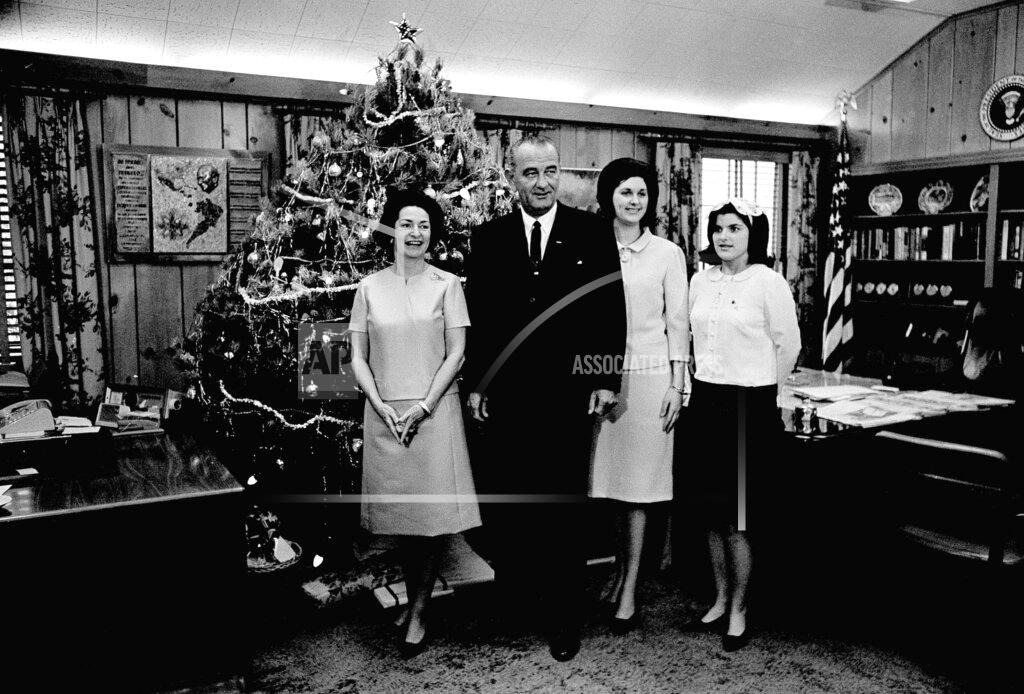
President Johnson enjoyed a warm, sunny Christmas today. He went to church, played with his dog, joked with reporters and ate turkey with about 20 relatives. The gift he received from Mrs. Johnson was a framed quotation by Abraham. Lincoln, which he hung on his office wall at the LBJ Ranch house 12 miles west of here. The President gave his wife and daughters, Lynda Bird and Luci Baines, small gold pins. The Lincoln quotation that Mrs. Johnson had turned into a Christmas gift for Mr. Johnson is a traditional favorite of Presidents. It reads: “If I were to try to return, much less answer, all the attacks made on me, this shop might as well be closed for any other business. I do the very best I know how — the very best I can, and I mean to keep doing so until the end. If the end brings me out all right, what is said against me won’t amount to anything. If the end brings me out wrong, 10 angels swearing I was right would make no difference.”
George Harrison’s girlfriend Pattie Boyd attacked by female Beatle fans. Fans assaulted George Harrison‘s wife, Pattie Boyd, when she came out of a Beatles concert early. Being a Beatle’s girlfriend and then wife was often a rough ride. Boyd and the other Beatles wives constantly battled hoards of screaming girls who wanted their husbands. “I found it absolutely terrifying,” Boyd said. “I got to see the Beatles play at a theater in London, and George told me that I should leave with my friends before the last number. So before the last song, we got up from our seats and walked toward the nearest exit door, and there were these girls behind me. They followed us out, and they were kicking me and pulling my hair and pushing us all the way down this long passageway.” Boyd said the fans yelled, “We hate you” to her as they kicked her.
John Huarte won the battle of the quarterbacks handily, but his North team had to go through a hair-raising fight before it finally conquered the South in the most exciting game of the Shrine Christmas football series, 37–30. Only five seconds were left when Huarte, Notre Dame’s Heisman Trophy winning quarterback, whipped a five-yard clutch pass to his teammate, Jack Snow, to break a 30–30 deadlock the South had forged with a gallant comeback just two minutes earlier. This and a magnificent gamelong performance won Huarte the vote as the outstanding North player. And he clearly outshone the two South quarterbacks, Navy’s Roger Staubach and Tulsa’s aerial record-breaker, Jerry Rhome. On the South side, Bob Hayes, Florida A&M’s Olympic sprinter, stole the show from the quarterbacks to be voted the outstanding player on his team. Hayes operated as a split end. After a mild first half that ended with the North in front 7–6, the Yankees exploded for 23 points in the third period on a 25-yard sprint by Penn State’s Tom Urbanik, a 20-yard pass from Huarte to Army’s Carl Stichweh and a 44-yard runback by Rudy Kuechenberg of Indiana with a pass stolen from Rhome. The South rallied to tie it before the North’s winning drive.
Born:
Jonas Sjöstedt, Swedish politician and chairman of Sweden’s left-wing Vänsterpartiet political party; in Gothenburg, Sweden.
Ian Bostridge, English opera tenor, in Wandsworth, London, England, United Kingdom.
Tim Royes, English-American music video director, born in London, England, United Kingdom (d. 2007).
Died:
Cheerio Meredith, 74, actress (“One Happy Family”).







 History Diaries