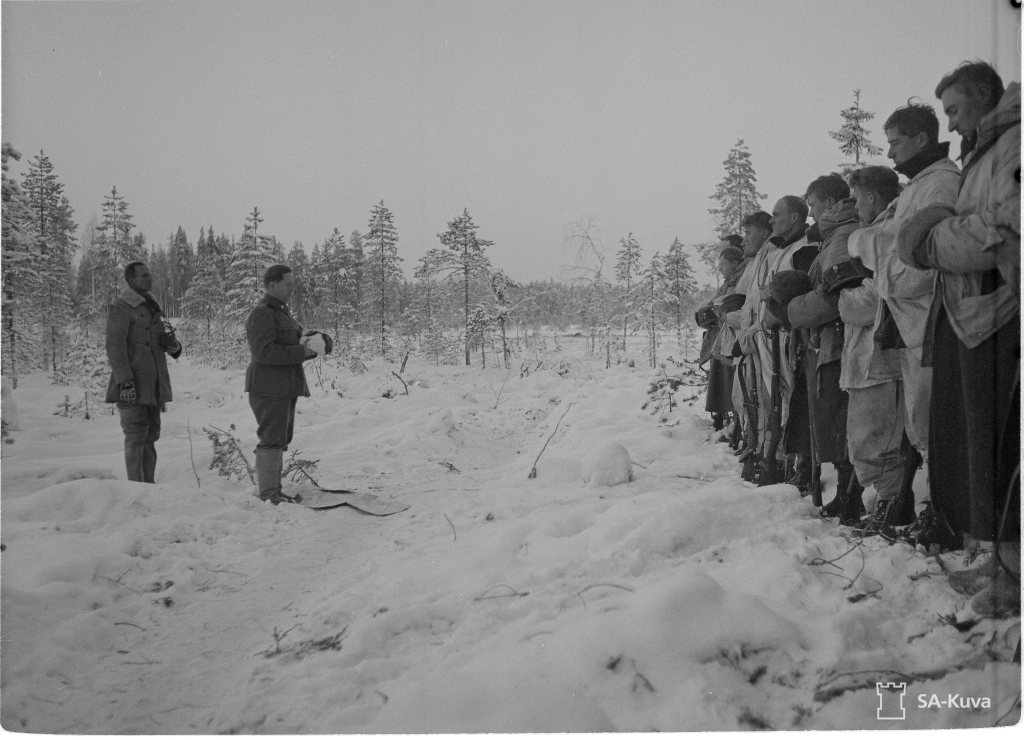
The Soviet campaign in Finland now has been in progress for 24 days, twice the amount of time expected in the Soviets’ overly optimistic plans.
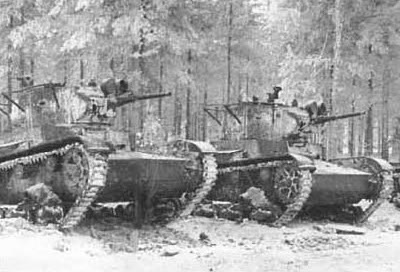
In Suomussalmi the enemy launches fierce counterattacks in the parish village, at Hulkonniemi and also along the Raate road. The Soviet 163rd Division tried unsuccessfully to break out of Suomussalmi, Finland; the Soviet 44th Division failed to move in to provide support for the 163rd Division. 44th Division, trapped further down the road, does not have enough strength to help them. The winter is working its magic on the Soviet troops and their vehicles, robbing them of strength and initiative. Part of the problem is that the Soviet 44th Division has plenty of skis, but no ski troops. The Finns can maneuver through the woods on skis and attack the Soviets all along the road. Both divisions are in increasing danger as days pass without resupply.
Soviet troops further north are being pushed back to Salla from the Kemijoki River by the Finnish troops under the command of Major General Kurt Martti Wallenius.
Finnish Army Group Talvela pushed Soviet 75th and 139th Divisions back across the Russian border. Finnish troops enter Soviet territory for the first time in the war, north of Lake Ladoga, near Lieksa, after routing Soviet troops in the Tolmojaervi and Aglajaervi districts.
At Tolvajärvi the enemy is pushed back across the River Aittojoki, where the front becomes stabilized for the remainder of the war.
In Northern Finland, Group Ilomäki advances from Jyrkänkoski to strike at the Rasti crossroads in Kuhmo, but has to withdraw to its original positions after 16 are killed and 37 wounded.
The enemy launches another offensive at Kollaa.
Finland mines the Soviet naval bases in the Baltic States.
In the Gulf of Finland, the Russian battleship Marat shells Koivisto Fortress.
Finland’s President Kyösti Kallio tours the military hospitals to greet soldiers wounded at the front.
In a speech at the Vatican, Pope Pius XII condemns the Soviet attack on Finland.
International aid to the Finns continues. Volunteers from virtually other European nations have been pouring in.
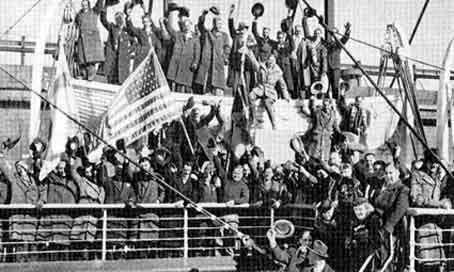
On the Swedish border, the first group of Finnish-American volunteers arrives in Tornio. The first Finnish-American volunteers reach Oulu, Finland, on Christmas Eve, to begin military training.
Pope Pius XII gave a Christmas address to 25 cardinals in which he offered a five-point program as a basis for negotiating a “just and honorable peace.” In contempt for freedom and human life, the Pope says, there have been “acts which cry for the vengeance of God.”
Christmas Eve brings feeble peace rumors; reports fly about Heinrich Himmler’s trip to Rome and the Pope’s expected plea to Cardinals.
Stalin stresses Soviet-Reich ties, saying they are cemented in blood.
Soviet and German authorities allow rail links between the former eastern and western territories of Poland to be reestablished.
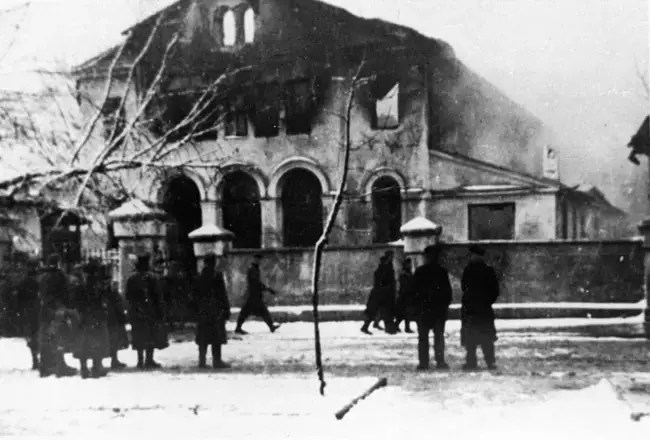
German troops accompanied by Polish policemen encircle the synagogue in Siedlce, remove the two Torah scrolls, and set the synagogue on fire. They also burn the scrolls separately. The fire spreads to nearby Jewish offices. The Polish police prepare a report blaming the fire on the Jews. The Germans then prepare to deport many of the Jews of Lublin to labor camps.
After blazing for a week, the hulk of the German pocket battleship, Graf Spee, burns out.
Hitler is still inspecting the Siegfried Line.
The Reich faces fiscal overhaul. A widening gap between buying power and consumer goods poses a problem.
French Premier Edouard Daladier exhorts people to courage. France will wage war to bar Germans from its soil, he says.
While it was impossible to make an accurate estimate, it was reasonable to expect that the war in 1940 would cost France at least 300,000,000,000 francs [the franc is currently quoted in New York at 2.23 cents].
[Ed: It will cost a bit more than that, mon ami.]
Count Ciano pledges Italy to support Rumania in event of Soviet aggression against Bessarabia.
RAF Bomber Command sends 17 aircraft to attack German shipping without success.
The British passenger ship Pegu ran aground off Southport, Lancashire. All 103 passengers rescued by lifeboats. The ship was declared a total loss.
Convoy OB.59 departs Liverpool.
Convoy HG.12 departs Gibraltar for Liverpool.
The War at Sea, Sunday, 24 December 1939 (naval-history.net)
On Northern Patrol, two cruisers were between the Orkneys and the Faroes, two cruisers and seven AMCs between the Faroes and Iceland, and one cruiser and one AMC in the Denmark Strait.
Heavy cruiser NORFOLK departed Belfast and arrived in the Clyde on 1 January.
Light cruiser SOUTHAMPTON arrived in the Tyne for repairs from 28 December until 23 January 1940.
Destroyer WALLACE departed Rosyth in the tow of two tugs for Leith.
Destroyers ECHO and ELECTRA departed Inchkeith escorting tankers to Loch Ewe.
Destroyers FURY and FIREDRAKE departed Loch Ewe and joined destroyers FEARLESS, KASHMIR, KINGSTON, ILEX, NUBIAN and MOHAWK in the Clyde.
Submarine TRIAD arrived at Rosyth after patrol.
Destroyers GREYHOUND and GRENVILLE attacked a submarine contact in 52-25N, 1-52E.
Light cruiser CALYPSO departed Plymouth for Gibraltar where she arrived on the 27th for duty with the Mediterranean Fleet.
Convoy OB.59 departed Liverpool, escorted by destroyers VOLUNTEER and VENETIA to the 27th when they detached to SL.14. Convoy OA.59 did not sail.
Battleship MALAYA and destroyers DELIGHT and DIANA arrived at Gibraltar, and left the same day with destroyer WATCHMAN. MALAYA proceeded to Halifax, and DELIGHT and DIANA to Portsmouth and Dover respectively, arriving on the 30th. DIANA carried on to Chatham, arriving for refit on the 31st.
Convoy HG.12 of 48 ships departed Gibraltar, escorted by French large destroyers JAGUAR and LÉOPARD, from the 24th until the destroyers arrived at Brest on 1 January, and also by destroyer KEPPEL. The convoy arrived at Liverpool on 2 January.
Heavy cruiser DORSETSHIRE had departed Simonstown on the 13th for Montevideo to join light cruisers AJAX and the New Zealand HMNZS ACHILLES. En route, DORSETSHIRE was diverted on the 18th to the Falklands. She arrived, re fueled from tanker OLYNTHUS on the 22nd in San Boroban Bay and on the 24th arrived in the Falklands to embark the prisoners from German steamers KARL FRITZEN and USSUKUMA. Off the Plate, ACHILLES departed on the 18th for the Falklands where she arrived on the 21st to land her wounded, and after re fueling, left to arrive back off the Plate on the 24th.
Heavy cruiser CUMBERLAND arrived in the Falklands on the 24th.
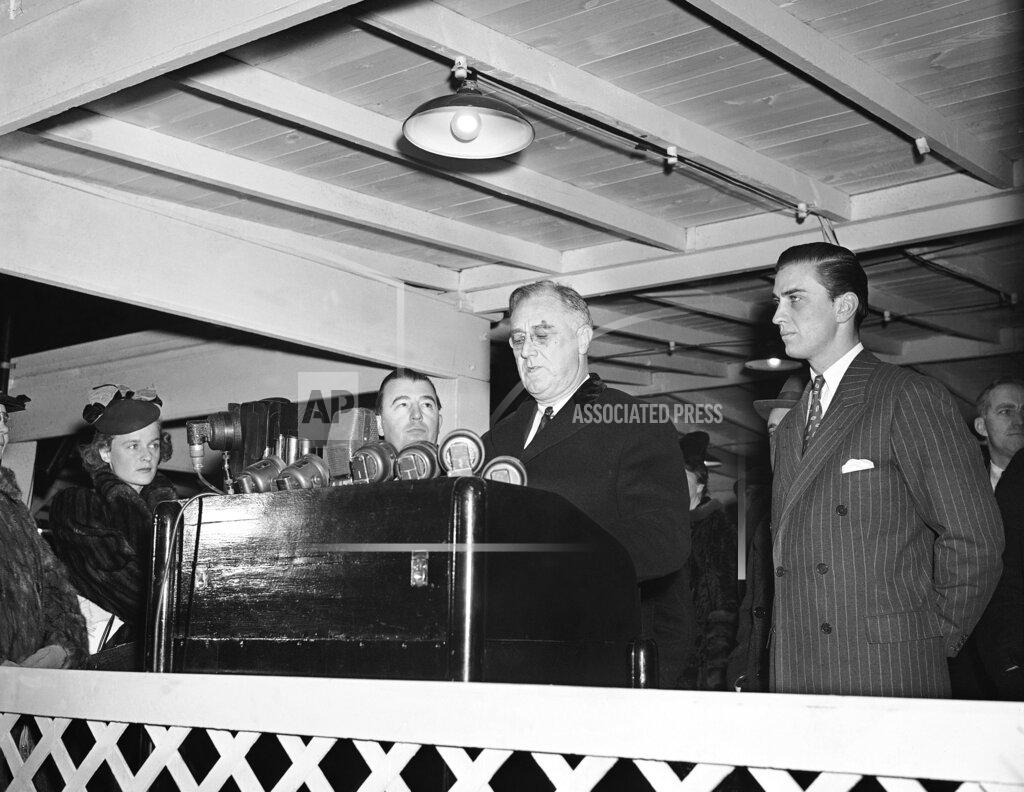
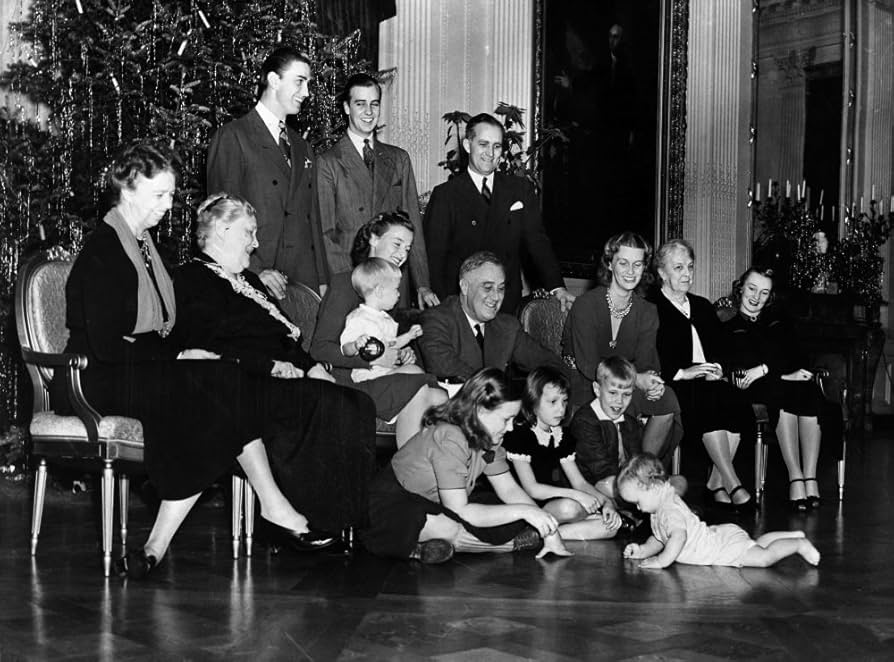
Lighting the National Community Christmas Tree late today in the Ellipse south of the White House, President Roosevelt gave thanks for “the interlude of Christmas” in a world “bowed under the burden of suffering laid upon it by man’s inhumanity to man.” While parts of the world were torn by war. Mr. Roosevelt said, this country had witnessed and was witnessing the spread of the “spirit of neighborliness” of Dickens’s Christmas Carol until it now encompassed the whole nation. As examples of this expansion of the neighborly spirit he mentioned that on January 1, under the Social Security Act, many thousands of elderly men and women all over the country would begin to receive old age retirement insurance and that unemployment insurance and Federal benefits for widows, orphan children, dependent parents, the crippled and the blind already were being paid.
Mr. Roosevelt prefaced this statement with the comment that it was a “Christmas rite” with him annually to read Dickens’s “immortal little story,” reading between the lines and picturing the humble home of Bob Cratchit as a counterpart of millions of our own American homes. In days of strife like the present, he continued, and in the presence of sadness in other lands, Americans and people in all the nations. which were still at peace should forbear to give thanks only for their own peace. Rather, he said, these more fortunate peoples should pray to be given strength to live for others, and do so more closely on the pattern of the Sermon on the Mount, with excerpts from which he closed his address.
At the ceremony, which was broadcast over nationwide radio networks, Mr. Roosevelt was accompanied by the entire Roosevelt family gathered at the White House, from his mother to his grandchildren. Bareheaded in the chill of the waning day, the President spoke from a temporary stand to several thousand persons seated and standing around the thirty-six foot Community Tree. The program had opened at 4:30 PM with a concert by the Marine Band, followed by an invocation by the Most Rev. Patrick J. McCormick, vice rector of Catholic University. Mr. Roosevelt was introduced by Representative Randolph of West Virginia and following his address the Federal Playhouse chorus sang five historic Christmas carols. The Rev. John W. Rustin, pastor of the Mount Vernon Place Methodist Church, pronounced the benediction.
U.S. Senator Borah of Idaho asks that trade with Japan continue after the pact expires in January; peace interests are cited. All “reasonable” efforts should be made to maintain trade relations with Japan after the commercial treaty between that country and the United States expires, Senator William E. Borah of Idaho asserted today.
Senator Arthur H. Vandenberg of Michigan will carry his campaign for the Republican Presidential nomination into the heart of the Farm Belt on February 10, speaking at St. Paul, Minnesota, where Thomas E. Dewey of New York formally started his own campaign.
The third annual convention of the Veterans of the Abraham Lincoln Brigade, a group of Americans who fought with the Loyalists in Spain, closed yesterday after two days of sessions at the Hotel Diplomat in New York, with the adoption of a resolution condemning “the people who prate about the rights of small nations and about the Soviet Union, because she is wiping out an imperialist base for aggression.”
[Ed: And when shitty leftists prattle about the “noble” Abraham Lincoln Brigade, realize they were mostly amoral Moscow-first communists, nothing more.]
Fifteen Christmas stockings hang in the White House, as the President and First Lady take their grandchildren to church.
A miner, 80, digs coal for Christmas gifts. He gives sacks of fuel to needy neighbors.
T.A. Crerar, Canadian Minister of Mines and Resources, returned today from a nine weeks’ mission in England and France and reported to Prime Minister W.L. Mackenzie King, who met him at the railway station.
Faced by the attitude of Cuban opposition parties that indicates they will refuse to participate in the general elections next February, Colonel Fulgencio Batista has invited the leaders of these groups to meet aim for a discussion of national affairs.
While elements of the Chinese forces remain on the offensive, the Japanese counterattacks are increasing. The Japanese proclaim the Chinese offensive has been “crushed,” and 16,500 Chinese killed.
Japanese 21st Army captures Yinchanao and Pachiangkou north of Canton in Chinese 4th War Area zone.
Japanese 2nd Independent Mixed Brigade relieves Paotou and Chinese 8th War Area goes on the defensive in that sector.
Chinese West Route Force attacking elements of Japanese 5th Infantry Division around Lungchow.
Born:
Christiane Schmidtmer, actress and model, in Mannheim, Germany (d. 2003).
Naval Construction:
The Royal Indian Navy auxiliary patrol vessel HMIS Lady Craddock is commissioned. Her first commanding officer is T/Lieutenant Charles Thomas Hyde, RINVR.
 History Diaries