
James is buried at Arlington National Cemetery, Section 37, site 1278. He is remembered on the Wall at Panel 1E, line 78.
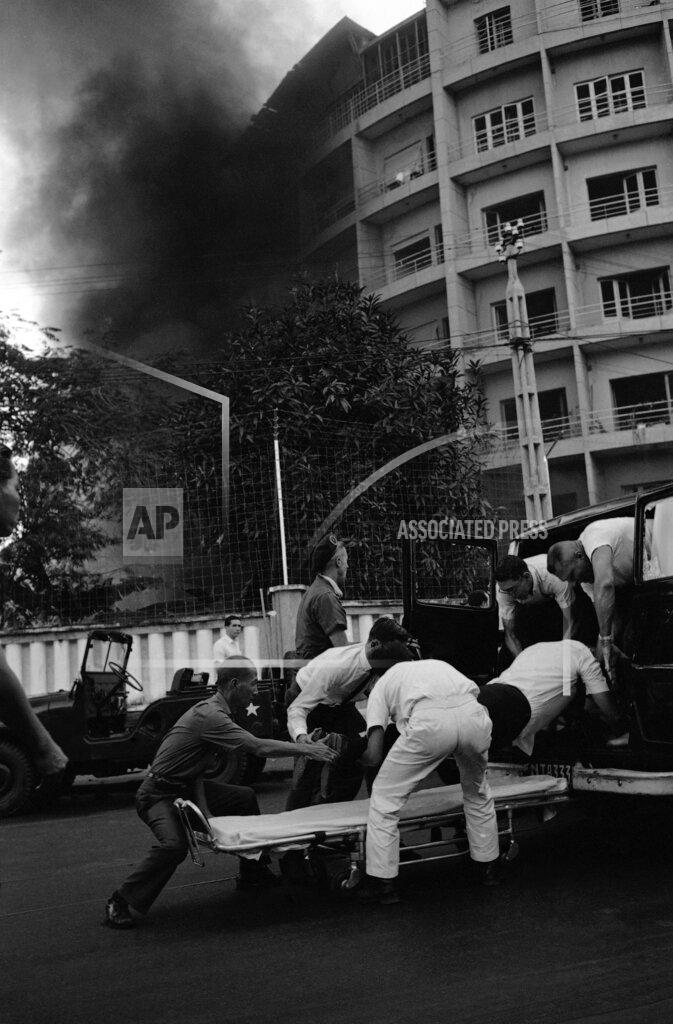
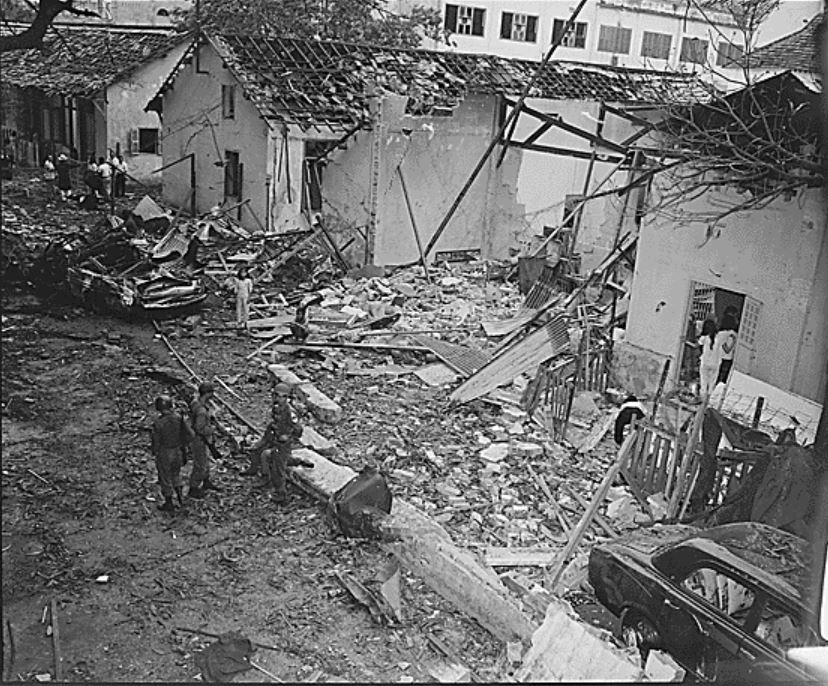
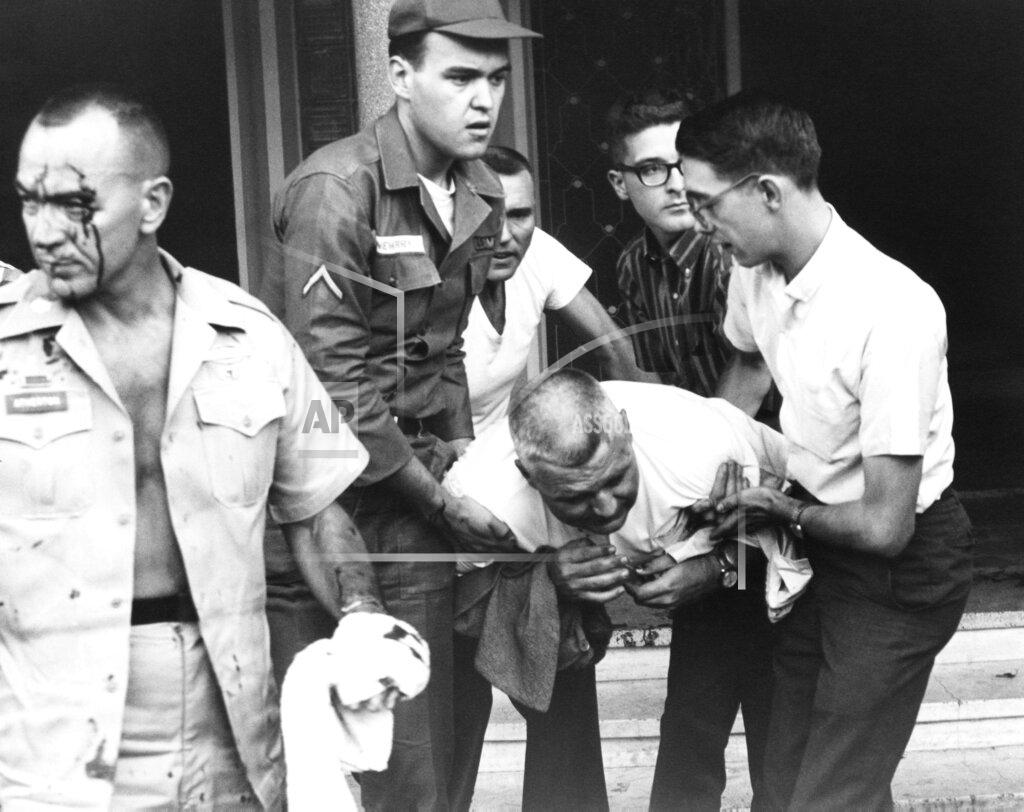
Two Việt Cộng agents, disguised as ARVN soldiers, leave a car filled with explosives parked at the Brinks Hotel, used to house U.S. officers. Two Americans are killed and 65 Americans and Vietnamese injured. Apparently aimed at visiting American comedian Bob Hope, a time bomb set by Việt Cộng terrorists exploded at Brinks, a U.S. Army officers club in Saigon, killing two Americans and wounding 50 others. Three years later, a captured memorandum was located that had criticized the terrorists for the fact that “The bomb exploded 10 minutes before the set time. Shortly after the explosion the cars of the Bob Hope entertainment group arrived. If the bomb exploded at the scheduled time, it might have killed an additional number of guests who came to see the entertainment.”
The bomb exploded with tremendous force below the concrete apartment building, known as the Brink billet, just as the staff officers were returning home. The explosion ripped holes through the lower three floors of the eight‐story building and hurled debris as far as a block. A ball of fire erupted around the building and the interior burned for 40 minutes before Vietnamese firemen extinguished the flames. The injured Americans were treated at a hospital for conditions ranging from lacerations from flying glass and plaster to concussions. The injured Vietnamese were employes in the building. The explosion silenced the Armed Forces Radio Service, whose studios are on the ground floor of the building only a few yards from the direct site of the blast. Two hours later the station returned to the air with an emergency transmitter, resuming a program of Christmas carols.
An estimated 200 pounds of plastic explosive was used in the bomb that wrecked the United States Army officers’ quarters in downtown Saigon. An American civilian and a United States Army officer were killed in the explosion tonight in the Brink officers billet. In the rubble, searchers found the body of Lieutenant Colonel James Hagen. The civilian died in a hospital of wounds. Authorities said more bodies might be in the ruins, but none of the injured Americans was expected to die. All but 20 of the wounded were released from the hospital within five hours.
The United States Army smuggled Bob Hope into South Vietnam today with secrecy greater than that normally used to veil the movements of generals and Cabinet officials. The Army apparently feared that announcement of Mr. Hope’s schedule might invite Communist attack on the audience at any base where the comedian and his troupe perform. Mr. Hope is on a Christmas tour of United States bases in the Far East. Putting on his first show in Vietnam at the Biên Hòa air base, he squinted against the sun and cracked: “Incidentally, if there are any Việt Cộng in the audience remember that I’ve already got my shots.”
Hope was making his first Christmas visit to South Vietnam, and he and his 60-member troupe entertained 1,200 servicemen at the Biên Hòa Air Base. He opened by joking, “Hello, advisers. Here I am in Biên Hòa… which is Vietnamese for ‘Duck!!’”. Referring to his surroundings as “Sniper Valley”, he said, “As I flew in today, they gave us a 21-gun salute… Three of them were ours.”
Taylor, Westmoreland and some other senior U.S. officials try to persuade President Johnson to respond to the bombing with retaliatory raids against North Vietnam, but Johnson refuses. In his cable to Taylor explaining his decision Johnson for the first time indicates he is considering a commitment of U.S. combat troops.
A State Department spokesman reported no progress today in Ambassador Maxwell D. Taylor’s talks with South Vietnamese leaders in an effort to restore political stability. Robert J. McCloskey, the department press officer, described the situation as one of “great complexity and seriousness” in the wake of the weekend military purge of the civilian High National Council. Terrorist activities against Americans in Saigon started on an organized basis last February 1, when a crude bomb exploded in a bar and killed one American and wounded three others. In the next three weeks bombs were planted in another bar, at a softball stadium and a movie theater. A defective bomb was thrown on the hood of a military vehicle when its occupants arrived to investigate a suspicious package left outside an American officer’s home. The work of the terrorist gangs that month resulted in six American deaths and 68 other casualties. The civilian and military community in Saigon started taking great security precautions as a result of the attacks.
An American surgeon applies his skilled hands to the torn limb of a Vietnamese soldier wounded in the war against the Việt Cộng. This is his Christmas, 1964. He is one of the more than 60 American physicians who have paid their way to come to Vietnam to give their skills to war victims and to share their knowledge with their Vietnamese counterparts. It costs the Americans about $1,800 to fly here. They must spend about $12 a day for a hotel room and must pay for their food and laundry, even the taxi fare to the operating rooms of Saigon’s Cộng Hòa Military Hospital. The expenses probably come to $3,000. In addition, they lose income through being away from their practices.
The Pentagon said today the bulk of the approximately 22,000 American military men serving in South Vietnam are there because they were ordered there, not because they volunteered. It adds that “no formal inducements” are being made to obtain volunteers. When the United States began giving military aid to South Vietnam four years ago, a substantial number — if not an actual majority — of the American military men who went to help in the war against Communist guerrillas were volunteers. Now, the Defense Department said in answer to a question, “most people of all services are assigned as individuals, with few exceptions.” These exceptions include, in addition to the individual volunteers, units that are deployed to the war zone. These include Army special forces outfits and crews of Marine helicopter units which are rotated on Vietnam duty.
Communist China warned today that all of Indochina would be plunged into war should the United States decide to bomb the Hồ Chí Minh supply lines that run through Laos from North Vietnam to South Vietnam. The United States has been reported working on plans to cut off the Communist supply trail to the Việt Cộng guerrillas which wanders through the jungles of Laos. “The Laotian situation is therefore fraught with danger,” said the Peking People’s Daily in an article signed Commentator. The newspaper is the official publication of the Chinese Communist party and the writer was believed to be a ranking member of the Politburo. The report was broadcast by Hsinhua, the Chinese press agency, and monitored in Tokyo. “The Chinese people unreservedly endorse [Laotian Communist] Prince Souphanouvong’s statement of December 17 warning United States imperialism and its lackeys against raids on the Laotian liberated areas and calling for the speedy convening of a 14‐nation conference to insure the implementation of the 1962 Geneva agreements on Laos,” it said. “It is quite obvious that the flames of war will spread to the whole of Indochina if United States imperialism succeeds in its criminal scheme.”
Prince Souvanna Phouma, Premier of Laos, said today that no agreement existed between his Government and that of the United States to permit United States planes to bomb anywhere in Laos. The Premier added he was not referring to the written reply given to a question submitted by The New York Times and published yesterday in the official Laotian press. A dispatch from Vientiane, printed in The New York Times on December 22, disclosed that the Laotian Government had agreed privately to allow increased bombing strikes by United States aircraft against Communist supply lines in Laos. Any decision to authorize such attacks would not be announced by official American sources, the dispatch said.
A spokesman at the United States Embassy in Vientiane, asked if an agreement existed permitting United States planes to carry out the bombing raids, replied, “No comment.”
Some of the loneliest men in the world on Christmas Day will be the 13 or more Americans believed held prisoner by the Communist Việt Cộng guerrillas. At least eight soldiers, one Air Force officer and four American civilians are reported to be in Communist hands in South Vietnam. Nine other Americans are listed as missing. However, a recent Communist broadcast said one of them, Captain Richard Whitesides of the Air Force, was a prisoner. None of the American captives is known to have received a letter, a Christmas card or any other word from home. Seven of the Americans are held in one of the Communist prisons. This will be their second Christmas in captivity. The International Red Cross has tried to ship standard prisoner‐of‐war packages to them, as well as letters, but there is no evidence that any have been delivered.
Poland has coupled cautious backing for a Chinese Communist call for a world nuclear disarmament conference with renewed support for Soviet disarmament proposals, it was reported in Warsaw today. The move came in a letter from Premier Josef Cyrankiewicz to Chinese Premier Chou En‐lai. It was briefly reported in an official Polish agency dispatch that was printed in leading newspapers today. The Peking proposal, sent to all nations, was issued October 17, just after Communist China exploded its first atomic device. The Premier said that Poland “shared the idea of the Chinese People’s Republic in calling a world summit conference to talk over problems connected with this matter.” At the same time Mr. Cyrahkiewicz’s letter said that Poland and other nations “support the proposals put forward by the Soviet Union that strive for the annihilation of nuclear weapons.”
Platon D. Morozov of the Soviet Union, speaking in the Security Council, accused Adlai E. Stevenson of hypocrisy today over Mr. Stevenson’s renewed statement that the United States and Belgian military airdrop in the Congo last month was purely humanitarian. Mr. Stevenson, the chief United States delegate, was attacked after he used strong language in denouncing accusations by Foreign Minister Charles‐David Ganao of the Congo Republic. Mr. Ganao spoke yesterday… Mr. Stevenson said that in debate since December 9 on this issue he had been torn between disbelief and sorrow as he heard “parrotlike repetition of absurd charges” and other evidence of African distrust of the United States. The Council meeting — unusual on Christmas Eve — brought no apparent change in the situation. The question was adjourned until Monday afternoon. Mr. Ganao’s charges were rejected in remarks by Mr. Stevenson, Chief S. O. Adebo of Nigeria and Theodore Idzumbuir of the Congo. Mr. Ganal had charged that the airdrop, intended to rescue foreign hostages from the rebels, was part of a colonialist plot and that both Premier Moïse Tshombe of the Congo and Foreign Minister Jaja A. Wachuku of Nigeria were puppets in the hands of the colonialists.
Rebel leaders warned today that Léopoldville would be attacked tomorrow morning. Government troops were placed on alert at dusk. Paracommandos armed with submachine guns took up positions in downtown Léopoldville and Congolese Air Force trainer planes, piloted by South African and Belgian mercenaries, swooped low over the shanty towns. The alert was ordered after the Committee for National Liberation, an exile group directing the Congolese rebellion, warned that it would strike at 9 AM. The communique, broadcast from Brazzaville, capital of the neighboring Congo Republic, said the attack would coincide with a “nationalist” uprising in the city. Rumors about an uprising tomorrow have been circulating in the capital for weeks.
Diplomatic observers regard the rumors as vastly exagjgerated, however, and they predieted that the city would get through the holiday . period without serious violence. Premier Moïse Tshombe appealed to the city’s 1.2 million inhabitants to remain calm. In a communiqué over the Leopoldville radio, he said the Government had noted “a certain effervescence” provoked by rumors about possible troubles in the capital. These rumors are “absolutely without foundation,” he said. “They are only maneuvers by certain countries hostile to the Congo, who are trying to sap the population’s morale and weaken the Government’s position on both the national and the international planes.” The Premier said all these efforts would fail “because the Government has taken all necessary steps to see that troubles do not break out.” Agitators will be “punished without pity” if they continue to circulate false rumors, he added.
Europeans here, particularly the large Belgian population, have become increasingly nervous in the last few days. One long‐time resident said the Belgian community was more nervous now than at any time since the Congo became independent in 1960. The Belgian Embassy is believed to have worked out an evacuation plan for the 20,000 Belgians in the city. The United States Embassy is also reported to have a plan, but officials refused to discuss it.
Diplomatic relations between the United States and the United Arab Republic (Egypt) took another turn for the worse today. The United States protested to the Government of President Gamal Abdel Nasser over the shooting down of an unarmed American civilian plane by Egyptian jets last Saturday and the protest was immediately rejected by the United Arab Republic. The diplomatic rebuff came hard on the heels of blistering criticism of United States policies in the Congo and of the American aid program last night by President Nasser in an Egyptian Victory Day speech at Port Said. The Egyptian President attacked the United States in another speech tonight, but by comparison with last night’s it was only a glancing blow. The American Embassy maintained an icy silence on President Nasser’s speech today although informed sources disclosed that a complete review of the American aid program to the United Arab Republic would be made in light of the Nasser attack last night.
Italy’s parliamentary regime, split into nine identifiable parties and numerous intraparty factions, appeared today to be trying to give an imitation of France in the declining years of the Fourth Republic. In December, 1953, the elected representatives of about the same number of French parties and factions required seven days and 13 ballots to elect René Coty, until then a relatively unknown outsider, as President of the French Republic. Many observers date the beginning of the end of the French parliamentary party system from that election because of the damage done to its public reputation by the spectacle of doctrinaire divisions it revealed. Four and a half years later the Fourth Republic collapsed and gave way to a presidential system headed by General de Gaulle. The Italian presidential electors — 963 Senators, Deputies and regional representatives — have completed 15 ballots without reaching agreement on a new chief of state.
The day before Christmas brought a cheerier atmosphere to the London financial district. For the first time in weeks, pressure against the pound lifted in a quiet, holiday‐restricted foreign exchange market. The stock market enjoyed a modest rise. Government securities‐held steady. There was continued strong demand for gold, however. For the Bank of England, the holiday has not come any too soon. It has been supporting sterling at heavy cost to reserves. The greatest pressure has hit the forward market. Companies with future payments due in pounds have been concerting these sums into other currencies. Behind this switching is the fear of devaluation.
Chancellor Ludwig Erhard called upon the German people tonight to hold to a steady, resolute course in a revolutionary world. “In the midst of a revolution in the history of humanity,” he said, “we cannot stand aside and await developments.” In the Chancellor’s traditional Christmas Eve broadcast, he added: “It would certainly be wrong to overestimate our possibilities and to dream of a world role that Germany does not merit. On the other hand, we do not want to underrate our contribution.” In separate broadcasts to East Germany and to listeners to the West German overseas radio, Dr. Erhard defined one area in which Bonn insists on a vigorous policy—German reunification.
The Foreign Ministry said today that Israel viewed the shooting on Mount Scopus yesterday, in which three Israeli policemen were wounded, with the greatest concern. The statement was made to General Odd Bull, Chief of Staff of the United States Truce Organization. General Bull, who was received by Mordechai Kidron, head of the Foreign ‐ Ministry’s Armistice Department, said he was awaiting the findings of United Nations observers investigating the clash between Israeli and Jordanian forces. A spokesman disclosed that the ministry had received queries from foreign visitors planning to participate in the pilgrimage to Bethlehem whether the Christmas crossing would be hampered by the incident.
While President Johnson weighed a $3.5 billion request for the financing of foreign aid, the program was enmeshed today in a bitter wrangle between its House and Senate managers on how it should be packaged. Representative Thomas E. Morgan of Pennsylvania, the chief spokesman on foreign policy in the House, charged his Senate counterpart, J. W. Fulbright, with “shirking his responsibility” because of a letter he had sent to Secretary of State Dean Rusk. The Arkansan wrote Mr. Rusk that he would refuse to handle the legislation in the Senate if the Administration demanded its consideration as an omnibus bill, as it has done in the past.
Mr. Fulbright, chairman of the Foreign Relations Committee, insisted in the letter that the program be broken down into separate authorization measures dealing with military aid, economic development loans, technical assistance grants and four other major categories of assistance. The Senator said he was tired of having the always contentious legislation used as “a garbage can” for all manner of amendments embodying foreign policy restrictions “which have nothing whatever to do with foreign aid.” “If they present a new bill in January in the same old omnibus form they sent up this year, I will not serve as floor manager for the measure in the Senate,” Senator Fulbright said.
He was supported in this position by the Senate majority leader, Mike Mansfield of Montana, who termed the omnibus type of legislation a “conglomerate mass” that invited every member with a point of view to “throw in everything but the kitchen sink.” “The defense aspects of the program should be considered separately by the armed services committees, entirely apart from economic aid,” Senator Mansfield said. “I also hope the Administration will send up its legislation early in the new session, so that it can be thoroughly screened by the Congress, trimmed down and made workable.”
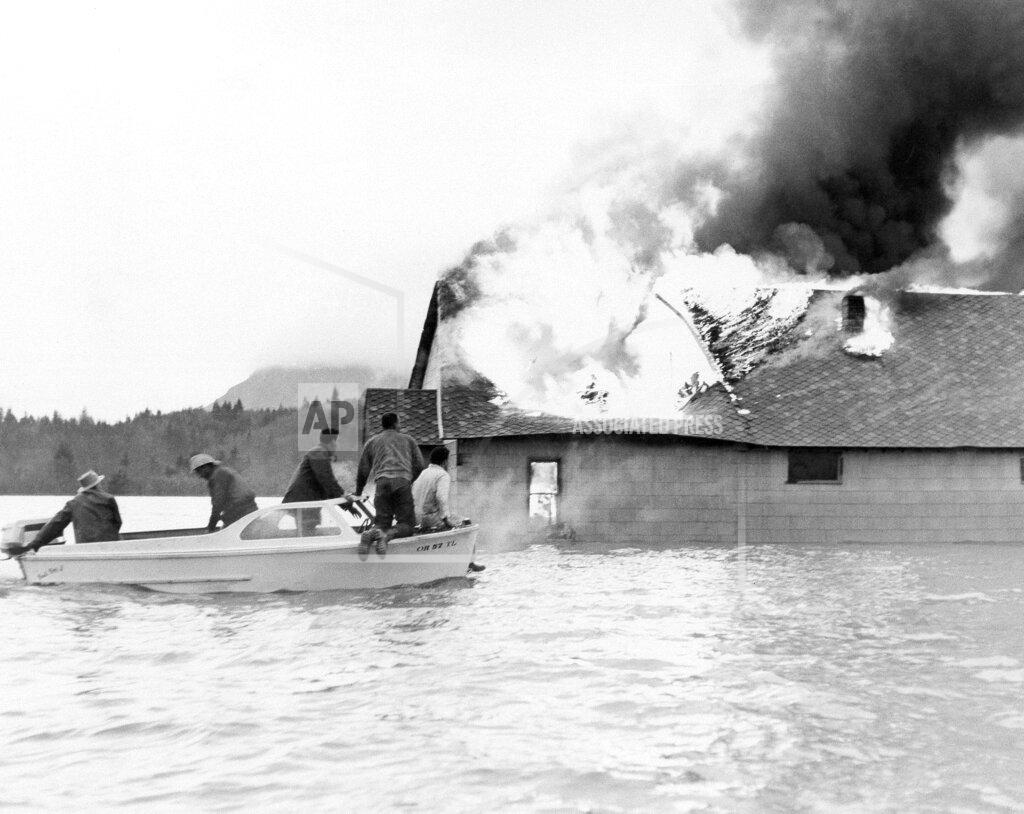
The Far West’s rampaging rivers began to recede today, leaving behind a Christmas Eve of misery for thousands of families in five states. President Johnson made stricken areas of California and Oregon eligible for Federal aid by declaring them major disaster areas. Deaths directly attributable to floods from a week of torrential rainstorms reached a known total of 37 tonight. Oregon led the list with 13. California’s toll was 10. Washington counted eight dead, Idaho, four, and Nevada, two. The Red Cross said 3,500 persons were in shelters in California and Oregon alone. Property damage was put in the hundreds of millions of dollars.
President Johnson declared flood‐stricken parts of California and Oregon major disaster areas today, making them eligible for federal relief that may total “many millions” of dollars. Mr. Johnson ordered Edward A. McDermott, director of the Office of Emergency Planning, to “coordinate broad programs of federal aid to flood victims and to communities ravaged by storms which have swept the West. Coast for the past four days.” Mr. Johnson acted in response to requests from California’s Governor Edmund G. Brown and Oregon’s Governor Mark O. Hatfield. The White House said Governor Brown “did not estimate the amount of aid his state would need” but it said Mr. Hatfield “asked for an initial allocation of $1 million to be used throughout the state but indicated that the sum needed may be many millions.”
President Johnson and his family exchanged Christmas gifts this evening. The President and Mrs. Johnson planned to attend church services tomorrow morning at St. Barnabas Episcopal Church in Fredericksburg, Texas, near the LBJ Ranch. Mr. Johnson spent a quiet and secluded day at the ranch today. There were no appointments, and two special assistants, Horace Busby and Bill D. Moyers, who had been working with him daily at the ranch, returned to Washington.
The President is expected to resume budget and legislative conferences next week with officials flown out from Washington. George E. Reedy, the White House press secretary, said he knew nothing about a report that the President would appoint Roswell L. Gilpatric, former Deputy Secretary of Defense, to replace John A. McCone as Director of Central Intelligence. It was a warm Christmas for the Johnsons, with afternoon temperatures in central Texas in the high seventies. The President’s daughters, Lynda Bird and Luci Baines, were at the ranch with their parents. So was Paul Betz, a pre‐medical student from Washington, who recently gave Luci Baines his school pin.
Federal Judge Joseph Sam Perry denied an injunction today restraining three railroad shopcraft unions from striking 187 railroads, but he issued a temporary order to prevent a walkout pending an appeal of his decision. Howard Neitzert, attorney for the railroads, said they would appeal. In a four‐page opinion that accompanied his 30‐page decision, Judge Perry said that although the merits of the case favored the railroads and the three other shop unions that have agreed to wage settlements, “the law favors the defendant unions.”
“It is the responsibility of Congress to modify the law,” the judge commented. “I can only apply it and note the need for some change in our laws to bring about more harmonious labor relations on our railroads. “The courts are neither qualified nor equipped to provide the expert understanding and knowledge that is required to settle controversies over wages and rates of pay. That should be handled by some administrative body with expert knowledge of economic and social problems — such as the Interstate Commerce Commission.”
A Black farmer who has been working with a group of Northern college students to rebuild a Black church in Ripley, Mississippi said he had been threatened today by a white man. “You won’t live four days,” the farmer said he was told. “You’ll be so full of bullet holes nobody will know you.” Tippah County Sheriff Wayne Mauny was notified of the threat and later arrested Tolbert Booker, a former county employe, on a charge of public drunkenness. Sheriff Mauny said he did not regard the incident as serious. He said Mr. Booker had recently been released from a state mental hospital. “I haven’t questioned him about the threat business yet,” the sheriff said. “I’ll have to wait until he sobers up.”
Late tonight, a metal mailbox on a wooden post in front of the church was shattered by an explosion that was heard for about a mile. A student member of the project, Marcia Aronoff, said the sheriff had been called but that he had not indicated whether he would go to the scene. She said cars had been passing the church, which is on a normally deserted back road, all through the evening.
The police in Fort Lauderdale, Florida said three white youths in a black car machine‐gunned a Black bar 23 miles north of there early today, injuring at least five persons. County sheriff’s deputies threw up a countywide roadblock as soon as they learned of the incident. They said none of the injured persons appeared in a critical condition. Witnesses told the police that a black 1957 Ford drove slowly past the bar and that a white youth in the back seat stuck a machine gun out of the window and opened fire. Officers could give no reason for the shooting.
United States District Judge Sidney Mize rejected a request today for a preliminary injunction to block “harassment” arrests of civil rights workers in the McComb, Mississippi area. Judge Mize said in a letter to lawyers in the case that he had decided to turn down the injunction request, brought by the Council of Federated Organizations, after “careful study.” Defense attorneys said such an injunction would give civil tights workers complete immunity from arrest. The council also sought the action to prevent the enforcement of the state’s criminalsyndicalism law. The injunction was requested until the council’s suit against a number of Mississippi officials come to trial. Copies of the judge’s letter were sent to District Attorney Joe Piggott of McComb, Pike County Attorney Robert Reeves, and Carsie Hall and Henry M. Aaronson, Jackson lawyers. Judge Mize told the lawyers he would set the suit, which names a number of state officials, for trial on its merits in February.
Justice John M. Harlan of the Supreme Court declined today to block a New York City Criminal Court order for arrest of Representative Adam Clayton Powell, Manhattan Democrat. The arrest order was based on a charge that Mr. Powell had transferred $900 to his wife to avoid paying a creditor. The order meant that the Harlem Representative could be arrested for failure to answer a summons on the money transfer charge any time he visited the city.
Unemployed electronics engineer Tom Osborne completed the prototype of the first desktop electronic calculator after more than a year of work at his home workshop, then spent another six months trying to find a buyer for his “Green Machine” (so called because he constructed the prototype casing from balsa wood painted green). After more than 30 rejections, he was able to sell the invention to the Hewlett-Packard company in Palo Alto, California.
The National Aeronautics and Space Administration announced some shifts in organization today and the creation of new high offices in the Manned Space Plight Division. Dr. George E. Mueller, associate administrator for manned space flight, said in Washington that the changes were made to meet requirements imposed by overlapping Gemini and Apollo launching schedules. The biggest change involves about 400 Manned Spacecraft Center’s personnel based in Florida, where they will remain. They will be placed under the Kennedy Space Center.
Arthur C. Clarke completed the first draft of his manuscript, “Journey Beyond the Stars,” which would be adapted by Stanley Kubrick as the film “2001: A Space Odyssey.”
Dow Jones Industrial Average: 868.16 (+0.14)
Born:
Elbert Shelley, NFL special teams gunner and defensive back (Pro Bowl, 1992-1995; Atlanta Falcons), in Trumann, Arkansas.
Steve Martin, NFL defensive end (Washington Redskins), in Angie, Louisiana.
Steve Griffin, NFL wide receiver (Atlanta Falcons), in Miami, Florida.
Carlos Diaz, MLB catcher (Toronto Blue Jays), in Jersey City, New Jersey.
Mark Valley, American actor (“Days of Our Lives”), in Ogdensburg, New York.
Died:
Badr Shakir al-Sayyab, 38, Iraqi poet.
Claudia Jones, 49, Trinidanian black activist.
Michael Munnelly, 23, was killed while assisting the victims of a riot in Regent’s Park, London. He would posthumously be awarded the George Cross.
Saint Kuksha of Odessa (Kosma Velichko), 89, Ukrainian Orthodox Church clergyman and saint.




 History Diaries