John Stonehouse, a member of the British House of Commons who had disappeared on November 20 in the United States, was arrested in Australia at Melbourne and charged with 21 individual crimes, including fraud, theft, and forgery, conspiracy to defraud, causing a false police investigation and “wasting police time”, a crime in England and Wales. He said he had fled because of “incredible pressures” in his business affairs and “various attempts at blackmail” in an effort to “create a new identity and attempt to lead a new life.” Despite being imprisoned in Australia and later extradited to the UK, he would continue to serve as an MP until resigning in 1976. Stonehouse, despite the denials of the Labor Party at the time (in order to protect their narrow majority in Commons), was in fact a spy for Czechoslovakia.
Six member countries of the North Atlantic Treaty Organization are planning a defense of pumping rigs in the oil and gas fields of the North Sea against possible attack by such terrorist groups as the Irish Republican Army and the Palestine Liberation Organization. Britain, West Germany, Norway, Denmark, the Netherlands and Belgium are participating in a staff study of measures to defend these ocean installations. They are vulnerable and protection against sabotage of the rigs is the immediate concern of those participating in the study, according to highly placed NATO officials. Senior NATO naval officers also emphasized that the West should be prepared, in a crisis with the Soviet Union — a kind of war‐peace twilight — for a Russian naval “guerrilla war” against the oil fields.
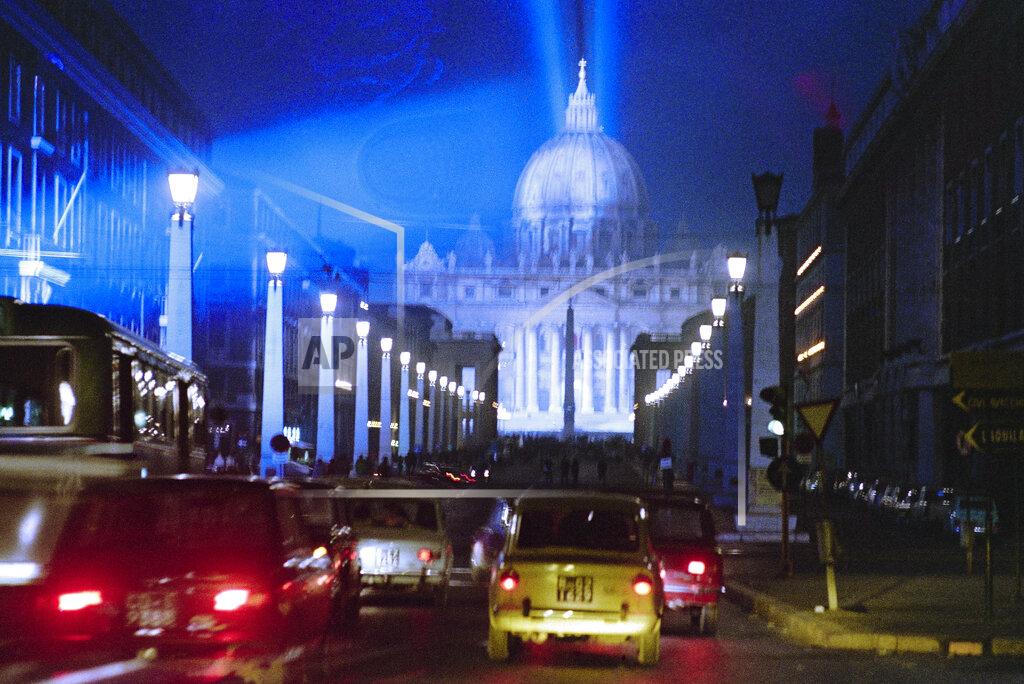
At the Vatican, Pope Paul VI inaugurated the 1975 Jubilee, designating the upcoming year as a Holy Year, in Christmas Eve ceremonies transmitted live to 45 nations. The ceremony of the Pope opening the Holy Door to St. Peter’s Basilica “was marred slightly when pieces of masonry from the door fell in front of the Pope,” adding that “Several small pieces struck him on the right shoulder and arm, but he pulled back and the mishap did not appear to upset him.” Pope Paul VI tapped three times on the “Holy Door” to St. Peter’s Basilica in Rome, walled up since the last Holy Year of the Roman Catholic Church in 1950. After workmen removed the door he led a procession into the church, inaugurating the 1975 Holy Year. In a Christmas mass after midnight he prayed for the coming of peace on earth.
Christian pilgrims attending the midnight mass in the Church of the Nativity in Bethlehem were subjected to close body searches by Israeli security forces because of recent terrorism in Jerusalem and Tel Aviv. The town was sealed off by soldiers after the Palestine Liberation Organization warned that the pilgrims might be caught in a crossfire. The Arab Mayor, Elias Freij, called the security “too strict.” The crowd seemed much smaller than usual.
Six people were strangled with steel wire and three others were injured last night in a wave of violence in Asmara, capital of the province of Eritrea, travelers said today. They added that a woman had been shot to death. This victim had earlier been identified as a man who had been stabbed to death. The bodies were found at dawn today, some lying in the street, some in doorways. The travelers described the victims as ordinary citizens. The Asmara radio said the seven persons had been killed in mysterious circumstances, but gave no details. The broadcast added that a man and two women had been injured, but did not elaborate. The radio also announced the arrest of nine persons for opposing the policy of Ethiopia’s military rulers.
The Burmese, overwhelmed by inflation and frightened by their repressive government, are embarrassed, even demeaned, by the petty corruption and black marketeering they are forced to engage in. A taxi driver says that his son has been missing since the recent student riots. A businessman shrugs and says: “Everything I’m wearing now is from the black market. Everything my family eats is from the black market.” A civil servant asks a foreigner if he has any dollars for Burmese kyats. “What can people do?” he asks. “We do the best we can. We must survive.” A man holds up a bottle of medicine for his child. It is stamped “UNICEF.” “It is smuggled in from Bangladesh and sold on the market,” he says. He points to his longyi, the wrap‐around sarong worn here, “From Thailand,” he says. He shows a small transistor radio. “From India.”
The Government’s “Burmese way to socialism” was designed to reorganize the economy along Marxist lines, spur revolutionary sacrifice among farmers and nationalize all industry, business and distribution. The tactics have largely failed because of low incentives to farmers, the use of military men with scant experience to run the economy and the scarcity of spare parts, consumer goods and raw materials, which the Government cannot afford to buy abroad. For urban Burmese, the nationalized people’s shops may be open or closed; it hardly matters. The shops were designed to provide food, cloth, soap and other basics at cheap prices. But the shops are often bare, and whatever is made available to the hundreds of people on line is quickly resold on the black market. A Rangoon joke is that if water were rationed by the Government, the population would die of thirst.
Thailand, which earlier in December lifted a 15-year ban against trading with China, has reached agreement with Peking on establishing direct trade relations, mainly involving industrial raw materials. Jute, rubber and tin are among Thailand’s potential exports to China, whereas China in the first nine months of 1974 sold Thailand $3.5 million worth of machinery, iron, raw silk and petroleum products.
Broadcasts from Lhasa, capital of Chinese-ruled Tibet, have stepped up their appeals to 80,000 Tibetan refugees in India, Sikkim and Bhutan to leave their “life of misery” and return home. These appeals to refugees of the 1958 Chinese takeover have urged that an amnesty offer be taken advantage of.
A leak from a refinery on Japan’s scenic Inland Sea has become the country’s biggest oil spill, stretching 80 miles by 20 miles. Damage to beaches and fisheries was already estimated at more than $20 million. There was speculation that the land reclaimed from the sea on which the refinery was built might have given way under a storage tank.
Shock waves caused by two high-speed Japanese trains passing each other in a tunnel blew about 20 train windows, injuring two passengers, according to Japan National Railway. The accident occurred in a three-mile long tunnel about 100 miles west of Tokyo. The trains were traveling about 130 m.p.h.
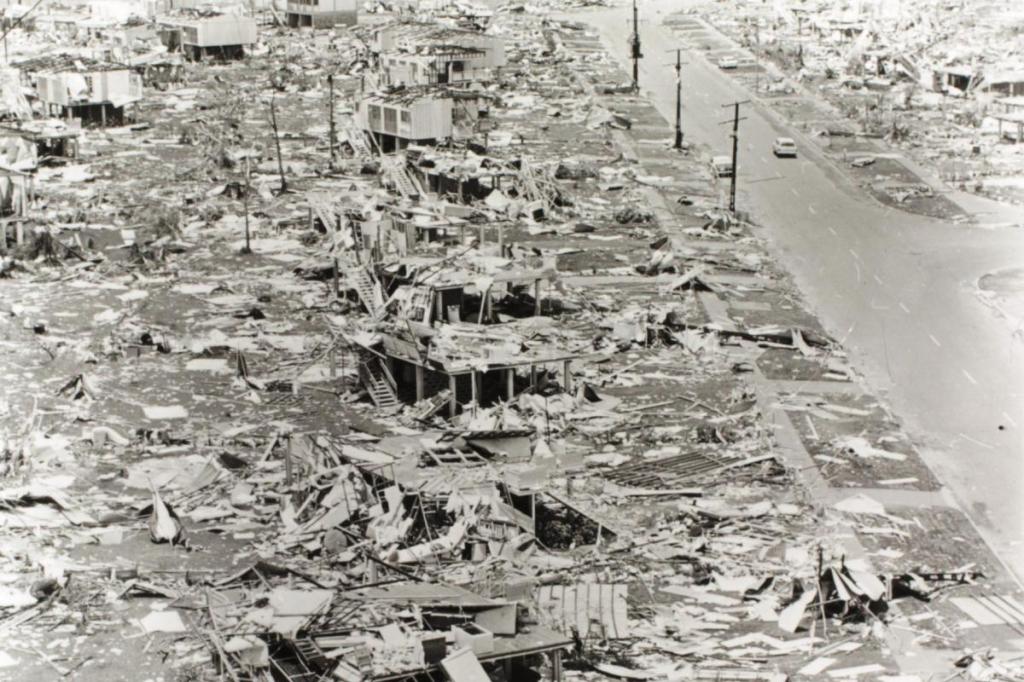
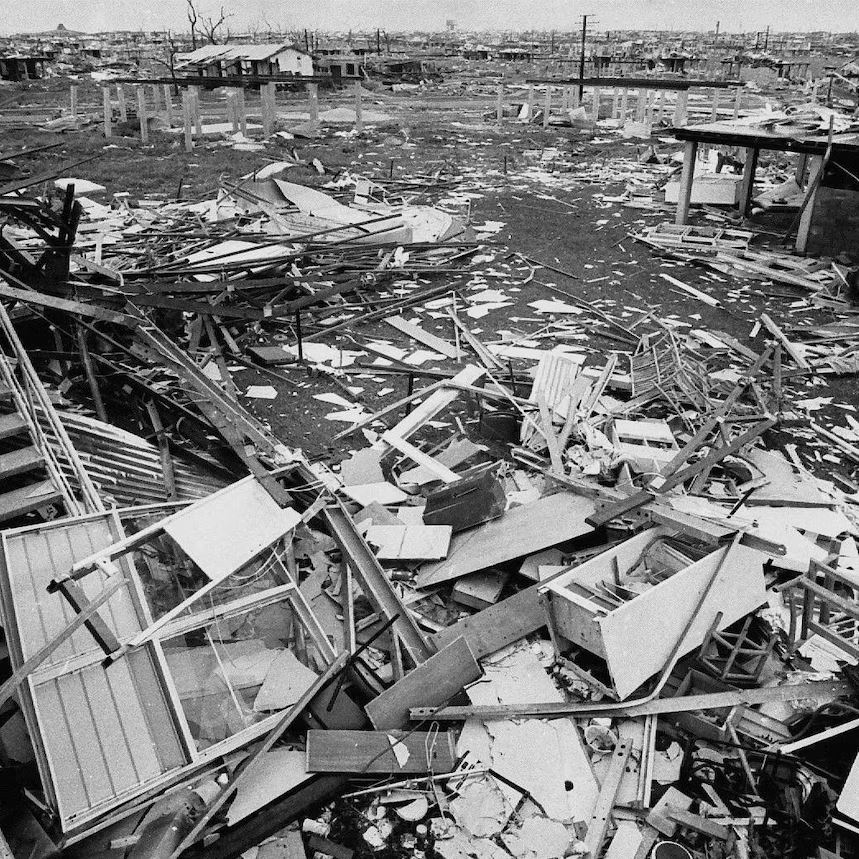
The city of Darwin in Australia was struck by Cyclone Tracy at 10:00 pm local time. Over the next eight hours, the storm would destroy more than 70% of commercial buildings and 80% of houses, leaving 25,000 of the city’s 47,000 residents homeless. Tracy killed 66 people and caused $837 million in damage (1974 AUD, about $7.69 billion in 2022, approximately US$5.2 billion). The last radio report from Darwin, a port city and capital of the remote northern territory, said that the city, which has a population of about 35,000, had been “completely devastated.” The roofs of buildings were blown off, power lines were brought down and hundreds of windows were smashed. The cyclone, designated Tracy, which first hit the area last night, brought torrential rain. All normal communications with the city were cut off and the only contact was through Australian Navy ships. Five vessels, including a naval patrol boat, went aground in Darwin harbor. One man drowned when a fishing boat, heading for the safety of the shore, capsized. After 10:00 p.m. ACST, damage became severe, with wind gusts reaching 217 km/h (117 kn; 135 mph) before instruments failed. The anemometer in Darwin Airport control tower had its needle bent in half by the strength of the gusts.
A series of three major explosions in the inner crater of Mt. Erebus on Ross Island in Antarctica have almost certainly forced scientists to abandon their plans for a daring descent into the crater. Dr. Shaun Norman, New Zealand leader of the 14man joint New Zealand-French expedition, said scientific work around the crater would continue for a few days. The descent into the crater was planned to collect gas samples.
Alistair W. Gillespie, Minister of Industry, Trade and Commerce, accused the United States today of “intolerable interference” in Canada’s business affairs after a United States company had ordered its Canadian subsidiary to halt a sale of $500,000 worth of office furniture to Cuba.
Colombia, in a surprise announcement, says it will lift some sanctions against the Communist government of Cuba’s Fidel Castro. Colombia led the 1962 move to expel the Castro regime from the Organization of American States. Foreign Minister Indalecio Lievano said Colombia was also considering reestablishment of diplomatic ties with Cuba.
President Ford is prepared to nominate Assistant. Secretary of State Harry W. Shlaudeman as ambassador to Venezuela, according to the Washington Star-News. He would replace Ambassador Robert McClintock, who is reported ready to retire. The ambassadorship is an important one since Venezuela is a member of the cartel of oil producing nations.
The newspaper O Estado de Sao Paulo quoted a Brazilian admiral as saying that Brazil would be building conventional submarines in two years and that the construction of nuclear submarines would be the next step. The newspaper said Rear Admiral Alfredo Karen, the commander of Brazil’s submarine force, made the remarks at a navy cocktail party.
Argentina’s 1974 death toll in political violence reached 222 with the death of a motorcycle officer fatally injured in an aborted terrorist attempt to assassinate the federal police chief in Buenos Aires with an explosives-filled pickup truck. The explosion missed Police Chief Luis Margaride but killed Cpl. Mario Bautista Ghioni and injured two others. Another policeman was killed earlier when five guerrillas seized a rural police station near Rosario and escaped with the weapons supply.
The State Department announced that Richard Helms, Ambassador to Iran and former head of the Central intelligence Agency, had categorically denied any “illegal” domestic spying by the C.I.A. under his leadership. But James Angleton, his former counterintelligence aide, was quoted as saying that there was something to the allegations published by the New York Times. Representative Lucien Nedzi, chairman of the House Intelligence Subcommittee, said that there had been an overstepping of bounds by the C.I.A.
The Environmental Protection Agency postponed for six months the enforcement of clean air standards requiring review by the states of land-use plans for projected highways, shopping centers, ports, stadiums and airports. The standards had been scheduled to take effect Jan. 1.
A second recount of votes in the November 5 Senate election for Senator for the U.S. state of New Hampshire showed that Republican Louis C. Wyman had defeated Democrat John A. Durkin by only 2 votes out of 223,363 that had been cast. Wyman had initially been declared the winner, but a recount led to Durkin having won by 10 votes. The third count, by the New Hampshire State Ballot Law Commission, found the result to be 110,926 for Wyman and 110,924 for Durkin. “I feel that two votes is not a real sentiment from the people,” Wyman said. Durkin was not present for the final commission report. If no court challenge is made it could be up to the Senate to decide which man to seat. Neither candidate was sworn in, and the seat would not be filled until a special election on September 16, 1975.
The FBI got permission to keep an eye on the Young Socialist Alliance convention, which opens in St. Louis December 28. The federal appeals court in New York overruled a week-old ban on surveillance or “confidential informant” monitoring of the sessions, saying the FBI only planned to do what it normally does. The court, however, ordered the FBI not to send attendance lists to the Civil Service Commission, which in the past has used such rosters to question workers or jobseekers. Attorneys for the Socialist group said they would appeal to the Supreme Court.
Attorneys for James R. Hoffa, former Teamsters Union president, argued that there were basic differences in his fight to get a commutation restriction lifted and a similar case decided Monday by the U.S. Supreme Court. The court held that the President had the constitutional right to impose conditions when he granted a pardon or commuted a prison sentence, as happened in the case involving a former Army sergeant convicted of murder. Hoffa was granted a commutation of his 13-year sentence for jury tampering and mail fraud by President Nixon in 1971 after serving almost five years. The commutation carried a restriction barring Hoffa from engaging in union activities until 1980.
Leroy Barnes, the reputed heroin kingpin who allegedly tried to bribe two New York City policemen with $130,000 in cash he carried in the trunk of his car, had his $2.6 million bail reduced to $500,000.
Pat Nixon decorated the large tree with ornaments the family has had since Tricia and Julie were little girls. She also placed wreaths around the house in San Clemente. Tricia and Edward Cox planned to stay over the weekend, while Julie and David Eisenhower were expected to remain through New Year’s Day. Year-end holidays at Casa Pacifica will be quiet. The local post office announced that former President Richard M. Nixon got more than 7,000 cards on Monday alone and gift packages had been coming in at the rate of six to 10 a day for several weeks. Dr. John C. Lungren said that his patient’s recovery was following the “projected course” and that he was showing gradual improvement and walking a total of about two miles a day.
A Montclair, New Jersey, State College freshman who set himself on fire then apparently changed his mind and threw himself under a shower was in critical condition with burns covering 90% of his body. The student, Everett Dancy, 21, of Washington, New Jersey, was in an “unresponsive state” in an intensive care unit. Dancy, who left a lengthy suicide note, has been despondent over a breakup with his girlfriend, and his mother had recently undergone major surgery for cancer, a college spokesman said.
H. J. Heinz Co. said that metal filings found in two boxes of baby cereal in Charlotte, North Carolina, apparently slipped into an empty bin during repairs. A spokesman said the machinery in the company’s Pittsburgh plant was completely checked and the filings apparently were packed into two boxes of Instant Rice cereal when production started up. The firm said it resumed normal shipments only after a complete check of the bin.
The Chrysler Corporation plans to suspend cost‐of‐living benefit payments to 18,000 of its 39,000 white‐collar workers in the latest of many recent efforts to cut operating costs. Only about one‐half of the white‐collar workers will be affected because 10,000 are union members and get the benefits under contract. Chrysler also decided to keep paying the benefits to 8,000 lower‐level employees and an additional 3,000 higher‐level executives have never qualified for the benefits because they get yearly bonuses. Chrysler has already laid off temporarily 15,000 white‐collar workers and there were indications from within the company yesterday that some of those will not be called back even if sales improve. “We’re all going to be leaner, tougher companies,” an industry source said.
The state of California has been given until Friday to post a $3.5 million bond if it wants to keep in force a federal court ban against work at two South Lake Tahoe hotel-casino sites in Nevada. The bond had been ordered for use to pay possible damages to developers should the state lose its case. California had filed suit claiming building of the $45 million Hotel Oliver by Oliver Kahle and the $40 million Tahoe Palace by Ted Jennings just north of Stateline, Nevada, would irreparably damage the lake’s environment.
A federal grand jury is investigating the finances of Irving Goldman, New York City’s Commissioner of Cultural Affairs. Court papers disclosed that the jury had heard testimony that he had used the Jola Candy Corporation, a family business, to evade income taxes. Mr. Goldman could not be reached for comment and a City Hall spokesman said there would be none from Mayor Beame, who appointed him to the $1-a-year post last February.
Dogs and sheep are being caught in traps set for coyotes in Mendocino County, California according to a suit filed in Superior Court by the Defenders of Wildlife. The conservation group filed suit to stop the county from trapping coyotes and the other animals until an environmental impact report is prepared, which could take six to nine months. The group claims the predator control program causes needless damage to animals other than coyotes because the trapping is nonselective. A show cause hearing was set for January 17.
St. Louis Cardinals speedster Lou Brock is named Sportsman of the Year by The Sporting News. He finishes ahead of such sports luminaries as tennis great Jimmy Connors, golfer Johnny Miller, and Dodgers ironman reliever Mike Marshall.
Dow Jones Industrial Average: 598.40 (+8.76, +1.49%).
Born:
Ryan Seacrest, American television host, producer and radio personality; in Atlanta, Georgia.
Kevin Millwood, MLB pitcher (All-Star, 1999; Atlanta Braves, Philadelphia Phillies, Cleveland Indians, Texas Rangers, Baltimore Orioles, Colorado Rockies, Seattle Mariners), in Gastonia, North Carolina.
Jamey Wright, MLB pitcher (Colorado Rockies, Milwaukee Brewers, St. Louis Cardinals, Kansas City Royals, San Francisco Giants, Texas Rangers, Cleveland Indians, Seattle Mariners, Los Angeles Dodgers, Tampa Bay Rays), in Oklahoma City, Oklahoma.
Keith Luuloa, MLB shortstop and second baseman (Anaheim Angels), in Honolulu, Hawaii.
Kerry Reed, NFL wide receiver (Miami Dolphins), in Miami, Florida.
Damon Winter, American photographer and Pulitzer Prize winner; in Elmira, New York.
Died:
Barbara Blondeau, 36, American photographer, of breast cancer.
 History Diaries