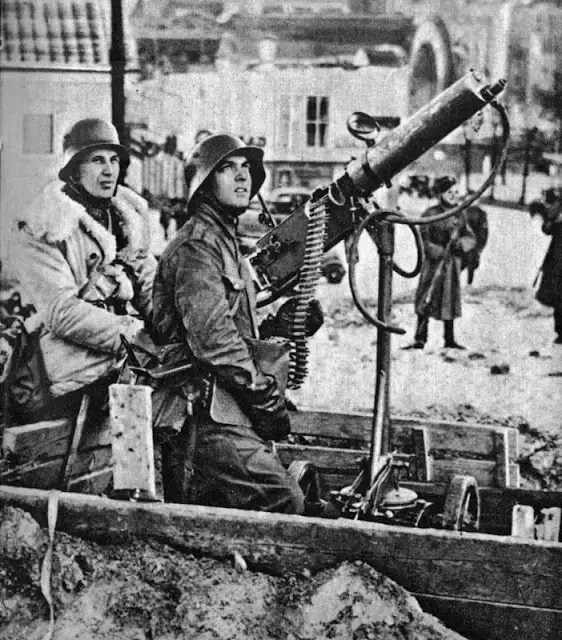
At 0630 hours, four Finnish divisions counterattacked on a 28-mile front on the west side of the Karelian Isthmus, against Soviet 7th Army forces opposite the Mannerheim Line, trying to trap resting Soviet forces in a massive encirclement. Without support of anti-tank weapons or artillery pieces, it was repulsed by tanks. Finnish General Öhqvist called off the attack at 1440 hours. There are roughly 1300 deaths on both sides, which, for the Finns, is a disaster. A stalemate ensues.
Soviet 8th Army stabilizes the front north of Lake Ladoga after heavy losses to 75th Rifle Division and 139th Rifle Division.
Finnish troops counterattack at Kollaanjoki, but the attack is broken off during the course of the evening.
In the Tolvajärvi sector, battalions from Detachment Pennanen win control of the Aittojoki parallel. The fighting at Tolvajärvi-Ägläjärvi comes to an end.
The vanguard of the Soviet 44th Division comes into contact with the Finnish troops on the Raate road. Captain Mäkinen’s 2 machine gun companies in the Finnish 9th Division attacked forward elements of the Soviet 44th Division (Soviet 9th Army), tying down the entire column of 15,000 troops and equipment. It is like a gigantic traffic jam with all lanes blocked.
The Soviet long-range ‘ghost gun’ in the Perkjärvi sector wreaks havoc and confusion in Viipuri, damaging numerous buildings in the city.
In the Turku archipelago the Merivoimat (Finnish Navy) armoured coastal vessels Ilmarinen and Väinämöinen move out of the archipelago into the open sea at Kihti to protect vital shipping routes threatened by Soviet aircraft operating out of Estonia.
The Soviets bomb Helsinki again, but this time with leaflets which contained a message from the Soviet’s puppet Finnish government. Also ther eis an ultimatum: “If Finland has not given up the fight by 1 PM today we will bomb Helsinki, destroying the city, Christmas morning. The town will be leveled to the ground.”
Unemployment statistics show that Finnish unemployment has fallen well below the level of one thousand.
Argentina’s positive response to the League of Nations’ appeal for aid to be sent to Finland has been joined by a similar response from Ecuador, Haiti, Peru, the Union of South American States, Bolivia, Venezuela and Mexico.
Gunnar Bärlund, the Finnish heavyweight boxer resident in the USA, beats Italo Golonello, with the referee stopping the bout in the seventh round. Bärlund donates part of his proceeds from the fight to the Finnish Relief Fund.
A Finnish general asks for U.S.war aid. He scoffs at Soviet bombs but fears their greater manpower.
The French prepare plans to attack if the Soviets move toward Iraq, Iran, and Afghanistan.
War, like necessity, makes strange bedfellows. Three days late, Chancellor Hitler’s birthday greetings to Joseph Stalin were made public in today’s Pravda, heading a column of congratulations from foreign statesmen.
Hitler tours the West Wall and visits German troops. Hitler begins three days touring the West Wall and visiting his troops.
In a communiqué bristling with charges of “brazen lies and Historic forgeries,” the German Government today replied to the French Yellow Book on the causes of the war.
The Rev. Martin Niemoeller, celebrated Lutheran pastor long in a concentration camp, has been unable to obtain a few days’ freedom to attend the golden wedding anniversary of his parents.
German SS organization decreed that Polish workers who left their workplace without permission were to be arrested and sent to concentration camps.
The refugee Polish Government warned Germany today that if the Allies win the war, German leaders responsible for the alleged mass executions of Polish patriots will receive the punishment “they justly merit.”
A U.S. envoy to the Vatican ends a 72-year gap. The appointment of Myron C. Taylor as Peace Ambassador to the Vatican recalled yesterday a long history of diplomatic relations between the United States and the Papal power, which terminated just before the States of the church were absorbed in the Kingdom of Italy in 1870, and Pope Pius IX lost his temporal domains.
The Rumanian Government makes inquires to the Italian government for support against Soviet aggression.
In Dublin, IRA activists steal the entire reserves of small arms ammunition of the Irish Army (some 1.1 million rounds) stored in Phoenix Park. The bulk of the ammunition is recovered during massive Army-police searches over the next 11 days.The British Military Intelligence Section 9 (MI9) was established under the command of Major Norman Crockatt. It was charged with aiding resistance fighters in enemy occupied territory and recovering Allied troops, including downed airmen and prisoners of war.
The first 7,500 Canadian troops arrive in the United Kingdom with Convoy HXF 12; on 27 December the first Indian Army troops will join the British already in France.
Two aircraft of RAF No. 10 Squadron fly a daylight anti-shipping sweep over the North Sea. No enemy shipping is seen.
The Royal Navy minesweeping trawlers HMT Glen Albyn and HMT Promotive struck mines and sank in Loch Ewe, Scotland in the North Sea (57° 52’N, 5° 40’W). Trawlers HMS Glen Albyn and HMS Promotive sank after striking mines that were laid on 27 October by U-31 at the entrance to Loch Ewe.
The decommissioned ex-Royal Navy repair ship HMS Dolphin struck a mine and sank 1.5 miles south-southeast of Blyth, Scotland in the North Sea (55° 06’N, 1° 27’W), while under tow to be sunk as a blockship. Dolphin struck a mine laid on 20 December by U-22. The ship had been used as floating workshop in Portsmouth Dockyard and was being towed to Hughes Bolckow at Cambois to be stripped of all machinery prior to being sunk as blockship at Scapa Flow. Of the ship’s complement, all 7 survived.
The Turkish cargo ship Kizilrmak sank in the Black Sea 6 nautical miles (11 km) off the Sinop Lighthouse.
The German freighter M/S Togo arrived in Hamburg, Germany and was requisitioned by the Kriegsmarine. The M/S Togo had been sitting out the beginning of the was in the Belgian Congo port of Boma at the mouth of the river Congo until had begun the trip of running the Allied blockade on October 25. The M/S Togo would be used as a troop transport during the invasion of Norway in April of 1940 and would serve briefly as the German commerce raider Coronel from late 1942 to March of 1943.
U.S. freighters Explorer (detained at Gibraltar since 9 December) and Oakwood (detained there since 20 December) are released by British authorities.
The War at Sea, Saturday, 23 December 1939 (naval-history.net)
Battleship RESOLUTION and destroyers ILEX, KINGSTON, and KASHMIR departed the Clyde to cover convoy TC.2.
Light cruiser EDINBURGH arrived at Rosyth to boiler clean and refit, and was under repair from 29 December to 30 January when she was able to depart for escort duty.
Armed merchant cruiser CALIFORNIA departed the Clyde on Northern Patrol.
Destroyer SIKH, which departed Malta on the 17th and Gibraltar on the 20th, arrived at Dover completing the transfer of the 4th Destroyer Flotilla from the Mediterranean. She moved on to Chatham arriving on the 26th for refitting and repairs until 10 January 1940.
Destroyer ESCORT with minelayer PLOVER and submarine H.34 arrived at Dundee from Scapa Flow, en route to Rosyth.
Destroyers EXMOUTH and ELECTRA arrived at Rosyth after Tyne-Methil convoy escort duty.
Minesweeper HAZARD departed Loch Ewe for the Clyde, and was joined by destroyer FORESTER for escort.
BRITISH NAVAL AWARDS
On 23 December, the first list of British naval awards and honours of the war was gazetted:
Harwood and the three cruiser captains of the River Plate Battle, Bickford and crew members of the submarine SALMON for the sinking of submarine U-36, Gregory of the submarine STURGEON for his “successful action” against a U-boat were listed.
Certain officers and ratings of submarine SPEARFISH and destroyer MOHAWK were listed for the incidents in which their ships were damaged.
Commanding officers of the following destroyers were awarded DSO’s for “successful action” against U-boats – AFRIDI, BROKE, ECLIPSE, ECHO, EXMOUTH, FAULKNOR, FORTUNE, INGLEFIELD, KINGSTON and SOMALI.
Commanding officers of the following warships were awarded DSC’s for “successful action” against U-boats – destroyers EXPRESS, FIREDRAKE, FORESTER, ILEX, IMOGEN, INTREPID, IVANHOE, VESPER, WALPOLE, and WINCHELSEA, sloop PUFFIN, and anti-submarine trawlers CAYTON WYKE and LOCH TULLA.
Commanding officers of the following destroyers were mentioned in dispatches for “successful action” against U-boats – ESK, FAME, FOXHOUND, KASHMIR, VOLUNTEER, WHIRLWIND and WOOLSTON.
Also, two officers and two ratings of VERNON were decorated for their work on magnetic mines.
Steamer PANDORA (ex-HMS DOLPHIN, 5670grt) was being towed by tugs for breaking up, when she struck a mine one mile to eastward of Blyth Pier. She sank rapidly 12.6 cables 131° from Blyth East Pier, but the crew of seven was rescued.
Convoy BC.20 of steamer BARON KINNAIRD departed Bristol Channel escorted by destroyer VIVACIOUS. They arrived in the Loire on the 25th, and returned, departing on 4 January and reaching Barry on the 6th.
Convoy FN.58 departed Southend at 1500, but was ordered to anchor in the Downs for the night. The escort was sloops FLAMINGO and STORK, joined by destroyer VEGA. The convoy was cancelled on the 24th, and FLAMINGO and STORK ordered to proceed to Rosyth if weather permitted.
Convoy FS.58 departed the Tyne, escorted by destroyer WOOLSTON and sloops FLEETWOOD and GRIMSBY, and arrived at Southend on the 24th.
Heavy cruiser SHROPSHIRE had departed Capetown on the 15th for Montevideo, but was diverted en route and on the 23rd arrived at Rio de Janeiro.
French heavy cruiser SUFFREN and British armed merchant cruiser CATHAY departed Trincomalee.
With definite information that President Roosevelt has told friends that he does not wish to run for a third term current in political circles, it has become apparent during the past week that there will be many candidates for the Presidential nomination in both Democratic and Republican conventions. Unless there are upsets in the Republican primary elections, the present indication is that there will be at least a score of aspirants who will receive votes on the first ballot at the Republican National Convention, including favorite-son candidates and those who really hope for the nomination for Vice President. Should President Roosevelt not change his mind — which many Democrats think he may do — there are likely to be nearly as many Presidential candidates in the Democratic National Convention.
A surprising recent development, based on the expectation that President Roosevelt will not be a candidate, is the suggestion of Mayor La Guardia for the Democratic Vice Presidential nomination. This suggestion, believed to be not entirely unacceptable to the White House, was made recently by friends of the Mayor to Democratic organization leaders. The argument for naming Mayor La Guardia for second place on the Democratic national ticket was based on the desirability of selecting a resident of New York State for Vice President if the Presidential nominee should be from west. of the Allegheny Mountains. There is the further contention that Mr. La Guardia as the running mate for the Presidential nominee would attract more votes in New York State than any other second-place candidate. It was suggested particularly that Mayor La Guardia would be an Ideal running mate for Secretary of State Cordell Hull, generally adjudged to be the most probable Democratic nominee for first place if President Roosevelt is not nominated.
The suggestion of Mayor La Guardia for Vice President was not received favorably by organization Democrats who have been approached. It was recalled that Mr. La Guardia, originally a Republican, was elected to the House of Representatives on the FarmerLabor and Socialist tickets in 1924 and more recently enrolled as a member of the American Labor Party. It was the view of these organization Democrats that it would be difficult, if not impossible, to get the Democratic National Convention to accept the Mayor. Although information concerning President Roosevelt’s desire not to run again is definite, there is doubt among Democrats that his present intention is irrevocable. It is believed that the international situation and a popular demand for his candidacy at home might conceivably cause him to be a candidate. Should he so decide, there is little or no doubt that the Democratic convention would renominate him.
Liberals in the House back Roosevelt for a third term. Representative John M. Coffee, Democrat, of Washington, said today that most members of the liberal group of “about fifty” which he leads in the House wanted President Roosevelt to seek a third term. Personally favoring Mr. Roosevelt as likely to have greater support among all factions of the party than “any other left wing Democrat,” Mr. Coffee expressed belief that the existing political situation would force him to seek re-election. In any event, he said, the liberals in Congress wanted the Democrats to nominate “an outstanding liberal because they fear the reaction in labor and liberal forces generally if some conservative Democrat is selected to head the ticket — someone of Vice President Garner’s stripe, for instance.”
President Roosevelt’s silence about a third term affects the Republican primary race.
President Roosevelt was reported authoritatively today to have pared upward of $700,000,000 from War and Navy Department estimates in an effort to hold national defense costs next year to little more than $2,000,000,000. As one result of a reported $400,000,000 cut, army proposals to increase the “Initial protective force” to 600,000 regulars and National Guardsmen are expected to be deferred.
President Roosevelt announced today his intention of sending Myron C. Taylor, retired chairman of the United States Steel Corporation, as his personal representative to Pope Pius XII, with the rank of Ambassador, but without portfolio. The appointment of Mr. Taylor, an Episcopalian, came as the President called on all churches of the world to throw their influence behind the cause of world peace.
High praise was given to President Roosevelt last night by the Most Rev. Francis J. Spellman, Archbishop of New York, for his latest move on behalf of world peace through the appointment of a personal representative to the Vatican.
Congressman Martin Dies predicts a step to oust 7 million. If his inquiry receives funding, he will move against aliens in industry. Representative Martin Dies, chairman of the committee investigating un-American activities, said today that if Congress permits the committee to continue its activities the investigation would result in deportation of 7,000,000 aliens.
The majority of American voters believe that additional money to pay for strengthening the national defenses should be raised by new taxes rather than by further government borrowing, a nationwide survey by the American Institute of Public Opinion, of which Dr. George Gallup is director, shows.
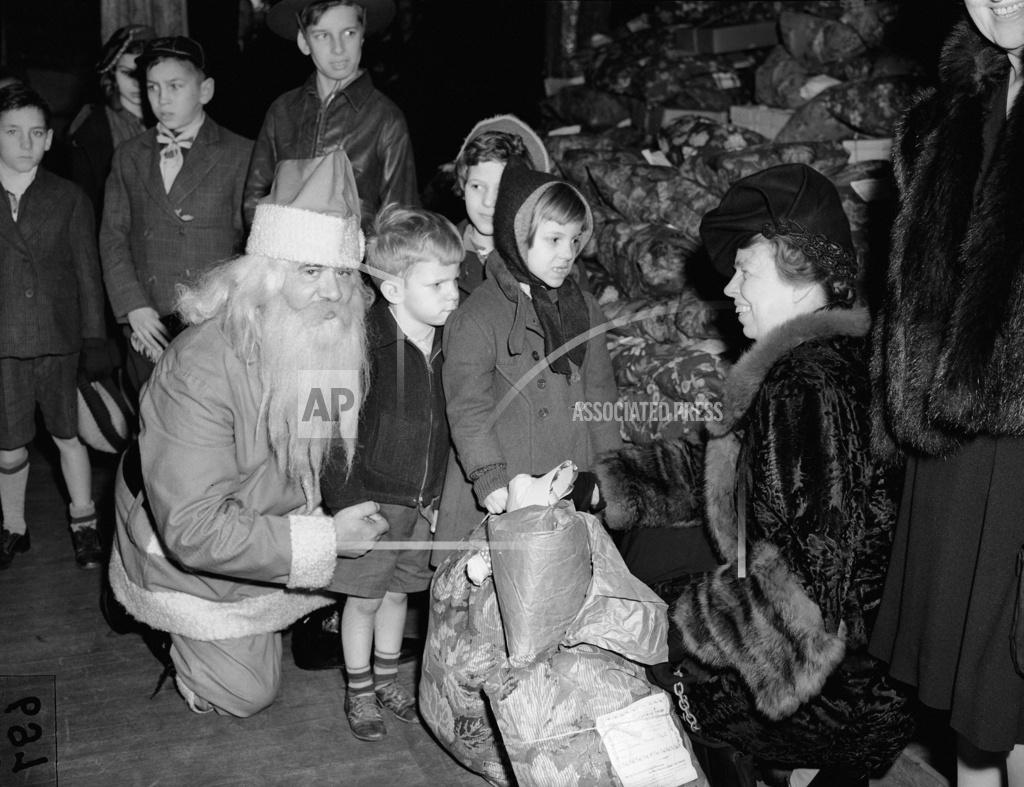
Four generations of Roosevelts gathered in the gaily decorated and brightly lighted White House tonight for their traditional Christmas celebration.
A Red paper condemns “Gone with the Wind,” calling the movie a glorification of the Ku Klux Klan. Communist indignation over “Gone With the Wind,” motion picture dealing with Civil War conditions in the South, found expression in print in New York yesterday, notwithstanding the resignation last week of Howard Rushmore, film reviewer for The Daily Worker.
The United States and Canada celebrate the Treaty of Ghent, the 125th anniversary of the end of the War of 1812.
A typhoon passes within 100 miles of Guam, in the Marianas Islands; although the gale force winds cause little damage to Navy property, they cause widespread crop and property damage in the native quarters.
A Pan-American protest is issued to the governments of Britain, France and Germany about the fighting inside the “security zone” during the battle of the River Plate. The detention and destruction of German merchant ships by British warships is also noted.
The Americas find war uncomfortably close, causing nations to implement the Declaration of Panama.
Gains by Chinese Reds trouble the Japanese. Following the arrival of the Chinese Communist forces in Shensi Province from Kiangsi Province and the establishment of a government at Yenan, the influence of the Chinese Communists, both politically and militarily, has increased considerably. Their political campaigns among the farmers and peasants of Shensi soon made it possible to form a government strong enough to defy the then Nanking Government. With the outbreak of hostilities. at Marco Polo Bridge between the troops under General Sung Cheyuan and the Japanese North China garrison on July 7, 1937, and when the fighting continued deeper and deeper into China, the Chinese Communists joined forces with General Chiang Kai-shek against the Japanese, and since then their influence has spread and been strengthened throughout the provinces of Shensi, Ninghsia, Kansu, and in parts of Sinkiang.
Although also in these provinces are stationed many detachments of troops belonging to the Chungking Government, it is doubtful if their military strength and political influence are sufficient to seriously affect the Chinese Communists. On several occasions there have been bitter disputes, to say nothing of armed clashes, between the Communists and the Chungking Government adherents, but in every case these clashes have been localized, with the Communist influence either unimpaired or stronger than ever. Operating from their capital at Yenan, in Northeastern Shensi Province, the Chinese Communist forces have caused no little trouble to the Japanese forces in Shansi and Suiyuan Provinces.
Chinese Winter Offensive: The Japanese are launching counterattacks in most places as the Chinese offensive begins to lose steam.
Japanese charges that Chinese claims of victories in counter-attacks are largely false are supported by reliable foreign witnesses. Instead of the Japanese forces in Kwangsi Province being encircled and endangered in the vicinity of Nanning, French officials in French Indo-China confirmed the fact that the Japanese had captured Nankwan and four other important towns near the Kwangsi-Indo-China border. Nankwan is almost 100 miles southwest of Nanning.
Chinese claims of successfully attacking Nanchang were exploded yesterday when two foreign newspaper men flew from Hankow southward to Nanchang. They toured the city and motored in a radius of eighteen miles outside, discovering no signs of military activity. Returning, they flew over districts southwest of Wuchang, where the Chinese have been claiming victories, and found the area quiet and the peasants tilling their fields.
The Japanese Army announced today that its troops invading the Southwestern China province of Kwangsi had smashed their way to the border of French Indo-China to cut Chinese supply lines. The Japanese flag was planted on the border and the commander of the Japanese detachment shook hands with the commander of the French garrison at Langson, Indo-China frontier town. An army communiqué said the Japanese troops thus had accomplished “their mission of destroying Chinese supply bases on the border of Indo-China” and later had left the cities of Nankwan and Lungchow, which they had occupied for forty-eight hours.
Both cities are near the French border and on the vital highway running southwest from Nanning, the former Kwangsi provincial capital, which Japanese forces, driving up from the sea, captured late in November. Huge quantities of Chinese military supplies were seized in the two towns, the Japanese said. The communiqué warned that the cities would be reoccupied “if they are restored as supply bases.” The Japanese said their troops were in possession of a large area, bringing the Chinese-French frontier situation under control.
Japanese troops land at several points along the Yangtze River to halt and drive off Chinese 3rd War Area.
Japanese 21st Army captures Lungmen and Tsotanhsu in Chinese 4th War Area zone.
Under pressure from Japanese forces east of the river, River North Army of Chinese 5th War Area begins withdrawing back across the Han River.
Chinese 8th War Area forces attack a Japanese relief column outside Paotou.
Battle of South Kwangsi: Elements of Japanese 5th Infantry Division are under attack and isolated around Kunlunkuan.
The promptness of what is interpreted in Tokyo as an American action guaranteeing Japanese trade against the effects of a non-treaty situation has created a highly favorable impression among the Japanese. The government is satisfied that the American response is proving to the public and to the army here that it is taking the right way to bring about an improvement in Japanese-American relations. Business circles are greatly relieved by the assumption that Japan’s best market is to remain open.
Dow Jones Industrial Average: 149.85 (+0.26)
Born:
La Lupe [Guadalupe Victoria Yolí Raymond], Cuban singer, in Santiago de Cuba, Cuba (d. 1992, of a heart attack).
Willie Hector, NFL tackle (Los Angeles Rams), in New Iberia, Louisiana.
Died:
Anthony Fokker, 49, Dutch aviation pioneer and aircraft manufacturer, of pneumococcal meningitis.
Naval Construction:
The Kriegsmarine (German Navy) Type IXC U-boats U-159 U-160, U-171, U-172, U-173, U-174, U-175, and U-176 are ordered from AG Weser, Bremen (werk 1009–1010).
The Kriegsmarine (German Navy) Type VIIC U-boats U-256, U-257, U-258, U-259, U-260, and U-261 are ordered from Bremer Vulkan-Vegesacker Werft, Bremen-Vegesack (werk 21–26).
The Royal Navy Flower-class corvette HMS Jasmine (K 23) is laid down by Ferguson Shipbuilders. Ltd. (Port Glasgow, Scotland).





 History Diaries