
The Kremlin is becoming increasingly agitated about the lack of Soviet successes in Finland. On 22 December 1939, they remove the commander of the Ninth Army, Dukhanov, and on 22 December 1939 bring in one of the successful and most hard-bitten commanders from Poland, Vasily Chuikov. For what was supposed to be a mere formality, the invasion of Finland is turning into a real dogfight.
Chuikov is a brutal but effective commander. Some of his troops committed war crimes in Poland while he was in command of the 4th Army, but he is a keen strategist and is adept at recovering from bad situations. He and his staff immediately start trying to figure out what is going wrong at Suomussalmi and the other flashpoints that have held up the advance.
He quickly realizes that the vaunted 44th Rifle Division, strung out along the Ratte road and essentially surrounded, was incapable of breaking out on its own. He sends a message to the Stavka that the division, highly regarded, “adjusts to the local conditions very badly.” His requests for troops to relieve this relief force, however, are denied.
Finland is becoming the graveyard of not only the graveyard of Soviet soldiers but also of the careers (and ultimately lives) of their Generals. Chuikov’s appointment is a sign that things are seriously off the track.
The First Battle of Summa ended in Finnish victory.
All quiet on the Mannerheim Line while Soviet 7th Army plans new offensive.
Soviet 17th Railway Artillery Battalion reinforces 7th Army and begins bombarding Viipuri.
Field Marshal Mannerheim of Finland authorized to launch the offensive planned by Generals Österman and Öhqvist presented to him on the previous day.
Finnish forces catch the Soviet 44th Motorized Division as it approaches Suomussalmi to attempt the relief of the trapped Soviet 163rd Division. The Finns block the road in front and behind the Soviet force and inflict enormous casualties in the ensuing close quarter fighting. Despite Chuikov’s appointment, Soviet 44th Rifle Division on the Ratte road continues to say that it is unable to break through the Finnish roadblock formed by Group Kontula. Thus, it cannot relieve the 163rd Rifle Division.
Finnish Army Group Talvela overran Soviet 75th division in hand to hand combat at Ägläjärvi (Russian: Yaglyayarvi) on the Karelian Isthmus. By 15.30 the village is under Finnish control. At Ägläjärvi, Group Telvela destroys the Soviet 139th Rifle Division. It also sends the Soviet 75th Infantry Division reeling. The remaining Soviets head back for the border. The Soviets lost over 1,000 dead, 20 tanks, 60 machine guns and the guns of two artillery batteries. The Finns lose over 100 dead and 250 wounded. This effectively ends the battle in this area.
“After days of fighting, Ägläjärvi has finally been captured today. The area had to be fought bunker by bunker, and the town itself ruin by ruin. Own losses significant, enemy’s much higher. Estimated 2,000 enemy KIA, 600 prisoners taken. Captured equipment includes 6 artillery guns, 8 tanks, 8 AT guns, 4 machineguns, 1 mortar and 240 rifles.”
-Excerpt from General HQ’s wardiary, page 152. (SPK 2777)
Two Finnish battalions pursue the Soviet troops retreating towards River Aittojoki.
The Soviets again raid Helsinki. The attacks are small, this time with only three bombers, and do not cause much damage.
The Ministry for Foreign Affairs wires the Finnish envoys in London and Paris to tell them that Finland desperately needs military assistance.
The first 150-bed field ambulance from the Swedish Red Cross arrives in Finland. The staff of the ambulance comprise 5 surgeons, 2 consultants and 10 nurses under the leadership of Professor G. Nyström.
Russia learns of big Soviet losses. Thirty thousand is the estimate as the injured fill hospitals in Leningrad and Moscow.
The Norwegian National Theatre in Oslo presents a Finnish programme including Heimo Haitto, the 14-year-old violin prodigy.
Argentina is the first country to respond positively to the League of Nations’ appeal for aid to be sent to Finland.
The Hungarian Pen Club awards its medal for 1939 to the Finnish poet Otto Manninen.
The French Chamber of Deputies votes credits of 304 billion francs for the production of armaments in 1940. Prime Minister Daladier announces the strengthening of the Maginot Line and the completion of new fortifications in northern France and the Jura Mountains.
At least three persons lost their lives this afternoon when the St. Louis Bridge, connecting the Ile St. Louis and Ile de la Cite, collapsed under the impact of a steel barge caught in the swift current of the Seine.
The British Ministry of Economic Warfare announces that the Allied Contraband Control has detained 870,000 tonnes of goods destined for Germany, since September 3rd.
Two express trains collided in Magdeburg, Germany, killing at least 132 people. Another 30 were reported killed in a second German train accident the same day.
Nazis jail a radio listener. The man gets 15 months for tuning to foreign broadcasts.
Werner Mölders and Hans von Hahn became the first German fighter pilots to shoot down British Hurricane fighters.
The first flight of the Soviet VI-100 is made. Designed as an advanced twin-engine high-altitude fighter, this becomes the prototype of the fast Petlyakov Pe-2 bomber.
An IRA gang stole the Irish Army’s entire reserve of small arms ammunition – more than one million rounds – from an ammunition fort in Phoenix Park, Dublin. Most of it was recovered over the following days.
Rumanian representative requests Italian support in event of Soviet aggression.
There is a major dogfight over the Western Front. Two British Hurricanes and one German Bf 109 go down.
The Royal Navy minesweeping trawler HMS Dromio collided in the North Sea off Whitby, Yorkshire with the Italian SS Valentino and sank.
The British steam merchant Gryfevale damaged by a mine three miles east of the Tyne Pier off the east coast of England in the North Sea (55° 01’N, 1° 20’W). At 13.40 hours the Gryfevale was damaged by a mine laid on 1 December by U-61. Gryfevale made it back to the Tyne under her own power and was repaired until June 1940. She was taken over by the Admiralty and used as water distilling ship in Freetown and Bathurst until April 1944 when the ship returned to trade by Anglo-Danubian Transport Co Ltd, London. The 4,434-ton Gryfevale was carrying cotton seed, oil cake, and rice and was bound for Leith, England.
The Clyde Shipping Company (British) cargo ship Longships ran aground on the Seven Stones Reef, between Cornwall and the Isles of Scilly. All crew were rescued by the St Mary’s lifeboat Cunard (Royal National Lifeboat Institution). She broke in two a week later.
Destroyer USS Philip (DD-76) relieves USS Twiggs (DD-127) of neutrality patrol duty trailing British RFA tanker Patella off east coast of Florida; while en route to Fort Lauderdale, Twiggs observes British light cruiser HMS Orion off Port Everglades and anchors to keep an eye on the British warship as the latter prowls the coast.
Convoy OA.58 departs Southend.
Convoy OB.58 departs Liverpool.
The War at Sea, Friday, 22 December 1939 (naval-history.net)
On Northern Patrol, two cruisers were between the Orkneys and Faroes, one cruiser and five AMCs between the Faroes and Iceland, and two cruisers and one AMC in the Denmark Strait. In addition, one additional cruiser and two AMCs were en route for the patrol line between the Faroes and Iceland.
Heavy cruiser DEVONSHIRE arrived at Scapa Flow from Northern Patrol, refueled, and left again that same day for the Patrol.
The Northern Patrol from 22 December to 4 January 1940 sighted 43 eastbound ships of which 35 were sent into Kirkwall for inspection.
Light cruiser GLASGOW arrived at Rosyth from Fair Isle Patrol.
Light cruiser MANCHESTER departed Portsmouth for the Scapa Flow, arriving on the 24th.
Destroyers FOXHOUND, FIREDRAKE, FAME and FEARLESS with the 1st Minesweeping Flotilla arrived at Loch Ewe.
Destroyer KIPLING (Lt Cdr A. St Clair-Ford) was completed. Following working up, she joined the 5th Destroyer Flotilla operating with the Home Fleet, on 18 January 1940. KIPLING was to have been completed in September, but turbine problems required the gears to be re-cut.
Convoy OA.58 departed Southend escorted by destroyer BROKE and sloop ABERDEEN. The destroyer was detached on the 24th, and the sloop on the 25th, when the convoy dispersed.
Convoy OB.58 departed Liverpool escorted by destroyer WINCHELSEA and sloop DEPTFORD to the 25th, when the convoy dispersed.
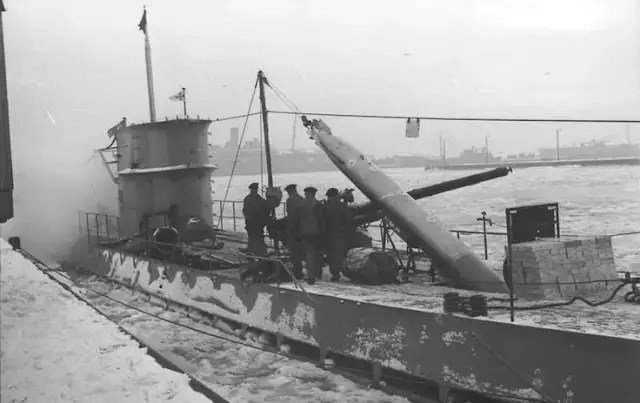
U-22 laid mines off Blyth, on which one merchant ship and one trawler were sunk.
Steamer GRYFEVALE (4434grt) was badly damaged three miles east of the Tyne Piers, off Whitby Bay on a mine laid by U-61 on the 2nd. She was towed into the Tyne and beached to prevent her sinking.
Canadian troop convoy TC.2 departed Halifax with troopships BATORY (14,287grt), ANDES (25,689grt), ORMONDE (14,982grt), ALMANZORA (15,510grt), ORAMA (19,840grt), CHROBRY (11,442grt) and REINA DEL PACIFICO (17,702grt) carrying 806, 1358, 1269, 1284, 935, 1045 and 1455 troops, respectively. The convoy was escorted from Halifax by Canadian destroyers HMCS OTTAWA, HMCS FRASER, HMCS RESTIGOUCHE, HMCS ST LAURENT and the British HUNTER. Battleship REVENGE (Vice Admiral Holland aboard returning to England to assume post on Admiralty-Air Ministry staff), French battleship DUNKERQUE and light cruiser GLOIRE were ocean escort.
Heavy cruiser CORNWALL and light cruiser GLOUCESTER departed Durban. CORNWALL arrived at Simonstown on the 26th, while GLOUCESTER proceeded to Mauritius.
President Roosevelt was described by usually well-informed officials today as reconciled to a $3,000,000,000 deficit in the next Federal budget, in spite of an announced desire to limit it to $2,000,000,000. When the President sends his annual budget message to Congress the first week in January, these sources predicted, he will ask for about $9,250,000,000 of expenditures during the year beginning July 1, 1940.
At the same time he is expected to forecast revenues during that fiscal year of about $6,300,000,000, not counting revenue from any new taxes which Congress might levy. Whether the deficit will be slightly more or less than $3,000,000,000 depends on adjustments in preliminary calculations which the President, the Budget Bureau and Treasury have yet to make before the big budget book goes to the printer next week.
Behind the scenes the war has increased some costs, particularly those for national defense, and has cut some revenues, such as customs receipts. But better business — some say this is also a war effect — has reduced certain costs, like relief, and has improved such revenues as income and excise taxes. By spending less and taking in more, the deficit in the next budget may be about $800,000,000 smaller than the shortage for the current year. Careful estimates are that the government will spend about $9,500,000,000 and take in about $5,700,000,000 this year.
The President has thrown out some pretty broad hints about his next budget which are keeping many Washington officials on pins and needles. The army and navy feel most comfortable. They are assured of increases which will boost the national defense total from about $1,500,000,000 this year to $2,000,000,000 next year. As usual, the army and navy will split this melon about 50-50.
But public works advocates are groaning under prospects of seeing their funds cut from $1,000,000,000 to about $500,000,000, including Federal grants to States for highway building. The budget is expected to rule out all new projects and to provide barely enough cash to continue those already begun. Relief is due for a slash from about $1,500,000,000 to about $1,000,000,000, many officials say. This cut is based on the belief that improving business can absorb a substantial number of the jobless. Decreasing relief demands were hinted oy WPA Commissioner F. C. Harrington yesterday when he said. that the agency would ask for no deficiency appropriation to operate until July 1. The WPA enrollment last week was 2,122,900, a drop of nearly 1,000,000 from December, 1938.
President Roosevelt advocated today a program for Federal construction of hospitals and medical centers in communities of poor States which now lack them and indicated he would recommend the plan to Congress after the Interdepartmental Committee on Health had studied it. The President rejected the Wagner Health Bill for immediate solution of the problem, declaring it too costly. He said that one trouble with such measures as the Wagner bill and the Harrison State Aid Education Bill was that the States must match Federal grants in order to obtain projects, which the poorer States could not do. These measures, he observed, would cost great sums.
He suggested that the hospital program be started modestly, and indicated his belief that fifty such hospitals should be the goal for the present. He proposed that a committee of doctors select the localities where the need for the hospitals is greatest. Mr. Roosevelt said it was his idea that the federal government should pay all costs of construction and then turn the institutions over to local groups who gave assurances that they could operate them. Title to the buildings, however, would remain in the federal government.
Discussing the matter at length during his press conference, Mr. Roosevelt said the Interdepartmental Committee, since his recent conference with the chairman, Miss Josephine Roche, had been working on the idea. He said he suggested a study of the matter with a view to immediate action, rather than waiting for a complete and perfected plan for a health program such as that proposed in the Wagner bill. Mr. Roosevelt observed that those states which have the most wealth are able to put up the most money to get federal aid and these states are the ones where health conditions are best. Conversely, the poor States are unable to match federal grants and these are the ones where hospital facilities are most needed. The President mentioned one county in New York State which he said had six hospitals for its 100,000 population, and could afford another one if needed. An area in the lower South, he said, of about the same population had no hospital, and those needing such facilities were compelled to travel eighty miles and then were admitted only if there was room.
The general thought, Mr. Roosevelt observed, was that there were probably several hundred such communities in the United States, and the government might step in gradually to relieve the deficiency in hospitals. It was his idea, he said, to turn the hospitals over to the local people, on the condition that they manage them in a successful way from the standpoint of health and finances. The President said it might be called the first experimental step in bringing general medical health centers to places which lack them. He said he thought it worth trying since the cost would not be great.
President Roosevelt made it clear today, with a broad smile and a reference to current foreign and domestic affairs of government, that he preferred for the time being to leave discussion of third terms, third parties, and 1940 Presidential candidates up to other political leaders. At his press conference, he was asked to say something about Vice President Garner’s recent announcement of his candidacy for the Democratic Presidential nomination, Secretary Ickes’s suggestion that if Democrats and Republicans nominated a “reactionary,” a “liberal” conference might enter the campaign, and Mayor La Guardia’s statement that voters should have a chance next year to “vote on real issues.” Mr. Roosevelt said he was too busy with foreign and domestic affairs to talk about potential events a long way off.
The National Labor Relations Board denied today charges by the American Federation of Labor that it had been partial to the Congress of Industrial Organizations and cited statistics to show that the two labor rivals had fared equally well before the board. Charles Fahy, general counsel, outlined the board’s position at a press conference after William Green, president of the American Federation of Labor, had said that evidence presented to a special House committee tended to support AFL accusations of partiality.
Churches make their preparations for Christmas worship services. Catholics in the city will honor the holiday with midnight masses.
New York’s first snow slows traffic causing holiday travelers to be delayed.
U.S. Navy awarded a $7,000,000 contract to build two new graving docks at Pearl Harbor, U.S. Territory of Hawaii; the future Dock No. 2 was to be large enough to hold a battleship, while Dock No. 3 was to be made for destroyers and submarines.
A House subcommittee is exploring the advisability of giving the navy 65,000-ton battleships. These would be larger and more powerful than any now afloat or known to be in prospect abroad. The Naval Appropriations subcommittee has asked the Navy Department to prepare estimates on the cost of such ships — almost double the size of the fleet’s biggest.
Coincidentally, Representative Maas of Minnesota, senior minority member of the House Naval Committee, recommended battleships up to 80,000 tons in size. He asserted that they would be cheaper in the long run and would make this country “absolutely invulnerable.” Chairman Scrugham of Nevada, conceding that his Appropriations subcommittee had requested the cost data on bigger ships, emphasized today that the question of their construction was decidedly in the exploratory stage and that no decisions had been reached. At present 35,000-ton battleships form what naval leaders call “the backbone” of the fleet. Congress voted funds this year to start work on two 45,000-ton battleships after hearing testimony that Japan already was at work on at least one of nearly that size. Officials said, however, that the 45,000-ton vessels still are in the planning stage.
The animated feature film “Gulliver’s Travels,” loosely based on the Jonathan Swift story of the same name, was released.
Twenty-one American republics protested to France, Britain, and Germany because of “the naval engagement which took place on the thirteenth instant off the northeastern coast of Uruguay, between certain British naval vessels and the German vessel Graf Von Spee, which, according ‘to reliable reports, attempted to overhaul the French merchant vessel Formose between Brazil and the port of Montevideo after having sunk other merchant vessels.
The ultimate fate of the German cargo steamer Tacoma was still in doubt tonight, although she continued to be held “under arrest,” with an armed Uruguayan guard on board. The government prepared a decree during the day formally interning the Tacoma for the duration of the European war, then at a late hour decided not to issue it. The Tacoma acted as an auxiliary for the German pocket battleship Admiral Graf Spee on Sunday, taking off half of the crew before the warship left port. Then the Tacoma, without clearance papers and without a pilot, followed the Admiral Graf Spee out of the harbor. When those aboard the warship left her and blew her up the Tacoma transferred the Graf Spee men she had to the tugs and barges that took all of them to Buenos Aires. Afterward the Tacoma tried to leave Uruguayan waters, but she was arrested by the Uruguayan cruiser Uruguay and brought back into port.
Many Indian Muslims are upset about not being consulted about the country’s support of Great Britain in the war. Members of the Indian National Congress resign from the government in protest. They call this the “Day of Deliverance.”
Chinese Winter Offensive: The Japanese are counterattacking as the Chinese attacks wind down.
Japanese forces counterattack Chinese 5th War Area around Wangwutai and Lochiatang and clear road from Wangwutai to Taopaowan.
Japanese 2nd Independent Mixed Brigade arrives to attack Chinese 8th War Area and relieve garrison holding part of Paotou.
Washington’s reply to the undertaking by Admiral Kichisaburo Nomura, Japanese Foreign Minister, to reopen the Yangtze River to foreign commerce, communicated by Joseph C. Grew, the United States Ambassador, last night, is accepted here as the responsive gesture that Japan had hoped for. On the strength of Mr. Grew’s observation the Foreign Office has informed the public that there now is little danger of a lapse in the commercial treaty. This is interpreted as assurance that the United States is willing to make a temporary working arrangement after the trade treaty expires.
Fears of embargoes or other forms of economic warfare are thus removed and with them goes the fear that a rejection of Admiral Nomura’s olive branch would have destroyed the government’s efforts to prevent Japanese-American relations from becoming dangerously strained. Mr. Grew’s assurances last night were cautious but they probably saved the government’s political life and ensured continuance of the effort now begun. While Mr. Grew and Admiral Nomura will continue conversations on policy in Tokyo, Ambassador Kensuke Horinouchi has been instructed to commence negotiations in Washington regarding a new trade agreement.
The Japanese Supreme Military Council, meeting in the presence of Emperor Hirohito, today approved the army’s new armament program. The proceedings lasted ninety minutes, during which the responsible officers outlined details. The details are secret but the press reports they are designed to replenish Japan’s armaments “from the standpoint of coping with the changing international situation and prompting the construction of a new order in East Asia.” The newspaper Asahi adds that members of the council answered the Emperor regarding “the fundamental principles guiding Japan’s armament policy.” Financial provision for the new armaments is made in the budget which allocates 1,018,000,000 yen to the army in addition to a special appropriation for China war expenses.
Dow Jones Industrial Average: 149.59 (+0.49)
Born:
James Gurley, American rock lead guitarist (Big Brother and the Holding Company – “Piece Of My Heart”), born in Detroit, Michigan (d. 2009).
Al Ferrara, MLB outfielder and pinch hitter (Los Angeles Dodgers, San Diego Padres, Cincinnati Reds), in Brooklyn, New York, New York (d. 2024).
Died:
Ma Rainey [Gertrude Pridgett], 53, American blues singer (heart attack).





 History Diaries