
As part of his Order of the Day, a regular message to the armed forces over Radio Vietnam, Lieutenant General Nguyễn Khánh went back on his promise to leave the country and announced that “We make sacrifices for the country’s independence and the Vietnamese people’s liberty, but not to carry out the policy of any foreign country.” Qualified United States officials considered General Khánh’s declaration a “throwing down: of the gauntlet” that could produce an entirely new situation in United States relations with South Vietnam. Even before the general’s statement was broadcast, officials let it be known that recent talks toward increasing United States aid to the South Vietnamese war effort had been suspended pending the restoration of a legal governmental structure.
Premier Trần Văn Hương was reliably reported as willing to cooperate with the military commanders who dissolved the council. The United States Ambassador, Maxwell D. Taylor, urged him to defy them. The scene appeared set for a showdown over American and South Vietnamese ideas of how best to fight the Communist insurgency. In his official assessment of the situation since Sunday, Mr. Taylor said that the military moves raised “serious questions” about the reliability of South Vietnam as an ally. The suspension of aid talks, while not affecting any of the present American support to the South Vietnamese war effort, was intended as a warning to generals that the United States commitment here was predicated on the promise of a stable government. In Mr. Taylor’s view, according to qualified sources, a sudden reassertion of military force in the political field is inconsistent with legal and orderly political procedures.
General Khánh’s order of the day, the first public reply to these American objections, was issued after a full meeting of the Armed Forces Council, the newly formed organization of the country’s leading military commanders. “Although the armed forces ever support a clean civilian government, when necessary they still have the task of acting as an intermediary to settle all disputes and differences if they create a situation favorable to the common enemies,” the order said. The common enemies cited were “Communism and colonialism in any form.”
The United States warned military leaders in South Vietnam today that American support was based on maintenance of a government free of “improper interference” by military leaders in Saigon. The warning was issued by the State Department with the approval of President Johnson, after a day in which Administration officials followed developments in Vietnam with some anxiety, uncertain how to change the course of the deteriorating political situation. The Administration was surprised and disturbed by the move of military leaders, with the approval of Lieutenant General Nguyễn Khánh, to undermine the authority of the new civilian government.
It was apparent that the military move had provoked a political crisis in South Vietnam that could lead to a reappraisal of United States policy. For the moment the Administration was uncertain where the United States stood in the situation in Saigon and where it and South Vietnam were proceeding. The Administration at first decided not to issue a statement on the ground that the situation was so unclear and so volatile that a statement might confuse the situation further. Later, when word was received that General Khánh had criticized Ambassador Maxwell D. Taylor and the United States in an interview with a correspondent of The New York Herald Tribune, the Administration changed its mind. In essence, the Administration’s statement was a defense of Ambassador Taylor, a rebuke to the military leaders, and a restatement of American policy, which seeks a stable government.
General Khánh was quoted as having said in the interview that if Ambassador Taylor did not “act more intelligently, the United States will lose Southeast Asia and we will lose our freedom.” He was said to have added that the Ambassador had acted “beyond imagination” in his reported efforts to obtain the release of politicians from jail and to restore the dissolved civilian legislature.
Until the political situation is clarified and the civilian government back in full control, officials in Washington indicated, the United States may postpone plans, announced two weeks ago, to intensify its aid to South Vietnam, now running at a rate of $1.5 million a day. It also appeared that the United States would defer any plan to strike at the Hồ Chí Minh trail in Laos, a supply route for the Việt Cộng guerrillas. A keystone of the Administration’s policy has been that it makes little sense to incur the risks of an expanded war until the home front is secured in Saigon. Among high officials, there is growing despair about how little leverage there is in the American aid. Any leverage appears largely offset by the recognition that the United States is not prepared to renounce its commitments and objectives in South Vietnam.
South Vietnam’s chief of state, Phan Khắc Sửu, has signed orders compulsorily retiring nine senior generals, including Lieutenant General Dương Văn Minh, informed sources said today. Mr. Sửu signed the order at the insistence of the commanders of key fighting units who dissolved the High National Council on Sunday, it was reported. Among those retired were three generals who, with General Minh, led the coup d’état that toppled the Ngô Đình Diệm regime in November last year. They have been charged with planning to hand over South Vietnam to a neutralist regime. The younger officers have been pressing for retirement of the nine generals, but they met opposition in the High National Council.
More than 500 soldiers and civilians from Communist‐held sections of Laos have surrendered in recent months, often because of propaganda leaflets similar to those General Dwight D. Eisenhower’s forces used 20 years ago in World War II. Since last August, the Laotian Army has printed more than two million “surrender passes.” Edged in red and replete with official‐looking seals, the passes have been dropped by aircraft into the northern and eastern areas controlled by the Pathet Lao begin successful of letters, the leaflets say: “Pass for safe conduct. Valid at any time. Officials are requested to treat the bearer fairly and to provide all necessary medical facilities.” The pass has been copied from those used to prompt surrender by the Germans. General Eisenhower’s instructions were that the bearer “be well looked after and removed from the danger zone.”
During the last few months, bands of six or seven Laotians, huddled around one man carrying a pass, have withdrawn to territory controlled by the Government. The officials who design the leaflets are not overly optimistic about their effectiveness, however. “They only work,” one said, “when we seem to hold a military advantage. If the Pathet Lao begin successful offensives no one is going to listen to us ask them to surrender.”
The Soviet Union has sent Premier Souvanna Phouma of Laos a note charging that the United States is planning to use Laos as a base for extending the war in South Vietnam, the Moscow radio said today. The note said that the United States wanted to make military provocations against North Vietnam, the Moscow radio reported. According to the broadcast, the note added that the national interests of Laos and the policy of neutrality proclaimed by the Laotian Government required an end of what was termed United States interference in Laos’s internal affairs. The note also said that the Soviet Union continued to support an international conference on Laos to discuss urgent measures to obtain a peaceful settlement in Laos between the Government and the pro‐Communist Pathet Lao, in accordance with the Geneva agreements of 1962.
More armed Indonesians have landed in southwestern Malaya, Malaysian Government announced today. A communiqué said at least 20 Indonesians carrying Sten guns came ashore from two large boats in the Pontian district about 6 AM today. The Pontian district, 150 miles southwest of Kuala Lumpur, was the scene of the first big Indonesian landing in Malaya last. August 17. President Sukarno of Indonesia has vowed to crush Malaysia, a federation of former British colonies, charging that it is a British “neocolonialist” creation.
Communist China announced today that it had captured a Chinese Nationalist pilot whose reconnaissance plane was shot down over East China. The Peking radio identified the pilot as Major Hsieh Hsiangho. The Nationalist Air Force announced Saturday that one of its RF‐101’s was missing on a coastal mission. Hsinhua, the Chinese Communist press agency, charged today that five United States warships “intruded into Chinese waters on six occasions over the weekend. Quoting a spokesman of the Foreign Ministry, it said the alleged violations had occurred off the coast of Fukien Province, in Southeast China.
The Soviet press, radio and television have waged one of their most extensive propaganda campaigns against the United States proposal for a mixed-manned nuclear force in the Atlantic alliance. Even such frequent targets as American policy toward South Vietnam, Cuba and the Congo and international crises in the United Nations have not been treated with comparable heat and bitterness. They certainly have not received anything like the same amount of space. The Soviet campaign is directed not so much against the fact that the Western powers are planning an integrate nuclear force as against the inclusion of West Germany. Soviet leaders, in the words of a recent “authorized statement” by Tass, the press agency, are convinced that the nuclear fleet would have no practical military value and would not change the balance of power between East and West. Stripped of its propaganda exaggerations, the Soviet position boils down to a demand that West Germany, at all cost and for all time, be kept from any role involving nuclear weapons.
Most Western observers in Moscow believe that this is not simply a propaganda stand but that the Kremlin’s fear of West Germany as a potential nuclear power is shared by the overwhelming majority of the Soviet citizens. A foreigner who broaches the subject with Soviet acquaintances encounters this fear at all levels of the population. “It’s not only a fear, it’s a nightmare,” one young Muscovite said. This feeling, of course, is strongest among those old enough to remember World War II. Although this is one of the many topics Russians do not normally talk about with outsiders, the foreigner sooner or later learns that almost all those around him have suffered in the war.
In the office of a correspondent, the cleaning woman is a war widow who raised her son alone and never remarried because, she says, “In my generation almost all the men were killed.” A translator lost his father at the front. Another employe Lost a brother and a third his father and sister. “To the loss of life is added the memory of the destruction by the Nazis during their invasion and retreat. One acquaintance remembers trudging through the Russian countryside in the wake of the retreating German armies. He recalls villages where only chimneys remained standing. Another Russian remembers signs at empty intersections bearing the names of towns that had vanished. And he recalls that a Soviet Army driver, after Crossing the border into Germany, in pursuit of the Nazi Army, exulted at the sight of a burning house and the realization that this was the first destruction he had witnessed on foreign rather than Russian soil.
Young Russians who were born too late to remember the war have been conditioned, by newspaper stores of this kind and also by radio commentators, numerous films depicting Nazi war crimes and by the recollections of their elders. A 15‐year‐old boy who was asked whether the Germans should be permitted to have nuclear arms looked startled and angry, as if faced with a monstrous proposition. “Of course not, they will start a war right away!” he answered without a moment’s hesitation. Whenever there is a lull in the controversy over the Western nuclear fleet — and the Soviet mass media are beginning to run short of ammunition on this subject — someone in the West seems to come along to revive the issue and to provide Soviet propagandists with a new excuse to hammer away at the theme.
Last week when the North Atlantic Treaty Organization session in Paris failed to produce the expected fireworks oyer the fleet Soviet editorial writers gratefully seized on Western reports that German generals and politicians had proposed a “belt of atomic mines” along the border between East and West Germany. There followed a daily barrage of articles and broadcasts explaining that the “atomic belt” proposal was one more proof of the incorrigibility of the German “militarists” and one more reason for all‐out Soviet opposition to the nuclear fleet plan. The occasion supported the Soviet thesis that the West Germans were “the driving force” and “the evil spirit” in a conspiracy to keep the threat of nuclear war from subsiding.
The United States, which until recently was censured by other Western countries for fostering the independence of territories that were presumably not ready for it, is now finding itself criticized as a colonial power. Charges of colonialism, neocolonialism and imperialism are being leveled at the United States in the 24‐member United Nations Special Committee on Colonialism. Along with Britain, the United States is accused of suppressing the independence of territories it controls — the Virgin Islands, American Samoa and Guam, all American territories, and the Trust Territory of the Pacific. Although United States officials at the United Nations state emphatically that the United States is not a colonial power, the newly independent states of Asia and Africa are “passionately intent on freeing all lands that are not entirely self‐governing, whether they want independence or not,” according to one United States spokesman.
What particularly angers United States members of the committee, according to one, is that the Soviet Union systematically tries to exploit this feeling. During a recent debate on the status of Guam, where the United States has an important imilitary base, Dwight Dickinson of the United States said that the Soviet Union’s real purpose for being on the committee is to strike at the vital interests of the United States. Later, elaborating, he said that the Soviet Union was seeking to further, through the committee, the aim of eliminating American and British bases in dependent territories. The British base at Aden and the United States installation at Guam, he said, are the prime targets of this Sovieteffort.
The United States and Belgium are putting heavy pressure on Premier Moise Tshombe of the Congo to take steps to improve his reputation in the rest of Africa. Concerned by a rising chorus of criticism, Washington and Brussels have urged him to make his regime more palatable to the rest of the continent. Reliable sources here said today that a series of steps were strongly recommended to Mr. Tshombe during talks he had last week in Brussels with Belgium’s Foreign Minister, Paul-Henri Spaak, and the United States Ambassador to Belgium, Douglas MacArthur 2nd. The sources here denied earlier reports that Mr. Tshombe was being urged to seek negotiations with rebel leaders to end the rebellion in the Congo.
Pope Paul VI tonight made a fervent Christmas appeal to the world for brotherhood, disarmament and rejection of class, racial and national strife. The spiritual leader of more than half a billion Roman Catholics addressed his message “to all men of all ages, of all countries, of all beliefs, toward whom today more than ever we feel we owe our esteem, our affection and our united efforts.” In this ecumenical spirit, he referred to his recent visit to predominantly non‐Christian India as “something of inestimable human value” and “a moment of understanding and blending of many hearts.” In his most direct passage on current world affairs, the Pontiff expressed alarm over “militarism” and the stockpiling “of weapons ever more powerful and destructive.” This, he said, is “a process that consumes enormous quantities of money and manpower” needed for humanitarian ends, “feeds the public mind on the thought of power and war and induces men to make mutual fear the treacherous and inhuman basis of world peace.”
Premier Levi Eshkol and his coalition Government were returned to office tonight by the Israeli Knesset (Parliament). The move had been expected. Mr. Eshkol and his fellow ministers had served as a caretaker Government since the Premier’s resignation eight days ago in a dispute with former Premier David Ben‐Gurion. Mr. Ben‐Gurion sought to reopen a controversial 10‐year‐old security affair. Parliament supported the restoration of Mr. Eshkol and his Cabinet by a vote of 59‐to‐36. There were nine abstentions. The division was strictly along coalition‐opposition lines although one opposition party, Mapam, abstained. Both the ministers and the composition of the political parties forming the hew Government were identical to those of the old. The only change was the selection of Akiva Govrin, formerly Minister Without Portfolio, as Minister of Tourism a new post.
Prime Minister Harold Wilson advocated today the establishment of a “non‐nuclear zone” in the Middle East and an international agreement to halt competitive arms shipments to the area. A “non‐nuclear zone” is necessary, the Prime Minister told the House of Commons, “to prevent what is already a dangerous situation becoming worse by becoming nuclear.” He did not elaborate on his fears, but they reflect the suspicion here that Israel and the United Arab Republic are engaged in a race to develop atomic arms. Mr. Wilson’s statement arose from questions by Frederick Burden, a Conservative, about the Labor Government’s attitude toward Israel. The questions were believed to have been prompted by the Government’s efforts to heal the breach with the United Arab Republic caused by the British military attack on Egypt in 1956.
Three Cubans, understood to be opponents of the regime of Premier Fidel Castro, were arrested last night in the December 11 firing of a bazooka shell toward the United Nations Headquarters. Chief of Detectives Philip J. Walsh said each of the three was charged with endangering life maliciously by placing an explosive near a building, and with attempting to damage a building or a vessel, both of which are felonies. They were further charged with conspiracy, a misdemeanor. Chief Walsh, Police Commissioner Michael J. Murphy and District Attorney Frank D. O’Connor of Queens said the arrests resulted from intensive police work, including painstaking checkups on the sale of bazookas. However, Stanley Ross, editor of El Tiempo, a Spanish‐language weekly, asserted the three had agreed to surrender after discussing the affair with him and his associates. Mr. Ross said the men had told him that “they could have hit the United Nations headquarters but purposely didn’t.” Instead, he said, they sought to stage a demonstration so as to take away newspaper headlines from Major Ernesto “Che” Guevara, Cuban Minister of Industry, who was addressing the General Assembly at the time.
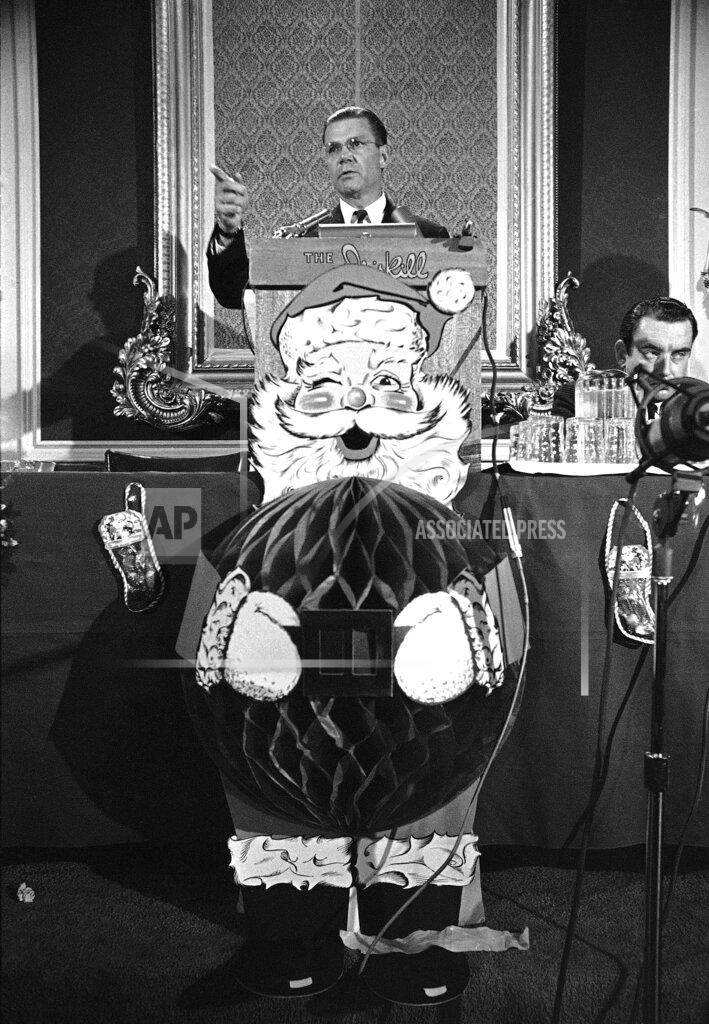
President Johnson ordered today the development of a gigantic new military transport plane that could carry 600 troops. But he planned to cut overall defense spending by about $500 million in the next fiscal year. Secretary of Defense Robert S. McNamara said after a budget conference with the President that Congress would be asked to appropriate $157 million next year to begin developing a new transport with three times the capacity of the largest existing cargo plane. Mr. McNamara said that the new jet plane, which would be the largest in the world, would “greatly reduce our reaction time” in meeting brush‐fire crises around the world by carrying both troops and heavy divisional equipment to trouble spots.
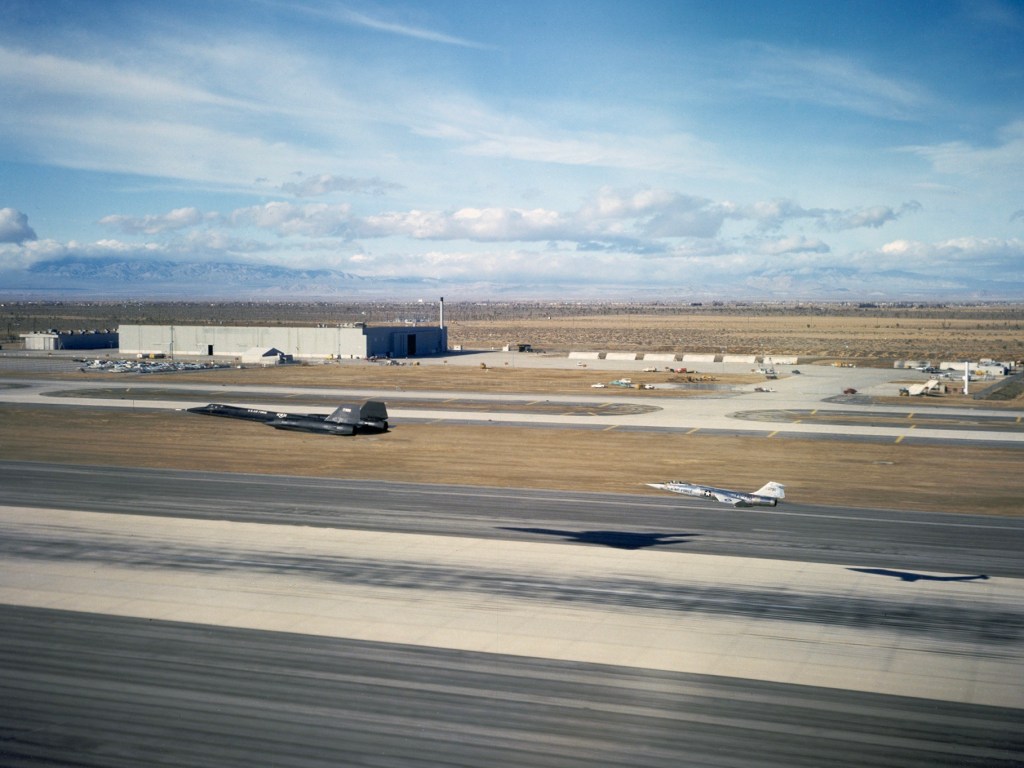
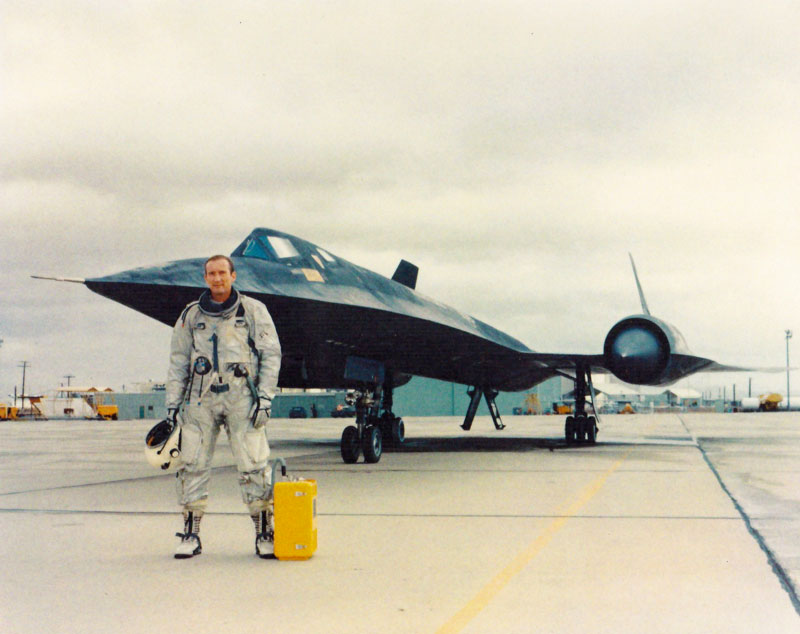
At Palmdale, California, the Lockheed SR-71 Blackbird made its first flight. Lockheed test pilot Robert J. “Bob” Gilliland made a solo first flight of the first SR-71A, 61-7950, at Air Force Plant 42, Palmdale, California. The “Blackbird” flew higher than 45,000 feet (13,716 meters) and more than 1,000 miles per hour (1,609 kilometers per hour) before landing at Edwards Air Force Base, 22 miles (35 kilometers) northeast, to begin the flight test program. Bob Gilliland made the first flight of many of the Lockheed SR-71s. It is reported that he has logged more flight time in excess of Mach 3 than any other pilot.
Mr. McNamara also announced that the defense budget for the fiscal year 1966, which begins next July 1, would be “closer to $49 billion than $50 billion.” Expenditures in the current year are estimated at $49.8 billion. At a news conference here, the Secretary said that Mr. Johnson had decided to name Gen. John Paul McConnell to replace Gen. Curtis E. LeMay as Air Force Chief of Staff when General LeMay retires January 31. Mr. Johnson conferred at his LBJ Ranch, 65 miles west of here, with Mr. McNamara, Deputy Secretary of Defense Cyrus R. Vance and the Joint Chiefs of Staff. Later he discussed budget matters with Secretary of the Treasury Douglas Dillon and the heads of the Federal Aviation Agency and National Aeronautics and Space Administration.
General John Paul McConnell will be nominated to replace General Curtis E. LeMay as Air Force Chief of Staff, Secretary of Defense Robert S. McNamara said today. General LeMay will retire from active service Jan. 31 after 35 years in the armed forces. He is 58 years old. General McConnell, who is 56 years old, had been expected to replace him. Mr. McNamara, after a conference with President Johnson at the LBJ Ranch near here, said that Mr. Johnson had approved the decision to nominate General McConnell, who is now Vice Chief of Staff. General McConnell would assume his new position February 1, Mr. McNamara said. General LeMay, a bluff, cigar‐chewing officer, rose to Chief of Staff after serving as commander of the Strategic Air Command, which he helped to build into a massive nuclear striking force.
President Johnson faces critical personnel decisions that will test the durability of business support for his Administration. The decisions involve appointees to the Government’s agencies that directly regulate business. Nine vacancies will occur in these agencies before the next year is out. Five of the posts are now held by Democrats, four by Republicans. The business community will be watching closely his appointments to the agencies, which are often regarded as having a “life‐or‐death” grip on many segments of the economy. The most immediate key appointment is to the Federal Power Commission, whose complexion could be sharply altered by the President. At present it is consumer-oriented. By naming a Republican more attuned to the wishes of the oil and gas industries, Mr. Johnson could turn the consumer majority into a minority and, thus, in effect, relax the tight regulations that the commission has exercised in recent years.
Secretary of Labor W. Willard Wirtz wants to dismiss the number‐two man in the Labor Department, Under Secretary John F. Henning. George Meany, president of the American Federation of Labor and Congress of Industrial Organizations, is said to be furious with Mr. Wirtz. Mr. Meany, the nation’s top labor leader, has told Mr. Wirtz bluntly, according to reliable sources, that if the Secretary pursues his plan to replace Mr. Henning, he will have to fight him. Mr. Meany is said to be angry enough to be considering a break with the Administration if Mr. Wirtz dismisses Mr. Henning and remains in the Administration as Secretary of Labor. Mr. Meany is understood to be deeply angry that Mr. Wirtz would seek to dismiss the top trade unionist in Government less than two months after an election in which organized labor went all‐out to help give President Johnson his landslide.
The search for a team of robbers who engineered a $513,000 holdup in Paterson, New Jersey yesterday continued with only scanty clues today. The most promising was the discovery that some of the stolen currency was in new bills, for which serial numbers were available. A spokesman for the First National Bank of Passaic County, from whose truck the money was stolen in an ambush from a church rectory, said the numbers had been given to the Federal Bureau of Investigation. The spokesman declined to reveal how much of the money was in new currency, but it was reported unofficially to have been $45,000 in $100 bills.
Vice President‐elect Hubert H. Humphrey and top Justice Department officials discussed today how the government’s expanding civil rights efforts could he carried out most effectively. Attending the meeting in the Minnesota Senator’s office at the Capitol were Acting Attorney General Nicholas deB. Katzenbach and Burke Marshall, retiring Assistant Attorney General for Civil Rights. Mr. Humphrey was designated by President Johnson on December 10 to coordinate enforcement of the Civil Rights Act of 1964 and other Federal programs in the field. Today’s conference was described as another in a continuing series of meetings Mr. Humphrey has been holding with Government officials with civil rights responsibilities and also with others outside the government.
The walls of the new Antioch Baptist Church began to rise today in the red mud of Mississippi. The Northern college students who are building the church on the site of one that burned last October devoted most of the day to laying the cement blocks that will be the base for the frame walls. Another carload of students and adults arrived during the day, bringing the total number of volunteer workers to 38. Memphis Youth Arrives Among the newcomers was a student from Tulane University who lives in Memphis, some 65 miles northeast of Ripley. He said he had read of the project in the Memphis newspapers and had driven to join it. The student said he preferred to remain anonymous. “The first thing you have to learn on this job,” the newcomers were told by an old hand, “is how to fight for a tool.”
A federal appeals court told a Mississippi federal judge today to hear a suit seeking to forbid all sheriffs, the Ku Klux Klan and others from interfering with the civil rights movement in Mississippi. The suit, filed by the Council of Federated Organizations, was dismissed by Federal District Judge Sidney, C. Mize last July 23. In reversing that order, the United States Court of Appeals for the Fifth Circuit said that “the right to be heard is one of the fundamental rights of due process of law.” Judge Mize was instructed to reinstate the case. At the same time, the council’s request for the appointment of special United States commissioners in six Mississippi counties was denied by the appeals court. The council, which coordinates most civil rights activity in Mississippi, sought an injunction against all Mississippi sheriffs, the director of the state’s highway patrol, the Klan and two segregationist organizations — the Citizens Council and Americans for the Preservation of the White Race.
The Birmingham News praised Burke Marshall today as a “man of integrity.” Mr. Marshall resigned recently as head of the Civil Rights Division in the Justice Department. “Here in the Deep South it may seem strange to some to be ‘saying a good word’ for the man who headed the Civil Rights Division of the Justice Department,” the newspaper noted in an editorial. “But Burke Marshall was never a trampler. He always tried to understand difficulties ‘on the scene’ and by temperament he was and is a healer. “Though this man Marshall was often involved in implementing laws and decisions very distasteful to the Southern majority, he personally earned the respect of those with whom we know he came into contact.” The News said it liked Mr. Marshall’s effort of always trying to understand both sides of the question while in Birmingham seeking solutions.
Mrs. Lyndon B. Johnson celebrated her 52nd birthday today strolling around the LBJ Ranch with the President and opening her gifts at the breakfast table. Their daughter Lynda Bird, 20 years old, arrived at the ranch to complete the family get-together for the Christmas holidays. The White House said Mrs. Johnson arose early this morning and took a walk with her husband. Later they both rode along the Pedernalesi River in their golf cart. The family ate breakfast at the kitchen table as Mrs. Johnson opened her gifts. She received a gold, brooch from the President.
Dow Jones Industrial Average: 870.36 (+0.62)
Born:
Mike Jackson, MLB pitcher (Philadelphia Phillies, Seattle Mariners, San Francisco Giants, Cincinnati Reds, Cleveland Indians, Houston Astros, Minnesota Twins, Chicago White Sox), in Houston, Texas.
Died:
Bonifacio Gil Garcia, 66, Spanish composer and folklorist.
Rosa Borja de Ycaza, 75, Ecuadorian playwright and activist.




 History Diaries