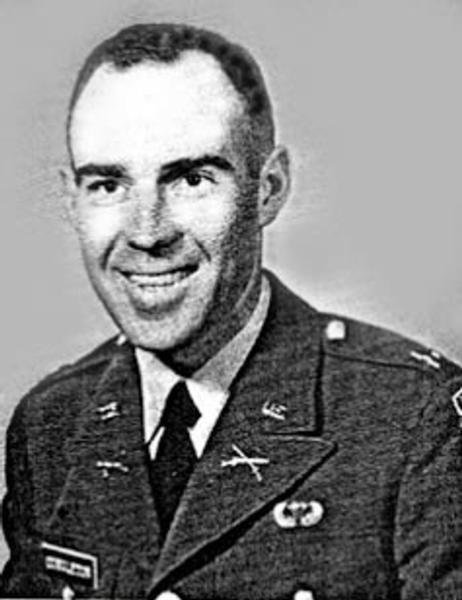
A United States Army adviser, Captain Roy E. Congleton, was shot and killed by Communist guerrillas today in a skirmish about 25 miles northwest of Saigon, a military spokesman reported. Two other American advisers were wounded slightly yesterday while helping Vietnamese provincial troops beat off Việt Cộng guerrillas on a main highway 280 miles northeast of Saigon. The death brought to 237 the total of American servicemen killed in action in South Vietnam’s war against the Communists since January 1, 1961. The American soldier was was shot in the chest during a brief skirmish with the guerrillas while accompanying a Vietnamese patrol. A Vietnamese soldier also died in the clash. There was no report of communist casualties.
In a series of talks with Lieutenant General Nguyễn Khánh, Premier Trần Văn Hương and other Vietnamese leaders, Ambassador Max Taylor tries to restore the constitutional civilian government. U.S. officials announce the suspension of talks on increasing U.S. military aid. But General Khánh deliberately gives an interview to the New York Herald Tribune and says that the High National Council ‘will not be reactivated’ just to satisfy, the United States. He also says that Taylor’s attitude during the last 48 hours… and his activity have been beyond imagination as far as an ambassador is concerned.’ On the 22nd, Khánh also issues an order from the Armed Forces Council saying that the military will retain responsibility. Although Secretary Rusk and other U.S. officials try to maintain a conciliatory stance, Khánh continues to call for defiance of U.S. influence.
In a private meeting with General Khánh, commander in chief of the armed forces, Mr. Taylor warned that the United States considered the present position untenable, qualified sources said. By abruptly dissolving the legislature and arresting some of its members, the military reasserted the supreme power it relinquished last August in favor of an orderly transition to civilian government. Premier Hương, whom the military commander pledged to support, attempted to clarify the intentions of the armed forces leaders now that the legal basis of the government had apparently been swept away. There was no evidence that the American opposition was having any effect on the military leaders.
Buddhist leaders expressed uncertainty about their stand. They called off their protest campaign against the Hương Government temporarily and were reported to have tried to meet with the generals to determine their attitude toward Buddhist demands. Air Commodore Nguyễn Cao Kỳ, commander of the Air Force and a leading spokesman for the officers who challenged the civilian regime, said the military meant literally its offer “to act as a mediator” on “all differences in order to achieve national unity.” The offer was contained in the officers’ announcement of the dissolution of the provisional legislature, the High National Council, as a source of “dissension.” “We must understand the demands of the Buddhists because some of their demands are good,” Commodore Kỳ was quoted as having said. He has been a leading critic of Buddhist attempts to enlarge their influence.
The Việt Cộng radio reacted quickly to yesterday’s sudden developments. Last night a monitored broadcast denounced the “dictatorial military clique” and said the abrupt move revealed the “violent internal contradictions” in the South Vietnamese society.
Two hundred pounds of Christmas toys for orphans in Saigon, South Vietnam, were started on the way by air today by members of the local Rotary Club. The club members here had gathered the toys oyer the last two months after an exchange of letters with the Gia Định Rotary Club in South Vietnam had pointed up the need. The toys are for 650 youngsters at the Gò Vấp Orphanage, run by nuns of the Roman Catholic Order of the Cross of Chợ Quán. The toys left Newark Airport this afternoon by commercial airliner for relay to Travis Air Force Base in California. Through the efforts of Senator Clifford Case, Republican of New Jersey, a plane will carry them from the base to Saigon for arrival by Christmas Day.
The Laotian Government has agreed privately to permit increased bombing strikes, including raids by United States aircraft, along the supply lines called the Hồ Chí Minh trail, informed sources said today. The sources emphasized that if American pilots joined in bombing the supply routes and depots used by Communist forces to assist the guerrillas in South Vietnam, the decision would not be announced. Discussing the attitude to be taken in Laos if American pilots did join, one man well acquainted with the situation said: “Open involvement by the United States here would be a great embarrassment to Prince Souvanna Phouma [Laos’s Premier]. Therefore, whatever is done will be done quietly.”
The United States Embassy in Vientiane is understood to have sent similar advice to Washington before Maxwell D. Taylor, the Ambassador to South Vietnam, recently held talks with the President on new measures. American officials here believe that any morale benefits that word of United States air strikes might bring to South Vietnam would be outweighed by political difficulties in Laos. As a country that signed the Geneva accords of 1962, the United States has pledged itself not to intervene in Laos. As circumstances have developed, the United States has been left with a certain leeway. At present, Royal Laotian Air Force T‐28’s make limited strikes almost daily along the Communist supply routes in eastern Laos. United States aircraft fly reconnaissance missions over the same areas, accompanied by fighter jet escorts.
By agreement with Prince Souvanna Phouma, the United States planes fire back at antiaircraft installations that begin shooting at the reconnaissance planes. On November 17, for example, a fighter‐bomber opened “suppressive fire” against a Communist base near the North Vietnamese border in central Laos. The American plane was destroyed and the pilot killed. Informed sources here point out that whether American planes had initiated fire instead of merely returning it could not be readily detected outside the area. The pro‐Communist Pathet Lao have repeatedly charged that such raids were already being made by American aircraft. The Pathet Lao have generally identified United Stales planes as AD‐6’s, propellerdriven Navy aircraft that resemble the T‐28’s flown by the Laotians. Some officials here expect that the stridency of the Pathet Lao propaganda in the past will prevent any immediate arousing of world opinion if the United States actually takes a more direct role.
Current bombings by the Laotian Air Force have been only partly successful for several reasons. At most the Laotians can put aloft about 15 aircraft, each carrying a maximum bomb load of 500 pounds. The semi‐skilled pilots fly only by day. They have reportedly encountered little activity along the trail although independent intelligence reports indicate activity has increased recently. The conclusion here is that Communist operations have been shifted to nighttime. To avoid civilian casualties, whenever possible the Laotian Air Force commander has tried to pinpoint military targets.
Recently the T‐28’s struck at Communist bases at Muong Phieng and Lak Sao on Route 8, and they have destroyed a bridge at Nape. The T‐28’s have bombed Route 23, a Communist truck route north of Tchepone. Tchepone itself, a major Communist crossroad and supply base, has so far been spared a thorough blasting. Some military sources believe that the Pathet Lao and North Vietnamese forces have now moved their major supply depots to the outskirts of town. The Laotian Air Force is concentrating on these more limited targets.
Although American planes could drop more bombs with greater proficiency, there are officials who doubt that the increased defensive success would be decisive. “A 500‐pound bomb makes a hole 5 feet deep and 10 feet across,” one officer said. “With 50 coolies filling the hole and packing it with a battering ram, the road can be ready again the next day. Even when we hit the bridges, we find they can ford the river.” Offensive measures are further complicated because the Communists are now believed to be using the trail principally to move men rather than material. The troops can move less discernibly over a wider area.
In Washington, the State Department had no comment on the reports. The Chinese Communist Defense Minister, according to a report from Reuters, said the United States would “be dealt most resolute counter‐blows and meet with complete defeat” if the South Vietnam war was extended.
Although President Johnson has ordered the end of pressure by the United States for an allied nuclear force, officials said today that there was a good possibility that such a force would be established, perhaps within six months. The question is said to be mainly one of agreement between Britain and West Germany, and officials expect to have a clearer idea of whether such agreement is possible by the end of next month. It is considered probable that any arrangement that can be made by Britain and West Germany will be acceptable to Italy, the Netherlands and perhaps one or two other allies. It is also considered likely to be acceptable to the United States. The President has made clear that there must be full consultation with France before any agreement is concluded. He has not made French acceptance a condition of settlement, but has insisted only that the door be left open for France to join. Officials said it was possible that an agreement could be completed before the end of 1965. The President has firmly ruled out any deadlines, however, and officials declined to make specific predictions.
The United States continues to favor a plan that would give the non‐nuclear powers, above all West Germany, a share in nuclear control without giving them a finger on the trigger. The President’s decision to end all pressure tactics does not mean that the United States no longer seeks a solution of the problem, officials said. The real question now, it was said, is whether Britain and West Germany will be willing to compromise to reach an early agreement. Britain has proposed a broad force including bombers, Polaris submarines and an undefined element involving mixed-manned crews. West Germany, until now, has favored the original United States plan for a mixed‐manned surface fleet carrying Polaris missiles.
Chancellor Ludwig Erhard called today for an urgent re‐evaluation of Western defense. However, he emphatically rejected suggestions that there was a crisis in NATO. In an interview published in Political‐Social Correspondence, a newsletter, Dr. Erhard said he was disappointed by the failure of the recent NATO ministerial meeting to come up with new ideas to strengthen the alliance. He urged that the Western countries think seriously about new ways to increase their military and political cooperation. An increase in such cooperation is required if Europe is to make progress on the road to political unity, he added. “But there can be no talk of a crisis in NATO,” the Chancellor said. “The military strength of the alliance has grown and the interests that link us are stronger than the difficulties that separate us.”
Britain’s House of Commons voted, 355 to 170, to abolish the death penalty for five years. The House of Lords would pass the Murder Act 1965 ten months later and it would receive royal assent on November 8, 1965; in 1969, the five year experiment would be made permanent.
Delegates from about half the 80 countries present drifted out of the General Assembly today as the Foreign Minister of South Africa defended apartheid. The Minister, Hilgard Muller, said his country’s objective was “a commonwealth of South African states, politically independent and economically interdependent.” As evidence he pointed to the setting up last May of an elected government of the Xhosa people in the Transkei with more than 3,000,000 inhabitants. He rejected as “caricature” the criticism that apartheid means “perpetual domination by one section of the population over the others.” Under the apartheid, or race-segregation, system in South Africa, the white and non-white populations are restricted to separate residential areas. The non-whites may work in other areas, but have no political rights except in their own territories.
The Soviet Union and China are going through nosecounting procedures in their ideological struggle. For the second time this year, Moscow is asking 25 Communist parties, including that of China, to join the Soviet party in arranging a world Communist conference to deal with the split. The Chinese rejected such an invitation last August. The Kremlin has set March 1 as the date of the initial meeting, having postponed at the last minute the one scheduled for December 15 by Premier Khrushchev before his overthrow. Again the Soviet party is using the proposal to line up its anti-Chinese supporters in public. Sor far, several of Moscow’s Eastern European allies have voiced renewed backing for a general conference; presumably this implies acceptance of the March 1 invitation.
This appears to be the first time, however, that the Chinese Communists have publicly sought to line up other Communist parties behind one of their proposals. During the summer, they confined themselves to opposition to Mr. Khrushchev’s call for a conference and influenced their allies to reject it likewise. the new Chinese device for counting noses is a letter sent October 17 by Premier Chou En‐lai to the heads of Communist and other states. It announced the first Chinese nuclear explosion and proposed a world conference to prohibit and destroy all nuclear arms. A well‐qualified Yugoslav observer has suggested that the Chinese tactics may have the following results. The Soviet Union and its allies will not endorse the Chinese nuclear test, and in answering Mr. Chou they will note that their governments have signed the treaty prohibiting all but underground nuclear tests. China has denounced that treaty as an imperialist plot.
A 12‐man African and Asian committee gave approval tonight to major changes in a plan drawn up by Alex Quaison‐Sackey, President of the General Assembly, intended to settle the crisis over unpaid Soviet assessments. Members of the committee said that the changes had been made in accordance with amendments submitted by the Secretary General, U Thant, and that they were intended to make the plan acceptable to the Soviet Union. One of the two principal changes proposed today by Mr. Thant, and accepted by the African and Asian committee, would eliminate the requirement that “substantial and adequate” voluntary contributions be made by all 115 members of the United Nations to solve the financial crisis. The revised plan gives no indication of the amount expected from the Soviet Union, which owes $52.6 million in assessments for the United Nations peace‐keeping missions in the Congo and the Middle East.
Colonel George A. Aubrey, the last of three United States military attachés charged with having spied during, a Siberian train trip, left the Soviet Union today.
The Soviet Union vetoed a United States‐British resolution today that would have called upon Israel and Syria to cooperate to prevent future clashes in the disputed area north of the Sea of Galilee. It was the Soviet Union’s 103rd veto in the Security Council. The Council has been meeting intermittently since November 16 at the “urgent” request of Syria and Israel to consider the tense situation resulting from the border fighting of November 13, which led to seven Syrian and four Israeli deaths. The resolution was also opposed by Morocco and Czechoslovakia. It was supported by the eight other members of the Council — Bolivia, Brazil, Britain, China, France, the Ivory Coast, Norway and the United States. Any opposing vote by a permanent member of the Council — the Soviet Union is one — is a veto. The resolution was thus defeated.
An investigation by the United Nations found that the firing on November 13 began from the Syrian side, when an. Israeli unit on patrol approached the border. It also found that both sides had joined in the twohour battle and that Israel had used military planes to bomb targets in Syrian territory before a cease‐fire. The Soviet delegate, Platon D. Morozov, told the Council that the resolution was “totally unacceptable” to his delegation. He described it as a “hypocritical document” and said it placed the two countries, the aggressor and the victim, on an equal footing. Not only did it not place the responsibility for the loss of life on the guilty party, Mr. Morozov said, but it contained nothing of real value in preventing similar occurences in the future. He charged that Israel was bombarding Syrian territory on a large scale and was unleashing a chain of dangerous events.
The trial of 20 men who worked at the Nazis’ Auschwitz death camp in Poland entered its second year today. Judge Hans Hofmeyer, presiding in the Frankfurt Assize Court, questioned Sigbert Löfler, a 61‐year‐old former Auschwitz inmate detailed in 1943 to work in the camp dental office. “You have described an incident at the unloading ramp,” Judge Hofmeyer said. “You were ordered to unload two freight cars of furniture. Instead of furniture, you found children in them.” “Yes, sir,” replied the witness, a bald, lanky Berliner who appeared eager to say the right thing. “About 90 in each.” “What condition were they in?” “They were dead.” “How did they die?” “They had been gassed.” “How did you know?” “I assumed so. You could tell. They were all carefully dressed, as if to go to a party.”
Congo’s Premier Moise Tshombe returned home today after two weeks in Europe. He immeditaely plungd into talks with his chief advisers. Shortly after he stepped off an Air Congo flight from Brussels at 7:30 AM, Mr. Tshombe met with General Joseph D. Mobutu, the Congolese Army commander; Victor Nendaka, chief of the Security Police, and Gotefroid Munongo, Minister of the Interior. Mr. Tshombe was briefed on the military situation, which has deteriorated somewhat in recent days. A mercenary‐led column is under attack at Paulis, and another column has run into rebel resistance near Bunia. Meanwhile, military sources said a Congolese Air Force B‐26, flown by a Cuban exile, had destroyed 15 rebel trucks in the far northeast of the Congo.
President Johnson conferred at the LBJ Ranch today with three Cabinet members on budgetary and legislative questions. He summoned the Joint Chiefs of Staff and Secretary of Defense Robert S. McNamara to the ranch for a review of military spending plans tomorrow. Secretary of the Interior Stewart L. Udall, Secretary of Commerce Luther H. Hodges, Secretary of Labor W. Willard Wirtz and John T. Connor, who has been named to replace Mr. Hodges, left for Washington this afternoon after spending the night as house guests of Mr. Johnson. In conferences today they discussed, and in some cases appealed, spending recommendations made by Director of the Budget Kermit Gordon, who was also present. “You win some and lose some,” Mr. Udall said at a news conference this afternoon. “I feel all right,” Mr. Hodges said of the President’s budget decisions.
President Johnson may ask Congress to extend the deadline for submitting his budget for the next fiscal year, White House sources said today. These sources also said the President would almost certainly ask more time for submitting his annual economic report. The budget is due January 19. This is 15 days after the convening of the new Congress. The economic report is due January 20, which is Inaugural Day. Many budget items still are under review, the White House sources said, and it may not be possible to have the document printed by January 19.
A showdown over the retention of Dean Burch as Republican National Chairman appeared inevitable today after Senator Barry Goldwater had held a series of conferences on strategy for keeping his man on the job. After meeting with Mr. Goldwater at his suburban apartment, Representative William E. Miller, his Vice‐Presidential running mate, said Mr. Burch should continue as National Chairman even if he received only a “majority of one” at the National Committee’s meeting in Chicago on January 22 and 23. His position, echoed by Representative Bob Wilson of California, thus rejected the view recently expressed by former President Dwight D. Eisenhower and former Vice President Richard M. Nixon. At a Republican conference in New York on December 10 the two said that Mr. Burch must have a broadly based support within the committee if he was to function effectively as chairman.
Mr. Wilson, who is chairman of the House Republican Campaign Committee, nodded assent as Representative Miller told a curbstone news conference that Mr. Burch should be given an opportunity “to demonstrate his ability to run the committee and carry out his dynamic program for reunifying the party.”
“I am sure,” Mr. Miller went on, “he would not continue if he had a majority of one, month after month. But he should have a reasonable length of time to show what he can do. If it were then shown that he is promoting only the socalled conservative cause or promoting the aspirations of Senator Goldwater to the exclusion of others, I would be among the first to say that he should resign.” Mr. Burch was the personal choice of Senator Goldwater, the Republican Presidential candidate, to head the National Committee. The Arizona Senator said last week that he hoped Mr. Burch would stay on as chairman since those demanding his resignation were seeking only to repudiate the Goldwater brand of Republican conservatism.
In another area of the postelection Republican power struggle, the House minority leader, Charles A. Halleck of Indiana, announced that he would fight the attempt of Representative Gerald R. Ford of Michigan to supplant him in that post. Mr. Ford is counting on support from younger House Republicans in his bid for the leadership. The contest will be decided at a party caucus on January 4.
The National Association for the Advancement of Colored People and 23 white citizens brought suit today to have Detroit’s new homeowners’ rights ordinance declared unconstitutional. The plaintiffs charged in Wayne County Circuit Court that the ordinance, which would slow the pace or housing integration, was unconstitutional because it denied them their property and civil rights. Adolph DeLue, president of the Greater Detroit Home Owners’ Council, sponsor of the. ordinance, said it was constitutional and that the group would fight the suit. He said the council would appeal to higher courts if it lost in Wayne County Circuit Court. The ordinance gave the Detroit resident “the right to choose his own friends and associates” and the freedom to sell or rent property to anyone “for his own reasons.” The law provides a $500 fine or 90 days in jail for violations.
Philip Gatti, proprietor of a small barber shop in Madison, New Jersey, defied a state civilrights order today by again refusing to cut the hair of Reginald G. Barrow, a Black man. The State Division on Civil Rights ordered Mr. Gatti last Wednesday to invite Mr. Barrow and Thomas P. Sellers, also Black, to his shop for haircuts. The two had filed a complaint against Mr. Gatti last spring, charging him with having refused to serve them because of their race. Mr. Barrow showed up at the three‐chair shop at about 8:45 AM without the invitation but accompanied by reporters and photographers. Mr. Sellers did not appear. Mr. Gatti and his assistant were working on two customers when Mr. Barrow appeared. The barber locked the door, Mr. Barrow said, allowing only one regular customer to enter.
The student ‘‘Carpenters for Christmas” who are rebuilding a burned Black church Here received a gift today from local white merchants. The students, who have come here from several Northern colleges, labored under overcast skies during the day and by early afternoon had poured three truckloads of concrete into the new foundation. The material was given to them at a discount. Burrell L. Scott, an Oberlin, Ohio, contractor who is overseeing construction, said he had received a 10 percent discount on the concrete from the Gaddis Ready Mix Concrete Company in Ripley. The owner of the concern, Mr. Scott said, cut the price because “I told” him we were building a church.” Mr. Scott, who is Black, said he had also asked for a discount from a local lumber yard. “I assume I got it,” he said, “because the price was very reasonable.”
A Federal grand jury investigating organized crime waited in vain yesterday to hear the promised testimony of Joseph Bonanno. Bonanno, or Joe Bananas, is a Mafia chieftain who is reputed to control rackets in Arizona as well as here. He disappeared — supposedly kidnapped — on October 21 just 10 hours before he was to appear before the grand jury. Bonanno’s whereabouts remained a mystery yesterday. And so the jury called William Power Maloney, Bonanno’s lawyer, who had promised that his client would appear before the jury. Mr. Maloney was questioned for 75 minutes by Gerald Walpin, chief of the special prosecutions division of the United States Attorney’s office, while the United States Attorney, Robert M. Morgenthau, stood by.
When Mr. Maloney emerged from the jury room, he appeared transformed from the ebullient, confident figure he had been on Friday, when he promised that Bonanno would appear. “They questioned me in minute detail, even down to what I had for breakfast this morning,” he said, seemingly shaken. “I can say that I have no reason to believe that Joe Bonanno is not alive,” the lawyer said. “I think he will reappear ready to go before the grand jury one of these days.” But sources within the United States Attorney’s office said Mr. Maloney had not shed any light on the crucial question: Where is Bonanno? The Federal Bureau of Investigation now has 100 agents in the state looking for Bonanno. At least eight New York City detectives are searching, too.
A wildcat longshoremen’s strike crippled more than half of the Port of New York. The walkout at piers in Manhattan, Brooklyn, Staten Island and Port Newark halted work on 55 of the port’s 95 piers and on 62 of 92 vessels. However, with the exception of Baltimore, where 1,000 dockers halted work, no walkouts were reported in major Atlantic and Gulf ports from Boston to Galveston. The reasons for the strike were unclear, but in some quarters, the walkouts were viewed as a revolt against the union’s leadership.
The robbery of $500,000 yesterday from an armored truck of the First National Bank of Passaic County in Paterson, New Jersey, ranks with the largest thefts of cash ever recorded. And it may well be the biggest amount ever stolen from a bank itself.
A 30-year-old woman from Oakland, California, became the first person to survive a suicide attempt at the Bay Bridge, after leaping 230 feet (70 m) into the San Francisco Bay. Mrs. Isabelle Kainoa was despondent over an illness that kept her from seeing her children; a U.S. Coast Guard boat was patrolling the bay and came to her rescue. The Oakland mother — despondent because leprosy separated her from her children — leaped from the San Francisco‐Oakland Bay Bridge today and lived. The woman, 20 years old, jumped from a high point on the span west of Yerba Buena Tunnel, midway on the crossing, in view of many motorists at 7:57 AM. Six minutes later she was rescued by a Coast Guard boat on patrol. At least 59 people had preceded her in jumping from the span. Mrs. Kainoa sustained a fractured pelvis, but survived; in 1937, shortly after the bridge opened, a movie stuntman had successfully performed a dive for movie cameras.
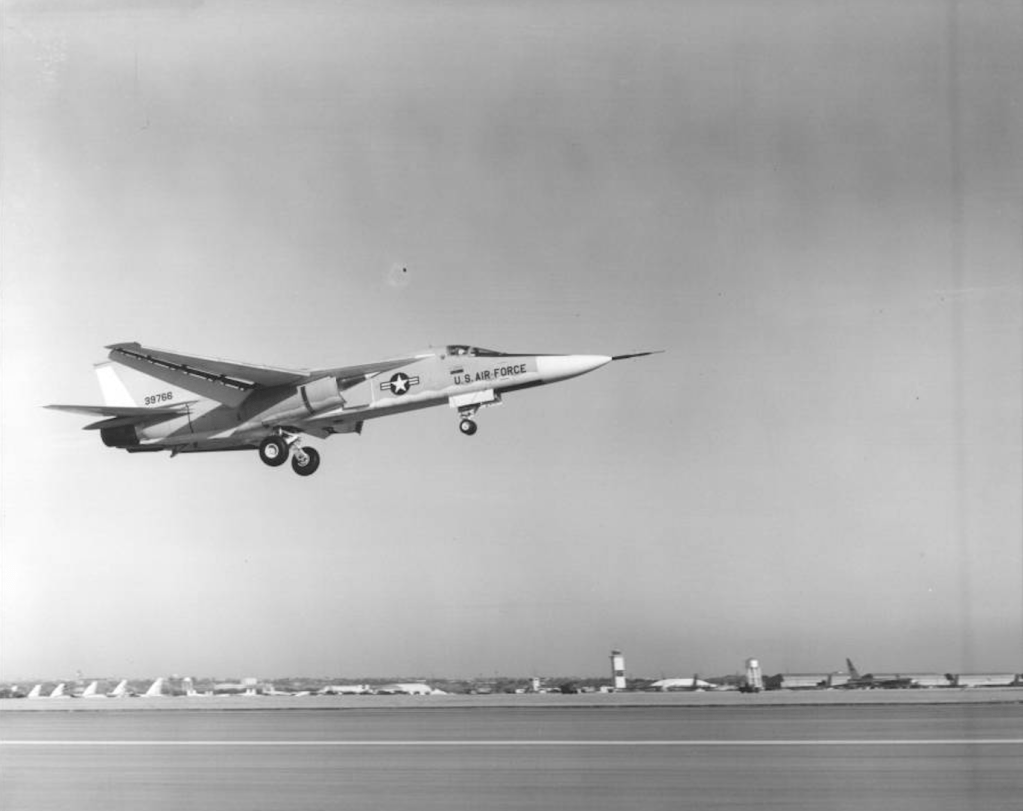
The supersonic F-111A tactical fighter aircraft, referred to commonly as the TFX (Tactical Fighter Experimental), made its first flight. The plane took off from Carswell Air Force Base in Texas, near the General Dynamics aircraft plant in Fort Worth. The F-111A climbed to 10,000 feet (3,048 meters) and the pilots cycled landing gear. Johnson later said, “I have flown several other planes [Convair YF-102 and F-106A] on their first flight and none of the others were able to retract the landing gear the first time out.” The wings remained at the 26° sweep setting throughout the flight, representing an “average” wing setting. Richard L. Johnson and Val E. Prahl took the plane aloft but terminated the scheduled 90-minute flight after only 21 minutes when a wing flap jammed. Described as “probably the most controversial combat aircraft in American history” because of its mechanical problems and cost overruns, the F-111 also had one of the best safety records, and would still be used by the Royal Australian Air Force 50 years after its introduction.
At the conclusion of his obscenity trial, American comedian Lenny Bruce was sentenced to four months in prison for “three counts of giving obscene performances in a Greenwich Village cafe” in New York City; the owner of Cafe Au Go Go was fined $1,000. Bruce was allowed to remain free on bond while he pursued an appeal of the verdict. and would die of an overdose in 1966 while the conviction was still on appeal. Thirty-nine years later, on December 23, 2003, he would be granted a posthumous pardon by New York Governor George Pataki.
The James Bond film “Goldfinger” premiered in the United States, after being released in British theaters in September. The first U.S. showing was at the DeMille Theater in New York; “Goldfinger” remains one of the most successful and popular Bond films ever made.
Dow Jones Industrial Average: 869.74 (+1.01)
Born:
Joey Kocur, Canadian NHL right wing (NHL Champions, Stanley Cup, Rangers-1994, Red Wings, 1997, 1998; Detroit Red Wings, New York Rangers, Vancouver Canucks), in Calgary, Alberta, Canada.
Keith Taylor, NFL safety (Indianapolis Colts, New Orleans Saints, Washington Redskins), in Pennsauken Township, New Jersey.
Fabiana Udenio, Argentine actress, in Buenos Aires, Argentina.
Died:
Carl Van Vechten, 84, American photographer.
Algernon Kingscote, English tennis player (Australasian Championship, 1919).





 History Diaries