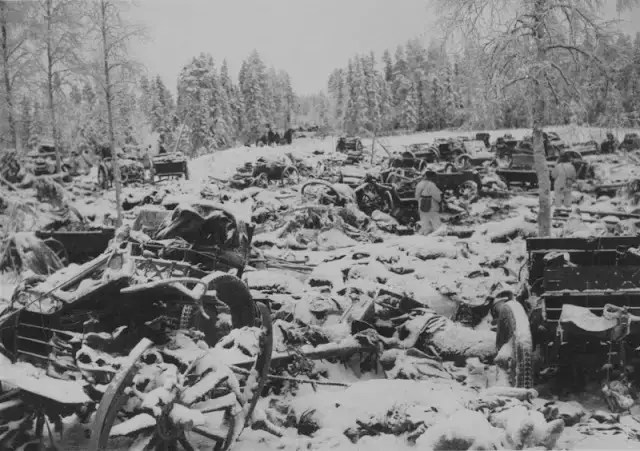
The main Soviet attacks against the Mannerheim Line, around Summa, continue with less force. The first Soviet offensive on the Isthmus runs out of steam. By evening the main defensive positions are entirely under Finnish control.
At Summa, the Soviets are becoming worn out by their repeated tank raids into the nearby frozen swamp which turn into killing zones by defenders throwing Molotov Cocktails and satchel charges. The weather is brutal, -20C, and the Soviet tanks and other armour is having difficulty due to the elements. The tanks can break through the Finnish lines, but they are unable to penetrate the fixed defenses that hold the key to the Mannerheim line. Without infantry support, the tanks are then picked off individually. When the fuel runs out, the vehicles freeze solid and then the Soviets must advance on foot through terrain the Finns handle with ease on skis.
The Finnish II Army Corps commanded by Lieutenant-General Öhquist are ordered to launch a counteroffensive.
The Soviet Army calls off the attack on Summa. A correspondent watches Finns impose heavy losses.
At Suomussalmi, the Finnish 27th Regiment is reinforced and now called the 9th Division. It has had the Soviets in the village surrounded for a week without any significant attempts to break the blockade by the relief force. The Soviet 44th Division has enough problems as it gets cut up by the Finns on the Ratte road. The commander of the 163rd Division trapped in the town, Andrei Zelentsov, asked permission to retreat from Suomussalmi. Permission is denied and he is told that more troops are being sent to rescue him.
The Finns take the initiative at Salla.
At Salla, Mannerheim has sent a division from his strategic reserve at Helsinki. It is used to drive the Soviet 122d Division, which has advanced along the southern fork almost to Kemijarvi, back to Salla. The entire advance out of Salla on both the north and south forks of the road has been repelled.
At Joutsijärvi in the Salla sector a Russian battalion manages to infiltrate behind the Finnish positions at Mäntyvaara. The Russian battalion is finally destroyed in hand-to-hand fighting. A battalion of the Soviet 122nd Division surprises two companies of Detached Battalion 17 which had been moved into reserve. After four hours of fighting, the enemy withdraws with the loss of 300 dead. Finnish losses are 17 dead, including the two company commanders.
The Soviet 122nd Division is cut off by Finnish attacks while advancing toward Salla from positions near the White Sea.
At Taipale, the fighting has diminished considerably after the Soviets stopped attacking strong points that they can’t overwhelm.
The Battle of Kollaa is becoming a long, drawn-out affair, which is exactly what the Finns wanted.
Colonel Paavo Talvela is promoted to Major-General, and Lieutenant-Colonel A.O. Pajari to Colonel.
The Finnish “Group Talvela” named after now-Major General Paavo Talvela), which is primarily 16th Infantry Division, attacks Soviet 139th Rifle Division. It remains surrounded at Ägläjärvi. Soviet 75th Rifle Division has been sent as a relief but it is accomplishing little.
In Ladoga Karelia, the enemy bombs and machine-guns a train carrying evacuees at Jänisjärvi Station in the parish of Harlu. 16 civilians are killed. Soviet aircraft also bomb Matkaselkä. Five people are killed and three seriously injured. The Soviets bomb Kontiomäki. One person is killed.
Donated ambulances leave Sweden and Denmark en route to Finland.
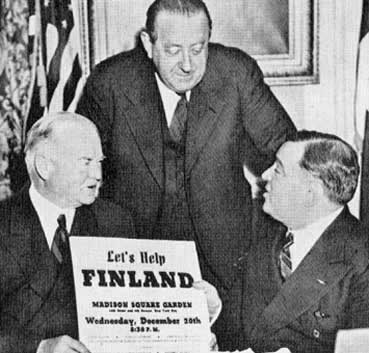
Former president Herbert Hoover forwards $100,000 for Finnish relief, to be used for children’s clothes and evacuation purposes.
German armored ship Admiral Graf Spee’s former commanding officer, Kapitan zur See Hans Langsdorff, commits suicide at Montevideo, Uruguay.
“I can now only prove by my death that the fighting services of the Third Reich are ready to die for the honour of the flag. I alone bear the responsibility for scuttling the panzerschiff Admiral Graf Spee. I am happy to pay with my life for any possible reflection on the honour of the flag. I shall face my fate with firm faith in the cause and the future of the nation and of my Führer.”
Meanwhile, British experts examine the radar equipment on board the wreck of the Graf Spee. The superstructure of the panzerschiffe is above water. At some point, local British authorities purchase the salvage rights to the Admiral Graf Spee for £14,000 from the German government. They examine the radar range finder and report back their findings to Fred Hoyle at the British Admiralty in order to develop countermeasures.
Rumania and Germany sign an economic agreement. Germany and Rumania reached a compromise economic agreement tonight calling for an increase of about 7 percent in Rumanian oil exports to Germany.
France and Spain halt trade talks after Madrid suddenly increases its original demands. Trade negotiations between the French and Spanish Governments were suspended today just when the two countries seemed on the point of reaching an agreement.
Berlin Jews take the most menial jobs; still the number of unemployed doubles in one month.
Air-to-air engagements take place over France along the German border.
A hope that “peace, reflected from Christmas night, may penetrate us and all humanity” was expressed again by Queen Wilhelmina of the Netherlands in a Christmas message broadcast to the nation and its colonies.
RAF Bomber Command sends 12 aircraft to attack German shipping without success.
The Royal Navy tug HMS Napia struck a mine and sank in The Downs, off Deal, Kent (51°15′45″ N, 1°25′00″ E) with the loss of all eight crew. Most likely she was mined in the same field, laid by German destroyers, which had claimed HMT Mastiff on 20 November.
The Swedish steam merchant Mars struck a mine and sank one mile east of St. Marys Lightvessel near Blyth off the eastern coast of England in the North Sea (55° 04’N, 1° 24’W). At 14.30 hours the Mars struck a mine, laid earlier the same day by U-22, and sank. Of the ship’s complement, 7 died and 15 survived. Nine of the survivors, four of them injured, were landed at North Shields a few hours later. The 1,877-ton Mars was carrying wood pulp and was bound for London, England.
The Swedish cargo ship Adolph Bratt struck a mine and sank in the North Sea off Terschelling, Friesland Netherlands (53°28′N 5°08′E) with the loss of five of the 22 people on board. Survivors were rescued by the Latvian ship Auskelis.
The Swedish cargo ship Vega was damaged by a mine off Terschelling. She was beached on 21 December near IJmuiden, North Holland but was declared a total loss. The 17 crew were rescued by the Swedish ship Venern.
Destroyer USS Twiggs (DD-127), on neutrality patrol in Yucatan Channel, relieves USS Evans (DD-78) of duty trailing British RFA tanker Patella.
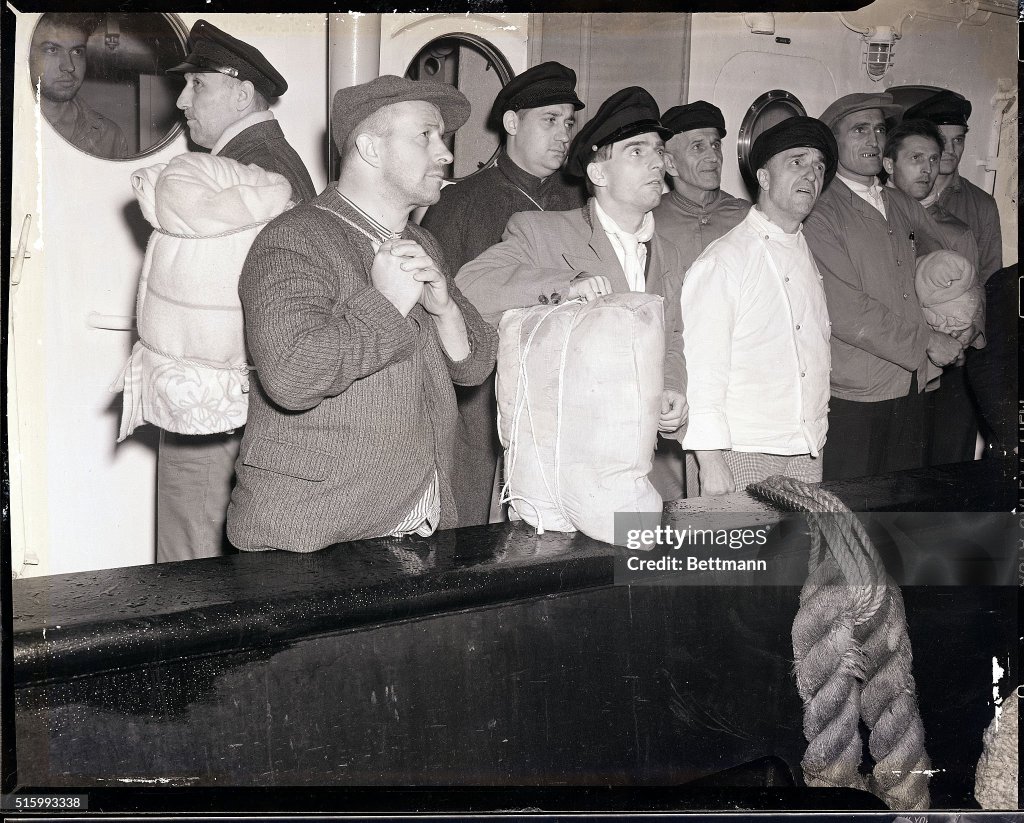
Heavy cruiser USS Tuscaloosa disembarks scuttled German passenger liner SS Columbus’s 579 “distressed mariners” at Ellis Island immigration center in New York.
U.S. freighters Oakwood, bound for Genoa, Italy, and Executive, bound for Greece, Turkey, and Rumania, are detained by British authorities at Gibraltar.
U.S. freighter Exochorda arrives at Naples with the 45 tons of tin plate condemned by the British prize court at Gibraltar among her cargo, having been permitted to sail by her master’s agreeing to ship the 45 tons of tin to Marseilles from Genoa. Another 100 tons of tin, however, consigned to a Swiss buyer, are put on the “detained list” and held in Genoa at the disposal of the British consul. That turn of affairs prompts U.S. Ambassador in Italy William Phillips, to take up the matter with the British Ambassador, who expresses his awareness of the “irritation and resentment…in American commercial and shipping circles” over the seemingly “arbitrary, careless, and casual” methods shown by the British contraband control people.
Convoy OA.57 departs Southend.
Convoy OB.57 departs Liverpool.
Convoy HX.13 departs Halifax for Liverpool.
The War at Sea, Wednesday, 20 December 1939 (naval-history.net)
On Northern Patrol, one cruiser was between the Orkneys and the Faroes, two cruisers and six AMCs between the Faroes and Iceland, and one cruiser and one AMC in the Denmark Strait.
Submarine SEAL reported she had engine defects requiring ten days to make good.
Vice Admiral Sir Max K Horton KCB, DSO was relieved by Vice Admiral R H T Raikes CB, CVO, DSO as Vice Admiral Northern Patrol. On 9 January 1940, Admiral Horton assumed command as Vice Admiral, submarines.
ATTEMPTED BREAKOUT BY GERMAN POCKET BATTLESHIP DEUTSCHLAND
A German warship, identified as DEUTSCHLAND, was sighted northbound in the Belt.
Light cruiser GLASGOW returning from Northern Patrol was ordered to refuel and join light cruiser NEWCASTLE on Fair Island Channel Patrol.
Submarine H.34 on trials with destroyer ENCOUNTER in Pentland Firth was ordered to patrol in the Firth. This patrol was terminated on the 21st.
Submarines L.23 and STURGEON were 10 and 25 miles south of Rjyvingen Light, respectively.
Submarine THISTLE was 80 miles WSW of Ryvingen Light.
L.23, STURGEON, and THISTLE then returned to their regular patrol stations.
If German warships were sighted in the North Sea, the Commander of the 2nd Cruiser Squadron with light cruisers EDINBURGH and SOUTHAMPTON was ordered to take battleship BARHAM, battlecruiser REPULSE, and light cruisers GLASGOW and NEWCASTLE under his command. Also, any available destroyers of the 12th Destroyer Flotilla were to join NEWCASTLE. The destroyers of the 8th Flotilla at Loch Ewe were put on one hour’s notice.
On 21 December, DEUTSCHLAND was sighted steaming south back towards Germany.
GLASGOW arrived at Rosyth on the 22nd and NEWCASTLE at Scapa Flow with destroyer ESCAPADE on the 23rd.
Destroyer ESCAPADE was sent to search for a submarine reported at the entrance to Kirkwall.
Sloop FOWEY attacked a submarine contact in 50-28N, 1-10W.
Convoy FN.57 departed Southend, escorted by sloops PELICAN, WESTON and HASTINGS, and arrived in the Tyne on the 22nd. There was no convoy FN.58.
Convoy FS.57 departed the Tyne, escorted by destroyer WHITLEY and sloops STORK and FLAMINGO, and arrived at Southend on the 22nd.
Anti-submarine trawler ARCTIC EXPLORER (501grt) attacked a submarine contact in Shapinsay Sound in the Orkneys. The same submarine was sighted again later and armed boarding vessel NORTHERN ISLES made another attack.
Heavy cruiser SUFFOLK departed Clyde on Northern Patrol duties, and arrived back on the 29th.
Light cruiser CARDIFF departed the Clyde for Portsmouth, and arrived on the 23rd for refitting, completed on 30 January.
Light cruiser DIOMEDE was refitting at Plymouth until 10 January.
Convoy OA.57 departed Southend escorted by destroyers WOLVERINE and ARDENT from the 20th to 21st. Destroyer WINDSOR was escort from the 21st to 23rd, when the convoy dispersed.
Convoy OB.57 departed Liverpool escorted by destroyers WANDERER and WALPOLE to the 23rd, when they detached to convoy HX.12.
Swedish steamer MARS (1877grt) was sunk one mile east of St Marys Light Vessel near Blyth on a mine laid by U-22 on the 15th; seven crew were lost, and 15 survivors rescued.
Tug NAPIA (155grt) was sunk on a mine off Ramsgate, in 51-15-45N, 1-25E. The entire crew of eight were lost.
Swedish steamer VEGA (1300grt) was badly damaged on a mine in 53 26N, 05 06E, and ran aground at Westergronden on the 21st near Ijmuiden a total loss. Seventeen survivors were picked up by Swedish steamer VENERN (1171grt). VEGA and VENERN had been in convoy together from the German Bight.
Swedish steamer ADOLF BRATT (1323grt) was sunk on a mine in 53 28N, 05 08E. Five crew were lost, and her 16 survivors rescued by Latvian steamer AUSEKLIS (1309grt).
U-22 laid mines off Blyth near Newcastle, on which one merchant ship was sunk.
Convoy HX.13 departed Halifax at 1000 escorted by Canadian destroyers HMCS FRASER and HMCS ST LAURENT. Off Halifax, Canadian destroyers HMCS SAGUENAY and HMCS SKEENA took over the escort and were detached on the 22nd. The convoy was turned over to light cruiser EMERALD which departed Halifax with the convoy for ocean escort; she detached on 3 January. The Canadian destroyers arrived back at Halifax the morning of the 23rd. Destroyers MACKAY and WARWICK from convoy OB.62, together with WOLVERINE and VERITY escorted the convoy from 2 to 4 January, when it arrived at Liverpool. EMERALD arrived at Portsmouth on 4 January to repair defects, completed on the 11th.
A fundraising rally for the Finnish Relief Fund called “Let’s Help Finland” was held at Madison Square Garden in New York. Herbert Hoover made a speech at the event which was also broadcast to the American people. Before 15,000 persons in Madison Square Garden, former President Herbert Hoover appealed to the American people last night to open their hearts and hands to Finland with contributions to the Finnish Relief Fund, of which he is national chairman.
The U.S. Government forbids the export of technical data for producing aviation fuel to belligerent countries. The United States embargoed “delivery to certain countries of plans, plants, manufacturing rights, or technical information required for the production of high quality aviation gasoline …” to belligerent countries.
President Roosevelt obtains information on the China war. China has begun a widespread offensive against the Japanese on all fronts, Ambassador Hu Shih of China informed President Roosevelt today during a short interview that he said had been arranged to explain to the President the developments in the Far East. The ambassador calls on the President to spread the news of the widespread offensive.
William Green, president of the American Federation of Labor, said todaythat evidence already produced by the House committee which is investigating the National Labor Relations Board “tends to support” AFL charges that the board has been partial to the CIO.
The most important narcotics case within the memory of federal officials ended at 10:47 o’clock last night when a New York jury of eight women and four men convicted Louis (Lepke) Buchalter and Max Schmukler of conspiracy to violate the narcotics laws.
District Attorney Thomas E. Dewey, candidate for the Republican nomination for President, will speak on January 4 in Boston and on February 12 in Portland, Oregon, it was announced.
The sons and daughters of diplomats in the United States broadcast greetings to the youth of the world. The German and Russian embassies fail to participate in the annual tradition from Washington.
An air defense force is set for the Northeastern United States. The Army coordinates all units. The army general staff disclosed today that the air raid defenses of the industrial Northeast would be put under a single command like those protecting London, Paris and Berlin.
There is no law that limits daily work Hours in the United States, but a federal bulletin from the Wages and Hours Administration states that the weekly aggregate cannot exceed 42 hours.
The New York Shipping Association, which represents most of the deep sea steamship companies, has agreed to give its longshore workers an increase of five cents an hour, it was learned yesterday at the close of a conference between steamship operators and members of the International Longshoremen’s Association.
To make certain that local taxpayers will derive maximum benefit from the Federal old-age insurance program, the Social Security Board will supply to State and local relief officials data on payments to aged workers, widows and dependent children, Mrs. Anna M. Rosenberg, regional director of the board, disclosed yesterday.
A baby health clinic opens in the Bronx. This is its ninth clinic and is jointly funded by the WPA and the city.
Submarine tender Bushnell (AS-2), operating out of Tutuila, Samoa, as a survey ship under the auspices of the Hydrographic Office, completes Pacific Island surveys, having covered a total of 76,000 nautical square miles since commencing that work on 1 July.
A $20 million contract was issued to Consolidated for 200 PBY Catalina aircraft to support an increase in patrol plane squadrons growing out of Neutrality Patrol requirements. This was the largest single order for naval aircraft since the end of World War I.
Canadian airmen are chosen for the front lines. The first squadron of the new Canadian Air Force has been selected and shortly will be dispatched overseas to serve with the first Canadian division, now in England completing its training for active service at the front.
The Chinese recapture Nanning positions. A counter-attack is said to have isolated the Japanese garrison in the south.
The Chinese Winter Offensive is continuing, but the initial impetus is starting to break.
Chinese 2nd War Area completes mopping up Japanese remnants around Wenhsi and Hsia Hsien and captures villages of Ankuo and Tienwang.
The Japanese 21st Army pushes north from Canton area along the Canton-Hankow railroad against minimal resistance from Chinese 4th War Area.
Chinese 3rd War Area troops unsuccessfully attempt to capture the south bank of the river and interdict Japanese boat traffic on the Yangtze.
The 35th Army and 81st Army of the Chinese 8th War Area continues attacks into Paotou.
Japanese counterattacks recapture Kunlunkuan, Chiutang, and Kaofengyi.
Six squadrons of Japanese bombers, nine planes to a squadron, raided Chinese bases at Sian, Lanchow, Pingliang, and Tienshui in Northwest China, it was reporte. in military dispatches today.
The Japanese are in a hurry to talk with the United States. The Cabinet is anxious for a temporary trade pact that does not need Senate approval. Although a new trade treaty with the United States cannot be negotiated before January 26, the Japanese expect or hope a working arrangement on lines that will not require the United States Senate’s assent can be negotiated.
The Cabinet faced increasing criticism today because of its action in announcing early reopening of the Yangtze and Pearl Rivers in China to general international commercial traffic. Ultra-nationalists accused the government of weakness and warned Premier Nobuyuki Abe they would not tolerate any policy of “appeasement” toward the United States that would tend to encourage a continuation of resistance by Generalissimo Chiang Kai-Shek.
The ultra-nationalists, equally opposed to suggestions for a “deal” with Russia that would result in a cessation of Russian support to China in return for concessions to Moscow by Japan, demanded that the government force the China war to a victorious conclusion under the Empire’s own resources. Indicative of popular opinion, 586 prominent persons, including former government officials and army officers, met late yesterday and adopted a resolution urging the government to take “appropriate measures” for disposal of the “China incident.”
Unmistakable indications that Japan’s policy in foreign affairs will be to bargain. piecemeal with third powers on her military hold on China’s coastal region and great cities was given here tonight when the Shanghai counselor of the Japanese embassy, in his capacity as embassy spokesman, threatened that if American and other foreign reception to the proposal to reopen the Yangtze River to commerce proved cynical or lacked understanding Japan would withhold other contemplated restitutions of violated treaty rights.
Radio Australia begins overseas shortwave service.
Dow Jones Industrial Average: 149.13 (+0.20)
Born:
Kim Weston, American soul singer (with Marvin Gaye – “It Takes Two”), in Detroit, Michigan.
Bill Keith, American bluegrass, country, and session banjoist, and tuning instrument tuner inventor, in Boston, Massachusetts (d. 2015).
Dianne Arndt, American artist and photographer, in Springfield, Massachusetts.
Kathryn Joosten, American actress (“Desperate Housewives”), in Chicago, Illinois (d. 2012).
Died:
Hans Langsdorff, 45, German captain of the Admiral Graf Spee (suicide).
Naval Construction:
The Kriegsmarine (German Navy) Type IXB U-boat U-122 is launched by AG Weser, Bremen (werk 954).
The U.S. Navy submarine USS Tambor (SS-198), lead boat of her class of 6, is launched by the Electric Boat Co. (Groton, Connecticut, U.S.A.).
The Royal Navy rescue tug HMS Lady Brassey is commissioned.
The Royal Indian Navy auxiliary patrol trawler HMIS Chandbali is commissioned.
The Royal Navy armed merchant cruiser HMS Alcantara (F 88) is commissioned. Her first commanding officer is Captain (Retired) James Geoffrey Penrose Ingham, DSO, RN.
The Royal Navy armed merchant cruiser HMS Circassia (F 91) is commissioned. Her first commanding officer is Captain (Retired) Henry Gerard Laurence Oliphant, DSO, RN.
The Royal Navy armed merchant cruiser HMS Dunvegan Castle is commissioned. Her first commanding officer is Captain (Retired) Hubert Ardill, RN.
The Royal Navy armed merchant cruiser HMS Hector (F 45) is commissioned. Her first commanding officer is Captain (Retired) Robin Wynell Mayow Lloyd, DSO, RN.
The Kriegsmarine (German Navy) Type 35 torpedo boat T-7 is commissioned.
The Nihon Kaigun (Imperial Japanese Navy) Kagerō-class destroyer HIJMS Shiranui (不知火, “Phosphorescent Light”) is commissioned.
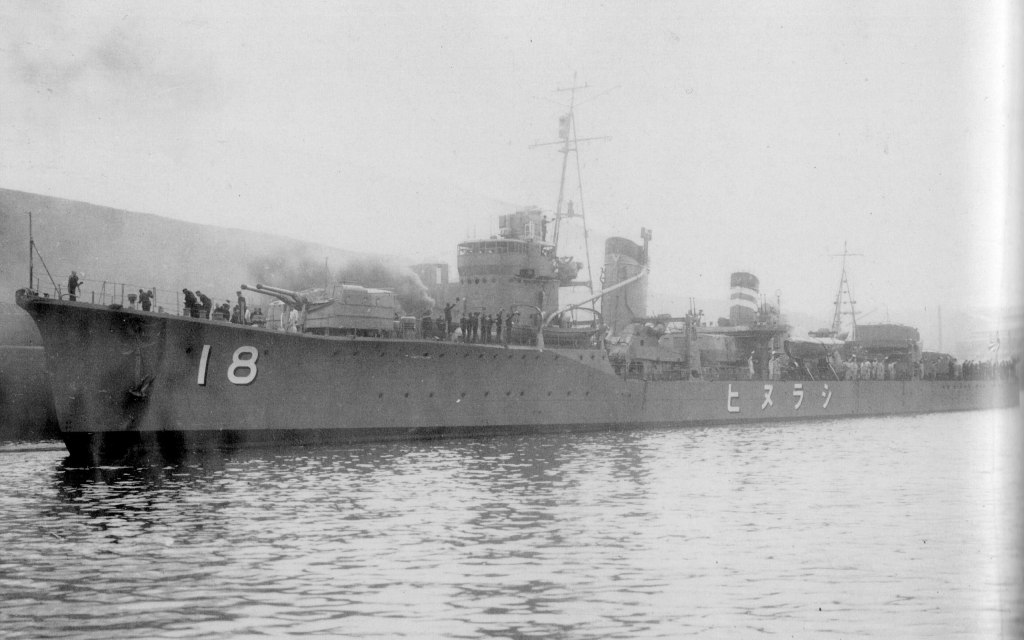
Shiranui operated with the Kido Butai aircraft carrier force for the first few months of WW2, including taking part in the Pearl Harbor strike force. The only break from this came at the biggening of March, where Shiranui involved herself in a small surface action when she helped to sink the Dutch freighter Modjokerto. Shortly after escorting troop convoys during the battle of Midway, Shiranui’s entire forward 3rd was blown off by a torpedo from the submarine USS Growler. Repairs lasted until the end of 1943, with the damaging being extensively photographed. After a series of patrol duties, she took part in the battle of Leyte Gulf, nearly surviving the battle, but being sunk with all hands by dive bombers from USS Enterprise during its final stages.
Lost 27 October 1944.
Shiranui was sunk with all hands by dive-bombers from the aircraft carrier USS Enterprise, 80 miles (130 km) north of Iloilo, Panay (12°0′N 122°30′E).
 History Diaries