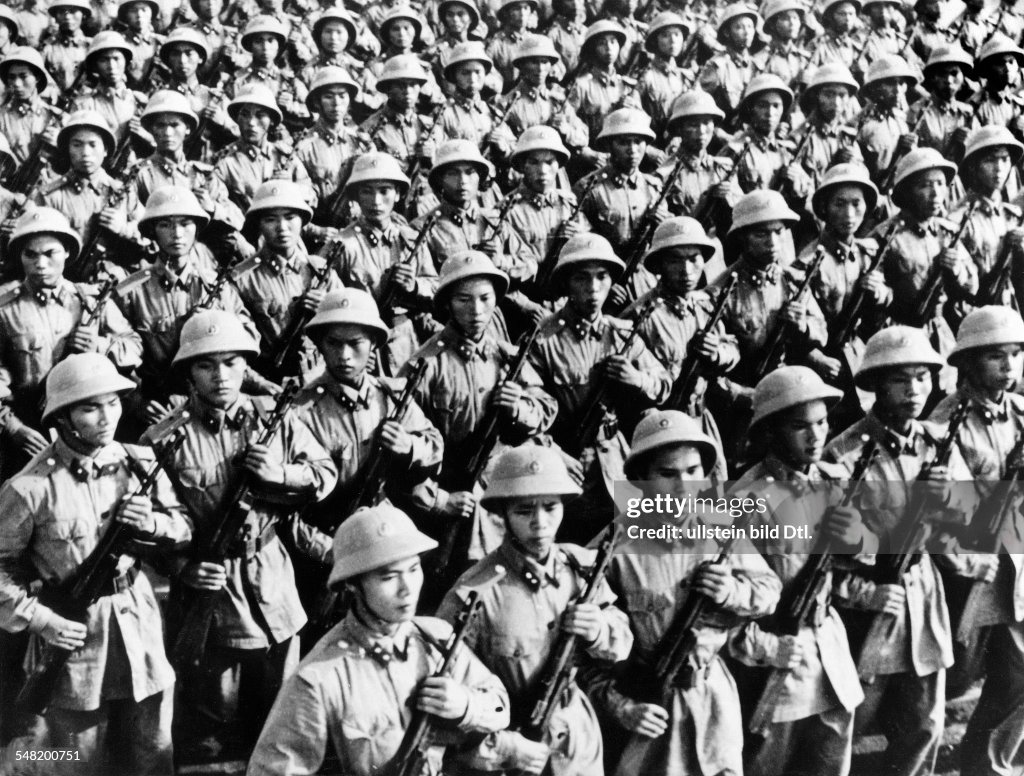
United States officials voiced strong displeasure today at the overthrow of South Vietnam’s civilian legislature by a group of military commanders. Ambassador Maxwell D. Taylor was reported to have warned the military men that unless “the fabric of legal government” was restored promptly, Washington might have to reconsider its position of close alliance with Saigon in the anti-Communist war. American officials criticized the sweeping aside of constitutional civilian government only two months after its restoration here. Although the leaders of this morning’s uprising expressed support for Premier Trần Văn Hương and his government, they abolished the High National Council, which set up that Government and which was serving as a provisional legislature. They also declared sections of the Charter, or provisional constitution, void, and arrested more than a dozen opposition politicians.
In public statements and in a private meeting with Ambassador Taylor, the military commanders, long known as a group of young dissidents, said their move was aimed at eliminating political interference in the conduct of the war. The dissidents’ leading spokesmen were Air Commodore Nguyễn Cao Kỳ, commander of the air force, and Brigadier General Nguyễn Chánh Thi, commander of the army’s, I Corps. Two other generals, fluent in English, accompanied Commodore Kỳ and General Thi to the meeting with Mr. Taylor. Lieutenant General Nguyễn Khánh, commander in chief of the armed forces, played no public role in announcing the military decisions. At a news conference in the afternoon, statements were made by the young generals, who have dominated military affairs here since their crucial actions last September to put down a coup attempt while General Khánh was still Premier. Informed sources suggest that General Khánh went along with the uprising, which was added upon late last week by a new body, the Armed Forces Council. But some diplomats believe that he did so only under pressure.
United States Embassy spokesmen pointedly declined to make any statement of support for the early‐morning move. Ambassador Taylor conferred twice with Premier Hương during the uncertain day that ensued. Millitary officers maintained that Premier Hương had concurred in their decision to dissolve the High National Council, but other sources said the Premier had in fact bowed only to what he could not prevent, and that with American encouragement he might still resist. The council, though it had grown ineffective in reaching substantial decisions, represents a thread of continuity in Saigon’s politics since the riots and demonstrations of last August, which led General Khánh to step down from the presidency and move to turn the government over to civilians. Ambassador Taylor telephoned General Khánh during the day to ask his views before meeting with four of the dissident generals at the embassy.
As seen in Saigon, the generals’ power play was bloodless and accompanied by few outward displays of military might. Unusual troop movements during the night alerted the city, but the day was calm, and afternoon strollers seemed oblivious of the developing political crisis. Reports indicated that 18 persons had been arrested. They were said to have been taken to a residence in Saigon and held there under guard. One member of the High National Council was also reported to have been arrested in Huế, the leading city of central coastal Vietnam. He was Dr. Lê Khánh Quyền, dean of the Huế University medical faculty and a leading spokesman for Buddhist political militants.
Buddhist leaders in Saigon, who have actively been opposing the Hương Government, seemed as surprised as American officials did. Americans learned of the military uprising at 5:30 in the morning. Half an hour later, General Thi read a first statement over the Saigon radio. It proclaimed the dissolution of the High National Council and affirmed support for the Hương Government. Crowds were gathering at the headquarters of the Buddhist movement on the outskirts of the capital for a demonstration that had been scheduled by the monks. When the news arrived, Buddhist officials abruptly canceled the demonstration and urged the crowds to return home until the situation could be clarified. Among the council members arrested was Trần Văn Văn, a central target of recent Buddhist opposition. However satisfactory this aspect of the generals’ action may have, seemed to the monks, they expressed dismay at the blunt reassertion of military power.
At the generals’ news conference, General Thi accused the High National Council of having plotted against the armed forces. He said there was “positive proof” that members had been inciting the population for “their own personal ambitions.” The military complaint seemed to center on the council’s refusal to approve a forced retirement of certain senior generals. These include some who overthrew President Ngô Đình Diệm in November, 1963, and who ruled for two months before General Khánh deposed their junta. The young dissidents have long disliked these generals and have been trying to demobilize them. The Charter makes no provision for the council to overrule any purely military decision taken by the armed forces, and the junior officers have been annoyed at what they consider an unwarranted attempt by civilians to interfere on military affairs. According to reliable reports, the generals say they have a copy of a letter from council members to the chief of state, Phan Khắc Sửu, warning him to beware of military pressures.
The latest military coup in Saigon gives disheartening new evidence of the instability, and fragility of the political situation in South Vietnam. Ironically, President Johnson told reporters only last week that the civilian government then in power was potentially the strongest since last year’s overthrow of the Diệm regime. Now the crude reassertion of military power over the short‐lived attempt at civilian rule has exposed the transitoriness of the regimes on which the United States has been obliged to rely. The understandable frustration and anger this newest development has aroused among the senior American representatives in Saigon is indicated by Ambassador Maxwell Taylor’s reported warning to the “Young Turk” generals that American aid may be reconsidered if there is no prompt return to legal government. United States aid to South Vietnam is based on the premise that the government and the majority of the people of that country want to be free of the Communist oppression that a Việt Cộng victory would bring. It also assumes that the Vietnamese are prepared to make the necessary efforts and sacrifices to achieve victory. Increasingly, however, developments call that assumption into question.
Attempting to avoid the mistakes of the strategic hamlet program in South Vietnam, the United States is extending limited but effective aid to villages in Laos. American officials involved in the Laos “cluster program” are quick to emphasize how their operation differs from the policies pursued in Vietnam under the late President Ngô Đình Diệm. They point out that the effort here is entirely voluntary, that the villagers are not asked to move and that no political propaganda accompanies the welfare and technical training provided by their program.
Also, in Laos the clusters are neither fenced nor fortified “They build an occasonal fence to keep the cattle out of their gardens.” one American said, “but that’s it.” In return for the program free of politics, the clusters enjoy a degree of immunity from the Pathet Lao, a pro-Communist army considerably less implacable than the troops of North Vietnam. “We have received verbal assurances from the Pathet Lao that under our present method of operating they will leave us alone,” said Dr. Howard E. Thomas, the United States aid program’s assistant director for rural development in Laos. With one exception, the agreement has kept free from attack the eight clusters already operating and the three being formed.
President Johnson has instructed the State and Defense Departments to make every effort in the new year to reunite the nations of the North Atlantic Treaty Organization. Apparently disturbed by reports that some of his associates have been using “pressure tactics” on the allies, it is understood that he has signed a National Security Council memorandum instructing all diplomatic and military officials concerned to conform to his policies and avoid any “private or official statements” that would add to the differences within the Western alliance. This memorandum was addressed to Secretary of State Dean Rusk and Secretary of Defense Robert S. McNamara for transmission to their associates here and in the allied capitals. It made these points:
- The United States continues to believe that the defense of the West is “indivisible,” but it wants the fullest possible consultation within the alliance on views about how the nuclear defense of the alliance is to be organized.
- President Johnson will approve no defense plan that is not acceptable to both Britain and Germany and will not agree to any program that is not discussed in advance and in detail with France.
- It is the policy of the United States to encourage the maximum unity of Europe and nothing proposed in Washington for the development of the Atlantic alliance should be interpreted by any American official as opposing this movement toward the economic and political integration of Europe.
- No “pressure tactics” are to be used on the allies. The United States is not interested in establishing “special arrangements” with any single ally or in confronting anyone with “deadlines” for acceptance of United States proposals.
- The President will approve no plan that does not leave the door open for any ally to join in the defense of the Atlantic alliance at any time in the future. This applies particularly to France.
This does not represent a change in American policy, but it does mean that President Johnson is insisting that his policies be placed before the allies on their merits, without any pressure of time, without any rancor toward President de Gaulle or anyone else who happens to disagree with those policies, and specifically, without threats that if one ally does not go along, Washington will make a “special deal” With someone else.
The British Government has taken mild alarm over the reports of nuclear cooperation between the United States and Frances that emerged from the North Atlantic Treaty Organization Council meeting in Paris last week. The news that disturbed London — and also, it is reported, Bonn — was that the United States agreed to coordinate targeting in Eastern Europe and the Soviet Union with the French force next year. According to reliable sources, Britain has let Washington know of her concern that the United States should seem to be building up France’s nuclear striking force just when the British Government is seeking to surrender national control over its nuclear weapons. The United States was reliably reported to have assured the British that nothing new was contemplated and that the invitation to send French officers to the Omaha headquarters of the Strategic Air Command was long‐standing and open to other allies.
The presidential election picture in Italy tonight after eight ballots in the National Assembly in five days, was: no President, no change. The nation’s biggest party, the Christian Democrats, still was unable to agree on one of its own as President, but was blocking the selection of anyone else. During today’s balloting the three parties allied with the Christian Democrats in the center‐left coalition Cabinet — the Democratic Socialists, the Socialists and the Republicans — refused to vote. On the seven previous ballots most of their 148 Senators, Deputies and regional representatives in the 936‐member Assembly of Presidential Electors backed Foreign Minister Giuseppe Saragat, a Social Democrat.
The Soviet Embassy in Berlin has given a qualified refusal to a Western proposal for four‐power talks in the city’s Communist and non‐Communist sectors, diplomatic sources said tonight. The Soviet response was said to leave the door open for further diplomatic maneuvering. The object of East‐West discussions under way in Berlin is a revival of regular consultations among the occupying powers — the United States, Britain, France and the Soviet Union. There have been no formal four‐power meetings in Berlin for 15 years. Last month, in informal conversation with a British diplomat, a Soviet Embassy official in Berlin raised the possibility of reviving four‐power contact. On Thursday a United States mission official declared that the Western powers were willing to begin regular meetings, but only if East Berlin was included as a site. The Soviet Embassy told the United States caller that the original remark had not meant to propose four‐power meetings.
About 100,000 West Berliners went to East Berlin today on the second day of the present arrangement between East and West Germany for Christmas visits across the wall that divides the city. More than a million people are expected to cross for reunions with family members during the 16‐day visiting period, which runs to January 3.
Thirty more white hostages are feared to be dead in the northeastern Congo, according to refugees who arrived here today. Fourteen survivors from the Bafwasende mission station said they believed 14 of their colleagues were executed by Congolese rebels on November 27, three days after the insurgents were driven from Stanleyville. The refugees said piles of clothing and bloodstains had been found at nearby Banalia, raising fears that 16 whites there had also been killed. All of those now feared dead were missionaries or members of missionary families. They include 15 Britons, eight Dutch, four Belgians, an American, an Australian and a Canadian.
“The good Lord only knows why some of us were saved and the rest killed,” said Mrs. Dolena Burk of Calgary, Alberta, whose husband is among those believed to have been killed at Bafwasende. Mrs. Burk, two British missionaries and 11 Italian nuns were rescued by a mercenary column yesterday after they had been held prisoner for three weeks at Bafwasende, a town about 150 miles northeast of Stanleyville. They were flown by helicopter to Stanleyville and arrived at Ndjili Airport in Leopoldville this afternoon aboard a United States C‐130 transport. Mrs. Burk, who is 54 years old, spoke in a quiet, tear-choked voice as she recalled the days of horror that followed the drop of Belgian paratroopers at Stanleyville on November 24. “When news of the paratrooper drop reached Bafwasende,” she said, “the rebels kept all 28 of us locked up in a single room for three days.”
Then Government planes struck nearby. “That made the Simbas [rebel troops] really furious,”she said. “They dragged us out of the house and said ‘we have to kill all of you.’ ” Her voice faltering, Mrs. Burk recalled how the rebels divided the group into two parts. Her husband, Chester, four Britons, an Australian and eight Dutch priests were led away and out of sight. “We don’t know exactly what happened then,” she said. “We heard only one volley of shots and then nothing.” None of the 14 have been seen since.
On the Chinese Nationalist island refuge of Taiwan, the dream of a counterattack against the Communist‐held mainland is fading. Instead, the concept of creating a prosperous society on Taiwan that would serve as a model to attract Chinese people is taking a firmer hold. Riding the crest of a remarkable economic upsurge set in motion with United States assistance, the Taipei Government is rapidly putting down the foundations of a viable independent economy. The economic well‐being has tended to mollify those members of the indigenous Taiwanese population of 10,000,000 who have been restive under the burdens of the dominating top‐heavy political hierarchy and costly military establishment brought here by the Nationalist Government following the fall of the mainland to the Communists in 1949.
Levi Eshkol forms the 12th Israeli government. President Zalman Shazar asked former Premier Eshkol tonight to form a new government. Mr. Eshkol said he would establish a Cabinet within 24 hours within the same coalition framework as the one that resigned last Monday.
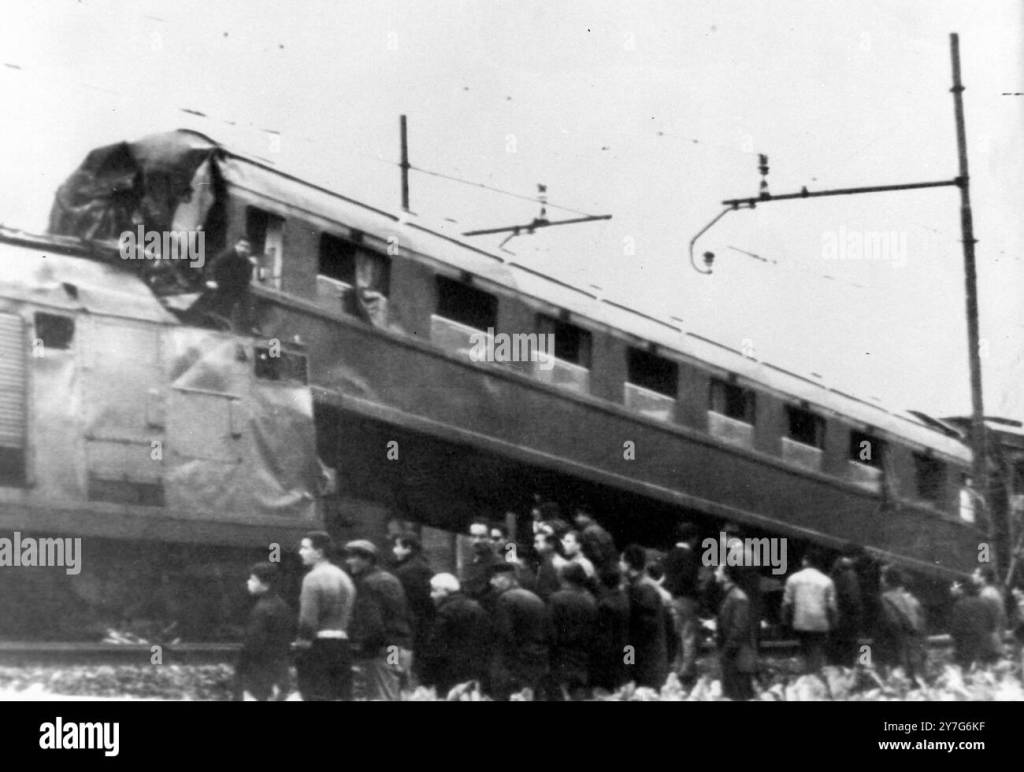
Forty-one train passengers were killed and 75 injured in Mexico in the village of Tacotalpa when a freight train smashed into their car. A member of the freight train crew told authorities that “the engineer was apparently dozing and unaware of the train on the main track until the last moment”; the engineer sustained minor injuries and fled from the scene of the accident.
Fifty-seven coal miners were killed in Peru in an explosion at the Cerro de Pasco underground mine outside the mountain village of Goyllarisquizga, 125 miles northeast of the capital of Lima. Two more men were reportedly seriously injured.
The continuing struggle for the leadership of the Republican party produced two new developments today. It was learned that Senator Barry Goldwater had called a meeting for tomorrow in Washington of a small group of Republican leaders, presumably to bolster Mr. Goldwater’s support for the continuation in office of National Chairman Dean Burch. The meeting called by Senator Goldwater included Mr. Burch, William E. Miller of New York, the defeated candidate for Vice President; Senator Thruston B. Morton of Kentucky and Representative Bob Wilson of California. Mr. Morton is chairman of the Senatrial Campaign, Committee and a former national chairman, and Mr. Wilson is campaign chairman of the House Republicans.
Representative John V. Lindsay of Manhattan, a Goldwater opponent, announced that the small group of liberal Republicans in the House might run a candidate of their own for the House leadership unless they were given more positions of responsibility. Mr. Lindsay made clear that his group found little to choose between the present two candidates for the leadership, Charles A. Halleck of Indiana and Gerald R. Ford of Michigan. Mr. Lindsay indicated that he himself did not want to run for the leadership if the liberal group decided to put up a candidate. But he said he would do so if the group decided it was “absolutely necessary.” Mr. Lindsay made known his views in an interview on radio station WNEW in New York. He later confirmed them here.
A group of college students and teachers moved into the quiet rural town of Ripley, Mississippi today to rebuild a Black church that was burned last October. Within a few hours after their arrival, the students — who call themselves “Carpenters for Christmas” — were shoveling mud and soggy ashes from the cement foundation of the razed Antioch Baptist Church. The students were from Oberlin College in Ohio. More workers from other colleges are expected in the next few days. All plan to devote their two-week holiday vacations to the project.
The students, who got here at 11:30 AM after a day-and-a-half drive from Ohio, were greeted warmly by the Black community. During their stay, they will live with Black families. Six other Oberlin students were delayed near Paris, Tennessee, when their car skidded on an icy patch. There were no injuries. They are expected here tomorrow after repairs have been made. There was no attempt by the white townspeople to interfere with the three‐car motorcade as it entered Ripley. During the afternoon, a number of cars with curious passengers passed the site of the church, on a muddy road some seven miles southeast of Ripley.
The site was also visited by Sheriff Wayne Mauney and B. M. Duncan, an investigator for the Mississippi State Highway Patrol.Sheriff Mauney, a tall, slender man, said he looked on the project as one that has “a lot of potential trouble.” He said he and his deputy would keep a close watch. After staying a while the officers drove away.By early evening, 15 Blacks had brought shovels and pickaxes and were working alongside the students. The Mayor of Ripley, Lowrey Smith, predicted in an interview that there would be no trouble over the workers unless there was some type of. “misunderstanding.”
LeRoy Collins, director of the Community Relations Service, said today he expected more civil rights demonstrations and civic disturbances next summer, and indicated some would be in the North. “There will always be room for lawful protest where people, are abused,” he said. “Where this exists you are bound to have demonstrations. You can expect people to protest.” The Community Relations Service is a conciliation agency created by the 1964 Civil Rights Law. Mr. Collins said the agency was encouraging communities to eliminate the sources of unrest and head off potential disturbances.
In an interview on the Columbia Broadcasting System’s radio and television show, “Face the Nation.” Mr. Collins termed racial problems in the North often more complex than those in the South. Riots swept through Black districts of New York City, Brooklyn, Philadelphia, and Rochester, New York, last summer. Mr. Collins linked such disturbances to poverty, disease and lack of decent housing. He saw no easy or immediate solution. Mr. Collins, a former Governor of Florida, was questioned about an apparent switch in his beliefs from once upholding and now opposing segregation. He answered: “What seems just at one time in a man’s life may come to seem unjust at other times. I, grew up in a segregated society. It never occurred to me that this was unjust.” He said he had come to understand that it was unjust.
Everett McKinley Dirksen of Illinois, the Senate minority leader, believes Republicans in Congress should set up party machinery for maintaining and continuous check on the enforcement of the Civil Rights Act of 1964. Mr. Dirksen, who is recuperating from a back injury at his vacation home in DeBary, Florida, said in an interview that he had been giving some attention to the problems of enforcement, particularly with respect to the ban on discrimination in public accommodations. Mr. Dirksen not only helped obtain the Republican votes necessary to shut off the Southern filibuster against the civil rights bill last summer, but also was a principal architect of the final measure. The Senator suffered the back injury in mid‐October while in the hospital for a kidney infection.
Last Monday, the Supreme Court unanimously upheld the constitutionality of the public accommodations section outlawing discrimination in hotels, motels, restaurants, theaters, places of amusement and gas stations. Now that the court has spoken, Mr. Dirksen said, the Republicans in Congress are “going to have to make some moves” to assure themselves about enforcement by the executive branch. “We said we wanted it enforced,” the Senator continued. “Now there may be some corner‐cutting and there may be some cheating in enforcement before we get through, and I think no matter where it takes place, we ought to take cognizance of it.” The Republicans, he declared, should not play “ducks and drakes with the pledges we have made to the country.”
The Rev. Dr. Martin Luther King Jr. said today the “civil rights movement and the labor movement must stick together,” and threatened a national boycott to aid workers striking against an Atlanta concern. Dr. King, who returned here last week after accepting the Nobel Peace Prize in Norway, asked, “What good does it do a man to have integrated lunch counters if he can’t buy a hamburger?” He said the Black could learn “to do anything a white man can learn” and leveled a charge that management at the Atlanta Scripto plant “will never treat the Black right voluntarily — you’ve got to demand it.” Dr. King spoke to about 250 striking Scripto workers at the Ebenezer Baptist Church, where he is associate pastor. He said his office was drawing up lists of colleges and businesses across the nation that might be willing to support an economic boycott against Scripto. The concern makes cigarette lighters and ballpoint pens.
Malcolm X, the black nationalist leader, declared yesterday that “we need a Mau Mau” uprising to win freedom and equality for Blacks in the United States. He hailed the Mau Mau — the antiwhite terrorists active in Kenya before that country gained independence — as “the greatest African freedom fighters,” who would hold an important place in history. He addressed a Harlem rally to support the Mississippi Freedom Democratic party’s challenge to the seating of Mississippi’s all‐white Representatives in Congress. Pointing his right forefinger vigorously and accusingly, he said justice demanded that “he who kills, by the sword shall be killed by the sword.” “A Black man has the right to do whatever is necessary to get his freedom,” he said. “We will never get it by nonviolence.” Urging Blacks to “even the score” with whites, he said: “Let the Klan know we can do it, tit for tat, tit for tat. We have brothers who are able, equipped and ready to do that.” As the audience cheered, he observed: “Freedom is gotten by ballots or bullets. These are the only two methods. Either ballots or bullets.”
President Johnson, accompanied by several members of his Cabinet, flew to Texas today to spend the Christmas holidays working on the new Federal budget at his ranch.
Bill Bradley of Princeton, named a Rhodes Scholar, promptly accepted the nomination for two years of study at Oxford. It had been generally believed he would be asked to play professional basketball with the New York Knickerbockers.
AFL Football:
Buffalo Bills 24, Boston Patriots 14
Denver Broncos 15, Houston Oilers 34
New York Jets 7, Kansas City Chiefs 24
San Diego Chargers 20, Oakland Raiders 21
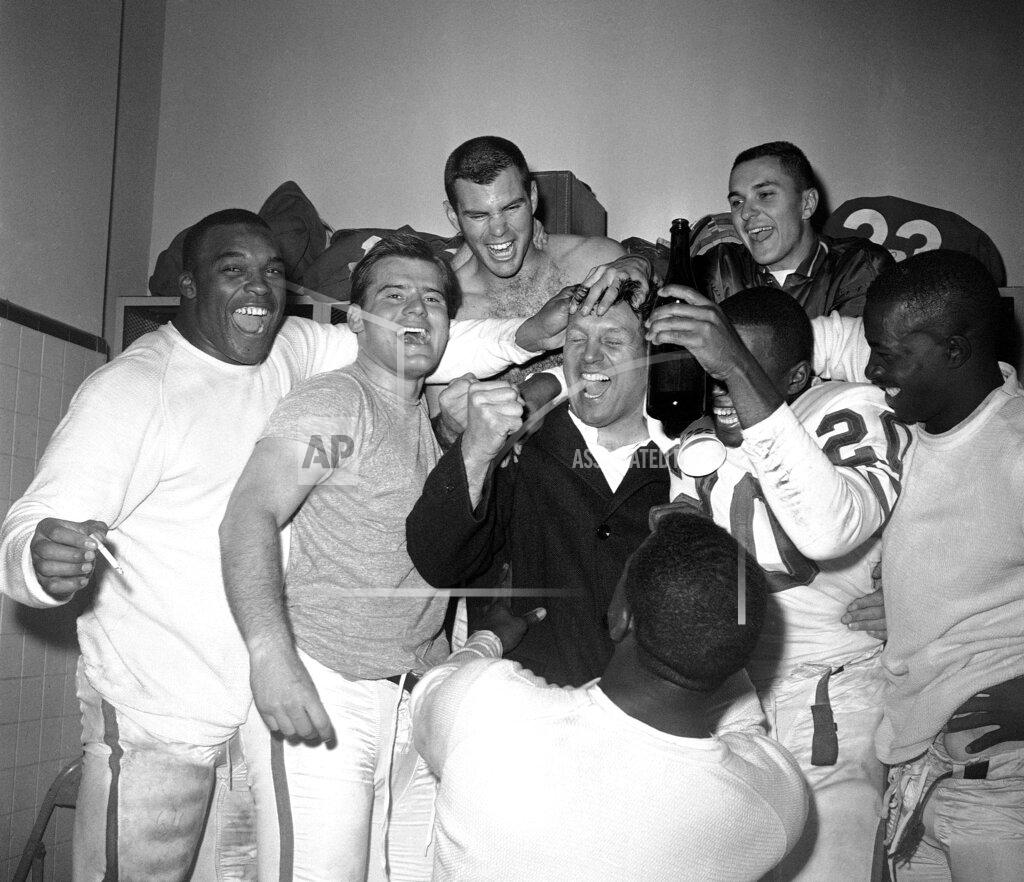
The vaunted defense of the Boston Patriots checked Cookie Gilchrist on a frozen field in Boston today, but could do little with Jack Kemp, the comeback quarterback of the Buffalo Bills. Kemp, relegated last week to the status of a benchwarmer, had a hot passing arm on a cold day and led the Bills to a 21–14 victory over the Boston Patriots. This was a pressure game, with the championship of the American Football League’s Eastern Division at stake. The Bills adapted best to the pressure and also to the arctic conditions. The scraping of four inches of morning snow from the field before the game delayed the start for half an hour, but Kemp did not delay. The poor footing limited Boston’s renowned pass rush and the Bills’ offensive line gave Kemp the protection he needed. His receivers were also able to utilize the usual advantage of a frozen field, being able to break away from their defenders. The pattern of the game was established on one big play in the first period, a 57‐yard bomb, that Kemp threw to Elbert Dubenion, his flanker back. Dubenion was way ahead of his defender, Chuck Shonta, as he caught the pass and ran 20 more yards into the end zone. Pete Gogolak kicked the conversion to give the Bills a 7–0 lead they never surrendered. Kemp completed 12 of 24 passes for 286 yards — a fine performance by an athlete who did not play at all in his team’s last game and was relieved by a substitute, Daryle Lamonica, in six others. Gilchrist, the Buffalo running back who leads the AFL in rushing, was limited to 60 yards in 20 attempts — considerably under par for Cookie — but he contributed by blocking well for his passer, Kemp. That was something Cookie did not do earlier in the season when the, Patriots beat Buffalo and ended the Bills’ nine‐game winning streak. The Bills will now take on the San Diego Chargers at Buffalo Saturday in the AFL’s title game. Buffalo beat San Diego twice in regular‐season play.
George Blanda set two American Football League passing records and Charlie Hennigan broke an all‐pro mark for receptions today as they led the Houston Oilers to a 34–15 victory over the Denver Broncos. The game was Sammy Baugh’s last as head coach of the Oilers and Houston’s last in Jeppesen Stadium. Baugh resigned Friday, effective today. Blanda’s pass to Hennigan early in the third quarter gave Hennigan 101 receptions for the year, smashing the 100‐reception mark of Lionel Taylor of Denver, set in 1961. The National Football League record of 93 was set by Johnny Morris of the Chicago Bears this season. Blanda’s first pass attempt of the game, a 52‐yarder to Charlie Tolar, was his 479th of the season, breaking the AFL mark. Blanca’s completed pass to Hennigan at 12:10 of the second quarter was Blanda’s 250th and broke the AFL mark. Both records were held by Frank Tripucka of Denver, now retired. Houston scored four times in the first half to run up a 24–0 lead on a run, a field goal, an 82‐yard punt return and a 25-yard Blanda‐to‐Hennigan pass.
The Kansas City Chiefs handed the New York Jets their seventh consecutive road loss, 21–7, today behind Len Dawson’s two touchdown passes. Dawson, the American Football League’s top passer, finished the season with 30 touchdown tosses. He gave way at quarterback in the fourth quarter to Pete Beathard, who threw a 23‐yard scoring pass to Reg Carolan with 21 seconds left. The Chiefs completed the year with a 7–7 record and took second place in the Western Division behind San Diego. The Jets, who made a game bid in the third quarter on the power running of their star rookie fullback, Matt Snell, closed with a 5–8–1 mark for third place in the Eastern Division. Dawson’s 11 ‐ yard scoring pass to Frank Jackson and Tommy Brooker’s 28‐yard field goal gave the Chiefs a 10–0 halftime lead. New York, which penetrated Kansas City territory only once in the first half, recovered a fumble by Mack Lee Hill on the Chiefs’ 19 in the third quarter to set up its only score. Snell cracked the Kansas City line on three successive plays, scoring on a 2‐yard smash off left tackle. Snell rushed 103 yards and ended with 945 yards for the season, a league mark for a rookie and a team rushing record. The Chiefs put the game beyond reach midway through the third quarter when Dawson hit Chris Burford on a 55‐yard scoring pass. Mark Johnston appeared to have intercepted the ball with a clear field ahead, but the ball bounced off his hands. Burford caught it at the New York 45 and raced down the sideline for the touchdown. Kansas City took the lead in the first‐quarter when Bobby Bell blacked Curley Johnson’s punt and Mel Branch recovered on the 11. On the following play, Dawson threw a strike to Jackson in the end zone.
The Oakland Raiders capped a disappointing season by rallying twice today on the passing of Tom Flores and the running of Clem Daniels to defeat the American Football League Western Division champions, the San Diego Chargers, 21–20. Flores, who went all the way in place of the injured Cotton Davidson, threw three touchdown passes — to Art Powell, Gene Mingo and Billy Cannon—and Daniels, one of the league’s most dangerous runners, figured in all scoring drives with timely runs. The. victory was the fifth against seven losses and two ties for the Raiders, who were preseason picks to battle the Chargers for the Western Division title. The loss was San Diego’s fifth against eight victories and a tie. The Chargers, who trailed at the half, 14–10, moved in front, 17–14, early in the third period when Paul Lowe sprinted 28 yards for a touchdown. They widened their margin to 20–14 two minutes later when Keith Lincoln booted a 32, yard field goal — his second of the game. Early in the final period the Raiders marched 94 yards in six plays to tie the score and Mike Mercer booted his third extra point for what proved to be the margin of victory. The Chargers took a 10–0 lead on a 17‐yard field goal by Lincoln in the opening period and a 39‐yard scoring pass from John Hadi to Lowe in the second period. The Raiders got back in the game four minutes after Lowe’s score when Flores capped a 65‐yard drive with a 26‐yard pass to Powell. Then, Flores connected with Mingo on a 10-yard toss with only 44 seconds left in the first half to give the Raiders their 14–10 lead at the intermission.
Born:
Clara Rojas, Colombian politician who was kidnapped along with presidential candidate Ingrid Betancourt during the 2002 campaign and held captive for almost six years; in Bogotá, Colombia.


 History Diaries