
The 35-nation Conference on European Security and Cooperation recessed today for a month with many delegates encouraged by the progress to date. Some Western delegates said privately that it might be possible to end the conference next summer with the flourish that the Soviet Union would like a formal session at which the heads of governments of the 35 countries, including the United States and Canada, would sign la la declaration on East‐West relations. While emphasizing that hard bargaining remains, these delegates said they believed that the Soviet Union would make just enough concessions to Western demands for provisions on human rights and a freer flow of information to enable Western countries to agree to a high‐level windup.
Western countries have insisted on fundamental concessions by the Soviet Union, particularly on exchanges of information and human contacts, before they could agree to a heads‐of‐government meeting. The Soviet Union, which had urged the convening of the present conference for years before it opened in Helsinki, Finland, in June, 1973, wants a declaration that amounts to ratification of Europe’s post-World War II boundaries. The most significant advances of recent weeks have been tentative accords on the reunification of families divided by frontiers and on facilitating marriages between nationals of different countries. “If nothing else,” a Scandinavian delegate said of the texts on family reunification and marriage, “they will give us the right to raise questions without being answered that we are interfering in a Country’s internal affairs.”
U.S. Secretary of State Kissinger will have separate meetings at the United Nations tomorrow with Foreign Minister Abdelaziz Bouteflika of Algeria, the president of the just-recessed General Assembly, and with Secretary General Waldheim. The meetings, according to a United States spokesman, will concern the Middle East and Assembly matters. During the Assembly session just ended, the United States warned of the erosion of support for the United Nations in Congress and among the American people — an erosion said to be caused by dominating activities of third‐world countries with Communist support, a socalled “tyranny of the majority.” Mr. Kissinger’s visit was planned before the United States policy statement, according to American spokesmen, who left the impression that the Middle East was the major concern at tomorrow’s meetings. However, it also was expected that the energy problem certainly would be taken up with the Algerian Foreign Minister at what will be the first Algerian meeting with Mr. Kissinger since diplomatic ties were re‐established in November.
President Ford was urged by several leaders of American Jewish groups not to use his new authority to grant lower tariffs to the Soviet Union until he was convinced that Moscow would carry out a controversial commitment to ease its emigration policies. The foreign trade bill passed by Congress today allows the President to authorize non-discriminatory tariffs to the Soviet Union for 18 months if he certifies that he has received “assurances” that Moscow will adopt freer emigration policies.
Emigration of Soviet Jews to Israel dropped by almost 50 per cent this year, according to official figures released today. A spokesman for the Intergovernmental Committee on European Migration told newsmen that the trend seemed to be toward a further decrease. This decline in emigration contrasted with a sharp rise in the number of Jews who decided to move from the Soviet Union to countries other than Israel. The spokesman said the committee had no official statistics on Soviet Jews settling in other countries, but estimated that the number was about 4,000, compared with 2,500 for 1973.
The government crisis in Turkey is now three months old, and there are few prospects for improvement. Since Premier Bulent Ecevit resigned on September 18, the country has been run by caretaker administrations. Meanwhile, various politicians have tried, and failed, to form a stable government. Mr. Ecevit won wide popularity here for his decision to invade Cyprus last summer following a coup against Archbishop Makarios. But he failed to gain approval for quick elections after his resignation, and now the next feasible date is late spring. The continuing instability here has hampered efforts to begin peace negotiations on Cyprus, where Turkish troops still control almost 40 per cent of the territory. As one Western diplomat put it: “Turkey picked a bad time to have her government unravel.”
President Valery Giscard d’Estaing said tonight that there was a new, smoother tone in French‐American relations but that it was easier to deal on equal terms with the Soviet Union than with the United States. “With the U.S.S.R., we deal only on a government‐to‐government basis,” the French President said. “Many of our relations with the U.S. are nongovernmental — on economics, finance, aviation and so on. So it’s harder to keep an equality of relations.” Mr. Giscard d’Estaing was reporting on nationwide television on his recent talks with government leaders, which concluded with a meeting with President Ford in Martinique last weekend.
In France, the Veil law, legalizing abortion up to the tenth week of pregnancy, was approved by a vote of 277 in favor and 192 against. The new law took effect on January 17, 1975.
The militant Provisional wing of the Irish Republican Army announced today a Christmas cease‐fire in Britain and Northern Ireland, and said the suspension could be made permanent if the British Government responded positively. The 11‐day suspension of guerrilla violence will begin at midnight on Sunday. In Belfast, Merlyn Rees, British Secretary of State for Northern Ireland, responded cautiously to the overture. He would not commit the British Government, but said the actions of the British security forces would be related to the level of terrorist activity. Mr. Rees said in a statement that it was now up to the people of Northern Ireland to insist that the initiatives for peace be kept alive. “When am sure people are acting politically,” he said, “A great deal can happen.” British officials in Northern Ireland indicated that there would be little response to the cease‐fire until after the Christmas period. If the cease‐fire held, the officials said, the government would act quickly to release some of the 600 detainees at the Maze prison, 10 miles southwest of Belfast, and scale down the army’s presence.
Avalanches in Iceland killed 12 people in two separate incidents at the fishing village of Neskaupstaður. At 1:30 in the afternoon, the first avalanche, covering a width of 400 metres (1,300 ft), killed five people, and at 1:50 a second avalanche 140 metres (460 ft) wide struck a garage, a concrete factory and a home, killing seven more, including two children.
Italy and Iran have signed an agreement expected to open the way for Italian technological aid to Iran in exchange for help in reducing the large deficit in the Italian balance of payments.
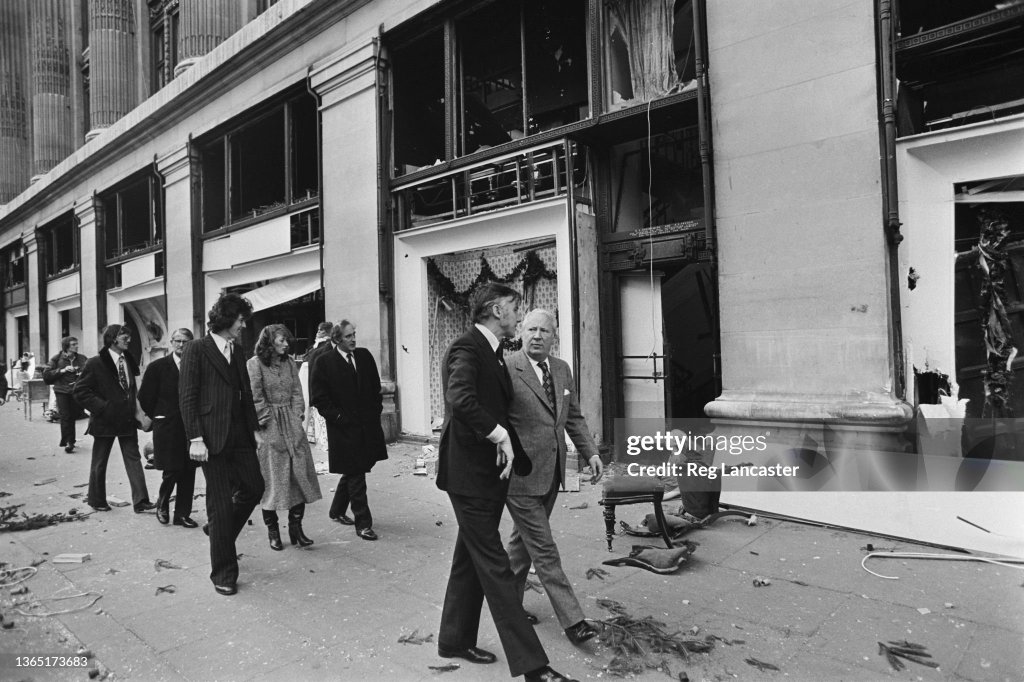
A bomb exploded in a police car today in Jerusalem’s busy Zion Square, wounding bystanders, destroying the vehicle and shattering the front of a store. The bomb had been found in a paint can outside a coffee house. Police officials said two policemen who had placed the bomb in the car moments before it went off were in fair to serious condition. Ten other persons were treated for lighter injuries. The police said that about 100 suspects, mostly Arabs, were detained in the vicinity immediately after the blast.
The United Nations has reportedly arranged for a temporary halt in Israeli shelling of olive groves in southern Lebanon to permit farmers to complete their harvest.
Premier Yitzhak Rabin of Israel challenged President Anwar el-Sadat of Egypt today to meet him face-to-face “for the purpose of a peace” between their two countries.
Ethiopia’s governing military council — with a motto of “Ethiopia first” — announced that it would turn the nation into a socialist country with a one-party system, collective farms and direct government control over all property useful for economic progress. The policy statement was broadcast on the 100th day after the ouster of Haile Selassie as Emperor.
In Cambodia, Hou Hong, a senior adviser to President Lon Nol, was appointed Defense Minister today, replacing Major General Thappana Nginn. General Thappana Nginn’s resignation yesterday was officially ascribed to health, but sources close to the government saw it as the first indication of American-instigated moves to bolster the government. Premier Long Boret appointed Mr. Hou Hong, the Minister for National Concord, to replace the general. This reportedly strengthens the Premier’s position and the United States Embassy is said to be pleased. In talks with Phnom Penh’s military and political leaders, American officials have stressed need for national unity.
A year ago a prominent South Korean professor died mysteriously while under detention by the Korean Central Intelligence Agency. The secret police said that the professor, Choe Chong Gil, had committed suicide. His family believes he was tortured to death. The case was carefully kept out of the controlled South Korean press. This week for the first time 1,000 South Korean Roman Catholics publicly marked his death and accused the government of responsibility at a memorial mass in the bitterly cold Myongdong Cathedral in Seoul. The participants did net attempt to march into the street past a cordon of helmeted riot policemen. But the mass significantly illustrated the problem President Park Chung Hee now faces.
Venezuela announced today that she was opening negotiations with Cuba to reestabish diplomatic relations broken off 13 years ago. The Venezuelan ambassador to the United Nations, Simon Alberto Consalfi, and his Cuban counterpart, Ricardo Alarcon Quesada, met today at United Nations headquarters in New York. Foreign Minister Efrám Schacht of Venezuela told newsmen in Caracas that the session was arranged by order of President Carlos Andrés Pérez. Mr. Schacht gave no target date for re‐establishment of relations. Relations between the two countries were severed in 1961 by former President Rómulo Betancourt on the ground that the Communist government of Fidel Castro was openly supporting leftist guerrilla efforts to topple Venezuela’s newly established democratic regime.
[Ed: You will be sorry, Venezuela.]
The Argentine Government today closed down the newspaper with the largest circulation in Argentina and a small leftist daily. Crónica, a sensational paper in tabloid format that sold over 600,000 copies daily, was ordered shut down for a campaign calling for an armed invasion of the Falkland Islands, whose ownership has long been debated by Argentina and Britain. The islands, a British colony with 2,000 English‐speaking residents, are about 300 miles off the southernmost coast of Argentina. The sovereignty issue has heated up recently after reports of possible oil deposits there. Crónica angered the Argentine Foreign Ministry by embarking on a campaign to enlist voluteers to invade the islands, which has reportedly inerfered with negotiations with the British Government.
A truck overturned 8 miles (13 km) from Sterkstroom, South Africa, killing 33 workers and injuring 26.
Some of President Ford’s economic advisers are projecting a huge budget deficit — as much as $35 billion — for the next fiscal year even without the income tax cut that is under intense debate within the administration. Several weeks ago, the Presiden said in an interview that the budget deficit for the fiscal year 1976, starting next July 1, might be as low as $10‐billion, although he conceded as a remote possibility that it might go as high as $35‐billion. Developments since then have convinced some highranking economic planners that the $35‐billion deficit has now become the probability rather than the far end of the range of the possible. Indeed, there is some suspicion that it could go even higher. If the deficit does approach the new estimate by the President’s advisers, it would set peacetime record.
The Labor Department reported that consumer prices rose nine-tenths of 1 percent in November. This, combined with a reduction in weekly pay because of a cut in average hours worked, brought a record drop of 1.7 percent in the workers’ “real” after-tax incomes. Soaring Sugar prices played an important role in the large increase, in food prices in November — a rise of 1 percent, or 1.4 percent after adjustment for normal seasonal change in some prices. Sugar prices have since stabilized and even declined a little. The consumer price index for November was 12.1 percent above a year earlier, which is the highest annual inflation rate since 1947. For the last three months, the index went up at an annual rate of 13 percent.
Nelson A. Rockefeller, on his first day as Vice President, apparently ran afoul of holiday traffic in the capital today and showed up five minutes late for the only job the Constitution specifically assigns him: presiding over the Senate.
John Wilson, the chief defense lawyer for H.R. Haldeman, in his final argument before the jury at the Watergate cover-up trial said that the prosecution’s chief witness, John Dean, was a “mastermind of chicanery” and a “perjurer.” He told the jurors not to believe Mr. Dean’s testimony, and he challenged the government’s case in a number of other areas.
The 93rd Congress adjourned tonight after giving approval to a foreign trade bill that rewrites the nation’s basic trade law for the first time in 12 years, and to several less significant measures. The Senate approved the trade bill, which was a compromise, by a vote of 72 to 4. The House adopted it by 323 to 36. President Ford’s signature is believed to be certain. The adjournment was the calmest in many years, free of the tendentious wrangles that often mark the last days of a session.
In a historic decision that is believed certain to be appealed, Federal District Judge William Sweigert in San Francisco ruled that the National Football League’s contract and player-reserve system is illegal. In an antitrust suit brought by Joe Kapp, a former Minnesota Vikings quarterback, Judge Sweigert said that the league’s “Rozelle” rule under which the N.F.L. can perpetually restrain a player’s employment choice was “patently unreasonable and illegal.”
More than a dozen foreign and domestic airlines agreed to admit to federal prosecutors that they have made illegal rebates — allegedly totaling many millions of dollars — to travel agents who gave the airlines favored status in regard to booking passengers. The airlines face prosecution. The case is the first ever in which airlines have been criminally prosecuted under the 1938 Federal Aviation Act, the law governing virtually all aspects of air commerce in this country. The airlines are alleged to have made kickbacks, involving many millions of dollars annually, to high‐volume travel agents in exchange for sending large numbers of passengers to them. Airline lawyers agreed at a meeting Thursday to submit to the criminal prosecution after several months of attempting to resolve a long‐running Federal grand jury investigation of ticket rebating with a civil‐consent decree pledging not to continue the practice. David G. Trager, the United. States Attorney for the Eastern District of New York, however, had turned down the decree and insisted on criminal charges.
Four young gunmen who held about 55 hostages for up to six hours when a policeman barred their escape from a Richfield supermarket were in jail today on armed, robbery and other charges. The last of the gunmen, who, included two juveniles aged 16 and 17, released the second of two large groups of hostages and surrendered at about 1:25 AM today after three telephone conversations with Governor Wendell R. Anderson. Thomas Morgan, Richfield’s director of public safety, said that the two adults, Darryl Thompson, 29 years old, and Patrick Weyars, 19, both of Minneapolis, would be charged with armed robbery. Other charges, he said, had as yet not been determined. “I’m surprised they let us go,” said one woman hostage after the five‐hour ordeal. “It must be an act of God.”
The Authorities said that the four bandits were Indians. One of them, Mr. Thompson, told reporters after the incident, “Indians have been down trodden for centuries. For some this is a way of life. There are others out there just like me.” The two adults were in the Hennepin County Jail in nearby Minneapolis, and the two youths were taken to a juvenile center. Governor Anderson told a news conference today in St. Paul that he was notified of the siege about 10:30 PM by the police, who put him in contact with the gunmen.
The South’s civil rights organizations are being squeezed by inflation and a shortage of operating funds, most of which come from foundations and wealthy people whose fortunes rise and fall with the nation’s economy.
“It is like decommissioning a battleship and putting it in mothballs,” Benjamin Malcolm, New York City’s Corrections Commissioner said as the “Tombs” was finally shut down. The prison, officially known as the Manhattan House of Detention for Men, at 123 White Street in Lower Manhattan, was closed under a federal court order, in which the judge said that conditions at the Tombs would “shock the conscience of any citizen who knew them.”
In Chicago, a city long dominated by Mayor Richard J. Daley and his Democratic party organization, the black community is making yet another move to win a measure of political power. But the odds against near-term success are great.
“The Godfather Part II”, directed by Francis Ford Coppola and starring Al Pacino and Robert De Niro, is released (Academy Awards Best Picture 1975)
George Harrison releases “Dark Horse”, his fifth studio album in UK.
The organizers of the 1976 Montreal Olympics have under wraps a report that shows construction costs for the summer Games will be substantially higher than original estimates, apparently leaving them with the decision of either finding new money sources or cutting back on planned facilities.
Dow Jones Industrial Average: 598.48 (-5.95, -0.98%).
Born:
Augie Ojeda, Team USA and MLB second baseman, shortstop and third baseman (Olympics, bronze medal, 1996; Chicago Cubs, Minnesota Twins, Arizona Diamondbacks), in Los Angeles, California.
Samantha Buck, American actress (“Law and Order: Criminal Intent”), in Dallas, Texas.
Die [Daisuke Andou], Japanese heavy metal rock guitarist (Dir En Grey), in Mie, Japan.
Vasyl Slipak, Ukrainian opera singer and Ukrainian Corps volunteer; in Lviv, Ukrainian SSR, Soviet Union (killed by Russian Army sniper, 2016)
S. Jithesh, Indian cartoonist and entertainer known for creating “speed cartooning”; in Pandalam, Kerala state.
Died:
R. Palme Dutt, 78, British Marxist, former General Secretary of the Communist Party of Great Britain.
Ellen Deborah Ellis, 96, American academic, founder and first chair of the political science department at Mount Holyoke College.
James H. Floyd, 54, member of the Georgia House of Representatives, party to the U.S. Supreme Court case Bond v. Floyd, died of a heart attack.
André Jolivet, 69, French composer and conductor.
Mun Se-gwang, 22, was executed by hanging for the murders of Yuk Young-soo, the First Lady of South Korea, and a high school student during an attempted assassination of President Park Chung Hee on August 15.
Ralph M. Parsons, 78, American engineer and industrialist.


 History Diaries