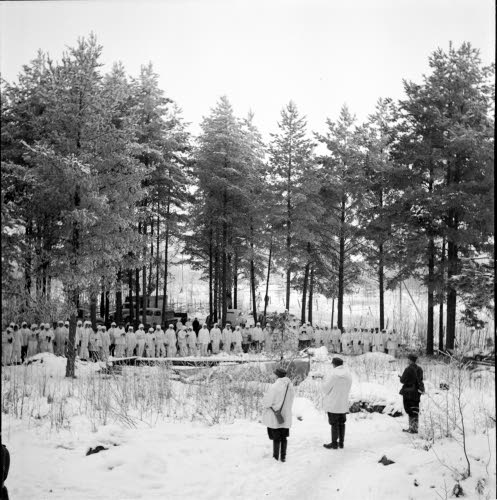
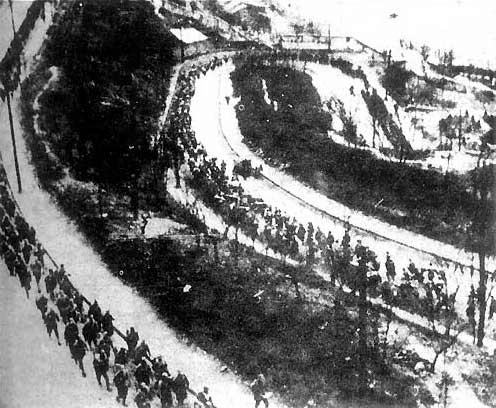
Red Army assaults on the Mannerheim Line around the village of Summa gained no ground while sustaining heavy losses. The main Soviet attacks against the Mannerheim Line, around Summa, continues. There is renewed Soviet bombing of Helsinki and shelling of coastal batteries. Enemy tanks once again penetrate the Finnish positions at Summa, but the infantry assaults are repulsed in all sectors.
Soviet troops take the village of Oinala to the southeast of Muolaanjärvi.
North of Lake Lagoda, the line at Kollaa holds and the Finnish IV Corps pushes Soviet 75th and 139th divisions back to Ägläjärvi as the Soviet 8th Army attempts to stabilize its lines. The enemy offensive gets bogged down at Kollaa. The difficult terrain makes it impossible for them to make effective use of their tanks and artillery.
In the early hours of the morning Detachment Pennanen continues its advance towards Ägläjärvi in the Tolvajärvi sector. The offensive fails due to a combination of exhaustion and bad weather. The troops return to their original positions.
Paavo Talvela is promoted from colonel to major general for his command at the Battle of Tolvajärvi on 12 December. The campaign at Tolvajärvi is quite not over yet, but its opening rounds have been a smashing Finnish victory. Battles are drawn-out affairs because the Finns are relying on the cold and hunger as their allies against the Soviets, and while those factors take time to work their magic, they are relentless.
Finnish counterattacks force the Soviet 9th Army to retreat in the Salla sector. Finnish troops under Major Perksalo defeat a Russian regiment at the parish village of Pelkosenniemi to the west of Salla. The Russians disengage and head for Savukoski. The Soviet 112th Division loses most of its tanks and other heavy equipment. The Finns are holding the Soviets on the south road toward Kemijärvi against fierce attacks. Once again, the Finns are showing their excellence at concentrating their minimal forces and defeating Soviet units in detail.
Other Finnish troops simultaneously halt the offensive by the main force of the 122nd Division at Joutsijärvi.
The Soviet 104th division reaches Kornettijärvi after advancing 120 kilometers.
Soviet 273rd Infantry regiment retreated in the face of attacks from Finnish 40th Infantry Regiment.
Soviet battleship Oktyabrskaya Revolutsiya and escorting warships bombard Finnish shore battery at Saarenpää.
In the far north, the Soviets advance from Petsamo to take Pitkaejaervi but can proceed no further. Three scratch Finnish companies are able to stop the Soviet 52nd Division at Höyhenjärvi. It is the heart of winter up there, with no sunlight and bitter conditions, terrible weather for army advances.
The Soviet Air Force launches an air raid against Helsinki.
In the Netherlands, Princess Juliana and Prince Bernhard give 1,000 guilders to the Dutch Red Cross to be passed on to the Finnish Red Cross.
The U.S. Navy agrees to transfer 44 ‘obsolete’ Brewster F2A Buffalo fighter planes to Finland. The Buffalos, which achieve little in U.S. Navy service, arrive too late to participate in the Winter War of 1939-1940 but are used to good advantage in the later Continuation War of 1941-1944.
The Stockholm correspondent of the newspaper Politiken said reports were received in the Swedish capital today from Moscow that Joseph Stalin had decided on a purge of Red Army commanders on the Finnish front because of their failure to achieve a quick victory. Mr. Stalin and Premier-Foreign Commissar Vyacheslav M. Molotov called in the chief officers of the Red Army General Staff, it was said, and asked why they were not making good their promise to complete the conquest of Finland by February. After the army chiefs had explained the campaign to date, the correspondent said, Mr. Stalin ordered an immediate purge and an investigation by the secret police. Another report in Stockholm was that an official investigation commission would be sent from Moscow to the Karelian front soon.
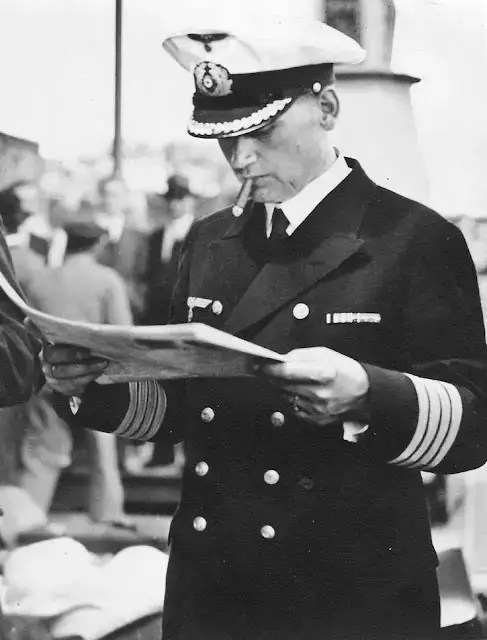
The Captain and crew of Admiral Graf Spee land in Buenos Aires. The Uruguayan authorities arrest four of them for scuttling their ship. The press is full of scorn at Captain Langsdorff for not going down with his ship, which is full of black humor because, if he had stayed on the bridge, he still would have been above water.
Captain Hans Langsdorff told The Associated Press today that the Admiral Graf Spee, while preying on Allied merchant shipping, once disguised herself as the British battle cruiser HMS Renown.
A German Labor Front leader asserts the Nazis’ divine right to rule. The Reich’s mission to dominate is among the war aims, he says, also demanding the annihilation of Britain, the obstacle to German success. In a speech in conquered Lodz, now annexed to Greater Germany, Dr. Robert Ley, Reich Organization Director and head of the German Labor Front, has proclaimed that Germany’s real war aims are the annihilation of Great Britain and establishment of the “divine right” of the German race to rule over others.
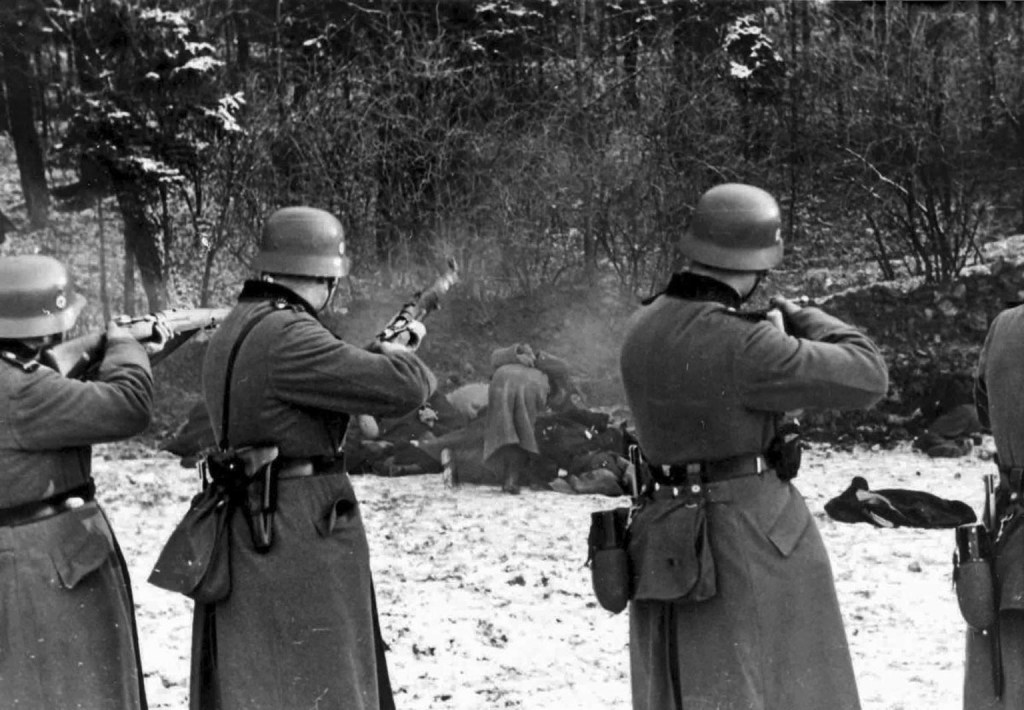
German soldiers execute Polish civilians in the city of Bochnia. 56 people are executed.
Lavrentiy Beria ordered first mass deportation of Poles to Soviet Union.
Hitler offers support to Quisling in exchange for assistance in Norway. Hitler meets Quisling again and promises German financial support in return for any assistance rendered to the German Armed Forces High Command. Hitler repeats his promise that any British invasion will be met by a German counter-invasion. Quisling becomes uncertain about Hitler’s motives – Quisling sees himself as ruler of an equal nation supported by Hitler, while Hitler sees Quisling as someone to govern a German possession — and somewhat belatedly denies being a supporter of the Third Reich. Hitler proceeds with his own plans for an invasion but now is not depending upon Quisling, though he continues supporting him.
Hitler cancels plan to restore King Amanullah to the throne of Afghanistan. Hitler has made diplomatic gestures towards several middle east and far east nations such as Iraq and Tibet. He has been toying with the idea of intervening in Afghanistan and restoring King Amanullah to the throne there, but gives it up as impractical. The British are dominant throughout the region.
Ice and snow and a biting wind rule on the Western Front. Few planes take the air, but ground troops continue their routine, although the scale of operations was smaller today. A French patrol captures two German officers.
The Italian press continued today to comment on Saturday’s speech by Count Ciano, the Foreign Minister. It was notable that some editorials criticized Germany on the ground that she had been hasty in going to war, but most of them stressed Italy’s nonbelligerency more than anything else.
Commodore Harwood — victor of the Battle of the River Plate — is promoted to Rear-Admiral.
The British Admiralty reports that 10 out of 1,100 ships transiting to or from British ports in the first ten days of December were sunk.
The Battle of the Heligoland Bight: 22 RAF Wellington bombers from 9, 37 and 149 Squadrons attempt a daylight raid on German warships in the Wilhelmshaven area, which ends disastrously. Detected by German ‘Freya’ radar, they are badly mauled by Bf109 and Bf110 fighters off Heligoland. This is the first combat success of radar. A swarm of 50 Bf 109s and 110s converge on the Wellingtons as they return home and eliminate a dozen of them at the cost of two fighters (figures vary by source). Ten Wellingtons are shot down outright, two ditch in the sea, and three limp home to crash-land at base. Two Bf109s are destroyed. The disaster will help convince Bomber Command that unescorted day bombers are too vulnerable to operate safely except under very favorable circumstances.
The British trawler Active was bombed and sunk in the Moray Firth 30 nautical miles (56 km) north by west of Rattray Head, Aberdeenshire, by aircraft of X Fliegerkorps, Luftwaffe with the loss of one crew member. Survivors were rescued by Caribineer II.
The British trawler Trinity N B was bombed and sunk in the North Sea off Kinnaird Head, Aberdeenshire (57°50′ N, 1°30′ W) by aircraft of X Fliegerkorps, Luftwaffe, with the loss of two crew. Survivors were rescued by the Danish ship Smart.
Destroyers USS Greer (DD-145) and USS Upshur (DD-144) relieve destroyers USS Ellis (DD-154) and USS Cole (DD-155) of shadowing German passenger liner Columbus. Later that same day, heavy cruiser USS Tuscaloosa (CA-37) replaces the destroyers in trailing the passenger ship.
U.S. freighter Meanticut, detained by British authorities at Gibraltar the previous day, is released.
Convoy OA.55G departs Southend.
Convoy SL.13 departs Freetown for Liverpool.
The War at Sea, Monday, 18 December 1939 (naval-history.net)
On Northern Patrol, two cruisers were between the Orkneys and the Faroes, two cruisers between the Faroes and Iceland, and heavy cruiser BERWICK in the Denmark Strait.
Armed boarding vessel NORTHERN DUKE attacked a submarine contact 55 miles NW of Cape Wrath.
Light cruiser SHEFFIELD departed the Tyne on Northern Patrol duties, and arrived at Scapa Flow on the 28th.
Light cruiser EDINBURGH departed Scapa Flow for Portsmouth, land left Portsmouth on the 22nd.
Light cruiser CALEDON departed the Tyne for Devonport.
Armed boarding vessel KINGSTON TOPAZ, en route to her first patrol, ran aground on Skea Skerries, Westray Firth. She was got off and taken to Aberdeen for repairs.
New submarine TAKU underwent trials off Liverpool during the day, escorted by anti-submarine yacht CUTTY SARK.
German destroyers FRIEDRICH IHN, FRIEDRICH ECKHOLDT and HERMANN SCHOEMANN departed Wilhelmshaven to lay mines off Orfordness. When they arrived and found the British navigational lights extinguished, they returned as the mines could not be accurately laid.
Light cruiser CAPETOWN departed Malta on patrol duties, and arrived back on the 26th.
Convoy SA.22 of two unescorted steamers departed Southampton, arriving at Brest on the 19th.
Convoy FS.56 departed the Tyne escorted by sloops PELICAN, WESTON, and HASTINGS, and arrived at Southend on the 19th.
Destroyer WALLACE and sloop STORK departed Methil with a group of merchant ships for the Tyne to join convoy FS.57.
Convoy SL.13 departed Freetown escorted by sloops WELLINGTON and LEITH, the latter detaching on the 19th. On 4 January, WELLINGTON was relieved by sloop ENCHANTRESS and destroyer WITHERINGTON. The convoy arrived on 6 January.
Light cruiser NEPTUNE attacked a submarine contact 150 miles east of Rio de Janeiro.
The Communist Party of the U.S.A. held a mass meeting last night at Madison Square Garden. In view of the confusion caused in Communist circles by recent switches in the “party line” following changes in policy by the Soviet Government, the attendance at the meeting was a matter of interest to party members as well as to neutral observers. Police said 16,000 were there. Party officials claimed 20,000. The Garden, as arranged for the meeting, had room for 18,500. Also of interest, as indicating what the party now stands for and the lines of policy that are proving popular with its followers, are the lists of principles and persons that were booed and principles and persons that were applauded. These were booed:
- Herbert Hoover.
- The American Jewish Congress and the Jewish Labor Committee, organizations that sponsored a meeting at the Garden December 13 at which persecution of the Jews in Nazi Poland was condemned.
- The moving picture “Gone With the Wind,” on the grounds that it was unfair to Blacks.
- Vincent Sheehan, left wing writer who has attacked the Nazi-Russian get-together.
- The Nazi party.
- The Fascist party.
- The Christian Front, an American organization opposed to communism.
- General W. G. Krivitsky, formerly of the Red Army, who has written a book attacking the Stalin administration.
- Isaac Don Levine, said to have “ghost-written” the Krivitsky book.
- The “Ku Klux Klan Dies Committee.”
- Premier Daladier of France.
- Leon Blum, French Socialist leader who is supporting the war.
- Premier Mussolini.
- Prime Minister Chamberlain.
- The “Mannerheim-Ryti White Guard bandits” — as a speaker described the present government of Finland.
These were applauded:
- The Soviet Union.
- Joseph Stalin.
- The Communists of Germany “who are working against Hitlerism.”
- The slogan “Keep the United States out of war.”
- The “Democratic People’s Republic of Finland,” the puppet government set up by the Russians.
- The “heroic Red Army.”
- The statement that “the main enemy of the American working people is at home; it is Wall Street and its monopolists and bankers.”
- The statement that “it was against the German-Soviet non-aggression pact that Britain and France declared war, and against nothing else.”
- A reference to “the two greatest nations of the world, the United States and the U.S.S.R.”
A U.S. Senator upholds private insurance. He sees a “politician’s paradise” if the federal government can enter the field. Urging the public to look with extreme caution upon all attempts of government to set itself up in the insurance business, Senator Millard E. Tydings of Maryland warned yesterday that if the field of life insurance were turned over to the Federal Government it would be a “politician’s paradise” and would soon break down not only the security of the insurance business, but government finances and institutions as well. He addressed 600 life insurance men at a luncheon meeting of the Life Underwriters Association of the City of New York at the Hotel Pennsylvania. His talk was broadcast over a national radio network. Mr. Tydings, a militant opponent of the New Deal, said that if government should enter the field of insurance the amount of insurance benefits to be paid would become an issue in many political campaigns. Some candidates for public office would promise to change the insurance laws so that wider benefits might be paid by the government, he added, “without regard to whether or not this was possible or practical.”
Summoning a regional director of the National Labor Relations Board to the stand, a House investigating committee questioned him closely today on one report in which he said a friendly city editor killed a story derogatory to the board, and on another in which he quoted the C.I.O. as saying it had an “obligation to Communists.” The witness, Philip G. Phillips, had reported that the story was killed by the city editor of The Cincinnati Enquirer, “a swell guy and a dear friend of mine.” Tonight W. F. Wiley, publisher of The Enquirer, issued a statement at Cincinnati, saying the Phillips testimony was full of “innuendo and bald misstatements of truth and fact.”
The CIO contradicts the claim of a labor shortage in the US. Thousands of mechanics lack work. Reports of a threatened labor shortage in the United States were described today by the Congress of Industrial Organizations as the “wishful thinking of those who want to believe that the nation does not have to provide for its unemployed.” In a leaflet devoted to the subject, the C.I.O, stated that “our national economy will be in danger if the propaganda of a shortage of labor is successful in fooling the nation to the belief that unemployment is wiped out.” Later in the day, John L. Lewis, chairman of the C.I.O., urged that Secretary Perkins, in her capacity as chairman of the Committee on Economic Security, institute “thorough and impartial investigation of the whole problem” of unemployment compensation in the States. In a letter sent to Miss Perkins and made public by C.I.O. headquarters, Mr. Lewis declared that a lack of definitive Federal standards had resulted “in confusion and regressive action on the part of the States.”
Jake Lvovsky, confessed co-leader of the smashed $10,000,000 New York narcotics ring, contradicted in Federal court yesterday the earlier testimony of Yasha Katzenberg, his former partner, that Louis (Lepke) Buchalter had invaded their racket and had demanded and received half the profits.
The final rush begins for holiday trade. Customers have waited for a dip in prices, with men’s clothing and liquor items that are selling.
The 1,039 officers and men of the Admiral Graf Spee are interned in Buenos Aires, Argentina.
The Graf Spee incident gives Latin America unity. Uruguay’s action in protesting to Britain and Germany is hailed by sister nations.
The Viceroy ties India’s fate to war, holding that the country’s future welfare hinges on the success of the Allied forces. Addressing the Associated Chambers of Commerce today, the Marquess of Linlithgow, the Viceroy, said that the fate of India in the international sphere turned on the success of the Allied arms.
The Battle of Kunlun Pass began in the Second Sino-Japanese War. The Japanese have captured this key route which provides access to the Chinese rear of Chungking. Chinese General Bai Chongxi has Chiang Kai-shek send the best unit in the Chinese Army, the 5th Corps from Hunan province, to stop them. Unlike other Chinese formations, it is equipped with tanks and other armor, and it sends two divisions to attack the Japanese. The Chinese plan is to sweep in behind the Japanese and cut them off. Progress on the first day is promising.
Chinese 2nd War Area troops captured Longhua, near Yicheng, Hubei Province, China. To the south, Chinese 5th Division captured Kunlunguan Pass in Guangxi Province.
Chinese 3rd War Area captures Chasan, Wangchiatan, Tsenghsingshan, Paifangshan, Maotan, Puling, Hsiangshan, Tuanshan, Hanshan, Shihtzeshan, Huiluling, Kangyaoling, and part of Chiangchiatashan.
Japanese 104th Infantry Division engaged with elements of Chinese 4th War Area around Yinchanao.
River North Army of Chinese 5th War Area attacking Japanese column around Wangwutai and Hanchingmiao.
Left Flank Army of Chinese 5th War Area captures Tzepakang and Changkang.
Chinese 8th War Area conducts diversionary attacks and raids to cut rail lines.
Successes in what is believed to be the beginning of a counter-offensive for the recapture of Nanning, on the Indo-China route in Kwangsi, are announced in a communiqué by the Chinese military headquarters here last night. The communiqué said that Kunlungkwan and Kiutang, two strategic points north of Nanning, had been retaken at 8 AM yesterday. “One whole Japanese brigade operating in the north of the Nanning area was expected to be wiped out by the advancing Chinese,” it said. Kunlungkwan is a mountain stronghold that dominates Nanning twenty miles north of the city. Its recapture coincided with marked activity by Chinese mobile units along the highway between Nanning and the sea, where the Chinese claim they are continuing to hold important towns.
Chinese 16th Army Group (West Route Force), 26th Army Group (East Route Force), and 38th Army Group (North Route Force) open attacks against Japanese positions north of Nanning.
Chinese North Route Force captures Kunlunkuan and Chiu-Tang.
Elements of Japanese 5th Infantry Division are under attack around Kunlunkuan.
There are Chinese attacks all across the front, and Japanese counterattacks are stymied.
The Japanese Government intends to reopen the Yangtze River between Shanghai and Nanking to the trade of all nations and intends also to reopen the Pearl River at Canton, “at the proper time.” This promise was given to the United States Ambassador, Joseph C. Grew, this afternoon by Admiral Kichisaburo Nomura, the Japanese Foreign Minister, who immediately afterward repeated it to Sir Robert Leslie Craigie, the British Ambassador, for the information of the British Government.
Although this promise was given out simply as a declaration of intention, and although the concession will appear small to Americans, it is important in the view of the Japanese Government because it is held to constitute concrete evidence that the “new order” in China is not intended to be a closed economy in which Japanese will enjoy a monopolistic position to the exclusion of foreign interests.
The Japanese Government evidently wants its action to be taken as the first installment of its reply to an American protest that was made a year ago against the Japanese policy in China. This can be read between the lines of the Foreign Office comment that was issued tonight in amplification of a communiqué announcing Admiral Nomura’s communication to Mr. Grew and intended to emphasize its significance.
It declared that foreigners were mistaken when they supposed that Japan intended to act in an exclusive or monopolistic manner or was trying to exclude other countries. from economic activities in China. The Foreign Office tonight repeats that those restrictions have arisen either as the unavoidable consequences of military operations in China or as the natural corollary of reforms connected with long-term reconstruction in China.
“The Japanese Government,” it says, “is not acting with a view to shutting out the economic activities. of other powers in China. As a matter of fact, it is not reluctant to open even the Yangtze and Pearl Rivers at the proper time and under appropriate conditions. It is hoped, in the light of the above explanation, that Japan’s real intentions will be understood not only by the United States but by other powers.” It can be assumed that the Tokyo government has been ready to make this concession for some time, but has been restrained by the fighting services.
While the government in Tokyo explained the closing of the Yangtze as an indispensable part of Japan’s blockade, the army and navy in China also considered it an effective weapon against powers that refused to view Japan’s policy in China in a “cooperative” spirit. They declared that nationals of foreign countries that had been assisting China should not receive facilities for trade and this feeling was so strong that the government in Tokyo had the greatest difficulty in inducing the commanders in China to re-open the Yangtze.
Dow Jones Industrial Average: 149.22 (-0.14)
Born:
Michael Moorcock, science fiction and fantasy author, in London, England, United Kingdom.
Zoilo Versalles, MLB shortstop, third baseman, and second baseman (All-Star, 1963, 1965; Washington Senators-Minnesota Twins, Los Angeles Dodgers, Cleveland Indians, new Washington Senators, atlanta Braves), in La Habana, Cuba (d. 1995, from arteriosclerotic heart disease).
Fred Moore, AFL defensive tackle (San Diego Chargers), in Sulligent, Alabama (d. 1998).
Sandro Lopopolo Italian lightweight boxer (Olympics, Silver medal, 1960), born in Milan, Italy (d. 2014).
Harold E. Varmus, molecular biologist and Nobel laureate (1989 Nobel for Medicine or Physiology for cellular origin of retroviral oncogenes), in Oceanside, New York.
Alex Bennett, talk radio host, in San Francisco, California.
Wiesje Backer, Dutch ballet dancer, actress, and playwright, born in Ammerzoden, Netherlands (d. 2018).
Died:
Heywood Broun, 51, American journalist (1st President of American Newspaper Guild), dies of pneumonia.
Ernest Lawson, 66, Canadian-American painter.
Naval Construction:
The Royal Navy rescue tug HMS Assurance (i) (W 59), lead ship of her class of 21, is laid down by Cochrane & Sons Shipbuilders Ltd. (Selby, U.K.).
The Royal Navy Dance-class ASW trawlers HMS Pirouette (T 39) and HMS Morris Dance (T 117) are laid down by Goole Shipbuilding & Repairing Co. Ltd. (Goole, U.K.); completed by Amos & Smith.
The Kriegsmarine (German Navy) Type VIIB U-boat U-85 is laid down by Flender Werke AG, Lübeck (werk 281).
The Kriegsmarine (German Navy) Type VIIC U-boat U-374 is laid down by Howaldtswerke AG, Kiel (werk 5).
The Royal Navy Hunt-class (Type II) escort destroyer HMS Heythorp (L 85) is laid down by Swan Hunter and Wigham Richardson Ltd. (Wallsend-on-Tyne, U.K.); completed by Wallsend.
The U.S. Navy Gleaves-class destroyer USS Ludlow (DD-438) is laid down by the Bath Iron Works (Bath, Maine, U.S.A.).
 History Diaries