The Soviet Union denied having given any specific assurances of easier emigration in return for American trade benefits and government credits. An official Tass statement said “leading circles” rejected as unacceptable any attempts to attach conditions to United States tariff reductions or otherwise interfere in internal Soviet affairs. It published a letter, dated October 26, from Foreign Minister Andrei Gromyko to Secretary of State Kissinger rejecting any interpretation that emigration from the Soviet Union would increase. It has in fact shown a tendency to decline, Mr. Gromyko said.
In Washington, Senate-House conferees agreed on a final draft lowering American tariffs on Soviet products. They acted after the Ford administration and key legislators indicated they expected emigration would be eased despite the Soviet statement. Senator Henry Jackson will seek enactment in both houses this week. The trade concessions, in the form of lower American tariffs on Soviet products, were approved for 18 months and may then be withdrawn if Soviet emigration practices are not liberalized. The Soviet statements were the latest complication in the drawn‐out negotiations involving the Kremlin, the Administration and the Congress over the trade and emigration link.
In Moscow, Deputy Premier Nikolai Baibakov said in a report to the Supreme Soviet that an attempt to reorient the economy in favor of the consumer in the current five-year plan had failed. He attributed the setback to incomplete fulfillment of the tasks given to the sectors responsible for production facilities and raw materials. He said this year’s grain harvest would be 195.5 million tons, compared with a planned goal of 205.6 million. Mr. Baibakov made the disclosures as he submitted for endorsement the economic plan for next year. The plan has already been approved by the Communist party’s Central Committee at a meeting this week. The mediocre showing in some important areas of the economy this year, Mr. Baibakov and the Communist party paper Pravda said today, was a result of continuing problems of poor management, inefficiency, lagging productivity, incomplete use of industrial capacity and resources and failure to complete new facilities on time.
A major split has reportedly developed in the Portuguese coalition Government following the jailing of 11 prominent businessmen. President Francisco da Costa Gomes is said to be trying to prevent the Cabinet from breaking up. Premier Vasco dos Santos Gongalves has been under fire from most of his Cabinet for having sent military units on his own initiative early Friday to raid the homes of 12 businessmen. Eleven are under arrest and the 12th is being sought. The businessmen were accused of having been involved in financial irregularities and economic “sabotage.”
The House passed and sent to President Ford a foreign aid bill that would permit continued military aid to Turkey until February 5. The vote was 209 to 189. A compromise with Mr. Ford on the Turkish aid question was the key issue in the $2.7 billion authorization measure. Congress had earlier mandated a December 10 cutoff on such aid after Turkey invaded Cyprus.
Michail Stasinopoulos of the New Democracy Party was elected President of Greece by vote of the Hellenic Parliament, receiving 206 votes from party members, sufficient for the 151 required for a majority.
The Provisional IRA exploded two time bombs in the English city of Bristol. The first was placed in a sports bag outside a photography studio on Park Street, and a telephone warning followed, bringing police to the scene to clear the area. The second, more powerful bomb had been placed in a trash can 90 feet (27 m) away from the first bomb, with the object of injuring police and other responders lured to the scene. No warning was given for the second blast, and 20 people were injured.
Britain’s ruling Labor Party was threatened with a serious rift when Robert Mellish, chief whip and member of the cabinet, offered his resignation after 58 members of Labor’s left wing voted against the government’s defense policy. That faction contended that proposed cuts of $10.8 billion over 10 years in defense spending were inadequate. Seventy-six party moderates reportedly were meeting to challenge the pressures toward socialism being applied by the left-wing group.
British Prime Minister Harold Wilson has been invited by President Ford to visit the United States beginning January 30, the White House said. On the agenda will be items dealing with the economy, energy, the Atlantic Alliance, Mideast troubles and East-West relations, the announcement said.
The United States and Yugoslavia have agreed to expand military relations leading to the possible sale of American arms to the Belgrade government, U.S. sources said in Belgrade. The sources would not comment on what sort of arms might be sold but observers said they could include planes, light helicopters, high-velocity weapons, communications systems and all-terrain vehicles and rockets.
France will begin building a nuclear-powered helicopter carrier next April and expects to have it operational by 1980, French naval officers said in Paris. The carrier, to cost an estimated $184 million, will have a crew of 840, and will carry 25 4-ton Lynx helicopters or 10 13-ton Super-Frelon copters for anti-submarine duties.
Lionel and Ivan Cruse, heads of one of France’s proudest wine houses, were found guilty in Bordeaux of illegally doctoring their product and falsifying the pedigrees of their wines. After 160 years, the Cruse concern is up for sale.
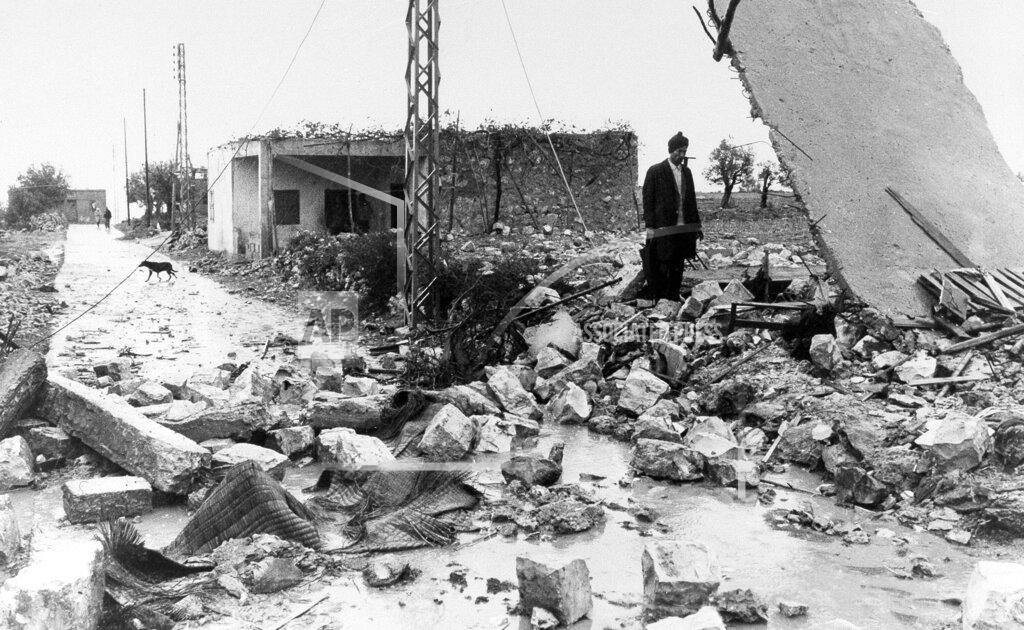
Raids were reported today on both sides of the Israeli‐Lebanese border, and gunfire was exchanged by Israelis and Arab guerrillas late in the day. Early today, Israeli soldiers raided the southern Lebanese village of Majdal Zun, five miles north of the border, and blew up six houses that were said to have been used by terrorists. The Israelis returned at about 2 AM with two prisoners taken for interrogation on suspicion of collaboration with Arab guerrillas. Shortly before 4 AM, Arab guerrillas attacked the Hamita communal settlement a few hundred yards south of the Lebanese border. Some buildings were reported to have been damaged by rockets, but no casualties were reported. According to an Israeli army spokesman, rocket and light arms fire was directed tonight at the northern Iseraeli kibbutz of Manara from Lebanese territory. The spokesman said that there had been no casualties and that Israeli forces had returned the fire.
President Anwar el‐Sadat is continuing to voice a sense of urgency about United States peace efforts in the Middle East and warning that the time is running out for the American step‐by‐step approach. Western diplomats say Mr. Sadat is reluctant to concede publicly that the United States has failed to produce a second‐stage Israeli withdrawal in the occupied Sinai peninsula. As long as there is still a glimmer of hope, these diplomats say, the Egyptians want Secretary of State Kissinger to continue his efforts. A public admission of failure, it is reasoned, would put an end to the special American role, would give the deadlock a formal status and would add to the danger of war. Egyptian officials, like most other Arabs, remain convinced that only the United States can induce Israel to withdraw.
South Vietnamese forces recaptured a small airstrip 60 miles north of Saigon less than 24 hours after it was overrun by the Communists but gave up two other positions in Phước Long Province. The Saigon military command said its troops drove the Red forces off the airstrip just outside Don Luan (now Đồng Xoài), a district town. About 70 government militia troops retreated from a bridge near Don Luan and another bridge near Bố Đức (Bù Đốp).
In neighboring Cambodia, rebels attacked an isolated garrison 41 miles southwest of Phnom Penh but were driven back after government forces counterattacked.
The crash of a Dutch DC-8 charter airliner that killed all 191 persons aboard December 4 was due to a navigational error by the pilot, a Sri Lanka magistrate’s inquiry ruled. The Martinair jet was carrying 182 Indonesian Muslims on a religious pilgrimage to Mecca when it crashed into a mountain about 14 miles from Bandaranaike Airport. Seven Dutch and two Indonesian crew members were among the victims.
China’s nuclear bomb test in June, 1973, tripled the long-lived radioactive fallout over Britain in the first six months of this year compared with the same period in 1973, the Atomic Energy Authority said. In the Southern Hemisphere, France’s seven atmospheric tests in the South Pacific raised the levels of short-lived radioactivity by about the same level as the 1973 French series. The AEC said the long-term effects of the 1974 tests cannot yet be assessed.
China should earn $350 million this year from oil exports, according to a magazine account in Hong Kong. “Oil may well become a major source of China’s foreign exchange earnings in the next few years,” the December issue of Current Scene said. China earned about $35 million from sales of crude oil and refined products to Japan and Hong Kong in 1973, the article said.
A special court-martial in Addis Ababa acquitted for lack of evidence the first former Ethiopian official brought to trial by the new military rulers on corruption charges. Abera Mogus, who was detained early last month, was ordered freed, and the official charges of opposition to the military leaders, who last September ousted former Emperor Haile Selassie, were ordered dropped.
South Africa is considering withdrawal from the United Nations as a result of the latest United Nations Security Council call that the government relinquish control of South-West Africa, or Namibia, Foreign Minister Hilgard Muller said tonight.
President Ford’s decision to rent a larger home for his skiing holiday in Vail, Colorado, led to a controversy because of the owner, Richard Bass, a Dallas oil millionaire and resort developer. Mr. Bass will be forced to pay, or could save, more than $100 million, depending on whether Mr. Ford vetoes or signs into law a strip-mine control bill. He has said he will veto it. Mr. Bass holds a 20,700-acre federal coal lease in northern Wyoming suitable for strip mining.
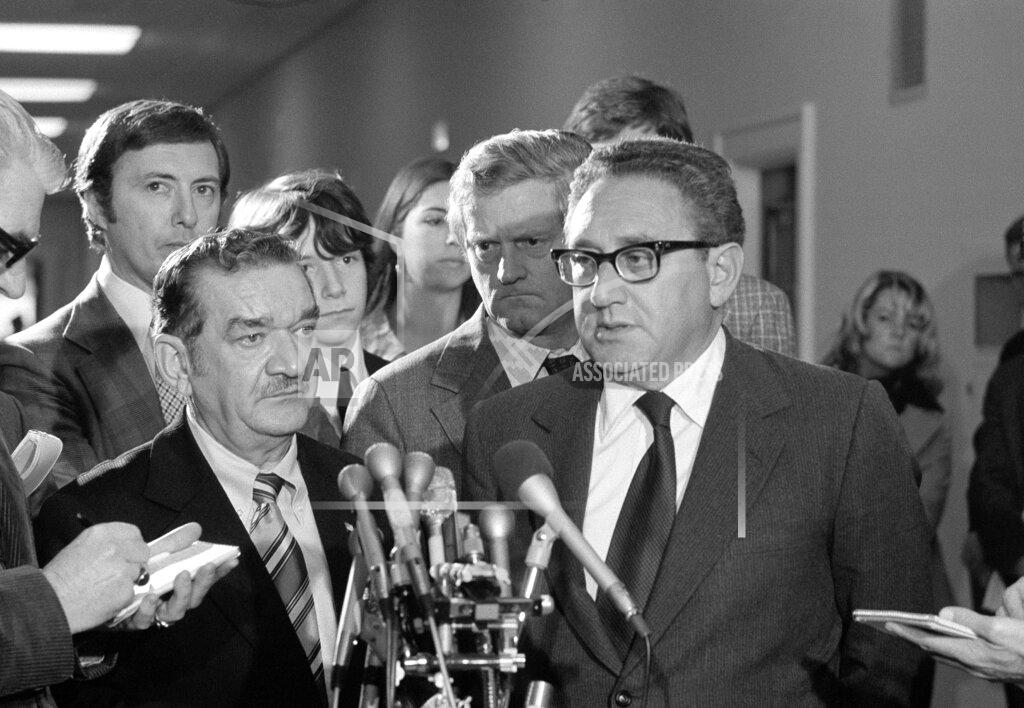
The visiting lady stopped to pay a courtesy call on President Ford in the Oval Room and they paused for pictures. My, the President said, his guest certainly was looking well. “Of course,” Secretary of State Henry A. Kissinger interjected. “She’s not working 18 hours a day now.” The visitor was Golda Meir, former prime minister of Israel, who is on a fund-raising tour of the United States. Mrs. Meir, 78, was honored by Kissinger later at dinner at the Department of State.
Not only is Kissinger a man of grace and tact in dealing with the ladies, but Senator J. W. Fulbright thinks that he is “the ablest and best equipped” secretary of state he has known. Fulbright, who was defeated in a reelection bid last month, was often a severe critic of U.S. foreign policy. Asked at a National Press Club luncheon in Washington if he would accept appointment as secretary of state, attorney general or an ambassador, Fulbright said he would do as little as possible after his term expires in a few days: “I am not interested in any of those appointments and certainly not in being an ambassador.”
The House passed today a $4-billion bill to provide 111,000 public service jobs and to extend unemployment benefits to jobless workers. The appropriations bill was sent to the Senate, where passage was believed likely tomorrow.
Sehator Mark O. Hatfield, assailing what he called a lack of leadership in the Administration, called today for an effort on the scale of that led by Herbert Hoover during and after World War I to feed the hungry and starving in nations threatened by famine.
A federal judge in Washington ordered the Treasury Department to cut off general revenue-sharing funds to Chicago for using the money in a discriminatory way. Chicago, which has already drawn $184 million in these funds, was scheduled to receive a quarterly check for more than $19 million on Jan. 6. The funds will be held, a Treasury official said. It was the first city to lose funds under the program.
Negotiators for coal mine contractors and striking construction workers reached tentative agreement on a new contract and a union bargaining council approved the pact a few hours later, federal mediators announced. A union official said the agreement was scheduled to be presented Saturday to United Mine Workers locals for rank-and-file voting, with ratification results available as early as Sunday night. Terms of the pact were not announced. Picketing by the 4,500 construction workers has kept nearly half of the nation’s soft-coal miners away from work.
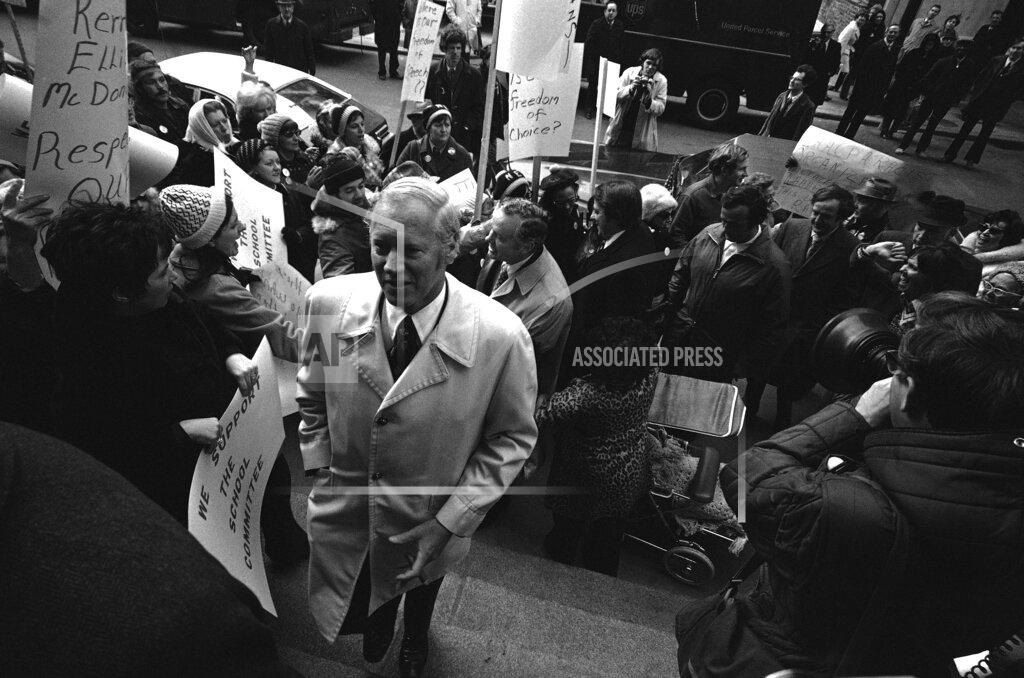
A motion that three members of the Boston School Committee be cited for criminal contempt for not approving a citywide school desegregation program was dismissed by U.S. Dist. Judge W. Arthur Garrity Jr. The motion had been filed by the Boston chapter of the NAACP. However, Garrity said he was considering taking away the authority of the three to help oversee integration of the city’s strife-torn schools because they had voted against his orders on desegregation. Garrity told the three, who were in court with the two other committee members, to be prepared to let him know December 27 where they stood on integration. Garrity will decide then whether to hold the three in civil contempt.
A young woman undercover agent, lying bloodied on the floor after being thrown through a glass bookcase, shot and wounded the suspected leader of a major drug ring in Chicago. Authorities, who did not identify the woman, said she and a male undercover agent went to an apartment to buy two ounces of high grade cocaine for $2,800 when the suspect spotted on closed circuit television nine other agents entering the building. The woman was hurled against the bookcase and the male agent was disarmed and threatened. The woman shot twice. The suspect was taken to a hospital for treatment.
New Orleans was hit by its first major transit strike in 45 years. Transit workers want a 34% wage increase, as opposed to the 7.4% offered by the city. Some 370,000 commuters, and Christmas shoppers took to their cars and to taxis today because of the city’s first transit strike in 45 years.
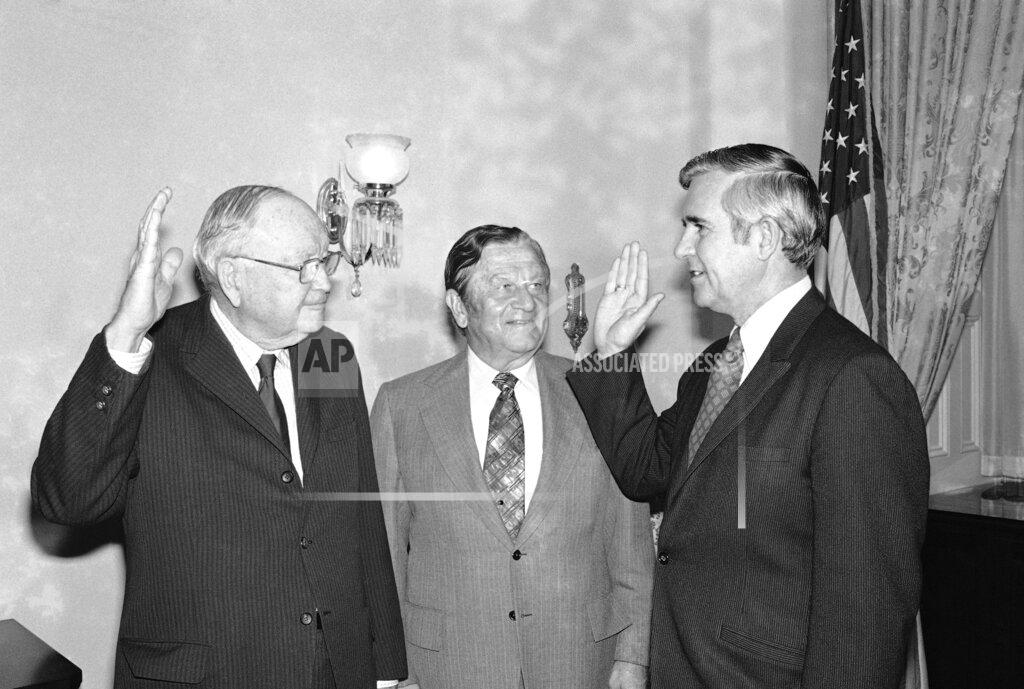
Paul Laxalt was sworn in today as Nevada’s junior Senator. The 52 year-old Republican thus became the first Senator elected last month to take office He gained seniority over the other freshmen Senators, who are scheduled to assume office January 3.
A claim that Chevron gasoline will produce no air pollution is false advertising, the Federal Trade Commission told Standard Oil of California. Although the FTC ruled that additives reduced to some degree polluting exhaust emissions, it said “the development of a product with laudable characteristics does not grant a license to exaggerate its effectiveness.” The commission declined to order the company to run corrective advertising.
A 100-mile-long chase ended at a roadblock near Greensboro, Georgia, when a 70-year-old sheriff fired his pistol through a windshield and killed a gunman who was holding a shotgun at the head of a woman hostage driving the car. A second gunman was taken into custody. Both men had been sought in the attempted holdup of the First State Bank of Wrens during which a bank employee was killed. At the roadblock, the sheriff, L. L. Wyatt of Green County, leaped from his car, ran to the front of the fugitives’ car, pointed his pistol at the windshield and fired.
A last‐ditch legislative effort to block construction of a giant hydroelectric project on the New River on the Virginia-North Carolina border was defeated tonight in the House of Representatives. A bill designed to put a 70‐mile stretch of the river in the Wild and Scenic Rivers System failed to get the necessary two‐thirds vote required when a bill is called up under suspension of the rules. The vote was 196 for the bill and 181 against.
The General Motors Corporation announced additional layoffs and production cutbacks for the first quarter of 1975. This reflected one of the severest declines in the automobile industry since World War II and indicated no recovery is expected early in the year. General Motors alone will have 91,000 workers permanently and another 41,000 temporarily laid off in January. The sales slump, with unit volume down 30 percent, is expected to continue into 1975.
A Justice Department official in Montgomery, Alabama, has confirmed that Air Force buses are being used to transport the children of military personnel at Maxwell Air Force Base to some all-white or nominally integrated private schools in the area.
Superport regulations providing for docking larger oil tankers to offshore buoys were approved by the Senate. The bill, which will go to the House for final congressional approval, is backed by both the oil industry and environmentalists. The system establishes procedures for oil companies of coastal states to set up superports about three miles offshore. Oil would be pumped through pipelines to land. The bill also would allow a state to veto applications for superports off its waters.
The oil industry and the state were invited by the Interior Department to suggest tracts off Alaska which should be opened or closed for oil drilling. Officials have set October, 1976, as the tentative date for the sale of oil and gas leases in the southeastern Bering Sea on the outer continental shelf. Written nominations and comments will be accepted through next Jan. 20. Under federal lands and environmental acts, states can request closing off certain tracts for oil drilling because of conflicting resource values.
The Food and Drug Administration has decided to approve an artificial food coloring known as Amaranth, although some of the agency’s own scientists say there are questions whether it may cause cancer and fetal death. It has long been widely used in the nation’s food industry.
A U.S. Air Force plane crashed at K. I. Sawyer Air Force Base in Marquette County, Michigan, killing pilot Lt. Robert Petrola and copilot Maj. George Hughey.
The Symphonie-A communications satellite, conceived and built by a co-operation between the space agencies of France and West Germany, was launched from Cape Canaveral, Florida in the United States at 9:39 in the evening (0239 UTC on 19 December 1974).
Hall of Famer Harry Hooper dies at the age of 87. Considered a standout defensive outfielder, Hooper batted .281 over a 17-year career with the Boston Red Sox and Chicago White Sox. He was elected to the Hall of Fame in 1971.
Dow Jones Industrial Average: 603.49 (+5.95, +1.00%).
Born:
Peter Boulware, NFL linebacker (NFL Champions, Super Bowl 35-Ravens, 2000; Pro Bowl, 1998, 1999, 2002, 2003; Baltimore Ravens), in Columbia, South Carolina.
Lance Carter, MLB pitcher (All-Star, 2003; Kansas City Royals, Tampa Bay Devil Rays, Los Angeles Dodgers), in Bradenton, Florida.
José Rodríguez, Puerto Rican MLB pitcher (St. Louis Cardinals, Minnesota Twins), in Cayey, Puerto Rico.
Kari Byron, artist and television personality (“MythBusters”), in Santa Clara County, California.
Tom Parker Bowles, British food critic and writer, son of Queen Camilla of the United Kingdom; in Westminster, London, England, United Kingdom.
Mutassim Qaddafi, son of Muammar Qaddafi and National Security Advisor; in Tripoli (executed 2011).
Euroboy [Raymond Herrera], Norwegian rock guitarist (Turbonegro), in Bergen, Norway.
Died:
Harry Hooper, 87, American baseball right fielder (World Series 1912, 1915, 1916, 1918, Boston Red Sox) and inductee to the Baseball Hall of Fame, died of old age.
Paul John Knowles, 28, American serial killer who was tied to the deaths of 18 people, and claimed to have murdered 35 victims, was shot to death during an altercation while being transported by the Georgia Bureau of Investigation (GBI) to the scene of one of his crimes. Knowles, though handcuffed, grabbed the weapon of the driver, Henry County Sheriff Earl Lee, firing one shot through the holster, before GBI Agent Ronnie Angel shot Knowles three times.
Ervin G. Bailey, 93, American mechanical engineer.



 History Diaries