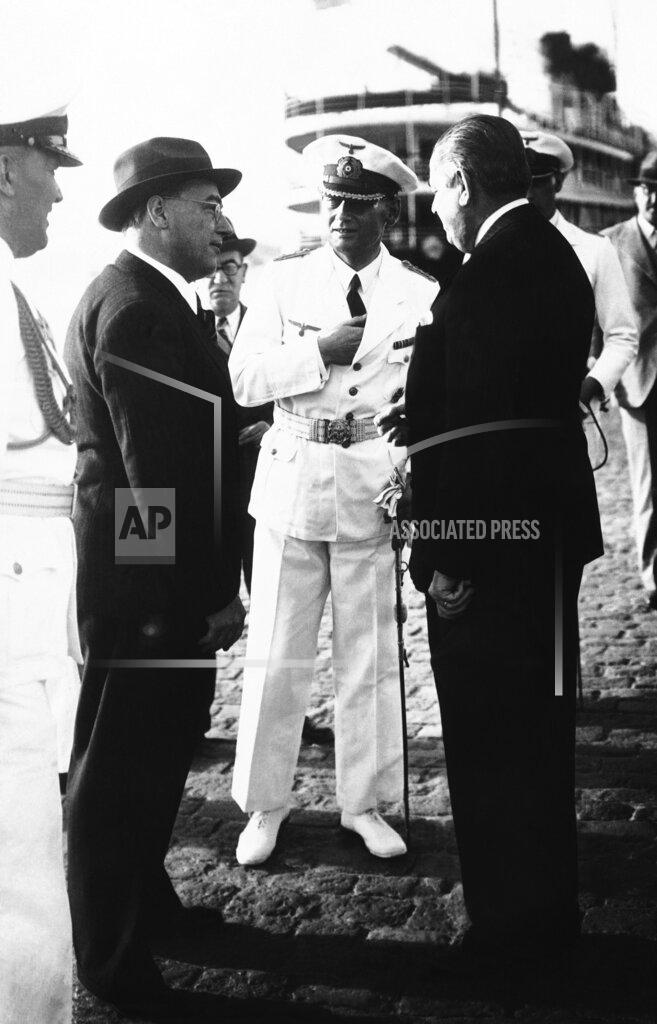
Captain Langsdorff must make a decision, and he does. The Admiral Graf Spee only has left a third of its ammunition, about as much as expended during the previous battle. It also has insufficient fuel left to return to Germany, with the prospect of being able to refuel while being chased by the British very unlikely.
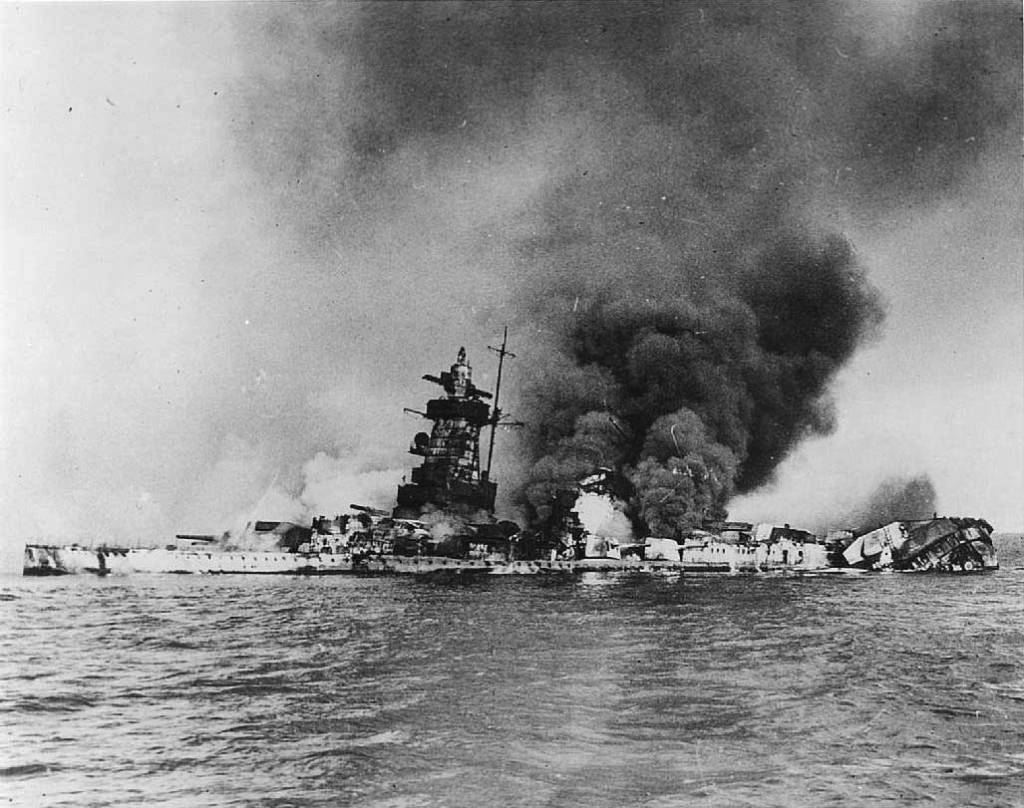
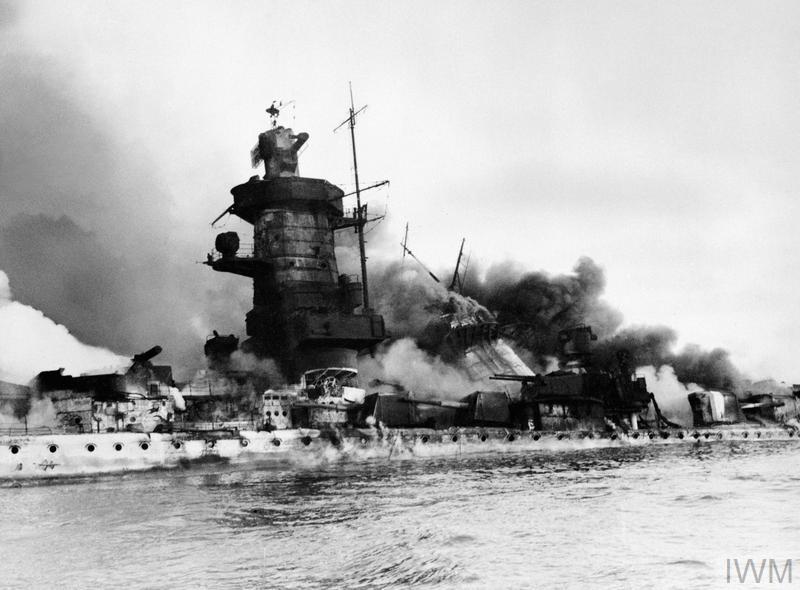
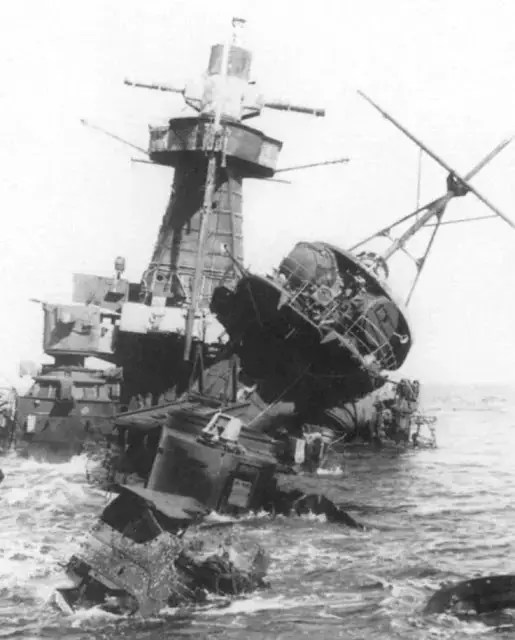
The German cruiser Admiral Graf Spee was scuttled in neutral waters near Montevideo as the time limit to leave port was running out. Captain Hans Langsdorff believed that British reinforcements were nearby and that he had used up too much fuel and ammunition to fight his way back to Germany. German armored ship Admiral Graf Spee, her allotted time in neutral Uruguayan waters for repair of damage received in the Battle of the River Plate having expired, and her crew transferred to freighter Tacoma, puts to sea from Montevideo, Uruguay. As Allied Hunting Groups converge on the River Plate, Captain Langsdorff takes the Graf Spee out into the estuary where she is scuttled and blown up. Only HMS Cumberland has actually arrived by this time, but British propaganda on the BBC gave the impression that the most powerful ships in the fleet, including an aircraft carrier, were bearing down on the Plate. Langsdorff had asked for instructions and Hitler himself had said that he had only two, scuttle or fight it out on the open sea.
Just before the three-mile limit the ship stopped and the crew took to the lifeboats. Minutes later there is a series of shattering explosions and flames. The ship settled on the riverbed, her upper decks above the water and still burning. The admiralty announces that 61 men of HMS Exeter’s crew died during the Battle of the River Plate with the Graf Spee. Admiral Graf Spee had sunk nine British merchantmen during her cruise, totaling 50,089 tons of shipping. Not a single life had been lost in the process. In World War I, the famed German raider Emden had sunk 16 ships of 66,146 tons before her demise under the guns of Australian cruiser HMAS Sydney. The destruction of Admiral Graf Spee comes, as First Lord of the Admiralty Winston S. Churchill later declares, “like a flash of light and colour on the scene, carrying with it an encouragement to all who are fighting, to ourselves, and to our Allies.”
Most of Langsdorff’s crew transfers to the German freighter Tacoma. He and his 1,039-man crew wind up in detention in Buenos Aires, Argentina.
The Admiral Graf Spee also badly damaged a heavy cruiser and kept a large portion of the Allied fleets searching the South Atlantic for weeks. This deprived convoys further north of protection. The Altmark, its supply ship, remains free and heads back north to Germany, loaded with Allied prisoners.
British RFA oiler Olynthus refuels New Zealand light cruiser HMNZS Achilles off Rouen Bank, the southernmost channel of the River Plate estuary. Light cruiser HMS Ajax and heavy cruiser HMS Cumberland cover the evolution.
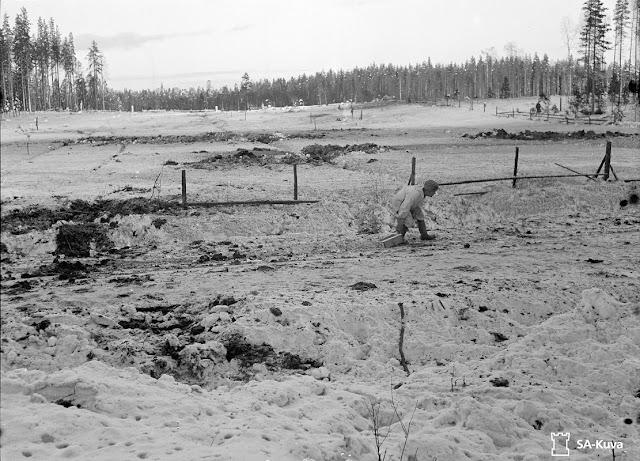
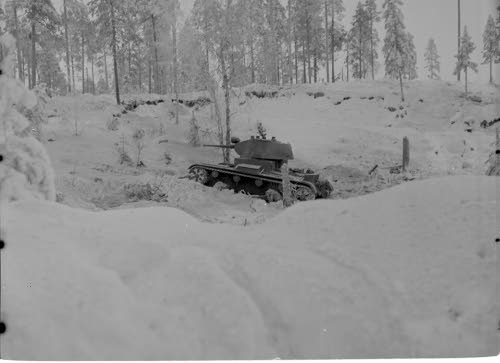
Soviet attacks continue at Summa. Soviet tanks continue attempting to penetrate the gap in the defenses in the nearby swamp. The Finnish infantry holds its ground and separates the Soviet tanks from their infantry support, then pick the tanks off with anti-tank guns and Molotov Cocktails primarily after dark.
The Red Army begins its main assault on the Mannerheim Line around Summa. Waves of Soviet infantry and tanks, with air support, attempt to overrun the Summa area (the First Battle of Summa). These initial efforts are subsidiary moves against the northeast end of the Finnish defenses. They continue for two days without success. Despite heavy artillery bombardment, the Finns are ready and mow down the advancing Red Army forces. The Soviets try for the first time their new tanks in the Summa area. Straight from Leningrad’s factories come the trial versions of the SMK, T-100, and KV-1 tanks. Some Red Army tanks penetrate Finnish defenses but are isolated and destroyed.
At Petsamo in the far north, the vanguard of the Russian regiment overcomes the Finnish holding detachment near Porojärvi. Detachment Pennanen retreats to the River Kornettijoki, 120 km south of Petsamo. The fighting disperses into skirmishes between patrols.
Fighting to retake the parish village at Suomussalmi continues. The Soviet 163d Rifle Division remains surrounded at Suomussalmi. The relief force is reeling from Finnish counterattacks and is not trying to break through again. The Finnish strategy is to cut the elongated Soviet caravan on the Ratte road into separate pieces and then finish them off individually.
In the Ladoga Karelia, Finland is forced to send 17-19-year-old schoolboys into battle at Salmi.
The Finns at Kollaa are counterattacking two Soviet divisions trapped on the coastal road. The Finns operating on skis can pick and choose their points of attack, while the Soviets are defending their immobile vehicles. The process is debilitating for both sides, but the Finns have turned the tables and are attacking the helpless Soviets.
Snipers are of huge importance in the woods. Finnish sniper Simo Häyhä, nicknamed “The White Death,” is accumulating kills.
At Salla, the Soviets have split into two parts at a fork in the road. The Finns block the Soviet move on the southern road toward Kemijärvi and put the weight of their effort on the north road. The Finns use these men to ambush the northern pincer moving toward Pelkosenniemi. The Soviet force on the north road, an infantry regiment a battalion, and a company of tanks, is outflanked and begins to retreat. A wild fight ensues.
The Soviet 122nd division tries to break the Finnish defenses in Joutsijärvi, but they are stopped.
The Finnish force fighting at Mursula on the shores of Lake Ladoga lose 26% of its strength and has to retreat. 32 Finnish soldiers are dead or missing. The enemy loses 300 men.
Unsuccessful attacks by Soviet 7th Army against Mannerheim Line in the Taipale and Viipuri sectors. At 8.15 Soviet troops continue the offensive at Taipale. The attempted breakthrough is thwarted mainly by Finnish artillery fire.
In Helsinki, “Isoviha” (“The Great Wrath”), directed by Kalle Kaarna, receives its premiere screening in Helsinki. Starring Hilkka Helinä, Kalevi Mykkänen and Santeri Karilo, Isoviha was banned during the negotiations on the eve of the war, and the version screened now is still partly censored.
The Soviets issue a long and entirely negative reply to the League of Nations resolution expelling it.
President Kyosti Kallio appealed to “the whole civilized world” today to aid Finland with war materials in the war with Russia.
Small groups of men marched today through the streets of Helsinki, en route to barracks, as 50,000 reservists left their homes to shoulder arms, and Finland’s mobilization was virtually complete with an estimated 380,000 or 400,000 men with the colors.
The decision to occupy Denmark was taken in Berlin.
The first Canadian troops to reach Britain, 7,400 men of the First Division, landed at Liverpool. Three months ago Canada was a country with a permanent army of 4,500 men, five mortars and 16 tanks. The Canadians are under the command of Major-General McNaughton and they arrived in five liners. Officers slept in suites and men in first class cabins.
Rome supports adherence to the Axis. One fact stressed by the press today in its comment on yesterday’s speech of Count Ciano, Italian Foreign Minister, is that the Rome-Berlin alliance is just as valid now as in the period before the outbreak of the war. The press stresses that the alliance with Germany remains unimpaired.
British destroyers lay mines off German coast.
German aircraft attack shipping off the UK East Coast. A small British motor vessel was sunk. There is damage and casualties in fishing trawlers, before the aircraft driven off.
An increase in German reconnaissance flights over the Western Front is reported.
The neutral Danish steam merchant Bogø was torpedoed and sunk by the U-59, commanded by Oberleutnant zur See Harald Jürst, 75 miles east of the Isle of May off the coast of Scotland in the North Sea (56° 12’N, 0° 17’W). At 02.34 hours the Bogø was hit by one G7a torpedo from U-59 and sank after breaking in two 75 miles east of May Island. Three survivors were picked up by the British trawler River Earn (Master P. Stevens), which was herself sunk two days later by German aircraft. All on board were picked up by the Norwegian steam merchant Rogaland and taken to Kopervik. Of the ship’s complement, 17 died. The 1,214-ton Bogø was carrying ballast and was bound for Methil, Scotland.
The neutral Danish steam merchant Jaegersborg was torpedoed and sunk by the U-59 east of the Firth of Forth, Scotland. At 05.36 hours U-59 fired one torpedo at a steamer of about 3,000 grt, observed a hit amidships and the sinking of the vessel after breaking in two about 50 miles east-southeast of Peterhead. The victim was probably Jaegersborg which was reported missing since 14 December after leaving Copenhagen. One body of a crew member was later washed ashore and another found on a raft. There were no survivors. The 1,245-ton Jaegersborg was carrying agricultural products and was bound for Leith, Scotland.
The British fishing vessel Compagnus was bombed and sunk in the North Sea 150 nautical miles (280 km) east by north of the Isle of May by aircraft of X Fliegerkorps, Luftwaffe with the loss of one crew member. Survivors were rescued by the Colleague.
The British trawler Eileen Wray was bombed and damaged in the North Sea off Hartlepool, County Durham by aircraft of X Fliegerkorps, Luftwaffe. She was towed into port but sank.
The British trawler Isabella Greig was bombed and sunk in the North Sea 145 nautical miles (269 km) east by north of the Isle of May by aircraft of X Fliegerkorps, Luftwaffe. All crew were rescued.
The British trawler Pearl was bombed and sunk in the North Sea 65 nautical miles (120 km) east by south of the Inner Dowsing Lightship by aircraft of X Fliegerkorps, Luftwaffe with the loss of one crew member.
The British trawler Serenity was bombed and sunk 8 nautical miles (15 km) east north east of Whitby, Yorkshire by Luftwaffe aircraft. All eight crew were rescued by a lifeboat.
The British trawler Zelos was bombed and sunk in the North Sea 110 nautical miles (200 km) east by north of the Isle of May by aircraft of X Fliegerkorps, Luftwaffe.
Destroyers Ellis (DD-154) and Cole (DD-155) relieve Lea (DD-118) and Philip (DD-76) of shadowing German passenger liner Columbus.
U.S. freighters Meanticut and Excalibur are detained by British authorities at Gibraltar.
The War at Sea, Sunday, 17 December 1939 (naval-history.net)
Admiral Forbes sent the armed merchant cruisers back to sea to counter a possible attempt by a number of German merchant ships to run the blockade to Germany. Four of them sailed from the Clyde to stations on the Northern Patrol, while heavy cruiser BERWICK headed for the Denmark Strait. Forbes returned to Greenock to refuel his destroyers on the 17th. At 0917/17th, his force was battleships WARSPITE, BARHAM, battlecruiser HOOD, and destroyers ISIS, ICARUS, IMPERIAL, FOXHOUND, SOMALI, INGLEFIELD and IMOGEN. Aircraft carrier FURIOUS, battleship RESOLUTION, battlecruiser REPULSE, and destroyers BEDOUIN, MASHONA, ESKIMO, MATABELE, FEARLESS, ILEX, IMPULSIVE, KANDAHAR, KHARTOUM, KASHMIR and KINGSTON arrived at Greenock at 1219/17th.
Light cruiser DELHI departed Scapa Flow for Belfast arriving on the 21st to dock and refit, completed on 8 January.
Destroyers IVANHOE and INTREPID of the 20th Flotilla and GRENVILLE, GREYHOUND, GRIFFIN and Polish ORP BŁYSKAWICA from Harwich carried out an anti-submarine sweep from the Thames entrance to Yarmouth between 1245 and 1515. IVANHOE and INTREPID then laid a field of 240 mines off Borkum in the mouth of the River Ems at 0200/18th in Operation IB, while GRENVILLE, GREYHOUND, GRIFFIN and BLYSKAWICA provided cover. After the lay, the Harwich destroyers carried out another anti-submarine sweep and arrived back at dusk on the 18th.
Destroyers JERVIS, JUNO, JAGUAR and JANUS, which departed Grimsby on the 16th, left Scapa Flow and refueled at Sullom Voe. JUNO was held up with defects, but the other three arrived off Tranoy late on the 18th to escort iron ore convoy NV.2 of six British and one Greek ship from Narvik, with light cruisers SOUTHAMPTON and EDINBURGH in support. JUNO sailed on the 19th to rejoin the convoy. On the 23rd, JAGUAR developed defects and was sent to Scapa Flow. One steamer was detached to the west coast and the convoy arrived safely at Methil on the 24th still with JERVIS, JUNO and JANUS.
Destroyer depot ship WOOLWICH departed Rosyth for the Clyde, escorted by destroyers ESCAPADE and ENCOUNTER.
Armed merchant cruiser LAURENTIC departed Liverpool for Northern Patrol, while AMCs TRANSYLVANIA, CHITRAL and MONTCLARE left from the Clyde.
Armed merchant cruiser JERVIS BAY departed the Tyne, north-about for Portsmouth, escorted as far as the Pentland Skerries by destroyer ECLIPSE.
Destroyer KEITH ran aground and required docking at Plymouth.
Convoy BC.19 of steamer BARON CARNEGIE departed Bristol Channel escorted by destroyer WESSEX, and arrived in the Loire on the 19th. The convoy returned with BARON CARNEGIE, leaving on the 24th and arriving in the Bristol Channel on the 25th.
U-59 sank Danish steamer BOGO (1214grt) 75 miles east of May Island in 56-12N, 0-17W. Seventeen crew were lost and survivors picked up by trawler RIVER EARN (202grt) which was sunk herself on the 19th with them still on board.
Steamer AGNITA (3552grt) was near-missed and badly damaged by German bombing SE of the Isle of Wight in 50 42N, 00 44E. Italian steamer VALENTINO CODA (4486grt) was also attacked in this raid, but not damaged.
LUFTWAFFE ATTACKS ON NORTH SEA SHIPPING
German bombers of the FliegerKorps X (10th Flying Corps – to be met a year or so later in the Mediterranean) attacked and sank shipping, primarily British trawlers, in the North Sea off the British coast.
On the 17th, five trawlers were sunk: (1) SERENITY (487grt) eight miles ENE of Whitby, (2) PEARL (198grt) 65 miles E by S of Outer Dowsing Light Vessel, with one crewman lost and the survivors, three wounded, picked up by an accompanying trawler, (3) COMPAGANUS (270grt) 150 miles E by N of May Island (she was abandoned 100 miles E by S of Aberdeen), with one member of crew lost and the survivors picked up by trawler COLLEAGUE (207grt) which had been fishing in company, (4) ISABELLA GREIG (210grt) 145 miles E by N of May Island with the survivors, two wounded, picked up by a drifter, and (5) ZELOS (227grt) 110 miles E by N of May Island, but without casualties.
Still on the 17th, EILEEN WRAY (227grt) was badly damaged off Hartlepool and CRAIGIELEA (211grt) northeast of Aberdeen. Two were wounded on CRAIGIELEA, but there were no casualties on EILEEN WRAY which was towed to Hartlepool but sank in harbour. Sixteen other trawlers and Estonian steamer MARVI (244grt) were attacked but not damaged.
On the 18th, two trawlers were sunk, (1) ACTIVE (185grt) 30 miles N by W of Rattray Head with one crew lost and survivors picked up by trawler CARBINEER II (297grt), and (2) TRINITY N B (203grt) off Kinnaird Head, in 57-50N, 1-30W with two crew lost and survivors picked up by Danish schooner SMART.
On the same day, ASTROS (275grt) and NEW CHOICE (236grt) were damaged off May Island and ETRURIA (373grt) off Duncansby Head. ETRURIA lost three crew killed, and was towed in by trawler SILANION (366grt). Four other trawlers were attacked, but not damaged.
On the 19th, two more trawlers were lost: (1) DANEDEN (210grt) ESE of the Shetlands, and (2) RIVER EARN (202grt) in 58-30N, 2-01E ENE of Kinnaird Head. The entire crew of RIVER EARN was rescued by Norwegian steamer ROGALAND (902grt) and taken to Kopervik.
Again on the 19th, STAR OF SCOTLAND (203grt) was damaged off the Shetlands with two men killed and two wounded.
U-60 laid mines off Cross Sands near Lowestoft. One steamer was lost on this minefield.
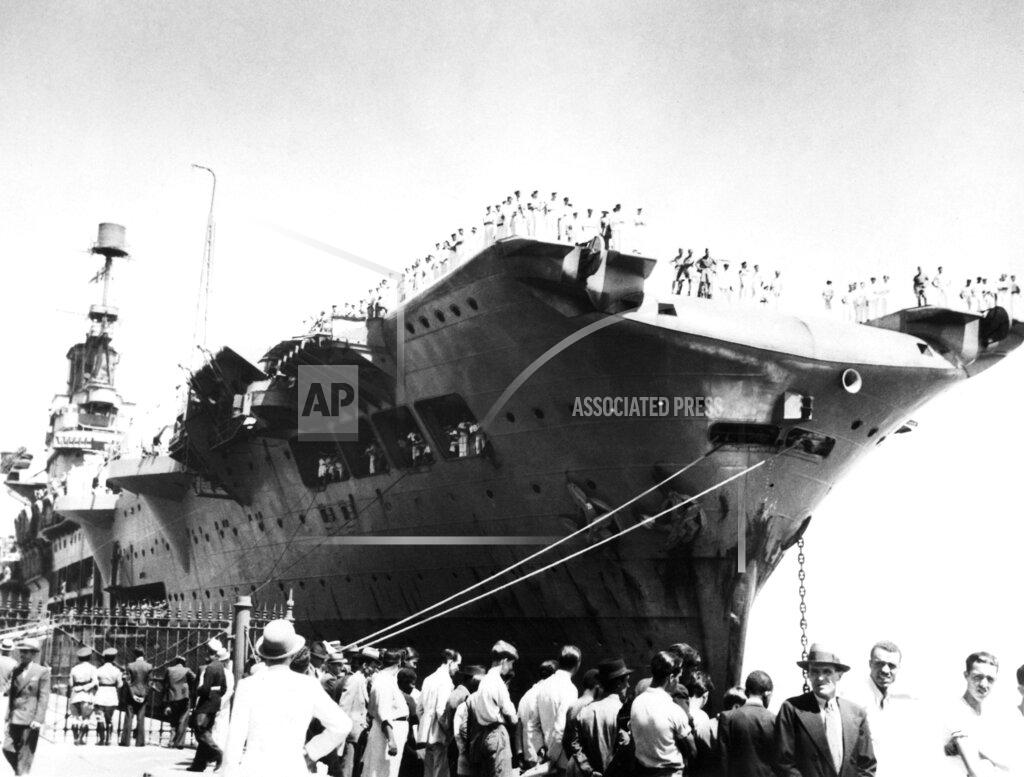
Aircraft carrier ARK ROYAL and battlecruiser RENOWN arrived at Rio de Janeiro, refueled and put back to sea the same day. Light cruiser NEPTUNE refueled at Santos and also departed the same day. Meanwhile, German pocket battleship ADMIRAL GRAF SPEE, after transferring her crew to German steamer TACOMA (8268grt), scuttled herself in the Rio de la Plata Estuary off Montevideo. The ARK ROYAL force, steaming at high speed towards Montevideo, had not gone far when word of SPEE’s scuttling was received. Joined by destroyers HARDY, HERO and HOSTILE and later by NEPTUNE, they swept through 16-40S, 27-50W searching for supply ship ALTMARK. French light cruiser DUGUAY TROUIN, armed merchant cruisers CHARLES PLUMIER, KOUTOUBIE, submarines ACHÉRON, FRESNEL, LE HÉROS and REDOUTABLE also searched from 19 December to 19 January. ARK ROYAL’s force then proceeded to Freetown, arriving on the 24th, light cruisers AJAX and HMNZS ACHILLES left the Plate Estuary and proceed to Port Stanley, while heavy cruiser CUMBERLAND remained off Montevideo.
Destroyer DIAMOND departed Aden on the 14th and arrived at Suez on the 17th completing the transfer of the 21st Flotilla from China to the Mediterranean.
MEDITERRANEAN FLEET MOVEMENTS INCLUDING ARRIVAL OF AUSTRALIAN DESTROYERS
Australian destroyer HMAS STUART, which had arrived at Aden from duty in the Indian Ocean on the 10th, reached Malta on the 17th for duty in the Mediterranean.
Australian destroyers HMAS WATERHEN and HMAS VENDETTA, escorting battleship MALAYA with destroyer DEFENDER, had arrived at Malta on the 14th followed by two more Australians, HMAS VAMPIRE and HMAS VOYAGER on the 24th.
These ships, with light cruisers ARETHUSA, PENELOPE, GALATEA, CAPETOWN and the 21st Destroyer Flotilla, which the Australians relieved for duty elsewhere, and submarines OSIRIS and OSWALD, comprised the entire operational Mediterranean Fleet.
On 2 January 1940, the Australian destroyers were organized as the 19th Destroyer Division.
Very shortly, light cruisers CALEDON and CALYPSO arrived from the Home Fleet and ARETHUSA and PENELOPE departed for Home Waters. CALEDON arrived at Gibraltar on the 24th, departed on the 26th, and reached Malta on the 28th for duty with the 3rd Cruiser Squadron. CALYPSO arrived at Gibraltar on the 27th, departed on the 28th, and arrived at Malta on the 31st, also for duty with the 3rd Cruiser Squadron.
The 21st Destroyer Flotilla was divided in two, with one half returning to Home Waters and the other going to the South Atlantic. In addition, in February, light cruiser GALATEA also departed the Mediterranean for Home Waters.
As a replacement for the Australian destroyers in the Far East, light cruisers COLOMBO and CERES were sailed in February after completing refits.
Sloop SCARBOROUGH departed Port Said after arriving from the Indian Ocean en route to England, arrived at Malta and departed on the 26th.
French large destroyer AIGLE was damaged in a collision with French auxiliary patrol vessel LEZARDRIEUX in Toulon Roads. The damage took a month to repair.
Light cruiser BIRMINGHAM, while refueling, collided with tanker FRANCOL (5620grt) at the Saddle Islands off Shanghai. Her port bow was holed, but after emergency repairs, she was able to continue patrol and arrived at Hong Kong for docking on the 27th. Repairs took two days.
Friends of U.S. Vice President Garner say that he is not anti-Roosevelt or anti-New Deal. Rather, he does not believe in a third presidential term for anyone. While the announcement by Vice President Garner at Uvalde, Texas, yesterday that he would accept the Democratic Presidential nomination was generally interpreted here as putting him in the race to stay, whether or not President Roosevelt seeks a third term, friends of the Vice President here declared that this did not mean he was running as an anti-Roosevelt candidate.
It meant, they said, that while he was in sympathy with many New Deal objectives, he felt that no man should have a third term. The quiet campaign which has been carried on by Garner workers for months is expected to gain immediate momentum, with the aim largely to solidify the elements of the party which are against Roosevelt for a third term for one reason or another.
By stressing that he is the only candidate so far who has not intimated that he would step aside if Mr. Roosevelt runs, Garner workers were said to be hoping to draw strength from such candidates as Paul V. McNutt, Federal Security Administrator, and Senator Wheeler of Montana, who have predicated their candidacies on Mr. Roosevelt’s retirement.
A comprehensive program of legislative demands, including revision of the National Labor Relations Act to provide criminal penalties for violators, was made public today by John L. Lewis on behalf of the legislative committee of the Congress of Industrial Organizations. Besides containing various proposals directly related to labor problems, the program demanded keeping the United States out of involvement in war, an elaborate federal job-making effort to provide work for 3,000,000 unemployed, revision of the tax system to reduce consumer taxes and levy more heavily on “large concentrations of income and savings,” a national health program, legislation to protect civil liberties and various other legislative actions. The recommendations for changes in the Labor Relations Act reverses the previous policy of the C.I.O., which, in the last session and earlier, stood out against any changes, in contrast with the attitude of the American Federation of Labor and various business and industrial groups.
The Lewis organization explained its switch of front on the ground that “two serious difficulties have arisen in the administration of the act which have frustrated to some extent the efforts of organized labor to achieve the protection to which it is entitled.” First, it said, the enforcement provisions, now limited to cease and desist orders and back-pay requirements, “are not sufficiently severe to obtain actual enforcement from those corporations which are still determined to violate the rights of labor.” Imposition of criminal penalties, it added, would bring the law into line with the Railway Labor and Wages and Hours laws.
Secondly, the report asserted, “the National Labor Relations Board, in an attempt to appease the reactionary interests, including the leaders of the American Federation of Labor, has issued decisions which have threatened the existence of the industrial unions of the C.I.O. by carving out crafts in industrial plants organized by it.” Besides the criminal penalties amendment, the report also advocated a provision preventing the government from awarding any contracts to employer violators to prevent “reactionary and vicious anti-labor corporations, such as Bethlehem Steel, Douglas Aircraft, and Standard Oil Company of New Jersey,” from being “frequent beneficiaries of government contracts.”
An amendment to prevent the “carving up” of C.I.O. unions and passage of the La Follette-Thomas Oppressive Labor Practices Bill to outlaw the use of industrial spies and the purchase of munitions by private corporations also were necessary to protect labor’s rights, the report said. Asserting that the Wages and Hours Law was threatened with amendments “actually intended to destroy it,” the C.I.O. said Congress should reject these demands. After the law has had time to demonstrate its value, it was added, its protection should be extended to the “millions of workers” not now covered.
An Administration supporter who voted against the House investigation of the Labor Relations Board predicted today that the inquiry would help “clear up the atmosphere around this whole situation.”
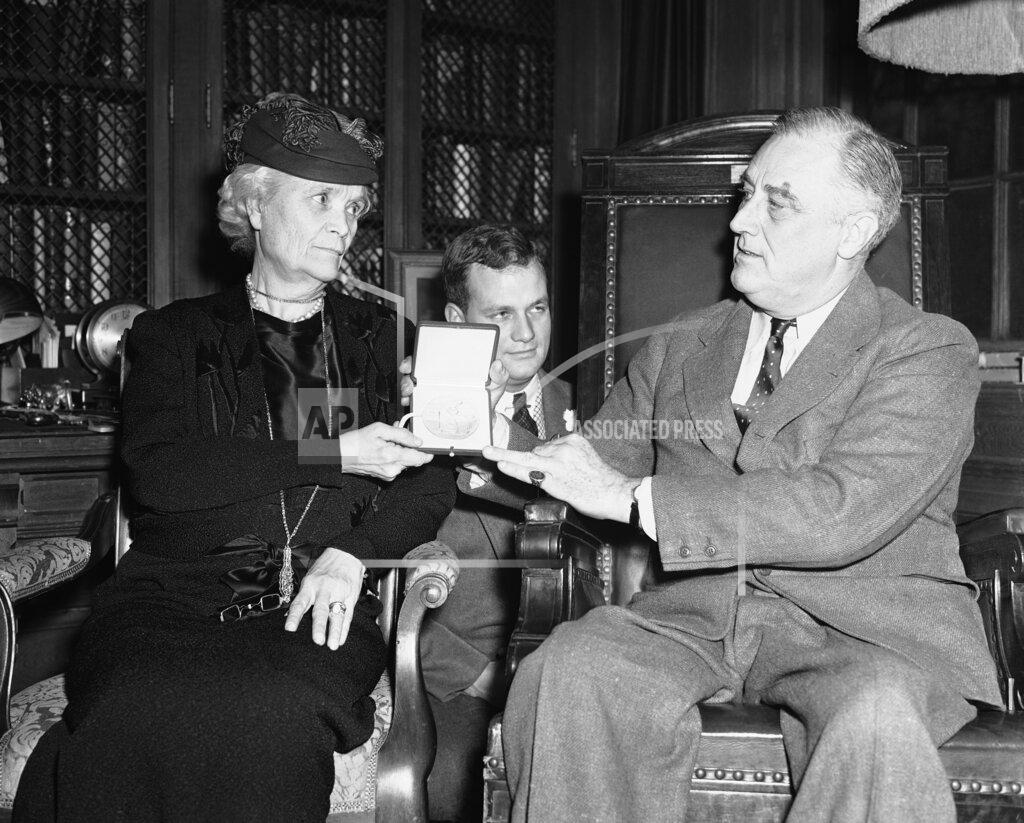
The heroic service of a Spanish-American war nurse received a belated reward of a grateful government today when President Roosevelt presented Mrs. Richard Aldrich of New York with a Congressional gold medal in recognition of her work of establishing hospitals and caring for military patients at Puerto Rico.
A bold plan to prevent war by cornering essential raw materials and withholding them from aggressor nations was put forward last Spring by Secretary Morgenthau, it was learned today from official sources. The plan, discussed by Mr. Morgenthau with close associates in the Administration during the final Czecho-Slovakia crisis, was abandoned only after experts studied the possibilities at his request and found that the undertaking would require an economic partnership between the United States, Great Britain and Soviet Russia and entail expenditures of about $100,000,000 a month.
After abandonment of the Morgenthau peace plan a series of conferences was held at the Treasury Department starting April 11 in pursuance to a request of President Roosevelt that the departmental heads concerned with this country’s markets get together and be ready for whatever might happen abroad. The meetings lasted through April 15, on which occasion there was a “dress rehearsal” on the report which the conferees subsequently made to the White House on April 18.
Assertions made by Senator McNary of Oregon that the trade of the United States with Canada, France and Great Britain had suffered because of war-time currency depreciation do not “square with the facts,” Secretary Hull stated in a letter to the Senator which the State Department made public today.
A proposal by the National Public Housing Conference that the United States Housing Act be amended at the next session of Congress to encourage housing for the middle income groups has evoked the sympathy of President Roosevelt.
Dr. William Irving Sirovich, Congressional Democratic Representative from New York, is found dead of a heart attack at home at age 57.
The president of the National Boot and Shoe Manufacturer’s Association points out that a minimum wage of 35 cents per hour will cost consumers $28 million more a year.
Chinese troops have fought their way into the Japanese-held city of Kaifeng on the Lung-Hai railway and set fire to many buildings in the ancient Chinese capital, according to Chinese press dispatches today. Chinese forces staged a “major attack” on the Japanese garrison in Kaifeng last night, according to the dispatches, and breached the city walls. Earlier Chinese plainclothes soldiers, who had filtered. into the city, had set fire to the Japanese arsenal and twenty other buildings. At midnight the Chinese were holding the south and west walls of the city, it was claimed.
Japanese forces were counterattacking on the Middle-Yangtse and Shansi Province fronts, the Chinese Central News Agency said. Battles were raging around Nanchang, in central Hupeh Province, and in southwestern Shansi Province. The Chinese claimed they had captured the Yochow railway station and killed 400 Japanese in the Yochow area. On the South Kwangtung Province front, near the border of French Indo-China, the Japanese still were on the “defensive” in the Nanning region, the Chinese said.
Combining guerrilla tactics with positional warfare, counter-attacking Chinese troops continued today to threaten Japan’s grip on important outposts bulwarking the military occupation of Central China. Pressing on Nanchang from three sides, the Chinese have fought their way to a line ten miles from the former Kiangsi capital, official Chinese Central News Agency dispatches claim.
Simultaneously, it is said, swiftmoving mobile units have retaken Shako and Huangloamen on the Kiukiang-Nanchang railway, seven and twenty miles, respectively, from the Yangtze treaty port, severing the rail line between the two points. In Southern Hupeh additional villages in the vicinity of Yochow and Puchi are asserted to have fallen to the Chinese, while in Central Hupeh, Hsientaochen, fifty miles west of Hankow, is reported to be reoccupied. Northwest of Hankow the siege of Chunghsiang is said to be continuing. Thousands of Japanese casualties have been claimed by the Chinese since the Central China offensive started last week.
Chinese 3rd War Area advancing north toward Yangtze River in Anhwei province.
Chinese 5th War Area attacks Japanese 116th Infantry Regiment and captures Hsientao and Szekang.
Japanese 104th Infantry Division reaches Yuantan in Kwantung province in effort to pin down Chinese 4th War Area.
Battle of South Kwangsi: Elements of Japanese 5th Infantry Division attacking toward Lungchow.
The Japanese foreign minister asks the U.S. envoy to discuss relations. Japan is anxious to improve relations in the face of Soviet pressure. The United States Ambassador, Joseph C. Grew, will meet Foreign Minister Kichisaburo Nomura at 3:30 PM today in another effort to find a formula for the solution of Japanese-American problems.
Born:
Eddie Kendricks, singer-songwriter (The Temptations – “The Way You Do the Things You Do”; “Just My Imagination”), in Union Springs, Alabama (d. 1992, of lung cancer).
James Booker, American R&B musician (Gonzo), born in New Orleans, Louisiana.
Novella Nelson, American actress (Antwone Fisher, Purlie, Chiefs), born in Brooklyn, New York, New York (d. 2017).
Charles V. Bush, African-American pioneer (1st African-American US Air Force Academy Graduate and US Supreme Court Page), (d. 2012).
Naval Construction:
The Вое́нно-морско́й флот СССР (ВМФ) (Soviet Navy) “ShCh” (ShChuka)-class (6th group, Type X-modified) submarine ShCh-406 is launched by A. Marti (Leningrad, U.S.S.R.) / Yard 194.
 History Diaries