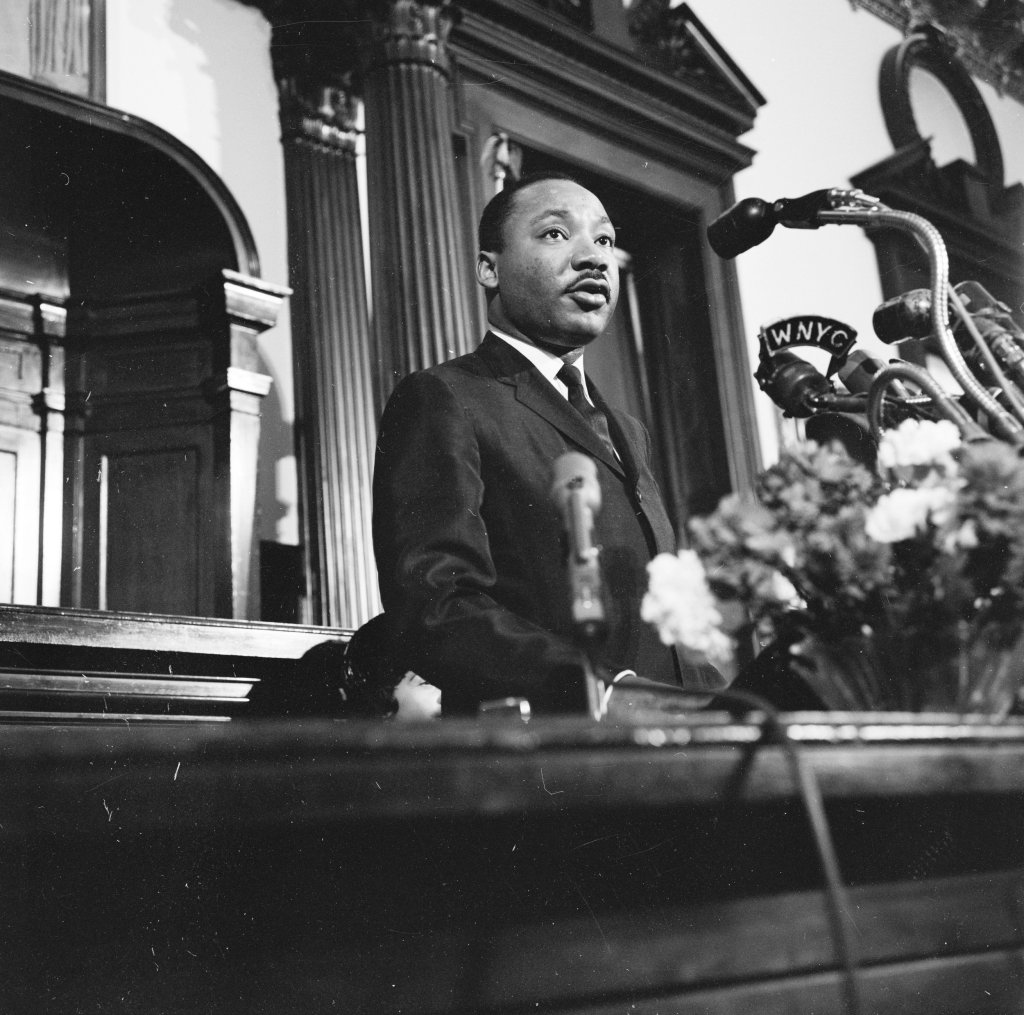
“Yes, our souls have been tried in the cold and bitter Valley Forges of the Deep South, and black and white together, we have met the test. We shall overcome.”
-Dr. Martin Luther King, December 17, 1964.
ARVN forces blow up a network of Việt Cộng tunnels some 15 miles northeast of Saigon; tons of earth fall on the Việt Cộng hiding there. United States military sources said that the bodies of 16 guerrillas had been pulled out and that many more were probably buried. The tunnels, discovered during a routine search near the village of Paris Tân Quy, yielded one prisoner. He was identified as a senior propagandist for the Việt Cộng in the northern Saigon area.
Peking broadcast a Việt Cộng claim that the Communist guerrillas had seized the military initiative in South Vietnam. It said helicopter and armored amphibious car tactics of the United States had been frustrated.
Việt Cộng disguised in uniforms of ARVN paratroopers ambush an ARVN convoy returning to Saigon after escorting General Khánh to Vũng Tàu (Cap St-Jacques); it is believed that the Việt Cộng expected to find Khánh with the convoy. While Việt Cộng guerrillas sometimes dress in government uniforms, they rarely bear regular army unit insignia, including the red berets of paratroopers. An investigation has opened, suggesting that there are doubts that the Việt Cộng were actually involved, the informant said.
United States Military Headquarters announced today that the body of an American adviser reported missing since Sunday had been found. He was identified as Sgt. Tommy D. Emert, whose widow, Margaret, lives in Fayetteville, North Carolina.
Thirteen United States servicemen died in South Vietnam during the week ended December 14, the Defense Department reported today. It was the largest weekly United States casualty toll of the Vietnamese war. Ten of the men were killed in combat against the Việt Cộng. Three died of other causes. Thirty‐five men were wounded. The deaths during the week brought to 339 the number of Americans who have died in Vietnam since January 1, 1961. Of the total, 235 were killed in battle and 104 died from noncombat causes. The wounded figure stood at 1,442.
Talks between the United States and Cambodia ended here today with no way found to resolve the differences between the two countries. Although final communiques by both sides Indicated a possibility that the talks might be resumed, the Cambodian one reflected impatience at the United States delegation’s decision to return to Washington for consultations. This impatience was an apparent reflection of charges of bad faith made Monday in Phnom Penh by Prince Norodom Sihanouk, the Cambodian head of state.
Philip W. Bonsal, President Johnson’s special representative and head of the United States delegation, said he hoped it would be possible to resume the talks later. He plans to fly to Washington tomorrow to “report on the Cambodian proposals,” which, according to a brief United States communiqué, “will require considerable study.” The longer Cambodian communiqué said the Cambodians had agreed to “interrupt the talks” even though they had come to New Delhi with a determination to conclude an agreement ending what was denounced as unjustified “aggression” by United States and South Vietnamese forces. Such actions have cost the Cambodian people 55 lives, the communique said, adding that 89 persons have been wounded and six kidnapped.
A five-nation meeting will be held next month to discuss the formation of an Atlantic alliance nuclear force, including a powerful internationally manned component, authoritative United States sources reported tonight. The disclosure was made shortly after the Ministerial Council of the North Atlantic Treaty Organization emphasized in a communiqué that “a thorough exchange of views” on nuclear and other weapons should be continued. The dominant issue in the council, which closed this afternoon, was the allied nuclear force. The most effective exchanges on this and other issues apparently took place outside the conference hall.
The United States remains determined to satisfy the desires of the nonnuclear Atlantic allies, the American sources explained, but it will be flexible in seeking to improve relations with President de Gaulle and his government, the foremost opponents of Washington’s plan for an international fleet. The Administration is not prepared to abandon such projects as the international force and invite dangerous alternatives in Europe, the source said. The United States, Britain, West Germany, Italy and the Netherlands will participate in the January meeting.
In the United Kingdom, the House of Commons voted, 311 to 291, to transfer control of the British nuclear arsenal to NATO or to “some sort of new Atlantic command”. In the debate in Commons, Prime Minister Harold Wilson told his chief critic, former Prime Minister Alec Douglas-Home, “Are you willing to go it alone in a war with Russia? Would you push the button setting off a kind of war that would mean total annihilation of all human life in Britain? If you can’t answer that, you don’t understand what the argument is all about.”
Nikolai T. Fedorenko of the Soviet Union violently attacked the Tshombe Government in the Congo today as an illegal “puppet” of the North Atlantic Treaty powers. Dr. Fedorenko, speaking in the Security Council, charged that Western “monopolies” were sponsoring a plan for Premier Moïse Tshombe “to transfer the Congo to the imperialists.” He asserted that there was al “highly unsavory Tshombe plan” made up of “three interlocking parts.” The first of these, Dr. Fedorenko said, is to use foreign forces “against the patriotic forces of the country;” the second, to transfer “the state apparatus in the Congo to the colonialists,” and the third, to give direct control of law and order to the “foreign monopolies.”
The Soviet delegate said the second point ‘consists of backing up every Congolese minister and high official in the Congo with a Belgian, who would in fact replace him in everything.” He charged that it became known in August “that the foreign monopolies which still owned the natural resources of the Congo were taking measures to put an end to the patriotic movement.” Among “monopolies” holding interests in the Congo he cited “firms and banks in the United States.” “For example,” Dr. Fedorenko said, “it is known that at the end of 1963 the Morgan Guaranty Trust, which belongs to the Morgan financial group in the United States, bought control over the Banque du Congo from the Belgian bank, Société Générale de Belgique.”
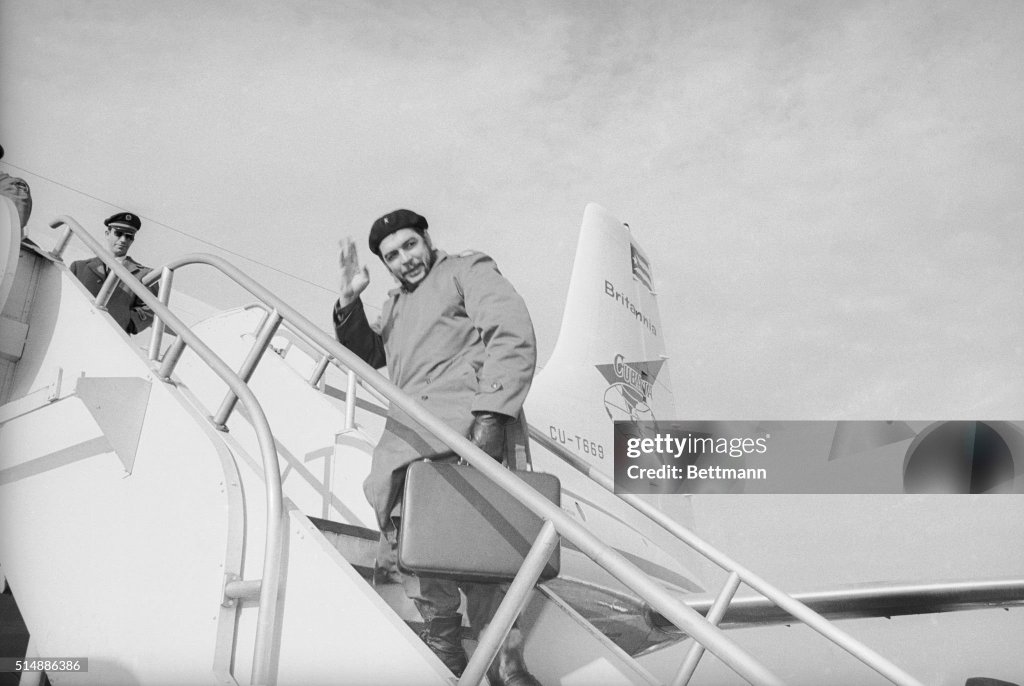
The New York Police Department made public yesterday an artist’s sketch of a man believed to have been involved in the firing of a bazooka at United Nations headquarters last Friday. The firing occurred while Major Ernesto “Che” Guevara, Cuba’s Minister of Industries, was denouncing the United States in a speech before the General Assembly. Ending an incident‐filled eight-day visit to New York yesterday, the major started on a trip to Algeria, departing on a Cuban jetliner. The sketch of the suspect in the bazooka firing was rendered from a description given the police by a witness. Chief of Detectives Philip J. Walsh said that the man had been seen “acting nervous” and glancing frequently at his wrist watch for about an hour, only a block from the waterfront lot in Long Island City, Queens, from which the missile was fired.
Major Guevara, Cuba’s Minister of Industries and her leading guerrilla expert, left New York by air today on a trip to Algeria. The move stirred speculation here that Cubans might support the rebel movement in the Congo. Major Guevara, who had been attending sessions of the United Nations General Assembly, departed aboard a special Britannia aircraft of Cubana de Avicion, giving only Newfoundland as his next destination. After takeoff, the Havana radio announced that he was headed for Algeria. Speculation among officials here on the purpose of his trip was based partly on a Cuban Government pledge of “militant support” to the Congolese rebels following the United States-Belgian mission to rescue white hostages in Stanleyville last month.
Major Guevara, the target of almost continuous demonstrations during his stay in New York, was guarded by more than 100 city detectives, Port Authority patrolmen and State Department security agents as he waited to board his aircraft at the isolated eastern end of Kennedy International Airport. A police helicopter circled overhead.
Rumania expressed “understanding” today for Communist China’s reasons for exploding a nuclear bomb two months ago and thus struck another blow at Soviet authority in the Communist world. The Government published an undated message from Premier Ion Gheorghe Maurer to the Chinese Premier, Chou En‐lai. It reasserted Rumania’s interest in better relations with the West, which she has pursued even more vigorously than Moscow, but pointedly dissociated Rumania from alliance with the Soviet Union in Moscow’s resumed quarrel with Peking. As far as is known here, Rumania thus became the first of the European Communist countries — except possibly Albania—to reply to Chinese messages of October 17 announcing the nuclear test and proposing the prohibition of all nuclear weapons. The timing of the Rumanian response struck Western diplomats as possibly even more significant than the context.
Rumania has refused for some time to participate in the public conflict between Moscow and Peking. Though she is inclined to favor the Soviet or “coexistence” side of the argument, she is interested in supporting the right of every Communist government to “independence” from the diplomacy of the others. Rumania has exploited the conflict to declare her own independence from the Soviet Union, especially in economic, relations, and she has supported similar assertions by Yugoslavia and Albania as well as China. An expression of sympathy for China’s desire to be a nuclear power was, therefore, no surprise. But its publication this; week seemed to be a reaction to more recent Soviet maneuvers inside the Communist, world.
Fifteen men of the Royal Netherlands Navy and the police, including 10 dropped by helicopters, silenced a pirate television station on a platform at sea two miles outside Dutch territorial waters at dawn today. The commercial television station, North Sea TV, had been operating for three and a half months despite a Dutch ban on commercial broadcasts. The station is five miles off the Dutch coast between The Hague and Noordwijk. The taped voice of a woman announcer broke off in midsentence when the raiders struck. Two navy helicopters lifted 10 men to the platform, which was like an oil drilling rig resting on the sea bed. After the 10 had seized a hoisting installation, hitherto used for bringing more welcome visitors to the platform, the rest of the tiny occupation force was brought in by ship.
The new Flag of Canada was hoisted up a flagpole by the government for the first time, displayed outside the Canadian Parliament hours after the Senate of Canada voted, 38 to 23, to approve the new maple leaf design. The House of Commons had approved the flag earlier in the week.
Thirty-two sailors on the Liberian-registered cargo ship SS San Patrick, nearly all of them from Spain, were killed when the vessel, a converted T2 tanker, ran aground on Ulak Island, the second most western of the Aleutian Islands. The 521 foot ship had been transporting grain from Vancouver to Yokohama when it encountered a heavy winter storm and sent out three SOS distress calls; a search by the U.S. Navy did not discover the ship until three days later.
Fernando Belaúnde Terry, the President of Peru, announced that the new agrarian law passed in the South American nation would be implemented in 1965, with the government expropriating farm lands (with payment for their owners financed through the sale of government bonds) and redistributing individual plots to the 56,000 peasant farmers who had been working on the farms as sharecroppers.
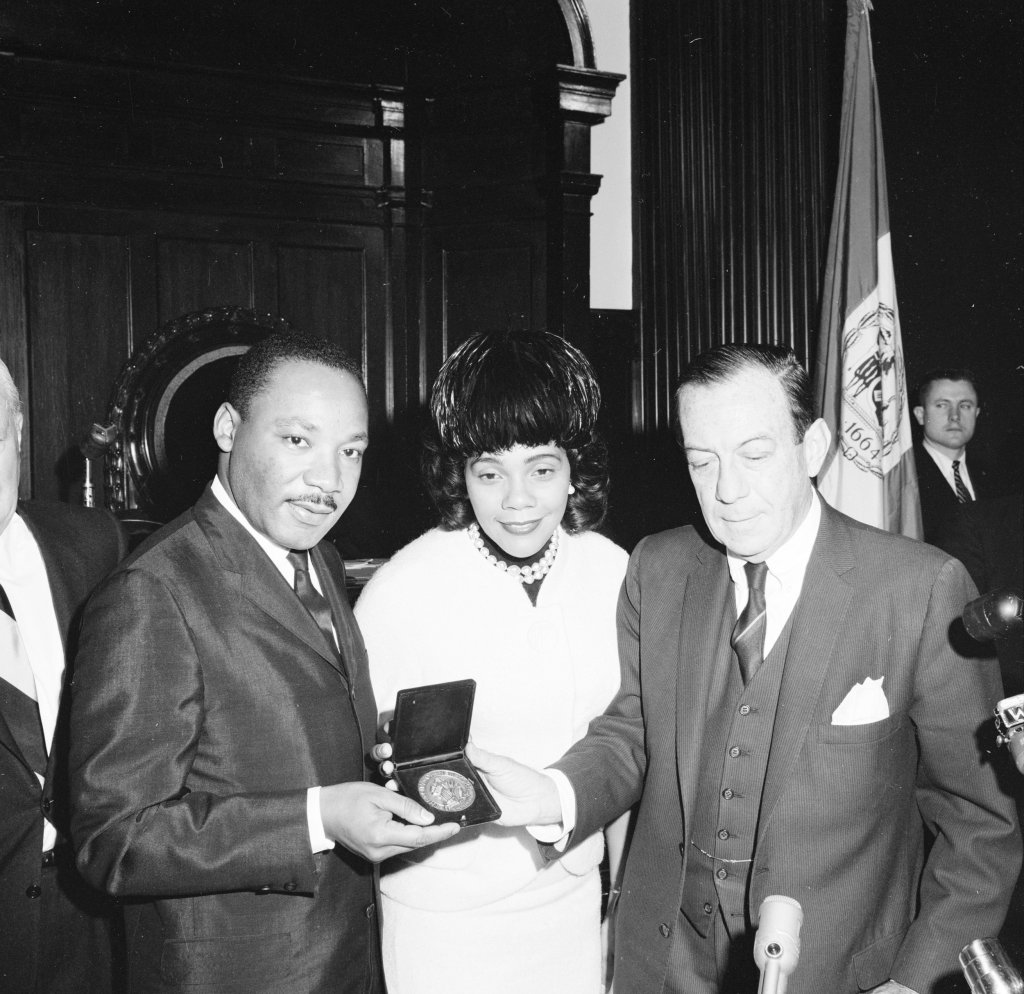
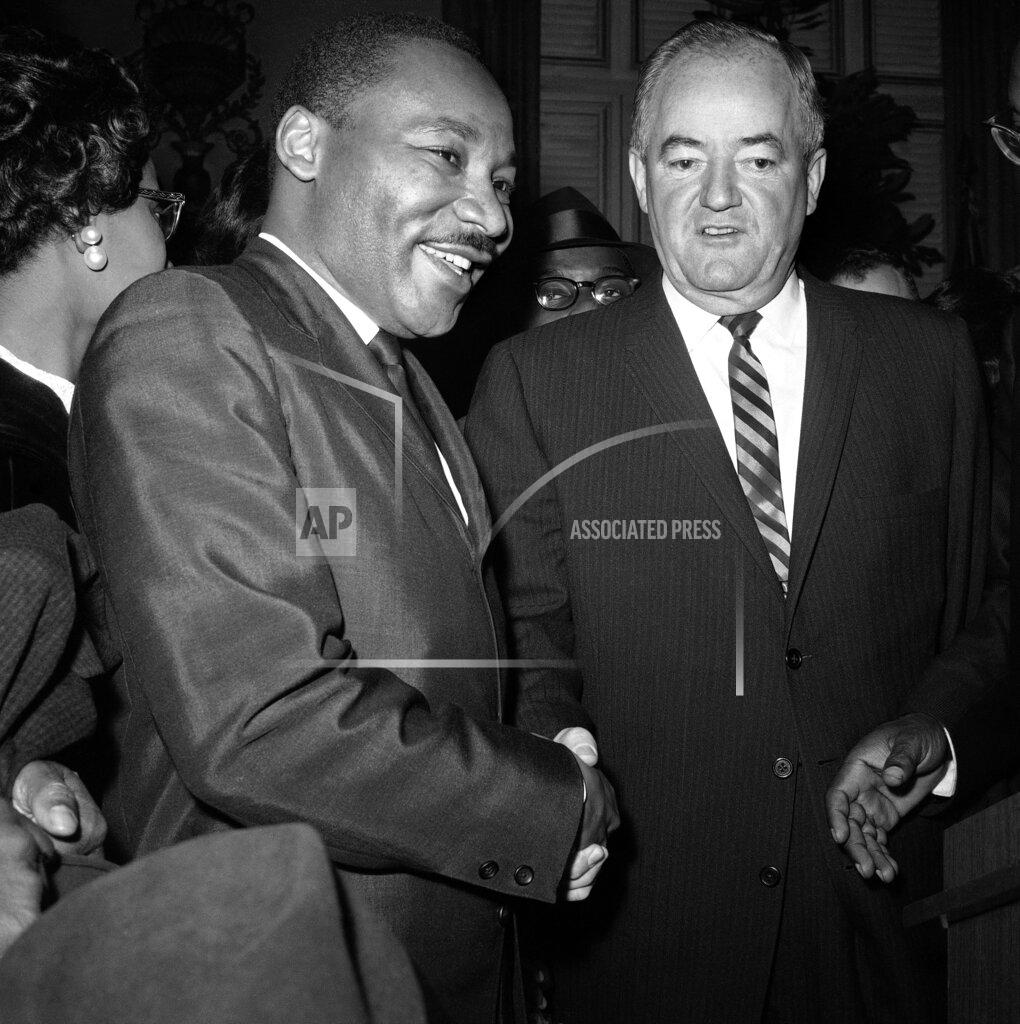
The Rev. Dr. Martin Luther King Jr., returning from Europe after having received the Nobel Peace Prize, received the full honors of New York City yesterday. “This city has officially welcomed many world‐renowned figures,” Mayor Wagner said at a City Hall ceremony. “I can think of none who has won a more lasting place in the moral epic of America. New York is proud of you, Dr. King.” Vice President‐elect Hubert Humphrey and Governor Rockefeller joined in welcoming the civil rights leader back to the country.
Addressing a crowd that packed every corner of the City Council Chamber and overflowed into the corridors of City Hall, Dr. King, in a deep voice and measured tones, said: “I am returning with a deeper conviction that nonviolence is the answer to the crucial political and moral questions of our time — the need for men to end the oppression and violence of racial persecution, destructive poverty and war without resorting to violence and oppression. “Yes, our souls have been tried in the cold and bitter Valley Forges of the Deep South, and black and white together, we have met the test. We shall overcome.” The audience, which included Dr. King’s mother and father, rose and cheered Dr. King with the kind of roar not often heard in the gilded chamber.
Twenty Representatives urged the Justice Department today to move for a specially appointed judge and a new grand jury roll in the cases arising from the killings of three civil rights workers near Philadelphia, Mississippi, last June 21. A letter from the House group, which includes 17 Democrats and three Republicans, to Acting Attorney General Nicholas deB. Katzenbach referred to the dismissal of charges by a United States commissioner in Mississippi against 19 of the defendants. The two other defendants were freed in separate actions. The 21 men were arrested by the Federal Bureau of Investigation in connection with the deaths of James E. Chaney of Meridian, Mississippi, and Michael H. Schwerner and Andrew Goodman of New York.
The Government, blocked from presenting some of its evidence before the commissioner, said it would take the case to a grand jury. The Representatives said in their letter that there was a “threat of similar actions by an openly hostile Federal district judge and a grand jury drawn from a discriminatory jury roll, with the result that indictments may not be returned in this crucial case.” If this should happen, the letter said, there will be a serious threat both to the prestige of Federal courts and to the prospects for compliance with civil rights laws. The letter did not name any judge regarded as hostile. Justice Department sources said that in the normal course of events the trial — which will be held only if an indictment is returned — would be before one of two Federal district judges, William Harold Cox or Sidney C. Mize. The department had no comment on the letter.
Two Jackson, Mississippi restaurants that have been sued under the 1964 civil rights act turned away two groups of Blacks seeking service today. The restaurants are owned by Angelo Primos and his family. One son is a past president of the Jackson Citizens Council. Charles Evers, state field secretary of the National Association for the Advancement of Colored People, said after the attempts: “We felt that due to the Supreme Court decisions in the Georgia and Birmingham cases that Primos may have changed his mind.” The Supreme Court, in cases involving an Atlanta motel and a Birmingham restaurant, this week upheld the section of the 1964 Civil Rights Act forbidding discrimination in public accommodations.
President Johnson is expected to ask Congress to step up the war on poverty with a multibillion‐dollar appropriation next year. A $2 billion request is under consideration but has not been decided upon, it was learned today. Such an appropriation would more than double the antipoverty allotment for the fiscal year ending next June 30. President Johnson had sought $962.5 million for the program. Congress appropriated $784.2 million. If Congress agreed to appropriate $2 billion daring the fiscal year starting next July 1, it would not mean that $2 billion would actually be spent in that fiscal year. Part of the increase could spill over into later years. With antipoverty funds now flowing to cities and communities throughout the nation, Administration officials believe that Congress will be willing to increase the appropriation substantially next year.
President Johnson “made clear” to labor leaders today that he supported the Democratic platform pledge to repeal Section 14‐B of the Taft‐Hartley Act, the White House said. The section authorizes state “right‐to-work” laws. Labor sources went further, saying Mr. Johnson has promised to support repeal and had promised reasonably fast action, although he had set no timetable for the controversial move. Mr. Johnson met for two hours and 15 minutes today with George Meany, president of the American Federation of Labor and Congress of Industrial Organizations, and a delegation of other labor leaders to hear their views on a legislative program for 1965. The labor leaders indicated after the meeting that they felt they had found a very warm friend in the President. Also, Mr. Johnson reportedly promised to study proposals to reduce the work week from 40 to 35 hours. This was regarded as an advance from the outright Administration opposition in recent years.
White House budget planners and the Agency for International Development are drafting a $3.5 billion foreign aid program for the next fiscal year. Their proposals, which were near completion today, include a request to Congress for a four‐year authorization for aid projects. Aid officials originally estimated the requirements of the economic and military assistance programs in the fiscal year 1966 at $3.7 billion, but the Budget Bureau has been resisting this. The agency proposal called for a $450 million increase over the appropriation for the current fiscal year, ending June 30. This sum is inconsistent with President Johnson’s new money needs to carry forward his Great Society concept, the Budget Bureau contends. Last year, the President asked for $3,516,700,000 and assured Congress that the full amount was needed if foreign aid was to remain an effective tool of United States foreign policy. Congress authorized $3.507 billion but then appropriated $3.250 billion, with $2.195 billion in economic loans and grants and $1.055 billion in military aid.
President Johnson will throw the switch lighting the national Christmas tree tomorrow at 6:40 PM, the White House said today. The 70‐foot‐high white Spruce came from the Adirondack Mountains in New York. It has 5,000 red and white lights. It will be the center of the traditional Pageant of Peace at Christmas time on the ellipse between the White House and the Washington Monument.
A confidential post‐election survey by a major voter‐opinion polling firm has found that only one‐fifth of the nation’s Republicans believe Senator Barry Goldwater of Arizona should stay on as head of the party. At the same time, a sizable majority — more than three-fifths — told the poll‐takers that they favored new leadership. The rest — less than 16 percent — indicated they had no preference or did not care. The poll, centered on interviews with a cross‐section of she electorate—a cross‐section that produced an accurate forecast of many elections, including the Presidential contest November 3 — may well help answer this much‐debated question: How many of the 27,145,161 men and women who voted for the Republican ticket on November 3 actually are hard‐core supporters of Mr. Goldwater?
The three leaders of the 1964 Republican campaign concluded a second session today at the hilltop home of Senator Barry Goldwater, the party’s Prsidential candidate. Dean Burch, the national chairman, said they had discussed “a little internal friction in the party,” but declined to be specific. Mr. Burch and Representative William E. Miller of New York, Mr. Goldwater’s running mate in the November election, flew into Phoenix yesterday and left this morning. Mr. Miller said the talks were a continuation of a Jamaica meeting, held immediately after the election. He said another meeting was planned but no date or place had been set. Although both men looked tired, Mr. Burch said their serious talks had lasted only about an hour and a half. Mr. Burch said they had discussed his future as party chairman, noting: “It’s hard to have any kind of discussion without going into that.”
A New York Supreme Court justice rejected today the first of a series of damage claims against the city of Rochester and Monroe County as a result of a three‐day race riot that rocked this city last July. Justice Clarence Brisco said the state’s War Emergency Act, first adopted by the Legislature in 1942 and reinstated in 1951, was in effect at the time of the riot. “The Legislature in its wisdom chose to preclude municipalities’ liability for riot damage until July 1, 1965,” Justice Brisco said. The ruling was made on a suit by Mr. Paint Shops, Inc., the first of many claims totaling about $2.6 million filed by businesses damaged by the rioting and looting.
A strike by carpenters crippled key construction today at the moon space facility and other rocket complexes at Cape Kennedy (Cape Canaveral). The tie‐up was, the fourth major work stoppage of the year at this space center. Earlier disputes were stopped by federal court orders. However, space officials said there were no immediate plans to seek a similar order to end the latest outbreak. The walkout today began at dawn when members of Local 1685, United Brotherhood of Carpenters and Joiners of America, set up picket lines at all the entrances to the Merritt Island moon base and nearby Patrick Air Force Base. They were protesting the use of nonunion carpenters by one contractor.
“Goldfinger”, third James Bond film, starring Sean Connery and Honor Blackman premieres in London.
The New York Yankees fire long-time television and radio voice Mel Allen. The well-known broadcaster popularized the “going, going, gone” home run call and often said “how about that” to describe happenings on the ball field.
Dow Jones Industrial Average: 863.57 (+3.49)
Born:
Tyrone Braxton, NFL cornerback and safety (NFL Champions, Super Bowls, 32 and 33-Broncos, 1997, 1998; Pro Bowl, 1996; Denver Broncos, Miami Dolphins), in Madison, Wisconsin.
Joe Wolf, NBA center and power forward (Los Angeles Clippers, Denver Nuggets, Boston Celtics, Portland Trailblazers, Charlotte Hornets, Orlando Magic, Milwaukee Bucks), in Kohler, Wisconsin (d. 2024).
Frank Pietrangelo, Canadian NHL goaltender (NHL Champions, Stanley Cup-Penguins, 1991; Pittsburgh Penguins, Hartford Whalers), in Niagara Falls, Ontario, Canada.
František Musil, Czech NHL defenseman (Minnesota North Stars, Calgary Flames, Ottawa Senators, Edmonton Oilers), in Pardubice, Czechoslovakia.
Michele Tafoya, American sportscaster (NBC Sunday Night Football; CBS, ABC, ESPN), in Los Angeles, California.
Eric Brown, actor (Buzz-“Mama’s Family”), in New York, New York.
Ginger Wildheart [David Leslie Walls], British singer-songwriter and guitarist (The Wildhearts), in Suth Shields, Tyne & Wear, England, United Kingdom.
Died:
Victor Francis Hess, 81, Austrian-born physicist and 1936 Nobel Prize laureate for his discovery of cosmic rays



 History Diaries