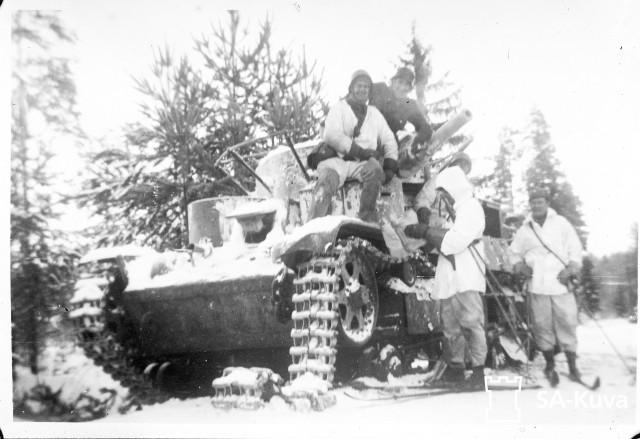
In Ladoga Karelia, the Finnish defence at Kitelä on the shores of Lake Ladoga is partly broken by the 168th Soviet Division.
The Tolvajärvi offensive comes to a halt at Ristisalmi. The Soviet 75th Division marches to the relief of the 139th Division which has gotten into difficulty. The Finns counterattack and send the relief force into retreat.
On the Eastern Isthmus, Finnish troops successfully repulse several enemy assaults on the River Taipaleenjoki.
Unsuccessful attacks continue by Soviet 7th Army against the Finnish Mannerheim Line in the Taipale sector.
At Salla. the position of the Finnish troops at Pelkosenniemi is getting harder by the minute.
Central Isthmus: enemy shelling is pounding the entire length of the 5th Division and 1st Division’s defensive sector between Summa and Muolaanjärvi. The Main Event is about to begin at Summa.
Apart from its value as a chokepoint against Soviet attacks north from Leningrad, the Mannerheim Line on the Karelian Isthmus serves to shield the city of Viipuri. Loss of the city would open a communications network into the heart of Finland, and it would be a major blow to Finnish morale. The terrain is much more tank-friendly beyond the city. The Finns have heavily fortified the village of Summa to Viipuri’s east which defends the city.
On this day, frustrated at Summa, the Soviets attempt to bypass Summa and instead head through the nearby Munasuo swamp to the east. In prioritizing their defenses, the Finns have left this area relatively unprepared. With the ground hard, 20 Soviet tanks blow through this gap, sometimes passing directly over Finnish infantry who hold their ground in trenches. The tank raid, though, could undermine the entire Mannerheim Line if handled properly. This battle introduces the world to “Molotov Cocktails, which are bottles full of combustible fluids thrown at the engine compartments of tanks to set them on fire.
Finnish employers are forbidden on pain of damages from firing a reservist on account of his being called up to the reserve.
In accordance with the decision of Finland’s General Headquarters, every effort will be made to send those fallen in battle home for burial.
In Paris, students demonstrate throughout the day in support of Finland.
Moscow accepts expulsion from the League of Nations quietly. The Russian public receives a minimized version; the Geneva body is said to have degenerated into a body of Allied imperialism. Moscow ridicules League expulsion and rejects the rights of “aggressors,” such as Britain and France, to champion the Finns.
After two weeks of fighting on the Karelian Isthmus, military experts of Finland are of the opinion that Russia’s Red Army has been overrated. Granting that two weeks of warfare is too short a time in which to reach final conclusions, Finnish officers believe events since November 30 are sufficient to give them a line on the strength and offensive capacity of the Red Army fighting off its own soil. Developments thus far also give a possible indication of the effect on the Red Army of the drastic purge which followed the execution of Marshal Mikhail Tukhachevsky and other high generals.
[Ed: This opinion wil also take hold in Berlin, and have the most important consequences in the Summer of 1941.]
The French stop a German raid on an outpost east of the Moselle River on the Western Front.
Moscow suffers a food shortage. Demand for vodka continues because of lack of consumer goods.
The repatriation of about 51,000 ethnic Germans (or Baltic Germans), from the Baltic state of Latvia to the “Incorporated Territories” of former Poland, is completed. They are sent to populate the portions of Poland that have been annexed to the Reich.
German Propaganda Minister, Dr. Josef Goebbels, describes the arrival of Australian destroyers at Malta as a “consignment of junk” and Australia’s “Scrap Iron Flotilla”.
Count Galeazzo Ciano, the foreign minister in the government led by Benito Mussolini, attacks the Soviet Union in a speech to the Fascist assembly. The tone reflects that of the Italian press and radio. Since the Soviet invasion of Finland, Italy has sent volunteers to fight with the Finns and large quantities of military equipment.
British light cruiser HMS Ajax, heavy cruiser HMS Cumberland and New Zealand light cruiser HMNZS Achilles patrol off River Plate estuary; Ajax’s Seafox seaplane reconnoiters the area.
Captain Langsdorff communicates with Berlin through the German embassy. He asks for instructions. He is told to either move the Admiral Graf Spee to Buenos Aires or scuttle the ship to avoid British intelligence from examining it. Admiral Raeder and Adolf Hitler are monitoring the situation closely. Force G remains outside the River Platte, with the Ajax’s floatplane monitoring the situation and the ships refueling. Commodore Harwood is promoted to Rear Admiral and knighted (KCB). The three Force G cruiser captains are made Companions of the Bath (CB).
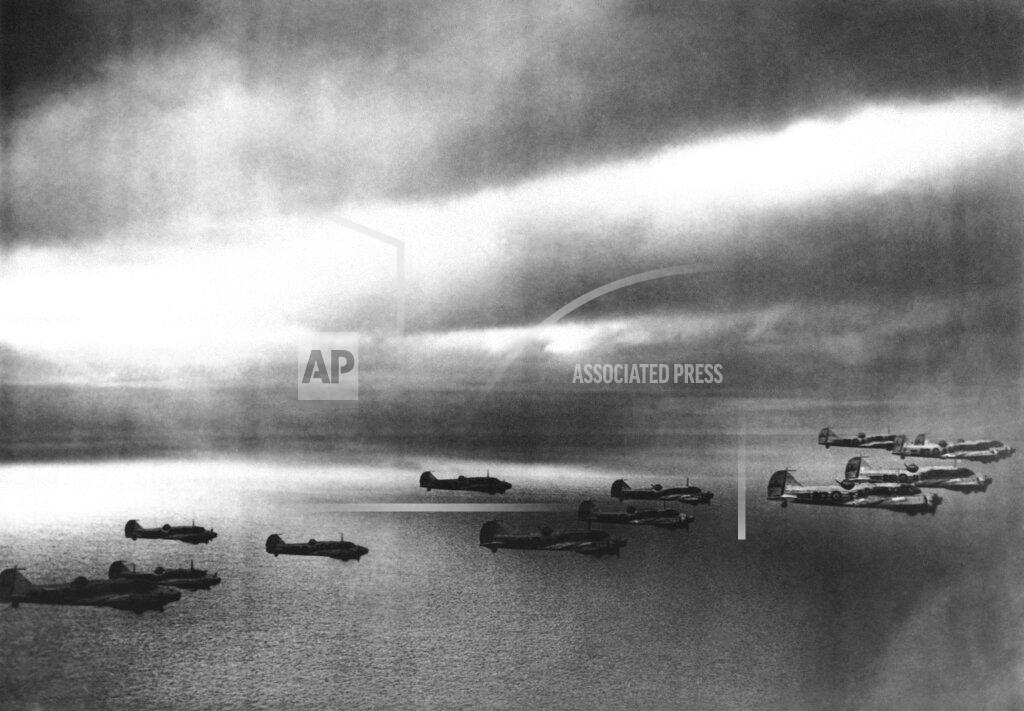
A daylight anti-shipping sweep over North Sea is flown by three aircraft of No. 102 Squadron. No enemy shipping is sighted.
A Security Patrol is flown over Hornum and Borkum by three aircraft of No. 77 Squadron. Four German flak ships are bombed without result.
The Royal Navy Trawler Evelina was sunk by a mine off the mouth of the River Tyne with the loss of all nine crew.
The Royal Navy ASW trawler HMT Sedgefly mined off Tynemouth, UK.
The neutral and unescorted Norwegian steam merchant Glitrefjell was torpedoed and sunk by the U-59, commanded by Oberleutnant zur See Harald Jürst, approximately 75 miles east of St. Abb´s Head, Scotland in the North Sea (56°14′N 1°04′E). At 12.49 hours the Glitrefjell (Master Elmar Malmgren) was hit amidships by one G7e torpedo from U-59 and sank after breaking in two about 75 miles east of St. Abb´s Head. The master and four crew members were lost. The 13 survivors were picked up by the Icarion some hours later and taken to Leith. The 1,568-ton Glitrefjell was carrying ballast and was bound for Tyne, England.
The neutral and unescorted Swedish steam merchant Lister was torpedoed and sunk by the U-59 approximately 130 miles off Newcastle, England. At 00.28 hours the Lister was hit in the bow by a torpedo from U-59 and sank about 130 miles off Newcastle (55°13′N 1°33′E). The Germans spotted the Swedish flag only after firing the torpedo. Six survivors were picked up by HMS Eclipse (H 08) (LtCdr I.T. Clark, RN) on 21 December. The 13 remaining survivors made landfall in a lifeboat on the Danish coast. The entire crew survived. The 1,366-ton Lister was carrying wood and was bound for Antwerp, Belgium.
The British tanker Amble struck a mine and was damaged in the North Sea off Sunderland, County Durham. The crew was rescued by HMS Wallace. Amble came ashore between Sunderland and Whitburn. She was refloated on 25 December but declared a constructive total loss and scrapped.
Destroyers USS Schenck (DD-159) and USS Philip (DD-76), soon joined by USS Lea (DD-118), relieve destroyers USS Jouett (DD-396) and USS Lang (DD-399) in trailing German passenger liner Columbus off Key West, Florida. Jouett and Lang steam to join destroyer USS Davis (DD-395) in attempting to locate freighter Arauca. Schenck soon proceeds on other assigned duties.
Convoy OA.54 departs Southend.
Convoy OB.54 departs Liverpool .
Convoy HG.11 departs Gibraltar for Liverpool.
The War at Sea, Saturday, 16 December 1939 (naval-history.net)
The Home Fleet with battleships WARSPITE, BARHAM, battlecruiser HOOD and nine destroyers was 300 miles west of Malin Head at 0730 covering arriving Canadian Troop Convoy TC.1. The twelve destroyers which had sailed on the 12th to meet the convoy failed to make contact on the 15th due to fog, but met it during the morning of the 16th. Troopship EMPRESS OF AUSTRALIA was separated from the convoy on the 15th again because of the fog, but rejoined on the 16th.
On Northern Patrol, two cruisers were between the Shetlands and the Faroes, and three cruisers between the Faroes and Iceland.
After a British aircraft attacked a submarine contact, destroyer ESCORT made another attack off Buchan Ness in 57-26N, 1-45W.
Light cruiser CERES arrived in Scapa Flow, departed the same day and arrived back on the 25th.
Sloop FLEETWOOD, which had returned home from the East Indies in November, completed a refit on the 16th at Dundee and joined Convoy C.
Convoy ON.5 of nine British ships departed Methil escorted by destroyers AFRIDI, MAORI, NUBIAN and submarine TRIAD. Destroyer MOHAWK departed the Tyne on the 18th, but was delayed by the German mining off the port and joined at sea. The convoy was due to leave Methil on the 14th, but was also postponed due to submarine activity. ON.5 arrived safely at Bergen on the 19th without incident. Return HN.5 was delayed 48 hours and meanwhile, the destroyers went to Sullom Voe to refuel. TRIAD carried out a diving patrol.
Convoy FS.55 departed Southend escorted by destroyers VIVIEN, VALOROUS and sloop BITTERN, and arrived at the Tyne on the 17th.
Russian submarine ShCh-322 damaged German steamer GILLHAUSEN (4339grt) with gunfire south of Hanko.
U-59 sank Swedish steamer LISTER (1366grt) in 55 21N, 00 38E and Norwegian steamer GLITREFJELL (1568grt) in 56 14N, 01 04E. Six survivors from LISTER were picked up by destroyer ECLIPSE on the 21st and 13 others in a large lifeboat arrived on the Danish coast. Five crew were lost from GLITREFJELL, with 13 survivors rescued by destroyer ICARUS and more by Greek steamer ICARION (4013grt).
Japanese steamer SANYO MARU (970grt) departed Rotterdam after a week in port and arrived at the Tyne on the 16th. She carried German nitrates and machinery along with a Dutch cargo to challenge the British blockade but left the contraband control station at the Downs on the 18th, her cargo intact.
Destroyers HARDY, HERO, and HOSTILE departed Pernambuco early on the 16th and arrived in the Plate during the morning of the 22nd.
French destroyers SIROCCO and LA RAILLEUSE, escorting convoy 40.KS, attacked a submarine contact 25 miles 245° from Cape Spartel,.
Convoy OA.54 departed Southend escorted by destroyers WREN and WITCH until it dispersed on the 19th.
Convoy OB.54 departed Liverpool escorted by destroyers WALKER and WHIRLWIND until the 19th when the convoy dispersed.
Convoy HG.11 departed Gibraltar with 52 ships for Britain and two more for Oporto, escorted by destroyer DOUGLAS and the French TIGRE and PANTHÈRE, the latter from the 16th until they arrived at Brest on the 23rd. DOUGLAS detached on the 19th to patrol off Cadiz-Huelva-Cape Santa Maria, and the convoy continued escorted by sloop SANDWICH from the 16th to 24th, when it arrived at Liverpool.
Destroyer WRESTLER departed Gibraltar for refitting at Malta.
Vice President John Nance Garner announced today his candidacy for President. He read a forty-fourword formal statement to a small group of newspaper men and friends, then left for his Webb County ranch for a four-day hunting trip. The statement said: “I will accept the nomination for President. I will make no effort to control any delegates. The people should decide. The candidate should be selected at primaries and conventions as provided by law, and I sincerely trust that all Democrats will participate in them.”
Only once did he raise his voice to emphasize any part of the statement. That was when he came to the words: “I will make no effort to control any delegates.” By his statement, Mr. Garner answered tersely and without fanfare the question which has been plaguing political friends and foes for months. As he read the statement on the side porch of his home here he wore a business suit. He hurried Into the house, changed into his outdoor clothes and emerged to put himself behind the wheel of his automobile and start away for the hunting trip.
Accompanying the Vice President on the hunting trip was Ross Brumfield. garage man, who has been his companion for many years on expeditions into the brushland of Southwest Texas. While Mr. Garner was issuing his statement Mr. Brumfield was in the garage packing the camping gear. Mr. Garner told no one in Uvalde that the statement was to be issued. He made it plain that the statement would not be supplemented.
The statement today broke a traditional silence on political affair) which has characterized Mr. Garner’s tenure as vice president. He made a speech at Philadelphia in 1936 accepting the Democratic. nomination for the Vice Presidency. He spoke once over the radio during the campaign that followed. He was smoking a cigar as he began his statement today. After he finished it he noted that it was the coldest day of the year in Uvalde, and remarked: “This is the best time of the year. I like to sleep out in the open in this kind of weather.”
The Garner-for-President movement had its official start near his birthplace at Detroit, in Northeast Texas, on December 6, 1938. There, near a split-log cabin on Blossom Prairie, publicized as his birthplace, speakers praised him as a self-effacing citizen who “seeks neither position, place, power nor influence.” Roy Miller of Corpus Christi, long-time friend prominent in State and national Democratic affairs, was the principal speaker. E. B. Germany, Dallas oil operator, and Mrs. Clara Driscoll of Corpus Christi, were named co-chairmen of the Garner-for-President committee, which set up elaborate headquarters and began a nationwide campaign.
Presidential candidate Thomas Dewey denounces the New Deal “zigzag” in economic policy, charging shifts on budgets, prices, and trust laws. He asks for the end of uncertainty. Asserting that the Democratic National Administration had proceeded in a “zigzag” road “toward nowhere,” Thomas E. Dewey charged tonight that President Roosevelt had blocked recovery of American business by repeated “socks on the jaw.” In his second speech since the formal announcement of his candidacy for the Republican nomination for President, the District Attorney, speaking at the dinner of the Pennsylvania Society of New York at the Hotel Waldorf-Astoria, attacked as completely fallacious the New Deal policy of increasing purchasing power by continued spending of borrowed money.
He asserted that only by the end of uncertainty regarding governmental policies and the revival of the spirit of free enterprise in American industry could there be reduction of unemployment, a retrenchment of unnecessary public expenditure, the beginning of a trend toward solvency and a balanced budget and money for relief of the unemployed, the needy and the aged-found, without continued borrowing, through increase in the national income.
“Much more than business is at stake,” Mr. Dewey told the thousand men and women at the dinner and his radio audience. “More than material prosperity is at stake. The chaos in Europe teaches us that we must restore our own free enterprise so that our own human freedom shall also survive. In all that we plan and in all that we do, we must keep in mind the central, vital objective. That objective is the maintenance of human liberty, of the right of the human being to worship and think and express himself in accordance with his conscience and his reason. History shows that these basic human rights can be perpetuated only by preserving a measure of economic freedom.”
The Republicans of Pennsylvania have a “favorite son” candidate of their own in Governor Arthur H. James and Mr. Dewey at first was not received with the same enthusiasm that was shown in his recent speech at Minneapolis. However, the audience warmed to the speaker as he proceeded. He brought genuine applause by his assertion that it was time to “change doctors.” His declaration that it was time to stop making unfounded charges against American business men brought cheers as well as hand claps. His plea for stopping excessive expenditures as a step toward solvency and a balanced budget stirred the audience to enthusiasm.
The Ohio governor demands reform of the WPA. He calls the agency, run under the New Deal, a “political racket.” Speaking at the fifty-fourth annual dinner of the Ohio Society of New York at the Hotel Pennsylvania tonight, Governor John W. Bricker of Ohio, a vice president. of the society, attacked the New Deal administration of WPA as a “political racket,” padding its payrolls in election years, and demanded its replacement by a new syatem administered locally and financed by local, State and Federal participation. He declared his refusal to be “clubbed” into silence by “maligners” and “falsehood, innuendo and propaganda,” or “flinch before a public crack-down from the White House” because he refused to let Ohio relief become “the football of disgraceful partisan politics in Washington, New York and the Department of the Interior.” Ohio is “still there,” he added, and has not been “taken over by the White House or the Department of the Interior.”
Immediate action by Congress on the proposed equal rights amendment was urged in a resolution adopted today at the biennial conference here of the National Woman’s party, which immediately thereafter went into executive session with representatives of supporting organizations on 1940 campaign plans in support of their demand. Seventeen national organizations of women, and scores of State and local groups now are joined on behalf of the measure, and sentiment in its favor is growing rapidly in all parts of the country, according to reports presented today.
Paul V. McNutt, Federal Security Administrator, who is a candidate for the Democratic nomination for President next year if President Roosevelt does not run, frankly admits that he is in the dark on his chief’s intentions.
A proposal for gradual withdrawal of the federal government from the field of public relief, leaving that problem to the care of state and local governments, was put forward today in a report by the committee on state and local taxation and expenditure of the Chamber of Commerce of the United States.
First Lady Eleanor Roosevelt warns about jobless youth; the nation must guide 4 million to careers, she says. Asking for a thorough study of the educational systems of this country, Mrs. Franklin D. Roosevelt yesterday warned that 4,000,000 young people, out of work and out of school, were a potential menace to their communities unless something was done soon about finding jobs for them.
A growing shortage of skilled labor in several parts of the country was found by the Chamber of Commerce of the United States in a survey made primarily to determine the effectiveness of the public employment services.
Gratified by the Communist party’s withdrawal from the campaign to boycott German goods, leaders of the boycott movement laid plans yesterday for an intensified effort to halt the sale of German products in this country.
A committee of three or four Finnish civilians, working with a personal representative of the Finnish Relief Fund organized by former President Herbert Hoover, will administer for civilian relief in Finland the moneys collected in the United States by the fund, Mr. Hoover announced yesterday.
The U.S. Army requests $4 million to build five bombers with double the speed and power of the current flying fortresses.
Now that a new so-called Central Government of China is soon to be established under Japanese guidance and direction at Nanking, probably headed by Wang Ching-wei, all foreign commercial interests in China are apprehensive lest force be used to occupy the Chinese Maritime Customs houses in Shanghai and at Tientsin. Such a forcible seizure by the Japanese military or by their Chinese puppets must necessarily be followed by the retirement of the present heads and staff, who are still employees of the Chinese Government at Chungking. This would result in a temporary paralysis of the customs administration, and eventually a new staff, largely Japanese or selections of Wang Chingwei’s pro-Japanese government, would administer the customs at China’s leading ports. In short order, it is feared, various discriminatory practices and rules would be developed that would effectively choke off American and European trade with China and give Japan a virtual monopoly.
Rice riots in Shanghai went on for a second day today with fifty-five rice shops looted, nineteen persons wounded and more than fifty arrested today. One rice dealer, one of six warned against profiteering yesterday, was wounded by Chinese gunmen. Police guarded all rice shops in the International Settlement, where thousands of hungry war refugees battled for food and in protest against high prices. Most rice shops were heavily shuttered.
In China, troops of the Chinese 81st Division (1st War Area) captured the city of Kaifeng in Henan Province, while troops of the Chinese 5th Division began to advance toward Kunlun Pass, Guangxi Province in southern China.
The Japanese forces are reeling, but manage some counterattacks such as against the Chinese 2nd War Area.
The Chinese 3rd War Area (Anhwei south of Yangtze River, northeastern Kiangsi, and territory to the east with 10th Army Group, 23rd Army Group, and 32nd Army Group) opens an offensive.
Chinese 5th War Area reportedly captures Japanese strongpoints at Niehchiachang, Funanchang, Wuhsuchiachang, Chouchiachang, Tunghsinchang, Tuochuanu, and Nanhofu.
The 73rd Army of Chinese 9th War Area opens attacks around Shihchengwan, Kueikoushih, and Tashaping and remains intermittently engaged in that area for a month.
Dow Jones Industrial Average: 149.36 (-0.28)
Born:
Wayne Connelly, Canadian NHL and WHA right wing and centre (NHL: Montreal Canadiens, Boston Bruins, Minnesota North Stars, Detroit Red Wings, St. Louis Blues, Vancouver Canucks; WHA: Minnesota Fighting Saints, Cleveland Crusaders, Calgary Cowboys, Edmonton Oilers), in Rouyn, Quebec, Canada.
Naval Construction:
The U.S. Navy repair ship USS Vulcan (AR 5), lead ship of her class of 4, is laid down by the New York Shipbuilding Corp. (Camden, New Jersey, U.S.A.).
The Kriegsmarine (German Navy) Type VIIC U-boat U-332 is laid down by Nordseewerke, Emden (werk 204).
The Вое́нно-морско́й флот СССР (ВМФ) (Soviet Navy) “ShCh” (ShChuka)-class (6th group, Type X-modified) submarine ShCh-405 is launched by A. Marti (Leningrad, U.S.S.R.) / Yard 194.
The Royal Navy armed merchant cruiser HMS Rajputana (F 35) is commissioned. Her first commanding officer is Captain (retired) Frederick Henry Taylor, DSC, RN.
The Royal Navy armed merchant cruiser HMS Carthage (F 99) is commissioned. Her first commanding officer is Captain (retired) Basil Owen Bell-Salter, RN.
The Вое́нно-морско́й флот СССР (ВМФ) (Soviet Navy) “K” (Katjusa)-class submarine K-1 is commissioned.
The Вое́нно-морско́й флот СССР (ВМФ) (Soviet Navy) “K” (Katjusa)-class submarine K-2 is commissioned.
The Kriegsmarine (German Navy) Type IXB U-boat U-64 is commissioned. Her first commanding officer is Kapitänleutnant Georg-Wilhelm Schulz.
 History Diaries