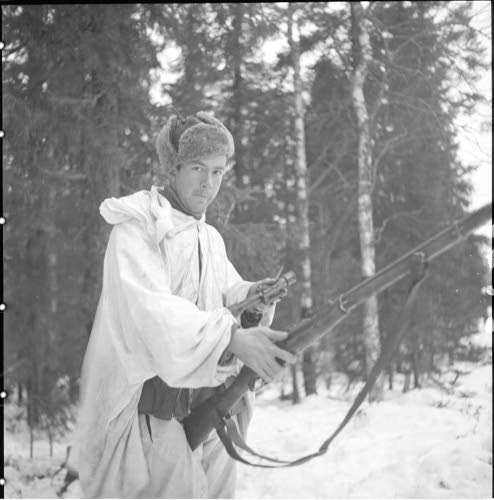
The Finns have been launching attacks on Suomussalmi that the Soviets in the town have been deflecting. Today, after days of waiting, the Finns on the Ratte road are attacked from the east. Units of the Soviet 44th Rifle Division reach Battle Group Kontula, which is barricading the road. Stretched out over the road, the Soviets attempt a company-sized assault which the Finns easily brush off.
The leader of the 163rd Rifle Division in Suomussalmi knows the danger and repeatedly requests permission to withdraw. He is told to await the 44th Rifle Division. Ninth Army (KomKor M.P. Duhanov) fails to coordinate assaults from the village and the relief force. With this failed attempt, the relief attack, in fact, ends for the time being. The 44th Division itself, confined to the road, now presents a tempting target for the Finns.
The Battle Of Tolvajärvi ends, as the Finnish counterattack against the Soviet 8th Army came to an end. It had been a resounding success with the Soviet 163rd and 75th divisions being completely destroyed and a large amount of military hardware captured.
Troops of the 13th Division under the command of Colonel Hannuksela launch an offensive towards Ruhtinaanmäki.
At Uomaa, a Finnish patrol rescues two wounded men who had survived in a tent for 12 days in territory overrun by the enemy.
Red Army assaulted Taipale, Finland. At Taipale, a Russian division launches a tank-supported offensive at 0830. The advance is halted at Kirvesmäki. They have a huge amount of artillery and about 150 tanks.
The fighting at Terenttilä continues into the second day.
In the far north, the Finns withdraw from Salmijaervi near the coast and blow up the nickel mines. They can easily travel off-road, the Soviets not so much.
Two Finnish companies launch a counterattack at Summa on the central Isthmus, but fail to get further than a few kilometres.
Meanwhile, the Finnish government decided to bring fallen Finnish soldiers of the Winter War to their home towns for burial.
The Finnish Foreign Minister broadcasts an offer to reopen negotiations to the Soviet Foreign Minister. He says that any design to annex Finland will be resisted to the last: “the Finns will never submit to a foreign yoke.” Foreign Minister Vaino A. Tanner broadcast tonight a radio appeal to Russia to end its “barbarous” invasion by accepting far-reaching Finnish concessions, but warned that Finland would “defend herself to the last.”
Frozen feet are impeding the activities of the Russian troops in this sector on the western shore of Lake Ladoga. Seven Russian prisoners, who limped painfully, declared that perhaps thousands of Russians on this front have suffered frozen feet. The seven men were the sole survivors of sixty who attempted to cross the Taipale River by boat. Finnish artillery smashed the boat.
Their shoes, thin and of poor quality, accounted for the frozen. feet. Only one wore the traditional Russian felt knee-high boots. One had wrapped his shoes with gunnysacking. Their uniforms were of a cotton, quilted material entirely unsuited for this kind of climate. Their overcoats were thick but were rough and of poor quality. They wore cotton underwear. When asked whether their clothing was warm enough, one replied, “Well, that depends on the weather. When it freezes, we freeze.”
Listeners are reminded that today is the last recommended day for sending Christmas packages to the troops at the front.
Despite the war, Finland is honoring the repayment schedule for its First World War debt to the USA. Finland paid its semi-annual installment of $234,693 on its war debt to the United States today in a ceremony in which a check was handed to Secretary Morgenthau by Hjalmar J. Procope, the Finnish Minister.
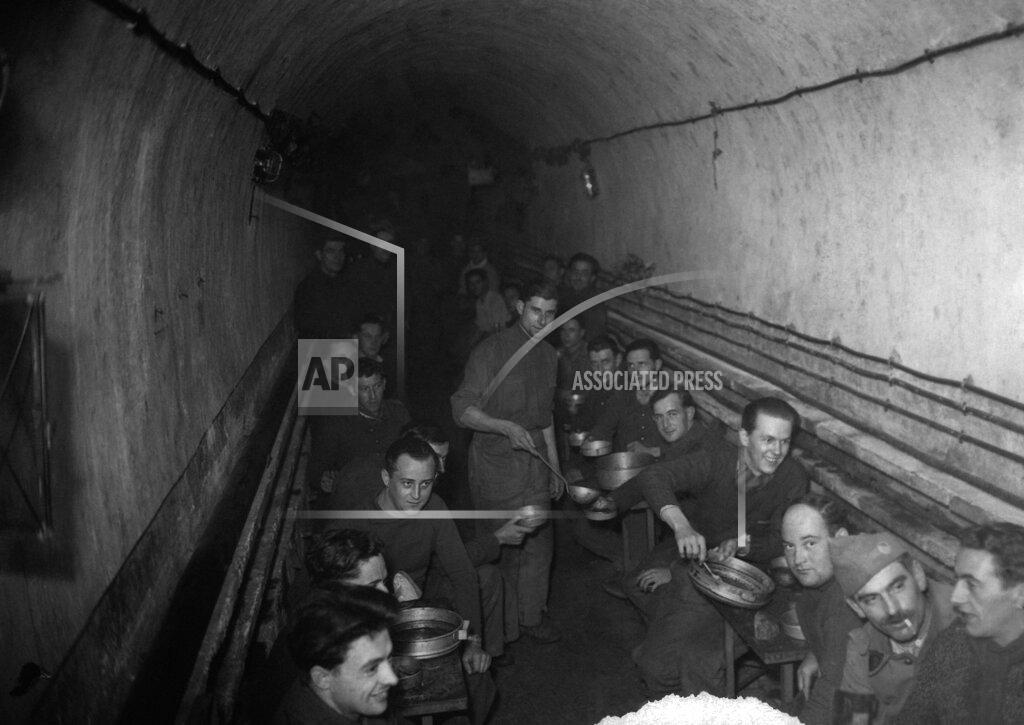
Three British infantry brigades sent to France in October are formed into the British 5th Division, BEF. This division is deployed south of Lille along a fortified line which is being extended and strengthened. The British Expeditionary Force is only in direct contact with German forces around Metz.
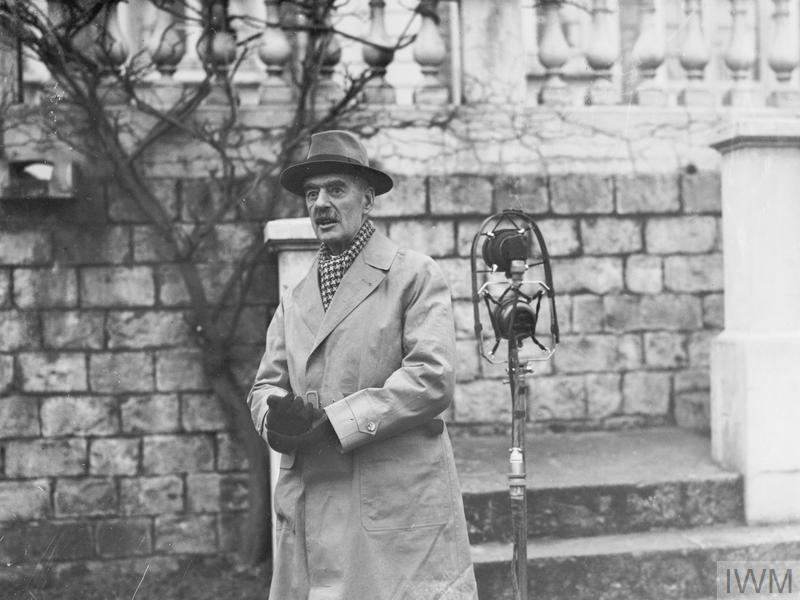
Prime Minister Neville Chamberlain visits the BEF in France with General Ismay. Prime Minister Chamberlain arrived by air in the British zone today for a brief visit to the British Expeditionary Force and the Royal Air Force.
The first bitter fruits of the naval action in which three British Empire cruisers disabled the German pocket battleship Admiral Graf Spee — an action that has been like a tonic to every man, woman and child in these islands — reached here tonight in the form of the casualty list of the light cruiser HMNZS Achilles.
The German press charge yesterday, which found support in well-informed German quarters last night, that the British had used poison gas shells in the sea battle against the Admiral Graf Spee off the coast of Uruguay Wednesday seemed to be dying a tactful death in Berlin today. The Germans were unable to provide any evidence at all to back the claim.
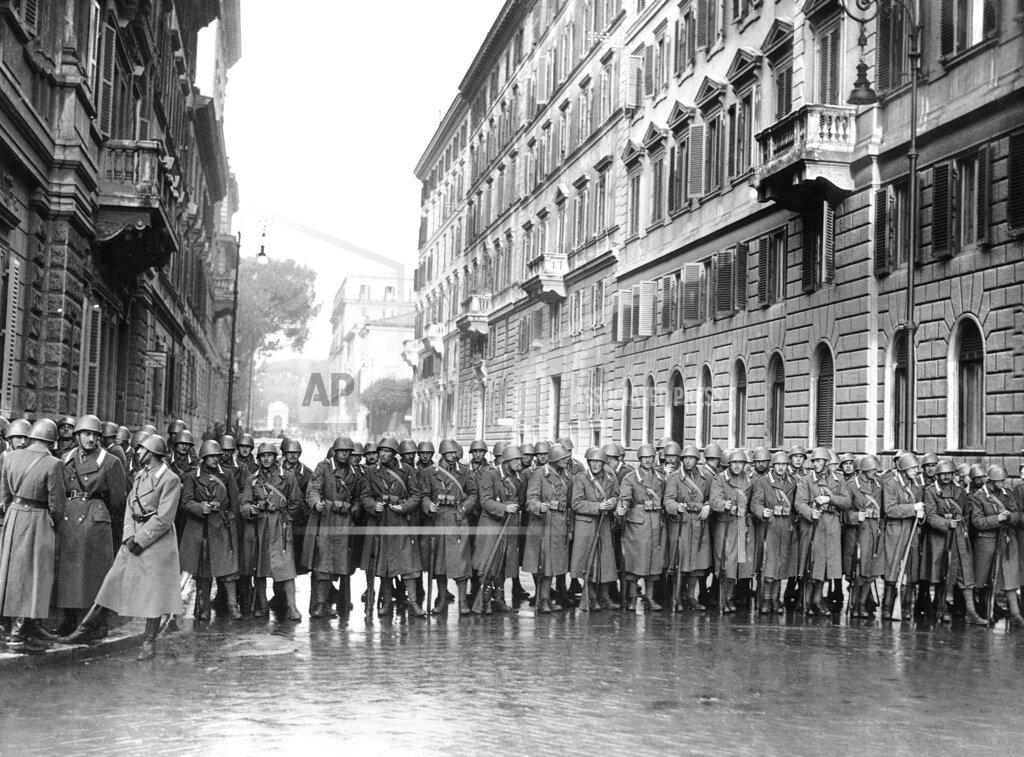
Foreign Minister Ciano strongly condemns Soviet aggression in a speech in Rome .
The French ambassador to the United States warns of the Soviet menace, calling it the gravest aspect of war.
Erich Raeder suggested that the pocket battleship Lützow and the blueprints for the Bismarck-class battleships could be made available for sale to the Soviet Union if the Soviet Union was willing to pay a good price.
The bodies of the thirty-six German navy men killed in the battle off Uruguay, Wednesday, were taken today to a common grave in the North Cemetery of Montevideo amid the graves of Germans and Britons who had died here in times of peace.
In Montevideo, Uruguay, the German pocket battleship SMS Admiral Graf Spee was ordered to leave port with 72 hours. The crew was repairing damage to the warship and fuel was taken in from a German tanker. Captain Langsdorff of the Admiral Graf Spee spends part of the day going to funerals for 36 of his men and ponders what to do with his ship and men. The released British sailors attend the funeral of their own volition and lay wreaths.
Langsdorff is told that he must leave within 72 hours. His men are repairing what battle damage they can, but the ship requires much more time. The British spread rumors by various means, including phony radio transmissions, suggesting that the British forces awaiting the Admiral Graf Spee are larger than they actually are. The British also play games with departures of British merchant ships, sending them out at intervals – the Admiral Graf Spee must give departing ships 24 hours head start, and the British want more time to assemble a fleet outside the Platte River estuary.
British RFA oiler Olynthus refuels light cruiser HMS Ajax at Samborombon Bay, off the coast of Argentina; heavy cruiser HMS Cumberland covers the evolution lest German armored ship Admiral Graf Spee should attempt to sortie.
RAF Bomber Command conducts a daylight anti-shipping sweep over the North Sea, using two No. 77 Squadron aircraft. No enemy shipping is sighted.
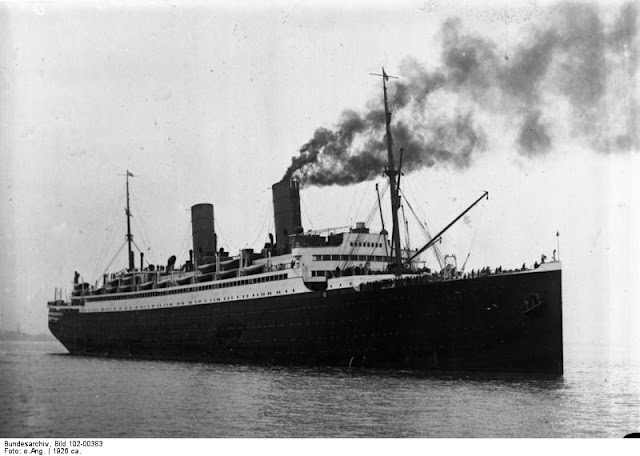
Destroyer USS Jouett (DD-396) relieves USS Benham (DD-397) at sea; the latter attempts to locate German freighter Arauca, while Jouett joins USS Lang (DD-399) in shadowing the German passenger liner Columbus.
The unescorted Greek steam merchant Germaine was stopped by gunfire and after the crew abandoned ship was torpedoed and sunk by the U-48, commanded by Kapitänleutnant Herbert Schultze, southwest of Ireland in the eastern Atlantic Ocean. At 16.11 hours the Germaine was stopped by a shot across her bow by U-48 southwest of Ireland. Because the ship was carrying cargo for Britain, the crew was ordered into the lifeboats and the ship was sunk by a torpedo at 17.40 hours. The entire crew was picked up by the Norwegian motor merchant Vinland. The 5,217-ton Germaine was carrying maize and was bound for Cork, Ireland.
The British cargo ship Harfry collided with the Portuguese ship Luso in the North Sea off Dunkerque, Nord, France and was beached.
The Norwegian cargo ship H C Flood struck a mine and sank in the North Sea (55°02′00″ N, 01°12′00″ W) with the loss of four of her 21 crew.
The Norwegian cargo ship Ragni struck a mine and sank off the mouth of the Tyne (55°02′ N, 1°12′ W) with the loss of six of her 19 crew.
The Norwegian cargo ship Strindheim struck a mine and sank off the mouth of the Tyne (55°02′37″ N, 01°17′35″ W) with the loss of nine of her 11 crew.
The Swedish cargo ship Ursus struck a mine and sank in the North Sea north of North Foreland, Kent (51°35′ N, 1°36′ E) with the loss of nine of her 20 crew. Survivors were rescued by the Dutch trawler Brindus.
The German torpedo boats Jaguar and Seeadler capture six ships in mercantile warfare in the Skagerrak.
U.S. freighter Exmoor, detained at Gibraltar by British authorities since 7 December, is released.
The War at Sea, Friday, 15 December 1939 (naval-history.net)
Battleships WARSPITE, BARHAM and battlecruiser HOOD with nine destroyers were 250 miles west of Malin Head. Heavy cruisers DEVONSHIRE, BERWICK and light cruiser GLASGOW were 480 miles W by N of Malin Head. Light cruisers SOUTHAMPTON and EDINBURGH were on patrol between the Orkneys and the Faroes. Light cruisers DIOMEDE, DELHI, CERES and CARDIFF were concentrated off the Faroes. If no further enemy reports were received, the battle fleet was directed to cover the Canadian Troop convoy, and the cruisers to return to Northern Patrol except SOUTHAMPTON and EDINBURGH which were to proceed to Scapa Flow for refueling.
Light cruiser DRAGON departed Scapa Flow on Northern Patrol and finished on the 18th for refitting at Chatham, arriving on the 21st. Her refit began on the 22nd December, completed on 24 February and on the 26th, she was transferred to the Mediterranean.
Destroyers VIMY and WITHERINGTON attacked a submarine contact 120 miles WSW of Land’s End in 49-14N, 6-36W. Destroyer ESCAPADE returning to Plymouth was ordered to search in the area.
After a submarine was reported by aircraft, destroyer BASILISK attacked U-57, 17 miles east of North Foreland.
Submarines SEAHORSE, STURGEON and UNITY arrived at Blyth after patrol.
Submarine TRIAD arrived at Rosyth after patrol, but had to put to sea again to fire off two torpedoes which had been armed.
After an aircraft bombed a submarine off Buchanness, destroyers ESCORT and ECLIPSE carried out a search, and on the 16th, ESCORT made an attack in 57 26N, 01 45W. The search continued until dark on the 16th when they relieved trawlers escorting captured German steamer CAP NORTE. The German ship, ESCORT and ECLIPSE arrived at Rosyth on the 18th.
Destroyers JERVIS and JANUS attacked a submarine contact north of Cromer in 55-20N, 1-05W.
Convoys FN.55, escorted by destroyers VIVIEN, VALOROUS and sloop BITTERN and FS.55, escorted by destroyer WOOLSTON and sloops GRIMSBY and WESTON were delayed due to fog. The FN.55 escorts proceeded to Sheerness to wait, but FS.55 was later cancelled.
Anti-submarine trawler NOTTS COUNTY (541grt) made a submarine contact SW of Pladda and attacked, but without success.
Minesweeper/patrol vessel SCOTT carried out a search in Mounts Bay after a submarine was reported in 50-40N, 5-39W.
U-22 laid mines off Blyth, on which one ship was lost.
U-48 sank Greek merchant ship GERMAINE (5217grt) west of the English Channel in 51 00N, 12 18W. Destroyers WANDERER, WALPOLE, WOLVERINE and ARDENT arrived on the scene about four hours later, but failed to find the attacker. The crew were picked up by WANDERER and transferred to Dutch liner PENNLAND (16,381grt). WOLVERINE and ARDENT were still searching on the 16th.
Steamer HARFLY (909grt) was sunk in collision off Dunkirk with Portuguese steamer LUSO (6207grt) which was damaged.
Heavy cruisers SUSSEX and SHROPSHIRE arrived at Capetown, but departed the same day for the Plate.
Destroyers HARDY, HOSTILE, and HERO arrived at Pernambuco from Freetown, refueled immediately, and departed for Rio de Janeiro.
Submarine CLYDE was under repair at Dakar from the 15th to 30th.
Destroyer DIANA, which had departed Malta on the 11th, was forced to leave her patrol to correct urgent defects at Malta.
President Roosevelt dodges questions about his candidacy in 1940. Supporters of Democratic Presidential candidates were notified by President Roosevelt today that they would look in vain for White House encouragement of arguments for or against specific aspirants. At the same time the President told reporters that they were wasting their time in trying to learn his own political plans for 1940. Mr. Roosevelt refused to endorse the verbal thrusts of Secretary Ickes against the Presidential aspirations of Paul V. McNutt, Federal Security Administrator. He said that he was too old to be taken in by questions aimed at eliciting his preference in regard to his succession. The President had been asked whether he agreed with the statement of Secretary Ickes that Mr. McNutt was not acceptable to the liberals as a candidate and would not get their support.
The President laughed at the inquiry and reminded his questioner that he was not in the habit of answering queries of that sort. He added that he was too old to fall for such questions. If he commented on the political qualifications of this, that and the other candidate, reporters would know exactly where he stood, Mr. Roosevelt explained. The chief executive talked with reporters as he detrained at Highland, across the Hudson River from Poughkeepsie, on his arrival there early this morning from Washington where he was host last night at a reception for the diplomatic corps.
He spoke from the front seat of his limousine but had little to say either on political developments at home or on the European war situation. The President conferred with Secretary Hull by telephone shortly after his arrival and received a late State Department report on the battle of three British cruisers and the German pocket battleship the Admiral Graf Spee. He had nothing to say to reporters, however.
The Communist party in the United States advised its members yesterday to stop boycotting German goods. William Z. Foster, national chairman of the party, said the boycott policy had been championed by Soviet Russia as a means of preventing war, but that this effort had failed because of “the opposition of the British and French imperialists and their Social Democratic lackeys.” The withdrawal of the Communists from the boycott movement was welcomed by Dr. Joseph Tenenbaum, chairman of the Joint Boycott Council of the American Jewish Congress and the Jewish Labor Committee. He said his group had never cooperated with the Communists and that it was not surprised at their present action. “It is better to be rid of such baggage,” Dr. Tenenbaum said.
In the same statement in which he announced Communist repudiation of the Nazi boycott, Mr. Foster reaffirmed the desirability of a boycott on Japanese products. Analyzing the effect of the European war on the old policy of applying economic sanctions against Germany, the Communist leader said: “This struggle is an imperialist war, one in which the workers. have no interest, except to bring it to the speediest possible conclusion. It does not further the workers’ cause of peace, democracy and socialism to single out one side in the war either for embargo or assistance, regardless of whether this side be the Allies or Germany. With the Japanese boycott, however, the situation is fundamentally different. The struggle of the Chinese people against the Japanese invaders is not an imperialist fight; it is a just resistance, a necessary defense of their liberties and national independence. Therefore, it is the clear duty of the workers in all countries to lend the heroic Chinese people all possible assistance, including the boycotting of Japanese products.”
The campaign to boycott shipments from Germany will continue under the leadership of Dr. Tanenbaum’s council, the Christian Volunteer Committee for Boycott of Nazi Germany, headed by William Jay Schieffelin, and the American. Boycott Against Aggressor Nations, of which Dr. Mary E. Woolley is honorary chairman. Dr. Woolley’s group recently extended its program to include a boycott of Soviet goods. In a statement issued last night the New York State committee of the Communist party viewed with apprehension the “growing agreement between the New Deal and anti-New Deal forces around the war program of President Roosevelt,” and particularly the asserted efforts of “certain people in the Administration to unite all the imperialist powers against the Soviet Union.”
[Ed: Communists. Utterly. Fucking. Contemptible.]
With dramatic abruptness, a House investigating committee summoned Edwin S. Smith of the National Labor Relations Board to its witness stand today, peppered him with charges that he sought to promote a union boycott of a hosiery mill and received flat and emphatic denials.
The Ohio governor criticizes the U.S. relief program. The federal government created the situation, he tells an insurance group.
The National Women’s Party demands equal rights. An amendment is needed, they say, to end discriminatory statutes. Passage by Congress of the Equal Rights Amendment was demanded and plans for an intensive campaign in support of its adoption were outlined today by Senator George L. Radcliffe of Maryland, Mrs. Carroll Miller, a sister of Senator Guffey, and others at the opening of the biennial conference of the National Woman’s party.
The people of the West and Midwest are showing “great interest” in the candidacy of District Attorney Dewey for President and are eagerly awaiting the start of the primary campaign, according to Governor Harold Stassen of Minnesota.
Nylon yarn was manufactured for the first time, in Seaford, Delaware.
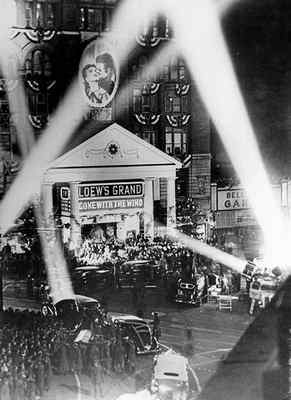
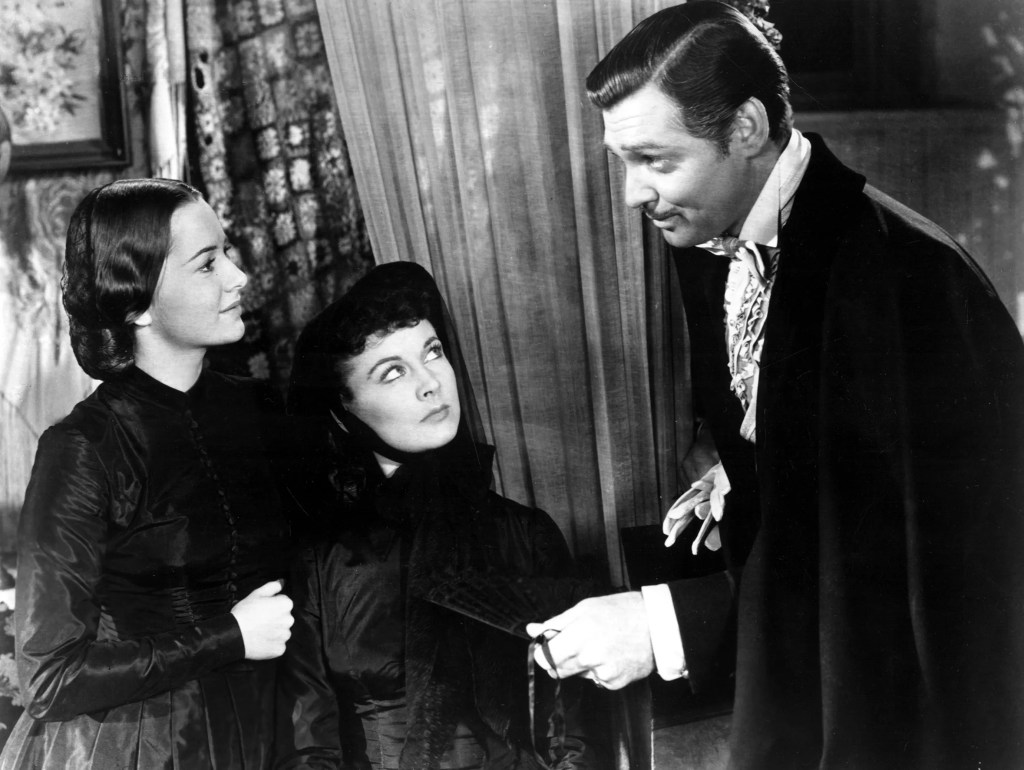
The motion picture “Gone With the Wind” starring Vivien Leigh, Clark Gable, Leslie Howard and Olivia de Havilland had its world premiere at the Loew’s Grand Theater in Atlanta. Mayor William B. Hartsfield declared a citywide holiday, and Eurith D. Rivers, the governor of Georgia, declares December 15 a state holiday. A crowd of 18,000 gathered outside the theater to catch a glimpse of the film’s stars.
The government of Uruguay gave the Admiral Graf Spee 72 hours to leave.
The Chinese said today their Winter offensive against the Japanese had been broadened to include Suiyuan and Honan Provinces in the north and the Canton area of Kwangtung Province in the south. They said that on Thursday Chinese troops killed 800 Japanese when they recaptured Puchi, in South Hupeh Province.
The Chinese Central News Agency said the entire city of Nanchang, south of Kiukiang, was set afire by Chinese attacks Tuesday night. Japanese munitions and equipment were burned, the agency said. It added that Japanese supplies in Yochow were being transferred to ships for removal to the Hankow area.
In the Shanghai area, the Central News said Chinese guerrillas penetrated Hangchow Wednesday night and killed 100 Japanese. Many buildings, including thirteen offices of the Japanese-controlled local government, were burned.
The news agency claimed Chinese batteries near Kiukiang shelled and sank a Japanese warship in the Yangtze River Tuesday, after recapturing Shao, and killed 100 Japanese sailors.
5,000 Japanese troops launched a counter-attack against recent Chinese offensives in northern China.
Chinese 1st War Area captures Lowang railway station.
Japanese troops counterattack Southern Honan Army of Chinese 5th War Area and recapture Yangliuho.
Left Flank Army of Chinese 5th War Area attacked around Chihchengshan and withdraws to Chikutien and Sanchingkuan.
Chinese 6th War Area (southern Hupei and western Hunan), assisting 9th War Area, unsuccessfully attacks Yuehyang and railroad station at Kaochiao approximately this date, but plays no other role in the winter offensive.
Chinese 8th War Area (Kansu, Ninghsia, Tsinghai, and Suiyuan) commences operations with 35th Army and 81st Army capturing Anpei approximately this date.
19th Army Group of Chinese 9th War Area attacking Hsintanpu, Tongyang, and Nanliqiao.
Elements of Japanese 33rd Infantry Division and 40th Infantry Division attacking Chinese 9th War Area around Shihmen and Shihpihu.
Chinese East Hupei guerrilla forces begin nuisance raids.
Overall, the Japanese are withstanding the Chinese Winter Offense and throwing in some solid counter-punches.
The Japanese Consulate notified authorities of other nations today that because of “military necessity” commercial traffic on the Pearl River would be suspended for two weeks, beginning Sunday.
The Yugoslavian cargo ship Vindovan was wrecked on Great Netuna, Netherlands East Indies.
Dow Jones Industrial Average: 149.64 (+0.71)
Born:
Dave Clark, British rock drummer, singer-songwriter, and producer (Dave Clark Five – “Glad All Over”, “Because”), in Tottenham, Middlesex, England, United Kingdom.
Cindy Birdsong, American rock vocalist (Patti LaBelle & Blue Belles, 1963-67; The Supremes, 1967-76), in Camden, New Jersey.
Nicolaus A. Huber, German composer, born in Passau, Germany.
Naval Construction:
The Kriegsmarine (German Navy) Type VIIB U-boat U-75 is laid down by Bremer Vulkan-Vegesacker Werft, Bremen-Vegesack (werk 3).
The U.S. Navy Gar-class submarine USS Grayling (SS-209) is laid down by the Portsmouth Navy Yard (Kittery, Maine, U.S.A.).
The Royal Navy Bellona-class light cruiser HMS Diadem (84) is laid down by Hawthorn Leslie & Co. (Hebburn-on-Tyne, U.K.).
The Royal Navy Tree-class minesweeping trawler HMS Juniper (T 123) is launched by Ferguson Bros. Ltd. (Port Glasgow, Scotland).
The Kriegsmarine (German Navy) Type 1936A destroyer Z23 is launched by AG Weser (Deschimag), Bremen (werk 957).
 History Diaries