Reports reach Saigon of recent battles in Sóc Trăng and Chương Thiện Provinces and in the An Lão Valley that have left some 580 ARVN troops missing and 40 known dead contributing to the highest casualties for a week among the South Vietnamese for the war until now. Bad weather and faulty communications have kept details of the battles from officials in Saigon, and they have been unable or unwilling to supply casualty figures. Reports that military forces and a large civilian population in the An Lão Valley, a vital area in central Vietnam, had to flee before the Communist assault. According to an official spokesman, a team of American military investigators flew to an outpost in the valley today, a week after a Việt Cộng force descended from the surrounding heights to attack the vulnerable position. No military report on the engagement has been made to the United States Ambassador, Maxwell D. Taylor, according to qualified sources, because of communications difficulties and bad weather.
Reliable but unconfirmed reports said that in each of the three actions Vietnamese fighting units had been routed by the insurgents. This is a break in the recent pattern of tenacious, successful fighting by well‐led South Vietnamese units. Because of the way in which battle statistics are prepared, the extent of the collapse in the three engagements is not expected to show up in the official statistics, which the American spokesman promised to make available tomorrow. If a company breaks and flees in combat, its personnel are missing in action after the battle. Since they may wander back in disarray a day or two later, they are not counted as missing.
Clashes Sunday around the airbase of Sóc Trăng, 100 miles southwest of Saigon, were reported to have brought the death and wounding of 43 government soldiers. More than 80 are said to be missing after the action.
A fierce battle Friday in the Mekong Delta province of Chương Thiện resulted in the routing of a battalion in an ambush, according to reliable reports. More than 200 men were reported missing. Official spokesmen declined to give casualty figurse
From Monday to Wednesday of last week, heavy fighting, including an ambush and heavy fire from powerful 57‐mm. recoilless rifles and 81‐mm. mortars, were reported around the An Lão outpost, a district headquarters. The clandestine Việt Cộng radio claimed the defection of 420 soldiers said to have broken during combat. Việt Cộng figures are almost invariably inflated, but the surces said the number of missing in action after the heaviest part of the assault was more than 300. About 20,000 people live in the valley, working small farms and tea plantations. Before the attack it was reported that about 2,000 had fled. In the last week many thousands more are reported to have done so rather than submit to Việt Cộng control.
North Vietnam charged today that an American‐built South Vietnamese transport plane violated North Vietnam’s airspace yesterday. It filed a protest with the International Truce Commission in Vietnam, Hsinhua, the Chinese Communist press agency, reported.
Five hundred Buddhist monks and nuns began a 24‐hour protest fast today against the Government of Premier Trần Văn Hương. A target of the Buddhists — Education and Cultural Affairs Minister Phan Tân Chuch — was reported to have resigned this morning. Unconfirmed reports said that other resignations would follow. Addressing the assemblage inside the Buddhist Institute pagoda, a Buddhist leader, Thích Tâm Châu, charged that Mr. Hương was “becoming a dictator like Ngô Đình Diệm and is being helped by some foreigners.” By foreigners he appeared to mean the United States. The main reason for the fast was the failure of Mr. Hương to take notice of a 48‐hour fast by three Buddhist leaders called to bring about the downfall of his government. The fast ended Monday.
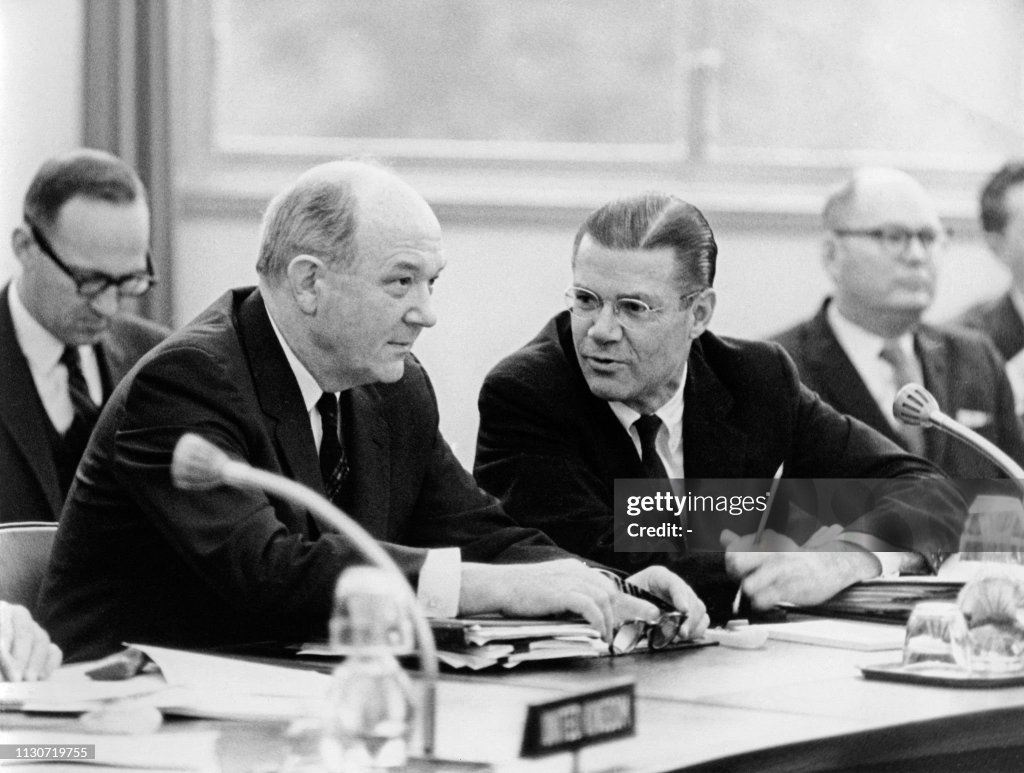
NATO Secretary of State Rusk, addressing the Ministers’ Council of NATO, says that the entire non-Communist world has a stake in the war in Vietnam and he asks that NATO countries provide more tangible aid.
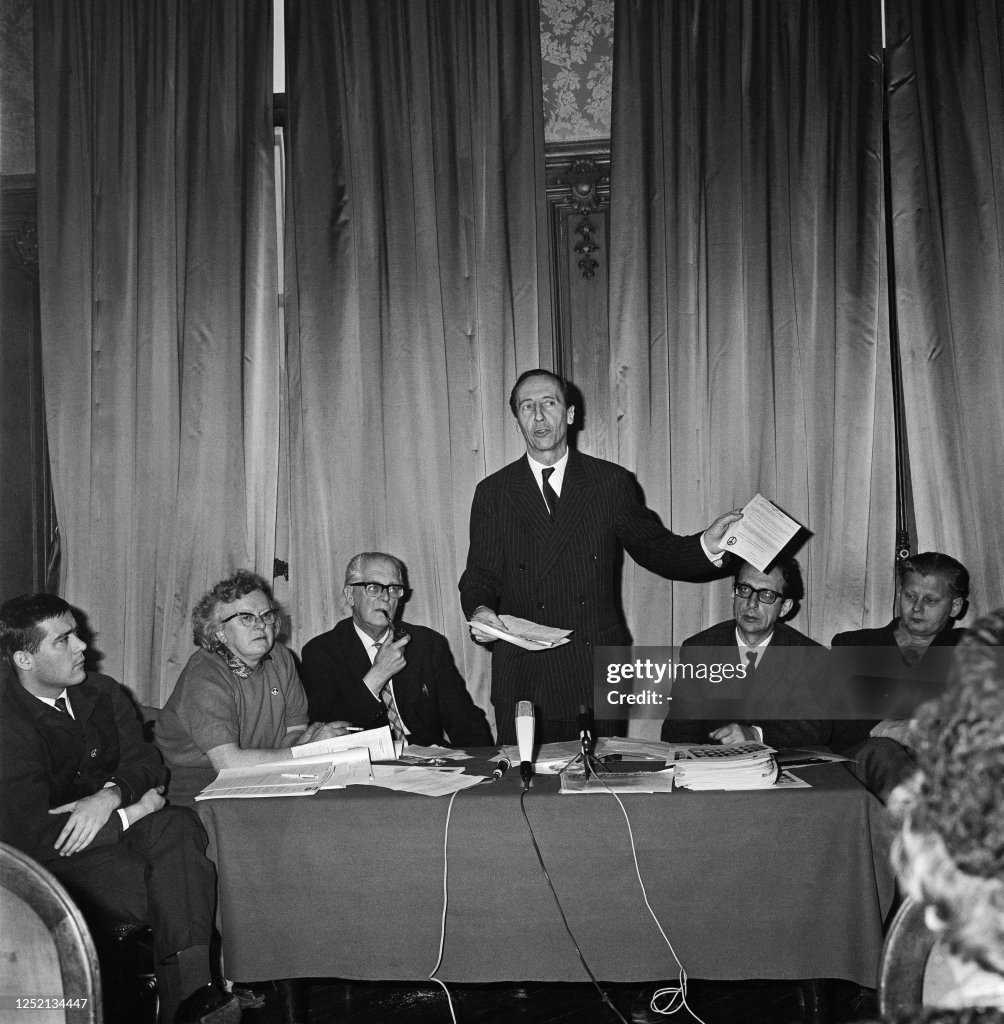
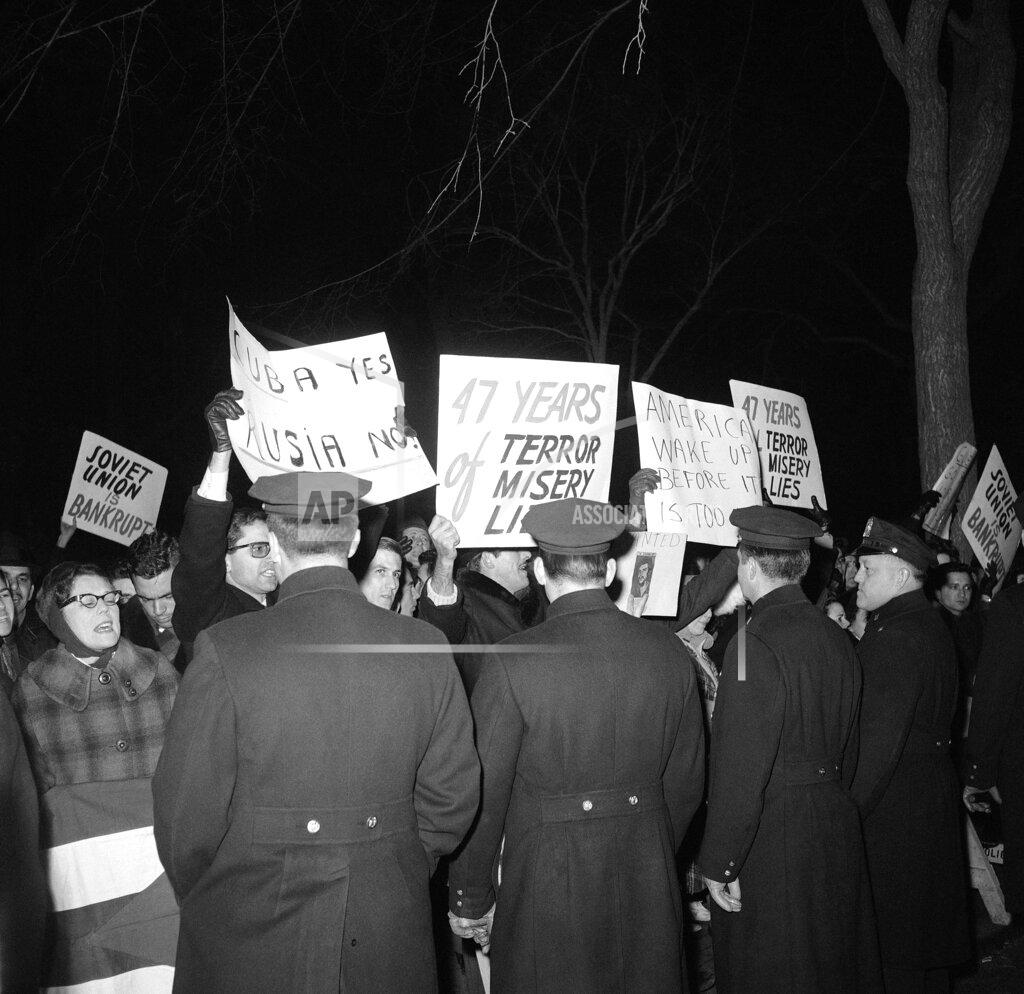
Plans for worldwide demonstrations Saturday to protest American participation in the war in Vietnam were announced yesterday. The Rev. A. J. Muste of the Committee for Nonviolent Action said vigils, rallies and marches would be held in eight United States cities while similar demonstrations take place in Tokyo, London, Paris, Montreal and Melbourne. The protest in the United States will be sponsored by 31 persons, including a number of clergymen, writers and members of peace organizations, Mr. Muste said. The nationwide demonstrations will be in New York, Boston, Philadelphia, Chicago, St. Louis, Minneapolis, San Francisco and Seattle. Mr. Muste said the purpose of the protest was to keep the Vietnam issue “before the public and before the Administration.” He said the United States should declare a cease‐fire, withdraw its supporting forces and sit down with representatives of the Peking and Moscow Governments to negotiate a settlement.
The New York Times reports:
“President Johnson is approaching his first full term in the White House determined to avoid high‐pressure tactics in dealing with his most important foreign problems and his major domestic programs.
“It can also be reliably reported that he plans no fundamental change in the United States’ course of action in the guerrilla warfare in South Vietnam.
“He is not mounting a hard selling effort or setting a dead line for the establishment of the controversial mixed‐manned nuclear fleet and he is willing to accept modification of the plan to meet the needs of the Western allies.
“At home, Mr. Johnson does not intend to blitz Congress with startling new programs aimed at developing the Great Society overnight. And he does not realistically expect in his time in office to reach either of two goals he has set for the nation — the elimination of poverty or the provision of complete educational opportunity for every American.
“Mr. Johnson’s attitude on such matters as these reflects a conviction that he could stumble into trouble by “throwing his weight around” — either with the nation’s allies, with the Chinese Communists, or with highly independent members of Congress.”
[Ed: No fundamental change n Vietnam? Welp…]
The “Year of Living Dangerously” continues. Six or seven Indonesians in a speedboat made a hit‐and‐run machine‐gun raid on a territorial army unit on an island off Singapore last night, usually reliable sources said today. The sources said the speedboat had sprayed the island with machine‐gun fire, which the unit returned, then disappeared before a Malaysian patrol vessel reached the scene. One report said two of the soldiers, had been injured. The territorial army consists of civilians who do parttime military training. Recently some were called up for full‐time service. President Sukarno of Indonesia has vowed to crush Malaysia, charging it is a British neocolonialist creation. There have been repeated Indonesian raids on Malaysian territory.
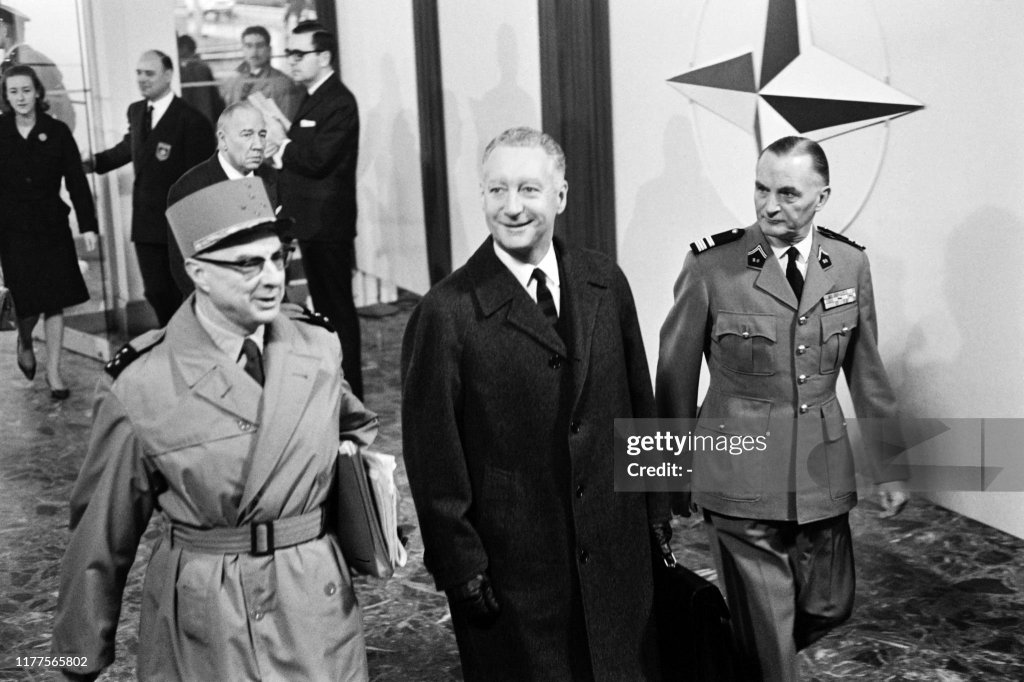
The quarrel in the Atlantic alliance over Washington’s proposal for an allied nuclear fleet openly strained the fabric of Western cooperation today. The foreign ministers of the United States and West Germany took positions favoring the force. To some extent their British counterpart joined them. Maurice Couve de Murville of France led the dissenters with backing from Belgium, Norway and Denmark. The issue, which most ministers had hoped to discuss only privately, dominated the 34th session of the North Atlantic Treaty Organization Ministerial Council almost from the outset.
Secretary of State Dean Rusk warned allies of the United States that the force should not be downgraded and that the proposal for it had been made in good faith in response to European requests. Mr. Rusk, who is to have a second meeting tomorrow with President de Gaulle, appealed for more consultation within the alliance and for greater integration of Western defenses. Those goals, encompassing the project for a nuclear fleet, jointly manned by the participating nations, conflict with France’s desire for national independence. General de Gaulle maintains that if the allied fleet were established it would prevent Europe from attaining political independence.
Dr. Gerhard Schrader of West Germany strongly supported the United States view at the council. Patrick Gordon Walker, the British Foreign Secretary, pledged his country’s nuclear power to an allied command subject to a Washington veto, but he reserved judgment on the specific plan for a nuclear fleet. Mr. Couve de Murville attacked the project as ill-defined and self‐contradictory. Mr. Rusk spoke at the afternoon session of the council, which opened its annual meeting this morning in the NATO building on the edge of the Bois de Boulogne. Foreign Ministers Paul‐Henri Spaak of Belgium, Halyard Lange of Norway and Joseph M. A. H. Luns of the Netherlands all discussed the nuclear‐force issue in speeches. United States officials termed their remarks “quite constructive.”
The French Foreign Minister’s remarks were not so palatable to the Americans. Mr. Couve de Murville said everyone was agreed that the spread of nuclear weapons to additional nations was bad; he did not mention France’s independent nuclear force in this respect. In the allied force, he said, nonnuclear powers might have a voice in the employment of nuclear missiles, and that would amount to the spread of these weapons. On the other hand, he argued, if the participating nations did not have a voice, the force could not be considered a sharing of nuclear power. Those who favor the force, Mr. Couve de Murville continued, must consider the consequences on NATO and on the prospects for the reunification of Germany. Thus the Foreign Minister was warning Bonn that in his Government’s option, no meaningful negotiation with the Soviet Union on reunifying Germany will be possible if West Germany has a share in nuclear weapons through membership in the projected force.
In the view of the East German Government, reunification or even confederation with West Germany in the foreseeable future is a pipe dream. Propaganda campaigns in East Germany still make use of the popular yearning for reunification, denouncing Western policies such as the proposed mixed‐manned nuclear fleet in the Atlantic alliance as steps that would make German union impossible. But no one in authority in the Eastern zone seriously pretends that it would soon be possible in any case. Communist officials are eager to break the pattern of isolation imposed by the West, quite apart from the question of winning formal recognition, and they think they are making slow progress. However, their interest even in step‐by‐step agreements with Bonn and other Western capitals stems from the need for trade and a more normal domestic atmosphere, not from any conviction that minor agreements could lead to major adjustments in Central Europe.
The reason for this is clear after only a few days of travel through the country. East Germany’s weak economic position and the Government’s lack of wide popular support make the very existence of West Germany a constant threat — even if West Germany were inclined not to press its commercial and propaganda advantages as hard as it does. Thus officials in the East cannot imagine any terms of confederation or unification that would not further undermine Communist authority. And it is the preservation of a Communist regime that is the unnegotiable starting position of East German and presumably Soviet strategy.
About 20 demonstrators appealing for world disarmament turned up at North Atlantic alliance headquarters in Paris today and paraded around the building. The demonstrators, who said they were of German nationality, were led away by policemen.
Prime Minister Harold Wilson has suggested to Leonid I. Brezhnev, First Secretary of the Soviet Communist party, and Aleksei N. Kosygin, the Soviet Premier, that they meet with him soon, reliable sources said today. The Russians were reported to have expressed interest in the idea. As a result of the exchanges, carried out so far by the Ambassadors in Moscow and London, the expectation here is that the new Soviet ruling team will come to London in the spring. Further preparation for the visit is expected to be made when Andrei A. Gromyko, the Soviet Foreign Minister, comes here in March. He will have discussions with Foreign Secretary Patrick Gordon Walker and will also see Mr. Wilson.
The Soviet Union announced today the expulsion of three American military attaches and one British naval attaché whose voluntary departure had been announced by the two Western Governments yesterday. In notes to their embassies, the Soviet Government declared that the activities of the four attachs during a train trip through Siberia last September had been “incompatible with their diplomatic status.” At that time, the Soviet Government accused them of spying. The two embassies had told the Soviet Foreign Ministry yesterday that restrictions imposed on the four officers made it impossible for them to discharge their duties and therefore they were being withdrawn. This action was preliminary to the expulsion of three Soviet attachés from the United States and one from Britain.
The National Assembly in Rome will begin balloting tomorrow for a new President of Italy, with the Communist and rightist extremes holding the balance of power. The moderate governing coalition has been unable to agree upon a single candidate in al week of interparty talks. The coalition’s dominant party, the Christian Democrats, gave formal backing today to former Premier Giovanni Leone. The three other coalition partners — Socialists, Democratic Socialists and Republicans — are backing Foreign Minister Giuseppe Saragat, Democratic Socialist. The new President will be chosen for a seven‐year term to succeed Antonio Segni, who resigned December 7 because of illness.
Turkey was accused today of fomenting disorder in Cyprus. Zenon Rossides, the Permanent Representative of Cyprus at the United Nations, said that the Turkish policy “continues to be one of division, disruption and conflict in Cyprus.” Turkey, on her part, has accused the Government of Cyprus of violating its Constitution to the detriment of Turkish Cypriots. Mr. Rossides sent a letter to the Secretary General, U Thant, for circulation to all member states, in which he complained of the Turkish protest.
The Yemeni republican regime charged today that British troops and fighter planes attacked its territory early this month, killing a child and two women. The charge was made in a letter to the president of the Security Council. It followed a British letter that accused the Yemeni republicans of having attacked the British‐protected Federation of South Arabia on the same days.
Ambassador G. McMurtrie Godley left today for consultations in Washington amid mounting indications of intervention by African countries in the Congo war. Reliable sources said Mr. Godley sudden move reflected growing United States concern at the support that rebels appear to be getting from Algeria, the United Arab Republic, Ghana, the Sudan and Uganda. At a news conference, General Joseph D. Mobutu, the Congolese Army commander, said 10 Egyptian planes landed yesterday at Juba, a Sudanese town 150 miles from the Congolese border. The general said the planes were loaded with ammunition and other supplies. General Mobutu also said that two Algerian transports landed at Juba yesterday and that within the last few days a plane from Mali and two from Ghana had been seen at Juba. Diplomatic sources here said they had had reports that at least four AN‐12’s had landed yesterday at Juba. The AN‐12, a Soviet‐made transport, has been used to ferry supplies in the Congolese war. Algeria, the United Arab Republic and Ghana are believed to have AN‐12’s.
Jaja Wachuku, Foreign Minister of Nigeria, appealed to the other African states today not to interfere in the Congo’s internal affairs despite their antipathy to Premier Moise Tshombe. Mr. Wachuku upheld the right of the Congolese Government, as a sovereign state, to authorize last month’s Belgian‐American expedition to rescue prisoners of Congolese rebels in Stanleyville. Mr. Wachuku was the first African representative to side with Belgium and the United States in the Security Council.
According to diplomats and Arabic‐speaking Westerners with long experience in this region, the Sudan is drifting toward de facto separation of the north and south, which radical southern leaders have been demanding. The violent rioting in Khartoum nine days ago is reported by recent travelers from the Sudan to have touched off a migration of black African southerners, living in the northern Sudan, back to their section of the country and a similar exodus of Arab northern merchants back from the south toward their home section. These sources report that the casualty toll of the racial rioting between Africans and Arabs in Khartoum is well over 100 and possibly as high as 200. The official toll is 41 dead and hundreds wounded.
After a lengthy debate that ended at 2:12 in the morning, Canada’s House of Commons voted 163 to 78 to approve the new Flag of Canada, with its pattern of a red maple leaf on a white background between two red bars. Voting then moved on to the Canadian Senate.
San Marco 1, Italy’s first satellite, was launched from Wallops Island in the United States by at team of Italian scientists, marking the first time that a foreign launching crew had been allowed access to U.S. facilities. The 254-pound spacecraft was successfully placed into orbit around the Earth for purposes of studying the ionosphere.
Jane’s All the World’s Aircraft praised United States space accomplishments today and said the Soviet space program appeared to be “going less smoothly than it did a few years ago.” “In terms of quality and quantity of scientific data acquired in space, America has probably been in the lead for some years,” a commentary by the authoritative Aviation Guide said. “Recent Soviet space probes have failed in their missions,” Jane’s said.
President Johnson will deliver his State of the Union Message to a joint session of Congress at 9 PM on January 4. the White House announced today. The nighttime address will allow Mr. Johnson to reach a wider television and radio audience than he would at the usual hour of 12:30 PM. George E. Reedy, White House press secretary, said the President had chosen the hour because he believed “that it is not only a report to Congress but to the American people.” The date of January 4 is the same day the new, 89th Congress will convene. Mr. Reedy said that the late President Franklin D. Roosevelt delivered his State of the Union Message on January 3, 1936, at 9 PM. President Johnson chose to deliver the State of the Union Message on the first day of the session, it was understood, because he was anxious to get off to a fast start. More frequently than not, the message is delivered on the second or third day of the session. Mr. Johnson will broadly outline his legislative program for 1965 and may give general figures for his new budget.
Mr. Reedy said that the total spending requests from Federal agencies for the fiscal year 1966, which begins next July 1, totaled from $109 to $110 billion. These requests will certainly be cut by Mr. Johnson, but by how much is not clear at this time. Although some observers believe Mr. Johnson is determined to keep the budget request to less than $100 billion, there has been some pessimism lately among officials that this will be possible. In his last news conference, on November 28, Mr. Johnson said, “I hope it can be $100 billion,” but added, “I would rather doubt it at the moment.”
Another tradition of the Roosevelt Administration was revived today as the White House returned to pomp and elegance for the first time in 25 years in receiving the credentials of foreign ambassadors. Eight new ambassadors arrived at the North Portico this afternoon between flanking, military honor guards, for the ceremonial presentation of their credentials. State Department spokesmen said it was the first time this traditional type of ceremony has been used since July, 1939.
Since that year, it has been usual for ambassadors to present their letters of credence in the Oval Office of the President in the West Wing of the White House with no more ceremony than a somewhat hectic picturetaking session. As demands on the President’s time increased, such calls became increasingly brief. One official remarked today that ambassadors had been kept waiting in the Fish Room across the hail “as if they were in a dentist’s office.” Angier Biddle Duke, chief of protocol for the State Department, said that the return to a more formal, traditional ceremony was meant to restore “a style and a manner that is more elevated.”
President Johnson will not propose to Congress next year a plan to turn over to the states free of strings a fixed portion of each year’s Federal income tax collections, it was reliably learned today. The proposal, originated by Walter W. Heller, the recently resigned chairman of the Council of Economic Advisers, was supported by a study group asked by the President to examine the matter. But it was opposed strongly within the government. Much of the opposition was based upon the view that the Federal Government can accomplish more with its grants to the states if it fixes standards of performance — in short, if the funds are “tied.” A committee of the Conference of State Governors had strongly backed the idea, arguing that there are already too many strings on Federal grants‐in‐aid to the states. These grants, now tied to specific purposes, total nearly $10 billion a year. The new plan would have supplemented rather than replaced them.
Under the most widely reported version of the plan, about $2.5 billion of the Federal personal income tax collections would be set aside each year for distribution to the states free of strings. This money would not enter the Federal budget on either the receipts or expenditures side. The amount would grow gradually with the rise in the economy and hence the growth in tax collections. Underlying some of the opposition to the proposal were doubts about the ability of state legislatures to spend money wisely and efficiently. There was also opposition on civil rights grounds, growing out of a fear that the money would help some Southern states preserve segregation in education and other fields.
The President plans to meet the long‐standing controversy over federal aid to education head‐on but has disclosed very few of his specific plans as yet. His program may not all be contained in one package, or presented in one year, and he compares it to a slow‐starting car in winter that begins to move faster as it warms up.
Senate investigators called for explanations today of “overpaternalistic” Government regulations covering the lives and activities of overseas civilian employes and their dependents. Complaints had reached the Senate Subcommittee on Constitutional Rights that employes at a Philippines air base had been subjected to harassment, illegal confinement and physical brutality. “Since these employes do represent their Government overseas,” Senator Sam J. Ervin Jr., the North Carolinian who heads the panel, said, “it is often necessary that they be subjected to certain restrictions, but it is also important that these restrictions be reasonable. It is important that the regulations be applied fairly and impartially, and that enforcement should be consistent with the concept of due process which every citizen expects his Government to observe.”
A House committee announced today a public hearing for Thursday on complaints by three members about a magazine poll naming them as among the five “least effective” Congressmen. The poll was published by Pageant magazine 10 days before the election November 3. The hearing will be conducted by a special committee formed to investigate campaign practices and expenditures. Representative Clifford Davis. Democrat of Tennessee, said that sworn complaints had been given to the committee by Representative Hale Boggs, Democrat of Louisiana; Wayne L. Hays, Democrat of Ohio, and Roman C. Pucinski, Democrat of Illinois. All three were at today’s meeting.
“I somehow felt that I would never have to serve 18 months in Jail for trying to be served in a restaurant,” Miss Mardon Walker said today. “It just seemed incomprehensible. But I wasn’t sure.” Miss Walker, 19 years old, is white and a junior at Connecticut College. She was sentenced to 18 months in jail and fined $1,000 last February for violating Georgia’s antitrespass law. Her case had been awaiting appeal to the United States Supreme Court. But apparently it was covered by the Supreme Court ruling yesterday that made the 1964 Civil Rights Act retroactive against sit‐in prosecutions, Miss Walker said. She wasn’t certain, however. Miss Walker, the daughter of Navy Captain Donald Walker of Washington and Mrs. Mary Walker of Long Beach, California, said she became involved in the Black civil rights movement by accident. But, she added, it has changed her life. “I had thought about being a lawyer, but I’d never thought about it in terms of civil rights,’ she said. “I never realized how badly needed lawyers are in the civil rights movement, and I feel this is the thing that I can do to help.”
Miss Walker went to Atlanta last year as an exchange student at Spelman College, a Black college for women. “I had never been interested in civil rights before,” she said. “I went for the educational experience. But I saw what segregation was doing to my teachers and to my friends. I felt it was my obligation to do something. That’s why I went downtown to sit in — because I felt it was something I could do. Do you know that there wasn’t a single place in Atlanta I could go with Black friends for pizza ?”
A Mississippi water supply district found no acceptable bids yesterday for $24.65 million of bonds that the National Association for the Advancement of Colored People had urged investment bankers to boycott. None of the underwriters that had withdrawn said their action was based on the N.A.A.C.P. appeal. However, observers in Wall Street said the racial issue was inextricably wound up in the decision.
The United Steelworkers of America went ahead today with a presentation of demands for substantial wage increases and expanded fringe benefits despite the steel industry’s admonition for restraint. David J. McDonald, president of the big union, showed that he and the steelworkers had not been deterred in their drive for major contract improvements by an industry statement yesterday. The statement charged that the union demands were “economically unacceptable.”
The government went to court today to try to force the United Mine Workers of America to grant autonomy to six of its “provisional” districts. The Justice Department, in a civil suit filed in United States District Court here in behalf of the Labor Department, said that five of the districts had been in provisional status since 1933 and the sixth since 1941. This means that their officers are not elected by the union members in the district but are appointed by the union’s International Executive Board.
The Duke of Windsor is scheduled to undergo surgery at 7:30 AM tomorrow for the removal of an aneurysm from an artery in his abdomen. After a series of tests at the Methodist Hospital yesterday and today, doctors confirmed that the surgery was necessary and tentatively scheduled it for later in the week. But the former King Edward VIII of Britain, 70 years old, asked that the surgery be performed without delay. “The sooner the better,” he said. The operation is to be performed by a team of surgeons headed by Dr. Michael E. DeBakey, senior attending surgeon at Methodist and chairman of the Surgery Department at the Baylor University College of Medicine.
Senator Edward M. Kennedy is planning to walk outdoors tomorrow for the first time in six months. He will be out of New England Baptist Hospital and with his family for Christmas. Mr. Kennedy is leaving the hospital to fly to Palm Beach, Florida, tomorrow for recuperation in the sun and the holidays with his wife, Joan, and their two children, Kara, 5 years old, and Edward Jr., 3. The Massachusetts Democrat is to leave the hospital 180 days after a plane crash in Southampton last June 19 in which his back was broken. He also had three broken ribs and suffered cuts, bruises and internal injuries. Doctors say he is healed now, though he will have to wear a back brace for a while.
Glenn T. Seaborg received a U.S. Patent No. 3,161,462 for the synthesized chemical element Curium. Seaborg had been granted a patent for Americium on November 10.
Jack Lawrence and Stan Freeman’s musical “I Had a BaIl”, starring Buddy Hackett, opens at Martin Beck Theater, NYC; runs for 199 performances
Detroit Tigers owner John Fetzer announces a 2-year television pact between Major League baseball and ABC-TV. The network pays $12.2 million to telecast games on 25 Saturdays, Independence Day, and Labor Day.
The St. Louis Cardinals purchase outfielder Tito Francona from the Indians.
Dow Jones Industrial Average: 857.45 (-3.20)
Born:
Jerry Ball, NFL nose tackle and defensive tackle (Pro Bowl 1989-1991; Detroit Lions; Cleveland Browns, Los Angeles-Oakland Raiders, Minnesota Vikings), in Beaumont, Texas.
Carlton Bailey, NFL linebacker (Buffalo Bills, New York Giants, Carolina Panthers), in Baltimore, Maryland.




 History Diaries