Operation BARREL ROLL, the secret bombing of the neutral Kingdom of Laos by U.S. planes, began with U.S. Air Force bombers flying out of Thailand to attack suspected concentrations of Việt Cộng guerrillas. Originally, attacks were limited to eight sorties per week but would increase in intensity and would last until the end of the war in 1973. Operation BARREL ROLL, the name given to the first phase of the bombing plan approved by President Johnson on 1 December, begins with U.S. planes attacking ‘targets of opportunity’ in northern Laos. (In Washington, it has been agreed that there will be no statements to the public about these raids unless a plane is lost, and then the government will insist the U.S. plane was simply on escort duty as requested by the Laotians.)
Four U.S. Army officers are killed when the Việt Cộng attack an ARVN division headquarters in Thủ Dầu Một. Communist commandos wounded four American officers today in a predawn bombing raid on a Vietnamese Army division headquarters 10 miles from Saigon. The strike against the American officers’ quarters at Thủ Dầu Một was carried out under a diversionary Việt Cộng mortar barrage. A United States military spokesman reported four American casualties in other actions, including one killed and one missing in action. The deaths raised to 238 the number of Americans killed in action in the war against the Communist guerrillas since January 1, 1962.
The Army today identified two more American servicemen killed in South Vietnam. They were Captain Wayne H. Kidd of Nutter Fort, West Virginia, and Captain John E. King of Sebring, Florida, killed on December 11.
United States officials in central Vietnam reported today that 500 persons drowned and 2,000 were left homeless after a new flood in two provinces over the weekend. Ninh Thuận Province, 170 miles northeast of here, was the hardest hit. Waters there were reported at depths to 12 feet. Crops were reported destroyed, with most livestock dead. The city of Nha Trang in Khánh Hòa Province also was heavily flooded. Last month central Vietnam was devastated by floods caused by heavy rain over mountain valleys. Several thousand persons died.
A survey of Americans reveals that one-quarter do not know there is any fighting going on in Vietnam. About the same percentage do not know that mainland China is communist.
Cambodia has injected her relations with neighboring South Vietnam into the list of topics she wants discussed with the United States in current talks here. The move is a result of a compromise reached on the nature of the discussions. The United States had stipulated that its delegation, headed by Philip W. Bonsal, could not deal with differences between Cambodia and other countries. But the United States spokesman said the Cambodians could bring up any subject of difference with the United States. Thus, in place of an “agenda,” the two sides compromised Friday on a “list of subjects serving as an agenda.” The Cambodians therefore will be able to discuss their problems with Vietnam even though the United States delegates will not respond directly. The Cambodian delegates, headed by Som Sann, was said to have made five demands. These are an end of United States and South Vietnamese aggression; the border with Vietnam to be supervised by the International Control Commission; indemnity for Cambodian losses in attacks by Vietnamese; an end of Cambodian rebel broadcasts and release by Saigon of Cambodian prisoners.
The Reserve Officers Legion in Manila, Philippines recommended tonight that troops be sent to South Vietnam to protect Philippine medical and civic action teams there. The troops should not be used in combat, the legion said.
The Common Market reached the final essential resolution of long and deep‐seated differences over farm policy shortly before daybreak today. Just seven weeks ago, President de Gaulle of France was threatening to wreck the historic postwar movement to unify Western Europe if industrial West Germany continued to block France’s vital farm interests. This morning, his menacing firmness seemed to have given the movement a new and decisive thrust. Foreign ministers, agriculture ministers, weary translators and more than 100 other functionaries, high and low, labored’ almost twice around the clock to achieve the agreement. It was their second marathon meeting in three days. They brought forth a major accomplishment.
The issues that stymied the first session and prolonged the second one were the unexpectedly stubborn demands of Italy. But the major issue was Germany’s refusal for seven years, since the trade bloc was established, to strike a deal on wheat by cutting German prices. The members of the bloc are Germany, France, Italy, Belgium, the Netherlands and Luxembourg. They are forming an economic union, and perhaps ultimately a political one. For such a union to be complete, it must include a common farm policy, and farm policy cannot be common unless prices are. The common price that has been established now for wheat, effective in mid‐1967, is $106.25 a ton. For German farmers this is a cut of 11 percent and more from present German levels, and for French farmers an increase of 8 percent and more.
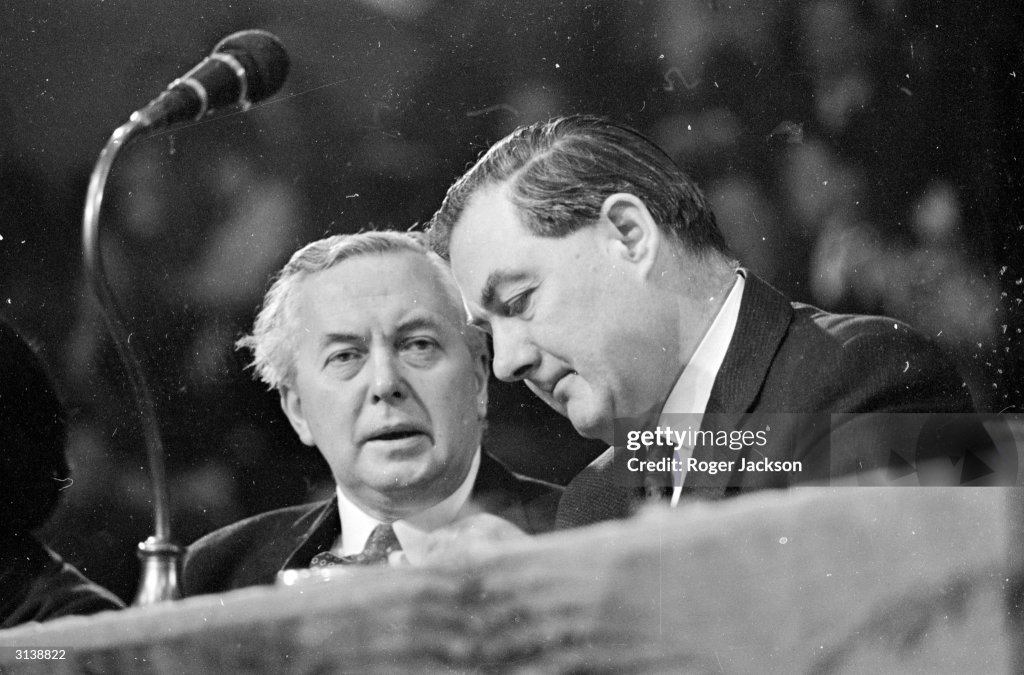
Defense Minister Denis W. Healey said today he believed it “extremely unlikely” that Britain would participate in a mixed‐manned, nuclear‐armed surface fleet if the project went through. Mr. Healey’s comment was made at London Airport before he flew to Paris for the meetings this week of the North Atlantic Treaty Organization’s Ministerial Council. Britain has opposed the project and has made an alternative proposal. The British would establish a nuclear command, separate from NATO and composed mainly of British and United States Polaris submarines and most of Britain’s “V” bombers. Foreign Secretary Patrick Gordon Walker went with Mr. Healey to Paris. He said he expected the British ideas to be discussed in “side talks” among the foreign ministers at the NATO conference.
Britain’s leaders came back from last week’s meeting with President Johnson convinced that the fleet project was, as one of them put it privately, a “dead duck.” They believe there is growing Congressional opposition to the project and that President Johnson’s support for it is fading. Even if the fleet project dies, as the British leaders expect, they are not optimistic that their own proposals will be realized, whether or not they are eventually broadened to include a mixed‐manned element. Prime Minister Harold Wilson and Mr. Healey are reliably reported to believe that French opposition to any form of allied nuclear force will prevent agreement among the others concerned. They apparently believe that Belgium and Italy, if not others, will finally elect not to risk an open breach in the alliance over nuclear policy.
In the end, British officials believe, West Germany may be as happy as the others if call the controversial ideas on nuclear policy are shelved. But if they are shelved a new problem will face Mr. Wilson. He will then be left with a national nuclear deterrent that he has pledged to abolish and that the left wing of the Labor Party is determined shall be given up, unilaterally if necessary. Mr. Wilson is unlikely to do this. At the moment, nuclear policy is the only shadow over the radiant picture of party unity achieved by the Prime Minister. Because they are not sure of the Prime Minister’s intentions, members of Labor’s left wing outside the Government have been chary of criticizing Mr. Wilson too strongly.
Secretary of State Dean Rusk sought to assure President de Gaulle today that the United States fleet proposal was not intended to isolate France in the North Atlantic alliance. There was no sign of a softening of the French President’s hostility toward this and other aspects of United States policy during a meeting at the Élysée Palace that lasted for just over an hour and a half. The meeting was the first between the President and a United States Cabinet minister since the French Government opened its campaign against the fleet proposal. The French leader believes participation in the fleet by West Germany and other powers would prevent the development of European unity and independence. “We had a friendly and frank discussion of the sort which is extremely helpful in relations among allies,” Mr. Rusk said after the meeting.
The United States warned today that Africa would “revert to a primitive state of anarchy” unless each African government recognized the right of others to exist and refrained from trying to overthrow those it disliked. Adlai E. Stevenson, the United States representative, made a spirited defense in the Security Council of the role played by the United States in rescuing prisoners held by Congolese rebels in Stanleyville. He urged the African states to follow the golden rule. “If every internal rivalry is to become a Spanish Civil War,” Mr. Stevenson said, “with each faction drawing in other Africans and great powers from other continents, the history of independent Africa in this century will be bloody and shameful, and the aspirations of Africa’s wonderful peoples will be cruelly postponed.” Mr. Stevenson replied to bitter attacks made on the United States by some of the 18 African states that complained to the Security Council about the rescue operation. Mr. Stevenson said he had never heard “such irrational, irresponsible, insulting and repugnant language.”
Mr. Stevenson said the United States decided to fly Belgian paratroops to Stanleyville with the authorization of the Congo Government, and after the representative of the rebels had refused to give any assurances about the safety of the hostages. “We have no apologies to make to any state appearing before this Council,” he declared. “We are proud of our part in saving human lives imperiled by the civil war in the Congo.”
The Secretary General, U Thant, has asked the Security Council to keep the “indispensable” United Nations force in Cyprus for three months after December 26, when its mandate expires. “All parties directly concerned,” he said Cyprus, Greece, Turkey and Britain — “wish the force to be extended.” He urged all United Nations members to contribute to its financing. He estimated the cost at $6,175,000 for the three months. The United Nations force in Cyprus consisted, as of December 4, of about equal contingents of troops from Canada, Denmark, Finland, Ireland, Sweden, and Britain, totaling 6,057 persons; a medical unit of 48 from Australia, and a total of 174 civilian policemen from Australia, Austria, Denmark, New Zealand, and Sweden.
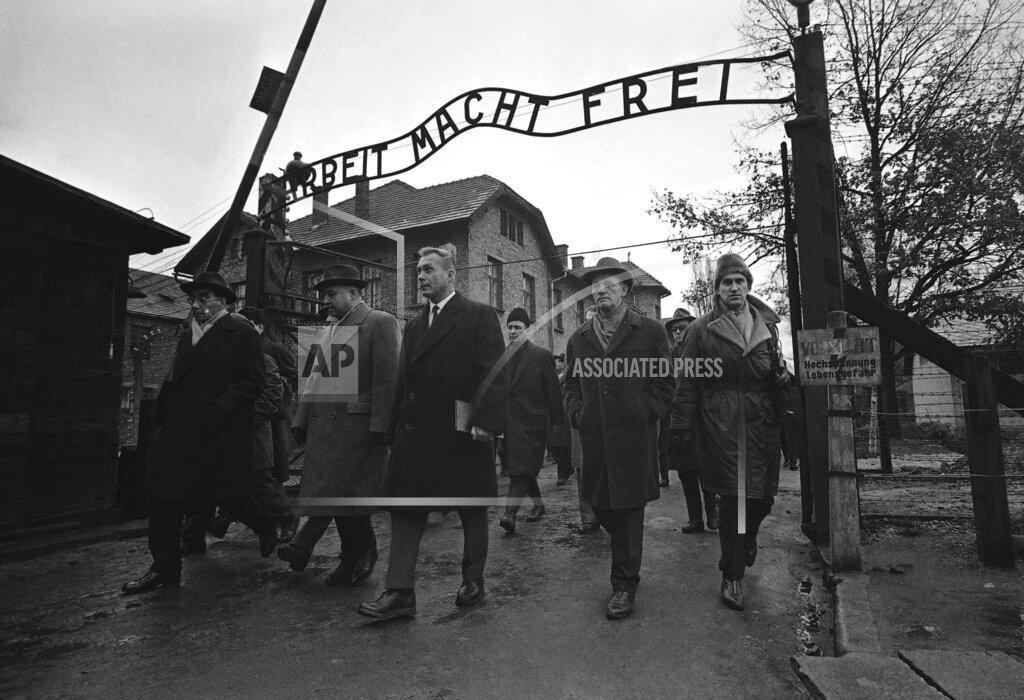
A West German court team visited the Nazi’s Auschwitz death camp today and viewed one of its end products — 75 acres of human bones and ashes at Birkenau, the largest camp of the Auschwitz complex. Assistant Judge Walter Hotz heads the group, assigned to an on‐the‐spot examination to clear up doubtful points in the Frankfurt trial of 21 SS guards and functionaries accused of war crimes at Auschwitz. More than 400,000 persons died at the camp during World War II. Auschwitz is the German name for Oswiecim. Prosecuting and defense attorneys, court officials and one defendant. Dr. Franz Lucas, accompanied Mr. Hotz to the camp, which Poland maintains as a museum. The group saw the “Black Wall” where SS (Elite Guard) men shot 20,000 inmates.
Israeli Premier Levi Eshkol, faced by a deepening crisis in his own party, resigned tonight. The resignation followed weeks of strife between him and former Premier David Ben-Gurion over whether to call a new inquiry into the 10‐year-old Lavon affair. Mr. Ben‐Gurion had cited “justice and morality” as his reasons for demanding a reopening of the case. Mr. Eshkol had opposed the move as detrimental to the interests of the government and the state. The issue was splitting Mapai, Israel’s dominant labor party. The Lavon affair is said to have involved an espionage and sabotage mission in Cairo that was uncovered by the Egyptians, with subsequent heavy sentences for the participants, including the reported execution of two persons. An aim of the mission was said to have been to foment anti‐Egyptian feeling in Britain and the United States. Disclosure of details of the affair have been barred by censorship in Israel.
Forbes Burnham was sworn in as the new Premier of British Guiana (now Guyana) after the British colonial government was forced to remove his predecessor, Cheddi Jagan, from office following the December 7 assembly elections. Jagan, who had held office for 11 years, had refused to resign, charging that the election was fraudulent. Queen Elizabeth II signed a parliamentary order amending British Guiana’s constitution to allow the colonial governor to remove the premier. The new law provided that “if any time before the House of Assembly meets the Governor informs the Premier that he is about to reappoint him or to appoint another person as Premier, then the Premier, and all other ministers and parliamentary secretaries, are forthwith to vacate their offices.” The Governor, Sir Richard Luyt, then informed Jagan that Burnham would be appointed as the new Premier, and Burnham was sworn in on the same day. In 1992, Jagan would be elected as the third President of Guyana.
The Supreme Court unanimously upheld today the public accommodations section of the Civil Rights Act of 1964. This section, known as Title II, prohibits the refusal of service or segregation in hotels, motels, restaurants, places of amusement and gasoline stations if their operations affect interstate commerce or if the discrimination or segregation is supported by state action. Justice Tom C. Clark wrote the opinion of the Court. President Johnson responded to the decision by praising the compliance there has been already and expressing the hope that “reasonable and responsible acceptance of the law will continue and increase.” All nine Justices agreed that the section was valid under the commerce clause of the Constitution. Congress’s power over interstate commerce, the Court said, is ample to prohibit racial discrimination when it might affect commerce.
In two separate cases, Heart of Atlanta Motel v. United States and Katzenbach v. McClung, the U.S. Supreme Court upheld the constitutionality of the Civil Rights Act of 1964 in its prohibition of racial discrimination in lodging and in restaurants, respectively. Associate Justice Tom C. Clark wrote the majority opinions in both cases. In both cases, the Court rejected the argument that the businesses were not within the jurisdiction of the “Commerce Clause” of the U.S. Constitution, which permits (in Article I, Section 8) Congress “To regulate Commerce… among the several States” because neither the Atlanta motel, nor the Birmingham restaurant (Ollie’s Barbecue) owned by McClung, were engaged in interstate commerce. Clark noted that the motel served travelers from other states, and that even if the restaurant’s clientele were local, the food served by the restaurant moved in interstate commerce. Quoting in the Heart of Atlanta case from a 1949 Supreme Court decision, Justice Clark noted that “If it is interstate commerce that feels the pinch, it does not matter how local the operation which applies the squeeze.”
The decision was no surprise to experts on constitutional law. From the time President Kennedy first proposed the public accommodations section in June, 1963, Justice Department lawyers and outside scholars generally forecast it would be sustained under the commerce clause. Nevertheless, the decision was clearly of major importance both legally and politically. It cleared the way for fullscale enforcement of the act. Justice Department lawyers and conciliators in the new Community Relations Service have been waiting until the constitutionality of the section was settled. And politically, the decision was a definitive answer to those in the South and elsewhere who have made an issue of the new law’s constitutionality. Most prominent among those is Senator Barry Goldwater, who voted against the law, saying he thought it unconstitutional.
In a 5‐to‐4 vote today the Supreme Court laid down the rule that the 1964 Civil Rights Act wiped out all pending state prosecutions of demonstrators who had tried peacefully to desegregate places of business now covered by the act. Justice Tom C. Clark wrote the majority opinion. With him were Chief Justice Earl Warren and Justices William O. Douglas, William J. Brennan Jr. and Arthur J. Goldberg. Each of the four dissenters wrote his own opinion. They were Justices Hugo L. Black, John Marshall Harlan, Potter Stewart and Byron R. White. The persons appealing sit‐in convictions or awaiting trial, most of them students, are nearly all likely to go free. The number of cases is estimated at 3,000.
But the decision will not by any means protect every racial demonstrator who has been arrested over the last few years. There are still distinct legal requirements that must be met. First, the rule applies only to demonstrations in places that are now covered by the 1964 act, mainly hotels and restaurants. Thus persons who dumped garbage on the Triborough Bridge in demonstrations earlier this year would not be protected by today’s decision. Justice Clark also emphasized the peaceful nature of the sit‐in demonstrations involved in today’s cases. A person who was violent or disorderly in the course of a demonstration would presumably not escape prosecution. The cases decided today were characteristic sit‐in cases. They were trespass prosecutions of young Blacks who sought service at lunch counters in Rock Hill, South Carolina, and Little Rock, Arkansas, in 1960. State courts upheld the convictions.
Civil rights leaders said yesterday that the Supreme Court decision voiding sit‐in convictions vindicated the efforts of thousands of young Blacks and whites who carried the public accommodations struggle through the South. A. lawyer who has been involved in the cases since the start estimated that 3,000 persons would be affected by the ruling, almost all of them in the South. Another civil rights lawyer said the ruling might encourage the filing of numerous civil damage suits by arrested persons against local authorities. The position of the Southern legal authorities was not immediately clear. Some of them indicated, in private conversations, that they would be willing and eager to forget about the convictions that have been piling up since the sit‐in movement started on February 1, 1960, at Greensboro, North Carolina. Some said they expected the authorities in some states, notably Alabama and Mississippi, to force a case‐by‐case settlement of the matter, even though the Supreme Court stated its feelings clearly yesterday in the 5‐to‐4 decision.
President Johnson hailed the decision of the Supreme Court today upholding the constitutionality of the public accommodations section of the Civil Rights Act of 1964. He said it assured “reasonable and responsible acceptance of the law.” In a statement issued during the afternoon by the White House press secretary, George E. Reedy, the President said the Court’s decision gave the nalion “a single voice” in this most controversial section of the new law. The President’s statement came in response to the Court’s action today upholding the public accommodations section of the act against challenges instituted by an Atlanta motel owner and the proprietor of a Birmingham restaurant.
“The Civil Rights Act of 1964,” the President said, ‘was proposed by two Presidents. It was overwhelmingly approved by Congress and now the constitutionality of the public accommodations section has been upheld by unanimous vote of the Supreme Court. The nation has spoken with a single voice on the question of equal rights and equal opportunity. I have been heartened by the spirit with which the people of the South have accepted this act even though many of them were opposed to its passage. There already has been encouraging and widespread compliance with the act during thefive months it has been law. Now that the Supreme Court has also ruled, I think we all join in the hope and the resolution that this kind of reasonable and responsible acceptance of law will continue and increase.”
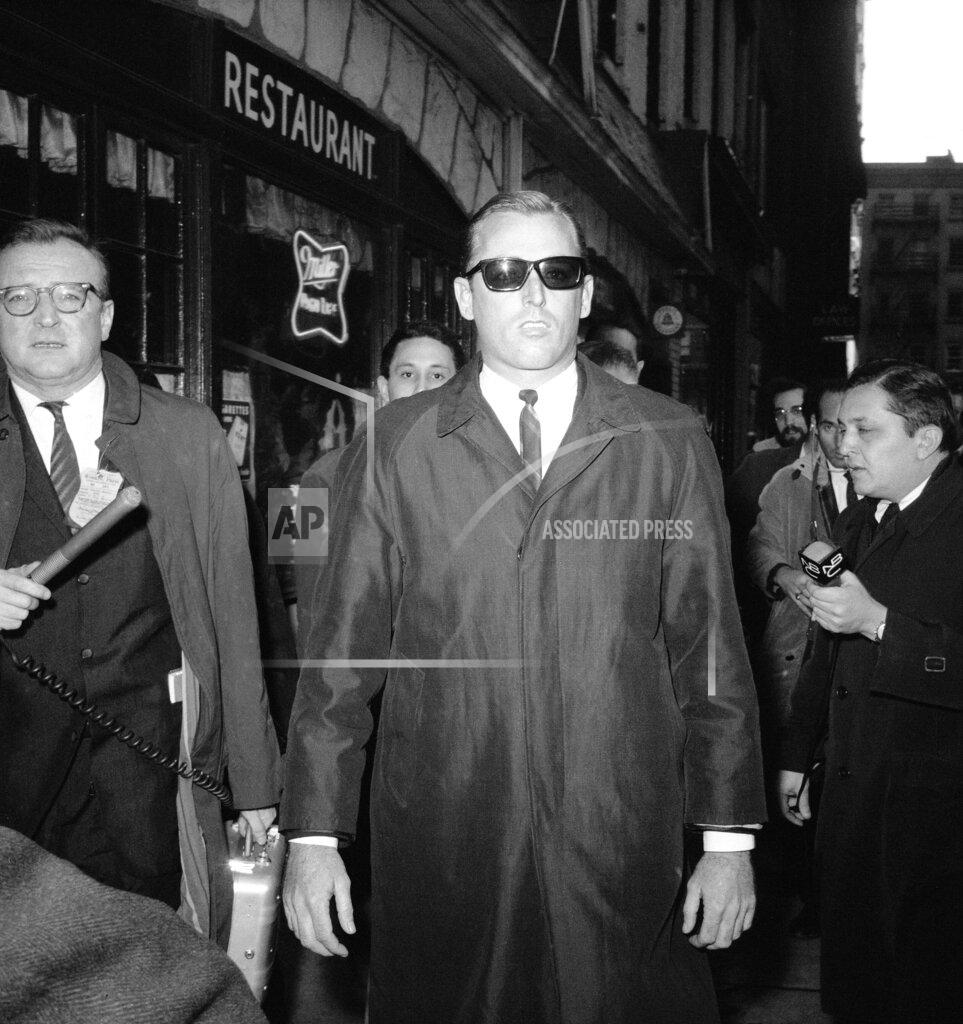
The Justice Department dropped a conspiracy charge today against Horace Doyle Barnette, who the Federal Bureau of Investigation said had signed a concession in the case of the three slain Mississippi civil rights workers. A government spokesman said a federal grand jury would be convened in Mississippi as soon as possible to consider possible indictments against Mr. Barnette and 20 others arrested in connection with the triple slaying. All 21 have now been freed and their bail has been remitted. Charges against the 20 others were dismissed last week after a United States commissioner at Meridian, Mississippi, refused to allow the introduction of Mr. Barnette’s alleged confession at a preliminary hearing. The commissioner, Miss Esther Carter, held the statement “hearsay”.
Mr. Barnette, who is 26 years old, and 18 other men were accused by the FBI of conspiring to violate the civil rights of Michael H. Schwerner, Andrew Goodman, and James E. Chaney. The youths disappeared last June 21 while investigating the burning of a rural Black church near Philadelphia, Mississippi. Their bodies were found August 4 beneath a red clay dam. All three had been shot. The two others arrested were charged with being accessories in that they allegedly withheld information about the crime. Mr. Barnette and the others, including the Neshoba County, Mississippi, sheriff and his deputy, were arrested December 4. Nineteen were freed by Miss Carter last Thursday and the 20th was released the following day at Biloxi, Mississippi.
An affidavit was filed yesterday in Jackson, Mississippi, requesting Federal Judge Harold Cox to disqualify himself from a three‐judge court due to hear a complaint alleging that 14 Mississippi statutes are unconstitutional. Lawyers who brought the action contend that one of the state officials cited in the original suit, Mississippi’s Attorney General Joe T. Patterson, is Judge Cox’s personal attorney in a pending proceding brought against the judge by the United States Justice Department. The lawyers allege that it is improper for a judge to sit in judgment on a case in which his personal lawyer is involved. The filing of the affidavit was announced here by the Lawyers Constitutional Defense Committee, Inc., and was confirmed in a telephone call to Jackson.
In the affidavit, Mr. Morey said that according to newspaper reports Judge Cox was being represented by Mr. Patterson in a pending action brought by the Justice Department to quash contempt proceedings against Nicholas de B. Katzenbach, the acting United States Attorney General, and Robert Hauberg, the United States Attorney for the Southern District of Mississippi. Judge Cox initiated these proceedings after the Justice Department had refused to sign indictments involving perjury charges against two Mississippi Blacks. The suit mentioned in the affidavit charges the Governor, Lieutenant Governor and other Mississippi officials with enacting and enforcing laws designed to deprive Blacks of basic constitutional rights.
Authorities in Montgomery, Alabama today set a preliminary hearing Wednesday for three white men who exploded a gas‐filled balloon outside a crowded Black church yesterday. The men, being held without bond, were also under investigation in the dynamite bombing of a Black’s home in Montgomery November 29. Henry Alexander. 35 years old; James M. White, 31, and Donald B. Landers, 19, all of Montgomery, were captured minutes after the balloon exploded outside the First Baptist Church. The building was crowded with children attending Sunday school. The men were taken into custody after a five‐block chase by Detective J. D. Wade, who had stopped at a nearby intersection for a traffic light and saw them. They were charged with setting off explosives “near an occupied building” — an offense carrying a maximum penalty of death.
The only reason Virginia has a tuition‐grant program is to insure that no white child should have to attend desegregated schools, attorneys for 24 Blacks charged in a Federal court here today. Pressing their omnibus lawsuit against the state’s six‐yearold tuition plan, the attorneys suggested that the program was unconstitutional for lack of a legitimate purpose. S. W. Tucker and Henry L. Marsh 3d, representing the plaintiffs, told the special threejudge court that availability of the tuition grants had been an “effective deterrent” to desegregation. As a result, they said, only 15,000 of the state’s 236,000 Black children “have any reason to know the Brown decision [Supreme Court school desegregation decision of 1954] was ever made.” Under the state plan, children who wish to attend nonsectarian private schools or public schools outside their jurisdiction can obtain grants up to $275 a year in state and local funds.
Legal action challenging the constitutionality of Proposition 14 on housing was filed in Sacramento County Superior Court today. Nathaniel S. Colley, attorney, for the National Association for the Advancement of Colored People. filed the action on behalf of a Black tenant threatened with eviction. The proposition, approved by a margin of 2-1 at the November 3 election, revoked California’s law against racial discrimination in housing and gave property owners “absolute discretion” to refuse to sell, rent or lease to any person for any reason.
Across the nation today the 538 members of the Electoral College performed their empty but constitutional duty of voting for President and Vice President. They also fulfilled their moral duty of following the popular election returns of November 3 in their respective states. As a consequence, to nobody’s surprise, 486 Democratic electors in 44 states and the District of Columbia “elected” Lyndon Baines Johnson to be President in his own right and Senator Hubert H. Humphrey of Minnesota to be Vice President. Fifth‐two Republican electors in six states — Arizona and the five Deep South states of South Carolina, Georgia, Alabama, Mississippi and Louisiana — voted for Senator Barry Goldwater of Arizona as President and Representative William E. Miller of upstate New York as Vice President. The Constitution gives to each state as many electoral votes as the total of its Representatives and Senators in Congress.
Senator Barry Goldwater said today that former President Dwight D. Eisenhower — who was ineligible — was the only Republican who could have defeated Lyndon B. Johnson for the Presidency in the November election. “I don’t say this in a bragging way, but I don’t know of any other one that could have gotten as many states as I got,” the defeated Republican candidate said in an interview with U.S. News & World Report. “They might have lost by a smaller plurality, but some would not have even carried a state, including their own.” Senator Goldwater carried six states — South Carolina, Alabama, Georgia, Louisiana, Mississippi and Arizona, his home state.
President Johnson spent a full day working on the next Federal budget “with a sharp eye and a fairly sharp pruning knife.” This was the report of the White House press secretary, George E. Reedy, who noted that the President had no outside appointments on his calendar today. Mr. Reedy said Mr. Johnson was making a line‐by‐line analysis of the document in an effort to pare requests from the departments and agencies totaling approximately $110 billion to the acceptable neighborhood of $100 billion.
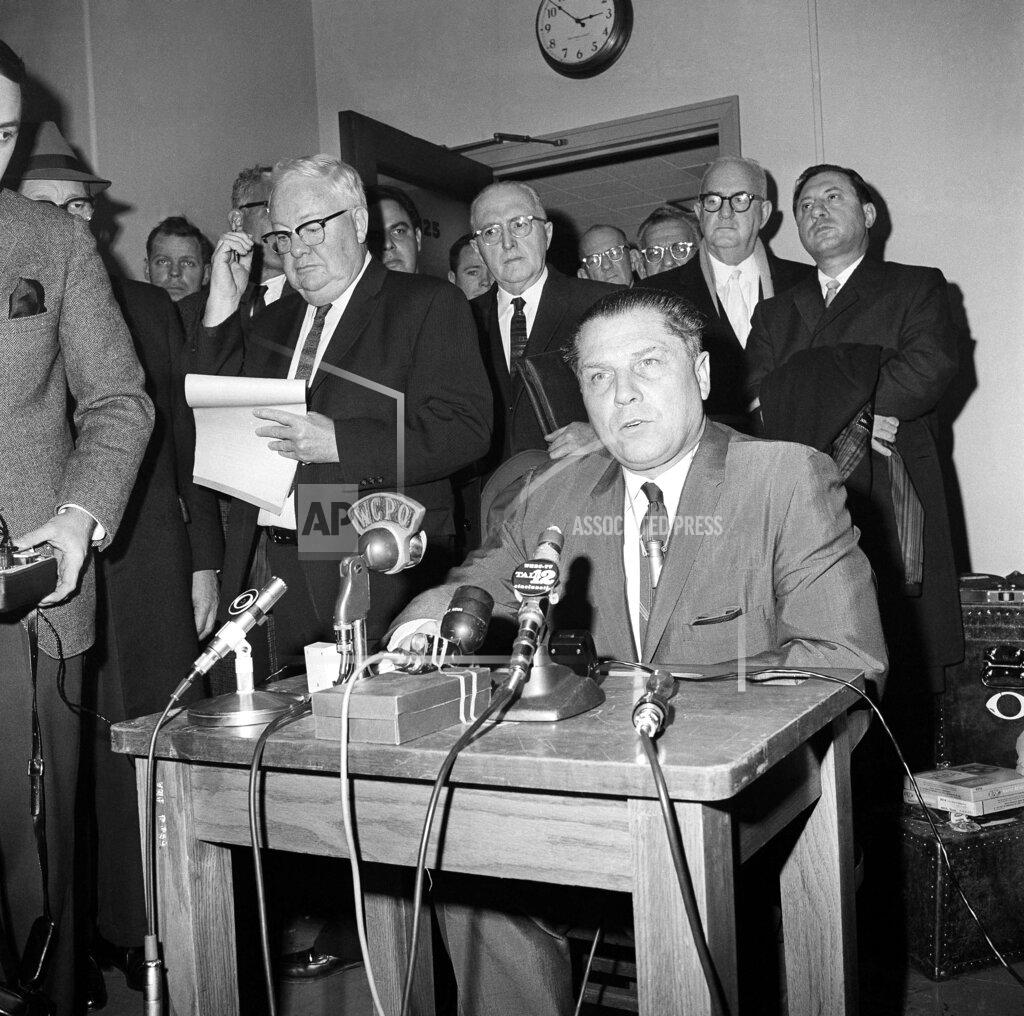
The contention that the testimony of the Government’s star witness should not have been admitted emerged today as the central argument of James R. Hoffa’s attorneys in seeking reversal of the Teamster president’s conviction for jury‐tampering earlier this year. The United State Court of Appeals for the Sixth Circuit heard oral arguments for four hours in the case of Hoffa and three other men, who were convicted with him, then took the appeal under advisement. Hoffa was sentenced to eight years in prison and the other three men to three years. They are free on bond.
James R. Hoffa said today he felt the pressure on his controversial union had eased considerably since Robert F. Kennedy left office as Attorney General. Hoffa made the remarks in a spirited news conference after his attorneys appealed his jury-tampering conviction. Of Senator‐elect Kennedy, Hoffa said: “There is no question the flood of subpoenas has ceased and there is no question that the conspiracy to sow dissension in our union also ceased since Robert Kennedy left office. “He took an interest in me first to further his own ambitions and secondly because he is a spoiled brat, one who thinks he can dictate policy to everybody. He was not a good Attorney General, and he’ll probably make a worse Senator. I hate to think what he would be like as President. We’d probably have a Fascist Government.”
R. J. Reynolds Jr., millionaire eldest son of the tobacco company’s founder, died yesterday at the St. Anna Clinic in Lucerne. He was 58 years old. Mr. Reynolds, an enigmatic combination of playboy, politician, financier and philanthropist, had been ill for five years with emphysema, a lung ailment. His fourth wife, the former Dr. Annemarie Schmitt, was with him when he died.
Michael Brown meets Renee Fladen, then writes “Walk Away Renee.”
The St. Louis Cardinals trade pitcher Roger Craig and outfielder Charlie James to the Cincinnati Reds for pitcher Bob Purkey.
Dow Jones Industrial Average: 860.65 (-3.69)
Born:
C. J. Snare, American rock vocalist (Firehouse – “Love of a Lifetime”), in Washington, District of Columbia (d. 2024).
Rebecca Gibney, New Zealand television and film actress known for the Australian TV comedy “Packed to the Rafters”; in Levin, New Zealand.
Mitch Lyden, MLB pinch hitter and catcher (Florida Marlins), in Portland, Oregon.
Darryl Russell, NFL defensive back (Denver Broncos), in Chicago Heights, Illinois.
Antje Vowinckel, German sound artist; in Hagen, West Germany.
Died:
R. J. Reynolds Jr., 58, American entrepreneur, Mayor of Winston-Salem, North Carolina (1941-1942), and the son of R.J. Reynolds, founder of the R.J. Reynolds Tobacco Company, of emphysema.
William Bendix, 58, American film and radio actor known for being the title character in “The Life of Riley”, died of lobar pneumonia from a chronic stomach ailment.
Francisco Canaro, 76, Uruguayan-born composer.


 History Diaries