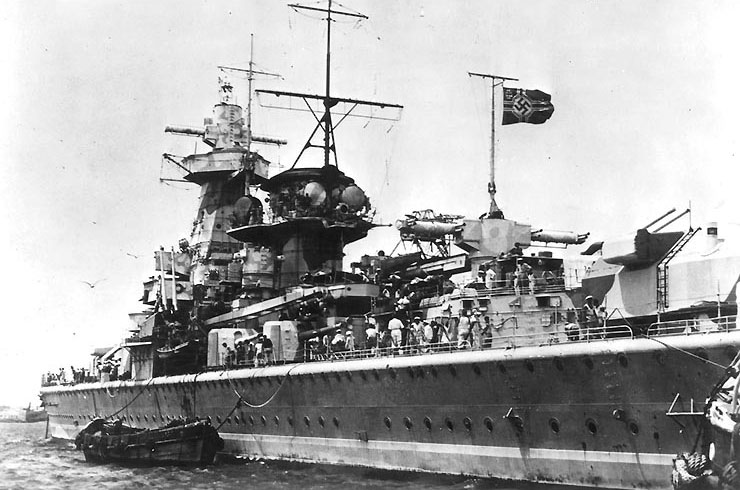
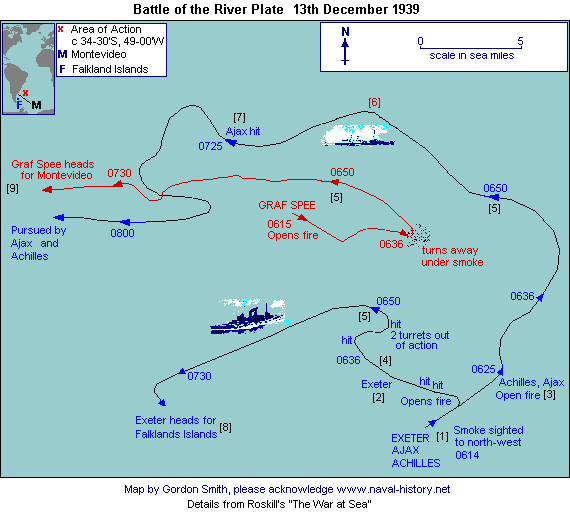
Battle of the River Plate. Royal Navy Force G under Commodore Henry H. Harwood, RN, comprising the heavy cruiser HMS Exeter, light cruiser HMS Ajax (flagship), and New Zealand light cruiser HMNZS Achilles found the German pocket-battleship Admiral Graf Von Spee off the River Plate. The German raider had enjoyed much success against merchant shipping in the South Atlantic, and was individually far more powerful than the three Commonwealth cruisers. Exeter drew most of the early German fire and was badly damaged, but the cruisers in turn inflicted significant damage on Graf Spee, and she ran for the sanctuary of the neutral harbor of Montevideo. Faced with the alternatives of the ship being interned, or a sortie to fight the Royal Navy ships heading for the scene, her captain will choose to scuttle her on 17 December. The President of Panama protested the military action in American waters, sending diplomatic notes to the British, French, and German governments. The U.S. Navy will study the Battle of the River Plate from a perspective of drilling gunners to maintain fire by local (rather than a centralized director) control. To this end, a scenario similar to the River Plate engagement will be included in an exercise in 1940. In addition, the Director of Fleet Training considers the “proper use of smoke either as a defense measure or as a means of covering movements of an attacking force” extremely important, and points out the demonstrable effectiveness of a smoke screen “as a means of protection for light forces” employed by Commodore Harwood in the battle with Admiral Graf Spee.
Captain Langsdorff in the Admiral Graf Spee closes on the three British cruisers (Exeter, Achilles, and Ajax) in Force G that are waiting for him just outside the Platte River. This is his second mistake (his first was offering battle at all): the Admiral Graf Spee has the range to stand off and destroy at least one of the British ships with impunity. By moving in, Langsdorff exposes his own ship to damage. The British ships immediately disperse, make smoke, and wait for their prey to get in range.
Langsdorff fires his first shot at 06:18 from 11 miles away. Commodore Harwood in command of Force G splits his forces to put pressure on Langsdorff’s ship because its big guns are not agile. By 06:23, the British ships are in range and returning fire, and they begin scoring hits. The pocket battleship’s fire is accurate,, too, and early on hits the HMS Achilles (four dead). HMS Exeter is the largest British ship, and Admiral Graf Spee focuses on it, hammering it with 7 11-inch shells that kills 61 crew. By all rights, that should have finished the Exeter, but it is a lucky ship (for now).
Heavy cruiser Exeter is left barely afloat but still firing. By 06:38, only twenty minutes into the battle, one of Exeter’s 8-inch shells plunges into the ship and luckily destroys most of Admiral Graf Spee’s fuel system. The battle is decided, though the British have by far taken the worst of the fighting: Admiral Graf Spee, now needing repairs but still functional, scurries for sanctuary in Montevideo. The British ships remaining outside the harbor call for reinforcements. British cruiser HMS Cumberland comes up from Port Stanley in the Falklands to replace the battered Exeter.
The Winter War: The Finns continue a series of attacks on the Soviet 8th Army. The Soviet 8th Army is forced back north of Lake Ladoga.
At Ilomantsi, north of Lake Ladoga, the Soviet 155th Division launched attacks on 12 December, but these failed. Soviet attacks on 13 December were also repelled by the Finns. The Soviets in turn repelled Finnish attacks by Task Force A on the same day. The situation is approaching stalemate.
Both sides continue battling over Salla, but the Soviets are tightening their grip on the village and looking for their next step. They are at a crossroads there in more ways than one. At Suomussalmi, the Finns remain in control and have completed surrounded the trapped Soviets in the village.
In the central Isthmus, Soviet troops continue their attacks with the support of artillery and tanks in the Summa-Muolaanjärvi sector. The last Finnish forward combat posts in the Perkjärvi sector are pulled back. The attacks are repulsed in all sectors of the front.
Finnish Major-General K.M. Wallenius takes command of the Lapland Group in the north. On the Soviet side, Grigori Shtern replaces Ivan Khabarov as commander of the 8th Army, an indication of how poorly the battle is going for the Soviets north of Leningrad.
International aid continues to flow to Finland. France ships arms there for the first time.
Hietaniemi cemetery in Helsinki receives it first five fallen heroes.
A private umbrella organization, the Finnish Centre for Nordic Aid, is set up to organize the evacuation of Finnish children to Sweden. The first shipment of children arrives by sea in Stockholm.
The Soviet Ambassador in Rome returns to Moscow, apparently in protest over a demonstration in support of Finland.
The U.S. Government refuses to grant Finland a credit to purchase military materials and equipment.
The House of Commons secretly debates supplies for the war. The galleries are cleared on Prime Minister Chamberlain’s motion. Members of the House of Commons, warned that they must not even discuss the business of the day with their wives, debated the question of Britain’s war supplies for seven hours and thirty-three minutes last night in the first secret session of Parliament since the last war. According to a tense statement issued seven and a half hour of debate, the Members of Parliament discussed “the organization of supplies for the prosecution of the war.”
A new government pledged to protect Sweden’s strict neutrality took office today in ceremonies before King Gustaf at the royal palace, with a 53-year-old career diplomat, Chiistian E. Guenther, in the vital post of Foreign Minister. Sweden will allow volunteers to cross the border into Finland but the government will not provide any official aid.
The same type of patrols without results that have continued along the border continue on the Western Front.
King Carol receives a negative reply from the British on whether they will defend his country from the Soviet Union.
The RAF intercepts and damages two Dornier flying boats over the North Sea.
The submarine HMS Salmon, commanded by Lieutenant Commander Edward O. Bickford, sighted a German task force in the central North Sea comprising the light cruisers SMS Nürnberg, SMS Leipzig and SMS Köln and the destroyers SMS Hermann Künne, SMS Friedrich Ihn, SMS Erich Steinbrinck, SMS Richard Beitzen, and SMS Bruno Heinemann. The cruisers were a covering force for the destroyers who had laid mines off Newcastle. From great distance the HMS Salmon managed to torpedo the SMS Nürnberg and SMS Leipzig. The SMS Leipzig was so badly damaged that she would never again be fit for combat duty and was only used as a training ship. The SMS Nurnberg would be out of action until May, 1940.
The unescorted British steam merchant Deptford was torpedoed and sunk by the U-38, commanded by Kapitänleutnant Heinrich Liebe, north-northwest of Honningsvaag, Norway. At 15.28 hours, the Deptford (Master John William Ferguson) was struck by one torpedo from U-38 in the foreship 0.24 miles north-northwest of Honningsvaag, Norway, and sank within five minutes. The master, 31 crew members and two Norwegian pilots were lost. Four crewmen were picked up by the Norwegian fishing vessel Firda, which observed the periscope of the U-boat. One other man and two bodies were picked up by the Norwegian steam merchant Nordnorge. A search carried out by the Norwegian steam merchant Sekstant was unsuccessful. All survivors were brought to Lakanger and then via Maalöy to Bergen. The 4,101-ton Deptford was carrying iron ore and was bound for Middlesbrough, England.
The unescorted Estonian steam merchant Mina was torpedoed and sunk by the U-57, commanded by Kapitänleutnant Claus Korth, off the eastern coast of England in the North Sea. At 19.15 hours the Mina was hit in the stern by one G7e torpedo from U-57 about 20 miles southeast of Lowestoft and broke in two. The stern part sank immediately and the fore part within 30 seconds. The ship had been missed by a first torpedo at 19.03 hours. All of the ship’s complement of 17 died. The 1,173-ton Mina was carrying ballast and was bound for Gothenburg, Sweden.
The Royal Navy minesweeping trawler HMT William Hallett is mined & sunk off the Tyne.
The Swedish cargo ship Algol hit a mine between Trelleborg and Falsterbo (55°19′N 12°28′E) and sank. Six crew were rescued. She was salvaged in 1940, repaired and returned to service.
The Soviet cargo ship Ashkabad was torpedoed and sunk in the North Sea off Dunkerque, Nord, France by U-57 with the loss of 17 crew.
British cargo ship King Egbert, in Convoy FS.53, struck a mine and sank in the North Sea (4.5 nautical miles (8.3 km) off Happisburgh, Norfolk with the loss of one of her 33 crew. The wreck was subsequently dispersed by explosives.
The Belgian cargo ship Rosa struck a mine and sank in the North Sea 6.5 nautical miles (12.0 km) off the mouth of the River Tyne (55°01′42″N 01°13′00″W) with the loss of a crew member.
The Svenska Marinen (Royal Swedish Navy) Äran-class coastal defence ship HSwMS Manligheten suffered an onboard explosion which killed six crewmen.
U.S. freighter Exochorda, detained at Gibraltar by British authorities since 5 December, is released.
Convoy OG.10 forms at sea for Gibraltar.
The War at Sea, Wednesday, 13 December 1939 (naval-history.net)
Submarine SALMON on patrol 130 miles W of Jutland in the North Sea in 56-47N, 4-00E sighted German light cruisers KÖLN, NÜRNBERG and LEIPZIG at 1036 while they were covering the five German destroyers returning from the minelaying mission off the Tyne. She fired six torpedoes at 1124, hitting LEIPZIG amidships with two torpedoes and NÜRNBERG with one. At 1357, the cruisers were joined by destroyers HERMANN KÜNNE, RICHARD BEITZEN and BRUNO HEINEMANN of the Tyne force, two F-boats and four M-boats. After she got home, LEIPZIG was laid up for a time and decommissioned for repairs on 27 February 1940 which did not complete until 1 December 1940. Even then, she did not return to active duty and with some guns removed and a maximum speed of 22 knots, was relegated to training duties. NÜRNBERG’s bow was blown off and her repairs were not completed until late May 1940.
The following destroyers proceeded to carry out anti-submarine patrols — AFRIDI, MAORI and NUBIAN from Rosyth in 56-15N, 3-30E; JERVIS, JUNO, JANUS, JAGUAR and JUPITER of D.7 from the Humber in 54-55N, 3-10E; and eight ships of D.1 from Harwich in 53-30N, 3-00E.
Destroyer KELLY departed Rosyth to relieve destroyer BASILISK escorting destroyer depot ship WOOLWICH in 57-08N, 1-53W.
Escort ship WOOLSTON departed Rosyth to search for a submarine reported by aircraft. It was found to be the Polish ORP WILK, and WOOLSTON returned.
Light cruisers SOUTHAMPTON and EDINBURGH departed Rosyth and arrived at Scapa Flow later the same day.
Light cruiser COLOMBO departed Scapa Flow on Northern Patrol duties and arrived back on the 18th.
Destroyer DUNCAN departed the Clyde escorting steamer DUFFIELD (8516grt) to Liverpool, and arrived back on the 14th.
Destroyer VANITY, which departed Rosyth on the 12th for the Humber, was in a collision in the North Sea with steamer WELSH TRADER (4974grt) in convoy FS.54. VANITY was able to continue to the Humber where she received emergency repairs. She left on the 17th for permanent repairs and conversion to an escort ship at Plymouth, arriving on the 19th.
Convoy FN.54 departed Southend, escorted by destroyer WALLACE and sloops PELICAN and HASTINGS, and arrived in the Tyne on the 14th.
Convoy FS.54 departed the Tyne, escorted by destroyers VALOROUS, VIVIEN and sloop BITTERN, arriving at Southend on the 14th. There was no convoy FS.55 as it was delayed by fog and later cancelled.
Anti-submarine trawler CAPE SIROTOKO (590grt) attacked a submarine contact five miles 170° from Portland Bill.
Patrol sloop PINTAIL attacked a submarine contact seven miles 164° from Portland Bill.
Anti-submarine trawler LADY ELSA (518grt) attacked a submarine contact six miles NNE of Kentish Knock. A destroyer stood by at the location.
U-38 sank steamer DEPTFORD (4104grt) ¼ mile NNW of Honningsvaag. Thirty-one crew were lost, with four survivors picked up by Norwegian patrol boat FIRDA and one more by Norwegian steamer NORDNORGE (991grt).
U-57 sank Soviet steamer ASHKHABAD (1173grt, formerly Estonian MINA as she is usually identified) off Cross Sand.
Swedish steamer ALGOL (978grt) was damaged on a mine in 55 19N, 12 28E. Six of the crew were rescued.
BATTLE OF THE RIVER PLATE
Light cruiser AJAX (Flagship Commodore Harwood, Captain C H L Woodhouse), New Zealand light cruiser HMNZS ACHILLES (Captain W E Parry) and heavy cruiser EXETER (Captain F S Bell) encountered German pocket battleship ADMIRAL GRAF SPEE off Rio de la Plata in 34 28S, 49 05W. The battle began at 0620 and in a short engagement, EXETER was wrecked by SPEE’s gunfire and forced to retire at 0729 in a near sinking condition to the Falklands where she arrived on the 16th.
EXETER received four 11in hits with Lt Cdr J Bowman-Manifold, Act/Sub Lt C A L Morse, Paymaster Sub Lt D H Tyler, Captain H R D Woods RM and fifty-six ratings killed, and Captain Bell, Py/Ty/Paymaster Sub Lt J E Causton RNVR, Act/Gunner (T) T J Lynn, Paymaster Midshipman L de N W Penn-Gaskell and twenty ratings wounded.
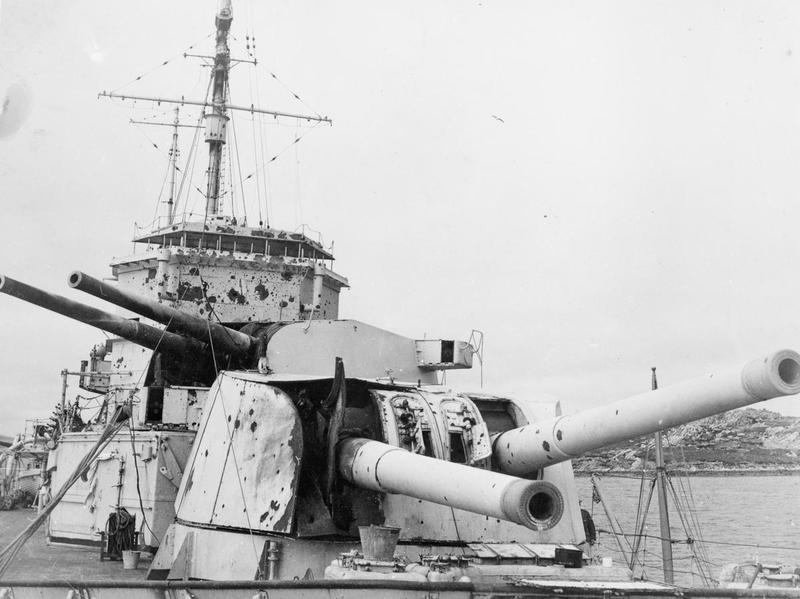
AJAX had two of her four turrets put out of action and ACHILLES fired 1240 rounds of 6-inch ammunition, almost her entire stock. AJAX had seven ratings killed and two wounded, and ACHILLES four ratings killed and three crew wounded.
Damage to ADMIRAL GRAF SPEE, both material and psychological, caused her captain to turn away and head for Montevideo for repairs in that port. Thirty-seven crew had been killed and 57 wounded. She arrived in Montevideo very early on the 14th, followed closely by AJAX and ACHILLES which immediately took up blockade of that port against SPEE’s departure.
British Force H with heavy cruisers SUSSEX and SHROPSHIRE arrived at Capetown for refueling before setting off for Rio de la Plata. Allied Force X with aircraft carrier HERMES and French heavy cruisers FOCH and DUPLEIX arrived at Dakar for refueling, also before setting off for Rio de la Plata. In night flying operations off Dakar on the 16th, Lt B E Coombs was killed when his Swordfish of 814 Squadron from HERMES ditched at sea. The pilot and air gunner were rescued.
Destroyers DOUGLAS and VIDETTE departed Gibraltar to conduct a night-time patrol off Cadiz.
Australian light cruiser HMAS SYDNEY, escorting liner STRATHALLAN (23,722grt) with the 2nd Australian Imperial Force to the Middle East, was relieved by Australian light cruiser HMAS ADELAIDE which continued the escort round the Leeuwin Promontory before returning to Fremantle. SYDNEY arrived at Sydney on the 18th for a refit that lasted from then until the 5 January.
Submarine REGULUS departed Hong Kong on the 13th and patrolled off the Soviet Pacific port of Vladivostok to check if U-boats were using it. She spent Christmas Day in Bosfor Vostochny Strait, the channel leading to Vladivostok and reported “The patrol was disappointing. No German merchant ships were sighted”, before arriving back on 4 January.
Before a mass meeting of more than 20,000 persons who filled every seat in Madison Square Garden last night, former President Herbert Hoover, former Governor Alf M. Landon of Kansas, New York Mayor La Guardia and William Green, president of the American Federation of Labor, headed prominent Christian and Jewish speakers who joined in protest against the persecution of Jews by Nazi Germany and in an appeal for the mobilization of the moral forces of the world against Hitlerism and Stalinism. The meeting, held under the auspices of the American Jewish Congress and the Jewish Labor Committee, unanimously adopted by rising vote a resolution asking President Roosevelt to convey American condemnation of the persecution of the Jews in Nazi Poland to the German Government and to use every possible means to succor the victims of the oppression. It was decided to appoint a committee representing the two organizations to take the resolution to Washington.
Cheering every reference to President Roosevelt’s neutrality program, the audience booed equally every mention of Hitler and Stalin. They laughed loudly when speakers ridiculed Nazi and Communist propaganda that Hitler and Stalin are working for peace against the imperialist war aims of England and France. They also applauded statements that the real issue was the defense of democracy against totalitarianism, whether its label was Nazi, Fascist or Communist, and that anti-Semitism was only the first step toward the destruction of all religions, labor unions and civil liberties. Many in the audience came in delegations from New York labor unions in which Jewish membership predominates.
The speakers and the audience made it clear that their protests were aimed at the Russian invasion of Finland as well as German aggression in Poland, and that their appeals for help were directed on behalf of the Finns as well as the Jews in Poland, Austria. CzechoSlovakia and Germany. It was announced that part of a collection taken up at the meeting to defray its expenses and to help Jewish victims of Hitlerism would be turned over to former President Hoover’s Finnish relief fund if the collection was large enough. The total was not announced, as the contributions were not to be counted until today. About seventy policemen were stationed outside the Garden in case of disturbances, but there was no trouble.
A contract for 200 Hudson bombers at a cost of about $20,000,000 was signed here late yesterday by representatives of the British Air Ministry and officials of the Lockheed Aircraft Corporation of Burbank, California. The original British order for 250 planes of this type was completed less than a month ago.
It was also learned yesterday that France has ordered 270 more of the Douglas bombers known as the DB-7. An all-metal, high-wing monoplane with tricycle landing gear, the DB-7 is powered by two Pratt & Whitney 900-horsepower engines and has a top speed of “300 mph plus.” Prior to the outbreak of war, France ordered 100 planes of this type.
Mrs. Franklin D. Roosevelt joined the President today in criticizing the recent charge of the Dies committee that consumers’ organizations were Communist “transmission belts.”
Joe Ozanic, young leader of the Progressive Mine Workers (A.F.L.), charged before a House investigating committee today that the National Labor Relations Board had followed a “plan” to give the United Mine Workers (C.I.O.) “a way out” in the desperate rivalry between the two unions. The “plan,” as he described it, was embodied in a controlling decision, which certified the C.I.O. union as the bargaining agent for all the coal mines in a specified geographic area. This was done, he said, despite provable majorities for the Progressives in individual mines affected.
As a result, he asserted, the United Mine Workers and employers in the field had forced thousands of Progressive members to switch to the C.I.O. union, and pay its dues, regardless of their own desires in the matter. In one instance which he cited, that of the Acme Semi-Anthracite Coal Company of Williams, Oklahoma, members of the Progressive union were unemployed, he said, because their jobs had been taken by miners imported by the United Mine Workers.
Congress is urged to set Thanksgiving Day by law as the last Thursday in November. The resolution from a business group in White Plains, New York, criticizes President Roosevelt for interfering by changing the traditional date.
Senator Taft calls for a 30% reduction in government spending and an end to “evil” government regulations that stifle bussiness.
The Republican party cannot sidetrack questions of foreign policy and concentrate on domestic issues in the 1940 Presidential campaign, Senator Borah asserted in a letter to Allen W. Dulles of New York, which the Senator made public today.
Dr. J.G. Thomas, a physician who made his rounds in a horse and buggy, dies at age 95. A Civil War bullet remained in his leg, post war, and he kept making rounds until he was 93.
New York Mayor Fiorello LaGuardia suggests a federal tax rule. He recommends that Washington fix rates and do all collecting, giving states credits.
Lieutenant Colonel Dwight Eisenhower boards the liner President Cleveland for return to the United States after several years working for MacArthur in the Philippines.
Among the U.S. naval officers promoted to Rear Admiral on this day are John Henry Towers, Isaac Campbell Kidd, Aubrey Wray Fitch, Robert Alfred Theobald, and Raymond Ames Spruance.
Canadian warships patrol their Atlantic coast.
American naval authorities said tonight that under international law the Uruguayan Government must decide just how badly damaged the German pocket battleship Admiral Graf Spee is and determine the minimum of repairs necessary to enable her to put to sea. After such repairs are made the ship must put to sea or else the neutral government must take steps to intern the ship, her officers and crew. It was pointed out that under Article 14 of the Declaration of London a belligerent warship may not prolong her stay in a neutral port beyond twenty-four hours unless she is damaged or has sought haven due to stress of weather. The law requires that the ship depart as soon as the cause of the delay is ended.
Indian Muslim leader Mohamed Ali Jinnah demands that a Royal Commission to investigate Moslem complaints of repression.
The Soviet prisoner transport ship Indigirka ran aground when trying to enter the La Perouse Strait off the Japanese coast near Sarufutsu while transporting fishermen with families and prisoners released for war effort. 741 of about 1,500 persons on board perished.
Chinese 1st War Area clears Taihsing Shan and cuts the Taotsing rail line.
40th Army and 27th Army of Chinese 2nd War Area open an offensive against Japanese 36th Infantry Division around Changtze and Tunliu. Troops of the Chinese 47th Corps captured the Taihang Mountain and cut the Taosin Railway by taking the stations at Poshan and Changkou. Chinese troops launched an offensive in eastern Shanxi Province in China, nearly encircling the Japanese 36th Division.
10th Army Group of Chinese 3rd War Area raids Fuyang, Yuhang, Nanchang, and Hangchow.
Chinese 5th War Area captures Changnaoyuan, Hsinchenshih, Chuankoutien, Chianghsitien, and Yangliuho.
Chinese 9th War Area reports turning back Japanese columns around Wulimiao, Tashihling, and Kueihuashu and also attacking around Fenghsin and Chingan overnight.
27th Army Group of Chinese 9th War Area is attacking around Chungyang, Kueihuashu, and Shihchengwan.
The Japanese forces are reeling and giving up ground everywhere from this vicious attack, which they appear to have had some advance notice of.
Dow Jones Industrial Average: 148.94 (+2.01)
Born:
Eric Flynn, British actor (“Empire of the Sun”), on Hainan Island, China (d. 2002, of cancer).
Jerry Burch, AFL wide receiver and punter (Oakland Raiders), in Mobile, Alabama.
Naval Construction:
The Royal Navy ocean boarding vessel HMS Marsdale is launched by Lithgows Ltd. (Port Glasgow, Scotland, U.K.).
The Nihon Kaigun (Imperial Japanese Navy) Kaibōkan (ocean escort ship) HIJMS Shimushu (占守), lead ship of her class of 4, is launched by Mitsui Engineering and Shipbuilding (Tamano, Japan).
The Royal Navy anti-aircraft ship HMS Goatfell (4.36) is commissioned. Her first commanding officer is Lieutenant Commander (retired) John Davis, RN.
 History Diaries