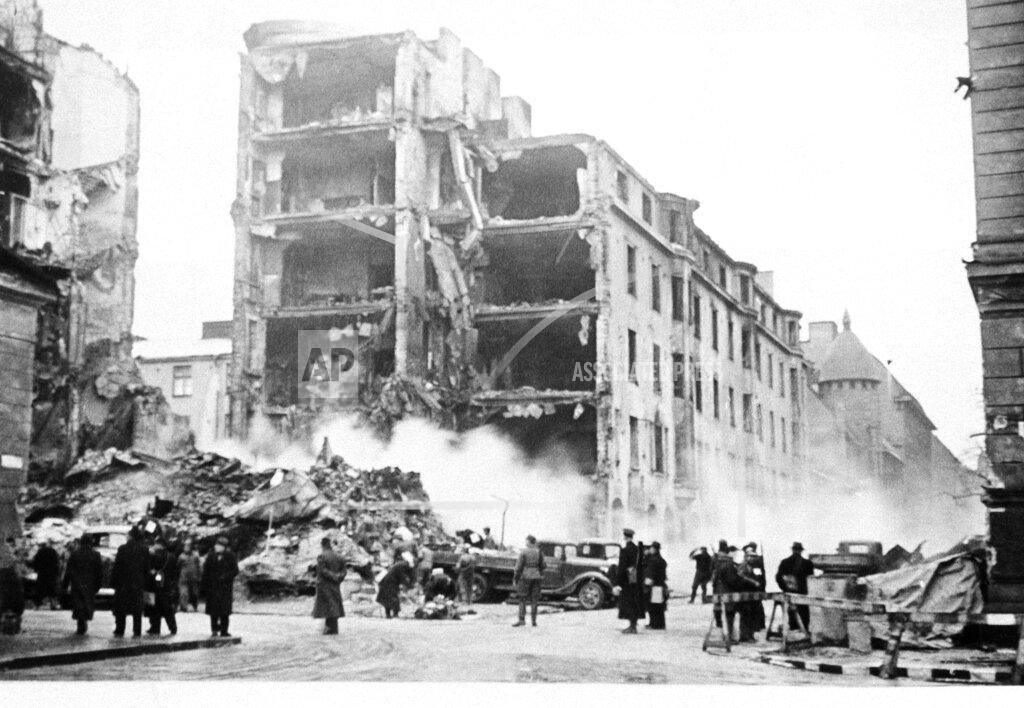
The League of Nations sent the Soviet Union a telegram calling for a cessation of hostilities with Finland and to submit the dispute with Finland to mediation by the League. After Finland asks for concrete aid, “not merely words of encouragement,” the League of Nations agrees to intervene in the conflict between Finland and the USSR. This is one of the few times that the League has attempted to take a decisive stand. The League urges the Soviet Union to cease hostilities in Finland within 24 hours and accept mediation.
Finnish troops launch a counteroffensive at Suomussalmi at 1000 hours to recapture the parish village. The Soviet 163rd Division is cut off in Suomussalmi by the attacks of the Finnish 9th Brigade. The Soviet 163rd Division was held by Finnish defenses north of Lake Piispajarvi in Finland, while Soviet 81st and 759th Regiments were likewise bogged down by Finnish border police forces to the south at Suomussalmi, a road junction village. Lightly-armed troops of the Finnish 27th Regiment, on skis, launched an attack on the Soviet supply line along the Raate Road in an attempt to isolate Soviet troops at Suomussalmi.
The village of Suomussalmi is an inconsequential little place in the middle of endless forests. However, on 11 December 1939, it is the last stop on the road west before the terrain opens up and provides easy access to the coast. Thus, holding it is critical to the Finnish defense.
Colonel Siilasvuo at Suomussalmi with his motley assortment of units is ready to make his move. Departing from his blocking position across the lake from the village, he leaves only a skeleton force of two machinegun companies and a few machine-gun crews from the 4th Reserve Battalion on the southern bank of Haukpera Lake to block that direction. With the remainder of his small force, he marches back east through the woods past the Soviet forces.
He then tasks Battle Group Kontula to cut the Ratte road, which constitutes the only means of communication for the Soviets based in Suomussalmi. Not only does the Battle Group Kontula advance to block the road, but the Finns also destroy a convoy of six Soviet trucks carrying wounded to the Soviet rear.
The Soviets react slowly despite the fact the road is their lifeline. Their headquarters takes its time sending the 44th Rifle Division from the east in relief. Battle Group Kontula squares up and forms a defensive line facing east, waiting, but nothing is seen. With them blocking any Soviet relief, Siilasvuo takes the infantry companies from the 27th Infantry Regiment and the 4th Reserve Battalion and marches down the Ratte road to the west – straight toward the Soviet 759th Rifle Regiment in Suomussalmi. Simultaneously, he has other elements launch harassing attacks on the town from other directions to provide a distraction. Siilasvuo plans to surround the town and defeat the Soviets there, then turn his attention to other threats later. He is in complete control of the only escape route the trapped Soviets have. The Soviet forces in Suomussalmi are trapped.
To the north, the Finnish 16th detachment continues blocking the Soviet 662nd Regiment, the only other source of succor for the Soviets in Suomussalmi.
Soviet troops launch a series of determined offensives at Kollaa.The frontal assault is accompanied by attempted flanking actions.
In the Tolvajärvi battle area, Colonel Talvela issues the order for the decisive attack.
In the Salla sector of Northern Finland, a Russian regiment shatters the Finnish defense at Märkäjärvi.The Finns retreat about 10 km west to Salmijärvi.
A Finnish “white book” clarifies its position, listing the Soviet demands and rejected counter-proposals leading to war.
The author Frans Emil Sillanpää arrives in Haaparanta on the Swedish border en route to receive his Nobel Prize for Literature.
Baron A. A. Yrjoe-Koskinen, Finnish Minister to Moscow until the outbreak of Russo- Finnish hostilities, said today that Russian police had held him, his wife and his legation staff of 26 persons under arrest for six hours at the frontier before permitting them to leave the Soviet Union. “Armed guards surrounded our train when we got to Bigosovo, on the border, Thursday morning.” said Baron Yrjoe-Koskinen, who is en route to Helsinki. “They kept us locked up for six hours. We finally received some food and the train was allowed to continue to Dunaburg. It was a rather alarming experience and I am thankful to get out of Russia, although I have been Minister to Moscow for nine years.”
The French and British at the frontlines in France await a German offensive.
A forced labor program is instituted for all Jews in the Polish General Government.
Norwegian Fascist traitor Vidkun Quisling met with Erich Raeder in Germany. Later, Hitler meets with Quisling, the head of the pro-Nazi Norwegian National Unity Party.
A Red Cross chairman doubts the need for a war drive, pointing out the help already given France, Britain, and Poland. The group will honor the wishes of donors who mark interest in Finland.
A German barrage balloon drifts loose and falls in the Shetlands. Luftwaffe aircraft are spotted off the Yorkshire coast.
Two IRA activists, Barnes and Richards, are sentenced to death for the murder of 5 people in Coventry on August 25, 1939 at the end of the Coventry Explosion trial.
The Eire (Irish) government plans for an army of 20,000 officers and men.
U-30 was forced to return to base due to engine trouble
U-61 could not lay mines as planned in the Firth of Forth due to the presence of numerous enemy escorts in the area.
The neutral Greek steam merchant Garoufalia was torpedoed and sunk by the U-38, commanded by Kapitänleutnant Heinrich Liebe, inside Norwegian territorial waters (64° 36’N, 10° 42’E). At 08.19 hours the Garoufalia was hit by one torpedo from U-38, while proceeding inside the Norwegian territorial waters. The torpedo struck in the engine room and killed the crew on watch below. She was sunk with a second torpedo 30 minutes after the first. The survivors, among them two Norwegian pilots, were picked up by the Norwegian steam merchant Tellus. They had observed the U-boat before the attack and this proved to both British and Norwegian authorities that German U-boats operated inside Norwegian territorial waters. This was a huge propaganda blunder for the Germans and they did not send other U-boats on such patrols. U-38 operated as far east as Murmansk and Liebe disregarded all respect of neutral shipping or warning before attack. But most torpedoes failed or missed. Of the ship’s complement, 4 died and 25 survivors were picked up by the Norwegian steam merchant Tellus. The 4,708-ton Garoufalia was carrying ballast and was bound for Kirkenes, Norway. The attack was observed by the Tellus and the sinking of the Garoufalia proved to be a huge propaganda blunder for the Germans as it proved to both British and Norwegian authorities that German U-boats operated inside Norwegian territorial waters. The Germans did not send other U-boats on such patrols.
The Norwegian cargo ship Storfjeld ran aground on the Seaton Rocks, Northumberland, United Kingdom (55°05′15″ N, 1°28′00″ W) and was wrecked.
U.S. freighter Azalea City, detained at London by British authorities since 27 November, is released to proceed to Antwerp, and Rotterdam, Holland, after certain cargo is detained for guaranties.
U.S. freighter Steel Engineer, detained at Gibraltar by the British the previous day, is released.
Convoy OA.51 departs Southend.
Convoy OB.51 departs Liverpool.
The War at Sea, Monday, 11 December 1939 (naval-history.net)
Battleship VALIANT departed Plymouth on trials after refit, escorted by destroyers ACASTA and ARDENT. She was to have arrived back on the 11th, but due to submarine activity in the area, remained at sea overnight with destroyers ENCOUNTER, ARDENT, ACASTA and GRENADE. She then headed for Portland, reaching there on the 12th and leaving on the 14th for Bermuda. VALIANT was met by destroyer HYPERION on the 21st, 240 miles 70° from Mount Hill Light and reached Bermuda on the 22nd for working up after the refit. She arrived back at Bermuda on the 25th.
A U-boat was sighted in the vicinity of the Plymouth indicator loops. Exercises were cancelled and submarine H.43 was ordered to return to harbour on the surface. Destroyer WOLVERINE and sloop LONDONDERRY hunted 60° and 320° respectively from a position 4 miles 45° from Eddystone, and WOLVERINE also took destroyer BRAZEN under orders to join in the search. A tug reported bumping a submerged object inside the loop at 1115. Destroyers ENCOUNTER, GRENADE, WHITEHALL and sloop LONDONDERRY searched without success but WOLVERINE did make a contact 6.5 miles 112° from Rame Head.
Light cruiser GLASGOW arrived at Scapa Flow.
Light cruiser EDINBURGH arrived at Rosyth.
Old German merchant ship ILSENSTEIN (8216grt), acquired pre-war, departed Rosyth escorted by destroyer ESCORT and escort ship WOOLSTON for Loch Ewe. After reaching the Pentland Firth, WOOLSTON returned to Rosyth. Destroyer ELECTRA was ordered to join ESCORT, but ILSENSTEIN could not proceed in the heavy weather.
Destroyer MOHAWK was in collision with a tug as she headed down the Tyne. Temporary repairs were completed in the Tyne on the 14th.
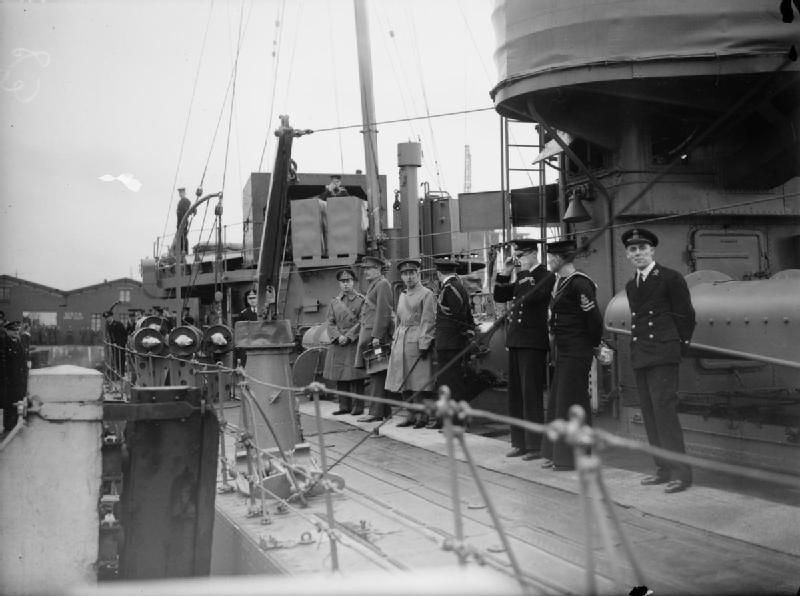
Polish destroyer ORP BŁYSKAWICA fired on an unidentified aircraft off Harwich.
Destroyer BEDOUIN departed Rosyth with tanker DAGHESTAN (5742grt) for Invergordon, then proceeded to Scapa Flow and on to the Clyde, arriving on the 12th.
Convoy OA.51 departed Southend on the 11th escorted by destroyers VETERAN and BROKE until the 13th when they were relieved by destroyers WHITEHALL and WIVERN. After the convoy dispersed on the 14th, WHITEHALL and WIVERN joined SL.11.
Convoy OB.51 departed Liverpool escorted by destroyer VOLUNTEER and sloop DEPTFORD.
Convoy BC.17 of steamers BARON GRAHAM, CLAN ROSS (Commodore), DUNKWA and GUELMA departed the Loire escorted by destroyer VESPER, and arrived in the Bristol Channel on the 12th.
Convoy SA.21 of two steamers departed Southampton, escorted by destroyer WINDSOR which reported a submarine contact in 50-15N, 02-00W. The convoy arrived at Brest on the 12th.
Convoy AXS.8 of one steamer, escorted by destroyer VIVACIOUS, arrived at Brest from Barry.
Convoy FS.53 departed the Tyne, escorted by destroyer WALLACE and sloop HASTINGS, and arrived at Southend on the 12th. Convoy FN.54 was delayed for 24 hours, but destroyer WHITLEY and sloops FLAMINGO and STORK guarded the ships overnight and were joined by destroyer GREYHOUND.
A U-boat was reported in the Channel near Portsmouth and destroyers ACHERON, VEGA and WHITSHED were ordered to search.
French battleship DUNKERQUE with 100 tons of gold for deposit in Canada and light cruiser GLOIRE departed Brest at 1700 for Halifax escorted by large destroyers MOGADOR, VOLTA, LE TRIOMPHANT, LE TERRIBLE and VALMY. VALMY detached on the 12th and the rest of the destroyers on the 13th. DUNKERQUE and GLOIRE arrived on the 17th.
U-38 sank Greek steamer GAROUFALIA (4708grt) in 64 36N, 10 42E with the loss of four crew.
U-61 laid mines off the Firth of Forth.
Battleship MALAYA, which had been escorted by Australian destroyers HMAS VENDETTA and HMAS WATERHEN in the Red Sea, arrived at Suez after duty in the Indian Ocean.
Submarine OSWALD departed Alexandria for patrol in the Mediterranean until the 23rd.
The U.S. Supreme Court widens a wiretapping ban, barring indirect use. In two important rulings today the Supreme Court shut the doors against the use of wiretapping evidence in federal criminal trials. Supplementing previous decisions, the justices outlawed such evidence, whether offered indirectly or directly and whether obtained by listening in on conversations carried on within a State or across State borders.
Some observers thought that the two opinions might have the effect of proscribing wiretapping evidence in State as well as Federal courts. In an opinion written by Justice Frankfurter, the court held, six to one, that Frank C. Nardone and two others must have a third trial because the government, at their second trial, indirectly used wiretapped evidence after direct use was denounced by the Supreme Court when it upset the original Nardone conviction. Justice McReynolds dissented, while Justice Reed stood aside because he was Solicitor General at the time of the original trial.
Through Justice Roberts the tribunal unanimously condemned interception of intrastate communications and held that use of evidence thus obtained entitled Joseph J. Weiss and three others as fully to a new trial as though the conversations had been of the interstate character, the use of which was forbidden by the court in the Nardone decision of 1937. In both cases the petitioners, over the protests of the government, won their appeals from the Second Circuit Court.
The wiretapping cases originated over the interpretation of Section 605 of the Federal Communications Act of 1934. This section states that “no person not being authorized by the sender shall intercept any communication and divulge or publish the existence, contents, substance, purport, effect, or meaning of such intercepted communication to any person.” The Supreme Court has now declared through the two Nardone and the Weiss rulings that this section precludes the use of wiretapping evidence, in what seems every form, although Congress can amend the law so as to permit properly controlled wiretapping as a help in criminal prosecutions.
An American employer is upheld in refusing to hire a member of a union. The court rules that either union or non-union employees may be engaged.
The indictment of 100 people from data collected by the Dies Committee is foreseen. Committee member Rep. Parnell Thomas (R-New Jersey) accuses the Roosevelt New Deal Administration of a “flirtation” with communism.
Representative Voorhis of California, a Democratic member of the Dies Committee, accused the committee today of using “undemocratic” procedure in preparing and making public a report which said that some consumer groups were Communist “transmission belts.”
The name of Harry Gannes, columnist and foreign affairs expert for The Daily Worker, was added yesterday to the list of prominent Communists who have been accused of the misuse of American passports in their travels about the world.
A bitter hidden conflict which has racked the National Labor Relations Board for months was thrust into the open today at the opening hearing before the special House committee created, to investigate that agency.
Senator Robert A. Taft, starting in Portland, Maine tonight a speaking tour of New England, asserted that “utter confusion” of Federal bureau and departmental activity under the Roosevelt administration was “one of the main reasons why the people have decided that a complete change is needed in 1940.
Senator Burton K. Wheeler was advanced today by Senator Johnson of Colorado as a “liberal” candidate who might make it unnecessary for the “President to run against his will in 1940.”
New York Mayor LaGuardia proclaims “Children’s Museum Day.”
Mrs. Roosevelt at her press conference today discussed her Christmas plans and youth projects.
Three American groups work together for truth in advertising. This is believed to be the first joint advertising committee with national influence and scope.
A U.S. conference displays plastics that can be used in the home. Sponsors say that acceptance of these products must precede general use.
Atlanta plans a four-day fête to celebrate the release of “Gone with the Wind.” Employees in downtown Atlanta will dress up in Civil War-era garb and buildings are being modified to give them a historic appearance.
Charles Walgreen, head of the U.S. drug store chain, dies. He began work as a factory hand, but turned to pharmacy after losing a finger. There are now about 500 Walgreens in 39 states.
Power politics in the Far East is assuming a new phase in connection with China’s reluctance to offend the Soviets with an adverse vote at Geneva on the question of Finland. Chinese sources from Chungking report that Moscow is coupling dilatory tactics in the parleys with Tokyo with intimations to China that the time has arrived “to recognize the realities” in relation to Outer Mongolia. This is being coupled with hints that if it is not done Russia’s assistance to China in arms and airplanes is likely to diminish.
What Russia wants is China’s formal recognition of the independence of the Outer Mongolian Soviet Republic and a formal relinquishment of Chinese claims of sovereignty. Outer Mongolia has been virtually annexed by Russia for almost two decades. This huge area, slightly exceeding 1,000,000 square miles, has long been closed to Chinese traders and has been dominated by the Russian army and air force. Rapidly and steadily it is being strategically developed in highways and air fields, all based upon the probability of a Russo-Japanese war.
China has lost vast territories since the beginning of the revolution in 1911, but never has formally relinquished her claims to sovereignty over them. She fears to establish a perilous precedent, believing that a similar demand for Sinkiang would come next. Nevertheless, with most foreign sources of war supplies cut off, except from the Soviets, and with the Japanese army in a position from which aerial domination of the Indo-China and Burma routes should be easy since the capture of Nanning, the Chungking government dare not alienate Moscow.
Retired U.S. Rear Admiral Harry Yarnell calls the Japanese bombing of China “stupid.” He says the attacks on cities have been a major factor of Chinese unification.
Chinese Winter Offensive: Chinese 2nd War Area defeats Japanese attacks around Wenhsi and Hsia Hsien.
The Berlin radio today circulated a dispatch from Shanghai asserting that Germans in China had been assured by unidentified Japanese naval authorities that Japan would not permit Britain and France to interfere with German exports to Japan under the Allied war blockade. The dispatch said the Germans had been informed that if Britain attempted to seize cargoes on Japanese vessels the Japanese would make equivalent seizures from British vessels in Far Eastern waters. The radio said Germans would watch the departure of the Japanese steamer Sanyo Maru, which is due to leave Rotterdam, the Netherlands, tomorrow with a cargo of German machinery for Japan. The radio also circulated a dispatch from Tokyo to the newspaper Neuste Nachrichten of Leipzig quoting Admiral Nobumasa Suetsugu, Japanese ultra-nationalist and former Home Minister, as having said that Germany should win the war. The Allied blockade will fail, the admiral was quoted having said, because Germany is largely surrounded by neutral States on which she can draw for supplies.
The Yomiuri Giants beat the Hanshin Tigers, 4–2, to clinch the Japanese league pennant. The Giants will win the pennant for the next 4 years.
Dow Jones Industrial Average: 147.05 (-0.88)
Born:
Tom Hayden, American civil rights and antiwar activist and politician (Rep-D-California), in Royal Oak, Michigan (d. 2016).
Thomas McGuane, American author and screenwriter (“Colf Feet”, “Tom Horn”, “Missouri Breaks”), in Wyandotte, Michigan.
Bevo Nordmann, NBA center (Cincinnati Royals, St. Louis Hawks, New York Knicks, Boston Celtics), in St. Louis, Missouri (d. 2015).
Died:
Charles Walgreen, 66, founder of the drug store chain that bears his name.
Naval Construction:
The Royal Fleet Auxiliary Dale-class fleet tanker RFA Dingledale (A 144) is laid down by Harland & Wolff (Govan, Scotland, U.K.).
The Royal Australian Navy auxiliary minesweeper HMAS Bermagui is commissioned.
 History Diaries