The United States has decided to increase its military assistance to South Vietnam for new action against the infiltration routes from Communist North Vietnam. According to a communiqué issued today, joint planning is under way between the South Vietnamese Government and American military and diplomatic representatives here “to achieve greater effectiveness against the infiltration threat.” The nature of the new military measures was not confirmed, “for security reasons,” but moves under discussion include air and ground attacks against Communist staging areas in the mountains of southern Laos, where the so-called Hồ Chí Minh trail enters South Vietnam. The attacks would be carried out by the South Vietnamese armed forces assisted by American advisory personnel and matériel support.
The Saigon announcement followed five days of consultations between the two Governments in which Ambassador Maxwell D. Taylor briefed the Vietnamese leaders on decisions taken by President Johnson during a recent Vietnam policy review in Washington. The United States also promised additional aid to strengthen Vietnamese air defenses, to increase the size of the country’s‐armed forces and the police and to speed up economic and rural development. American and Vietnamese officials declined to disclose the type or value of the new increase in aid. The United States is spending $700 million a year in military and economic aid to help the Saigon Government crush the Communist insurgency. There are more than 22,000 American military advisers on duty in Vietnam. The commitments undertaken by the Government of Premier Trần Văn Hương were less clearly spelled out in the communiqué.
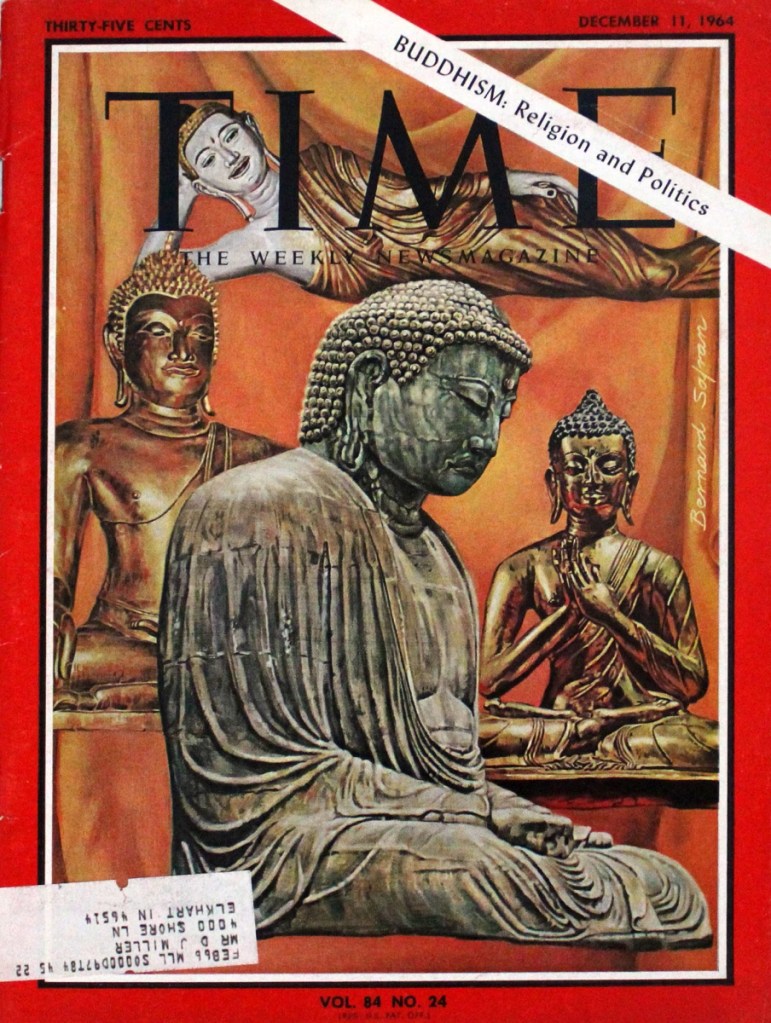
As soon as the communiqué announcing increased U.S. support for the government is released, the Buddhist leaders announce a campaign to oust Premier Hương, particularly because they claim he is being kept in power by the Americans. Thích Trí Quang and two other prominent Buddhist leaders go on a 48-hour hunger strike. Holding back from the vehement anti‐American statements expressed by Buddhist leaders lately, the chief political spokesman for the church organization, Thích Tâm Châu, nevertheless wrote to Mr. Taylor today holding him “responsible before the Vietnamese and American peoples for the continuation of the Hương Government.” In a five‐point communiqué and a letter to the chief of state, Phan Khắc Sửu, the Buddhist leaders emphasized what they considered the American Ambassador’s responsibility for maintaining Mr. Hương, in power against “the just desires of the Vietnamese people and the Buddhist Church.”
The South Vietnamese Defense Ministry said today that the Việt Cộng had carried out the most costly ambush of the war by wiping out an armored column. But it added that this loss had been offset on another front by a big Việt Cộng defeat. The ministry said Communist guerrillas staged a daylight ambush 39 miles southwest of Saigon Wednesday and destroyed six armored personnel carriers costing $172,800 and wrecked other heavy equipment. The victory was reported in the An Lão Valley, 300 miles north of Saigon, where a spokesman said a record 162 Communists were killed and 38 captured Wednesday. Twenty‐seven was the highest toll of any single engagement of the war.
A C-123 transport crashes during take-off at the Đà Nẵng airport and two U.S. servicemen are killed; because the Defense Department does not provide any explanation for the plane’s mission, it leads to public speculation that the U.S. Air Force is engaging in some kind of secret operations. Two United States servicemen and 36 Vietnamese soldiers were killed when a transport plane crashed tonight at Danang Airport, 380 miles northeast of here, Air Force sources said today. United States officials would not comment. The plane, a Vietnamese-piloted C-123 transport, crashed into a mountain just after takeoff, the sources said. Aboard were six Vietnamese crewmen, 30 Vietnamese Special Forces troops and the two United States servicemen. The plane’s mission was cloaked in secrecy.
Last Friday, two United States officers were killed in combat situations in the southern Mekong Delta. Eleven Americans have died in a week of strong Việt Cộng attacks. The total of Americans killed in action in Vietnam has risen to 235. One of the officers killed Friday was directing helicopter action against Việt Cộng mortars, the other was with a Vietnam unit defending the town of Duc Long. The body of an American adviser, reported missing in the battle of An Lão in the north, was found. He was Specialist 5 William R. Hamlin of Seattle.
U.S. Senator Wayne Morse, Democrat of Oregon, said today that whether President Johnson could escape an expanded war in Southeast Asia “will be the first great test of his Administration.” Mr. Morse, a critic of Administration policy in South Vietnam, said in an address prepared for the Denver forum that if the United States expanded the war into Laos, North Vietnam, or Communist China, “we will not only be inviting disaster, but will be flouting every principle of international policy we have espoused since World War II.”
An Army helicopter pilot from Sylvania, Georgia, who refused to abandon a wounded United States adviser in South Vietnam last July will be awarded posthumously two of the nation’s highest medals for valor. The Distinguished Service Cross and the Silver Star will be given to the widow of Major Charles L. Kelly in ceremonies at Fort Gordon Saturday.
United States and Cambodian negotiators announced tonight after a day‐long working session that they had agreed on an agenda for their talks on differences between their countries. The announcement said also that they had also begun discussion of items on the agenda. Today was the fourth day of the talks in New Delhi and was the longest session that the delegations have held, beginning this morning and lasting until 6:30 PM. There was no indication of the substance of the agenda. The talks are aimed at settling differences arising out of Cambodian charges of United States complicity in aerial violations of the Vietnamese‐Cambodian border and of countercharges that the Cambodians have given refuge to Việt Cộng rebels against the South Vietnamese Government. The talks are expected to last at least another week.
At least four Indonesian guerrillas were killed, three wounded and three captured in scattered fighting in Malaysia’s jungles during the last 24 hours, the Malaysian Government reported today.
Communist China issued today its 350th “serious warning” to the United States. It protested what was termed the intrusion of two United States warships into China’s territorial water yesterday and today, Hsinhua, the Chinese Communist press agency, reported.
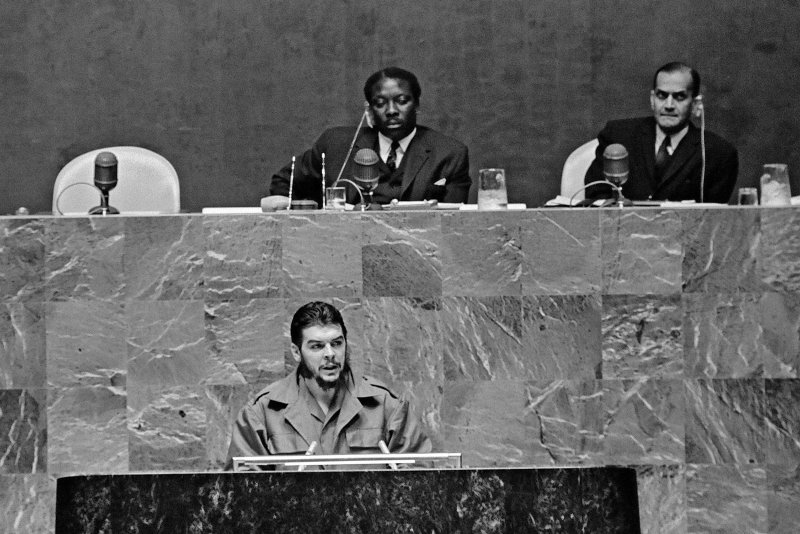
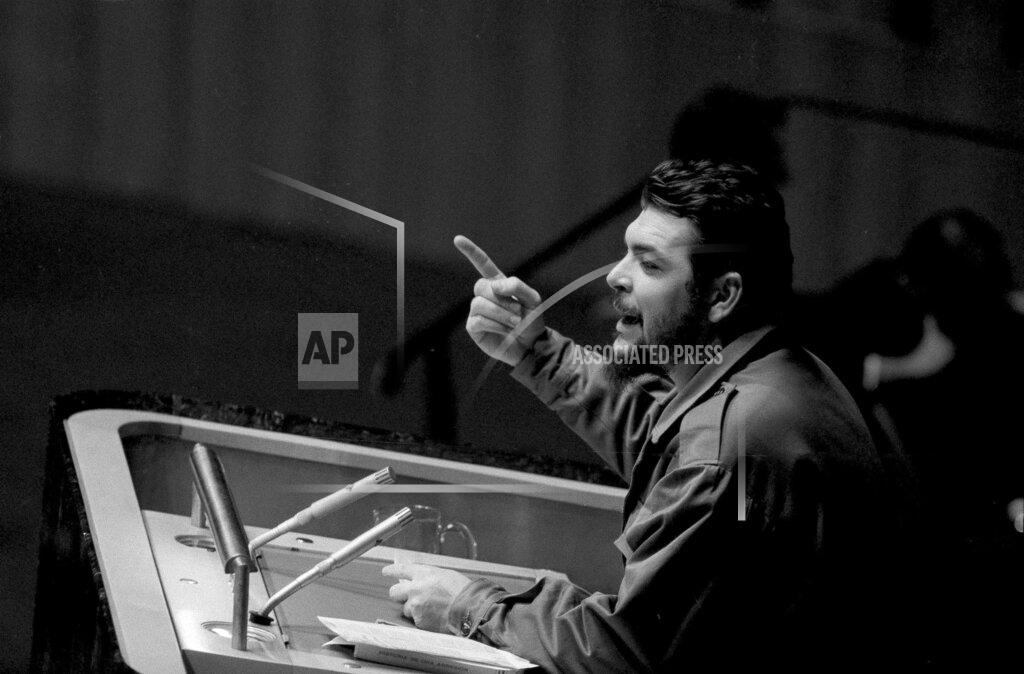
Che Guevara addressed the U.N. General Assembly. Guevara, a guerrilla leader in the Cuban Revolution, was serving at the time as the Minister for Industry in Cuba as part of the cabinet of Fidel Castro. Guevara charged that the United States was a warmonger and said that there had been 1,323 provocations by the U.S. along the boundary between the Guantanamo Naval Base and the rest of Cuba. “A gigantic flock of 200 million Latin Americans is giving a warning note to the Yankee imperialists,” Guevara said. “The hour of vindication is being pointed to with precision.”
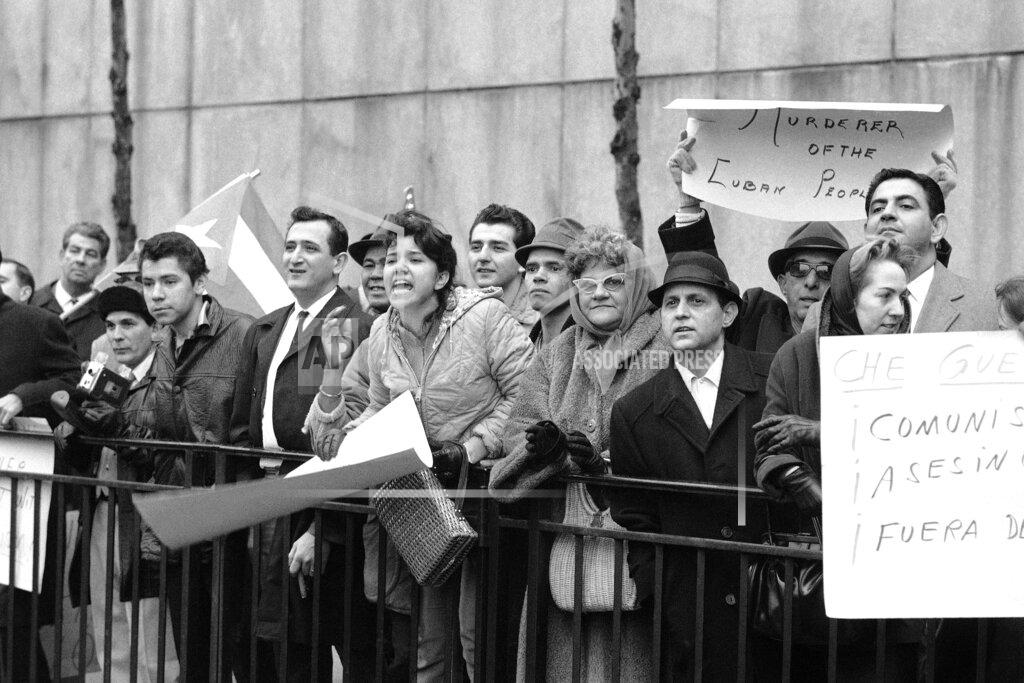
Guevara, a top lieutenant of Premier Fidel Castro, charged in the General Assembly today that the United States, helped by Latin neighbors, was preparing aggression against Cuba. The charge was promptly rejected by the accused Central American nations and by Adlai E. Stevenson of the United States. “We are taking every step necessary,” Mr. Stevenson said, “to insure that raids are not launched, manned or equipped from United States territory.” As Major Guevara spoke, windows in the Secretariat skyscraper on the East River were shaken by the explosion of a rocket‐launcher shell believed to have been set off by Cuban exiles. Noisy pickets outside the United Nations buildings took up the chant “Guevara carnicero!”—”Guevara butcher!” Delegates in the Assembly paid no heed to the developments outdoors. They listened intently to the major’s speech. Many agreed later that its significance was not that it offered new ideas but that it emphasized colonialism and racism, issues preoccupying the Asian and African nations.
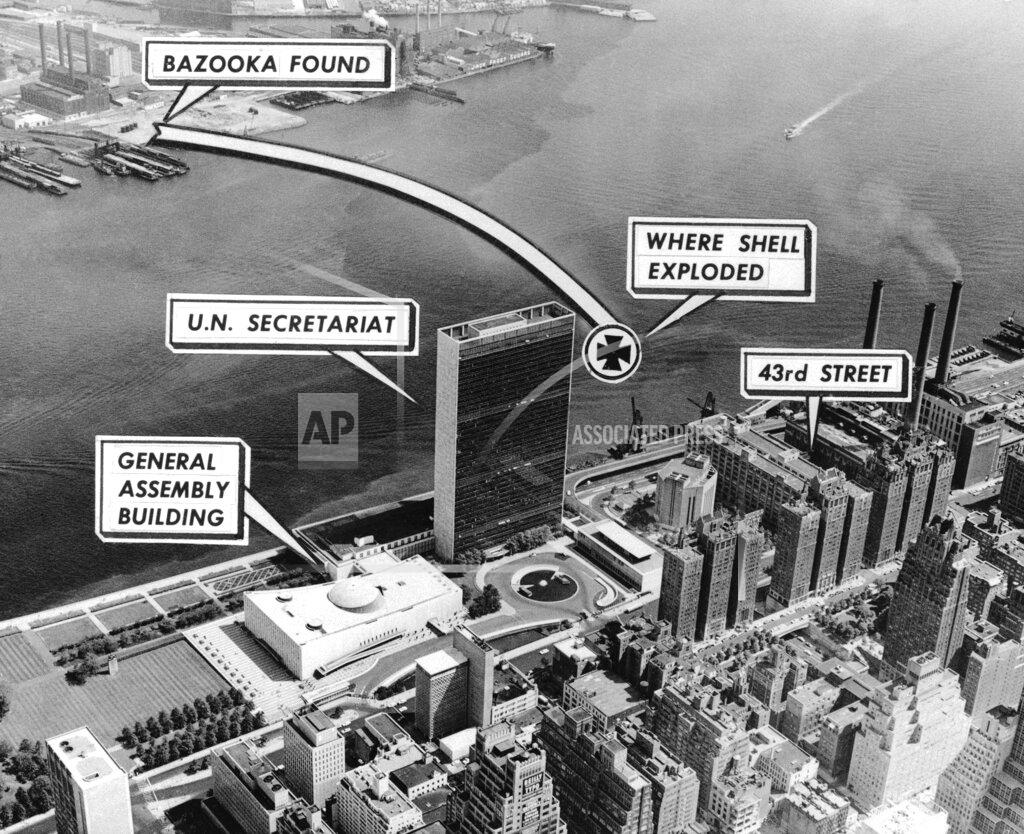
During Guevara’s address, an anti-tank rocket was fired at the United Nations Headquarters in New York City by a person holding a bazooka. Police found the weapon on a street in Queens, “mounted beneath a Cuban flag”, and apparently fired by a Cuban exile. The shell fell 100 yards from the UN Building and landed in the East River where it exploded. The attack coincided with a demonstration by anti‐Communist Cubans at the front entrance against the presence of Guevara. The blast sent up a geyser of water and rattled windows in the headquarters just as Major Guevara, Havana’s Minister of Industry, was denouncing the United States.
Shortly before, a hysterical woman brandishing a hunting knife with a seven‐inch blade detached herself from 50 antiGuevara pickets and tried to force her way into the front entrance. The police subdued the leather‐jacketed woman, and later quoted her as saying she intended to assassinate Major Guevara. The rocket launcher was found abandoned directly opposite the United Nations in a weed‐strewn lot on the east bank of the East River. The device consisted of a tube about three feet long which was bound by ropes to a crate filled with ballast. It had a sighting device, which, according to the police, was fixed on the misty silhouette of the 38-story United Nations Headquarters. It was fired, apparently by a clock‐like device, at 12:10 PM. At that time a noisy demonstration in front of the United Nations Headquarters was at a peak of tension. The crowd of Cuban exiles was hurling curses at the police, who, at the time were carrying away Molly Gonzales, the woman who said she wanted to cut down Major Guevara with the hunting knife.
The Soviet Union announced today that a commission would meet in March to plan an international conference of Communist parties. The announcement appeared in Pravda, the Soviet Communist party newspaper. Pravda said that “on the basis of mutual consultations carried out between the fraternal parties” the first meeting of the planning commission had been scheduled for March 1. The announcement indicated that a meeting of 26 Communist parties that had been scheduled for next Tuesday by Nikita S. Khrushchev would be postponed. Before he lost authority, Mr. Khrushchev proposed the meeting to prepare for a full-scale showdown in the ideological dispute between the Soviet Union and Communist China. Peking is strongly opposed to such a parley.
The Soviet Union is seeking to restore regular diplomatic contacts with the Western allies in Berlin. Some officials consider this an attempt to establish a fourpower status for West Berlin. Officials said today that diplomats from the Soviet Embassy in East Berlin recently suggested to their American, British and French counterparts in West Berlin that routine meetings of representatives of the four powers be held to discuss “outstanding matters of joint interest.” The United States and France are understood to have taken a firm stand against the Russian suggestion, but British officials are said to have shown greater interest in it.
Yugoslavia condemned today Communist China’s atomic explosion in October and said that lasting peace and security could not be achieved if proposals for negotiations were followed by nuclear explosions. Yugoslavia was replying to a letter from Premier Chou En‐lai directed to all chiefs of state, including President Tito, proposing a world conference on the banning and destruction of nuclear armaments.
Foreign Minister Paul-Henri Spaak of Belgium bitterly accused African delegates today of anti‐white racialism. Addressing the Security Council, Mr. Spaak said that speakers from Africa had tried to turn this week’s debate on the recent United States‐Belgian rescue of hostages in the Congo into a conflict of black man against white. Some of the speeches, he said, were “painfully close to that type of racist feeling which has been so heatedly denounced and fought against.” The Foreign Minister said it was his sincere conviction that there had never been a guilty race or even a guilty people but that “there have only been misguided men and contemptible men.”
“Hitler was a contemptible man and, I regret to say, Gbenye is a contemptible man,” Mr. Spaak declared. He referred to the Congolese rebel leader, Christophe Gbenye. The Security Council was called into session on Wednesday to consider a complaint signed by 22 nations, 18 of them African, against last month’s United States‐Belgian mission to rescue hostages from the rebels. The Congolese Government asked separately for a meeting on the ground that the rebels were aided by neighboring countries.
Premier Moïse Tshombe of the Congo canceled today a scheduled visit to the United Nations in New York. An aide said Mr. Tshombe, who was in Italy seeking economic aid, probably would return to Leopoldville by the most direct means available. Mr. Tshombe’s decision to stay away from the United Nations was made on the advice of Congolese diplomats in several capitals, according to a member of his party. They were said to have warned that his personal and political unpopularity with many Asian and African leaders might hurt the Congolese cause in both the Security Council and the General Assembly if he were to head his country’s delegation.
The French Government has rejected a United States suggestion for more frequent meetings of the Ministerial Council of the North Atlantic Treaty Organization, a qualified soudce said today. The source added that the proposal had been made in Paris during the visit of a high American official. The visitor suggested that the council — comprising the foreign ministers of the 15 member states — meet every two or three months, instead of twice a year. The aim would be to give the alliance more coherence and direction. France’s rejection reflects stiffening opposition to the continuation of NATO as it is now constituted. According to this source, the French view NATO as incompatible with the country’s interests because it is an extension of American supremacy in Western Europe.
President de Gaulle and his Government favor retaining the alliance but dismantling its organization, the source said. This view will apparently be made known to Secretary of State Dean Rusk and other NATO ministers when they arrive here next week for a Ministerial Council meeting. When the French speak of the organization, they mean all the organs of military integration that have been developed in the 15 years of NATO’s existence. These include the North Atlantic Council and Supreme Headquarters Allied Forces Europe. But the French believe that the alliance, with its provisions for collective defense, must be maintained because it guarantees continued American nuclear protection until a united Europe is capable of providing its own defense.
The Spanish Government warned Juan D. Perón early today to grve up an political activity or leave Spain within a month. The government also expelled “all persons not belonging to the family” of the former Argentine dictator who had participated in his unsuccessful attempt to return to Latin America December 2. On landing in Rio de Janeiro, he was turned back by the Brazilian Government.
Japanese Premier Eisaku Sato’s discussions with President Johnson in Washington next month will assist the Japanese leader in “clarifying his own line of action” on the China problem, a Foreign Ministry spokesman said today. “Mr. Sato is very conscious of the need to arrive at a satisfactory solution to the China problem,” said the spokesman, Akira Sono. “However, he has not really solidified his thoughts into a definite line of action.
The conspiracy charge against a 20th defendant in the murder of three civil rights workers in Mississippi was dismissed today at the request of the government. Mrs. Verta Lee Swetman, the United States Commissioner in Biloxi, released James Edward Jordan, a 38-year‐old construction worker, from a charge of conspiring to violate the civil rights of the victims and from $7,000 bond pending action of a grand jury. Similar action is expected in the case of‐Horace Doyle Barnette, the defendant who is reported by the Federal Bureau of Investigation to have signed a confession in the murder. Government attorneys asked for dismissal of the charges after the United States Commissioner here, Miss Esther Carter, refused to admit FBI testimony about the confession in a preliminary hearing yesterday. An FBI agent was on the stand to tell how he obtained the confession when Miss Carter sustained a defense motion that his testimony was hearsay and therefore incompetent. She then dismissed charges against 19 defendants who were in court.
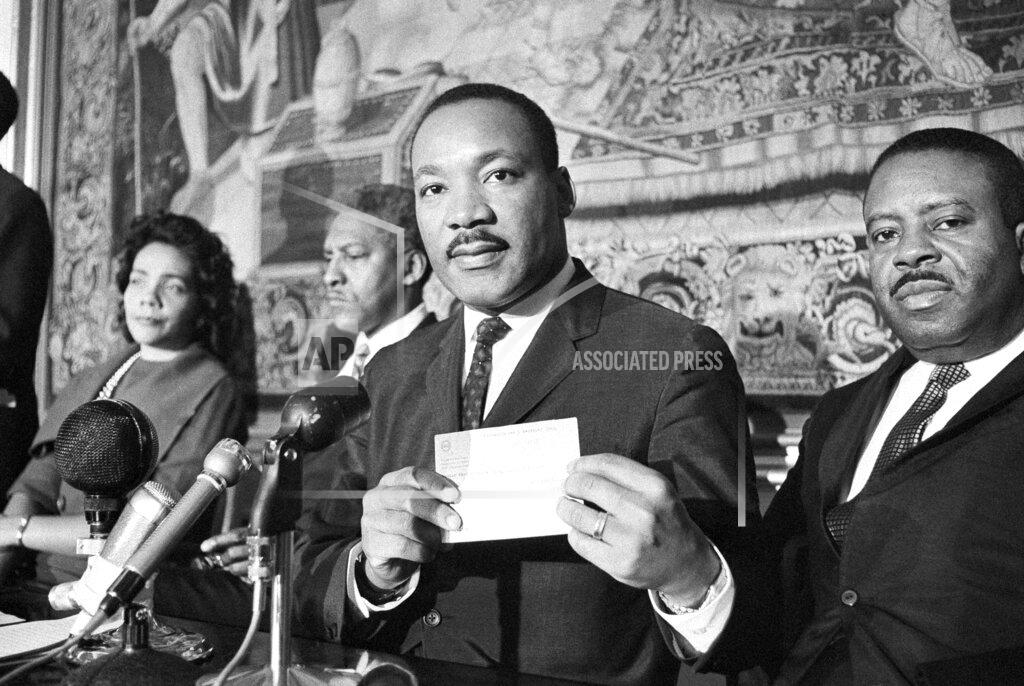
The Rev. Dr. Martin Luther King Jr. said today he would protest directly to President Johnson against the release of 19 white men who had been arrested in the case of three civil rights workers slain in Mississippi. Dr. King, who received the 1964 Nobel Peace Prize yesterday, said the dismissal of charges against the 19 men “reveals again the absence of justice in the state of Mississippi as far as Negroes are concerned… This miscarriage of justice will revolt the American people and will alienate people of goodwill throughout the world,” Dr. King said.
The Rev. Dr. Martin Luther King Jr., who received the Nobel Peace Prize yesterday, called again today for an economic boycott of Mississippi products unless ways could be found to bring “justice for all men in that state.” Commenting on the release of 19 white suspects in the slayings of three civil rights workers in Mississippi, Dr. King said: “Unless the federal government or the state of Mississippi can find methods of maintaining justice for all men in that state” he would urge a “complete boycott of Mississippi products.”
Nations as well as people might consider experimenting with the philosophy and strategy of nonviolence, the Rev. Dr. Martin Luther King Jr. suggested tonight. The Nobel Peace Prize winner, addressing students at Oslo University, said the “freedom movement is spreading in the widest liberation in history.” In its vanguard, he said, is the spirit of nonviolence. “It was used in a magnificent way by Mohandas K. Gandhi to challenge the might of the British Empire,” Dr. King said, and in the last 10 years by “unarmed, gallant men and women of the United States” fighting for civil rights. Dr. King urged that “nonviolence become immediately a subject for study for serious experimentation in every field of human conflict, by no means excluding the relations between nations.” This remark invoked applause, one of only two tunes he was interrupted by the audience in the University Aula (Hall), scene of yesterday’s Nobel ceremony. The other occasion was when he said that man must learn to live together because “we can never again live without each other.”
The Alabama State Supreme Court upset a ruling of the Court of Appeals yesterday and held that the pastor of a white church had acted with proper authority when he asked three Blacks to leave Easter services in 1962. The Blacks were fined $100 each and sentenced to 90 days in jail on trespassing charges for conducting a “kneel‐in” when told to leave the church at Talladega. The appeals court had set aside the convictions, saying the minister had no authority to order the Blacks out. Such authority, it said, must carry the specific approval of the congregation.
Governor George Romney of Michigan conferred secretly today with former President Dwight D. Eisenhower and the Republican National Chairman, Dean Burch. He said the prospect was increasing that Mr. Burch would be replaced. Mr. Romney met with the national chairman just before leaving Washington. But the governor — a leader among Republican moderates seeking the ouster of Senator Barry Goldwater’s hand‐picked party head — declined to say whom he favored as a replacement. Mr. Burch said he initiated the session with Mr. Romney but “didn’t get any encouragement” in his defense of his position. He met briefly with the governor at his office, then rode to the airport with him. The chairman said he wanted to make it clear that he was “not in a position of not being willing to talk to anyone.”
Meanwhile, Representative Melvin R. Laird told newsmen a conference of House Republicans Wednesday might result in a definite move to replace the House leader, Charles A. Halleck of Indiana. “I wouldn’t be surprised,” the Wisconsin Republican said in reply to a question on whether the closed conference might develop into a revolt against Mr. Halleck. The conference was called at the insistence of “young Turks” in the party, some of whom are not happy with Mr. Halleck’s leadership. Asked then if Representative Gerald R. Ford of Michigan would be the likely choice as a replacement in the event Mr. Halleck were ousted, Mr. Laird again replied, “I wouldn’t be surprised.” Mr. Ford was among Republican leaders whom Mr. Romney saw in a whirlwind visit to the Capitol.
The White House refused today to divulge the salaries of President Johnson’s principal White House aides. This position touched off a lively exchange between newsmen and George E. Reedy, the President’s press secretary. The question arose because of special circumstances. Mr. Johnson signed on August 14 a Federal pay bill that authorized him to increase the salaries of six administrative assistants and eight secretaries and special assistants to a maximum ceiling of $30,000 from old levels that varied between $22,500 and $17,500. A few weeks ago, according to Mr. Reedy, Mr. Johnson did give to some of his special assistants raises “which I, at least, regard as quite adequate.”
Senator Joseph S. Clark of Pennsylvania announced today his support of Senator John O. Pastore of Rhode Island for the post of Democratic whip in the Senate. Mr. Pastore is one of three candidates to succeed Senator Hubert H. Humphrey of Minnesota as assistant majority leader when Mr. Humphrey leaves the Senate to become Vice President. The other candidates are Senators Russell B. Long of Louisiana and A. S. Mike Monroney of Oklahoma. Mr. Clark, in a statement, urged his colleagues to join him in voting for Mr. Pastore at a Democratic caucus on the opening day of Congress in January. He said: “John Pastore can be counted on to support the programs and policies of the Democratic party developed over the past four years of the Democratic national Administration, adopted in our platform at Atlantic City last summer, and enunciated by the President and Vice President in the successful campaign.”
Senator Pierre Salinger, former White House press secretary, announced his resignation today from the Senate as of December 31. Governor Edmund G. Brown almost immediately said he would name Senator‐elect George Murphy, a Republican, to the vacancy as soon as it became legal to do so.
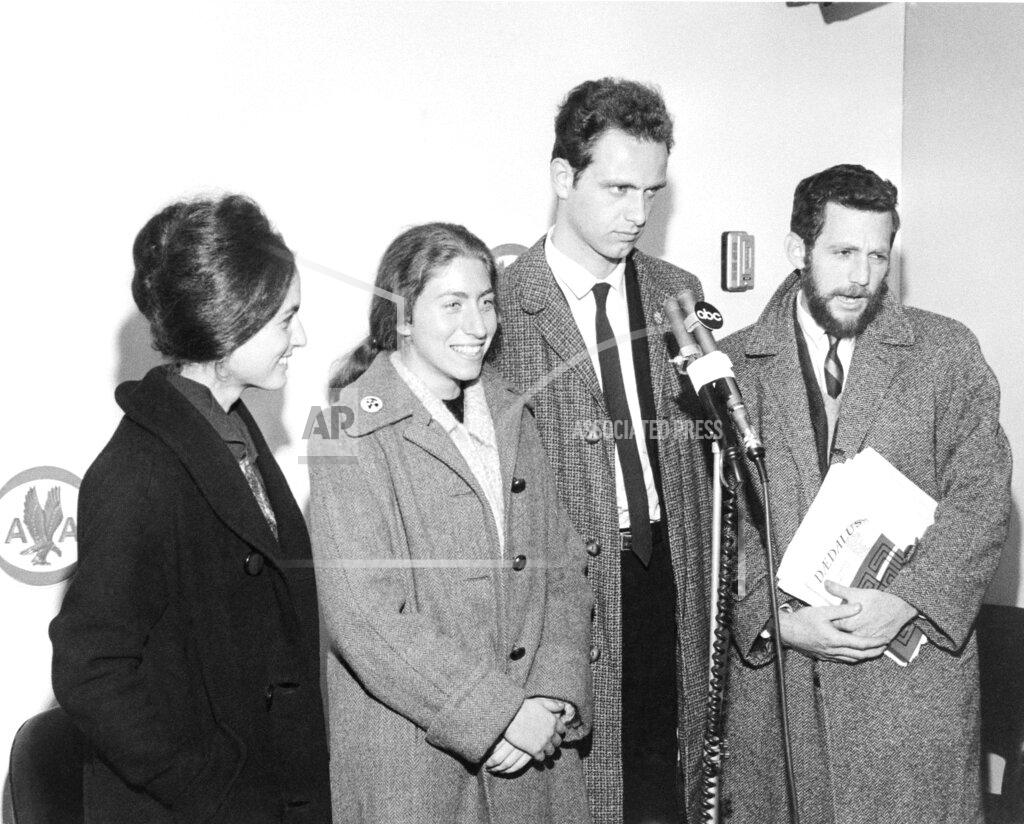
Two women and a man who refused to reply to questions in a closed session of a House subcommittee on Un‐American Activities were cited today for contempt of Congress. Accused of contempt were Mrs. Dagmar Wilson and Mrs. Donna Allen, both of Washington and active in Women Strike for Peace, an organization opposing nuclear weapons, and Russ Nixon of New York, general manager of a newspaper called The National Guardian. The citations now go to the United States Attorney for the District of Columbia, who must determine whether to prosecute. Because Congress is in adjournment, a formal vote of the House of Representatives is not required. The three persons cited refused on Monday to answer questions unless the committee opened its hearings to the public and press. They emphasized that they did not invoke the Fifth Amendment, which guarantees against being required to give self‐incriminating testimony.
The badly lagging program that is to “soft land” an unmanned spacecraft on the moon made some encouraging progress in a test flight today. An Atlas‐Centaur rocket carried a “mass model” of the Surveyor Lunar Spacecraft intoi orbit around the earth. The model had the same weight and center of gravity as the finished product but carried little equipment. A bonus objective, a second ignition of the liquid‐hydrogen upper‐stage Centaur, was not achieved because the rocket and still‐attached Surveyor model had begun to tumble. But re‐ignition is not involved in a Surveyor mission. And Robert Gray, operations director here for the Federal Space Agency’s Goddard Center near Washington, said that, if an actual Surveyor had been aimed at the moon today, it would have made it.
TIME magazine calls Susan Sontag “one of Manhattan’s brightest intellectuals” in a review of her groundbreaking essay “Notes on Camp.”
Dow Jones Industrial Average: 864.34 (+1.20)
Born:
Dave Gagner, Canadian National Team and NHL centre and left wing (Olympics, 1984; NHL All-Star, 1991; New York Rangers, Minnesota North Stars-Dallas Stars, Toronto Maple Leafs, Calgray Flames, Florida Panthers, Vancouver Canucks), in Chatham, Ontario, Canada.
Joe Kelly, NFL linebacker (Cincinnati Bengals, New York Jets, Los Angeles Raiders, Los Angeles Rams, Green Bay Packers, Philadelphia Eagles), in Sun Valley, California.
Thomas Howard, MLB baseball outfielder and pinch hitter (San Diego Padres, Cleveland Indians, Cincinnati Reds, Houston Astros, Los Angeles Dodgers, St. Louis Cardinals), in Middletown, Ohio.
Justin Currie, Scottish rock vocalist and bassist (Del Amitri – “Roll To Me”), in Glasgow, Scotland, United Kingdom.
Cosy Sheridan, American singer (The Pomegranate Seed), in Concord, New Hampshire.
Dave Schools, American musician (Widespread Panic), in Richmond, Virginia.
Michel Courtemanche, French Canadian comedian (A New Comic is Born), in Laval, Quebec, Canada.
Ayelet Waldman, Israeli born American lawyer and mystery novelist; in Jerusalem
Died:
Sam Cooke, 33, African-American singer and songwriter known for such songs as “You Send Me”, was shot dead by the manager of the Hacienda Motel in Los Angeles, located at 9137 South Figueroa Street. Bertha Lee Franklin, who was also African-American, told police that Cooke had kicked in the door to her office and struck her with his fist, and accused her of hiding a prostitute who had been registered at the motel with him. Mrs. Franklin said she pulled a pistol from her desk and fired three shots at Cooke, one of which struck him in the chest; the young woman told police that Cooke had forced her to his room and attempted to rape her. A coroner’s jury would later conclude that the death was justifiable homicide. Cooke’s funeral was held at the Mount Sinai Baptist Church in Los Angeles, “where a crowd of 5,000 packed a 1,500-capacity sanctuary for an emotional, tear-filled service.” Cooke would be one of the original inductees into the Rock and Roll Hall of Fame in 1986.
Percy Kilbride, 76, American stage and screen actor (“The Egg and I”; “Ma and Pa Kettle films”).
Alma Mahler, 85, Austrian socialite who had been married to Gustav Mahler, Walter Gropius, and Franz Werfel
Mariano Rossell y Arellano, 70, Roman Catholic Archbishop of Guatemala


 History Diaries