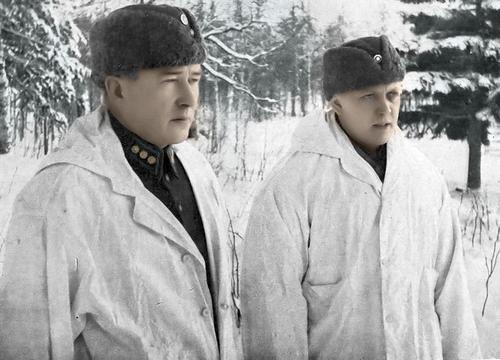
Near Suomussalmi, the Finns bring Soviet attacks to a halt. A brilliant night attack is also mounted on the 9th Army units near Kollaa.
Colonel Hjalmar Siilasvuo is in command of the Finnish 9th Infantry Division in the Suomussalmi area on 9 December 1939. While successful so far, he is facing two Soviet rifle divisions (the 44th and 163rd) approaching from two different sides (north and east), each backed by tanks and artillery. Siilasvuo only has a scattering of infantry between the Soviet troops: 4th Reserve Battalion, 15th Detached Battalion, 16th Detached Battalion, 27th Infantry Regiment, Battle Group Kontula, and the 5th and 6th Ranger Groups. All together, Siilasvuo has maybe nine infantry companies — less than a division. The only saving grace is that some of the men are elite Border Guard Rangers, and every single man is fully committed to the cause. The risk is that the Red Army divisions will hook up and create an overpowering force.
Siilasvuo makes the classic textbook mistake of dividing his forces in the face of a superior enemy. His plan is to defeat them in detail. Siilasvuo decides that his first step is to cut the Raatte Road which is supplying the main Soviet forces in Suomussalmi from the east. He begins rearranging his troops and getting them into position. It will take a couple of days, but the Soviets are having a rough time in the forests and snow so there may be sufficient time to arrange things just right.
Colonel Siilasvuo’s first transport arrives at Hyrynsalmi a day late. Further north, Soviet troops finally take the parish village at Salla.
Elsewhere, the Finns are holding tough at the Kollaa River — there is a vicious night battle there — and Soviet gains in the far north are minimal.
Troops from the covering force reorganized to form the Finnish 1st Division under the command of Major-General Laatikainen are to assume responsibility for the eastern section of the front in the 5th Division’s defence sector on the Karelian Isthmus.
In Ladoga Karelia, the Finnish 13th Division takes up defensive positions between Lake Ladoga and Varpajärvi.
The League of Nations Council held its one hundred-sixth session in Geneva. The League of Nations meets and agrees to intervene in the continuing dispute between Finland and the Soviet Union.
The blockade is illegal, Finns tell Russians. Helsinki argues that the action lacks justification without a declaration of war.
Stavka in Moscow assumes direct operational control over Soviet forces on the Finnish front. Kliment Voroshilov’s incompetent handling of the first week of the invasion has left the Red Army little closer to defeating the Finns than when they started. Dissatisfied with operations in the Winter War, the Kremlin (The chief of staff of the Red Army (Stavka), Boris Shaposhnikov) assumes more direct operational control of tactics from local commanders and strips Commander of the Leningrad Military District Kiril Meretskov of his overall command of the campaign. Meretskov is effectively demoted to the command of the Soviet 7th Army. It is the first official recognition by senior Soviet military leaders that something is going seriously wrong in Finland.
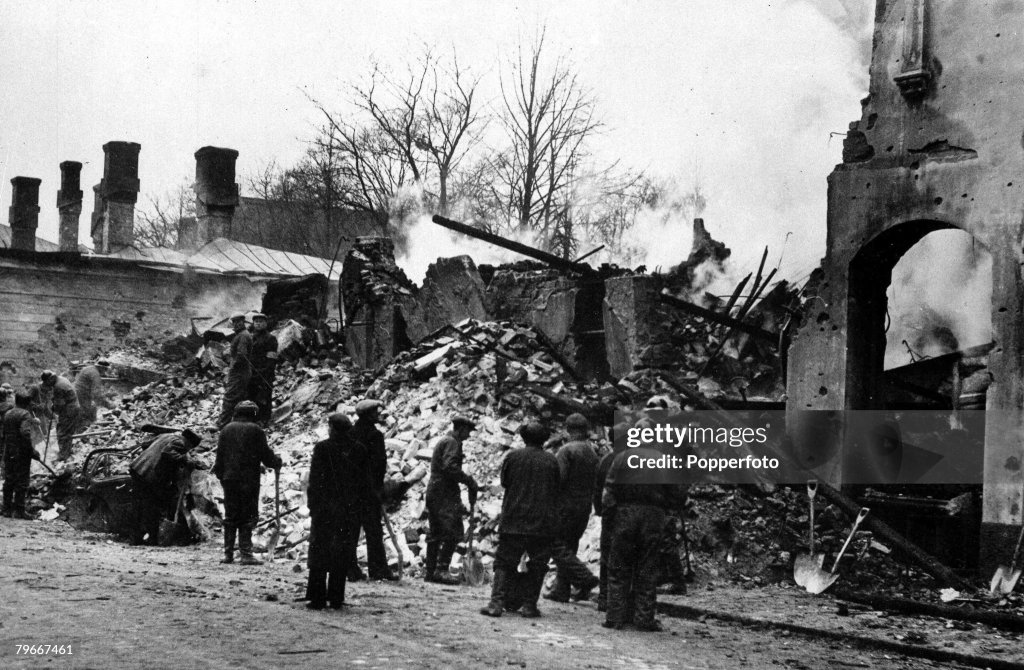
There is another Russian air raid on Helsinki, and three raids on the city of Hangö (Hanko).
The Swedish Government tonight appointed an active Commander in Chief of all Swedish military forces —a step usually undertaken only in anticipation of an emergency.
Finland’s stubborn, cool resistance to the Russian giant has dealt a severe blow to the prestige of the fabulously large Red Army throughout Europe, including Germany, it seemed today.
The news agency TASS carries an erroneous report that Germany is sending supplies to Finland. A sensational development in Soviet-German relations appeared at 2 AM today when, for the first time since the signing of the Soviet-German non-aggression pact in August, the official news agency, TASS, issued a bulletin conveying criticism of Germany. In fact, the Germans are not sending supplies, but Italy is shipping material to Finland through Germany. Ironically, virtually everyone else in the world is aiding the Finns, including German ally Italy — but not the Reich. Moscow-Berlin relations are strained by the report.
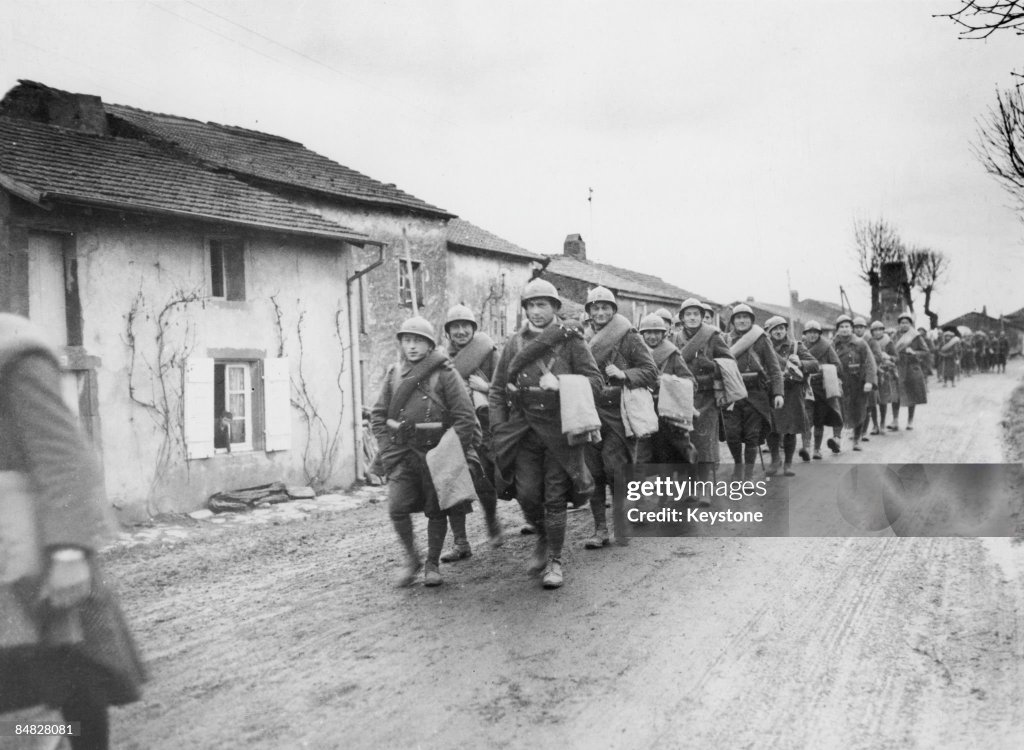
27-year-old Corporal Thomas Priday, of the King’s Shropshire Light Infantry, while leading a patrol near Metz, France, became the first British soldier to be killed in the European War. He was killed by friendly fire.
King George VI completes a 5-day visit to the British and French troops.
Some 200 Polish Jewish survivors cross over the Bug river into Soviet occupied Poland after surviving being deported by the Nazis — and forced marched — from their homes in the cities of Hrubieszow and Chelm. About 1,800 Jews began the trek.
Pianist and statesman Ignacy Paderewski becomes Chief of National Council of Poland (government in exile)
Walther Funk, Economics Minister, urges the Reich to save for war, saying the use of private accounts will avoid inflation.
Italy’s Axis stand pleases Germany. The reaffirmation of solidarity measures up to all Nazi expectations, they say.
The plight of Jews in Poland is critical. All live in terror of the Gestapo.
German cruiser Admiral Graf Spee sailed toward the River Plate estuary on the border of Uruguay and Argentina to attack a reported convoy departing from Montevideo, Uruguay. Meanwhile, Royal Navy Force G (light cruisers HMS Ajax and HMS Achilles, Commodore Henry Harwood) continues toward Montevideo on Harwood’s hunch that the Admiral Graf Spee will head there next. He also orders HMS Exeter, just to the south at Port Stanley, Falkland Islands, to rendezvous there as well. Another heavy cruiser, HMS Cumberland, is also at Port Stanley but is unavailable.
U-47 attacked a British destroyer in the North Atlantic, but without success
The unescorted and neutral Danish steam merchant Magnus was torpedoed and sunk by the U-20, commanded by Kapitänleutnant Karl-Heinz Moehle, approximately 40 miles east-northeast of Peterhead, Scotland in the North Sea (57° 48’N, 0° 35’W). At 19.21 hours the Magnus was hit in the forward hold by one torpedo from U-20 about 40 miles east-northeast of Peterhead. The foreship settled quickly and the vessel sank bow first within 90 seconds. The ship had been missed at 18.41 hours with a first torpedo. Eightteen men were lost. The survivor was picked up by the British steam trawler Philippe on 13 December. The 1,339-ton Magnus was carrying ballast and was bound for Methil, Scotland.
Sailing with Convoy OB.48, the British motor tanker San Alberto was torpedoed and sunk by the U-48, commanded by Kapitänleutnant Herbert Schultze, approximately 120 miles south of Cape Clear, Ireland in the eastern Atlantic Ocean (49° 20’N, 9° 45’W). At 07.10 hours the San Alberto (Master George Waite, OBE) was hit amidships by one torpedo from U-48 about 120 miles south of Cape Clear and broke in two. She had been missed by the first two torpedoes at 06.44 and 06.46 hours. The forepart sank in 49°28N/09°51W and the stern was first reboarded but had to be abandoned in worsening weather and was scuttled by gunfire on 11 December by HMS Mackay (D 70) (Cdr G.H. Stokes, RN), which took over the master and 35 crew members of the San Alberto from the Belgian tanker Alexandre André and landed them at Plymouth. One crew member was lost. The 7,397-ton San Alberto was carrying ballast and was bound for Trinidad.
The German cargo ship Adolf Leonhardt was scuttled by her crew in the South Atlantic off Portuguese West Africa when intercepted by the Royal Navy cruiser HMS Shropshire, which rescued the 25 crew.
The German tanker Nordmeer sails from Curaçao, N.W.I.
U.S. freighter Explorer is detained at Gibraltar by British authorities.
The War at Sea, Saturday, 9 December 1939 (naval-history.net)
Battleship RODNEY, escorted by destroyers ECLIPSE, GURKHA and FEARLESS, arrived at Liverpool for repairs. The ships followed convoy SLF.10B into port.
Battlecruiser HOOD and destroyers KINGSTON, KANDAHAR, KASHMIR and KHARTOUM left their patrol area covering convoy HN.4 and proceeded to the Clyde, arriving on the 10th.
Admiral Forbes withdrew the armed merchant cruisers from Northern Patrol. The threat of German mining, brought home by the damage to NELSON, prevented his heavy ships from leaving and entering port, and therefore were unable to cover the Northern Patrol ships. Seven armed merchant cruisers left the Patrol for the Clyde and Liverpool. Light cruiser SHEFFIELD was en route to the Tyne, passing Fair Island Channel at 2100/9th while light cruiser NEWCASTLE proceeded to Scapa Flow to relieve her on Northern Patrol duties. Heavy cruisers SUFFOLK and BERWICK moved from the Denmark Strait to SE of Iceland.
Heavy cruiser DEVONSHIRE departed the Clyde to relieve BERWICK on Northern Patrol, and arrived at Scapa Flow after patrol on the 22nd.
Heavy cruiser YORK began refitting at Liverpool.
Light cruiser CERES departed the Clyde, and arrived at Scapa Flow on the 16th.
Armed merchant cruiser CHITRAL arrived in the Clyde.
Anti-aircraft cruiser CURLEW departed Chatham for Invergordon, arriving on the 10th.
Destroyers EXMOUTH, ECHO and ECLIPSE departed the Clyde to rendezvous and escort arriving battleship BARHAM.
Destroyer IMOGEN drydocked at Govan to repair defects.
Convoy BC.18 departed Bristol Channel, escorted by destroyers MONTROSE and VESPER, and arrived in the Loire on the 11th. The convoy returned, departing on the 13th and arrived back in the Bristol Channel on the 15th.
Convoy FN.52 departed Southend, escorted by destroyers VIVIEN, VALOROUS and sloop BITTERN, and arrived in the Tyne on the 10th.
Convoy FS.52 departed the Tyne escorted by destroyer WHITLEY and sloop STORK, arriving at Southend on the 10th.
U-20 sank Danish steamer MAGNUS (1339grt) in 57 48N, 00 35W; her sole survivor was picked up four days later on the 13th by British trawler PHILIPPE (203grt).
U-48 torpedoed tanker SAN ALBERTO (7397grt) from convoy OB.48 west of the English Channel in 49 20N, 09 45W. One member of the crew was lost and the survivors abandoned ship to be picked up by Belgian tanker ALEXANDRE ANDRE (5322grt). However, the rescue was cut short when the Belgian tanker’s engines became partially disabled. SAN ALBERTO broke in half and the forward section sank in 49-28N, 9-51W. The stern section was relocated on the 11th and reboarded by her crew who were able to restart her engines. She was able to proceed for ten hours, but eventually scuttled by destroyer MACKAY.
Convoy HG.10 departed Gibraltar with 62 ships, escorted by destroyers WATCHMAN, ACTIVE, HAVOCK and the French CHEVALIER PAUL and TARTU. The French ships remained with the convoy from the 8th to 16th when they arrived at Brest. ACTIVE was detached that evening, still on the 9th. HAVOCK and WATCHMAN detached to OG.9 on the 10th and escorted that convoy for one day before arriving back at Gibraltar. HAVOCK then left on the 12th to return to Sheerness for repairs. On the 15th, the convoy was joined by destroyers VISCOUNT and ANTELOPE from OG.10 and also destroyer VIVACIOUS. All three were with the convoy when it arrived at Liverpool on the 16th.
Northwest of Mossamedes, heavy cruiser SHROPSHIRE of Force H encountered German steamer ADOLF LEONHARDT (2990grt), which had departed Lobito on the 8th. She scuttled herself off South Africa rather than be captured, and her six officers and 19 crew were picked up by SHROPSHIRE.
French sloop COMMANDANT DUBOC attacked a submarine contact 2.5 miles 357° from Cape Spartel.
Heavy cruiser DORSETSHIRE arrived at Simonstown.
Light cruiser EFFINGHAM arrived at Bermuda for refitting, completed on the 23rd.
German merchant ship NORDMEER (5671grt) departed Curacao, and despite efforts by French submarine OUESSANT to intercept her in Mona Passage on the 15th, was able to reach Vigo on 5 January 1940.
German steamers SEATTLE (7369grt), HANNOVER (5537grt), WESERMUNDE (5356grt), VANCOUVER (8269grt), PATRICIA (3979grt), ESTE (7915grt), HENRY HORN (3164grt), ALEMANIA (1383grt), KARIBIA (428grt) and FRISIA (561grt) were also at Curacao. Only SEATTLE and HANNOVER had managed to escape before 10 May 1940 when the remaining ships, less steamer WESERMUNDE which had been sold to the United Fruit Company on 28 December 1939, were seized by Dutch forces and renamed for Dutch service – VANCOUVER became CURACAO, PATRICIA the ARUBA, ESTE the SURINAME, HENRY HORN the BONAIRE, ALEMANIA the ST MARTIN, KARIBIA the ST EUSTATIUS, and FRISIA the SABA. On 10 May 1940, two other German steamers were in Dutch Caribbean ports, the ANTILLA (4363grt) at Aruba and GOSLAR (6040grt) at Paramaribo, Suriname. These ships were scuttled by their crews to avoid capture.
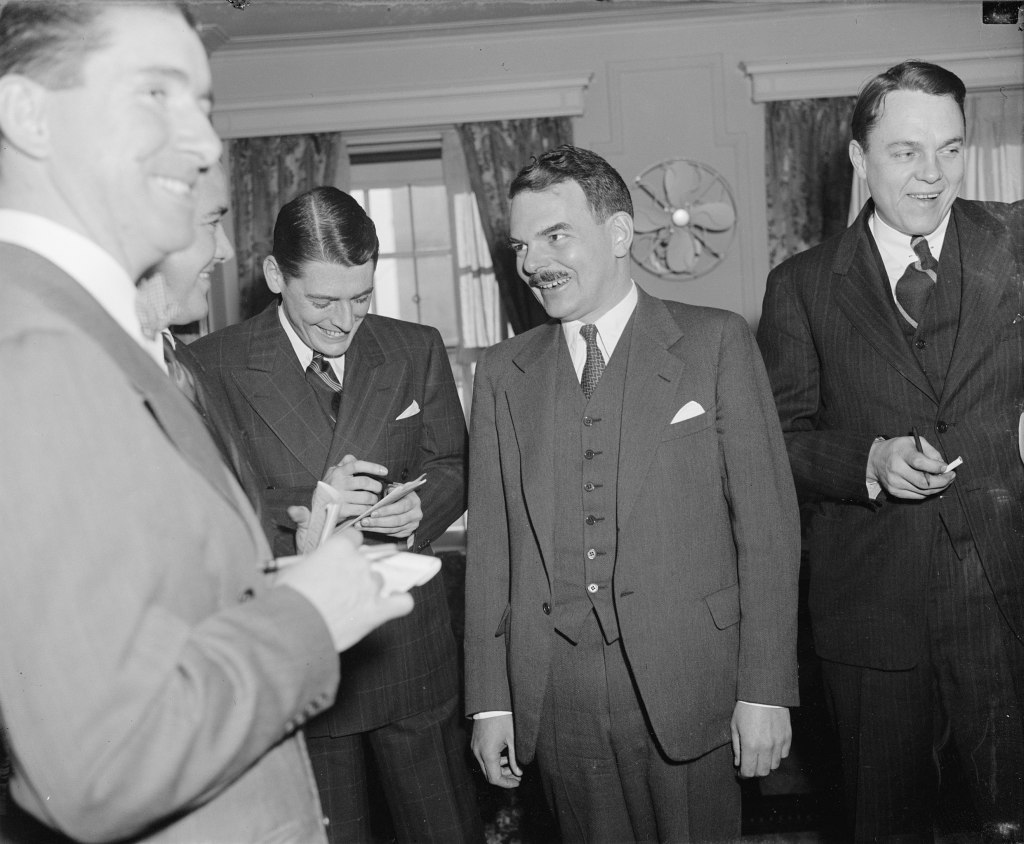
Thomas E. Dewey declared in New York today that the next President could and must balance the budget, adding that only a Republican could do the job because no Democrat of whatever description was “capable of cleaning up the mess of the last seven years.” The New York District Attorney, who arrived in the capital late last night on a visit to attend the annual dinner of the Gridiron Club this evening, received reporters in a hotel suite today and answered a barrage of questions concerning his political and economic views.
The 37-year-old Republican who opened his campaign for the Presidential nomination this week greeted the correspondents individually and smilingly answered as many questions as he thought proper. When the going became. too heavy he asked that he not be forced into “the role of a prophet” or to deliver all his campaign arguments on the spot. Asked whether the next President would be able to balance the budget, he answered without hesitation: “Certainly he can. I don’t say it can be done in one year. But I say he certainly can because he’s got to. There is a bottom to every well.”
In answer to another question, Mr. Dewey conceded that the next President’s ability to balance the budget would depend “on the course of events,” but insisted that the imperative necessity of bringing federal expenditures into balance with revenues permitted no alibis.
“Do you think it is a very serious thing to have the budget just a little bit out of balance?” he was asked. “What you are now asking is whether a little bit of bankruptcy is a bad thing,” he replied. He cited that New York City’s budget had to be balanced under the law, but added that mandatory legislation of that kind could freeze Federal action. Having said that it would take a Republican President to clamp down on Federal expenditures and balance the budget, he was asked: “What about an anti-New Deal Democrat?” “Do you think any kind of a Democrat can clean up the mess that’s been made in the last seven years?” he queried.
In Mr. Dewey’s first press conference in the nation’s capital he was challenged all along the line as reporters sought to elicit flat opinions on Administration policies, on foreign affairs, on the third term. tradition and on the outcome of the 1940 election. “My views on the third term are the same as those of most good Americans,” he declared. “So what?” interjected an impatient reporter. “So I think I will stand on that statement.”
Frank Gannett, Rochester publisher and aspirant for the Republican Presidential nomination, outlined a seven-point program for the Republican party last night and called for immediate intensification of the Republican campaign against the New Deal.
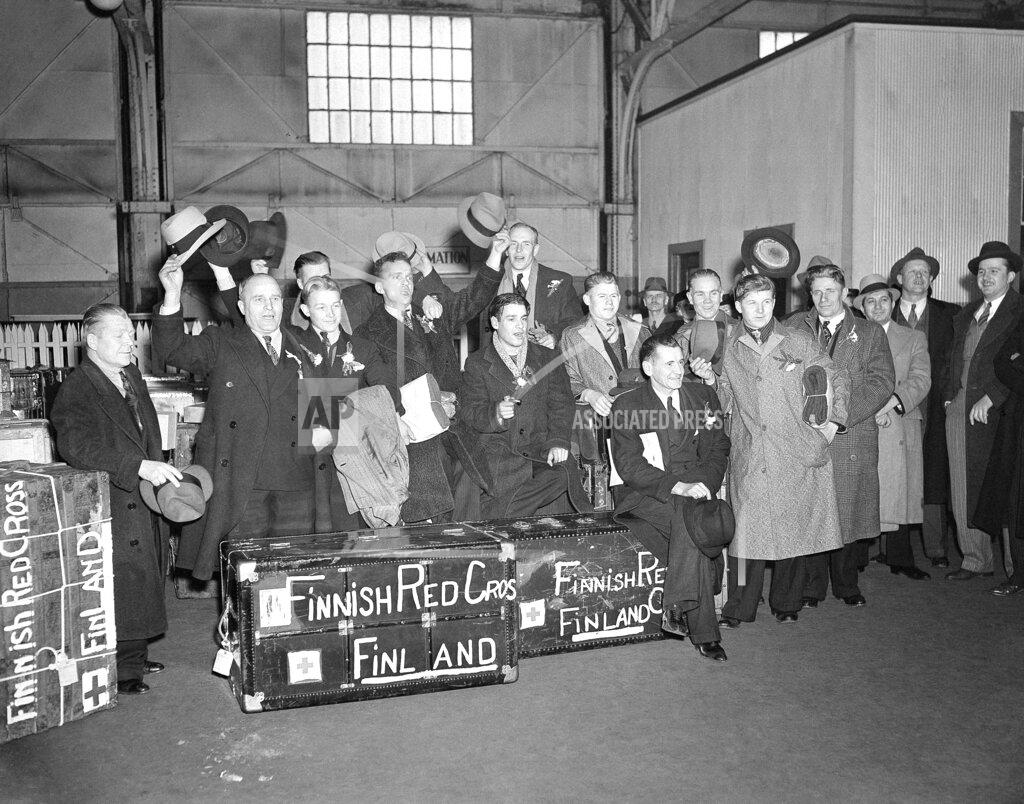
In New York, the first detachment of Finnish American volunteers — around fifty officers, pilots and mechanics — board ship bound for Finland. Fifty Finnish army recruits, many of them long resident in the United States, although none were citizens, sailed yesterday on the Swedish-American liner Gripsholm to fight for their native country against the Soviets.
The vast majority of voters urges peace between the AFL and CIO, a Gallup survey says. Union rights are supported, but there is also a strong sentiment — 79% of respondents — for the federal regulation of workers’ groups.
Members of the House committee investigating the National Labor Relations Board disclosed tonight that their agents had removed a “truckload” of correspondence from the board’s files and hinted broadly that some letters bordered on the sensational.
President Roosevelt’s reported desire to sidetrack controversial issues as far as possible in the coming session of Congress got a cool reception today from Republican leaders.
President Roosevelt discussed with Attorney General Murphy at luncheon today a list of recommendations for filling vacancies in the Federal judiciary. There are thirteen vacancies, including two in the Circuit Court of Appeals and two in the Court of Customs and Patent Appeals.
Nicholas Dozenberg, a founder of the Communist party in the United States and reputed secret agent of Soviet Russia, was overtaken by Federal agents yesterday after a transcontinental chase and arrested in Bend, Oregon, on charges of conspiracy in the Communist passport frauds under investigation.
An extensive experimental program to test the efficacy of fast motor torpedo boats and motorboat submarine chasers for inshore defense was announced by the Navy Department today.
Three Civil War veterans die. Two of them — one Confederate and one Union soldier — were present at Lee’s surrender.
The 1940 NFL draft was held. The Chicago Cardinals selected George Cafego of the University of Tennessee as the first overall pick.
Wally Moses is traded by the Philadelphia A’s to the Detroit Tigers for Benny McCoy and George Coffman. The deal will later be voided by Judge Landis, who declares McCoy a free agent because of a Tigers cover-up. He gets a $10,000 bonus to sign with the A’s.
College Football:
Centenary (Louisiana) 19, @ Louisiana Tech 0
(3) Southern California 0, @ (9) UCLA 0
Southern Methodist 13, Rice 6
(2) Tennessee 7, Auburn 0
The Winnipeg Blue Bombers edged the Ottawa Rough Riders 8–7 to win the 27th Grey Cup of Canadian football.
Mahatma Gandhi asked Muslim League president Muhammad Ali Jinnah to end the observance of the Day of Deliverance. Gandhi’s request was made in light of upcoming discussions between the Congress and the Muslim League, and in anticipation of a third-party review of the Muslim League’s allegations against Congress.
Between December 9–14, 1939, Nehru and Jinnah exchanged several letters. Nehru offered to address specific allegations of anti-Muslim actions, but the discussions failed.
France and Great Britain will continue to give China the rightof-way through Indo-China and Burma and will not betray her or desert her in her fight for national existence and independence, Dr. Hu Shih, Chinese Ambassador to the United States, predicted yesterday in an address at a luncheon of the Foreign Policy Association at the Hotel Astor in New York. “China could not have fought so well and so long without the help of Soviet Russia, Great Britain, France, and the United States,” Dr. Hu said. “Even after the outbreak of the European war, China has continued to receive substantial assistance from the Western Powers.
In conclusion, Dr. Hu said: “The events of these eight years of invasion, aggression, and devastation (since Japan’s active aggression began in China) have vindicated the wisdom of the fathers of the Open Door Policy that the door of China cannot be kept open in any part of her territory where China’s sovereignty and administrative integrity have been destroyed. The cardinal pre-condition for a permanent peace in the Far East and in the Pacific area in general is an independent, sovereign, modernized and strong national State of China.”
The evacuation of Japanese troops and the formation of a Chinese army to take over defense after the Japanese Army leaves are essential parts of Wang Ching-wei’s peace terms and have been accepted by Japan, according to a statement made by Mr. Wang to the Shanghai correspondent of the Japan News Week, an American-owned weekly published in Tokyo.
When asked if he expected an immediate withdrawal of Japanese troops, Mr. Wang said “evacuation is a concomitant part of any peace agreement.” He added that as long as Generalissimo Chiang Kai-shek continues hostilities a complete Japanese withdrawal could not be expected, but that the principle that evacuation and the conclusion of peace would be coincident had been accepted. He said he was confident Japan would act on it.
Mr. Wang said that the date of the establishment of his new government at Nanking had not been fixed. When asked concerning the causes for the delay he hinted there had been difficulties regarding the return of Chinese property confiscated by the Japanese. He asserted the new government would allow autonomy for the North China regime. Among the terms already settled are State ownership of railroads, several of which are now owned by foreign interests, and customs autonomy.
Dow Jones Industrial Average: 147.93 (+0.07)
Born:
Patricia Stephens Due, African-American civil rights activist (FAMU jail-in), in Quincy, Florida (d. 2012).
Ed Beard, NFL linebacker (San Francisco 49ers), in Fredericksburg, Virginia (d. 2023).
Virginia Vestoff, American actress (“Dark Shadoews”, “1776”), in New York, New York (d. 1982 of cancer).
Naval Construction:
The Royal Navy “U”-class (Second Group) submarines HMS Union (N 56) and HMS Urchin (N 97) (later the Polish ORP Sokol) are laid down by Vickers Armstrong (Barrow-in-Furness, U.K.).
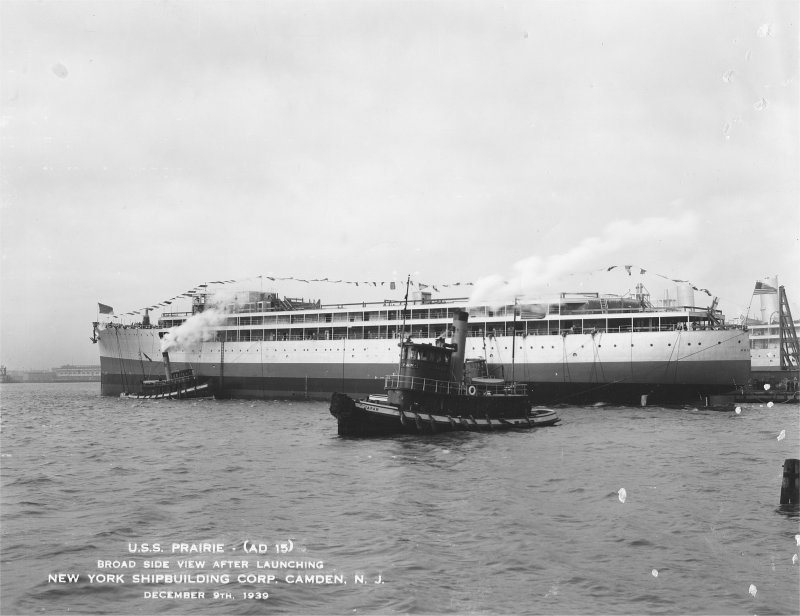
The U.S. Navy Dixie-class destroyer tender USS Prairie (AD-15) is launched by the New York Shipbuilding Corp. (Camden, New Jersey, U.S.A.).
The U.S. Navy destroyer USS Gleaves (DD-423), lead ship of her class of 66, is launched by the Bath Iron Works (Bath, Maine, U.S.A.).
The Kriegsmarine (German Navy) auxiliary cruiser Orion (Schiff 36), formerly the freighter Kurmark, is commissioned. Her first commanding officer is Korvettenkapitän Kurt Weyher.
The Kriegsmarine (German Navy) auxiliary cruiser Widder (Schiff 21), formerly the freighter Neumark, is commissioned. Her first commanding officer is Korvettenkapitän Helmuth von Ruckteschell.

 History Diaries